


This blog is about a debut novel that, in my view, examines deliberate and / or necessary complications of what we mean by ‘being clear’, especially in the pursuit of physical satisfaction to selves full of yearning. You may guess this concerns an art that takes aspiring men and boys mainly as its subject matter, the debut novel being ‘Jean’ by Madeleine Dunnigan.

The English and USA covers of the novel with Madeleine Dunnigan
The phrases: ‘Let me be very clear about this’, and ‘I am very clear about this’ or the use of the word ‘clearly’ are more common than ever in British politics, as the above linked article from The Herald suggests (for an example from the USA, try this link): so much so that they arrive on any listener’s ear with accompanying tedium associated with political discourse and with no expectation of clarity at all. there is a kind of studied awareness in discussions of the issue that this is ‘just politics’and that the phrase, as the link to a Reddit discussion following shows, often accompanies a complete lack of clarity or truth about matters a politician is questioned about or clarity indeed about something they are NOT being questioned about. But sometimes clarity comes about a matter in front of us with harmful persistence in failing to see the complexity and nuance of an idea. For a prime minister and his ministers associated with ‘forensic’ understanding of legal issues this has accompanied various over-simplified, and illegal uses of the law prompted with ‘clarity’ by Keir Starmer on issues, not least the proscription of Palestine Action, that have produced bad law and harmful political and human consequences.It is useful then to find some academic study of the the issue regarding the call to ‘clarity’ in political communication by Parker Bach and colleagues in the journal Communication Theory. They say in their article’s ‘Abstract’:
While clarity is often upheld as a core element of successful communication, we argue that a lack of clarity can also benefit a speaker, a concept called strategic ambiguity. This concept has been used across disciplines for decades, but its definitions are often overly context-specific. In this article, we follow Chaffee’s (1991) framework for explication to survey the literature and provide a unified definition of strategic ambiguity as a rhetorical tactic in which a communicator creates a: (1) polysemic message with multiple reasonable interpretations supported by the text, that is: (2) aimed at audiences from varying interpretive communities; and (3) by which polysemy the communicator stands to gain some specific advantage. [1]
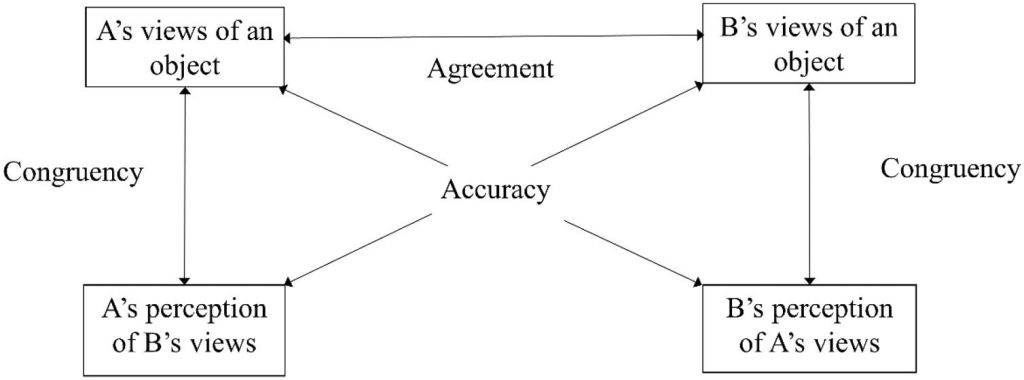
The Chaffee framework might highlight how ‘accuracy’ of communication is achieved but it surely also explains richness and multivalence of interpretation, for I often think that ambiguity might be used too not merely as a strategy advantaging the speaker, but advantaging the communication where truth is sought and truth is more complex than the call for clarity requires, for in many cases (that of Palestine Action for instance) the truth is not ‘clear’ or found in unambiguous statements, where numerous, even contradictory things can be simultaneously true. But then I am a person more concerned deep down by acts of genuine inter-communion, as in art at its best, than politics.
That last statement however needs pursuing. This blog is about a debut novel that, in my view, examines non-strategic ambiguity, although sometimes within that some cases that are strategic, especially in the pursuit of physical satisfaction to selves full of yearning. Of course you may guess this concerns art that takes aspiring men and boys mainly as its subject matter, the debut novel being Jean by Madeleine Dunnigan.
Academic communication theory does help with this novel. Take, for instance, Bach and his colleagues’ definition of strategic ambiguity as: ‘ (1) polysemic message with multiple reasonable interpretations supported by the text, that is: (2) aimed at audiences from varying interpretive communities; and (3) by which polysemy the communicator stands to gain some specific advantage’. In Jean the boys (and teachers) use strategic ambiguity to gain sex, or perhaps more strictly sexual practice, or some advantage over each other in terms of relative power in the group, but there is also a way in which the ambiguity persists without being aimed at gaining ‘some specific advantage’ for the person speaking ambiguously but which nevertheless advantages interaction and recognition of the complex truth of some relationships or relational matters like those involved in the mutual sharing of feeling, thought and actions, even sharing bodies.
The means by which this conveyed is often through the complication of binary concepts such that they are no longer sustainably binary, although not primarily around, if inclusive of sex/gender binaries: instead the binaries whose confusion creates poetic or poetic prose is the means, where dark blends with light, sound with silence and what seemed clear with what is obscure in meaning (often beautifully obscure): hence the fascination in the novel with the boys learning the poetry of Gerald Manley Hopkins, not always with appreciation of much of it – for the über-macho self-display of the rich but parentally-neglected boy Hugo, Hopkins is just a ‘Faggot’ (I remember my own English teacher making rather peevish innuendo about Hopkins being less than ‘Manley/manly’. For Jean, however, coming to terms with both his tendency to violence and queer mismatches between his feelings, desire and remembered and current experiences all that is left to do in this scene is to be the novel’s point of view and acute observation of detail. The remembered experiences he finds obscure to interpret in himself include those of oral sex with an Italian man on holiday (who was alternatively making a play for his mother, Rosa) and recurrent prompts to remember his once neighbour the rock star, Mick Caro, who once wrote a popular song about Jean called Boy In Space and with whom he seems to have had a semi-conscious non-sexual intimacy. Jean has deeply suppressed that song and its composer and singer from his conscious memory, or re-created unclear reminiscent mental material thereof, just as examples of maleness with difficult-to-comprehend set of human responses to the world and the men in it.
After Hugo has voiced his ‘faggot’ thesis about Hopkins, Jean’s English teacher, Charles Burrows with his ‘bright, patterned shirts that cling to his body, three-piece suits in red and brown and orange, and oval tinted spectacles’, struggles with his bored class of boys chanting the word ‘faggot’ rather than responding to the meaning of some lines from Hopkins, especially the word ‘dappled’. [2] Jean can only think that when Charles addresses that ‘faggot’ thesis, ‘his eyes flick towards him’, though it ‘may be just Jean’s imagination‘. Nothing is clear but much underlies the surface events and the words said, particularly the violent weaponisation of ordinary objects like scissors which Jean is attuned to notice (‘or ‘is it just Jean’s imagination’) . Reading the following passage, in the ‘light’ cast much later, when we learn in the novel of adult teacher Charles using Hugo sexually later in the novel, not at all known – or maybe even happening – at this time (for when things happen is a major obscurity in this novel of flashbacks and unsolicited memories of uncertain meaning): I cannot decide if the odd syntax of Charle’s opening speech is deliberate on Dunnigan’s part, however [3]
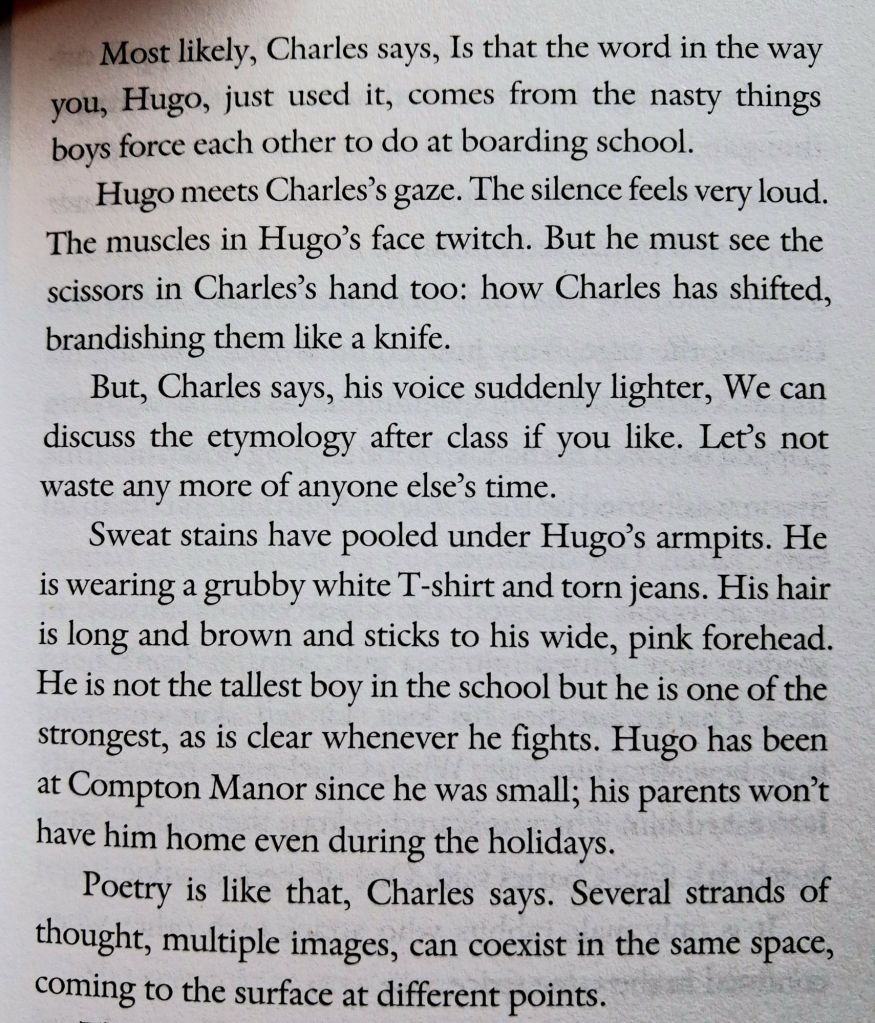
The rather good queer novelist, playwright, and theatre director Neil Bartlett, reviewing this novel for The Guardian, says of its writing that it ‘is constantly surprising, as unafraid of sensulity as it is of the story’s repeated eruptions of brutality’. [4] although this is a lesson certain instance, the prose is full of the resonance of compromised binaries, some present like the ‘silence was very loud’, others implied like the opposition of what is said ‘lightly’ rather than heavily. But most important is Charles’ definition of how poetry works: ‘Several strands of thought, multiple images, can coexist in the same space,coming to the surface at different points’. The unnamed poem they are discussing in class is Hopkins’ Pied Beauty (the poem whc h encompasses to the full the Jesuit poet’s celebratory, but concealed in practice, queerness).
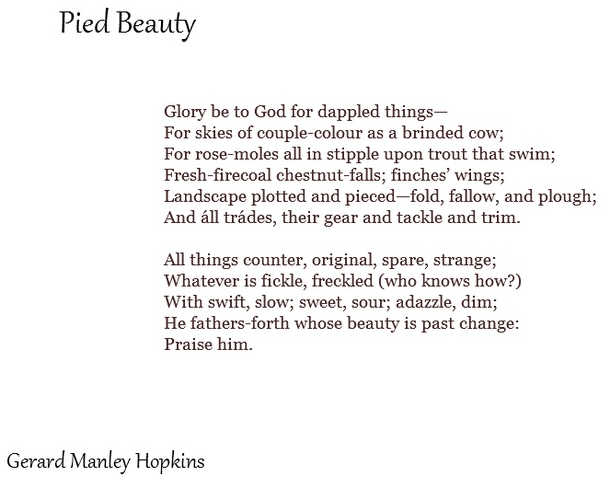
Of the school and possibly from Jean’s point of view the novel says: ‘There are lots strange things about Compton Manor, but Charles Burrows is strangest of all’. To be ‘counter, original, spare, strange’ like Charles or, as Tom too is certainly the last but possibly also the penultimate adjective too, ‘fickle or freckled’ is the stuff of Compton Manor as a Gothic school, building and its grounds with secret places within its woods and lakes. The sexual passages in the novel that take place in these secret places or in adventurous camping hikes, are also poised in the range of the binaries ‘swift, slow; sweet, sour; dazzle, dim’, for they too are a poetry of bodies interacting .wherein ‘several strands of thought, multiple images, can coexist in the same space,coming to the surface at different points’. The key word of the poem is ‘dappled’ and it is remembered at the novel’s denouement where Jean finds their human and sexual being in mixture of qualities, that here and elsewhere in the novel are about admixture of light and dark, aestheticised by the presence of the song Boy in Space in his head, but also accessing the potential to be som many things in his ‘potential futures/ as he makes them for himself out of all the space and time available to him, incuding ‘ a boxer’ or ‘a poet’:
He steps out, walking in time with the music. Around him the light falls through the plane trees, dappling his face and boots, so he feels like he is moving through something more substantial than air. … [5]
That moment where ‘light falls’, with its suggestion of post-lapsarian imperfection is pure Hopkins as it creates that mixing of tones in the ‘dappled’ as in Pied Beauty, which uses the word ‘falls’ in the same manner, which Jean has just quoted to his mother before setting out away from her and her practical containment of her future at her own place of work. The school attended by Jean is the ideal setting for a Gothic, almost literary, mode of double being, of opposing light and dark, though more threatening than life-giving as in Jean’s Hopkinsesque final visionary glance at the possible futures ahead of him. Even in the opening of the novel Jean looks through the window of the Headmaster’s office to see set against the light of day ‘the dark smudges of boys’ in the distance. Otherwise the school is entirely Gothic in its interiors:
… strange dark rooms in the depths of the building, surrounded by tapestries and old paintings. … There are other roo, hidden in the folds of the building’s expanse. filled with shapes under ghostly white sheets, dust particles hanging in the air or, otherwise, locked. [6]
David Larkin the headmaster may encourage the boys outdoors but his own doctrines of male single-sex group education contain more than a hint of what is more shadowy than in the fullness of light. Twice in the novel his motto from the Gospel of John (1 John 2, 10-11) is repeated and it is thoroughly binary in its application of light and dark contrasts (here as quoted by David):
Whoever loves his brother lives in the light, and there is nothing in him to make him stumble, … But whoever hates his brother is in the darkness, and he walks about in the darkness, He does not know where he is going because darkness has blinded him. [7]
These for David become the words, in their second use, of the pupils leaving the school in an initiation rite that involves cross-dressing and the carriage of rune stones for the boys, associated with Ra and other sun religions, and various symbolic role identities, which I have referred to in an earlier blog (at this link). The imagery of pagan initiation is mixed with Biblical icons of transition – the boys are ‘cleansed’ in water, as in baptism and the St. John of the gospel is confuted with John the Baptist: ecept that it is the head of Jean’s favoutite pig, of course Salomé, that is severed not John the Baptist’s at this mixed ritual. These rites seem mixed with male coming-of-age symbols (‘the Sowila symbol, meaning sun, … Raidho, which signifies a wheel or a journey‘, and, for Jean, ‘Perthro, which a drunken Charles says means male ‘destiny‘ but which Jean learns to mean ‘nothing’, literally ‘nothing’. [8] But ritual and religion are too oft vehicles of binaries that real life complicates in multiple potentials, like those in poetry, and in some of the gorgeous descriptions of the setting of dramas between the boys becoming men.
Take this scene where Hugo seeks out Tom, who has been having sex with Jean in a private place to tell that a girlfriend of Hugo’s has declared herself pregnant and seek comfort. Seeing Tom with Jean sparks a revelation to Jean in the heat of the moment that Hugo knew Tom was having sex with Jean but that it was only for the lack of women at the school and for ‘practice’. The disillusion this prompts in Jean has much to do with his core beliefs about relationships between men can ever be authentically loving ones rather ones of convenience, for necessary physical pleasure or ‘practice’ for the ‘real thing’ heterosexual sex. This is the meeting point of the boys in Chapter XI. What impels us are the obscurities in Jean’s understanding, for it all comes from his multiply and forever dividing consciousness, and of the events as they unfold that seem at first to stem from nature itself:
There is something sickly about the morning sky, the pale lilac beginning to lift. He is sure Tom can feel it, or is it just that he doesn’t want to be caught with Jean at four in the morning? Is that why, then, the figure of Hugo seems not simply menacing but fatal when they come upon him in the billiard room? He is sitting in a dark corner so that when he speaks, it is as if a disembodied voice looms out at them from the gloom.
The dialogue that follows is as urgent and dramatic as that description is slow and constantly questioning itself when it claims to be most ‘sure’ of Tom and his feelings, especially of their lovemaking just completed, it is at its most ‘uncertain’. Hugo digs at Jean that he hopes he hasn’t been a ‘naughty boy’, begin a process of Jean’s romantic attachment and assumptions of its mutuality with Tom, especially as Jean realises that Tom may have shared the stories of their contacts with Hugo. He taunts hugo with his own knowledge of Hugo’s liaisons with Charles Burrows, but when Hugo says ‘The bitch’, he thinks hugo is talking about him not the pregnant girl demanding he pay for her abortion. Moving between ideas that Hugo has been told, in some reductive manner, about their sexual unions and then that he has definitely not been told, the end of the section of this chapter is damning, as, after Tom leaves, Hugo says to Jean: “You know he’s only fucking you for practice”. [9] This is powerful writing, not least because of the different kinds of shift from the darkness to light, supposed clarity to muddy obscurity of feeling and thought, another kind of dark and light contrast. Dappled things you see include how one should write novels as well as poetry.
But that scene also shows how cunning are the shifts in sex/gender identity as Jean thinks it is he who is referred to as a bitch – Tom’s bitch. That delicate balance between binaries in single-sex schools and their coming together in the party where Tom and Hugo wear skirts is an uncertainty that exists in readers even before reading the novel. I was alerted to it by Bartlett’s review but even then I felt uneasy, even me who claims to be entirely open to the non binary in sex/gender, and regularly say so, whilst still choosing male identity in everyday life, that I could not confidently say how the one-word title, Jean, was pronounced. Though a proper noun in a novel written in a language which does not gender nouns generally.
‘Jean’ is not a name thar raises no ripples in gendered consciousness. Every time I came across the name / word I had a double take about how to pronounce, as the French male name ‘Jean’ as in Jean-Paul Sartre, or Jean as in the English or Scots pronunciation of The Prime of Miss Jean Brodie. I knew that Dunnigan intended this discomfort because she raises it in relation to the boy himself and his peers at Compton Manor, but not until 80 pages into the novel, just after discussing the fact that rumour had it, Jean finds, that Hugo, butch as he is always described is a long-term star of the oral sex that takes place between older boys and younger ones: [10]
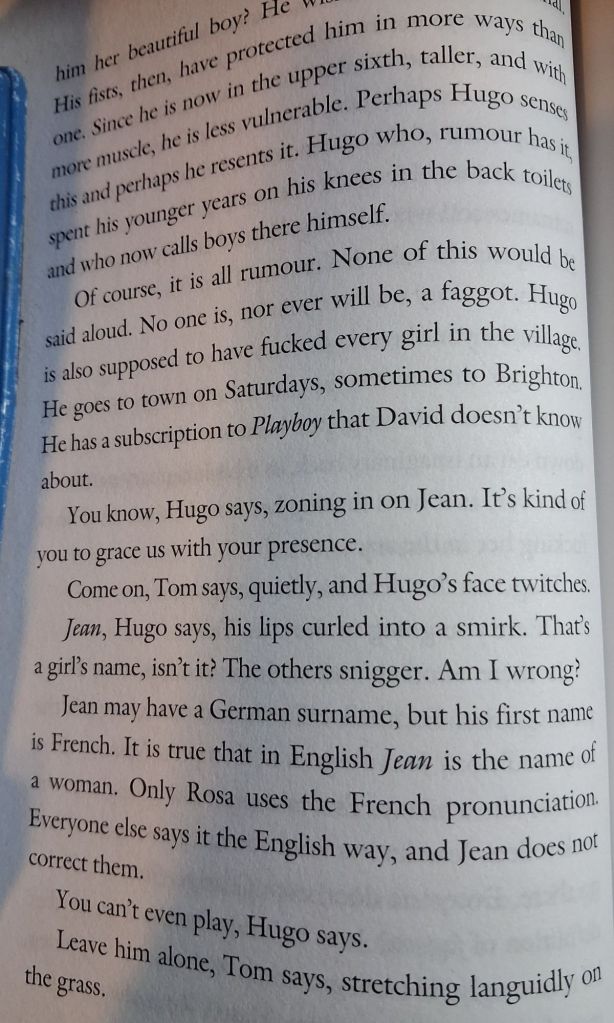
The refusal of binaries, even between extremes like faggot. starting as a young boy in the passive role (if indeed it can be called ‘passive’ – there’s another exploded binary) in oral sex, and heterosexual stud/playboy is the nature of a kind of reality that has more to do with variation across a range of differential traits than anything else, and then crowned by choice. But in the midst of this Dunnigan allows Jean to reminisce about how even the pronunciation of his name has involved sex/gender placements and evaluations, starting with Hugo’s view that ‘Jean’ is ‘a girl’s name’ to his Bohemian mother being the only one to insist on the French masculine ‘Jean’, and some even thinking it a German male name but still pronounced like the ‘girl’s name’. The point is Jean never corrects anyone, and it thus appears to be everyone who uses that pronunciation. The firm conclusion that the proclaimed ‘truth’ that ‘Jean’s is female in English is left a truth that does not need contesting because Jean moves fluidly between all identifications applied to him by anyone wishing to do so, even determining he may be ‘a bitch’.
The embrace of the ‘dappled’ is an embrace of the multiply determined in the past and present and multiply potentiated in the future, and the eradication, or modification, of clear boundaries and pathways in favour of an fuzzier approach to definition of self and life-project, other than through choices made in the time and place appropriate to them. This does not mean coming to a wider understanding of how behaviours like violence in the face of frustration are determined and can be addressed. Jean comes to an understanding of the violence initiated in his earlier life – when he destroyed all the art glass crafted by his mother because of his response to what felt like (and was most probably) rejection by his father in favour of a more conventional life, when he sees the same happening to him with Tom, of whom he had believed, helped by Hugo’s revelations, that the mutual pleasure of each other’s bodies was being betrayed by Tom’s functional attitude to sex and lack of love.It also makes him see both the Italian man and Mick Caro in his past in a different light but not to deny that he has by the end of the novel the capacity to also be The Boy in Space of which Caro sang: as ‘he feels like he is moving through something more substantial than air’. I think Neil Bartlett is correct to say that, like ‘all good coming-of-age’ stories’ this one too has ‘two opposing narrative drives’ – the first being to ‘disillusion’ about the supposed certainties in the world like love, the second ‘discovery’ of the key to avoiding future ‘self-sabotage’. [3]
How, though, does this produce what many commentators note about the book its brave and innovative, though Dunnigan attributes much of her learning in this respect to Garth Greenwell (see an example of my blogs on him here) and Brandon Taylor (the link here to an example). Bartlett expresses her method well:
Like Jean’s body, her sentences are wonderfully alive to physical fact; like his mind, they are in cool pursuit of what those facts mean’. [3]
Jean knows the other boys around him are both more knowledgeable and experienced in sex and body pleasures, regardless of the sex/gender of its object – for objects it is largely about. Hence to the reader it is no surprise that Tom betrays Jean, and that he wasn’t called ‘King Cock’ just because he had responsibility for the Compton Manor School chickens. Let’s see how one paragraph of sentences wield the power of admitting physical fact about the sexually functional parts of the body and the desire that it mean something other than functional self-centred pleasuring. On their semi-legal camping trip together (the trips were meant to be executed alone) as the boys bathe in the cold sea Jean ‘is shocked by the cold and by Tom’s nakedness’.
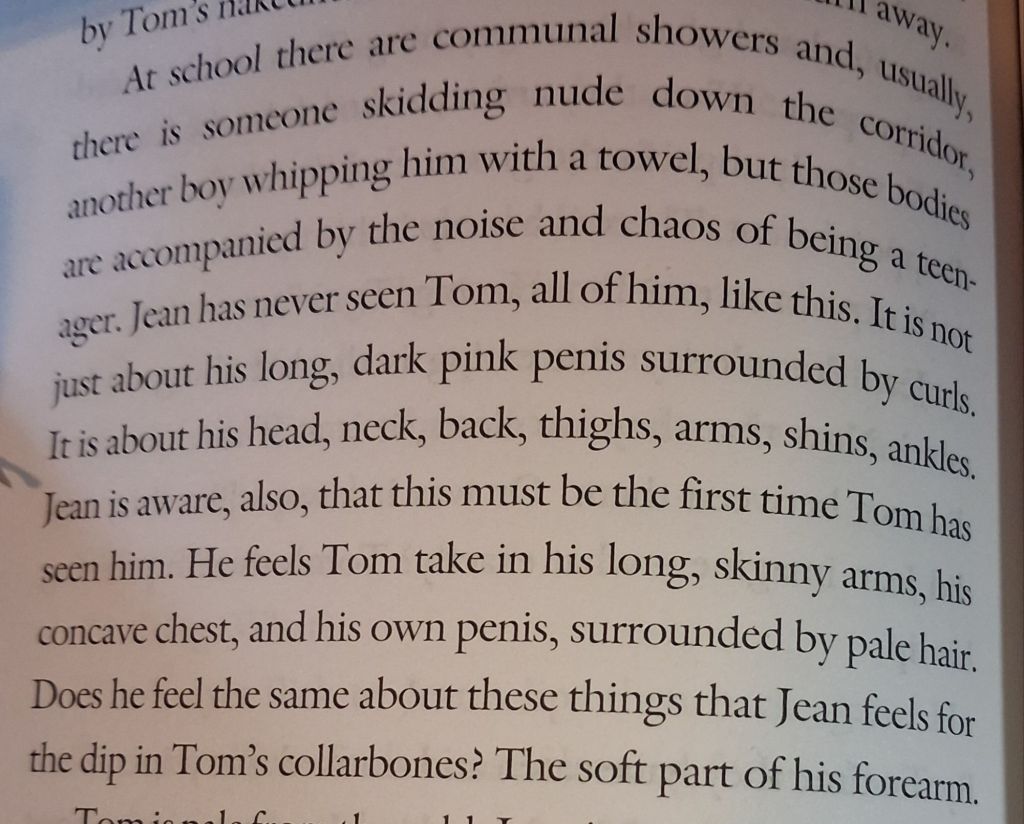
The physical fact of boys aware of each others’ bodies is encapsulated here in the bound up with an oft-repeated memory of a boy’s school shower scene where ‘bodies are accompanied by the noise and chaos of being a teenager’. It is a locked perspective seen by each boy alongside functional awareness that each can inflict pain on the other through the naked body, not unlike the ‘noise and chaos’ that aligns bodies with functionally pleasuring each other too. The first sentence of this paragraph everything noted is impersonal, about ‘someone’ and ‘another boy’. But the sentences that follow are crafted not like noise, and with chaotic flashback to common events but to the personal in short sentences that use repetition and clauses merely for emphasis of the fact so that it grows beyonf itself: ‘Jean has never seen Tom, all of him, like this’. The ‘long, dark pink penis’ is not ‘King Cock’ but something that has obscured (‘dark’ even) effect beyond the fat of its physical presence. The repetition of the word ‘feel’ which begins with physical touch launches into the fusion of emotion with sensation, in a daring thought that feeling each other can be a mutual thing, involving the ‘soft part’ of even previously unsexualised body parts and straining to be whole – from ‘all of him’ to the mutual query – which remains unanswered: ‘Does he feel the same about those things that Jean fells for the dip in Tom’s collarbones?’
The literary treatment of writing about sex between men was revolutionised by Garth Greenwell but this writing takes us further out of the physical fact, notably in the Chapter III which charts the first three times sex enters into the relationship between Jean and Tom which begins with Jean sensing Tom as a metamorphosing element of the natural scene that is Orphic, like the poet we know he may become: ‘As if the world had flattened, as if Jean is experiencing some deep interconnectedness between all living things’. [11] Those sensual mutual links to the world actuall decrease by the ‘third time’ as ‘Jean is gripping, trying to get purchase through Tom’s shorts, trying to find something that is firmer than material’. Back here then to ‘physical fact – the materiality of erection, and it followed by a darkness indeed: ‘And it is dark, so dark that when Jean opens his eye, he sees only blackness’. [12]
But the most wonderful writing is saved for that on the solstice, Tom, dressed in a skirt as per the rules of the evening, having come away from the girl he might have fucked had the girls not been sent home, to, as Jean later realises, a ‘second-best’ substitute. But we see and hear it only through Jean’s consciousness before he knows that for certain, where all is unclear and rich and beautiful, and provided with a nightingale in the background that might be related to the ones in Coleridge and Keats. And yet the physical remains and has to be acknowledged like the smell of half-digested food in a partner’s mouth:
With his free hand Jean brings Tom’s forehead to his own, When they are not kissing, they breathe into each other’s mouths. Beans and smoke and river. [13]
Nothing that matters is ‘clear’. It is all dark and light, a mix of disillusion and discovery, dark and light: dappled.
All for now but read this debut novel. It’s wonderful.
With love
Steven xxxxxxxxxxxxxxxxxx
___________________________________
[1] Parker Bach, Carolyn E Schmitt, Shannon C McGregor (2025) ‘Let me be perfectly unclear: strategic ambiguity in political communication’, in Communication Theory, Volume 35, Issue 2, May 2025, Pages 96–106, https://doi.org/10.1093/ct/qtaf001 Available at: https://academic.oup.com/ct/article/35/2/96/8024232
[2] Madeleine Dunnigan (2026: 27ff. Chapter II) Jean London, Daunt Books.
[3] ibid: 37
[3] Neil Bartlett (2026) ‘Bohemian rhapsody’ in The Guardian [date lost from the cutting from my newspaper)
[5] Madeleine Dunnigan, op.cit: 273
[6] ibid: 1 & 3 respectively.
[7] quoted by David in ibid: 6 & 125.
[8] ibid: 126
[9] ibid: p. 239 to 242.
[10] ibid: 80f.
[11] ibid: 58
[12] ibid: 65f.
[13] ibid: 193f.
 Steve_Bamlett_blog