Have you ever read a book that changed your opinion on something?
View all responses
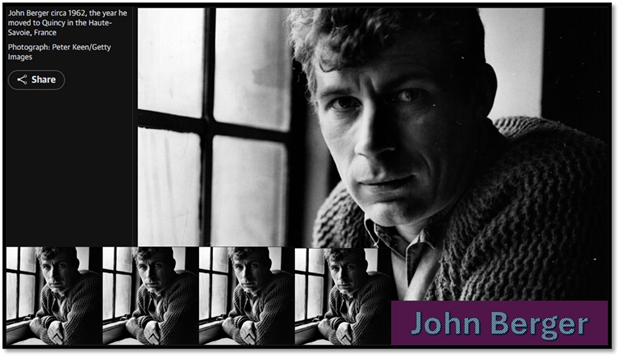
‘For John the old sense of the dead was a forest, and modern isolation is a field of stumps and craters. … For you dying was a joining, the final proof of how much of life was shared’.[1] Tom Overton does not change my opinion about John Berger but establishes his truth in my mind in Tom Overton (2026) ‘John Berger: From Life’, London, Allen Lane,
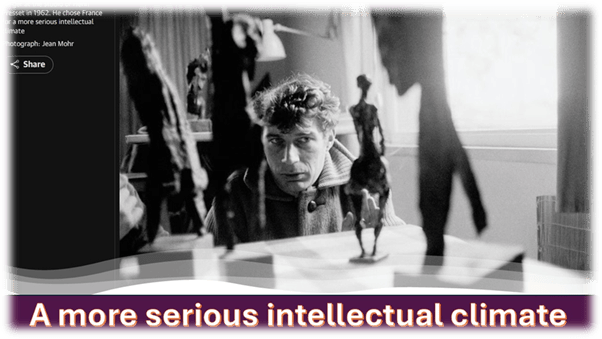
It was thought at the time that Gerger moved to France fo find ‘a more serious intellectual climate’ than that prevailing in the UK.
Books have been changing my ‘opinion’ on things since I started reading them, but the habit of reading perhaps impinges most on my fully fledged dislike of the notion of the opinion. The entry on it in The Online Etymology Dictionary reads:
Opinion (n.): early 14c., opinioun, “a judgment formed or a conclusion reached, especially one based on evidence that does not produce knowledge or certainty,” from Old French opinion “opinion, view, judgements founded upon probabilities” (12c.), from Latin opinionem (nominative opinio) “opinion, conjecture, fancy, belief, what one thinks; appreciation, esteem,” from stem of opinari “think, judge, suppose, opine,” from PIE *op- (2) “to choose” (see option).
Where there is much desire to learn, there of necessity will be much arguing, much writing, many opinions; for opinion in good men is but knowledge in the making. [Milton, “Areopagitica“]
The word always has tended toward “a judgment or view regarded as influenced more by sentiment or feeling than reason.” The meaning “formal statement by a judge or other professional” is from late 15c. The specific sense of “the estimate one forms of the character or qualities of persons or things” is by c. 1500. Public opinion, “the prevailing view in a given community on any matter of general interest or concern,” is by 1735.
Middle English, perhaps reflecting the era’s concern for obtaining knowledge through learned disputation, had opinional “characterized by likelihood rather than certainty” and opinial “based on probable but not certain evidence” (both mid-15c.).
None of the etymological material here quite explains my antagonism to the ‘opinion’ – for that you have to jump to the most common of uses of the word, namely that which opines (significantly enough an opinion not a statement of knowledge or fact): ‘everyone has a right to their own opinion’. Against the view that this statement is simply erroneous, we need John Milton’s sentence as quoted above, which reserves for the ‘opinion’ the status of a preliminary stage in a process by which knowledge is eventually stated with certainty and evidence that is difficult or impossible to discount, a status not unlike the ‘hypothesis’ in scientific enquiry, which is a form of expression of a ‘belief’ or possible fact to be tested by a method approved in science to eradicate error. But note that for John Milton this is not the same as saying everyone has a right to state their opinion on anything and have its statement respected, but only ‘good men’. Nor could it ever be the basis of accepting the truth of a statement because it can be established as a feature of ‘public opinion’, an opinion taken seriously because of the quantitative consensus around it. Books that change opinion are legion and are as cursed as the legion by name that possesses the storehouse kind of mind of the merely suggestible, that will live and die in videogames.
Books that assert a hold over the mind do so because they provide qualitative evidence of what we have individual minds for, which is to build a communal base for what is good. As a person who read and followed John Berger from early times, I suppose it’s difficult to claim that anything by him or about him would change me now, but Overton’s book has done so. And, perhaps, it does so by making me realise I read Berger myself too thinly, despite my love of his words, his actions and his performance of a model of the function of connection based solidarity with other humans. The base of this connection was the extraordinary power Berger felt lay in compassion with those who share the same vulnerabilities of an embodied mind, a mind cast in and inseparable from ‘flesh and bone’, of which he saw Rembrandt as the key maker of past images of that solidarity.
These images trod the boundary too people imagine there may be between humans and animals, because though animals may not have the same vertical line of transhistorical consciousness, or the same kind of comparative interiorization of experience, humans often extend their own consciousness of this kind to animal suffering and animal company, in a body somewhat like theirs but not the same and with other differences, harder to discern, and is at the base of Berger’s theses on ‘looking at animals’ from the essay ,“Why Look at Animals?,” from the essays collection of 1980 About Looking.
What were the secrets of the animal’s likeness with, and unlikeness from man? The secrets whose existence man recognized as soon as he intercepted an animal’s look.
In one sense the whole of anthropology, concerned with the passage from nature to culture, is an answer to that question.[2]
This quality of the ‘book’ to invite us, in examining its entrails, that it holds insides, is not unlike Berger thought the mystery seen in animals that in part led to belief in divination from sacrificial animal entrails, or of paintings which arrange their subjects as invitations to enter within them, Berger even wrote to his son, Yves’ of the sameness of spatial perspectives of Van Gogh’s 1885 Still Life with A Bible (in fact a Bible open for reading) to Goya’s La maja vestida, in which a fully dressed woman lies open to the gaze, as much as the Bible does. Yves answered this in a way that entirely chimed with his father – by naming the motif of both his paintings and the Soutine reproduction he sent in response, itself a reworking of Rembrandt.
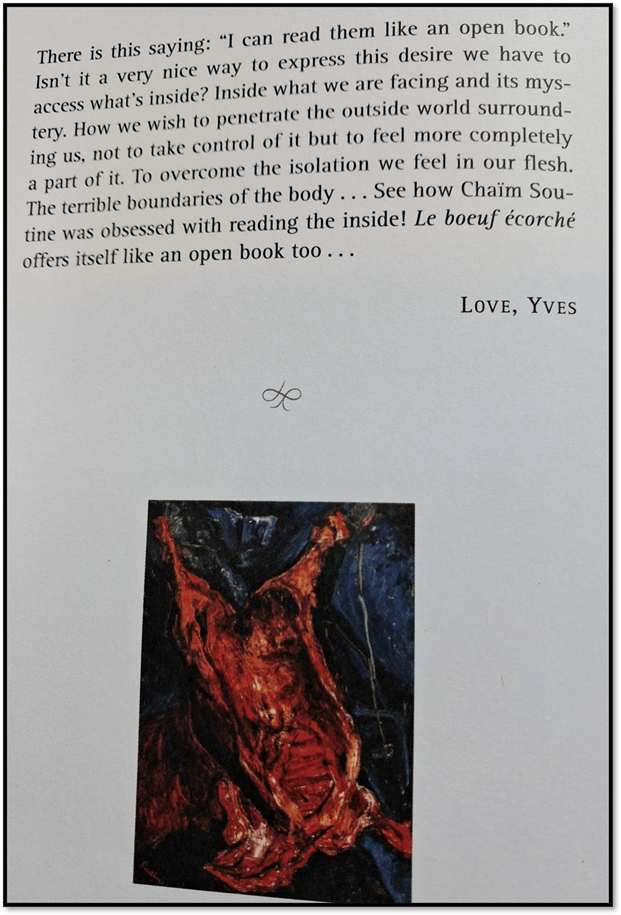
In his reply to that letter, Berger quotes back to his son, the words about overcoming isolation and the ‘terrible boundaries of the body’. [3] My intention here is to lift those ideas from this exchange to help me understand better how Overton reads Berger, after prolonged exposure to the living (and now sensibly beginning to be obviously dying) man and his works, as archivist, co-editor and authorised biographer, but only on promise that no biography appeared before Berger’s actual death), constantly requiring the way books and images become an invitation to the isolated to enter into company, with image or text, storied message and/or body to overcome isolation and escape ‘terrible boundaries’. This is not however to promise a kind of golden glow of empathy, or worse sharing of opinions unearned by experience, but empathy at the price of conjoint vulnerability to bodily and mental suffering and/or pain in demonstratable experience – often from international sources: and not least from Palestine, where Berger, an anti-Zionist Jew, found a likeness to himself, with those essential differences to Mahmoud Darwish and the dispossessed of the Nakba.
Below however, Overton is narrating John’s delivery of a speech at Oxford Union about the imperial war, taken over by the USA from Britain and France sequentially, we call the Vietnamese War.[4]It’s beauty lies in its full and comprehensive knowledge of Berger that uses the dead writer’s own metaphors as his own.
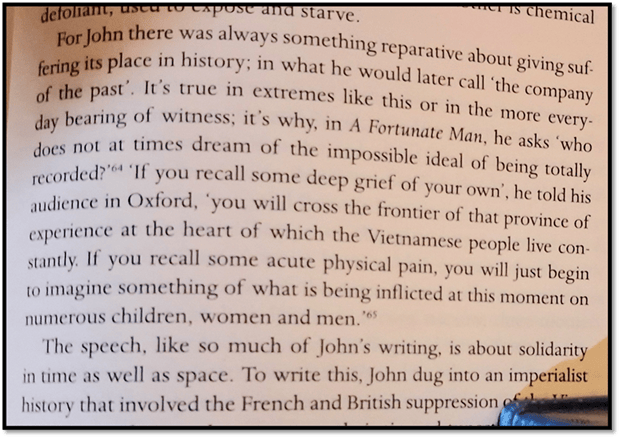
Take the phrase ‘cross the frontier’, which implies not an image but a story of border-crossing, like that of the migrant, in order to understand a little of the experience for whom war-torn Vietnam is the province they call ‘home’, and which, for a little time, at least, the reader will use their experience of pain and marginalisation to find a home briefly too – yet still safely within the reading experience. This is one of the methods by which a well written book, one that invites you into it and the experiences its pages unfold, changes you. And this is what both writers (Tom and John) mean by ‘solidarity in time and space’, connectivity but one so much less than of a kind that lives comfortably still in its own native assumptions.
As an example of the latter take E.M. Forster’s dictum, ‘only connect’, based in a view of humanity that simply ignores real power relations in connections, and that sullied his relationships with men who lived in British colonies in India and Alexandrian Egypt, both left to their own devices when Forster returns to Western reality, and plumps instead for a working-class white lover suitably provided by a beard of a wife. (I love Forster nevertheless – God help me!). This is why every book about human experience (and surely the treatment of migrancy in A Seventh Man is seminal)
If traumatic experience can be shared in stories or even things that from some static point infer the past and possible futures they mediate, we have to think about stories differently. This is one point, and the only one I think, where I seriously distance myself from Overton’ especially in the generalised summation of Berger’s, in response to Berger’s own frequent assertion as he aged that he was in essence ‘a storyteller’. Here is the passage, which end with a reference that also applies to that ‘open book’ flesh painting so important to Berger, Rembrandt’s 1665 Slaughtered Ox (a life reduced to flesh and bone, innards taken out and already commodified). That picture was versioned later by Soutine and later still discussed with his father by Yves (see above):
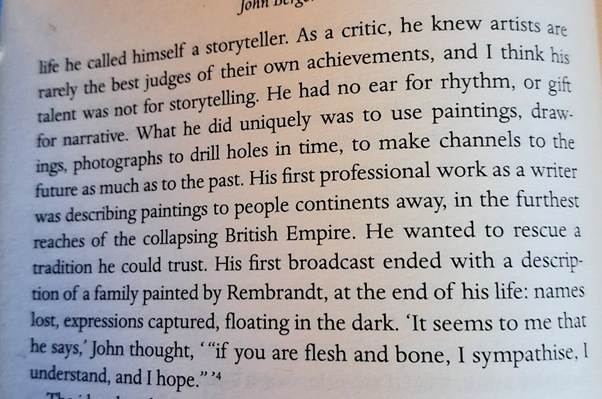
I cannot agree that Berger had no ‘ear for rhythm – some of his poems astound – nor gift for narrative. It is just that the ear, and narrative expectations, of most readers of books required to be disrupted, if they were to move from the easy sense that, of course, they wanted to connect with others, to recognising the fact that the cultural expectations of modern capitalism and hierarchical governance thereof, had fundamentally severed the connectability of bourgeois sensibility from the majority of people, and that this is why they are marginalised, just as animals intended for slaughter are by necessity marginalised and easily conceived as mere commodities. Perhaps this too applied to subjects like women who have become subjected to the ‘male gaze’, as defined in Ways of Seeing, to the people of Palestine exposed to displacement from the forced formation of Israel in 1948, as seen and addressed by Mahmoud Dawish, to the dead and dying on TV shots in napalm attacks in Vietnam. This is how we know suffering.
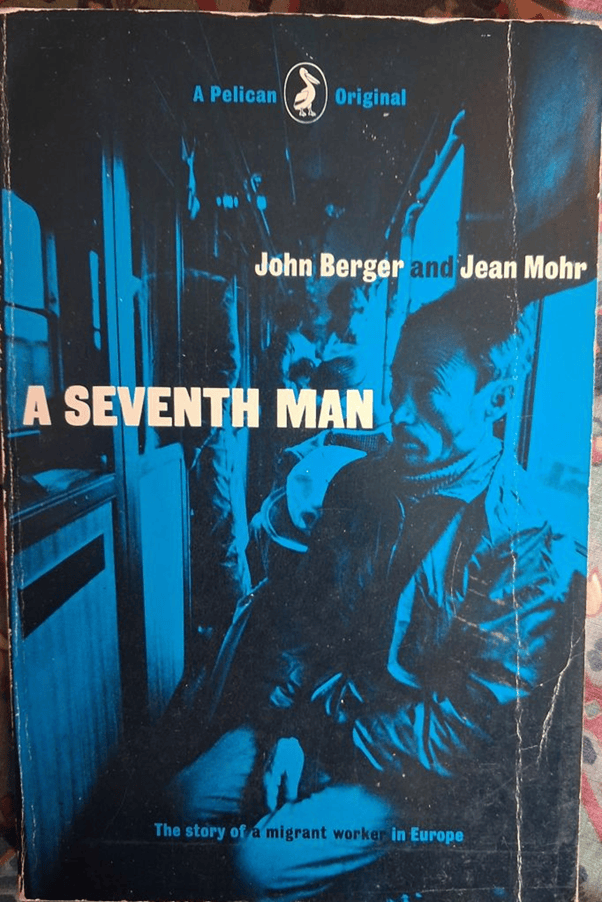
Why I so disagree with Overton here is that he expects John’s talent to be that of the storyteller as supposed traditions had moulded them. Such stories don’t placate by rhythms or narrative ability performative of life as we know it in the conventional traditions of storytelling, but attempt to reformulate art by crossing the frontiers of expectation setting traditions, like genre or mode of writing, disrupting expectations of the place and finishedness of illustration and analogous expression, even of illustrative diagrams. Only when you understand this can you see how many ways we can place the story of, for example, the migrant male on the cover of The Seventh Man, sometimes needing to use photographs that at first appear comic, or popularised (in the sense of aimed at being understandable by many) psychological theory illustrated in rough diagrams as in the page folds below:
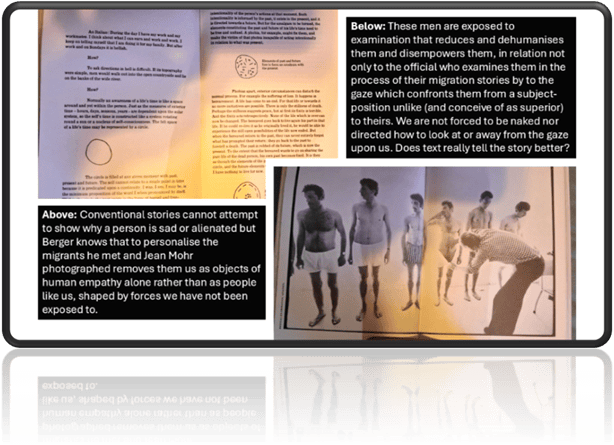
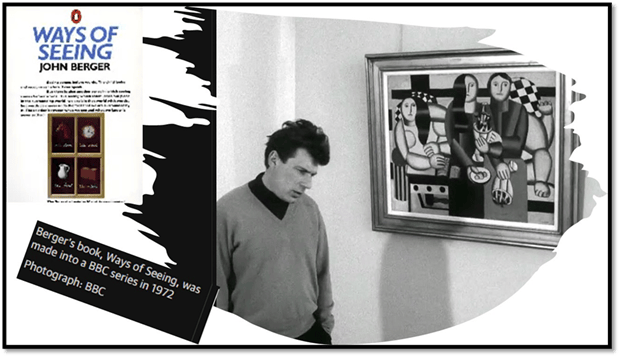
We cannot respond to the narrative methods of Berger, in his novels too, without seeing we are provided with lenses that enforce us to see the power relations involved in the ‘suffering’ (which is after all a kind of word for passive experience, where resistance gets you into conflict in which you must be the loser). Look back at the Jean Mohr photograph on the cover of A Seventh Man. Does not it tell a necessary story of transition and power (also see my favourite book with Anne Michaels, Railtracks).

As for Berger’s own view on storytelling and his sense of his skill in multimedia, multigenre and multidisciplinary innovation, I’d instance a text not mentioned in Overton, nor known by me until Overton forced me to search again those things my library missed too. I found I missed a volume by Euan Duff the photographer of working class life published in 1971 and entitled How We Are, to which Berger provided an introduction. Berger’s thesis as I interpret it is that Duff’s book, divided into chapters but with no text or titling other than that on its cover, is presented to us as a story told, which he claims does not always ‘work’ as story but also appears to be attempting that.
The story as Berger reads it is not, the critic readily admits, the same kind of story as told by Berger, which continually reveals the contexts of power of the dynamics of that story, seeing as he does a complex narrative pattern in the early wedding photographs that show that though beliefs about romantic love are sustained, where ‘each self wishes to go beyond itself and become reciprocal with other; in brief, they want deep connection, even solidarity, outside of the ‘terrible boundary of each of their bodies, but in conflict with a knowledge everyone at the wedding also has that this marriage, like all others is ‘primarily a property contract’, and is ‘one of the guarantors for the continuity of private property. Berger is enabled to see this not because he reads the intention of Duff in the telling as to show that but because the photographer gives the characters of the story autonomy and freedom from being subjected to the story an ‘authorial’ presence wants to tell and considers himself the authority thereon. Indeed Berger suspects or knows Duff thinks very differently bout his story’s meaning than Berger, saying in a remarkable passage:
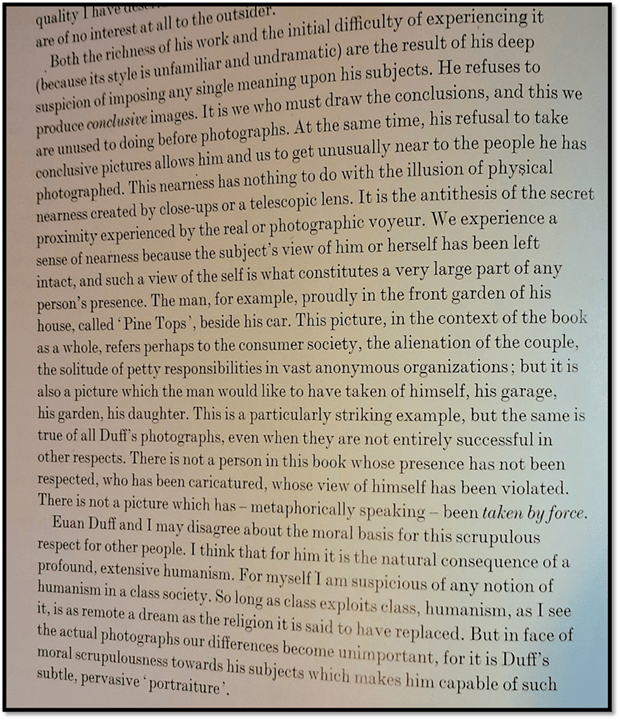
My photograph of John Berger (1971, unpaginated) ‘Introduction’ in Euan Duff How We Are London, The Penguin Press.
The interesting thing here is that all narrative that works, works by achieving respectful intimacy, not by pretending that the gaze which organises the image in front of itself is not there or there only because of a convention of their supposed invisibility, but that the relation between storytelling eye or pen-holder is one in which all participants believes in the respect of each for the other, without the will to power that imposes ‘any single meaning’ on its subjects or characters, but allows for many, including those of the participants. You might think ‘humanism’ (an unbreakable belief in the reality of the human subject’s integrity) is the best way of achieving this balance of interest in photographs and stories – the kind of thing Forster strains for in his ‘round characters’ – but Berger shows that ‘humanism’ is for him an illusion that hides disparities of, and interaction through, disparities of power, that requires that we keep a political framework available for interpretations, as Duff has, even perhaps without intending so to do, kept one open. And Berger exploits that framework in reading Duff, writing a political prose so powerful that it shakes the foundations of a society supposed to believe in the freedom of the individual. He says of Duff’s narrative, and it is no small praise, even if Duff thought about it differently (it is also a sentence of rhythmic beauty and narrative :
I can think of no comparable contemporary English work of literature or visual art which so gently, so persistently and so finally brings one face-to-face with the wretchedness of the kind of society in which we live: a society in which every personal meaning achieved by an individual is pitted against corporate meaninglessness; in which every personal need, expressed in terms of what is socially available, is in agonizing conflict with the origins of that need in the soul.[5]
I think it is time I gave some overview however of where Overton has allowed me to begin to list the areas in this great biography where conclusive consensus of agreement about Berger can be built.
- That Berger as a human being, family man, writer and activist sought continually to develop a theory of connection between beings that broke down the ideological barriers that sustain the notion of an isolated self, whose relation to other selves can be only competition
- Consequent on that, the transformation of how we see biological boundaries and events (like sex, reproduction and death) to mental barriers that can be overcome by being reformulated in thought. This includes the barriers we sustain between selves in time, and the magical overvaluation of the unknown and unknowing, rather than exploring the vertical line of time consciousness which runs through every current place at which we make a ‘home’ in the lateral line of life events and spatial motion.
- The destruction of all industrial achievement by capitalist relations of production and consumption and failure to see where such achievement is that based on co-operation and true debt to the past.
- The reduction of qualitative life issues to quantification (wars, migrants and HIV/AIDS)
In an earlier blog I promised to write on how Overton gives us access to how Berger dealt with HIV / AIDS s a social experience, but felt it best as I reflected for that to be readable direct from Overton. One thing however needs saying – he took up the project of integrating a knowledge of HIV/AIDS in his late novel To The Wedding by the knowledge that his son Jacob’s partner was dying of AIDS when she went through a marriage with Jacob. This was an extremely complex relationship, in which Jacob saw his father as a possible sexual threat to his marriage. And yet, the novel does not depend on reference clearly that personal link. What was clear is that Berger saw capitalism and hierarchical power relations as responsible for diminishing the national governance and medical response HIV required. He had intended a book on the subject before the issue became personal,
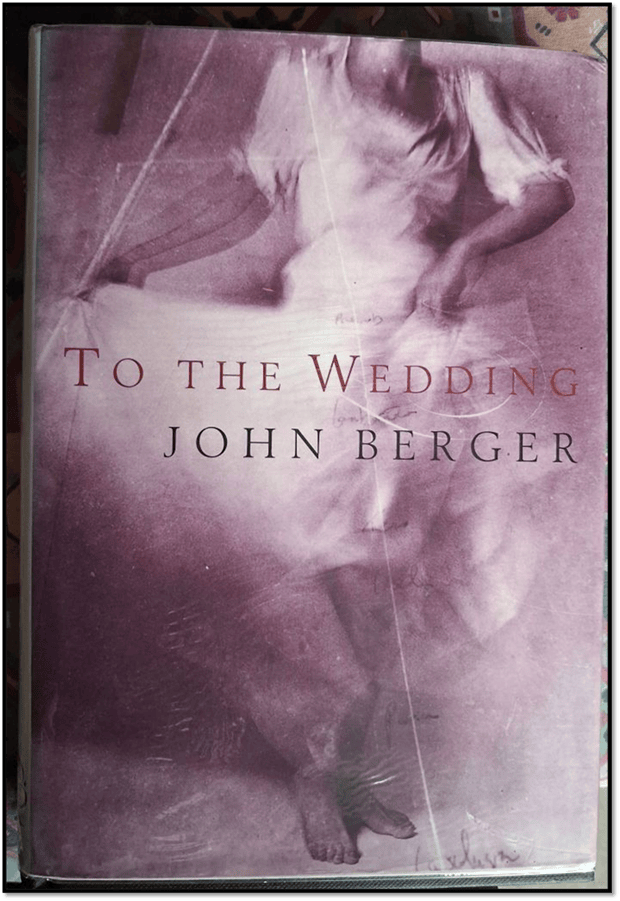
Overton tells us tht fact and that the intention was based on the effect in part of reading Susan Sontag’s book on the subject. One purpose of the story was going to be – though not so in the final version – was that it be written so that the reader was allowed to believe the coming together was of two men, one dying but not the other, before the reveal that it was a heterosexual couple thus effected in the novel and the one dying was the woman. The point is the history of HIV/AIDS had hitherto been told as part of the armoury of homophobia, leading to the differential oppressions that struck every group effected, the largest of course being gay men.
There is when we think of Berger and his own achievements always a contradiction present in our reading minds between the solitary reflective great mind of the man, hungry to be in connection with a diminished number of like minds, and the longing for connection / solidarity. Overton addresses this and is well enough described in a review in :a review by Zach Gibson in the Los Angeles Review of Books:
As an adolescent, Berger’s budding sense of class-consciousness led him to cultivate a contrarian, outsider persona that prefigured the reputation he later earned for both his firebrand polemics in the periodical press and the self-imposed exile that led him to abandon London for Continental Europe. “I was a flamboyant impatient rebel,” he writes in “Myself When Young,” an autobiographical essay from 1961. Working hard to express his hostility, Berger antagonized the St. Edward’s faculty by taking up outlandish positions during in-class debates and provoked the ire of his classmates by wearing a hammer and sickle lapel pin he bought from an Oxford bookshop. He kept his peers at arm’s length and spent much of his school days in solitude.[6]
Moreover he found solidarity in empty images of it for too long, in the Stalinist USSR, for instance, and this Overton tells us “caused John at least one major breakdown.” Perhaps both of these traits, Overton allows us to see why he stressed the idea of a continuity between past and present, a felt presence of the continued life of the dead in current society and a longing for the company of the past or its heritage, like that of a ‘peasantry’. Xan Brooks in The Guardian stresses Overton’s emphasis on the theme extremely well below:
If there was a bright running thread through Berger’s portmanteau career, it was this preoccupation with the past and its connection to the present. The dead and the living are interdependent, he said. The stronger the link, the happier and healthier the society. Great paintings in a gallery allow us to travel in time. So too do some people, if they are skilled and sensitive enough. Berger’s 1967 book A Fortunate Man paid gorgeous tribute to Dr John Sassall, a country physician from the Forest of Dean whose work at times bordered on the supernatural. “The doctor,” Berger wrote, “is the familiar of death … the living intermediary between us and the multitudinous dead.” He might just as easily be talking about the role of great artists and critics. Possibly British Library curators as well.[7]
None of this actually invoked the ‘supernatural’ and was oft represented in the presence of institutional archives, and archivists (Overton was Berger’s for The British Library) but also cultural institutions of working-class solidarity, political and economic, as well as literary and painterly traditions (illustrated everywhere in Berger) which require to be constantly looked at again. And then there is the passage I use in my title:
‘For John the old sense of the dead was a forest, and modern isolation is a field of stumps and craters. … For you dying was a joining, the final proof of how much of life was shared’.[8]
What is beautiful in this edited passage is the illustration of Overton can speak of ‘John’ (not ‘Berge’r) and, as easily slip into directly addressing him as a living presence, ‘you’, but now not one that could interrupt Overton to put him right, although in the book we feel the presence of that critical voice and the stress it causes in Tom, as well as joy. We also sense the presence of Berger’s dying body in the building of the book, Tom recalling the smell of ‘leaky prostrate’ mixed with to bacco and wine, stale smelling. There is no room for sentiment here. After all, the terrible boundary of the body smells ripely in its going hence sometimes. It is something Tom catches himself not liking as much as the mind he handles physically in his archival research work, though some of that was messy too.
For me reading it, there is so much that brings pain. I was on the committee of a conference organising team that invited Berger to a conference Peasants and Countrymen in Literature, held in the Roehampton Institute in 1981, where I spoke (dully enough but with reference to Lenin) on George Eliot’s Romola, in which a scholarly character in it sees a parade of peasants from country to the city of Florence, ‘like a wayward ancestry returning’.(as if Eliot had read Berger’s Pig Earth too). I met him and Jean Mohr, shared with them in a seminar my teaching of A Seventh Man with a first year foundation literature class and received a lovely dedication on my copy of Pig Earth. But Berger was just magnificent then, alive and troubled even through his status amongst academics who looked in comparison thinner souls.
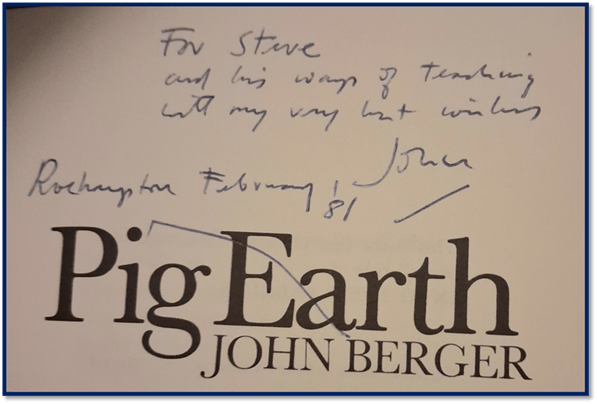
I read his books as they appeared, and went back to read the novels – but all too long ago for good recall. I never lost my politics because, I think of him, and how he faced and wore contradictions greater than mine – for he was the finest of intellects and not from the working-class but in lateral consciousness from a lower-middle-class public school status. He was a beautiful young man and a beautiful old man. I never touched him but in reading him but each time now I feel I touch him. Do read this book. It is a treat and, for some of us, a penance, for we knew him too ill before Overton, and sometimes we knew him too thinly and glibly (our fault not his).
Did I read a book that changed my opinion by Berger? Hardly, they were too busy changing my life.
With love
Steven xxxxxxxxxxx
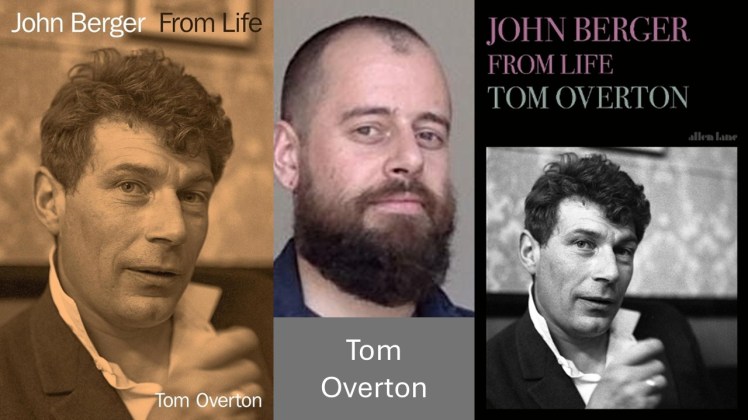
[1] Tom Overton (2026: 309) ‘John Berger: From Life’, London, Allen Lane
[2] John Berger (1980: 4) About Looking, London, Writers and Readers Publishing Cooperative.
[3] The exchange of letter and the photographed page (page 12) are from John Berger & Yves Berger (2024: 11 – 13) Over To You: Letters Between a Father and Son, London, Pantheon Books.-
[4] My photograph of detail of Tom Overton op.cit: 157
[5] John Berger (1971, unpaginated) ‘Introduction’ in Euan Duff How We Are London, The Penguin Press
[6] Zach Gibson (2026) ‘A Flamboyant, Impatient Rebel’ in the Los Angeles Review of Books (September 30, 2026) Available at: https://lareviewofbooks.org/article/john-berger-from-life-tom-overton-biography-art/
[7] Xan Brooks (2026) ‘John Berger: From Life by Tom Overton review – a vibrant biography of the pioneering critic’ in The Guardian (Mon 10 Aug 2026 07.00 BST Last modified on Mon 10 Aug 2026 16.07 BST) available at: https://www.theguardian.com/books/2026/aug/10/john-berger-from-life-by-tom-overton-review-a-vibrant-biography-of-the-pioneering-critic
[8] ibid: 309


*The Lie You Tell Yourself To Keep Going*
What is the lie you tell yourself every day just to keep going?
You know it’s not true, but you repeat it anyway because the truth is too heavy to carry.
“I’ll be fine.” “They will come back.” “Tomorrow will be better.”
You say it with a smile, but deep down you know you are just trying to survive one more day.
What is the lie you tell yourself every day just to keep going?
LikeLiked by 2 people