What’s a completely useless fact you love sharing?
The fact is that what a fact is is, in all probability, often the product of its use as a term within a process of shared discussion.
Is a fact how it is used in shared exchanges in different contexts, or not? See Wikipedia on the term.
At base, if you are asked what a fact is,
you'd be wise to say it is first of all
a word, or recognised as such by some
who use the language in which the word fact,
in fact, to mean  one thing or another,
is used. Hence, why should a fact be useful?
Its use lies in its sharing by us, them
and others, standing as a foundation.
I asked AI ‘why a fact should be useful’? It said: “A fact becomes useful when it connects to a goal, a problem-solving process, or a decision, turning raw information into a tool for action and understanding”.Isn’t that much the same as saying: ‘A fact becomes useful when it is used for something by a person, persons or human societies and cultures. Do pigs use the fact that they have an instinctual drift built in root in the ground when they hunt a truffle, or do human use it to define a pig, or pig behaviour depending on the weight applied to the word ‘instinct’, as something distinct from what is not a pig and / or pig behaviour? Yet a pig turns ‘raw informaormation into a tool for action’ at the very least.
In his poem Maud, Tennyson has his, possibly insane, narrator say:
O let the solid ground
Not fail beneath my feet
Before my life has found
What some have found so sweet!
Then let come what come may,
What matter if I go mad,
I shall have had my day.
The narrator’s father killed himself when the ‘ground failed beneath hios feet’ (he flings himself into a quarry or ‘pit’. But is the ‘ground’ so solid anyway?
I want to share with you some facts. It's strange
you back away from that, for they are facts
you use everyday, as you walk along
the path you tread that keeps you so secure,
or so you think. The solid ground moves as
fast as you, not far below its surface
its not solid. Neither in fact are you,
in much of that being yourself you prize.
We go on ‘connecting’ things we think we know ‘to a goal, a problem-solving process, or a decision, turning raw information into a tool for action and understanding’ all the time and the truth of the think ‘known’ is only some times necessarily the factor in our success or failure. We call our enemies ‘devils’ or ‘transients’, though that’s opinion not fact but it can form a decision or an understanding that tkes us to some place we wanted to go. Here’s an example from Dickens:
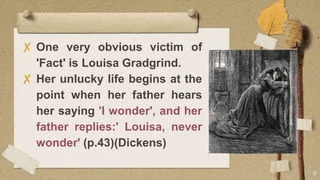
Thomas Gradgrind, sir. A man of realities. A man of facts and calculations. A man who proceeds upon the principle that two and two are four, and nothing over, and who is not to be talked into allowing for anything over. Thomas Gradgrind, sir—peremptorily Thomas—Thomas Gradgrind. With a rule and a pair of scales, and the multiplication table always (in his pocket, sir) ready to weigh and measure any parcel of human nature, and tell you exactly what it comes to. It is a mere question of figures, a case of simple arithmetic. You might hope to get some other nonsensical belief into the head of George Gradgrind, or Augustus Gradgrind, or John Gradgrind, or Joseph Gradgrind (all supposititious, nonexistent persons), but into the head of Thomas Gradgrind—no, sir!
In such terms, Mr. Gradgrind always mentally introduced himself, whether to his private circle of acquaintance, or to the public in general. In such terms, no doubt, substituting the words “boys and girls” for “sir,” Thomas Gradgrind now presented Thomas Gradgrind to the little pitchers before him, who were to be filled so full of facts.
Indeed, as he eagerly sparkled at them from the cellarage before mentioned, he seemed a kind of cannon loaded to the muzzle with facts, and prepared to blow them clean out of the regions of childhood at one discharge. He seemed a galvanising apparatus, too, charged with a grim mechanical substitute for the tender young imaginations that were to be stormed away.
Gradgrind was the representation of Utilitarian – that nothing had value other than in its usefulness. Fancy had no use, nor imagination, a fancier name for fancy. Childhood had no use but as raw material for the ueconomically useful adult, whose productivity of use can be measured.But fact is, you can make a ‘galvanising process’ through facts even though its use is not to galvanise life out of death but death out of life. Nevertheless it has a use.
Now, what I want is, Facts. Teach these boys and girls nothing but Facts. Facts alone are wanted in life. Plant nothing else, and root out everything else.
What a pig roots out, it roots out in search of sustenance, without much care for the fact its rooting behaviour represents. Humans follow Voltaire in cultivating their garden but they care more for establishing the fact of what is a weed and what is a plant, not knowing those terms are conventionally fixed by human thought not based on solidified opinion that acts as fact. And yet we have so industrialised our world by turning it to use value that we may not survive its transformation under the effect of unforeseen changes wrought. Is that a fact? I wonder?
With love
Steven xxxxxx

