


Should we start much earlier than we do learning about ‘Life, the littleness of it’.[1] Do little books about littleness in enlarged contexts need prizes or forgetting? Do little books about littleness in enlarged contexts need prizes? This is a blog on Emma Cline (2026) Switzy London, London, Chatto & Windus (Penguin).

In a final reprise of ‘real life’ as he considers whether the others at the scene of his chosen time of self-administered death, David Hastings can think of nothing much to characterise it but routine tasks that American living entails – discarding ‘sour milk’ or empty cans or picking up shirts from the laundry. In the novel, there follows one of those frequently occurring stand-alone paragraphs from the novel that can consist only of a short sentence, and here, a brief phrase, not even a sentence: ‘Life, the littleness of it’.[2] So near to the end of the book and David’s life, the phrase stood out to me, even though I think it may have been prepared for in the text in quite a dark manner. Near the opening as David compares his ways of thinking, informed by the needs of a different world to those of the young of the current age for whom the world was all ‘false fronts, the papier-mâché masks, the pulleys and gears’. Yet summing all that up in a short paragraph following, we cannot know for certain that his view of how the young feel about things but how he too may feel, even quoting (from mis-memory) T.S. Eliot on Webster:
This little life, this little life. It was awful to see things this way. Just the skeleton under the skin.’[3]
But if David thinks there may be differentiation of his idea, should it exist, that some things in life are substantial and more than a surface phenomenon, they tend to centre on memories of an old friend, Tom, whom it is his plan to see before he dies. Yet, when Tom, finally seen is found to offer no succour for whatever fulfilment and resolution he seeks, the diminution of life may in the following sentence seems not only complete at the level of the axiomatic but also part of the everyday for the busy executive viewing business pitches from prepared slide presentations, even before PowerPoint, we inevitably notice, in the way only a very old businessman would remember:
Life was little and brief and it was over with clank of the slides changing in the projector.[4]
The echo of Seneca’s De Brevitate Vitæ, though probably inevitable, still however offers no moral compass to evaluate either modern times as David sees it nor himself. It is possible that we might ask if any of the accused do as Seneca says those do whose life is:
devoted to no good end, forced at last by the ultimate necessity we perceive that it has passed away before we were aware that it was passing. So it is—the life we receive is not short, but we make it so, nor do we have any lack of it, but are wasteful of it. Just as great and princely wealth is scattered in a moment when it comes into the hands of a bad owner, while wealth however limited, if it is entrusted to a good guardian, increases by use, so our life is amply long for him who orders it properly.[5]
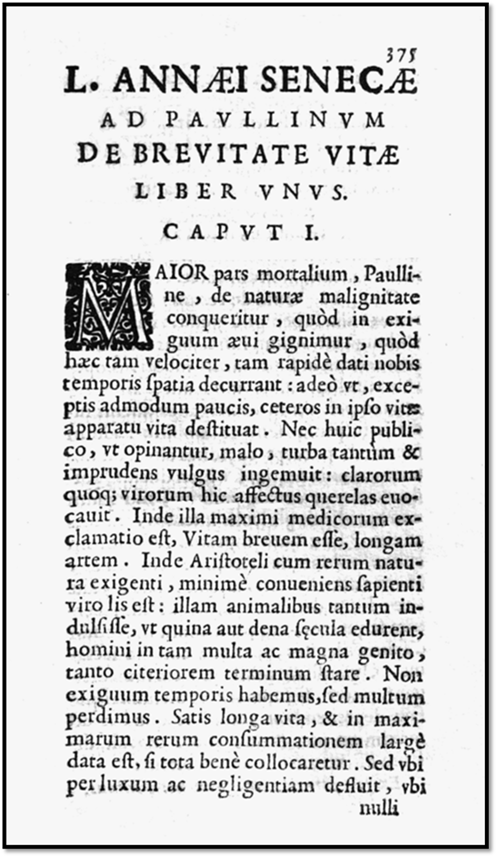
I suspect any attempt to shoehorn the moral paradigm of Seneca into the situation of David Hastings will not wash, although the novel does indeed introduce us to his own life-review at the moment of ‘ultimate necessity’, in this case the moment at which David might be adjudged to have lost capacity for informed consent regarding his wish for assistance in dying in a Swiss clinic that is probably modelled on Dignitas.

However, we see enough of that life-review, fragmented as it necessarily must be in the consciousness of someone with dementia, to see that issues of what he achieves in living as well as what could be seen as time wasted, ill-used by a ‘bad owner’ of that life. What were his achievements, and what his failings as an employer, then an employee, a husband, father and grandfather and as a friend, and as a man. Do we ask that? But even if we do not, we know that David has long thought of himself as inadequate and failing both to see himself whole or to ‘change his life’ in ways that would answer to the fact that ‘time was unbearable to’ him: some ‘exit’ from that life though often making do with being ‘good at finding the workarounds’. [6] It would be clear to us if David were trying to sell a second-hand care of his rather than ‘shuffle off this mortal coil’ that he knew he wasn’t so good an owner of his unwanted asset.
Moreover David is very judgemental about how well accounts are kept, and although those accounts are largely financial accounts in the novel, they surely include the stories that make up even a collaged together life-review. The sentence that sticks out in the paragraph I last referred to is its first one: ‘You had hidden things from others and from yourself’. Later I will be using the critical review of this novel by Chris Power in The Guardian, with some agreement about one way in which he characterises the role of the character Tom, his ‘boarding-school roommate’ , in novel and as a memory in a novel where memory is necessarily uncertain. However, that demands we confront something too glibly assumed in Power’s review – that any type of dementia has fixed characteristics. Indeed Power starts off by saying this:
The word “Alzheimer’s” never appears in Switzy, Emma Cline’s third novel, which arrives pre-endorsed as a Booker prize longlistee. But we can be certain that it is the disease afflicting its central character, David Hastings – certain in a way he finds it increasingly hard to be about anything.[7]
He needs to establish this because later he will say that the representation of n Alzheimer’s type of dementia is belied by the handling of the narrative around the story of David and Tom:
The reader’s knowledge that David will remember – an expectation drummed into us from myriad stories that work this way – runs counter to the reality of his predicament, to which neither narrative nor real-world logic applies. Behind his chaotic decline, the “unknowable soup” of his reality in which cause and effect have become terrifyingly uncoupled, hums a perfectly calibrated narrative machine as smooth and obliging in its operation as the doors of his private jet.
I think if we put these paragraphs together the error of critical judgement in Power is clear. Just because discovery narrative, even where the discovery of something forgotten rather than deliberately hidden, requires a certain expectation that the required memory of why Tom matters to David will be supplied before the stories in a narrative package come to a close around each other, does not rule out that such a memorial recovery could not happen to someone with a dementia of any type. Indeed, Power has probably less reason for being certain of this than Cline for allowing it to occur – and then be lost again. What sounds like a clever point about not using the word ‘Alzheimer’s’ is less so when we see that other more precise descriptors are used mor fitting to current knowledge of the disease’s causation, medical mitigation and progression. In one memory he can recall the effects of the drug Aricept (often peculiar to different users), name some of the neural events that mark the disease ‘Cotton wool plaques, Tangles, cell death from feverish inflammation, even characteristically miscategorising some factors – Amy Lloyds for amyloids, for instance in a way characteristic of category misrecognition in some people with the disease. This is not a case of NOT naming the disease and leaving the certainty up to the reader to find but of living in the diagnostics of the present and not of the past of the original discovery by Alzheimer.
I say this not to nit pick at Power, a considerable novelist in my thinking, but to suggest that to find critical objection in this author misrepresenting the neural disease assumes a superiority over the author’s knowledge base that may not be true and is unprovable anyway. It is a cheap way of saying that Cline is novelist who sacrifices some part of the realism of the novel (in this case to inbuild uncertainty in to the point of view of the character David) for the sake of coming up with neat narrative of delayed awareness, of what Aristotle called ἀναγνώρισις (anagnorisis) – a discovery that provokes the narrative’s closure.
This certainty that novelistic convention would be obeyed works against the uncertainty Cline otherwise evokes so brilliantly. It’s true that with Alzheimer’s long-term memories can persist as short-term memories cease to imprint. But David, too, appears to be searching for precisely what happened between himself and Tom. The memory is conveniently unavailable, provoking suspense, and then, just as conveniently, it returns to provide satisfaction.
In my view, we can’t catch inadequacy in operation in the novelist in that way at all. That there are narrative conventions in storytelling does not preclude the fact that such conventions can be used in cases where reality matches the model in one way or another. If a critic is to use generalisations about the nature of any dementia, they need to be well informed, and there is more depth to the analysis of ‘uncertainty’ in the operation of the states of fragmented consciousness in the behaviour and narrative performance of people with dementia than Power realises, not least the presence of confabulation. Confabulation is an issue not only in medical approaches to dementia which locate it in issues of brain damage, often in the frontal lobe of the brain, but in psychodynamics and I have blogged a definition from this approach in an assignment on a massive open online course (MOOC) led by Mark Solms – the globally known psychodynamic psychiatrist located in South Africa – see this link. In some humanist accounts moreover confabulation is explained in people with dementia as a response to denial of the knowledge that one might have dementia and are behaving and talking unconventionally. It is a defence against the anxiety of the accepted diagnosis and prognosis of the disease.
Confabulation occurs as a narrative process alongside normative accounts of episodic (autobiographical) memories and can mix truths with fictions that explain things in more understandable or acceptable ways to the storyteller of their own life-stories. This is how we need to approach David Hastings. Before returning to the problem of the narratives that create our idea of Tom in this book, I think we might look a little more into the self-conscious concern with ‘accounts’, which as well as being a tool of financial recording name the products of storytelling too. David’s life has been lived in discovering signs of deception in financial accounts: ‘It was part of his job: to catch these errors and frauds and tricks, collect the evidence of human wrongdoing’.8 Despite evidence to the contrary that Cody is doing everything he can to keep David operative in work, life and now, even in the act of dying, David is building up a conviction that David is lying, deceptive and embezzling his accounts:
Cody had taken how much from him by this point – nearing the mid-six figures, or was even that a low estimate? The numbers were neutral. Not even a flare. It seemed to matter less and less. A story in a language that he was quickly forgetting. Or was it that, in a way, it seemed fair? An accurate accounting for what had passed between them? The boy had quietly decided that the existing agreement was not sufficient, that there were larger debts to be paid. For his loyalty, for tethering himself to David’s downward spiral. Perhaps the boy was exactly right?[8]
That prose captures the lack of evidence for a story unfurling in David’s confabulating mind anyway, though it changes its tenor and almost admits the fact that David is no longer capable of the languages he once used to command the accounts before them and monitoring they were ‘exactly right’? In dementia accusations of deception are commonly aimed at caregivers – often to cover cognitive and memory script lapses (category cognition slips like storing slippers in a fridge rather than a cupboard) that the person with dementia does not want to consciously own since all are evidence of ‘downward spiral’ better left unacknowledged by blaming effects on another agent. The process was there from the onset of dementia as David remembers that despite knowing, in a kind of intuitive way, that he was in error often, he ‘still maintained a grip on competence, seeming competence’.[9]
The best example of this with Cody is his willingness to collude with David’s confabulated story that his boyfriend, Sam, entered David’s room and stole his jumper. There is name in dementia caregiving for Cody’s informed behaviour here in ‘admitting’ the confabulated theft and ‘restoring’ the jumper despite the inconvenience to his partner, Feil’s validation therapy, in which direct challenge to confabulation is avoided and the person with dementia’s sense of ‘reality’ validated and not challenged directly. The processes are accurately described in terms of the consequences on interpersonal behaviour, when David is publicly exposed as someone who has to have someone act for him in everyday tasks: Cody is, like a doppelgänger, stealing everything that was his, even his name and person, where the slip between naming what he displays to ‘seeming competence’ from its preferred alternative ‘competence’:
A sense that he had already disappeared. Cody had stepped into the outline of David, had already taken his name. His name![10]
Into David’s narration slips rhythmic jingles, again characteristic, like the opening of popular songs, insistent long-term memories and oft the whole of The Sound of Music, displacing the harder to grasp occurrence in which they are triggered. Likewise people who give care to people with dementia often have to come to terms with confabulations that explain the constant losses felt by that person by the notion that someone – and probably their caregiver is stealing from them. Time itself is oft the thing stolen – the memory of processes falling into lapse and being forgotten and replaced by likely confabulating reasons, which however painful are less so than the reality that the cognitive comprehension of the passage of time and its contents are removed by the loss of pathways in the brain.
Sometimes this makes David’s defensiveness unsympathetic. Note this wonderful passage where David refuses to deal with trauma in the family that he is ‘steal himself’ away from them in a clinic in ‘Switzy’. As he leaves his daughter Rebecca’s home he mouths a statement about loving her ‘and this embarrassed them both but he let it wash over him, his eyes closed, and then left her in the doorway of her home’. That defensive shutting off of consciousness of pain or social discomfort – of others and of himself – is typical, defensive and effecting a mechanical closure like that of the eyes, that diverts the emotions it raises of anger at loss into the lap of the current caregiver, where David uses the usual strategies to deflect from allowing painful thoughts entry to his consciousness,: closing his eyes to head them off.[11]
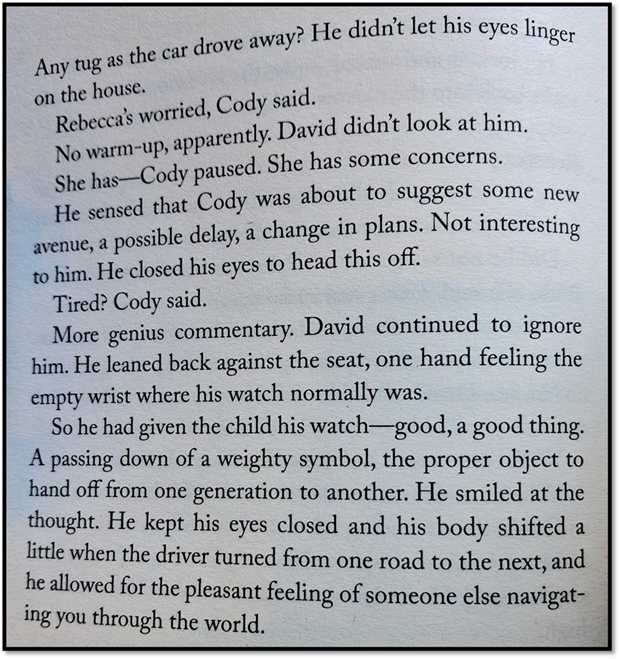
There is something quite harsh in David’s treatment of Cody that turns into sarcasm about ‘more genius commentary’, but what this passage deals with confabulations over the ‘tug’ of time into the inevitable progression towards David’s assisted suicide, that then switches into confabulations about a symbol of time – the lost watch, for which he will return unable to fix the actual story of its loss by donation or some other mechanism such as gets forgotten. It allows hi to symbolise that he is in fact taking from Rebecca’s child – his presence as a guide to navigate him ‘through the world’. Of course, in part we are conscious that Rebecca and her boy will ‘move on’ as we say and that, as we see them that there is evidence they will do this relatively more easily than they might want to admit, but few of us see into the role of our contradictions when attributing contradictory behaviour to others.
What is David missing from letting time and its measurement of progression. I isn’t any particular ‘timeline’ in which he might be thought to have responsibility but those evocations of a time measure beyond measurement, oft carried to him from that Edelweiss song from the 1959 ‘switzy’ song The Sound of Music:

Edelweiss flower By Michael Schmid – Self-photographed, CC BY-SA 2.0 at, https://commons.wikimedia.org/w/index.php?curid=227446
Blossom of snow, may you bloom and grow forever – that’s the part that twinged in David.
Forever – a timeline he had not really considered before.[12]
If natural cycles of growth (and death of course) continue forever, what of a death that must be ‘forever’, a timeline with no end and therefore hardly a timeline but a lost watch no longer needed. But to feel in that sentimental song is too a kind of softening of the harsh – a confabulation provided by the world to make death forgettable, for the time being. Some timelines get fraught by that forever perspective:
LONDON, TWO DAYS, THREE DAYS ZURICH, COLD – the word COLD was underlined twice.[13]
That moment in David’s aide de memoire notebook is meant to remind him of the need for warm clothing, but isn’t the cold also the ‘forever’ of life relinquished, something like the living ‘geranium flower’ that Browning’s narrator in Evelyn Hope chillingly inserted into the dead child, Evelyn’s ‘sweet cold hand’. It is like the snow metaphorised in the ‘blossom of snow, that David confidently expects to be falling in Zurich only to told by the clinic’s agent, whom he calls ‘The Ghoul’ rarely happens in Zurich and which he must have misremembered to have happened on earlier visits.The truth is his life is full of this forgettings and confabulated misremembering such thar he ‘lost what felt like hours’ (or longer.[14]
The problem to with financial accounts in which money seems to be lost is that there are reasons for blaming a likely culprit for their theft more palatable than explaining that all time is gradually and forever being lost to you for no fault of anybody’s. We can falsify financial accounts but so can we narrative accounts. No wonder David feels he is being cared for by a false account-giver. Indeed that is sometimes true as Cody oft accepts David’s confabulations to lower David’s internal stress should a more ‘true’ accounting’ be made for loss. In the novel, much occurs – but also by the that is about not only accounting for the lost – a lost direction when David leaves his hotel in Zurich and does not know how to return to it – but also by the way change or new information makes it feel as if we are constantly transitioning from an old world encapsulated in a possibly confabulated memory to a new one, that could be equally one capable of confabulation: ‘The past grinding into the future’. [15] What if people keep talking mentioning a piece of music you don’t recognise but registers as somewhat to do with ‘Chaiko’ (a mishearing of Tchaikovsky’s (re: the 6th Symphony which some call a ‘Farewell symphony) perhaps is I suspect (but I cannot know for there are other Chaikos) is being contrasted with Mahler): we aren’t told exactly what because ‘nobody would clarify what this meant’. Would you feel included in that world?
He’s working on a section from Mahler. Theninth.
It’s the farewell symphony, the boy said pleasantly.
…
Farewell. He looked from her face to the boy’s face – nothing to see, no trick they were playing, no secret knowledge.
They kept talking. Something something Chaiko.
Chaiko? David repeated.
Yeah.
It seemed nobody would clarify what this meant.
He was used to a certain delay in conversation, resigned to making his own way. He knew to keep his face attentive while his brain took its own time. …, a lone man finding a path through the fog. [16]
Some things stay lost ‘forever’. This is even described as a contrast of old and new ways, of life, ones of public risk (a bit like David and Cody’s work) and a ‘new kind of privacy’. A world inside the self, older than even the ‘old way of life’ outside, but new to you.It is a world necessitated in order to feel ‘safe’, but can it trap you too, a space where security means eternal retreat into the littlest of life containers. It is a container the smaller in contrast to those huge ever expanding worlds of the young child trying not only to place themselves in the world but at the same time enlarging the size of the world in which they wish their significance to register, an address that always ends with the largest entity in which one lives like The Universe
In a sense all this is about aging, altbough death is a more end-stopped presence of yo allow it to be and think of ly of oneself. Aren’t trained to do so. At age 13, David was trained to recite ‘I grow old,I grow old’ from a work unmentioned. [17] It is in fact T.S. Eliot’s The Love-Song of Alfred J. Prufrock. It is a text whose memory is deep embedded in David and the books theme of time passing;
I grow old. . . I grow old. . .
I shall wear the bottoms of my trousers rolled.
Can it be true that the ‘world after this world will be like this world, but a little different’,? It is a statement David often queries. [18] Af even this world is full of contrasting ‘worlds’,like ‘Old Towns’, as in Zurich, but it is uncertain how much each world exisys only outside the mind that perceives it. Nevertheless, in these worlds David more easily gets lost. [19]
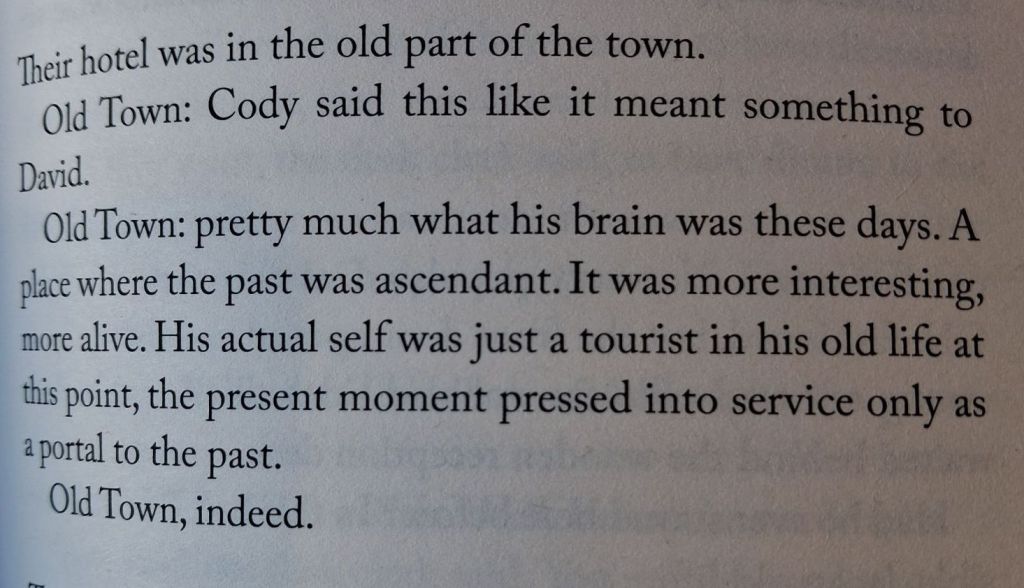
Moreover:
Cody had grown up in a small town and propelled bimself by dint of pure will and ambition into a different world. [20]
Perhaps every transition between old and new, the same and different world exposes the gaps between the world’s, the spaces in which tjey refused to cohere. Again this gets illustrated through human behaviour involving watches that measure time. These gaps appear anywhere to show how the world as fragmented:
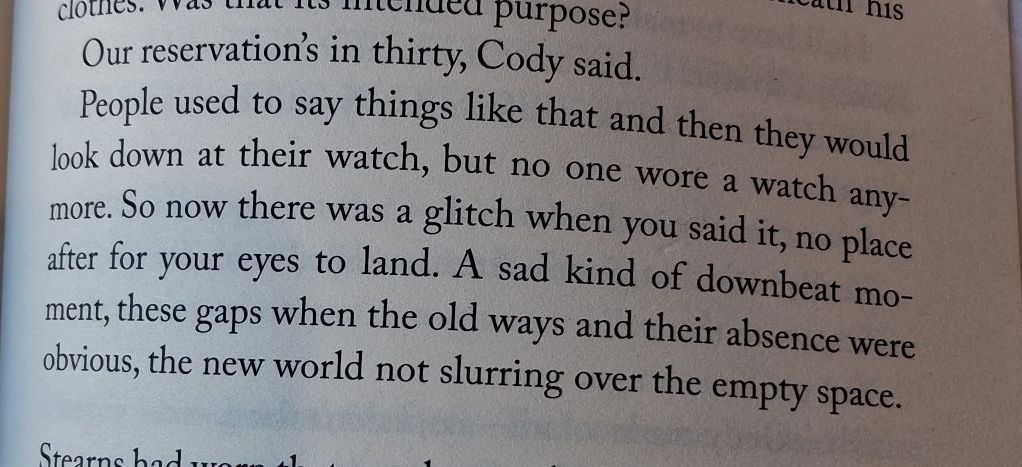
Chris Power brilliantly sees these gaps as discoveries of the reading process, saying about how we get to feel ourselves in David’s world this:
He compares his situation to that of a “mental ice floe, populated only by David, floating off into the polar darkness”. The text elegantly reflects this, its atomised paragraphs separated by white space – treacherous voids across which the thread of David’s awareness might not stretch from one moment to another. Yet as his comprehension thins, our own deepens. As his self-referential and fragmented stream of consciousness, often rich in similes, rebounds between the inputs of wherever he happens to be – in a car, at a restaurant, walking the streets of one city or another, always with Cody beside him – and his piecemeal memories, we begin to catch the resonances he no longer can.
I want to end this blog on the issues that interest me in particular, the issue of queer self and other identification. The core of this theme is the Tom story since it hangs upon some incident whete David outed Tom as gay but is played out another cpunterfactual narrative which wants David to be outed too, and that regulates the frequent emergencies in it of David’s sexual desire for men. It connects too the issue of a primal ‘boy” self, prior to adult repression in its full force whete he has memories of having gained ‘lain on the dock with another young self’.
The finger that grazed his wrist. A point of contact. This was a turn wasn’t it – a turn in the stars. The body that acted without thought. [21]
The theme of the ‘boy includes other major characters. To David, Cody has so often to be ‘the boy’ for his name is as lost as other tbings Cody helps him to organise in his life. But that boy is also the thing that will survive his death and may be stealing his life,including that chance to exercise free sexual self-determination, though he seems also to call out hiss ‘prissy’ femininity of manner. Cody has a partner but oft his role ro David shifts between son and husband, caring roles but with, in this novel, a sexual edge. There is a sense in the reflection about hoe ‘much time had David and the boy spent together, if you added up the hours’ a sense of a man-boy relationship that remains over time and transcends calculation. [22] When, after slumber, David awakes to find the ‘boy, there in the doorway’ that before ‘information came, piece by piece’ the thought of how that computes with an ‘unfamiliar bedroom’ raises questions even silently for David I believe. Not least the boy is a memory that can be young David himself or his friends. The figure sometimes hangs loosely in his head, where it might be what he thought Tom was: ‘The boy of my youth. The friend of my youth -‘. [23]
There are otner boys, including ones in fantasy literature like Nemo in Slumberland,a boy who falls out falls into adventure, he illustrates the book’s cover. The grandson is a boy but there are others in memory – young boys in memory, boys who touch each other and who might hold hands or go off hand in hand, like the fantasy that emerges from the novel’s final end.That endpoint seems dependent upon the confusions in this paragraph where Cody is holding David’s hand as he prepares for his final drink and boy is Cody, Tome and David’s young self:
Who was the timekeeper here? Not him. Someone was keeping trck. The boy sat very straight but David felt his energy dipping in and out of presence. Tom, he thought. Here, holding his hand. But it wasn’t Tom. whose child was this boy? Who did he belong to in this world? [24]
Tom entered the novel as a memory as a a boy with ‘shining face, the honey-coloured guitar in his arms’ whose ‘voice was sweet but still childish and earnest, and in that way, embarrassing’. [25] It appears youthful boyish beauty both attracts and causes embarrassment, perhaps later repulsion, for that ‘boy’ must not be David. Masked by conventional clichés of childhood friendship that are patently untruths (‘Faithful friends who are near to us’). [26] The hints of what happened betwwen the boys remain just that – in the subdued retelling of their friendship with gaps and sometimes overt cover, as here:
HADN’T DAVID THOUGHT IT would happen again? That last summer. He drank himself dumb at every opportunity. As if that would summon it.
Hadn’t he reach for Tom in a stumbling drunk and hadn’t Tom turned away, tucked him on the couch for the night with a blanket?
Brown liquor, ver sicker.
Ger some sleep[27]
All followed by cover up! After school and in college David writes letter ‘about nothing, airy talk about a girl he’d taken out, probably some worldly allusion to “screwing”. {28] When David apologises when they come together for what must have been an outing of Tom for being the gay predator, he hopes both men will take on again the role of the boys together ‘knowing beyond knowing’ but Tom dismisses the apology, drains the events of significance, describing David’s belated approach as unnecessary. [29]
Unlike Chris Power then I do not think the reader ends with the moment of recognition to which the narrative drives. Tom disappears from the stage but the ‘boy’ he was part of remains there, alone holding out his hand to be touched, and for me this links to much of the material in the novel about past anonymous sex with unnamed men in David’s life. Some of it is purely a picture of desire that stays in the mind like David’s vision of a male swimmer whose ‘laps were hypnotic. Steady’. For here is a vision of the body believing in its eternity: ‘Laps that said: In fact I secretly know that I will live forever’, suggesting that for David the life of the male body is that from which he is excluded. even in swimming with Tom as a boy ‘ hadn’t he always been reluctant to cede control to the physical self, whether to a sensation good or bad?’ [30] He slet with a cowboy as a boy – a toy in his room. However, there is the vague moment lying on a dock ‘with another young self’ already quoted [31]. And then there are those queer flirtations dubbed ‘fits of bravery’ where, ‘you danced with a man, a little older than you, put your hands on his pants and felt him’., and then mixed with heterosexual acts and voyeurism that might be between people of any sex, he ‘kissed a man against a towel bar in a bathroom’, which wait to the very end for final release.[32]
In the end all these things are not about outing David as the others were not really about outing Tom, but to show that the body may exist in a world that does not pay much heed to the binaries that control conventional worlds, and that David learns this a hard way, through imposed uncertainty and category imprecision that dementia brings in its wake. the ‘body that had carried you along. Your body which had remained itself’, [32] whether boy or old man, and without a sexual label. I have to admit that I am uncertain of all of the stuff of my reading; and, perhaps, this is what the novel is truly about. It is about what a little thing a life is – how long however however is the sentience of the body’s history as it transforms between persons across space and time. Let’s learn it early rather than late!
With love
Steven xxxx
[1] Emma Cline (2026: 329) Switzy London, London, Chatto & Windus (Penguin)
[2] ibid: 329.
[3] Ibid: 19
[4] Ibid: 276
[5] Seneca (translated by John W. Basore) On the shortness of life, Chapter 1, available at https://en.wikisource.org/wiki/On_the_shortness_of_life/Chapter_I :
The majority of mortals, Paulinus, complain bitterly of the spitefulness of Nature, because we are born for a brief span of life, because even this space that has been granted to us rushes by so speedily and so swiftly that all save a very few find life at an end just when they are getting ready to live. Nor is it merely the common herd and the unthinking crowd that bemoan what is, as men deem it, an universal ill; the same feeling has called forth complaint also from men who were famous. It was this that made the greatest of physicians exclaim that “life is short, art is long;” it was this that led Aristotle, while expostulating with Nature, to enter an indictment most unbecoming to a wise man—that, in point of age, she has shown such favour to animals that they drag out five or ten lifetimes,[4] but that a much shorter limit is fixed for man, though he is born for so many and such great achievements. It is not that we have a short space of time, but that we waste much of it. Life is long enough, and it has been given in sufficiently generous measure to allow the accomplishment of the very greatest things if the whole of it is well invested. But when it is squandered in luxury and carelessness, when it is devoted to no good end, forced at last by the ultimate necessity we perceive that it has passed away before we were aware that it was passing. So it is—the life we receive is not short, but we make it so, nor do we have any lack of it, but are wasteful of it. Just as great and princely wealth is scattered in a moment when it comes into the hands of a bad owner, while wealth however limited, if it is entrusted to a good guardian, increases by use, so our life is amply long for him who orders it properly.
[6] Ibid: 332
[7] Chris Power (2026) ‘Switzy by Emma Cline review – this Booker-listed account of a man’s last days is profoundly moving’ in The Guardian (Mon 31 Aug 2026 07.00 BST Last modified on Tue 1 Sep 2026 10.20 BST) Available at: https://www.theguardian.com/books/2026/aug/31/switzy-by-emma-cline-review-this-booker-listed-account-of-a-mans-last-days-is-profoundly-moving
[8] Emma Cline op.cit: 35
[9] Ibid: 63
[10] Ibid: 301
[11] Ibid: 177. Followed by my photograph of following detail from ibid: 178.
[12] Ibid: 8
[13] Ibid: 17
[14] Ibid: 22
[15] ibid: 116
[16] Ibid: 164
[17] ibid: 44
]18] ibid: 29
[19] ibid: 201 my photograph.
[20] ibid: 34
[21] ibid: 173
[22] ibid: 2, ‘prissy’ on p. 5
[23] ibid: 318
[24] ibid; 231
[25] ibid: 43
[26] ibid:79f.
[27] ibid: 241
[28] ibid: 250
[29] ibid: 273f.
[30] ibid: 72 – 73
[31] ibid: 131f. [173 was already quoted]
[32] ibid: 332 – 333


3 thoughts on “Should we start much earlier than we do learning about ‘Life, the littleness of it’. Do little books about littleness in enlarged contexts need prizes or forgetting? This is a blog on Emma Cline (2026) ‘Switzy’.”