In looking at drawings and perhaps even serial paintings whether explicitly named versions of a concept, or ‘studies’ or whatever, something the brilliant Lauren Elkin says about the relationship of found drawings of an artist *speaking of those Gwen John made of Saint Thérèse of Lisieux and Her Sister and the ultimate form they might have taken if any, really rings true of John’s method of always repeating and simultaneously varying at least one element or indeed several between different artworks at whatever phase of completion each was. Elkin says that in calling found drawings on the same subject ‘studies’, “we create a teleological relationship to them as if they were merely leading up to, and culminating in, a single oil painting executed to the artist’s liking’. I suppose an underlying idea in Elkin as I read her here might apply also to series of supposed finished paintings of the same subject, like The Convalescent series, or likenesses between varied other works like those of identifiable or otherwise women standing by windows. Of these too we might also say with Elkin: ‘Can we look at the series of images … and really say for sure which … which is the version that most closely reflects the artist’s intentions’.[1] This is a blog on seeing the Gwen Joh exhibition in Edinburgh in 2026, using the catalogue edited by Rachel Stratton and Lucy Wood, Gwen John: Strange Beauties.
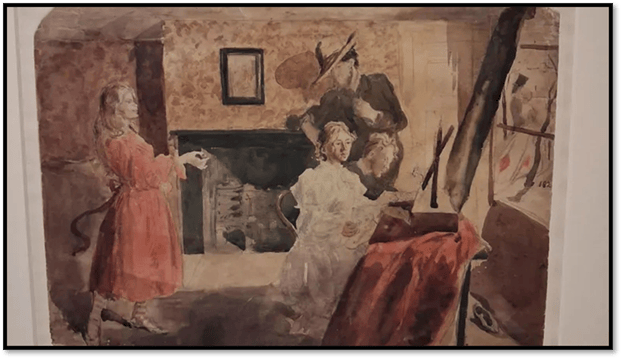
This blog comes after stating the intention to write up my experience (and of course rethinking) of visiting an exhibition of Gwen John paintings at Edinburg stated in a blog I made the day after the visit (see it in all its naivety at this link if you wish), Afterwards I trying grouping some of my visit photographs into collages and I will use these here but they show me that I needed the catalogue to really get a grip on Gwen john as an artist. I have had to admit to myself That not only do I not know her work well enough, except the classic vacant chairs and females found inside interiors and making something new and less conventional of womanhood for the time in which she lived.
I still like the early work above of the John family at home in Tenby but I no longer trust even my grasp of that. Now when I look at it, it isn’t quite so homely and the left and right margins of the work fall into uncertainty and perhaps abstraction for me, where I find identification of objects (so clear in the central scene) a bit too numinous and perhaps abstract. Is there a window on the left or a mirror. What is the purpose of the black daub on the left to the top of the piano? Whilst the picture seems more exciting after seeing it, I find no help from the catalogue which reproduces it without comment. It is just that other things said there, about other paintings, make me look at it again with uncertainty and the total absence of the feeling I had of Edwardian whimsy in the picture.
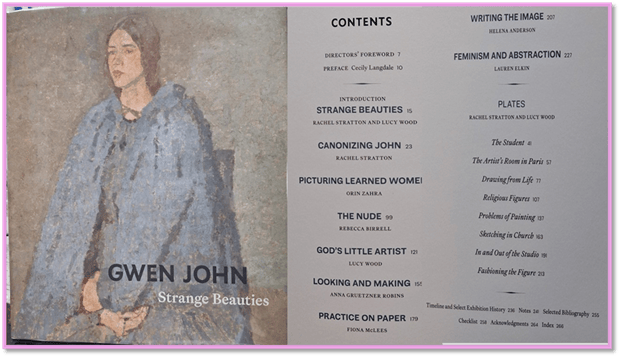
Even without the catalogue (cover and contents collaged above), it was obvious from the exhibition that there is room now for reassessing Gwen John. Moreover, the catalogue for this exhibition shared between Edinburgh, Wales and the United States at Yale once read as I have read it now certainly helps to do so, If this blog has a flat tone it may be that though I find the arguments in this book convincing, they don’t establish John as, for me and me only, a major figure in art except in rethinking what art does and doing it as a kind of discipline of the spirit of art. I will try to explain that and how full of interest that is, or should be, but I can’t identify with it and I come back from Gwen John realising she and I don’t share much of a vision of the world and its value. And sometimes you have to give in to the truth that some artists don’t speak to you or that you cannot hear them with an adequate reception because of the noise of your own value-system.
I will go ahead with my original slides, supplementing them when it becomes clear to me that when I prepared them and took the pictures I could have made better selections, having learned much more about John after the reading the book. The catalogue after all is much more than a catalogue – it is an exposition of a theory that we have only ever known her through contexts imposed upon her whilst she lived but also afterwards, which have turned to her life rather than work for their rationale, even in the feminist projects she has sustained (rightly of course). I have already blogged on John’s feminist biographer, Alicia Foster, a splendid book (see this link. Moreover, given the men who despite themselves sometimes overshadowed her, like her brother, Augustus John, once (though his star and its shadow over Gwen is now flown (see this link for a queer reading of the uxorious Augustus, blogs on him), a feminist approach remains necessary. Celia Paul, herself an artist overshadowed by the big-dick reputation of Lucian Freud, has made her own comparison of how male artists can diminish women artists who fall under their spell by concentrating on Gwen too but in relation to the monumental hugeness of the reputation of her lover, Auguste Rodin (see my blog on the wonderful Paul book here). The latter still has more power to make me favour Gwen John’s art more than anything in this otherwise brilliant and scholarly catalogue. An education by Rodin must have forced more passive attitudes than even her text-book learning at art-school, shown in her textbooks. Her portrait of Rodin may be small but the head of the Master is its achievement, as if the record of worship.
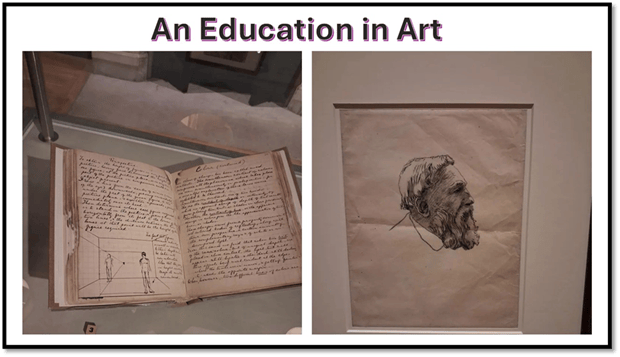
In brief the first two chapters of the catalogue make it plain why the editors of the book and curators of the exhibition felt reassessment was needed. Rachel Stratton and Lucy Wood want to emphasise the strangeness of the beauty and meanings we find in John, as something not covered by our attempts to see her plain through her most famous work and mainly the oils. Stratton in Chapter 2, ‘Canonizing John’, looks at how the insistence on finding an appropriate canonical principle skewed selections of her art and commentary on them, whether as realist extensions of British Pre-Raphaelitism, impression and post-impression, with some attempts to see her as like Degas, and more lastingly seeing in her an avant-garde affiliation that stood against the conventions of the academy (though impression itself could be called into this camp). Yet in these schools, except perhaps that of feminism realism or symbolism under the rubric of the ‘New Woman’ where you could be ‘niche’ and ignored by the patriarchal critics and still a submissive Catholic pietist of the most slavish kind, she was fated to seem minor. Even her exemplary United States’ collector-general, John Quinn, with his art advisor, emphasised these categorisations, very much the flavour of art history at the time.
The catalogue’s authors and curators clearly have a mission to find a new Gwen John emergent not as much from her life, though that too, but her work – and including those on paper and in monotone. In the Edinburgh exhibition much in the first room – downstairs in Moden Two across from the bookshop – is about her as immersed in family, female community and then as a student, as if biography were taking the lead, as with the Tenby picture we have already looked at together, but there is more than learning your craft apparent when I compared a tiny portrait of Gwen by Augustus and one of her most noted self-portraits:
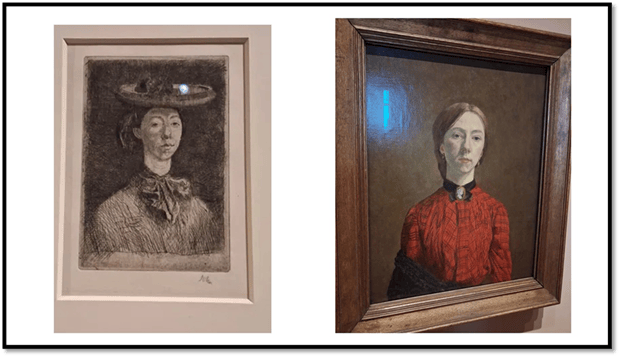
They differ considerably in size, a fact not clear from my collage: on the left Augustus’s portrait was never intended to make a statement that the 1902 Self-Portrait by Gwen does on the right, though both, in dress at least, emphasise a more passive feminine pose than in other pictures in Gwen’s oeuvre, which is how it was presented at New York’s MoMA by Andrew Carnduff Richie in 1956 as that of an artist, whose work may reflect ‘stereotypical ideas about femininity’ but was increasingly recognised as hat as professional painter and therefore exceptional for a woman: ‘one of the rare, complete individuals among women painters’.[2] The work itself was completed just after her training and ‘fills most of the canvas, the play of light and shadow over her face and neck demonstrating her skill at veristic representation and tonal modelling’.[3] And I placed it next to Augustus because his skill in drawing was often thought to be in comparable to Rembrandt. Yet, though he intends also to show the play of light and shade, he only achieves a mask-like effect, in which the light in Gwen’s eyes look like holes in that mask. The volume given to the design of the hair, the large hat, scarf tend to create the woman out of her clothes and accessories to appearance. Gwen’s self-portrait put this feminine stereotype into touch by he comparison of the cameo, with the curled hair, bare shoulders and plunging neck with the plain gingham of her portrait, high collar and plain parted hair-style falling flat and plain. Neither shows an exceptionally pretty woman and both create the sense of a face full of sallow hollows, though Gwen does this while maintaining the sense of embodied volume, fading shade into a blush shade surprisingly high and near the eyes. This is a woman consumed in the observation of detail, even in the plain, even as she surveys her sitter and/or viewer, critically. All that cannot appear in Augustus’ drawing.
Women in John are often using their minds critically and they survey the world they live within through the filter of observant eyes, often signified by books. When I prepared my pictures for this piece more than a week ago, I thought I would show that through that beautiful piece A Lady Reading (about 1910 and set in the ‘room of one’s own’ Gwen created for herself) and to which she oft invited Rodin.
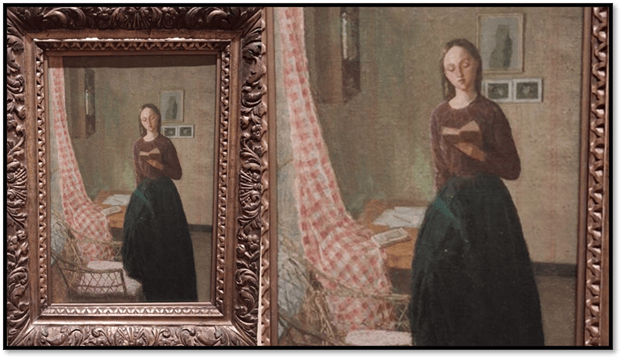
My intention in choosing this that it so perfectly shows various recessive types of interiorisation that resist any display of the female body, by the use of voluminous costume and a torso in which the breasts are covered by a book, upon which the figure’s face is fixed. The parting of light and shade on the face emphasises I believe our regard on the interior mind by which lit exteriors give way to the shad created by the relative darkness of a room interior shadow. I have to say that I was totally unaware that there was tradition of painting the female reader or liseuse in France, though I have seen many represented in many European paintings, that is mentioned by Orin Zahra in her catalogue essay and novels. Of course notably in literature, Madame Bovary, is centrally about a liseuse though not there to create only an interior life for the central figure of Emma Bovary but rather a theatre stage on which to show her downfall. Zahra claims that John ‘developed a pictorial language for depicting learned women as contemplative, imaginative, and discerning of the world around them. I accept that and think too that her depictions pose a challenge to patriarchal liseuse in literature – not just those in male novels,. Think of Jane Austen’s Catherine Morland in Northanger Abbey. As I contemplate A Lady Reading, I sense a woman who finds objects to enlarge her interiority – the book of course but also the drawings behind her and the bust atop the dark shelves behind the window. On the table is writing paper and pen, whose use has been interrupted by something within a passage in her book that requires more concentrated attention> that she stands, rather than use the chair with plentiful light from behind it to aid her reading seems important too.
And just as her figure is hidden in volumes of cloth that don’t end at the bottom of the picture frame but merge into shadow, so other fabrics become captors of the remaining mid-afternoon light. I was happy with my reading but Zahra shows the comparison I missed registering in the gallery by placing that painting next to that, probably of about 1911 Girl Reading at a Window, where I failed to look deeper into the clearly intended variation of themes. First Zahra notes that the face of Lady Reading is not that of any ‘Lady’ but of a Madonna painted by Albrecht Dürer, a choice that she later described to Ursula Tyrwhitt as a ‘very silly thing to do’. [4] Nevertheless to see Mary as a divine contemplative of the holy Book is a Catholic tradition.
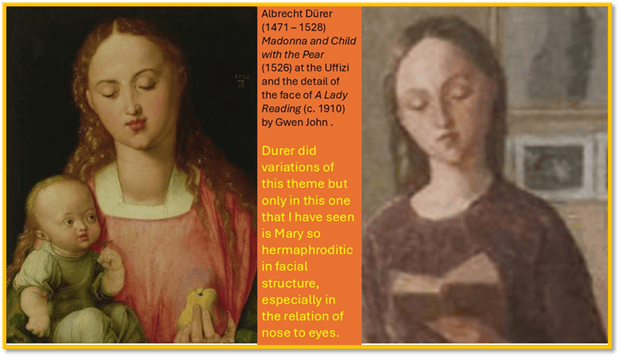
However, Zahra makes another point about the comparison of paintings that that Gwen changed the face of the figure, using a self-portrait of her own features, not that I had noticed that in truth. They say that varying from a copy of a classic painting to a sel-portrait face on the body of a person known primarily as a model liseuse, John was ‘placing herself among her learned liseuses. By creating rather than copying, she was also in effect demonstrating her ingenuity as an artist’.[5] This raised interesting thoughts in me that tended to develop as the book says more and more from other points of view about repletion and variation as simultaneous creative acts. Zahra satisfies themselves with a point that John may be using the pose she modelled naked for Rodin for Rodin’s Monument to Whistler, in whicha draped muse with a nude torso is represented scaling the heights of art. Personally I can take or leave that reading and don’t find it all that convincing, however, what does matter is the kind of artistic control that repetition with variation calls forth in Gwen John. I didn’t take enough attention in the gallery to the contrast in the liseuse paintings so I place here a photograph of the reproductions on page 84 and following. This is pity because the lighting is entirely wrong in both reproductions but the main point on variation can be made.
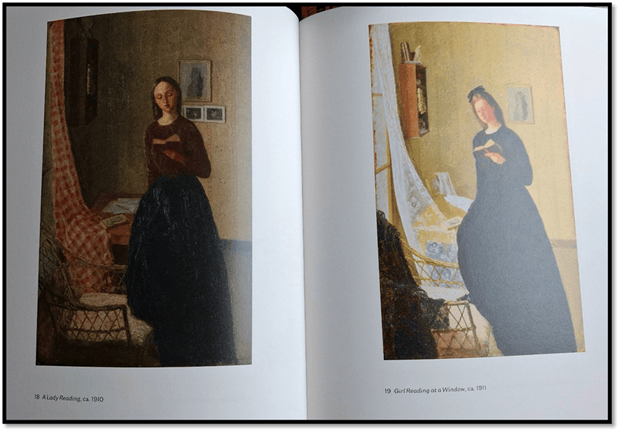
Yes, the face has changed and the crass association of the ‘learned Lady’ with the Virgin Mary abandoned but the variations otherwise show an intensity of how variation and configuration creates telling newness across a frame of the same basic form – constituted increasingly on the huge volume of dark cloth which made the Lady and Girl both dominate their surroundings – their dresses flowing below the visible in the frame as if representing an abstract icon – but of what? Because it is post-Baroque art, we don’t need an allegorical reading however nuanced and semantically multiple. This is no picture of contemplation or piety simply because it is only interested in the way the icon absorbs what it attends – the written page on which its downward gaze falls, but with what differences. The light, the supposed time of day, the relative volume of the textiles and their transparency and / or opacity, the reflectivity of surfaces – the painter shows how each of these objects and their varied appearances in different contexts all determine a constancy only in the mutability of meanings, like those perhaps in the text scanned by the figure.
Now, I did notice the theme of variation across subjects – it is not anyway new perception but only of the most famous painting of John’s of a chair in an isolated interior. Hence I produced this collage to make the point:
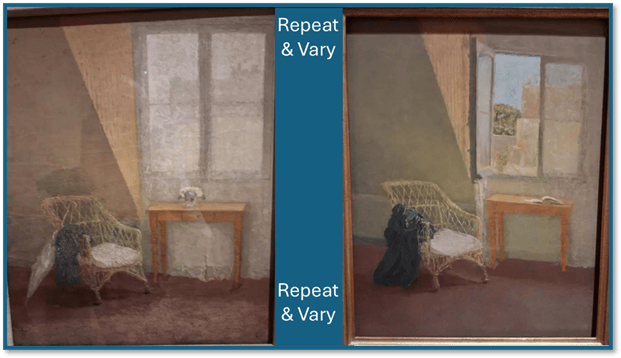
Repetitions of a whole subject are not the only source of creativity in this artist. Yes, she shows us the same chair in the same corner of the room of detail, we might think noting the differences implied in light, temperature, as well as implied time of day that recreates appearance inside and outside in this ‘interior scene’. It plays with the use of relative opacity in veiling what we see too, as with apparent size caused by variation of point of view. But does the artist want you to just assume that she is representing the sameness of basic objects in her scenes or does she question whether perception based on the current function of objects itself varies the object, its very being.
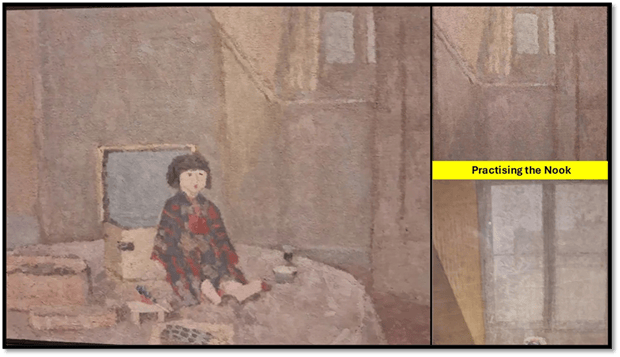
For me, in this famous pair, what I began to concentrate is on the representation of the window nook, for between these paintings there is a change in apparent physical structure that cannot be merely a product of light and shade but of a basic change in what first appears as relative architectural details but then is seen as contingent on a difference of configuration of our perception caused by the edge of the open window. The chair too differs because the cushion on its seat is differently configured, suggesting differences in the kind of absence of figure implied by differently purposed objects proximate to it. The table becomes a different table when used to support a book rather than ornamental flowers. The distance between it and other marks seem to change.
Perhaps the painting of nooks in a room changes too by practice in perception or variation of the pretend real against the abstract suggestion. Is that what I saw in the late piece of a table underneath a nook with a Japanese doll upon it.
Here I edge upon the issues I emphasised in my title paragraph. Let’s repeat and vary some of it here:
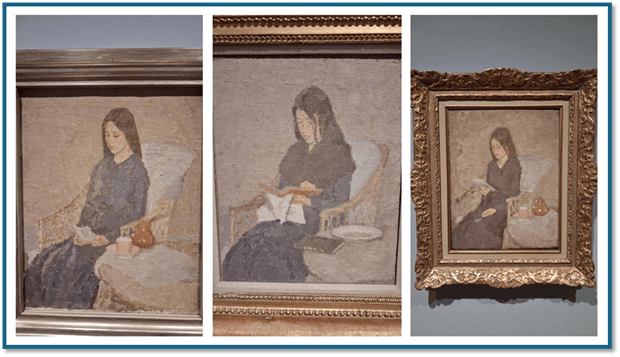
In looking at drawings and perhaps even serial paintings whether explicitly named versions of a concept, or ‘studies’ or whatever, something the brilliant Lauren Elkin, in her catalogue essay ‘Feminism and Abstraction’, says about the relationship of found drawings of an artist really rings true of John’s method of always repeating and simultaneously varying at least one element or indeed several between different artworks at whatever phase of completion each was.She is speaking of those repetitions of two figures that Gwen John made of Saint Thérèse of Lisieux and Her Sister. If these were studies we might be asked to consider the ultimate form they might have taken, if any, but Elkin says that is ONLY because we have named these found drawings on the same subject ‘studies’: “we create a teleological relationship to them as if they were merely leading up to, and culminating in, a single oil painting executed to the artist’s liking’. I suppose an underlying idea in Elkin as I read her here might apply also to series of supposed finished paintings of the same subject, like The Convalescent series, or likenesses between varied other works like those of identifiable or otherwise women standing by windows. Of these too we might also say with Elkin: ‘Can we look at the series of images … and really say for sure which … which is the version that most closely reflects the artist’s intentions’.[6] Let’s take then that famous series of wonderful paintings named The Convalescent, of which I give only three below. Even looking at these, do we wish to see studies of the same subject, even if in finished form, or do minor variations make for major revisions of what the subject covered here is. And some variations are not so minor, either in effect – like the allowance in one of the fall of a strand of hair, or in substance, where the occupation of the hands and the objects related to that vary. These paintings are truly more than studies of femininity as identifiable appearance, and the consequences of such, but also of the concepts of the exterior and interior in personality and the means of passage between these states.
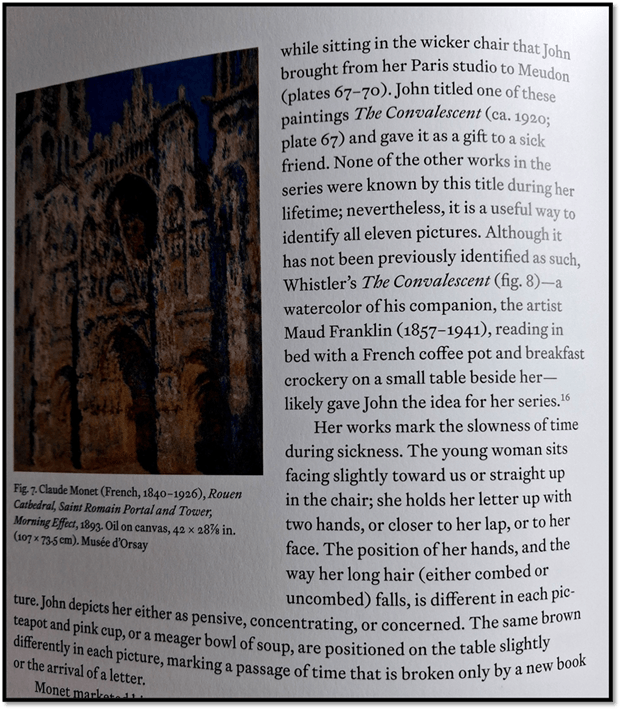
I do not think it useful to see this as a narrative series in showing the process of recovery of a girl during convalescence as Anna Gruetzner Robins does in her catalogue essay, ‘Looking and Making’, which treats other pictures as means of. manifesting female creativity through everyday occupation. This side-steps the issues by giving the paintings a commonality that reduces each to a version of the other in a time continuum. Here is what Robins says, noting that giving the whole series The Convalescent is anyway an art historical imposition on what might be John’s intentions. Indeed Robins implies those intentions by imposing another context, those of Monet’s many pictures of Rouen Cathedral, that are often seen as bearing a narrative telling of changes in time of day. This doesn’t deny that labelling all eleven pictures in the series by the same name isn’t ‘useful’ to an art interpreter looking for a way into the interpretation of the paintings, but usefulness in tying down paintings to imposed interpretation cannot be the arbiter of meaning in a painter like Gwen John: [7]
This means of dealing with the artistic urge to repeat and vary simultaneously, though tenable for this and other examples where time of day is one of the obvious variations created as an effect of pictures we have seen, feels too convenient and rather novelistic rather than painterly an aim. Even when repetition is explained as a relationship between a study and a finished painting that feels inadequate for me, as in the relationship between the versions of The Brown Teapot (c. 1915) and not just because only art history not the artist calls the picture on the left below, a ‘study’.
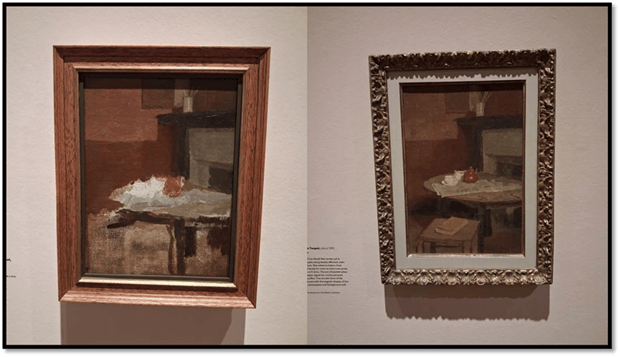
It feels as appropriate to call each a study of perception or planar configuration of coloured forms that making the ‘teapot’ the aim of both paintings, especially since this object also appears in many of the ‘The Convalescent’ series. Isn’t it rather that what Gwen saw as ‘the problems’ of painting – including the fact that it is necessarily reducible to configured shapes of varied definition and focus on a flat surface. Are not these problems of conceptual and perceptual psychology too and of metaphysical philosophy – where the being of an object is under examination, its haecceity.
The very earliest repeated figure in variation is surely the key to a woman, who made her living in part by posing naked, querying what makes a woman perceived as such and with certain cultural meanings attached are those 1910 companions: Girl with Bare Shoulders, and Nude Girl.
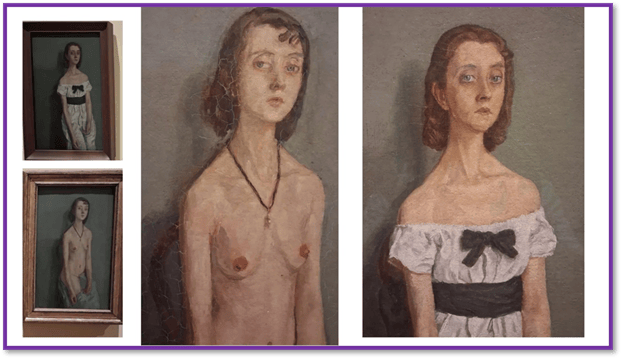
I have yet to read an explanation of this pair that works to explain these beautiful paintings for they always concentrate on the central figure as the same girl (we do know the name for the model of course – in that sense she WAS the same girl) but for me John wants to examine what woman is by even a pastiche of certain conventional ways of representing women, whether dressed and nude, and playing the convention against how a developing female body looks without being turned into an appearance, an artist’s object. I’d welcome feedback from others on this.
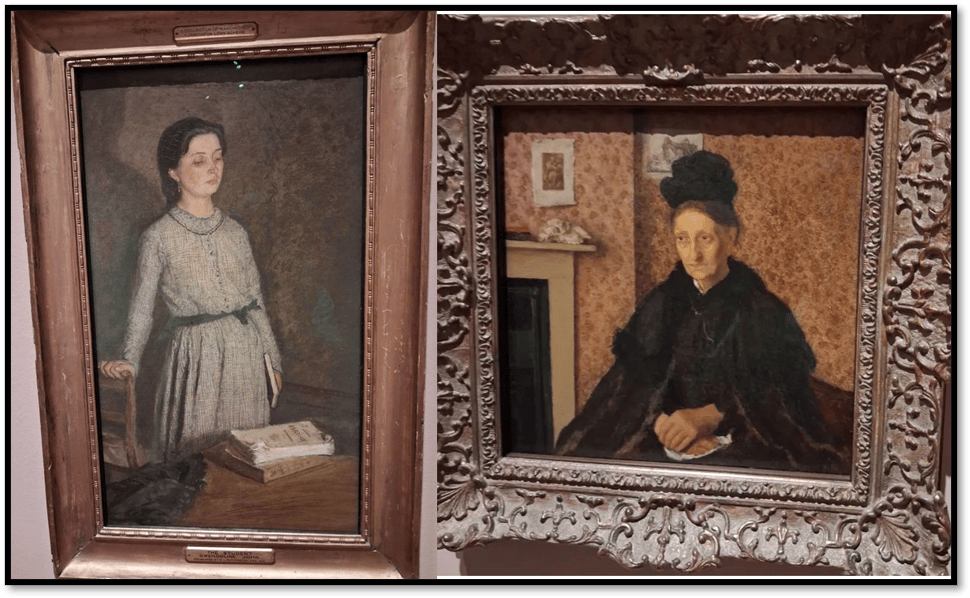
I think nevertheless that the idea of Gwen John as student of haecceity applies, more than I would be sure it does for a teapot, when the object in the painting is a figure, more relevantly so for John, a female figure, for her fascination in what women make is also one in what they make themselves relative to other perceptions they cannot control and which try to define them from without. At the beginning this may be a project subsumed under a realist painter’s project. Below we see he same struggle with very different female figures – to represent them uniquely. We see Dorelia, a friend and some say lover of John (as Dorelia also became the live-in lover of Augustus with his wife in an uneasy threesome) – whose very stature and function (that cast shadow behind her is just awesome) is queried by this painting, an early liseuse. But thus Mrs Atkinson too, whose life, closed up entirely in black and squashing a paper that might contain news she can only bear to endure, is balanced against a sheep skull on the mantlepiece beside her:
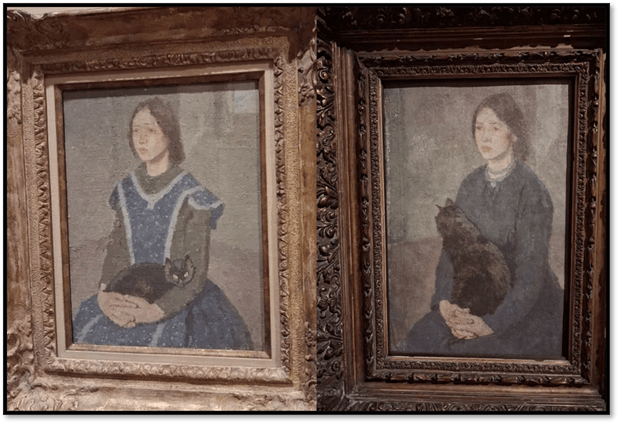
It is difficult to look at many repeated variations of women holding black furry cats on their lap without sensing some question is being asked I do not wish to speculate upon:
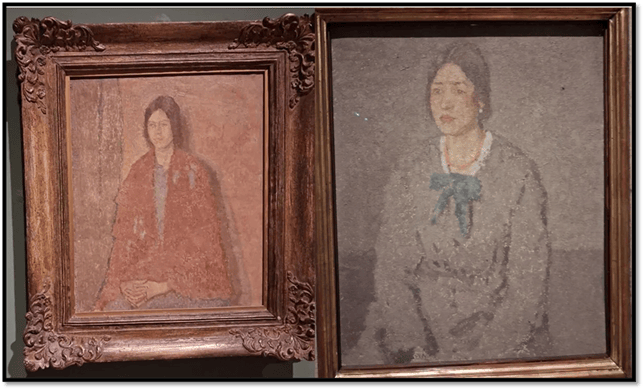
Looked at this way, many non-serial paintings seek to repeat and vary things – like the common motif of how one shows a woman clasping her hands together, as the instances below:
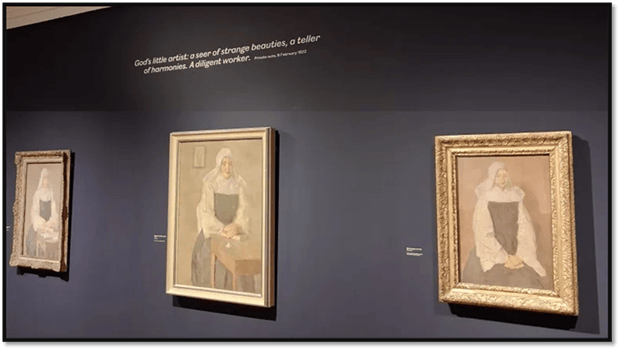
Her interest in nuns later often played against a stereotype of a nun taken from an old representation given to the resident nuns as a prayer card of the foundress of their house, Mère Possepin. This commission from the nuns led to pictures of the nuns themselves as well as the figurehead, but it was the most careful of her studies that repeat and vary to get to a concept for which there is no prototype but many reflected facets.
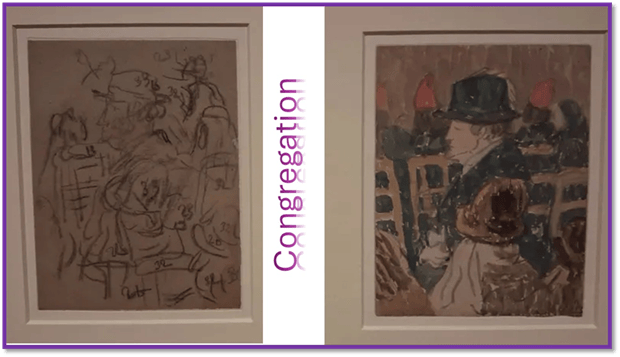
Sketches she late did in church seemed to want to define the difference between individual and group:
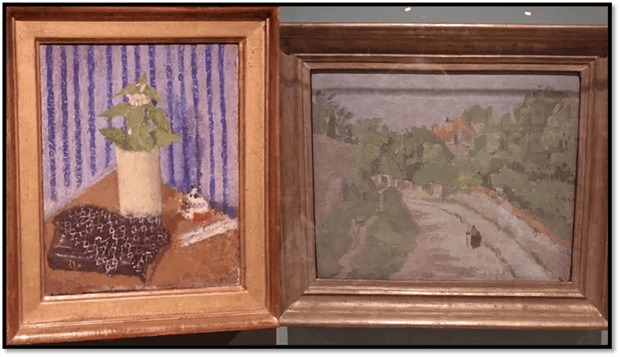
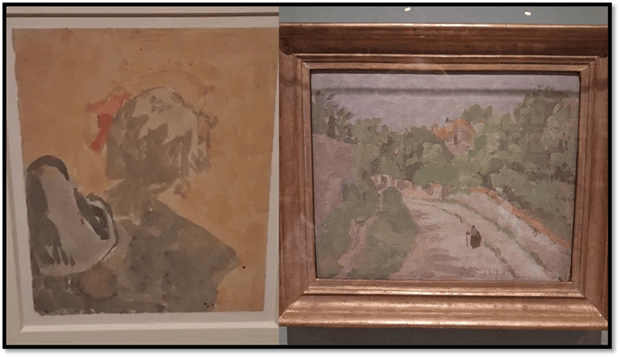
The later turn to nearly abstract grasp of objects and landscapes made shadows query substance when the shadow from vase of flowers falls on wallpaper, or figures become defined by the hard materiality of their seen circumstances, as in the older woman struggling against the scene in which she appears, a tiny figure.
Sometimes things even lose thingness, as in the painting on the left below:
But I have run out of juice on this blog and will submit now.
All my love
Steven xxxxxxxxx
[1] Lauren Elkin (2026: 235) ‘ Feminism and Abstraction’ in Rachel Stratton and Lucy Wood (Eds.) Gwen John: Strange Beauties, New Haven & London, Yale Center for British Art & Yale University Press, 226 – 235.
[2] Rachel Stratton and Lucy Wood (2026: 38) @strange Beauties; in ibid: 14 – 39
[3] ‘The Student’ in ibid: 41
[4] Cited Orin Zahra (2026: 73) ‘Picturing Learned Women’ in ibid: 70 – 75
[5] Ibid: 73
[6] Lauren Elkin (2026: 235) ‘ Feminism and Abstraction’ in Rachel Stratton and Lucy Wood (Eds.) Gwen John: Strange Beauties, New Haven & London, Yale Center for British Art & Yale University Press, 226 – 235.
[7] My photograph of detail of Anna Gruetzner Robins (2026: 160) ‘Looking and Making’ in ibid: 155 – 161.

