What’s the kindest thing someone has ever done for you?
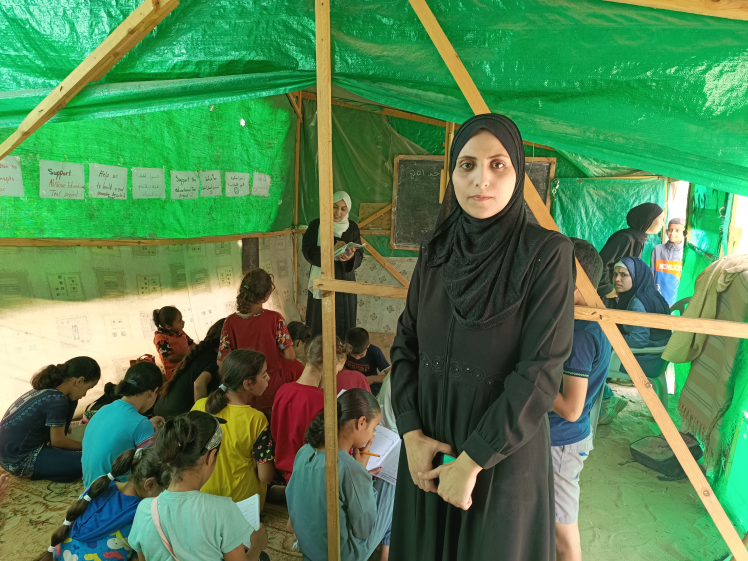
Ikram Talaat Ahmed teaches displaced children in Gaza from https://afsc.org/news/courage-and-kindness-amid-loss-gaza
Kindness is a strange enough quality I think. It is a word with all its duplicity born in its origins, as Shakespeare noticed when he gives the following dialogue, in a crowded scene (Act 1 Scene 2 of Hamlet) in which a new king manifests his kindness to his subjects, starting with the courtier, and son, Laertes, of his noblest advisor, Polonius, and then turning to his own ‘son’, although son only by marriage and once but his nephew (which in Shakespeare’s time could more easily be named as among the genus of ‘cousins (the word used by Claudius), but nevertheless a kinship a little more removed than son is to father:
KING
Take thy fair hour, Laertes. Time be thine,
And thy best graces spend it at thy will.—
But now, my cousin Hamlet and my son—
HAMLET, aside
A little more than kin and less than kind.
KING
How is it that the clouds still hang on you?
HAMLET
Not so, my lord; I am too much in the sun.
QUEEN
Good Hamlet, cast thy nighted color off,
And let thine eye look like a friend on Denmark.
Hamlet is known for his courtly wit and this is thinly expanded upon in this web page, which mentions the punning use of the word ‘sun’ to play on Hamlet’s distaste in being brought too close to an uncle he despises by a mother whose sexual appetite he distrusts. In this piece his mother, the Queen, names Claudius by the country he now rules and insists that this grand personage is merely trying to befriend Hamlet as he has just done Laertes. Whether the web page I cited correctly or appropriately refers to an Elizabethan proverb Hamlet’s ‘A little more than kin and less than kind‘, is playing with meanings still considered related to each other in the development of English as can be deduced from the Etymological Dictionary entries (somewhat abbreviated below) of the common origin by which the noun ‘kind’ related to the noun ‘kin’ by association of ideas or perceived realities of the time:
kind (n.): “class, sort, variety,” from Old English gecynd “kind, nature, race,” related to cynn “family” (see kin), from Proto-Germanic *kundjaz “family, race,” from PIE root *gene- “give birth, beget,” with derivatives referring to procreation and familial and tribal groups.
Ælfric’s rendition of “the Book of Genesis” into Old English came out gecyndboc. The prefix disappeared 1150-1250. No exact cognates beyond English, but it corresponds to adjective endings such as Goth -kunds, Old High German -kund. Also in English as a suffix (mankind, etc., also compare godcund “divine”). Other earlier, now obsolete, senses included “character, quality derived from birth” and “manner or way natural or proper to anyone.”
kin (n.): c. 1200, from Old English cynn “family; race; kind, sort, rank; nature” (also “gender, sex,” a sense obsolete since Middle English), from Proto-Germanic *kunja- “family” (source also of Old Frisian kenn, Old Saxon kunni “kin, kind, race, tribe,” Old Norse kyn, Old High German chunni “kin, race;” Danish kjön, Swedish kön, Middle Dutch, Dutch kunne “sex, gender;” Gothic kuni “family, race,” Old Norse kundr “son,” German Kind “child”), from PIE root *gene- “give birth, beget,” with derivatives referring to procreation and familial and tribal groups.
Already Hamlet’s wit and wordplay puts the contradistinction of kinds of kinship relationship at the centre of his barbed responses suggesting that however many kinship relationships Claudius claims to him (he mentions only ‘cousin’ and ‘son’, though they ought to be contradictory), he is not even of the same sort of being as him (less than ‘kind’). But, of course the word ‘kind’ here is also used as an adjective, whose etymology can be seen below, from the same sources as above:
kind (adj.) : “friendly, deliberately doing good to others,” Middle English kinde, from Old English (ge)cynde “natural, native, innate,” originally “with the feeling of relatives for each other,” from Proto-Germanic *kundi- “natural, native,” from *kunjam “family” (see kin), with collective or generalizing prefix *ga- and abstract suffix *-iz. The word rarely appeared in Old English without the prefix, but Old English also had it as a word-forming element -cund “born of, of a particular nature” (see kind (n.)). Sense development probably is from “with natural feelings,” to “well-disposed” (c. 1300), “benign, compassionate, loving, full of tenderness” (c. 1300).
We should note that the development of the adjective sprung from the idea set that equated kinship with the greater likelihood of having behaviour shown to you that was meant to do ‘good to you’. The split that fired the supposed Elizabethan proverb: “The nearer in kin, the less in kindness,” which means our closest relatives often treat us the worst’, has much to do with the constant deconstruction of assumptions about family, or even other associated links like ‘race’, that are as old as the concepts themselves – for families are ‘kind’, as individuals often find only by accident not of birth but of innate and / or en-cultured personality (else why the great family tragedies of the Greeks) where family as oft births natural enemies as kind friends. All this, Hamlet (clever boy) potentially refers to – Claudius is said to be perhaps not even humankind in his real self, that which underlies his show of familial and national feeling as ‘Denmark’.
Why do I say all that? I do so in order to move onto the next part of my issues about ‘kindness’ received or offered. To be ‘kind’ in truth is to keep actively informed about unkindness to those who are in truth still your kind. I am not a Christian but Jesus Christ has a point other than in saying something about doing honour to God when he says (in Matthew chapter 25):
31 When the Son of man shall come in his glory, and all the holy angels with him, then shall he sit upon the throne of his glory:
32 And before him shall be gathered all nations: and he shall separate them one from another, as a shepherd divideth his sheep from the goats:
33 And he shall set the sheep on his right hand, but the goats on the left.
34 Then shall the King say unto them on his right hand, Come, ye blessed of my Father, inherit the kingdom prepared for you from the foundation of the world:
35 For I was an hungred, and ye gave me meat: I was thirsty, and ye gave me drink: I was a stranger, and ye took me in:
36 Naked, and ye clothed me: I was sick, and ye visited me: I was in prison, and ye came unto me.
37 Then shall the righteous answer him, saying, Lord, when saw we thee an hungred, and fed thee? or thirsty, and gave thee drink?
38 When saw we thee a stranger, and took thee in? or naked, and clothed thee?
39 Or when saw we thee sick, or in prison, and came unto thee?
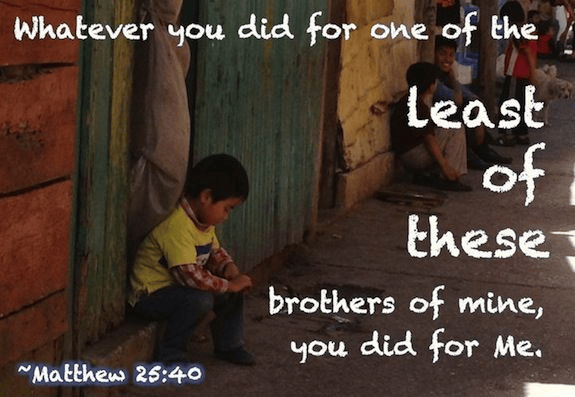
40 And the King shall answer and say unto them, Verily I say unto you, Inasmuch as ye have done it unto one of the least of these my brethren, ye have done it unto me.
The separation of sheep from goats is called Apartheid on earth and it is done by the unwise and unkind on a non-egalitarian principle of division and exclusion. Howevet, just as God when he is a King in parable or apocalyptic vision is not just one of a kind, class or group as Kings on earth are always from a class dubbed as aristocrats, so God’s division is on the basis of a radical separation of those who have resources doing good (or being kind) to those who cannot who have none for themselves; from those with resources to those without them. The point is that God gathers all nations (from the rich and powerful to the most poor and those made vulnerable) but does not favout the rich who have a high bar set to measure their ‘kindness’:
- First, that they do kindness most where kindness is most needed and without means testing, formal.or informal.
- Second that they understand they are of the same kind, tne ‘brethren’of tbose that they give kindness and do it solely for that purpose, because it is thus those that they favour with kindness can be seen to be of the same one family, group or nation as they. It is in that spirit alone that ‘kindness’ can be given and received’.
- Third, that the collective is one that disregards human borders of difference, perhaps even difference of religion. In this respect Matthew was conscious of Christ deconstructing the differentiation of Jew and Gentile on both sides of that false binary; false, however needful on Earth.
Return then to the picture at the top of this blog. Where in great hardship, kinship is shown by knowing that the suffering of one Palestinian child is the same as that of a Jewish or orher category of human person. We are of the same kind and to ignore such suffering is the same act of classification of ill-being as the Bible parable categorises as a goat. I have been thinking about this recently following a session on the disappeared in right wing administrations in South America (in Argentina and Chile) as represented by two fine human beings and writers.
In both these blogs I stressed how people turned their back on the suffering of a minority, they may not have identified with, as a category, including those chosen categories like socialists. The turning of backs was of a kind wherein people said they were ignorant of the happenings, often despite campaigns that publicised them from the brave point of view of the kin of the disappeared. Thus the solicitor claimed to an interviewer that if he ‘knew then what he knows now’ he might have acted differently, on recall of him defending General Pinochet in English and Argentinian courts. This included defence of Pinochet’s conscious use of Holocaust methodologies learned from Walther Rauff, now a Chilean citizen, the inventor of the mobile gas vans that killed Jews, people with disabilities and mental illness, gay men and nomadic groups. Yet that solicitor was a Jew with knowledge of even worse things in the Holocaust that affected his kin in his own background.
Now his Jewish status is irrelevant other than in the fact that he had knowlege or could have easily have gained it of the horrors of the Pinochet regime and its welcome to, and support of, Nazis from Hitler’s Germany. However, that statement applies to us all, especially sadly when we excuse our inaction in circumstances of visible oppression by saying that ‘we don’t know enough about it’, or worse, for many people during the worst of the Israeli genocide in Palestine and its continuum, one that goes on even now whilst being labelled ceasefire, say not only things like, ‘well, I don’t know enough about it’, and, at the same time, complain that pictures of the oppression and its consequence on innocent bystanders by the IDF are not shown, because, ‘well, we already know all about it without the gory images’.
In my pieces on South America already referenced I tried to define a concept I called ‘collusive ignorance’ which oft covers not only silent collusion with oppression of the marginalised but even complicity, as in the case of the UK government in many cases, and by all ruling political parties, or even participation by, for instance, the supply of resources that can only be used to fuel the oppression. The Jewish academic Gordon Neve argues that in the case of genocide, which he clearly sees happening in Gaza and the West Bank area of Palestine, we miss the heinousness of response to genocide if we concentrate on its perpetrators for ‘wider systematic genocide needs‘ in order to survive untouched a networked phenomenon of “genocide denial‘.

He calls this a ‘culture of deception‘ [1- 19].. However, I think this exonerates too many people who do not need to think that they are deceiving anyone (and indeed consciously both are not and not an intention so to do, or counter the idea that it is against their nature to employ lies and deceit, they only know that they ‘do not know enough or at all’ about the issue. But that is too passive a view of human responsibility surely. Neve Gordon finds both in the core texts of the Torah and in his study of Hannah Arendt that Jews are asked to define their faith by the active pursuit of Justice, and such pursuit requires that we do not see any individual as let off the hook by ignorance. To say that one is thus ‘let off the hook’ is to collude in remaining ignorant, whatever the level of absence or presence of barriers to knowledge.
And, although the UK media have reported with bias to Israel on this issue, partly because they were and are denied access to Gaza, enough information was available for people to know they had a duty to self-education and enough exposure of tbe myths that sustain Israeli half-truths, and, let’s face it, lies. Hence, the importance of report called The Gaza Tribunal: Britain’s Complicity in Genocide by Jeremy Corbyn, Neve Gordon and Shahd Hammouri, with an afterword by the Irish novelist Sally Rooney. Professor Shad Hammouri argues that government has a big responsiblity for ignorance of facts about the Palestinian genocide in that they knowingly denied a basic right to people in the UK: ‘The right not to be complicit a genocide’, or even inappropriate and disproportional response to a terror attack (if you insist on that semantic point). However, in truth, denying even the name genocide to something as clearly that as it could ever be in the view of most global expertise in the subject and most people generally feels like collusion.
Hammouri continues her point by saying the right to protest even a situation that might lead to genocide, the real duty placed on the UK by the International Court has been criminalised and made to appear transgressive of human norms: this occurs she says when the right to protest genocide or its potential is considered ‘intangible in a world system that marginalises meaning and human connection’ and where it becomes a threat that ‘to be human in the UK during the genocide meant risking your freedom, your job, your source of income’. No wonder we prefer to remain ignorant or identify our complicit bias with ignorance we wotld amend when we know what we can’t know now. [2]
Of course, the knowledge is not as hidden as you might think in this context. and Jeremy Corbyn too emphasises that, at the very least, we must not deny the humanity of the Palestinian people and its culture that is intangible by heritage standards but certainly available in tangible forms like books, artworks, recorded music and creative energy among migrants, who feel exiled from their home. [3]
The report proper collects in very readable form the evidence for all the book’s claims under the headings: Genocide, Preventing Genocide (a duty even if you do not believe genocide to be yet occurring), Complicity in Genocide, A Reckoning for Genocide, which casts the mind forward into the consequences for the collusively ignorant. It ends with a more abstract point that we have seen emerge a ‘Gaza Doctrine’ which sets in stone a supposed right for the more powerful to not only ‘do nothing’ when human decency is transgressed in mass murder, except to justify more (much more) of the same in reverse and directed at non-combatants, but to allow us to believe that those who do know what is happening and have the power to challenge it would be doing it anyway if they could since they (Israel, The United States, The UK, The Labour Party, and the countries of the EU) are presumed just in seeking knowledge, speaking it and acting upon it. nothing could be further from what I see as the obvious truth.
The kindness thing ever done for me would be for someone to respect their own and my own humanity enough to stop collusion with a complicit government – still complicit, even under a kinder face and kinder and more value-driven in other ways Labour leader and Prime Minister.
That’s all for now
In sadness at our human frailties and willingess to collude, and, of course, love, in the hope of otherwise
Steven xxxxxxxxxxx
____________________
[1] Neve Gordon (2026: 16 – 20) ‘Justice, Justice You Shall Pursue’ in Jeremy Corbyn, Never Gordon and Shahd Hammouri (2026) The Gaza Tribunal: Britain’s Complicity in Genocide, London, Pluto Press, 14 – 21.
[2] Shahd Hammouri (2026:11) ‘In Defiance of Illusions’ in ibid: 7 – 13.
[3] Jeremy Corbyn (2026: xv) ‘Preface’ in ibid: 1 – 6

