‘I myself dislike to be dictated to by anybody and am inclined, like Thucydides and others of his time, to be an anarch, or “agin the government” and the lust for, and abuse of, power which invariably goes with it’.[1] Man-made mythic men: the queer case of the ‘rebel without a cause’: an irreverent (and possibly scurrilous) case study of Augustus John (4 January 1878 – 31 October 1961) .
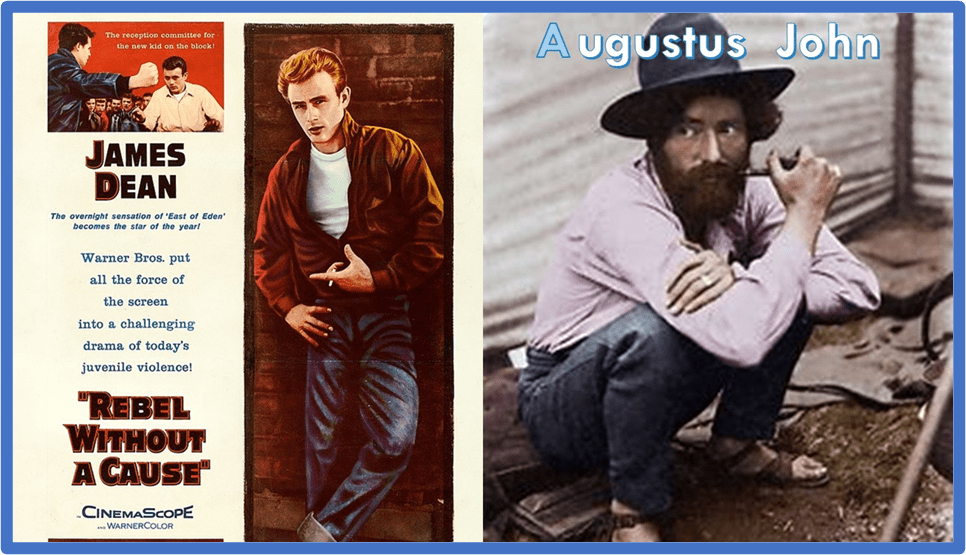
Looking at this photograph of Augustus John, actually of him [taken by Rebecca John] on a caravanning holiday, an analogy with James Dean seems less bizarre than might at first have been supposed. Later I will go on to analogue not only Dean but the rebel equally without cause whom we know as the glorious Bruce Chatwin. The quizzical stare, with more than a hint of suspicion, to his audience already suggests that the studied masculinity in the pose of each of the above-named is already replete with childlike vulnerability. It suggests that the proposed self-efficacy of the male pose is more than a little performative, hiding behind it intense sensitivity, vulnerability and yet also an overwhelming, childlike too, hunger for self-gratification. Those hands are large male hands clearly but they cross over the body defending it. The man may be rebelling against the norms of a conventional world but isn’t this rebelliousness wearing its aetiology – its theoretical ‘cause’ as well, a cause rooted in developmental and personal psychology. In each case, these men are not rebels who takes up a cause, an issue of social justice perhaps for which one is ready to battle, but also and predominantly persons who exhibit behaviours that it is engendered in causative factors intrinsic to the rebel’s individual relationship to a world that wants to shape them, though they deeply resist such shaping.
Those behaviours however are complex and overdetermined enough not to outwardly display their root in vulnerability but rather to occult that particular agency of determination in the contradictions of child development. Theirs is a rationalised and / or temperamental rebelliousness, tied as much to its often unknown causation as to the cause it wears on its banners. At base rebels without cause are often merely empty vessels in a world of true political action, too truly engrossed in the benefits to their present status, usually as an over-determinedly constructed ‘man’ in a patriarchal world that privileges such constructs. Wyndham Lewis (a rebel of a similar nature (but whose rebelliousness turned in later life in a more sinister direction) says rightly how Augustus John directed rebellious activity against norms in ways that merely amplified the well-known sexual privilege of men in status quo patriarchy: ‘I think John will end by building a city, and being worshipped as sole man therein, – the deity of Masculinity[i].[2] It is in that the latter sense that an analogy to James Dean and Bruce Chatwin will break down, for Augustus John relished his own masculine privilege and the benefits it gave him in sexual and cultural politics in ways that were not possible for the more conflicted sexualities, in an even more sexually conflicted later age of Dean and Chatwin. Though I will not, perhaps cannot, pursue this point here and it will remain a generalisation.
Augustus John was able of course to ‘brush up’ nicely and to appear what his role in the class-based cultural system required him to be or at least appear, as other photographs attest, wherein he at the most a rebel ‘dandy’.
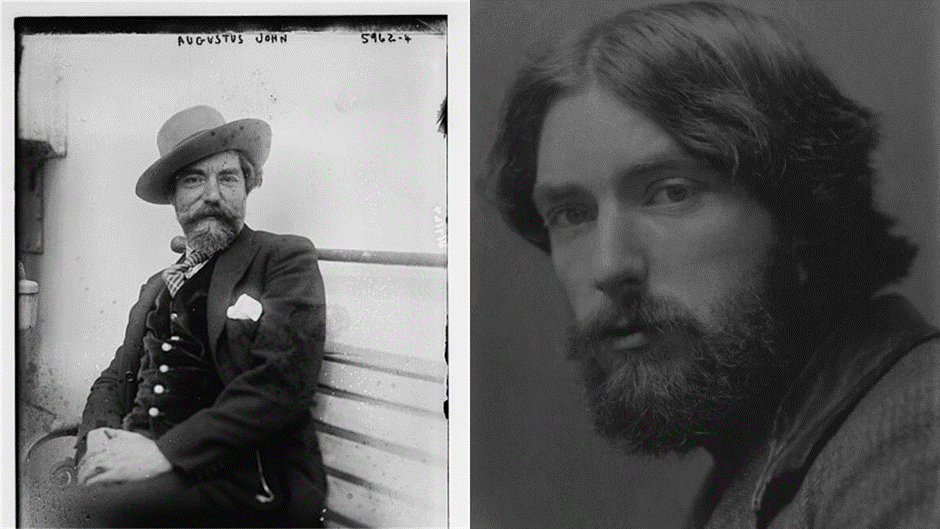
Yet he was wont, even in his middle and older age to point to such a constitutional origin, by which I refer mainly to the constitution of ‘character’ of his antagonism to authority, as in the citation in my title, from a section of his posthumous second volume of biographical reminiscences entitled ‘Communism’: ‘I myself dislike to be dictated to by anybody and am inclined, like Thucydides and others of his time, to be an anarch, or “agin the government” and the lust for, and abuse of, power which invariably goes with it’.[3] This anti-State political perspective may have been an accidental import to John’s thinking, because Holroyd argues that throughout his life the painter’s reading was haphazard but in that he ‘had come across the writings of Charles Fourier. Writing to his son, he dismissed the ‘socialist pedantry’ therein but found wisdom in ‘his elimination of the state, of national frontiers, armies & trade barriers, and in his principle of co-ownership’. Holroyd argues that in his later years Fourier became a central political influence on John and supported his actions in actively opposing the period of British Communist influence on the National Council for Civil Liberties. [4]
What he took from Fourier was a theoretical and cognitive validation of the ‘George-Borrow-romantic’ painter’s idealist belief in freedom, whatever its source or consequences. Belief in the freedom of the individual and free speech matters of course but it has a dark side. Augustus John’s sexual politics may have emphasised in practice, if not in theory, a freedom for men that was available to women, whom Gus in effect condemned where it suited him (and it often did so) to the service of his sexual needs and (especially his first wife Ida – née Nettleship – herself an artist) the care of children and domestic life that he felt till late in his life an imprisonment, as Holroyd constantly shows. Similarly Holroyd shows that his profligacy with family finances for his personal wants rather than the maintenance of his family was as rooted in freedom ideologies as Holroyd says of John’s later more wealthy state: ‘for John money was freedom, and he could not tolerate being imprisoned by the lack of it’.[5] In his younger days the same rather romanticised version of ideologies of individual freedom could look like a rejection of capitalism and all its works, writing as he does to Will Rothenstein in 1904 about his family outings in a ‘gypsy’ cart (the parallels with Bruce Chatwin’s idealisation of nomadic cultures are precise): ‘The call of the road is on me. Why do we load ourselves with the chains of commodities when the trees live rent free, and the river pays no toll?’[6]
Ideologies of individual freedom (and free speech) of course serve right and left and are notoriously suspect in sexual politics for they serve those with hegemonic power over others – usually cis white heteronormative men – with greater access to the power to abuse in the name of their freedom. To this we must return in examining Gus John’s sexual politics and folk theories (if we can call them that) of the family as a social structure later. However, we might need first to turn towards issues of sexuality first, for to label Gus a cis white heteronormative man just won’t do, for this suggests a too boundaried definition of a person whose very nature turned against boundary marking, and not just in nations. Gus was in open competition, at least as far as the principals involved in the interaction were concerned with his sister, Gwen, for the attentions of Dorelia McNeill, for instance. Pansexualities were therefore known to him. He knew well enough to borrow apartments in foreign cities the closeted bisexual Chilean diplomat Don José-Antonio Gandarillas and must have known of the latter’s affair with painter Christopher Wood (the link is to my blog on the latter). Staying in Gandarillas’s apartment in Paris in 1919 he wrote to Gwen that he “had a queer time”, thus describing the lurid and fashionable life’ of his host. The word means nothing though without context so I am not using it as ‘evidence’.
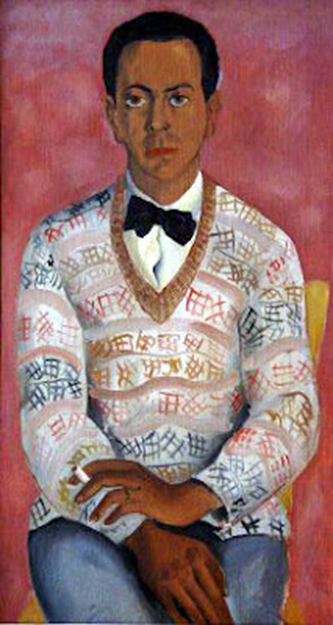
Gandarillas by Christopher Wood
However, John drops hints about his awareness of queer sexual and love attachments throughout his autobiographical writing. My favourite appears In Chiaroscuro in a fragment on ‘Oscar Wilde’ who in describing therein his intimate friend and social and artistic promoter, Will Rothenstein as not ‘without a decided streak of romanticism himself’ says that Rothenstein:
… once suggested that he would like to play the part of Vautrin to my Lucien de Rubempré! Neither of us would have been suitably cast in these roles. He used to talk of his friend Oscar Wilde, and quoted this wit’s mot, ‘The death of Lucien was the greatest tragedy of my life’. …
Such prose is more than tongue in cheek, creating the suggestion of the same sexual alliance idealised by some (Proust for instance if not exactly Wilde who went on to associate this ‘great tragedy of my life’ to moments of intense pleasure) created by Balzac in Illusions perdues (Lost Illusions) perhaps and certainly in Splendeurs et misères des courtisanes (known in English as A Harlot High and Low). Idealised it may be but the context in the Balzac novels was a form of alliance akin to prostitution. And as A.S Byatt has argued in 2005 that Balzac ‘idealised’ prostitution as a form of rebellion against mechanistic capitalism (see her words in the figure below).
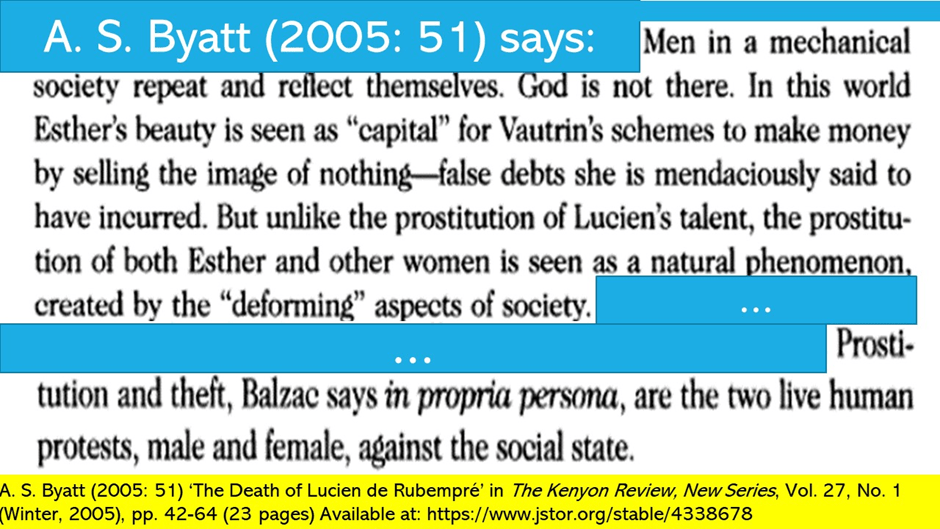
Even though Gus undermines the analogy to the queer relationship between the Balzac characters in his autobiography he also therein often contemplates role-play as a possibility even when the casting of the personae as played in life in these new roles is not entirely ‘suitable’. Moreover, we shall see this theatrical terminology in my next example too, for it is a given that ‘suitability’ is not a criterion of nature but of human social artifice and custom. This particular passage leaves the suggestion of how and why Vautrin and de Rubempré might have modelled a possibility in the relationship between Rothenstein and Gus entirely open, indeed it is unclear why it is mentioned at all, except to instance Gus’ ambivalence about Oscar Wilde’s words such as the one he repeats here: ‘I could only listen in respectful silence, for did I not know that “little boys should be obscene and not heard”?[7] The play with counterfactual queer personae is I think symptomatic of Augustus John who never rules out the potential of behaviour that is othered from what might be expected.
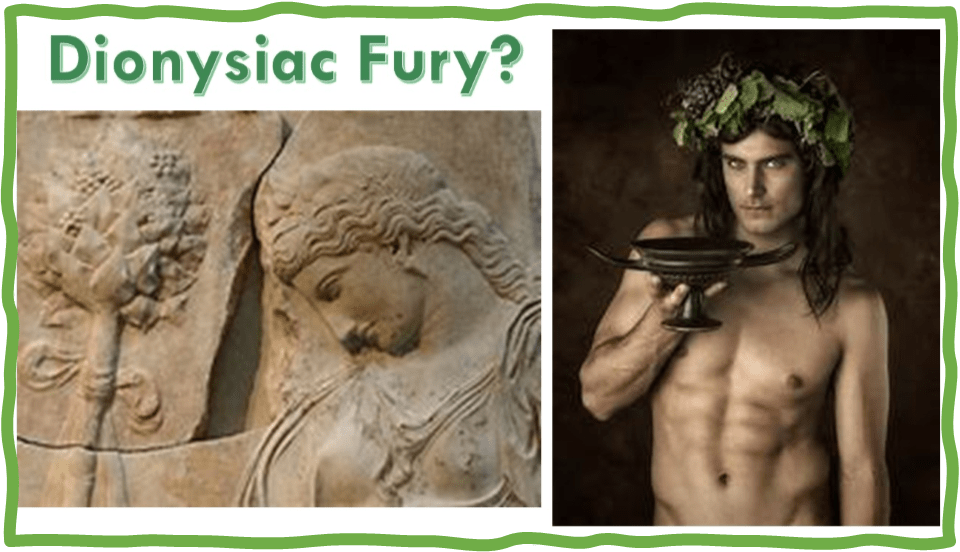
There is a fine example of this very trait in John In the second (the posthumous) volume of his autobiography to which I have already referred (regarding the fragment on ‘Communism’) he charts the beginning of his antagonism to authority in his disillusionment, at school, with the ‘ex-policeman’ who was his Headmaster (doubly therefore a symbol of social authority) in a short piece called ‘Dionysian Fury’. Herein he describes a moment where he breaks out from a regimented ‘formal promenade with my schoolfellows, under the surveillance of his Headmaster’ in order to strip naked on a beach and dance extemporaneously in ‘motions’ that were ‘unrehearsed and wild’: ‘This tendency must have been instinctive, since my performance, I repeat was quite impromptu’.[8] This reference to instinct or inner drive that drives performance without conscious intention is I think essential to John.
Moreover, I have no doubt that we have to invoke unconscious intentionality in his case, for it seeps through any attempt to understand his life as well as art, even its preference to be told in the form of ‘fragments’; because he called his first volume (the only one to be published in his lifetime) Chiaroscuro: Fragments of Autobiography: First Series. And there are many hints in this that he apprehended his life in such ‘fragments’, as if his model of the artist was Orpheus after he was torn to pieces by Dionysus’ Maenads, in a ritual act known to the Ancient Greeks as σπαραγμός (sparagmos) but carried on singing nevertheless. Tracing behind fragments for some unseen (and perhaps unseeable) whole was an act he encouraged. Thus in the section ‘Dionysiac Fury’ (the fury note of the Maenads of which a classical scholar like John was well aware) under current scrutiny there is a note where John says he has ‘recorded elsewhere the conclusion of this unfortunate affair’, to wit, his naked dance in front of his Headmaster. In the footnote reference to this phrase his motives in relation to this paedagogus, who had after all censored his more sexually frank drawings, he connects to an earlier pen-portrait in his first series of 1952 Fragments. The passage here referred back to contains a clear and honest acknowledgement of the libidinal content in John’s early association to the Policeman-Headmaster. Though that content is marked as not yet fully understood, the explanations begs the question of an unconscious queer sexual intention, especially since John uses the term ‘unconscious transference’ as it used in psychodynamic theory in this earlier text.
This man, with no outward marks of distinction to recommend him, had, no doubt, some charm, which though illusory, sufficed to arouse the hero-worshipping faculties of a lonely adolescent. Possibly through unconscious transference of the filial instinct, I ‘fell’ for him, and though at first he responded genially, later on the naïve warmth of my affection. …, was felt as a menace, bound sooner or later to show up the meanness of soul which it was his chief business in life to conceal. His dignity, though protected by an imaginary gown of authority, was in danger. I had become an embarrassment. (my italics )[9]
This passage so often contradicts its own explanations of what is going on here that it fails to validate the claim that the love involved here was a type of Carlylean hero-worship alone. Everything said is a possible explanation of human behaviour but never a fully valid one, whether it attempts to explain about how and why young Gus really ‘fell’ for this headteacher or acts as a ‘imaginary gown of authority’ to cover up something more tawdry, whatever that ‘meanness of soul’ may be. Nowhere in what I say above though am I trying to assert gay identity for Augustus John, only to assert that his tendency as a human being was to act, think and feel in ways that were queer to conventional acting, thinking, and feeling, in sexual as well as other terms.
I have hinted already that this ‘tendency’ expressed itself in a passion for what he considered to be the Romany or Gypsy culture. The strength of this analogue of the nomadic life which sets its values against those of the conventional, ‘settled’ and non-othered world was equally of course an issue for Bruce Chatwin who looked for analogues throughout the non-North-Western civilizations that were othered by the Mediterranean Occident and modern North America. John was by 1952 less content to see ‘Gypsy’ nomadic culture as his ideal of ‘freedom’ where he distances himself from myths of Romany life and history, as having descended from the Egyptian Pharaohs for instance’; whose representative claimants he says have been discovered to be ‘exhibitionists’. Yet again these personages represent a psychological impulse in those who venerate them, the source of which is unconscious: ‘Whatever the truth of the matter, these ‘aristocrats of the road’, as they have been called, possess a fatal attraction for some people’.[10] Whether John himself as a younger man had been a sufferer of such ‘fatal attraction’ remains a question, for by 1952 he was happy to record a distance too from his main companion in the study of Romany life and lore whilst both taught in the University of Liverpool, often embodied study in the form of libidinous visits to camping grounds like Cabbage Hall in Liverpool, ‘where the Boswells were in the habit of encamping in the winter months’.[11]
Sampson, according to Holroyd, opened up to Gus not only a knowledge of Romany lore and language that became enshrined In Sampson’s The Dialect of the Gypsies of Wales but the secret of polyamorous marriage, to the advantage of men at the least, validated by claims for Romani culture that encompassed some of the highest and lowest forms of writing in Persian, Indian and other language stores of myths. Together they produced, in Sampson’s words to John, ‘a “strictly amoral” book, and therefore “an excellent one to give to chyes {children]”’: The Wind on the Heath.[12]
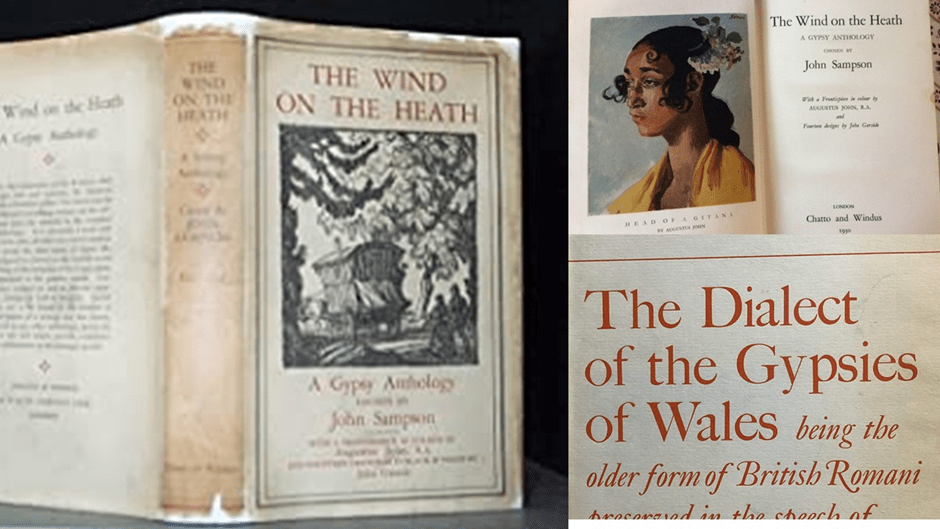
Holroyd makes it clear however that whatever Sampson’s example to John of polyamorous loving and sex, and perhaps chiefly the latter, that Sampson was only a furtive rebel who ‘led a secret life’, whilst, according to W.B. Yeats’ private view in a letter to a mutual friend, John advised him to ‘sin openly and scandalize the world’. Sampson indeed idolised John for his OPEN rebelliousness of nature, with more than a hint of his sexual openness across boundaries that he owed to his ‘calling’ as an artist: strong, handsome, a genius, beloved by many men and women’ (my italics).[13] For instance, his view of Sampson had often an ironic tinge. He would laugh at the latter for his vanity about aging and appearing ugly. It was when Sampson complained that Romani men had pointed out his obvious hair loss as a possible index of attractive youth and sexually attractive vitality that John had given his advice to Sampson to be more open about his sexual polyamory. John’s portrait drawing of John Sampson is I think as beautiful as any of his great drawn portraits. Its fidelity to Sampson’s unshaved and frankly near naked deshabille is not only frank but seeks what is beautiful in what might in conventional terms be thought potentially ‘ugly’ and, indeed these are the terms in which John was, even in his own time, praised but, more often, ridiculed. The contemporary Cambridge academic Greek scholar Jane Harrison, whom he painted, however praised his ‘real vision of “the beauty of ugliness” … a curious beauty of line: character I suppose it would be called, that comes into all faces however “plain” that belong to people who have lived hard; …’.[14]
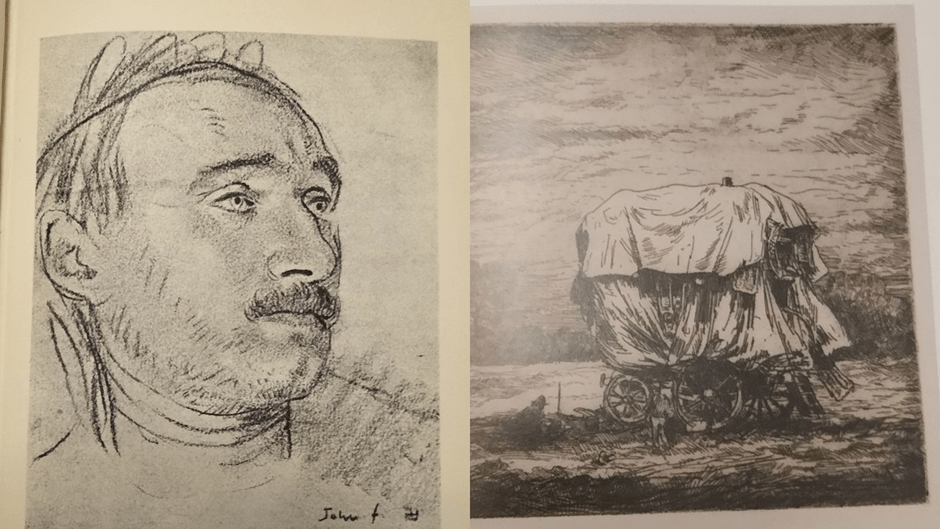
My photographs of John Sampson as drawn by Augustus John (Augustus John 1952 op.cit: facing p. 58) and a detail of an etching The Hawker’s Van, c. 1905 (David Boyd Haycock op.cit: 49).
The beauty of Sampson, like that of the ‘hard’ facts of a free life in The Hawker’s Van Romany picture, is the blend of youthful vision, conveyed by the upward gaze of the eyes and the fine Roman nose, with hair that apes the figure youth it no longer has and which bruits both its obvious increasing sparsity while registering the attempt Sampson has made to cover his baldness at the crown. The curves and line are beautiful, as are the neck wrinkles and rough, unkempt appearance of skin and face-hair. The shading on the viewer’s right feels like an aura of a distinguished body. But romance died hard for John. He performed Sampson’s funeral oration in Romani, made the even live up to ideology, though he could still produce caricatures of Sampson that ridiculed the reality of his unappealing fatter older self, as in the one I show below where beauty is absent from the face I compare it with. Double lines evoke double chins and a few lines only convey Sampson in his bourgeois character as a University Professor.
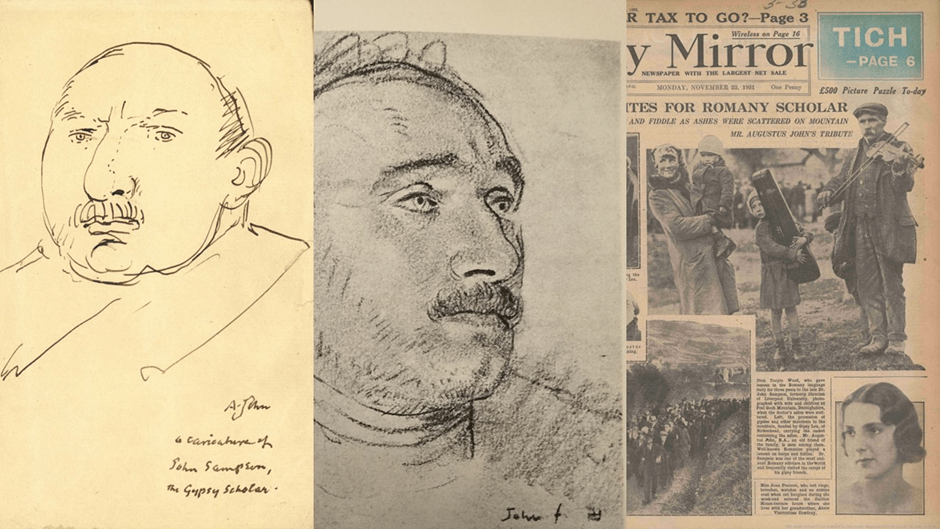
My cropped collated slide with the two images to left and right from: https://www.liverpoolmuseums.org.uk/stories/augustus-john-and-liverpools-gypsy-lore-society
The true ideologue of Romany freedom was the poet, condemned to later to be misunderstood and considered insane, which he may have been, Arthur Symons It was he, in particular who produced poetic images that depended on a contrast between Romany freedom and the constricted, contained lives most often idealised, wrongly in his view as an ideal security that was, as John often claimed his married homes were, prisons. Holroyd contrasts John’s letter to Ottoline Morrell, wherein he ironically casts a dinner party thrown for the sculptor Jacob Epstein’s family in 1908, as exemplum of being ‘bourgeois folk with carpets and front doors and dining-rooms’ (Heaven forbid!) with Symon’s verses of Romany nomadic freedom favoured by John:
Wanderers, you have sunrise and the stars;
And we, beneath our comfortable roofs,
Lamplight and daily fires upon the hearth,
And four walls of a prison, and sure food.
But God has given you freedom, wanderers!
(from The Wanderers in Amoris Victima 1897)[15]
John’s ‘caravanning’ is as pastiche a version of Romany life as a supposed passion for Romany culture can get, as the family photograph below suggests. However, John took seriously the idea that the Romany life system was the emblem of a generalised freedom, a practical rebellion as it were, against bourgeois conventions, not just in the home but the hierarchically ordered structure of family and society organised for the comfort of a few, policed in the few’s, and not the many’s, interests. In later life, this idea would meld with the elements of anarchism and Fourierist value systems that characterised his political ideals, and which, of course, made them unrealisable and therefore sustainable without overt contradiction.
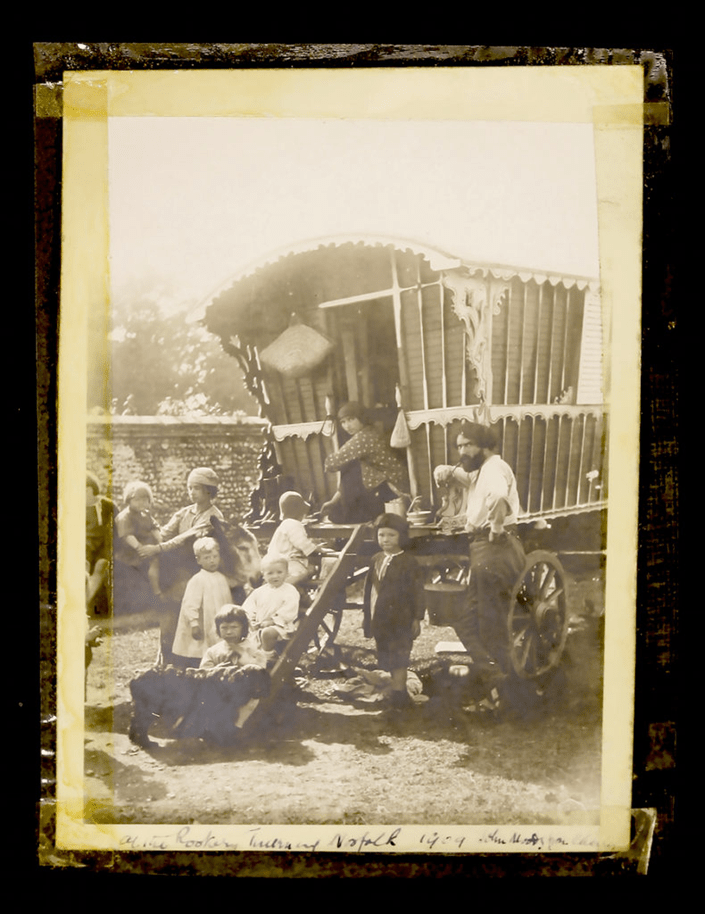
Available (3/4/23) at: https://antique-collecting.co.uk/2017/04/06/augustus-john-photograph-in-sale/
Of course such freedom could still, when lived as a holiday by the rich such as Gus became, be at the expense of others such as the urban working-class who made the wealth on which such fantasies could be sustained. Meanwhile the live of real travellers remained subject to both bloody, in Middle Europe, and ‘bloodless persecution’ John nevertheless did speak out against the enforced settlement of ‘Gypsies‘ in English ‘overcrowded and insalubrious slums’, seeing that as a less obvious brutal suppression but akin to the policy of Hitler in Germany.[16] More obviously though, and from the beginning, it was, without doubt, at the expense of women that the ideological version of traveller life would be sustained by men keen to maintain their patriarchal advantage as sexual rulers. John could admire Romany extended families he knew by pointing to the relative freedom of their women, who by their robust exercise of ‘an oblique and derisory intelligence’ about men that allowed them to play the latter to what might seem to be (to the men thus ‘played’) their advantage. These ‘free’ women, where freedom was defined by less publicly constrained sexual mores than middle-class European women, were still obvious servants of the reproductive function of patriarchal families. And John’s relationship to women always used the contradiction between believing in a freer and more respected female embodied intelligence and expecting that at least women bound to him, like Ida, service his home and children whilst minimising his discomfort to him.
Augustus John required a sexual freedom that used women whilst ignoring that that they could not, like he, escape (at least sometimes) the consequences of the link of unprotected sex with reproductive consequences and the ongoing duties to vulnerable offspring this engender. Later he unwillingly paid for abortions for mistresses, earlier he relied on women he could trust to support home whilst he ranged the road (and many women) ‘freely’. No aspect of his art confirms this better than John’s illustrations to the 1901 Romany version of the Omar Khayyam published by Sampson. No messing about with boys here, In both versions of a picture of the philosophical scholar-gypsy under a bough with his love that I have found the beloved is a Romany woman and drawn in a provocative prose with her hips thrust and naked breasts exposed to the eye of the man gazing up at her. These pictures he, even more worryingly, labelled in letters to Rothenstein amongst his ‘”parcels of fancies” and “pastels of sluts”’.[17] His later mistress-and-model Alick Schepeler was no doubt expected to be pleased to be told by Gus that her first name ‘rhymed with “phallic”’.
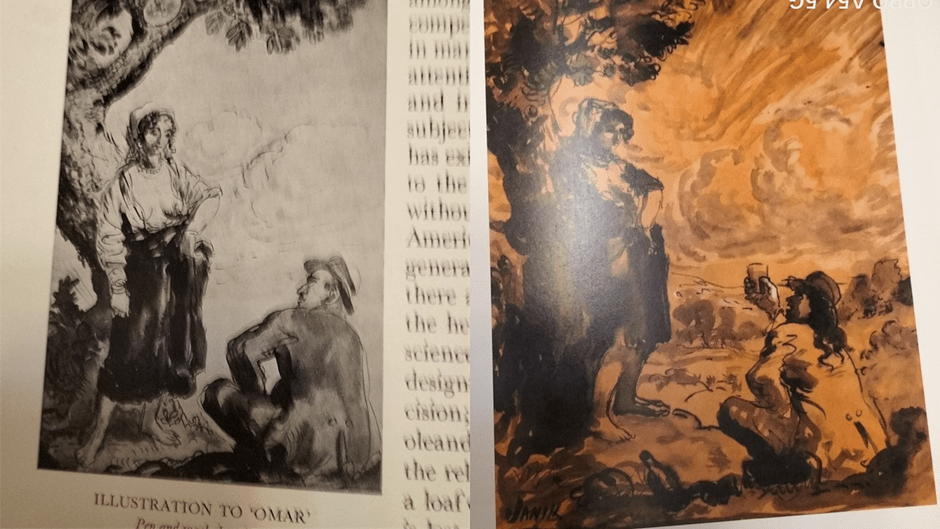
My photographs of ‘Illustrations to Omar’ Pen and wash-drawings L. in Rothenstein op.cit: 8, R. in Boyd Haycock op.cit: 53
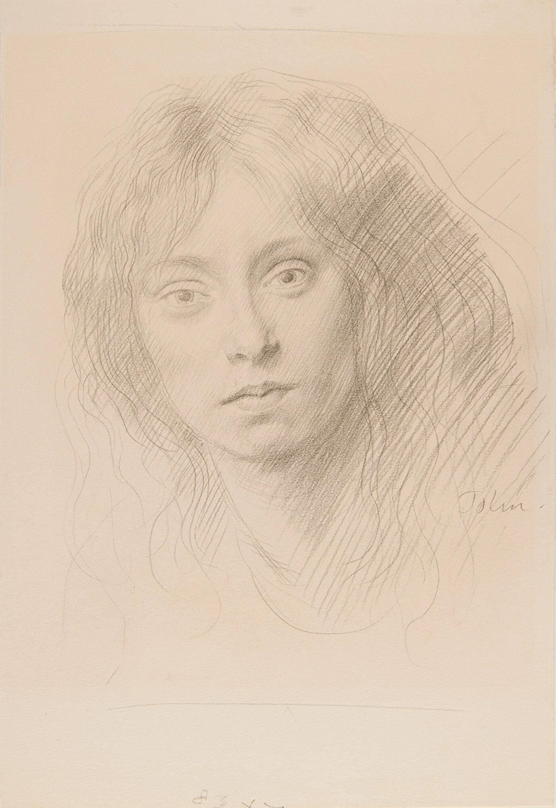
Alick Schepeler by Augustus John 1907 Available at: https://www.gardnermuseum.org/experience/collection/12355
Here women are no more than an illustration of male freedom validated by ancient traditions thought to continue by Sampson and perhaps John, at least in his early career. It would be a gross mistake however to think that Augustus John had only a take on woman’s rights that made them sexually free with men (or indeed women as in the bisexual example of his sister, Gwen). There is no irony at all in the fact that it was Gus that was, amongst male critics, the sincerest believer of his own age in the superiority of Gwen John to himself as a painter, writing after her death and in his older age: ‘Fifty years after my death I shall be remembered as Gwen John’s brother’.[18] He had no trouble with finding excellence in Women as subjects of portraits whether radical academics like Jane Harrison, society women like Ottoline Morell or the cellist, Guilhermina Suggia. Holroyd expresses the contradiction thus as ‘an impossible ideal’: ‘What he sought in men – inspiration and entertainment – he also looked for in women, though in a different form’. And the excuse for those qualities being ‘in a different form’ was their supposed biological link to ‘Nature and to the mystery of birth’.[19] That might be very well as an explanation of feminine genius as something more deeply creative than that of males but it’s a poor excuse for ensuring that it is women who bear the entire social cost of their role in the reproductive system, as he fully expected in Ida and Dorelia – the mothers of his children, Ida even dying in childbirth and exhausted by being expected to maintain his home such that it imprisoned him only on temporary stays and left him free for other women. Chapter 4 of Holroyd’s revised biography: ‘Men Must Play and Women Weep’ is a fine exploration of Ida and Dorelia’s story and the ménage à trois in which even his then mistress Dorelia’s children would be cared for by Ida, his wife, whilst John also pursued Alick Schepeler and visited brothels at will.
So much then for expectations of consistency in the bohemian rebel against bourgeois convention, order, and organisation. In a sense the role of Romani lore in John’s life, apart from the fact tat he added its language to his already prodigious linguistic repertoire. Gwen dealt with the contradictions between polyamorous (and in her case bisexual) constitution and possessive lovers better, as did perhaps Dorelia, but women as well educated and open to learning as Gwen were not the norm – not even of the norm of men.[20] For men, freedom imaged in transgression in which women represented the object of temptation rather than the subject of a contractual and more equal love had been justified in Romantic painting sometimes by travellers, and myths about them, but also ‘bandits’, as explored in William Gaunt’s 1937 Bandits in a Landscape: A Study of Romantic Painting from Caravaggio to Delacroix. And failing that Romantic artists turned to myth (often through Goethe) and so fid John in his imagination of Walpurgis Nicht.
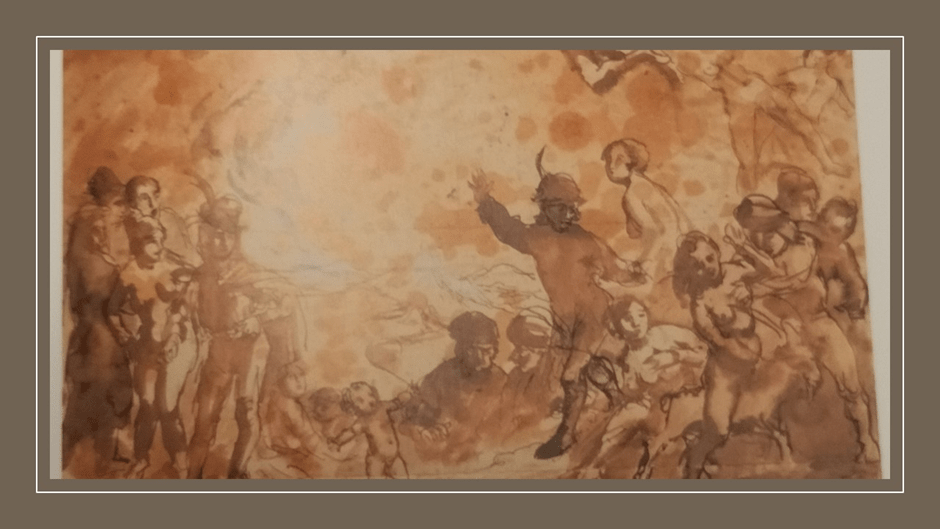
Men rove amongst women who use magic powers of dancing, flying and naked emergence (and the secret – to bourgeois nineteenth and early twentieth century public society – that they too could enjoy sex) to be more available to men. The myth is powerful. Women tied to biology were women ties to subservience and men like John could enjoy the greater power this gave them – naturally as it were – without as much guilt as observation should have aroused. Both Gus and Gwen John felt artistic genius required artists to feel in ways quite unlike other men and women and therefore liberty to love widely. Hence, for us, a lot hangs, if we accept that argument, with how good an artist John is. However, I am truly of the mind that we can’t quite decide on Augustus John’s qualities as an artist yet, until we become more aware of his known and unknown ‘intentions’, those that are the cause of his rebellion against bourgeois norms. Let’s take his drawings of nudes and of lower-class sexual passion in the examples below.
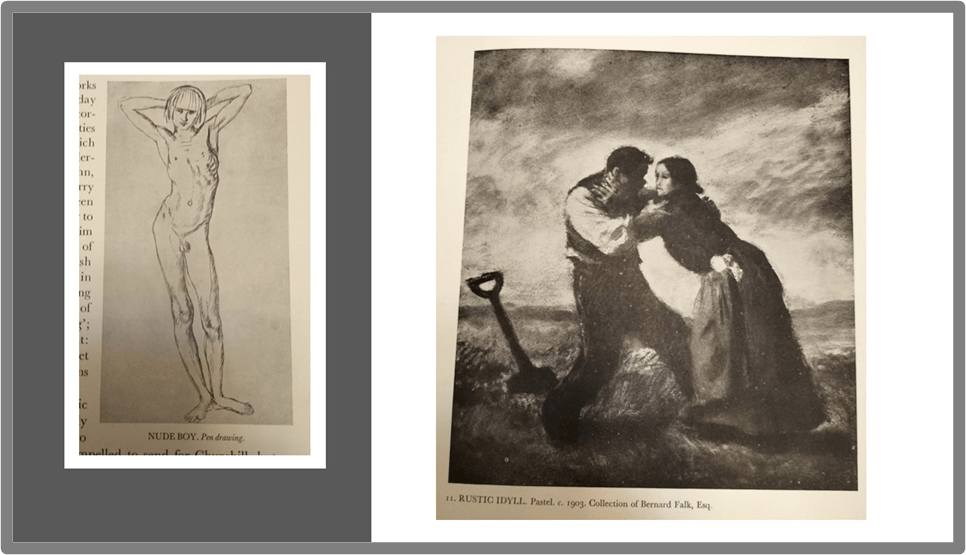
Augustus John Nude Boy (pen drawing) and Rustic Idyll (pastel, c. 1903).My photographs of reproductions in John Rothenstein (1966:page 15 of ‘Introduction’ & Plate 11 respectively) Augustus John Oxford & London, Phaidon Press Ltd.
Illustrations often help to realise what one is pointing to in an argument in art but you have to face the fact with Augustus John that this effect is truly muted, not only by the poverty of reproduction styles in old surviving texts of this now well-marginalised historical artistic figure, but perhaps too by the relative poverty of the art realised by him per se. Does the undated Nude Boy, as suggestive and provocative as is its pose, arouse any classic ‘Dionysian Fury’ such as John refers to in the essay I referred to when I started about his own naked dancing in front of a beloved Headmaster. Are we instead put off by the ambiguity of the marks that make it up and the lack of formal beauty therein? The boy does not take a conventional classic pose for the male nude, though the small penis and contrapposto stance of the classical figures are in some small way aped. We are not shocked by frenzy as such but rather too aware of what is ‘unrehearsed and wild’ in its realisation as a picture rather than as a felt idea of passion. I would say the same of the passionate embrace of the pastel Rustic Idyll, in which violence is as much suggested in the approach to each other of the lovers’ embrace.
However, is there more to these works than just carelessness of execution. Do the figures in Rustic Idyll demonstrate the restraint placed on the art of the natural body in action by the distancing stance through which the genital areas of the lovers are kept apart from each other as they lean into their embrace? Is it therefore intelligent about sexual emotion and the cusp with denial and violence? Is the peat shovel left at the angle of an erect penis to the left of this male pointing to the repressed sexual content fighting to get out. We remain unconvinced because we are no longer able to validate the judgements which in the early twentieth-century compared him to Ancient, Renaissance and Baroque Old Masters – to Michelangelo and, his own favoured model, Rembrandt. These are comparisons the Bloomsbury afficionado Richard Shone was already questioning in 1978, as cited by David Boyd Haycock:
Was he really that good? Is there still time for a phoenix to arise from, admittedly, pretty cold ashes? What was it that seduced so many into making comparisons which strike is now as ludicrous – that his drawings compare with Michelangelo’s, his etchings are as fine as Rembrandt’s, his paintings superior to Gauguin’s?[21]
The comparison to Gauguin is especially apt, for to many John was the English Post-Impressionist Master and John did indeed admire that Gauguin, the teacher whom would enlighten Philistine England to the beauty of wild and self-evident brush stokes that only appear random.[22] However, the truth is that in his oil paintings with some exceptions in some of the wondrous Dorelia pieces and certainly excepting the very fine portraiture, it is very difficult not to feel that the brush strokes lack any passion of communion with the viewer as they do in Van Gogh. Moreover, the colour designs can just seem actually random in design to my eye, though I make no claims for my eye in this respect – where there ought to dynamism in the brushstroke there is only flatness to me. A later fancier of these pictures may claim that wild randomness to be their beautiful achievement. I am not there yet. Glance at the landscape following, In Southampton’s Art Gallery and decide what you might think when you see the original. For me, the jury is still out.
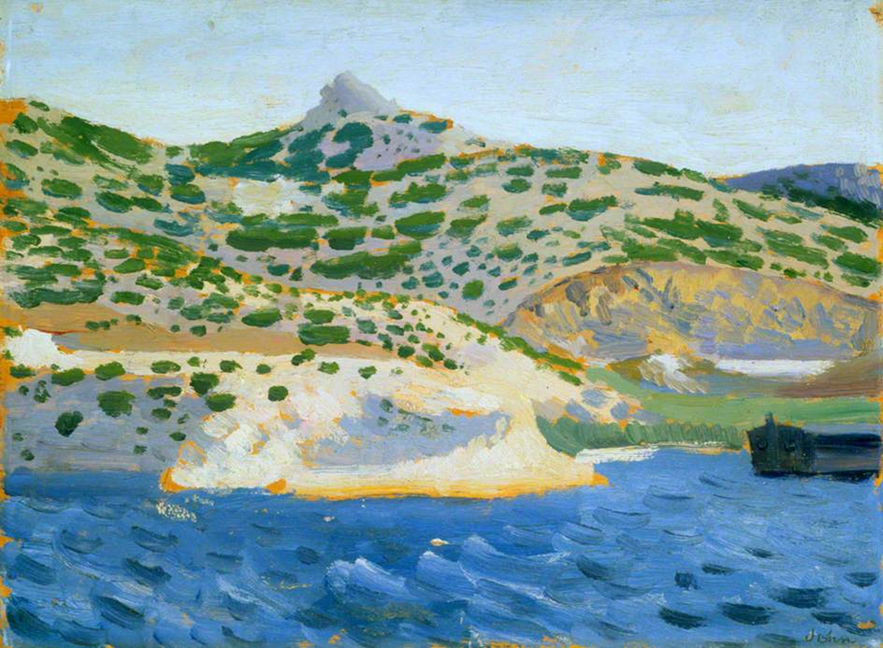
Porte de Bouc, 1910 Available at: https://artuk.org/discover/artworks/port-de-bouc-17765 .
I still very much admire John’s figurative pen drawings, and pen portraits, and his oil portraits. I have mentioned already how much I like his image of Sampson. What causes its brilliance is the capture of a deeper intention than is on the surface for me. I love how Augustus John captures the time process involved in aging as it works with human bodies. For me this is aligned with his proficiency in hatching, which was once what gained comparison of his drawing To Rembrandt. Surely he learned from Rembrandt in the following pictures which are best looked at as pictures of the continua and change across time in aging bodies, and hence I don’t identify them (though one is of course obvious).
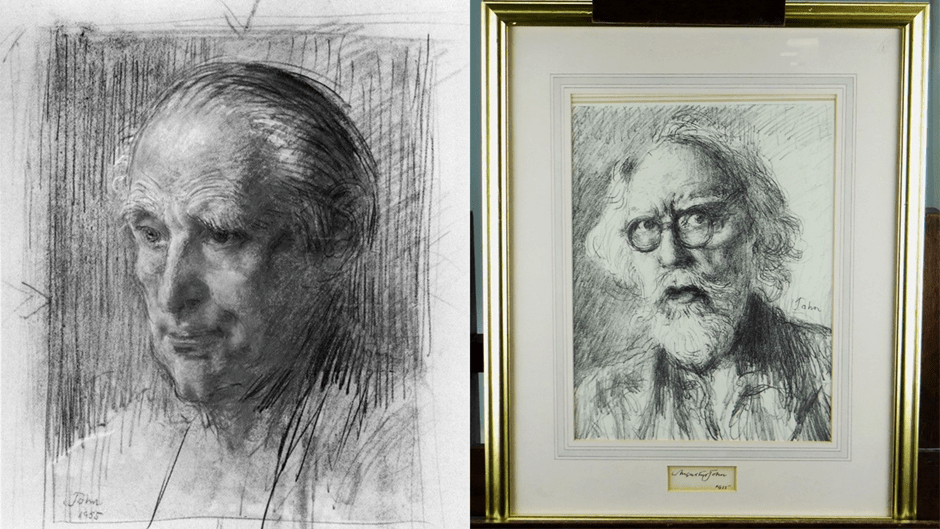
Lines here have physical and emotional weight, balancing one sometimes against the other. Light is both realised and somewhat symbolic, changing meaning in context. The description of facial hair is to me brilliant. These are men but they are also an amalgam of feelings and thoughts, even surprise at the viewer’s otherness in one that is the highest mark of respect of a painter who wants his self-portrait displayed. The early oil portraits too are amazing to me, like this of Dorelia, known as Merikli (1902).
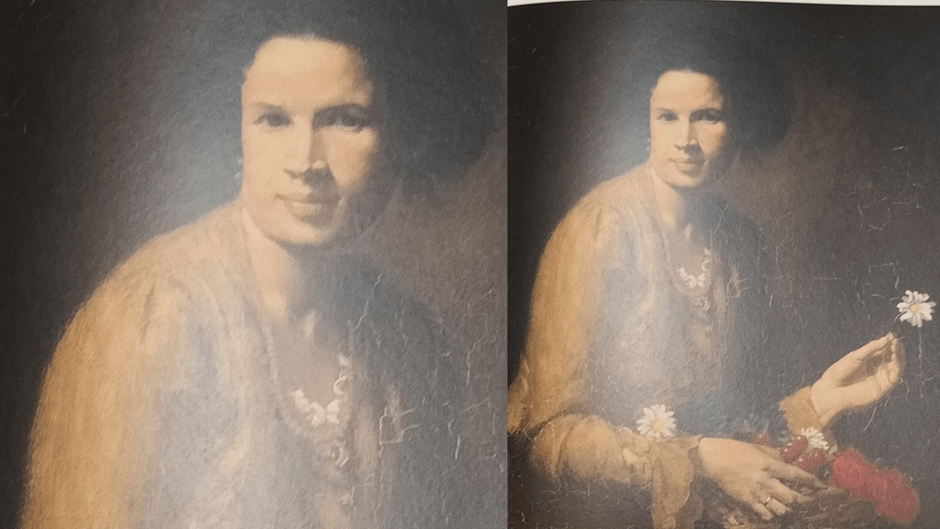
Merikli, Boyd Haycock tells us, is Romany for ‘jewel’. At the time it was first shown in Manchester The Athenaeum critic praised it but noted that ‘his work shows a perverse disregard for beauty which is to be regretted’.[23] Now though one might have expected this of that monumental portrait of Ottoline Morrell as a galleon of cultural pride, I resent it here. Indeed for us, to whom Dorelia seems simply beautiful, though her cheeks are pudgy and her hands overlarge, and her clothing dishevelled this may be because John created out of what his contemporaries saw as a principle of ‘beauty in ugliness’ new standards for the appreciation of embodied beauty. A jewel indeed takes up the centre of the space, pendent from ‘vulgar’ orange beads but Dorelia is intent on displaying a jewel more in the arrangement of natural flowers and fruits. Augustus John often addresses endearments to Dorelia, even when attempting to persuade her to leave Gwen in France and return to Ida and himself, as ‘fat’. He uses the word quite bluntly. Knowing this helps me see how and why this is beautiful. It rejects conventions of what is expected of the ‘beautiful’ and replaces it with what is or should be beautiful. It is the act of a rebel without a cause, for the cause needs no elaboration, it is based on psychological persuasion of the eye to FIND BEAUTY, not have it served up from prescribed recipes. Rothenstein summed it up thus, cited by Holroyd: “His work … was deemed deliberately ugly, … Were people altogether blind to beauty’.[24]
And this goes for male beauty too, which is plentiful (and sometimes in surprising places) in John’s portraits. It is a beauty found in idiosyncrasy however, hence his best portraits are of writers and artists. His W.B. Yeats of 1907 was dismissed by Lady Gregory, Yeats’ aristocratic patron as failing to use markers of high social class which she identified with the poet’s national importance, saying it was ‘like a tinker in the dock, or a charwoman at a prayer meeting’. Do we see though what Yeats saw in it? For he saw that this was precisely beauty liberated from notions of beauty that had been locked in notions of ‘academic form’ (the forms regulated by Academies of Art that is). What John was doing said Yeats in his 1910 lecture, he was doing in poetry: ‘revolt from academic form has been the great event in the last two generations of painting … In poetry we have had an exactly equivalent revolt’.[25]
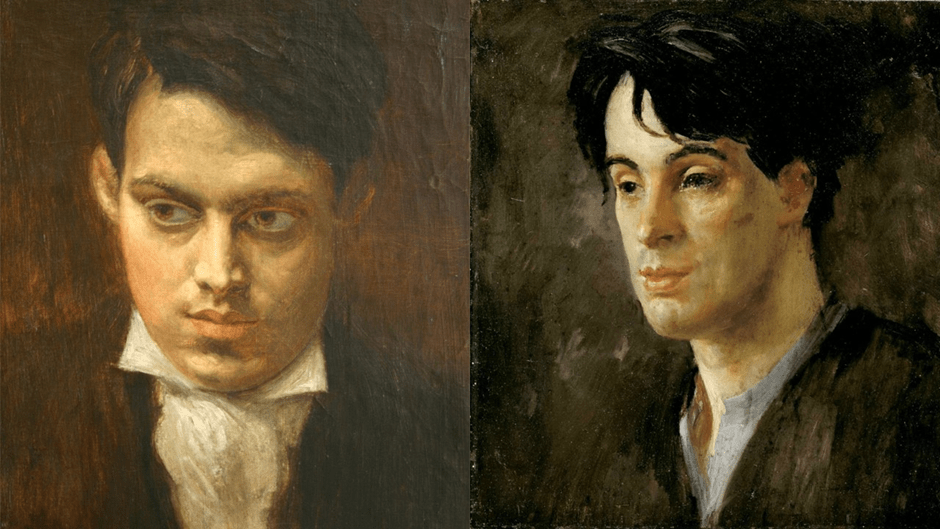
For me Yeats’ beauty is described in this painting as something emergent from its muddy background silvered as it is by light, just as does Yeats poetry from gritty myths of the present politics of his Ireland, such that a ‘terrible beauty is born’. As for Wyndham Lewis, the beauty belongs to something secreted and held in, not only in Lewis but in the relationship between him and his viewer. This seems to rhyme with Holroyd’s description of the ‘long and precarious relationship’ between the men, both painters but Lewis a writer of great pretension as well. Holroyd describes Lewis, as seen by John as someone whose ‘dynamic progress through life was conducted as if to outwit some invisible foe’. From the story told of the fiery arguments between them, I think it’s deducible that John painted him looking out at the very foe, sometimes the foe must have been John since Holroyd see their ‘whole relationship’ as ‘bedevilled by ingenious dissension’ (a wonderful phrase in a biographer).[26] Sometimes though I believe it to be the Public that Lewis goaded.
I can’t leave John though without going back to his wonderful old men and particularly the portrait of Thomas Hardy and the portrait painted in 1923.
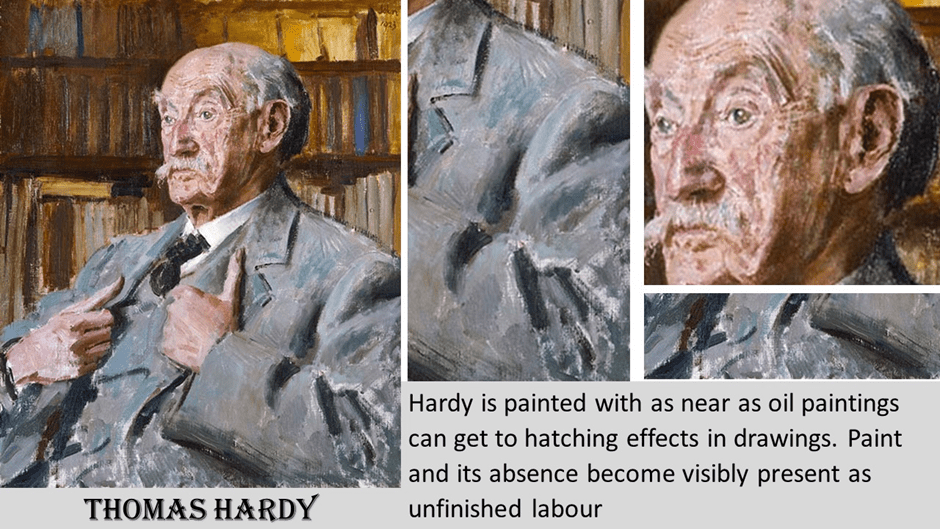
Holroyd says that John says of the sitting for it that: ‘An atmosphere of great sympathy and almost complete understanding at once established itself between us’. Hardy said of the painting that he didn’t know ‘whether this is how I look or not, … but that is how I feel’. [27] I have absolutely no doubt of either of these statements since here is a painting of a rebel without a cause by one. Hardy is painted with as near as oil paintings can get to hatching effects in drawings. Paint and its absence become visibly present as unfinished labour. Indeed John tried to persuade Hardy this a ‘merely preparatory’ painting but for me this is a symptom of John and Hardy’s relationship to each other and the world: something unfinished, wherein cause exists to find what is lacking and address it and those in the world that allow it, for the many, – all those various versions of Tess and Jude that must have haunted both men obscurely.
I have to admit I love Augustus John for his love of people, contradictions about sex/gender notwithstanding.
All the best
Steve
[1] Augustus John [Ed. Daniel George] (1966: 149) Finishing Touches London, Readers Union, Jonathan Cape Ltd.
[2] Wyndham Lewis cited Michael Holroyd (1996: 220) Augustus John: The New Biography London, Chatto & Windus.
[3] Augustus John 1996 op.cit: 149.
[4] Holroyd op.cit: 576
[5] Ibid: 420
[6] Ibid: 165
[7] Augustus John (1952: 53) Chiaroscuro: Fragments of Autobiography: First Series London, Jonathan Cape.
[8] Augustus John 1966 op.cit: 132
[9] Augustus John 1952 op.cit: 37
[10] Ibid: 62
[11] Ibid: 59
[12] Holroyd op.cit: 103 (see 10ff. for more on Sampson at the height of his influence on John)
[13] Ibid: 103
[14] Jane Harrison cited Ibid: 285
[15] Both cited ibid: 278 (note 77 with attribution ibid; 654).
[16] Augustus John 1952: 39f.
[17] Ibid: 107
[18] Cited ibid: 49.
[19] Ibid: 208.
[20] See ibid: 154ff.
[21] Richard Shone cited David Boyd Haycock (2018: 12) Augustus John: Drawn from Life London, Paul Holberton Publishing for Poole Museum & The Salisbury Museum.
[22] See Holroyd op.cit: 241.
[23] Boyd Haycock, op. cit: 36
[25] Boyd Haycock, op. cit: 67f.
[26] Holroyd, op.cit: 121f.
[27] Ibid; 464


One thought on “‘I myself dislike to be dictated to by anybody and am inclined, like Thucydides and others of his time, to be an anarch, or “agin the government” and the lust for, and abuse of, power which invariably goes with it’. Man-made mythic men: the queer case of the ‘rebel without a cause’: an irreverent (and possibly scurrilous) case study of Augustus John (4 January 1878 – 31 October 1961) .”