


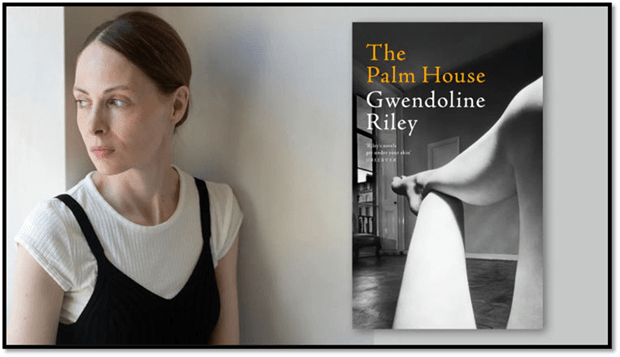
I used to worry about finding out that a novel was not ‘for me’. But you don’t have to like writing just because in its own terms, it is good. This is a blog on Gwendoline Riley (2026) The Palm House London, Picador. It starts by defining that strangeness in the novel that is precisely ‘not the kind of strangeness for me’ anymore. The character, Craig Reid, one of the many lustreless men with whom the narrator, Laura, of Gwendoline Riley’s The Palm House, has lustreless relationships, stands in an open window, touching rather than holding on to its frame. The picture is conjured so that Laura can tell you that ‘it seems to pulse in my mind’. However, what follows is stranger still taking the concept of unreliable narration to its limit: ‘I’ve even wondered if he did fall. If perhaps, everything since then has been a fantasy I’ve conjured. Perhaps I’m actually strung-out in a mental institution somewhere’.[1]
[For links to other 2026 Booker nominees, use this link first}
That scene I refer to in my title is not the only scene in this novel that is ‘framed’ and / or set up as a picture or set of a play. Clare Clark in The Guardian is entranced by the opening landscape setting of the novel, saying:
In the opening pages of The Palm House, London is enveloped in a dust storm blown up from the Sahara. As old friends Laura and Putnam meet for a drink in a Southwark pub, a packet of crisps open between them, the occluded atmosphere renders the city unsettlingly strange: the sky is “dark yellow … like iodine”, …[2]
But what amazes about those opening lines is that the world presented is that of a stilled picture, its only dynamism being the effect of ‘painterly’ treatment, for what we see is not even pretending to be the everyday real, as it seems the fashion to say of Riley: the very brief review in Kirkus Reviews ends: ‘Riley elevates the everyday to exceptional heights’.[3] I only saw one sentence that merited that accolade: ‘The rain fell quickly from a tawny sky’.[4] However, the full first paragraph of this novel is indeed ‘unsettling strange’ but not necessarily in relation to the city itself but to the city as an ‘unsettlingly strange’ observer recreates it as writing;
These were the murky effects: a dark yellow sky – like iodine – and brownish clouds, mounted in flat, extravagant painterly puffs.
The words that strike me is the strangely unsettling manner in which what is described here are ‘effects’, without any sense of what causes those effects and that then launches into a weirdly disorientating scene where landscape effects are ‘mounted’, in a strangely imprecise way especially when we are talking of something that is ‘flat’ but also appears as ‘extravagant painterly puffs’. It is as if we move from a painting as described by Clement Greenberg to one baroque in its staginess and emphasis of the particular effects of artistry. The colours seem as ‘precise’; as people say her writing is, except that the presence of iodine here, which is only yellow in certain environments, and then only in a ‘yellow-brownish’ way.
The name iodine actually comes from the Ancient Greek Ιώδης (iodis), meaning ‘violet’), and that is what is considered the independent colour of the mineral as gas or solution, though encountered in laboratories as yellow-brown compound. Whatever else it does the phrase ‘like iodine’, does not achieve something distinct. In this evocation of landscape, at least, it does not achieve the Riley effect that Kirkus Reviews characterises as ‘episodes and involvements … evoked with visual clarity’. Rather, like iodine itself, it stains the medium onto which it is introduced, indicating what other chemicals are present by colour changes. Indeed colour is an ‘effect’ created in iodine by some other causal agent. And it could be that Riley was aiming for this effect.
As Laura and Putnam move on from Southwark Bridge and are encountered after a pause in the account ‘down breezy Clink Street, past Pickford’s Wharf, with a new tincture in the air now. The streets felt like a shadowy set’, we move from painting to theatre with the town buildings being of a nature of a theatrical ‘set’ made of ‘flats’. And that word tincture, used of solutions of chemicals that function medicinally, especially tincture of iodine, but named after colour effects in the solution, the word itself related to the use of colour dyes. All of this to me evokes a kind of artifice and a mannered style that becomes the focus of our readerly attention. Isabella Gullifer-Laurie In The Los Angeles Review of Books opens her review with a useful analogy where we aren’t in the simple precision of writers like Penelope Fitzgerald mentioned by Clare Clark, but Dickens at his most Baroque- Gothic:
THE FIRST PAGE attends to “murky effects.” A man and woman trudge along Southwark Bridge under “a dark yellow sky—like iodine—and brownish clouds, mounted in flat, extravagant, painterly puffs.” It is a literary fog: a cousin to Charles Dickens’s smoky “London particular” and the meteorological considerations in Middlemarch (1872) that hint at mental weather. In Gwendoline Riley’s The Palm House (2026), the sky is hurricane-whipped from Saharan sand, from drifting fire ash in Spain and Portugal. Laura walks oblivious. “Well, it’s a storm now,” says Putnam. The winds of chance, a quotidian disturbance.[5]
That helps more than Clark to set the nature of the prose that Clark names as like ‘a Saharan dust storm’, continuing with the judgement Riley ‘recasts our relationship with the familiar, transforming ordinary, unremarkable lives of her characters into something startling and new’. This feels like a definition of the uncanny, the specialism of a highly fraught queering of life so that things and events that ought to be recognizable – stories of families, work colleague groupings and so on – are estranged.
Now, in part, this is because Riley’s novel is full of people who [pretend to be what they are because they know themselves in no other manner than as a pretence or a set of pretences. Gullifer-Laurie actually makes this point plainly:
Laura is surrounded by pretenders. Performing for others is almost a sin in Riley’s books, not quite a moral failing but a deadly requirement. Life makes actors of us all. People have a weakness for playing their parts, and they suffer from it. Riley has an ear for people who take this to an extreme, who overdo their roles, who play the ham.
Laura’s mother also “does voices,” framed as the vulgar symptom of a showy nature. She would “call out hopelessly, and in a strange accent, ‘Speak-a to Charlie!’” Her mother is always putting it on:…
Of course her cast is of writers, variety artists and actors – people who involved in the creation of stories and people in them for a living, even when they are literally just living and not working – in magazine or journal production, touring gigs or theatre. Even their characteristics are role played. Chris Patrick is known for his child-like ‘Fank you’ to those who serve him, even sexually, talking like a Dickens stereotype: ‘ “And what is Laura hup to for the rest of ‘er day?” Chris Patrick said – Dickensian again’.[6] Craig Reid, just before he stands theatrically miming a pre-suicidal contemplation of a cruel world is described as able to ‘sit and bask’ until ‘by and by, a course of action seemed to suggest itself to him for the expression of his flickering spirit. He used to strip off sometimes’.[7] Craig introduces her to Lawrence Wells, who ‘was so actorly, he seemed at times to be acting the part of an actor’, often an effect enhanced by nudity.[8]
And if her mother is a stock character so are the literati of the magazines, especially Putnam, who, when he meets Lara’s mother demonstrates a ‘world where sod’s law is the natural law’.[9] But these people are estranged from life because their values are not at all those of the rest of the world but a world where ‘books, poems, plays, all that’ were something that ‘mattered’ to those who worked and lived with them – a formula of Putnam’s as he talks of his friendship with Barry.[10] Putnam’s pet hate was ‘built-in obsolescence’ as is Laura’s.[11] However, he is himself nothing less than the thing he hates – a man from a world in comic, rather than tragic, decline, to be replaced by people ‘with the idea that there should be changes’ like ‘Shove’ Halfpenny, or ‘Shouty Bumcrack’ as his team name him. [12] What then is a world where literature no longer matters or the people who espouse it lazily. It is a world where people have no ‘interest’, where it is not the lack of knowledge that matters, but, according to Putnam, ‘no curiosity either. Loudly enthusiastic, but without a scrap of interest’. And the lack of interest is defined by ‘the demonic dictatorship of the present’, as another literato says.[13] And Putnam is himself defined by a famous literary character – a reader too though a ‘bad’ one; Madame Emma Bovary. In her lengthy analysis of Putnam’s deficiencies early in the novel, Laura wonders how little Putnam has learned from an acquaintance with art, ‘years, thinking, watching films’:
Why should he have learned anything? Was this a way to look at it? Or had he absorbed something else? Was this a sort of bovarism I was dealing with?[14]
Bovarism is a rare word now, which Riley uses without the spelling linking it to Flaubert’s novel, but it equates Putnam, but through the knowledge of classic books, not the mysteries of stage or the ‘painterly’ in art to those pathetic actors that otherwise frequent the novel. Though these people do have curiosity value, they do invoke interest.
I believe that this is the one place where Riley becomes at one with her absurd characters – in a pact that says that the past and its products matter, however poor the grasp of them the people, including Laura, in her novels actually have of that past and its products – even history as represented in her magazine job – but the alternative is worse. If I have in the past not cared for the work of Riley (and I do not think this novel makes me start caring) it is because despite the distancing comedy and mannerism of style, she is a deeply confessional novelist who herself wonders if she has obsolescence ‘built in’ ; that perhaps being the case for all artist solely interested in their achievement of fineness of form in the absence of other overt significance other than the literary or the meta-analytic in art. It is a dark vision that helps no-one. Hence that strange moment when Laura feels she may only invent fiction whilst ‘strung out’ in a mental institution. What a dark vision. Kenan Orhan, her companion on this year’s Booker longlist, is the natural comparison here but this novel addresses real world issues as well as their subjective absorption and the damaging effects of the latter. But nothing there is as dark as this semi-joke, when Laura wonders if she saw what truly happened to Craig Reed as he was ‘framed’ in a window:
‘I’ve even wondered if he did fall. If perhaps, everything since then has been a fantasy I’ve conjured. Perhaps I’m actually strung-out in a mental institution somewhere’.[15]
Now Clare Clark in her first paragraph of the novel cited early in this blog, ends the paragraph with what she sees as an analogue to the opening iodine landscape: ‘…, while the pictures in the evening paper show a “blood red sun”, a “jaundiced” City square, a “prodigious cloud, menacing the Shard”. But this reference is much later in the novel and refers to Laura seeing those pictures in an abandoned newspaper whilst travelling in the Tube. They almost describe visually a world such as might be left after climate change. But are they that? I don’t think they are intended so, but rather as more ‘murky effects’. Gullifer-Laurie is the best on the novel I have read. She says of her conversations with Putnam, which this critic thinks are meant therapeutically:
As Laura explains it, “Our conversations would keep landing there, when I least expected it: it was like falling through a trapdoor into a punishment cell.” This theme of thanklessness returns: “I used to feel, at those times, talking to him, as if I were trying to climb a steep sand dune, while he stood on the crest: exultant in his misery.” In this state of “sheer bloody-mindedness,” she thinks, he has surrendered rather inelegantly to life.
But this punishment cell is very like the place Laura might herself be – continuing to tell literary stories whilst ‘actually strung-out in a mental institution somewhere’. Where is somewhere? I would have to kill you if I told you
That’s all for now
With love
Steven xxxxxxxxxxxxxx
[1] Gwendoline Riley (2026: 114) The Palm House London, Picador.
[2] Clare Clark (2026) ‘The Palm House by Gwendoline Riley review – the laureate of bad relationships’ in The Guardian (online) [Thu 2 Apr 2026 07.00 BST] available at: https://www.theguardian.com/books/2026/apr/02/the-palm-house-by-gwendoline-riley-review-the-laureate-of-bad-relationships
[3] From https://www.kirkusreviews.com/book-reviews/gwendoline-riley/the-palm-house/
[4] Gwendoline Riley, op.cit: 194
[5] Isabella Gullifer-Laurie (2026) ‘Murky Effects: A novel of desire and domestic disorder amid a disintegrating literary establishment in The Los Angeles Review of Books (online) [May 18, 2026] Available at https://lareviewofbooks.org/article/gwendoline-riley-palm-house-friendship-london-novel-review/
[6] Gwendoline Riley, op.cit: 87
[7] Ibid: 113
[8] Ibid: 131
[9] Ibid: 104
[10] Ibid: 8
[11] Ibid: 189
[12] Ibid: 197
[13] Ibid: 199
[14] Ibid: 40 – 41
[15] ibid: 114


5 thoughts on “I used to worry about finding out that a novel was not ‘for me’. But you don’t have to like writing just because, in its own terms, it is good. This is a blog on Gwendoline Riley (2026) ‘The Palm House’. It starts by defining that strangeness in the novel that is precisely ‘not the kind of strangeness for me’ anymore.”