


“If love be rough with you, be rough with love. / Prick love for pricking, and you beat love down.—”. A quotation is a thing used again to make it live, not a thing to save and favour in secret. This blog in honour of Sisu Theatre’s production of ‘Mabel’, a dark feminist fantasy on sex/gender and the death of Mercutio.
Last night I saw Sisu Theatre’s play at the Gala Studio Theatre in Durham enact a 50- minute play written by Madeleine Carter (publicity leaflet above), who also played Mercutio and did both like the artist and scholar of Shakespeare’s theatre that she is. She played Mercutio, its central character, riffing all the way on what you could call the ‘masculine performance’ as a thing at the heart of tbe play Romeo and Juliet, and especially the role of Mercutio, and .ore urvently so in tbis play.
As I write,I remember that I once enacted the role myself in a performance at the then Roehampton Institute, now University, and remembered being noted as having the longest death scene of any Mercutio the director had ever seen. That wasn’t a compliment and I blush rather to tecall it. But I remember rather better the rehearsals where I spoke that line.
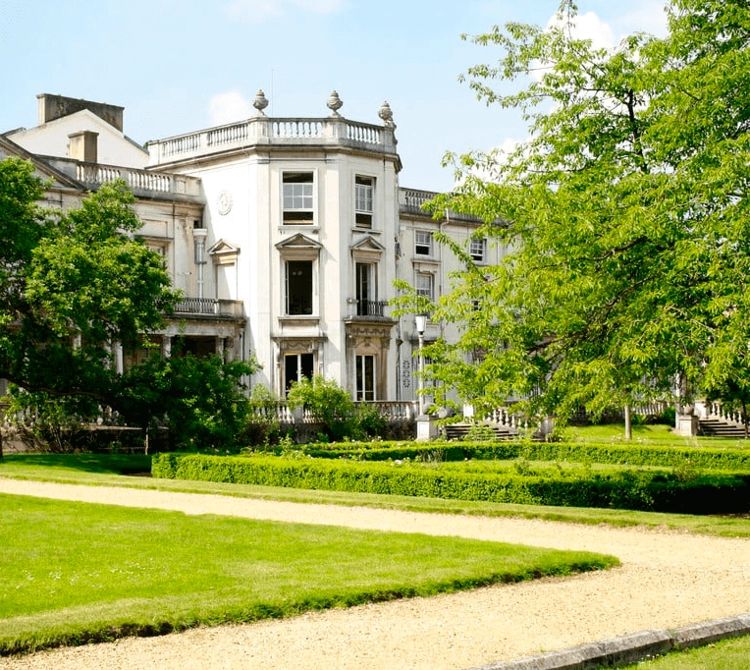
Romeo was played by a young graduate who rightly played Romeo standing on a balustrade on the Parkside frontage of Froebel College, the still remaining central building of the now University (seen in the photograph below) with the place where the scene was played in a partially walkabout production before the scene shifted indoors to the Hall behind the facade, though Mercutio as now dead enforced me to sit the rest out, just behind the lampost visible there, on the steps and terrace of the College’s imposing bow front:
We reached the line where Mercutio advises that Romeo concentrates not on what he thinks is his heart but on his ‘prick’, a favoured pun of Shakepeare being using the verb ‘to prick’ to stand for the masculine thing itself. It’s best known that pun in the sweet Sonnet 20, the greatest poem of the non-binary lover feeling under attack from the first evidence of those who argue for the biological binary, tbough not all as banally as the modrn TERF movement led by J.K. Rowling: the existence of the penis. The sonnet is also used as evidence tbat Shakespeare’s young male lover was named Hugh:
A man in hue, all hues in his controlling,
Which steals men’s eyes and women’s souls amazeth.
And for a woman wert thou first created,
Till nature as she wrought thee fell a-doting,
And by addition me of thee defeated
By adding one thing to my purpose nothing.
      But since she pricked thee out for women's pleasure,
      Mine be thy love and thy love’s use their treasure.
Ro dramatise all this, I thrust my arm hanging in the form of a stiff-necked giraffe with its head hanging downward (as enacted by my limp hand) between his legs from behind to mimic the erectuon of male pride that uses women to return to itself, uncluttered by what its young soul only thinks of as love.
After all, verbally what Mercutio does is take up Romeo’s naive use of the verb ‘pricks’ and manhandles it into full playful masculine enactment of violent sex used against women as a punishment for their ruffling of the male pose into something too soft – a body that bleeds at the prick of a 🌹 rose’s thorn. My play with young Romeo fully enacted the symbol but, on first thrust, it rather disturbed the then innocent undergraduate. Fortunately, we became firm friends afterwards.
ROMEO
Is love a tender thing? It is too rough,
Too rude, too boist’rous, and it pricks like thorn.
MERCUTIO
If love be rough with you, be rough with love.
Prick love for pricking, and you beat love down.—
Madeleine Carter’s script uses that line about men being ‘rough with love’ superbly, applying it to his relationship to both Romeo and the extrapolated (from the imagined personification of desire, dreams and perhaps imagination itself, Queen Mab, in Mercutio’s most famous speech) character, Mabel. Both Mabel and Romeo were brilliantly played by Vilma Kitula (see below for credits from Sisu’s website) who wad also the puppeteer for the loyal dog of Mercutio, who won our hearts from the very beginning.
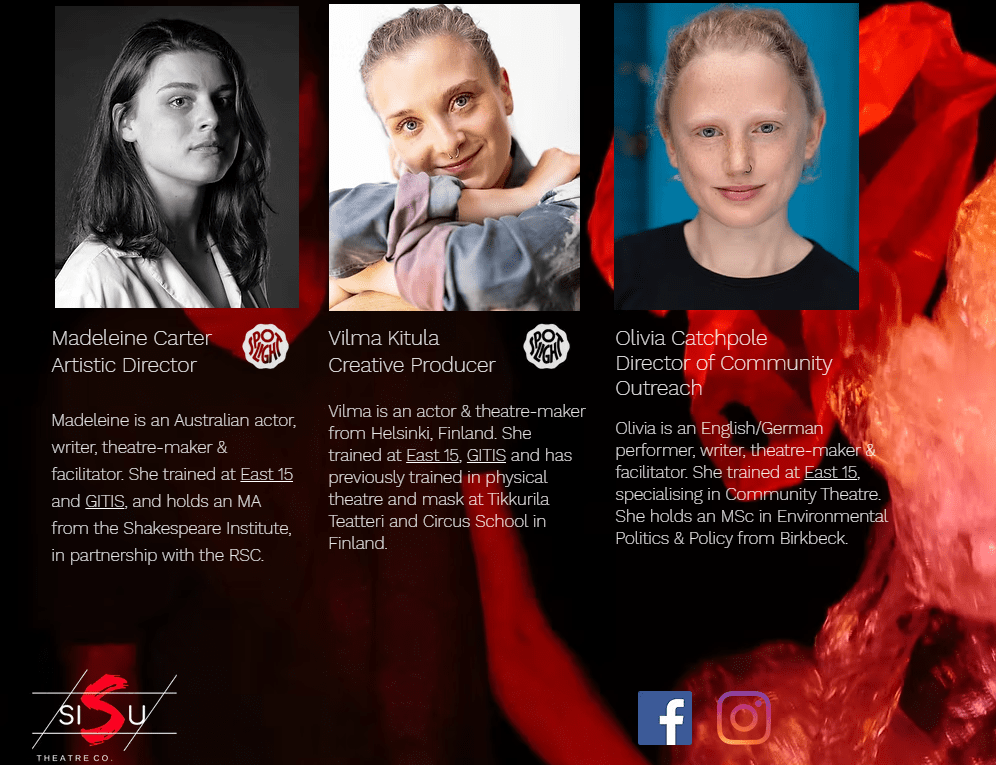
Sisu is very serious theatre, describing its group values on its website thus:
Sisu Theatre is a female-led theatre company founded in 2018 at East 15 Acting School and based in the UK. We collaborate with local and international artists to produce stories that resonate with, educate and empower the community. We specialise in new writing & devised theatre, with particular focus on environmental conservation, mental health and community enrichment. We’re here to start conversations, challenge perceptions and achieve social impact through performance and creative outreach.
There is no profession here of a particular feminist value-system, but make no bones about it, this was fine critique of the masculine performative as if from within, for Carter exploited all her ability to use her own hermaphrodite physical qualities in a tall muscular body with large hands to enact the male performative extremely convincingly. Even her playing down of Mercutio’s inane violence was conducted with brilliance, in which Mercutio tells a story of how he used to share a flat with Benvolio, but hated that because the flatmate would bring animals home, and, once, Mercutio, mistaking two bunnies for novelty slippers slammed his feed own on them and ended their floppy-eared lives. It’s a very nuanced story to tell in illustration of your belief in never hurting animals, because, in rbis case you felt so awful afterwards. But thence is performative .asculinity.
The best examples involved Carter lounging on a stage box- bench with their head hanging downwards or otherwise displaying masculine length and languor speaking of the horror of resing your head on tne cold porcelain of tje toilet bowl as you were sick after a laddish binge. And then recounting tne story of Mabel, made pregnant by you and of your rather pathetic attempts to ‘do the right thing’ until, of course, she lost the baby by miscarriage and loaded away like Quern Mab as you attention turned again to Romeo who was, after all, there for you and bolstered your masculine amour-propre.
Whether I interpret this competently at all I don’t know, for during the performance I was mainly entranced by , what else, but the performance values tested against the emotions they complexly raised within me. This does relate to the play of course as Carter well knows. In Shakespeare, as Mercutio finally dies, taken offstage before doing so, Romeo curse women, and Juliet,now his wife, in particular, for feminising him and ruing the reputation his masculinity performed hard before to attain through his tendency to moody despondency about womankind, like the unseen Rosalind:
This gentleman, the Prince’s near ally,
My very friend, hath got this mortal hurt
In my behalf. My reputation stained
With Tybalt’s slander — Tybalt, that an hour
Hath been my cousin! O sweet Juliet,
Thy beauty hath made me effeminate
And in my temper softened valor’s steel.
Being made ‘effeminate’ and ‘soft’ is the plaint against women sapping men’s steel right up the male Avenger ‘superman’, Andrew Tate and his creed of violence. When I played Mercutio, I little realised the dark side of that man, the Prince’s ally, stuffed with pride of class and gender, oblivious to anyone’s need but his own, though vulnerable nevertheless, as would-be he-men oft tend to be, as dramatised in the TV series, Adolescence (see my blog at this link).
In fact taken back to more of Act 3, Scene 1 of Romeo and Juliet, I sensed it now in ways I had never noticed when I either studied or co-learned the play with learners at Roehampton where I taught Literature. Look, for instance, at the aggressive masculine performance that drives Mercutio via its master star-performer, Tybalt; the first boy to die in the play of its venom. In commentaries on the play much is made of the class insult received by Mercutio at an unintended slur on him that he is a ‘minstrel’, but surely Mercutio picks up a slur on his manhood too from Tybalt’s word ‘consortest’ that drives the minstrel analogy, as if it meant half-man rather than just a group associated with poverty and radical anti-aristocratic politics only.
TYBALT  Mercutio, thou consortest with Romeo.
MERCUTIO  Consort? What, dost thou make us minstrels?
An thou make minstrels of us, look to hear
nothing but discords. Here’s my fiddlestick; here’s
that shall make you dance. Zounds, consort!
BENVOLIO
We talk here in the public haunt of men.
Either withdraw unto some private place,
Or reason coldly of your grievances,
Or else depart. Here all eyes gaze on us.
MERCUTIO
Men’s eyes were made to look, and let them gaze.
I will not budge for no man’s pleasure, I.

Enter Romeo.

TYBALT
Well, peace be with you, sir. Here comes my man.
MERCUTIO
But I’ll be hanged, sir, if he wear your livery.
Marry, go before to field, he’ll be your follower.
Your Worship in that sense may call him “man.”
TYBALT
Romeo, the love I bear thee can afford
No better term than this: thou art a villain.
ROMEO
Tybalt, the reason that I have to love thee
Doth much excuse the appertaining rage
To such a greeting. Villain am I none.
Therefore farewell. I see thou knowest me not.
TYBALT
Boy, this shall not excuse the injuries
That thou hast done me. Therefore turn and draw.
ROMEO
I do protest I never injured thee
But love thee better than thou canst devise
Till thou shalt know the reason of my love.
And so, good Capulet, which name I tender
As dearly as mine own, be satisfied.
MERCUTIO
O calm, dishonorable, vile submission!
Alla stoccato carries it away. He draws.
Tybalt, you ratcatcher, will you walk?
TYBALT  What wouldst thou have with me?
MERCUTIO  Good king of cats, nothing but one of your
nine lives, that I mean to make bold withal, and, as
you shall use me hereafter, dry-beat the rest of the
eight. Will you pluck your sword out of his pilcher
by the ears? Make haste, lest mine be about your
ears ere it be out.
TYBALT  I am for you.He draws.
ROMEO
Gentle Mercutio, put thy rapier up.
MERCUTIO  Come, sir, your passado. They fight.
ROMEO
Draw, Benvolio, beat down their weapons.
Romeo draws.
Gentlemen, for shame forbear this outrage!
Tybalt! Mercutio! The Prince expressly hath
Forbid this bandying in Verona streets.
Hold, Tybalt! Good Mercutio!
Romeo attempts to beat down their rapiers.
Tybalt stabs Mercutio.
PETRUCHIO  Away, Tybalt!
Tybalt, Petruchio, and their followers exit.
MERCUTIO  I am hurt.
A plague o’ both houses! I am sped.
Is he gone and hath nothing?
BENVOLIO  What, art thou hurt?
MERCUTIO
Ay, ay, a scratch, a scratch. Marry, ’tis enough.
Where is my page?—Go, villain, fetch a surgeon.
Page exits.
ROMEO
Courage, man, the hurt cannot be much.
MERCUTIO  No, ’tis not so deep as a well, nor so wide as
a church door, but ’tis enough. ’Twill serve. Ask for
me tomorrow, and you shall find me a grave man. I
am peppered, I warrant, for this world. A plague o’
both your houses! Zounds, a dog, a rat, a mouse, a
cat, to scratch a man to death! A braggart, a rogue, a
villain that fights by the book of arithmetic! Why the
devil came you between us? I was hurt under your
arm.
ROMEO  I thought all for the best.
MERCUTIO
Help me into some house, Benvolio,
Or I shall faint. A plague o’ both your houses!
They have made worms’ meat of me.
I have it, and soundly, too. Your houses!
All but Romeo exit.
ROMEO
This gentleman, the Prince’s near ally,
My very friend, hath got this mortal hurt
In my behalf. My reputation stained
With Tybalt’s slander—Tybalt, that an hour
Hath been my cousin! O sweet Juliet,
Thy beauty hath made me effeminate
And in my temper softened valor’s steel.

Enter Benvolio.

BENVOLIO
O Romeo, Romeo, brave Mercutio is dead.
That gallant spirit hath aspired the clouds,
Which too untimely here did scorn the earth.

[Act 3 Scene 1 Romeo and Juliet]
Carter wrote lines, from the above into her play and delivered them with every masculine performative embodiment imaginable, as if she has lived the role, at least in imagination. It is worth seeing one set of them again:
Men’s eyes were made to look, and let them gaze.
I will not budge for no man’s pleasure, I.
Assertion of the power to gaze and to make our stand from that point of view is very much the Assertion of the male performative that enacts without motion, daring all comers to challenge the ground and space you make your own. This Carter showed by the positioning of their body on a block dais and filling it, without needing those words each time it was done. However she also made full use of the words of the death scene. It has never struck me before how much Romeo ‘s description of Mercutio’s received sword-wound as a scratch of a man not a le to bear such as not quite a man would have hurt Mercutio, who nevertheless makes a joke about how wide and deep a wound might be that others think narrow and shallow,much like themselves:
ROMEO
Courage, man, the hurt cannot be much.
MERCUTIO  No, ’tis not so deep as a well, nor so wide as
a church door, but ’tis enough. ’Twill serve. Ask for
me tomorrow, and you shall find me a grave man. I
am peppered, I warrant, for this world.
As well as using these lines, Carter explains a little later to news of Romeo’s persistent asking of him, where he is by saying something like: “Romeo asked me and I told him where I would be”: in brief, ‘a grave man’, a man in his grave! The point for me is that men are at their most dangerous and most shallow other than in temper when their manhood is queried and/or queered.
But at the heart of the Susu Theatre play is the character of Mabel who is perhaps a part of Mercutio and /or Romeo but whose biology, far from being merely a marker like the possession of the penis is for men in ideology, is to bear, carry, birth and lose children sometimes forced to that sei of choices by men. For Mabel, drunkenly seduced by Mercutio, has a baby to him which she loses and despairs. Now the only clue to Mabel from the play creators is on the leaflet thus:
Mercutio is dead. Almost.
In his fractured mind, a woman emerges.
Is she real or is she imagined?
We need to take the idea of the emergent woman seriously, and her story, including its differences to Romeo, the other target for the dart of Mercutio’s passion. Emergence is a function of combination and interaction so that something new emerges from that process – the woman of which men find it difficult to acknowledge their independent reality and yet essential sharing of some characteristics. For Shakespeare’s Mercutio, Queen Mab is far from fleshed out and capable of bearing children and, if involved in the production of them it is only as the representation of the faulty nature of female desire, as condemned as the greedy desire of male lawyers, to be laid upon by a man for which she will be blamed. Yet she is the ‘fairies’ ‘midwife’, a facilitator of the children of others, not the carrier of the (for good or ill in her own interest, like Mabel. In case you have forgotten the scene (Act 1, Scene 4) from Shakespeare, here is enough of it, beginning at that point where, on the way to the Capulet party, Mercutio hastens the lads on, whilst Romeo feels a sudden need to delay:
MERCUTIO
... . Come, we burn daylight, ho!
ROMEO
Nay, that’s not so.
MERCUTIO  I mean, sir, in delay
We waste our lights; in vain, light lights by day.
Take our good meaning, for our judgment sits
Five times in that ere once in our five wits.
ROMEO
And we mean well in going to this masque,
But ’tis no wit to go.
MERCUTIO  Why, may one ask?
ROMEO
I dreamt a dream tonight.
MERCUTIO  And so did I.
ROMEO
Well, what was yours?
MERCUTIO  That dreamers often lie.
ROMEO
In bed asleep while they do dream things true.
MERCUTIO
O, then I see Queen Mab hath been with you.
She is the fairies’ midwife, and she comes
In shape no bigger than an agate stone
On the forefinger of an alderman,
Drawn with a team of little atomi
Over men’s noses as they lie asleep.
Her wagon spokes made of long spinners’ legs,
The cover of the wings of grasshoppers,
Her traces of the smallest spider web,
Her collars of the moonshine’s wat’ry beams,
Her whip of cricket’s bone, the lash of film,
Her wagoner a small gray-coated gnat,
Not half so big as a round little worm
Pricked from the lazy finger of a maid.
Her chariot is an empty hazelnut,
Made by the joiner squirrel or old grub,
Time out o’ mind the fairies’ coachmakers.
And in this state she gallops night by night
Through lovers’ brains, and then they dream of love;
On courtiers’ knees, that dream on cur’sies straight;
O’er lawyers’ fingers, who straight dream on fees;
O’er ladies’ lips, who straight on kisses dream,
Which oft the angry Mab with blisters plagues
Because their breaths with sweetmeats tainted are.
Sometime she gallops o’er a courtier’s nose,
And then dreams he of smelling out a suit.
And sometime comes she with a tithe-pig’s tail,
Tickling a parson’s nose as he lies asleep;
Then he dreams of another benefice.
Sometime she driveth o’er a soldier’s neck,
And then dreams he of cutting foreign throats,
Of breaches, ambuscadoes, Spanish blades,
Of healths five fathom deep, and then anon
Drums in his ear, at which he starts and wakes
And, being thus frighted, swears a prayer or two
And sleeps again. This is that very Mab
That plats the manes of horses in the night
And bakes the elflocks in foul sluttish hairs,
Which once untangled much misfortune bodes.
This is the hag, when maids lie on their backs,
That presses them and learns them first to bear,
Making them women of good carriage.
This is she—
ROMEO  Peace, peace, Mercutio, peace.
Thou talk’st of nothing.
MERCUTIO  True, I talk of dreams,
Which are the children of an idle brain,
Begot of nothing but vain fantasy,
Which is as thin of substance as the air
And more inconstant than the wind, who woos
Even now the frozen bosom of the north
And, being angered, puffs away from thence,
Turning his side to the dew-dropping south.
BENVOLIO
This wind you talk of blows us from ourselves.
Supper is done, and we shall come too late.
ROMEO
I fear too early, for my mind misgives
Some consequence yet hanging in the stars
Shall bitterly begin his fearful date
With this night’s revels, and expire the term
Of a despisèd life closed in my breast
By some vile forfeit of untimely death.
But he that hath the steerage of my course
Direct my sail. On, lusty gentlemen.
BENVOLIO  Strike, drum.
They march about the stage
and then withdraw to the side.

[Act 1 Scene 4 Romeo and Juliet]
That Mab represents desire (for other wages than of sexual sin alone) is the reason for characterising her as not only a dream but a continual romp through the landscale of sexual adventure. Mabel, the play uses the telling line:
And in this state she gallops night by night
But this is to describe the lurid imagination of women by men, tainted as it is by their fear that men lack the sexual stamina for longevity of sexual performance of women – men like Mercutio and Romeo. Women like Mabel have to find their own way through the frameworks in patriarchy that subordinate them in heterosexual sex, in childbearing, and in the loss of children, which men grasp only notionally and cognitively. And that superiority I think Mercutio understood too to lie in the possession only of ‘a round little worm / Pricked from the lazy finger of a maid’; and there he goes with those hidden ‘pricks’ again.
It’s on again tonight this play and I wonder if I have the energy to go again, having sat enthralled emotionally and in pure pleasure at the performances, including that of the puppet dog, but with not much cognitive enlightenment about the play. I thought re-reading parts of Romeo and Juliet again helped me with me that, but perhaps I missed the point still. But if I lose heart don’t you!. See it tonight at Durham or ellsewhere – perhaps it is going to Edinburgh (I haven’t checked).
Bye for now
With love
Steven xxxxxxxxxxxxxxxx


