Who is the fictional character you relate to the most?
Does anyone ‘relate to’ the Two Peasants Binding Firewood by Pieter Brueghel the Younger, ‘as Moralist and Entrepreneur’ as the Barber Institute of Fine Arts identifies their maker? If not, what could be the use of art that approaches humanity through the making of types, not persons?
I was drawn in a sale at Waterstones bookshop in Durham to an item sold in it for which a lowly sum only was asked in cost. I bought it and read with a little fascination the account of an exhibition held at the Barber Institute of Fine Arts in Birmingham about one painting in its own collection, although the exhibition contained also variants of the painting, including analytic studies of its process in various imaging techniques, analogues of the work by the same artist, Pieter Brueghel the Younger (1564 – 1637/8), and his father, once known as ‘Peasant Brueghel’ or Pieter Bruegel the Elder (c.1526/30 – 1569) – Jamie L. Edwards tells us that he spelled his name without an ‘h’ after 1599 in order to make his name look less Flemish and more Latinate (with other spelling changes as well).
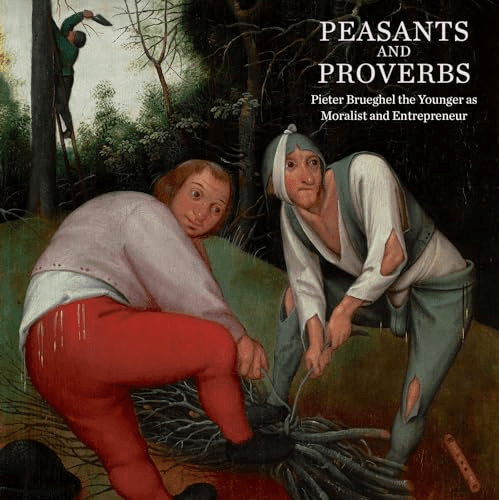
It is a fascinating book about a painting I did not previously know: the book reference being Robert Wenley (ed.) (with writing by Jamie L. Edwards, Ruth Bubb, Christina Currie also) [2022] Peasants and Proverbs: Pieter Brueghel the Younger as Moralist and Entrepreneur, Birmingham, The Barber Institute of Fine Arts with Paul Holberton Publishers (the book cover illustration is of the painting itself). But, given the prompt question I found yesterday, reading this book and examining its main topic, that painting, set me thinking about the issues that gather round the responsibility of art and artists not just to the human figure as a technical challenge to draw to the representation of humanity as an underlying idea.
Of course ‘humanity as an underlying idea’ is hardly a concept that can be thought of as a constant across history but it is too easy as well to say that attitudes to humanity are entirely determined by distinct social cultures that exist in one time-space only, differing by historical ‘period’ and cultural-geographic space, including the concept of nationality and perhaps ‘race’. Doing that means we are taking on board a determinism so profound that it invalidates any attempt to look at art other than through an appropriate but nevertheless constructed lens, pretending to configure the eye and brain in ways that simulate that specific time-space.
Yet art history often takes this approach and this book is no exception, taking the challenge of disputed interpretations of the figures in this painting and what they represent socio-culturally, as in the following from Jamie Edwards as an aid:
… to uncover its likely meanings and significance for early viewers. This will be attempted by exploring its relationship with visual traditions and iconographic conventions definitively established in the sixteenth century by Bruegel the Elder and his contemporaries. The second aim is to examine market factors surrounding the composition’s production. [1]
The determinants of meaning ‘to early viewers’ (it always amazes how such a vague and unspecific term can be an adequate lens for any worthwhile ‘understanding’ of a picture) are then the modes by which art history claims hegemony over meaning by invoking conventions and traditions specific to an age and/ or ‘period’ in any one culture and the inferred reasons for an economic demand for paintings such as the one analysed, in an age where the ‘market’ gives a better idea of what prospective owners of art wanted than to look, as we do in earlier periods at the wants of powerful patrons and commissioners in the worlds of the Church, hierarchies of social power and governance.
So powerful is the force of art history that we can often be fooled into believing that any other way of looking at art is amateur, trivial or only subjectively interpretative, lacking grounds for what it sees in such art. Yet ‘likely meanings’ in ‘early viewers’ are still a matter of inference, even grounded in ‘evidence’, sometimes of uncertain relevance,
Central to Edwards’ inferences is a belief that the use of peasant subjects by the younger Pieter Brueghel was based on a desire to capitalise on the market for his father’s paintings and for the subject matter he made a pertinent focus of art for the rich collector of the ‘modern’ art of his period. Hence, it is unlikely that Pieter the Younger was motivated, we can only infer, by an interest in an idea of humanity in choosing his figures but in reproducing types (Edwards calls them ‘stock figures) he found in art such as his father’s, and the sort of avowed cultural interests those human ‘types’ could be based upon.
The cultural interests of the art connoiseurs he names is that of the folk proverb, formulaic statements about basic nature best represented by those at tne ‘base’ of society: the peasant labourer or smallholder. If this is so, those peasants were related to their owners and viewers, in their finely appointed houses, but only of a human nature from which the bourgeois connoisseur had removed themselves by a refinement of nature that could claim to be a metamorphosis.
It doesn’t surprise me at all that art history has almost canonised refinement, in, for instance the fate of the word connoisseur to indicate a learning through good taste in choices of purchase and the term ‘fine arts’ itself, which goes as far as it can to lift itself above manual labour, craft and a mere living of the relatable likeness of art to shared human values. That peasants could represent morality at its grossest is what suited them to a bourgeois culture looking to understand why its fineness was superior in practically every sense – ethical, spiritual and aesthetic.
Hence, before we even get to Pieter the Younger, we are forced to consider the compelling case Edwards makes for the downgrading of the myth that Bruegel the Elder made art of peasants because he came from peasant stock and was painting his relation to it. At his first discovery by art history in the early twentieth century he was known by some as ‘Peasant Bruegel’. Edwards says that ‘modern art history’ has ‘effectively laid to rest the image of Bruegel the simple peasant’, though one of the reasons that rest is uneasy is that the mythical image was actually first created in the seventeenth century and perhaps fostered by Pieter the Younger’s generation as part of the commodity background to peasant stocked art that was based on proverbial folk wisdom.
That belief actually suited bourgeois preconceptions about class and the hierarchy of finesses and civility. The myth was a product of the first biography of Bruegel by Karel von Mander in 1604 who indicated that ‘Nature’ picked the artist out ‘in Brabant in an obscure village amidst peasants’. Based on little evidence (what there is suggests he was born in Breda, a mayor city, and perhaps to an eminent barber-surgeon, a professional tradesman and gentleman) and was filled up with invention to make up for its omissions. Von Mander’s account was backed up by a engraved portrait of Bruegel the Elder by Hendrick Hondius of 1610 (and probably reliant on van Mander’s prior account). In the engraving (see below), the painter stands in profile back-grounded by two peasants (female and male – one on each side – with their boy’s painter’s palette hung on the wall) .

I don’t doubt Edward’s careful account of others’ research nor that the appearance of all this speculation vastly increased Pieter the Younger’s production of peasant proverbial art after 1604, but the implication of how the argument is marshaled so that it seems Pieter was cashing in on a myth for moralised peasant pictures – full of fun but very much fun based on grotesque typification of peasant life. Now within that paradigm the re-interpretation by the authors of this book has much to recommend it. Here is Pieter the Younger’s painting reproduced.
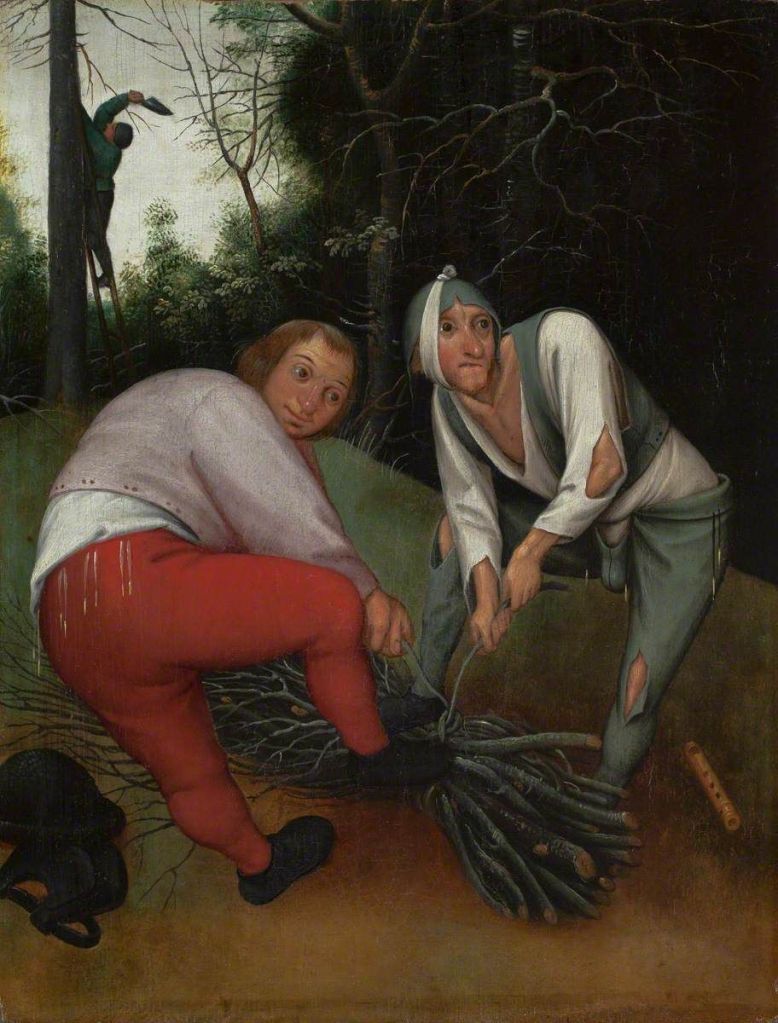
The argument in this book is that the two peasants are stock types of human vices – but very much those that the Flemish bourgeoisie felt lifted above by civilisation. The man on the left has the rotundity of the ‘glutton’, emphasised not only by his thick and fat legs and buttocks, and, red bulbous nose but also the rotund woolly hat and the bag/purse to his left on the ground. The man on the right has a huge codpiece, associated with syphilis treatment, the phallic identity (as well as trivial pleasure-loving lifestyle, indicated too by the fat musical pipe to his right. The rag tied to his head was, Edwards says, a stock trope of the deceptive workshy man with pretended earache (a visual motif found in Pieter the Elder’s Neverlandish Proverbs) and both contrast with the man at work in the background cutting down branches for fuel which these two are stealing. The evidence for that last idea, it is said is that:
both figures have twisted their bodies to turn and face an unseen outsider who occupies the position of the viewer of the painting. This motion, coupled with the startled expressions suggests the two have been caught in an illicit act, an impression reinforced by the right hand figure’s grimace, the original appearance of which is better seen in the Belgian version, which seems to betray discomfort, murmured speech, or both.[2]
The point of all this however is to underline the main point about art in this catalogue – that it is best understood by returning to specific meanings of iconography of the period and of the themes demanded by art connoisseurs of that period, who are more than likely to agree that the lower classes are brutish unless overlooked by them selves or their estate or enterprise managers. It is funny to see the shiftless in action but only because their antics are discovered by the wise who need to know and act to prevent these antics or put an abrupt stop to them. The funny side of being caught in the act would be unlikely to be seen by real Flemish peasants so in need they need to steal wood from thrifty people at labour, if that indeed is what the painting shows. Their reaction ofsurprise at being caught by the kind of people who owned, or visited the owners,of these pictures is unlikely to be just surprise given the severity of punishments in the period, For the bourgeois owner though fun can be had from such discovery – but only when you felt warranted punishment however severe still showed respect for life, inequality being God-given.
Of course morality judgement may be present even in the picture’s composition. Both men belong to the darkened and shaded areas of the composition in the 3 quadrants of it seen in the quartered version below (with natural light represented only in the top left quadrant. But I am not over-convinced that he bandage shows the figure on the right as a malingerer even if there is a similar motif in the painter’s father’s works. For that would not explain the ragged clothing, torn and exposing of this man. There is enough light for us to ‘discover’ these men, even as just witnesses to crime, but I think Edwards description of the pose inaccurate.

He says: ‘both figures have twisted their bodies to turn and face an unseen outsider who occupies the position of the viewer of the painting’. Yes the figures are twisted but their posture is also governed by what seems to be the management of foothold on rising ground, for their gaze looks down on the viewer not directly at. Being ‘looked down upon’ is a radical thing in a painting where we are told that these men are ‘based’, socially and morally. In the case of the man in green (and the other, though more by the position of the iris of his eyes) the gaze is slanted away from a viewer standing in front of the painting, as if to someone approaching from their left side (our right) below them, possibly through the scrub of the wood that had concealed them. Another possibility is that the men do not want to look directly in the face of a superior and thus slant their gaze, but this isn’t the case with the man in red pantaloons, whose eyes open widely and unashamed. The redness of face may be embarrassment but could be an effect of labour. Those eyes are meant to attract the viewer to them. They demand to be noticed..
Another problem with the pictures is the fact that the twist of the bodies is precisely what places the man-in-green’s codpiece in full sight near the centre of the right of the picture. Similarly at the same height is the buttocks of the man on the left, both anatomical parts at the level of the hands about a third of the height of the picture, perhaps at the level of the gaze of the imagined viewer coming up the hill from woods, if not the one viewing the picture. Almost reduced to arse and cock, these men seem to be lifted by their sense they are being intruded upon but there is no sense of sin, error or crime that I find here.
And why should I not see these men not as warnings in a moral proverb against stealing the labour of the hard-working but rather as the hard labour that goes into binding the faggots of wood for carriage – somewhat more arduous than the labour of the branch-cutter, who could be one of their team of labourers. Would rich connoisseurs of art in seventeenth century have wanted such honour cast on peasants, as Millet, and Van Gogh after him, would. Not if the thesis of this book is right. The men have to be both laughable and diminished not pictures of noble poverty – not obviuosly a theme attractive to wealthy Flemish traders, who also collected art.
But I want to see this painting as men who rise above everything that is included in the picture, if it is, to diminish and ridicule them as the most base of men – poor bare forked animals as Lear says. For me, I want to keep looking up to these peasants and neither to doubt their willingness to work whilst in poverty not to see that they can still starve in this situation: ‘a man’s a man for a’ that’. As I see these fictional characters, I relate to them without fat-shaming or using inadequate signs to intuit illness I am told to be severe about, such as syphilis. But some categorisations of art commentary hate the freedom of interpretation I take in doing so, Perhaps they are right consigned to history, as long as they don’t take the art of which these entitled persons claim to own the right of interpretation with them.
I think I’ll put my copy on Ebay of this book.
With love
Steven xxxxxxxxxxxxxxx
_________________________________
[1] Jamie L. Edwards (2022: 15)’ ‘Peasants and Proverbs’ in Robert Wenley (ed.) Peasants and Proverbs: Pieter Brueghel the Younger as Moralist and Entrepreneur, Birmingham, The Barber Institute of Fine Arts with Paul Holberton Publ. 15 – 39.
[2] ibid: 30

