


There is life in the old portrait yet! A visit to the Laing Art Gallery’s reframing of the ‘Herbert Smith Freehills Kramer Portrait Award Show 2025‘
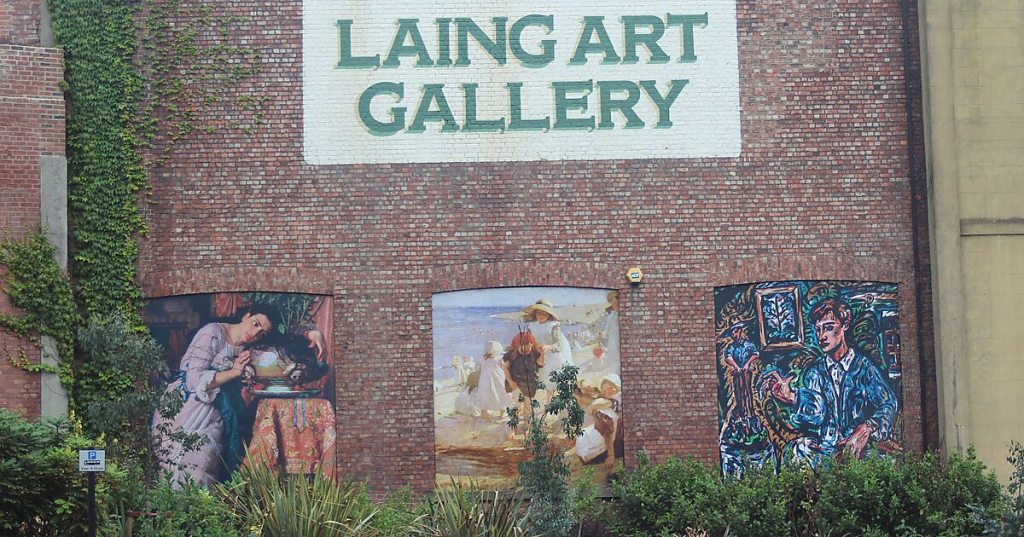
This blog follows on from yesterday’s which reported a visit to The Hatton Gallery to see their new exhibition Lines of Action (see it at this link). The day-trip on the train really was to see the latter but with time to spare. I decided to go to the Laing without knowing whether there was an exhibition to see. All this was fortuitous because I think I would not have chosen to go it without actually having already done the travel. And perhaps that has much to with hard to revise ideas, received long ago in my development, about the li.its of portraiture, even after its pu lic overhaul in tje ‘identity’ revolution, in which new freedoms are said to be asserted in identity preference and / or display. Even now, looking at the prose in tne Laing’s section of the Tyne and Wear Museums site, I don’t think I would have been tempted even with my Art Fund Pass reduction on the entry price, for it is not that but the travel tbat puts me off otherwise. Hete is the infor.ation on tne site:
The Laing Art Gallery will show the National Portrait Gallery’s celebrated painting competition, the Herbert Smith Freehills Kramer Portrait Award 2025, now in its 43rd year. The exhibition will be shown alongside Exploring Identity, a portraiture exhibition curated from North East Museums’ art collections that provides historical context to the Portrait Award.
The Herbert Smith Freehills Kramer Portrait Award 2025 features 46 portraits selected for display by a panel of judges and explores themes of cultural heritage, companionship, sexuality, illness, conflict, and grief. Highlights from the exhibition include a striking self-portrait by artist Moira Cameron, who has been named the winner, Michelle Liu’s portrait, Kofi, winner of the Young Artist Award, and the second and third prize winners are Cliff, Outreach Worker by Tim Benson and Memories by Martyn Harris.
Exploring Identity brings together some of the finest portraits from the Laing, Shipley, and Hatton Gallery collections. Highlights from the collections include works by Francis Bacon, Christina Robertson, Frederic Leighton, John Lavery, Harold Knight, and Arthur Hughes. Also represented are some of the North East’s most famous artists including Norman Cornish, Robert Jobling, and Harry Thubron. In this exhibition, portraits are so much more than just a physical likeness of a person—they are an embodiment of who that person is, their personal experiences, and their hopes for the future.
Neither the institutional pull of a National Gallery sharing its exhibition with Newcastle nor the title Exploring Identity could have broke through my prejudice, partly because if there is an idea I dislike it is that appearance, even in the subtle modulation of art, equates with Identity, the very name an imposition on time of a very metamorphic idea – that of who and what a person is. Moreover, tbe exhibition blurb on tbis very pretension puts me off more in claiming that in: “this exhibition, portraits are so much more than just a physical likeness of a person—they are an embodiment of who that person is, their personal experiences, and their hopes for the future.
Those words cannot truly explain the basis of personhood or our means of its expression- painted figures ate not bodies, even if the use of impasto paints give them volume and density as well as superbly configured surface qualities. Recently people, me included, have thrilled over the attempt to find body in the qualities of paint: in Bacon and in late Titian for instance, but though there is merit in the way that argument goes, which I won’t repeat here, there is none for that regression to the idea that paintings manifest experience or the feelings of tbe represented person,including their hopes.
That last addition is not miles away from the idea of the portrait as a picture of Destiny; in relation to either families or nations whom the figures are said to represent. It is more to do with the dominant discourse about art than art itself, even given that these are necessarily related to, and interactive with, each other. My own prejudice is that visual art is a mode of creating prompts to various senses, thoughts and actions that engage us in the drama of mutual response and interpretation between viewer, sitter and maker of tne art object, in which the definition of personhood, shaped also by contextual space into which the notion of the person fits or not.
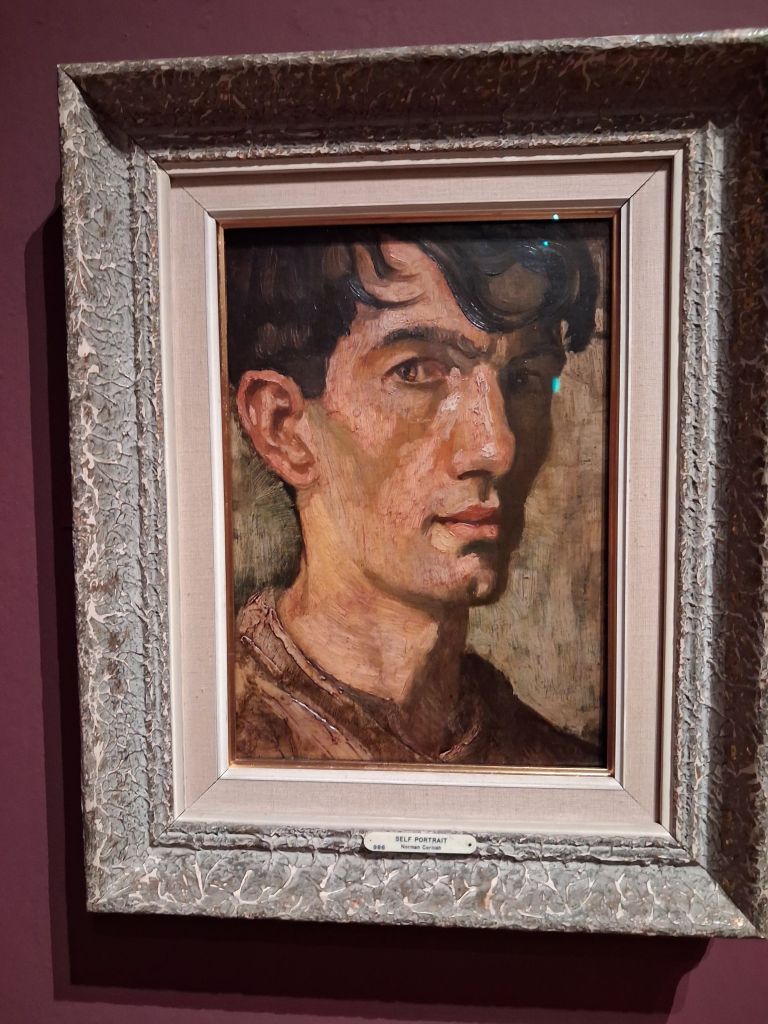
In fact this perspective works well.with tne somewhat contingently structured introduction exhibition; confined to those works to which Tyne and Wear Museums has access, notable the academically motivated collection of the Hatton, and those of rich nineteenth century bourgeois collectors that formed the basis of the Shipley, Laing and other collections. Nevertheless, destiny may win out in terms of this introduction being lead by the self-portrait of the working class former-miner hero, Norman Cornish.
But here, I don’t feel the signals are of someone fitting their framing as ‘fine art’ as it was called then almost universally in academic art departments. Norman presses against the frame that confines, wearing clothes and hair-style indicating his laddish ‘marra’ status. The defiant gaze from the artist’s avatar on himself painting himself, from one eye only as if in the process of turning away from the implied judgement on its visual object and of it on him, and necessarily those of the viewer gazing back, suggests to me a struggle between a self wielding a paint brush in the making of a living and the young miner. This is not the portrait of the artist as much as of that which defiantly claims a status that is experienced the claimant feels uncomfortable about, as if about to a respond to a challenge to his integrity.
The dark marks beneath the challenging eye form a ‘V’ that reminds me of Tony Harrison’s poem V. In which the wrkimg class youth taunts tne over-educated class traitor, Tony Harrison, poet. We turn from this to other paintngs, in which the attitude of sitter, viewer and even patron-artist, since this is believed to be a portrait of the latter’s som, are consonant with pride in art as a vindication of a self who fits into the world, and perhaps has claim to be a future leader rather than follower thereof.
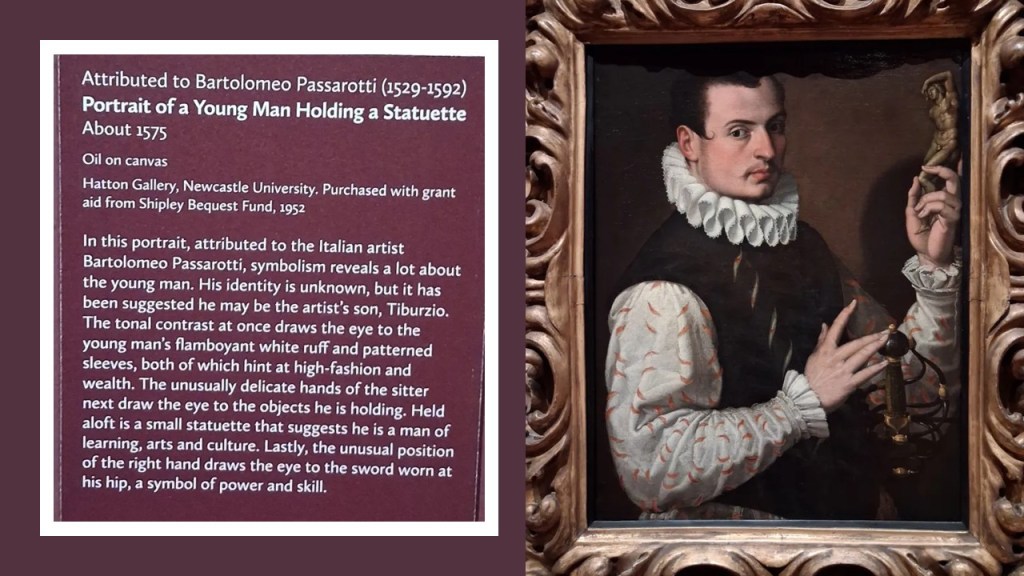
Is it art, wealth, and the personal design capacity both give claim to that we see here, or perhaps it is the power of money and art that commands knowledge of the art of the past in the present and points to a confident future. For me to, there is something about the holding up of young male nudity as an ideal that runs through and invigorated the cult of male rule in the Italian Renaissance.
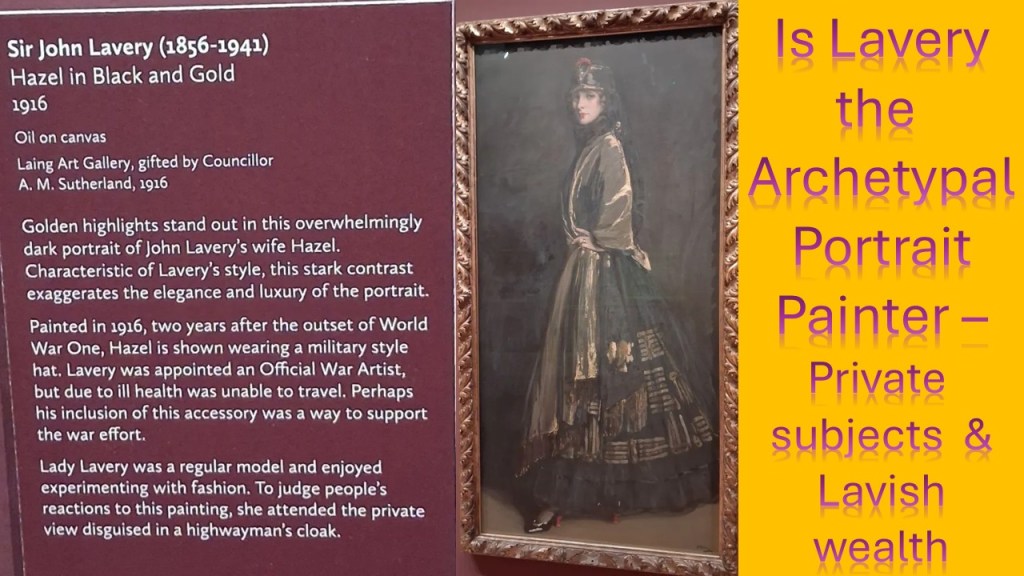
It was good to see Lavery’s wonderful portrait at home in Newcastle (last seen in a retrospective in Edinburgh) for, to some extent he is the archetypal portraits, after Sargent of course, of lavish wealth, taste in arr in clothing, setting and ability to commission a portrait, associated with gold in every sense. It is what turned me off portraiture but in this company, it is a necessary reminder that when we talk of the richness of the colourists (excepting Van Gogh of course), we speak with ambiguity to their service relation to wealth acquisition. Here wealth itself is framed, even in the painter’s wife.
Against this set Francis Bacon’s Study for Figure VI. The wall plaque speaks of us seeing here ‘the unease of the sitter,possibly read as much from our knowledge of gim: Peter Lacy, a violent alcoholic and former air pilot, unable to sustain the pride he needed to sustain his primary male-on-male sexual desires.those desires were as timged with unease that manifested in violence against his male lovers, not least Francis Bacon, who was once thrown out of their shared home’s window, sustaining massive physical damage.
But surely it is not just unease imported from knowledge of the sitter we see here put rather the tremendous lengths the painter goes to to contain Lacy’s figure, swamped by the picture frame but also tightly contained in illusory three dimensional vitrine frame which holds him relatively still, Bacon’s signature settings for violent subjects like Pope Innocent.
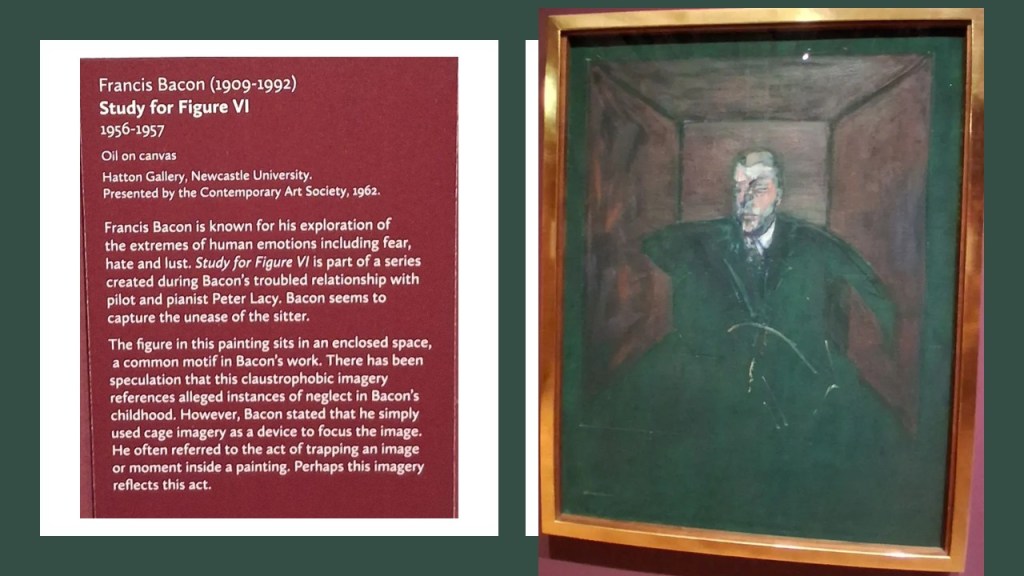
There is a kind of naivety in the idea that Bacon used his interior frame to focus his figure by trapping it, as if this was entirely a matter of painterly technique, for it speaks of the control and resistance that go into the portrait of a relationship, even if it were not a lover, a tying down of tne subject and dressing it with marks of your choice and infliction, as true of Lavery as Bacon.
Bacon’s nearest follower, though entirely different in every way,, Frank Auerbach, is well represented in the Laing’s collections.
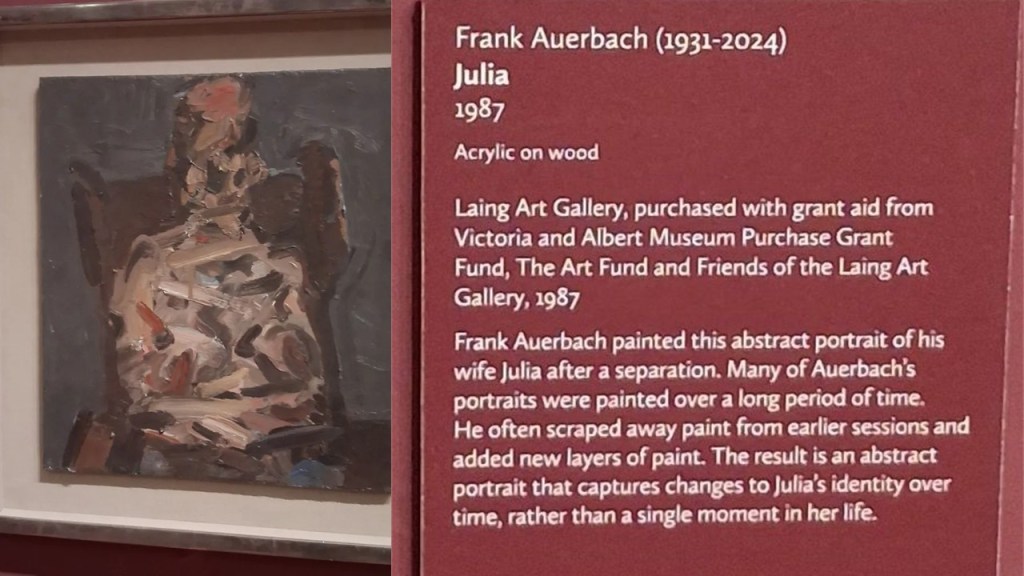
This example, one of many of his wife, Julia, is the darkest example of what portraiture might do in representing relationships of the gaze, marked by a painter’s hand very literally. Julia is imagined, detail scraped away and erased leaving space for overlay of the painter’s choice, design and making. I always forget Auerbach when I think I have gone off portraits, for there is an entire study in his attitude to them, that sits a long way from his friend, Lucien Freud, in nearness to Bacon. As I looked at this I knew I was near to the huge double-door that contained the modern portraits. It readied me for them, as did the last seen, the wonderful self-portrait of another favoured queer artist, Adrian Wizneiweski.
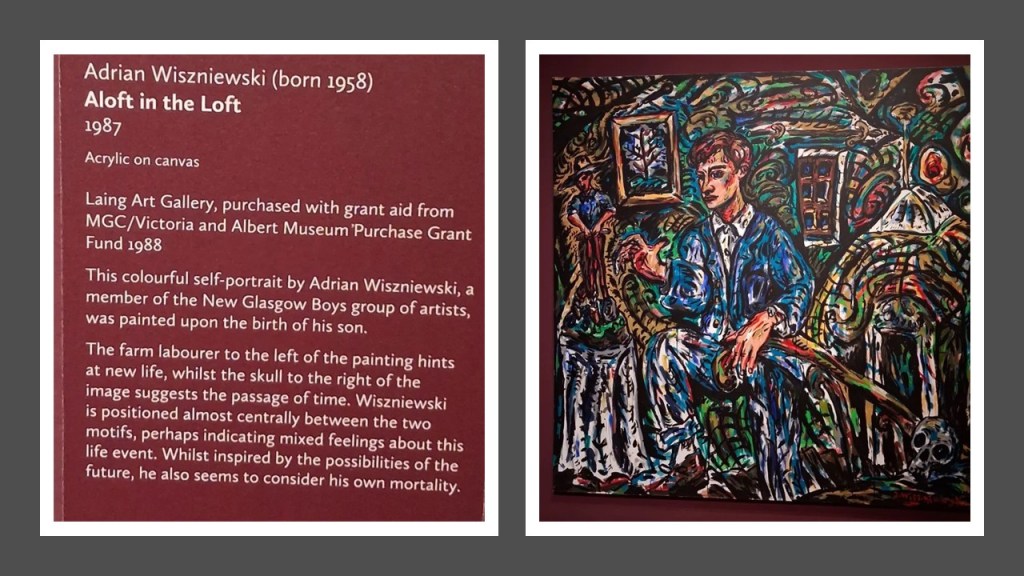
This painting owned by the Laing is so loved it is represented as a highlight on the outside brick wall to the West of the gallery,: see the introductory photograph. Reminiscent in some ways of the Renaissance piece seen on entry, the sitter, the painter himself, fingers a male figure held aloft, while his other hand points to a classical memento mori, a skull. Aloft in a loft says a lot about this painter of troubles and contradictory marks on canvas, in which every relationship is questioned, even to his viewer, who, as it were, holds him aloft as he does the farm boy. I don’t need to think more about this for I want the thinking to continue over time.
As we push through the heavy double -doors to the room with the award paintings, please don’t think I have covered the prelude room of locally curayed paintings. There is much beauty to see there – William Orpen’s self-portrait for instance, and other great moments in portraiture beyond its stereotype in my mind, that often returns until challenged as today. But here we are in fresh modernity – the fruits of the 2025 competition at tne National Portrait Gallery, with the winners chosen. What you see below is the wall facing the door (left in the cillage), the corner of tne east wall (top right) and looking from the door down to tne west wall.
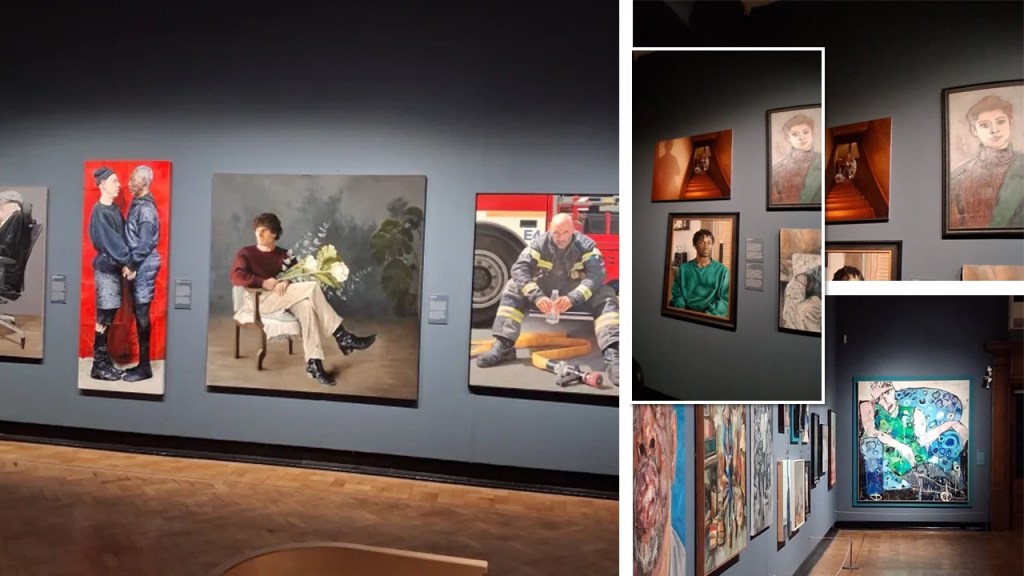
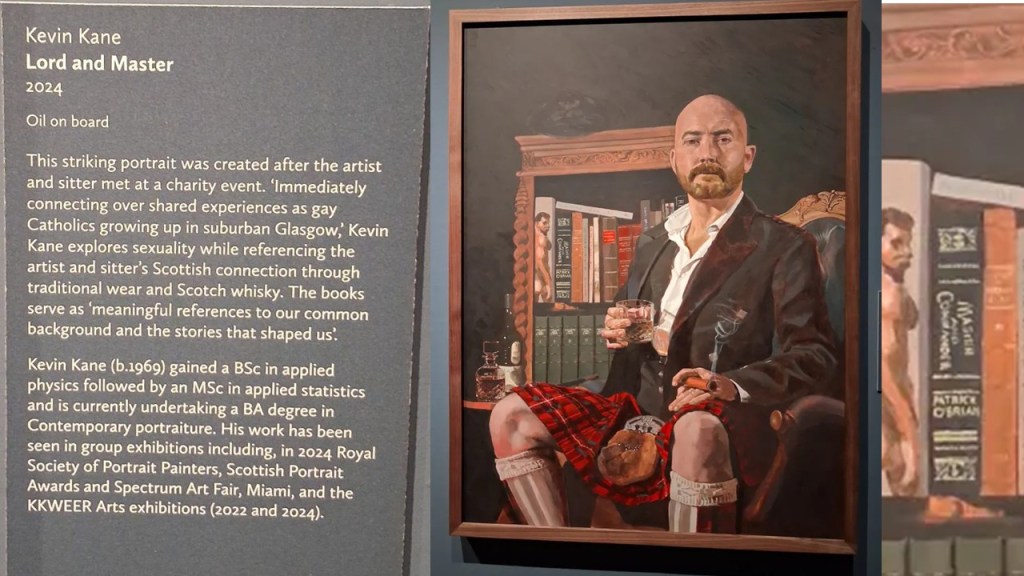
The paintings facing you look like a wall anguished in its masculine protest, centred on a painting of a man holding an enormous bunch of ornamental cabbage flowers. Do see it for yourself. It’s lovely but I don’t intend to linger. Tallulah Hutson wanted it to explore ‘ideas of vulnerability’ and challenge ‘traditional notions of masculinity’ (Amy Emmerson Martin & Luke Uglow (2025: 17) Herbert Smith Freehills Kramer Portrait Award 2025 London, National Portrait Gallery). My choices of favourites will be biased to the need to discover models of queer excellence in painting, such as Kevin Kane’s Lord and Master. Based on a meeting between sitter and artist where both discovered a shared heritage as Scottish queer Catholics, the painting is as near that attributed to Passarotti above, from the earlier room, not least because of the prominent position of the nude male, apparently accidentally poking from the bookshelf behind the sitter (detail reproduced on the right of my collage). It is full of jokes about thevimagery of sex/gender and sexual power, not least the book by Patrick O’Brian Master and Commander , whose title seems almost to comment on the hirsute male nude next to it. Is the smoking cigar that points lewdly from the frame level of the painting, in illusion, ‘only a cigar’ as Freud said defensively they sometimes are, or a phallic symbol, complimenting the open legged look of the sitter, whose groin is represented by his sporran. The stereotypical image of the male ‘top’ (shaved head and facial hair) here plays games with ideas of relative power that run down not to personality but to the imagery of modern queer male sexuality in the context of a traditional social order, where it is unclear what is a symbol of what, if indeed it is a symbol, for in the end, appearance is only appearance – more role than reality and even less a promise or expectation. I spent a long time deciphering book titles but forget to take notes – at my age a great problem.
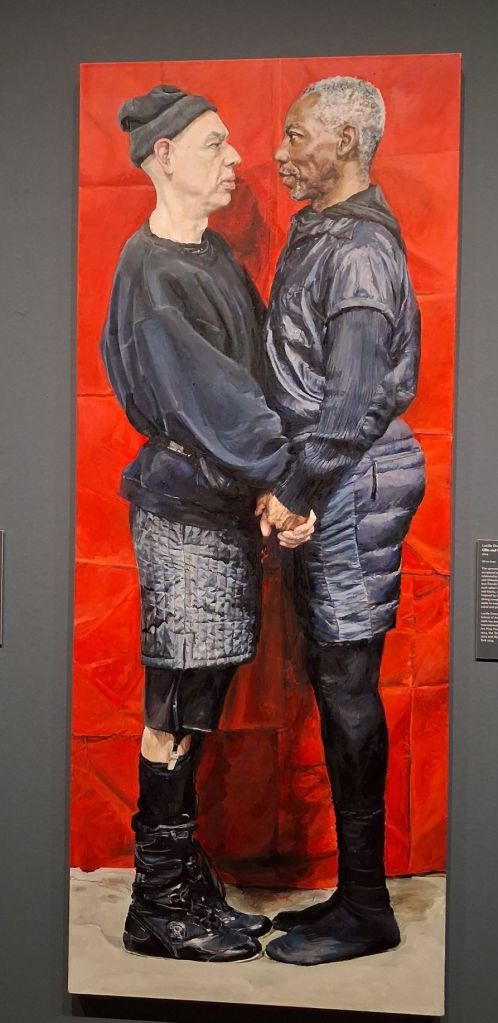
If this picture queries the marks used to indicate power, a painting near to it, Lucille Dweck’s Ollie and Orlando (The New York Couple) in which marks used to indicate social difference, such as that that appears as skin colouration) are used here to indicate equalities and exchange of power between the ‘standers’ – both friends of the artist. In ever way crafted – in the colour-coded dressing of the men and their posture, their bodies describe the space between them as touching points (even of the toe of boots and slippers) and distance. It is an arresting piece full of humour and paradoxical beauty.
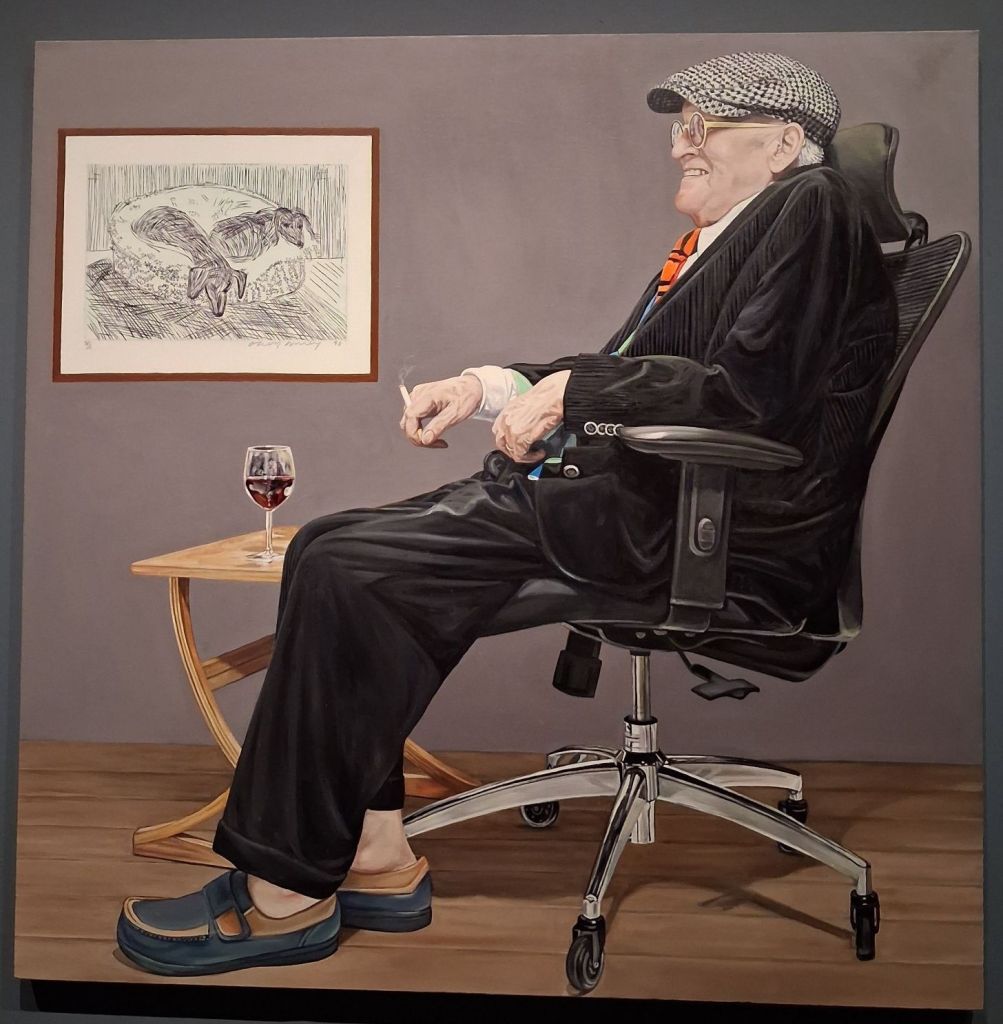
Further west of this is Brenda Ziamany’s portrait of David Hockney called Two Dogs (Portrait of David Hockney inspired by Whistler’s Mother). Hockney died not many days ago so this portrait is the more poignant, but perhaps we miss what we only see if we really pay attention to detailed markings (not really visible in my photograph nor that in the catalogue) for I am told that examined closely one sees ‘Ziamany’s own self-portrait subtly reflected in the glass’, and that this is because this painting is intended to show ‘ideas of community and shared history’ between artists, and imaginatively also, artists and any viewer open to ‘see’ art, as they live with it.Clearly photo-realist, even that style reduces to marks, to show, for instances, reflections og light through a glass half-full of wine.
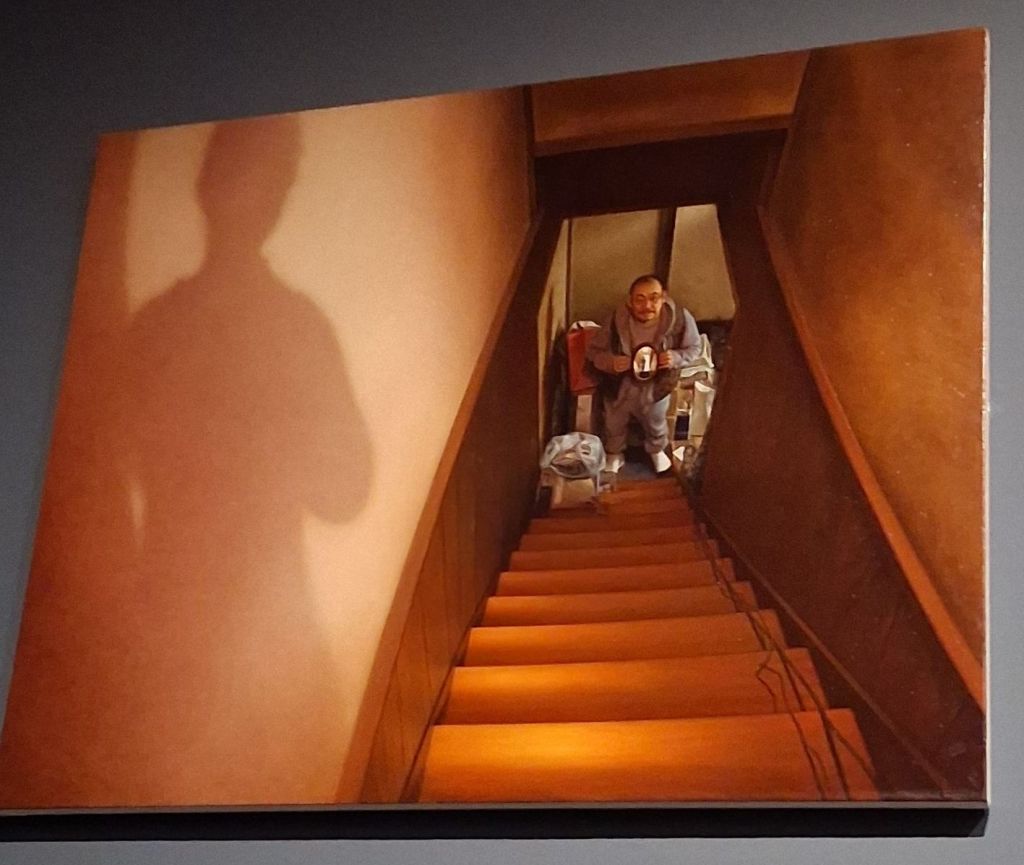
In another picture marking a queer relationship, the artist Shinji Ihara, appears as a shadow at the top of stairs which apparently look down towards his sitter, his life-partner, who is holding a small distorting mirror in which the artist appears in miniature. Called Light and Shadow, it claims influence from van Eyck’s Arnolfini Portrait, that classic study of how a painter’s mark-making uses perspectival illusion to query a relationship, not least between himself and his subjects. Power is clearly the issue here, as the painter’s duality, as reduced in his partner’s hands, and enlarged in his shadow, tumbles into the near impossible-to-imagine visual placing of the couple in relation to each other. Orientation of gaze as well as distance constantly displaces the focal centre of the painting as the viewers attention gets absorbed by peripheral shadows, including that of the artist. Clearly though cleverness alone wins no prizes but I want to see this piece again – i really do.
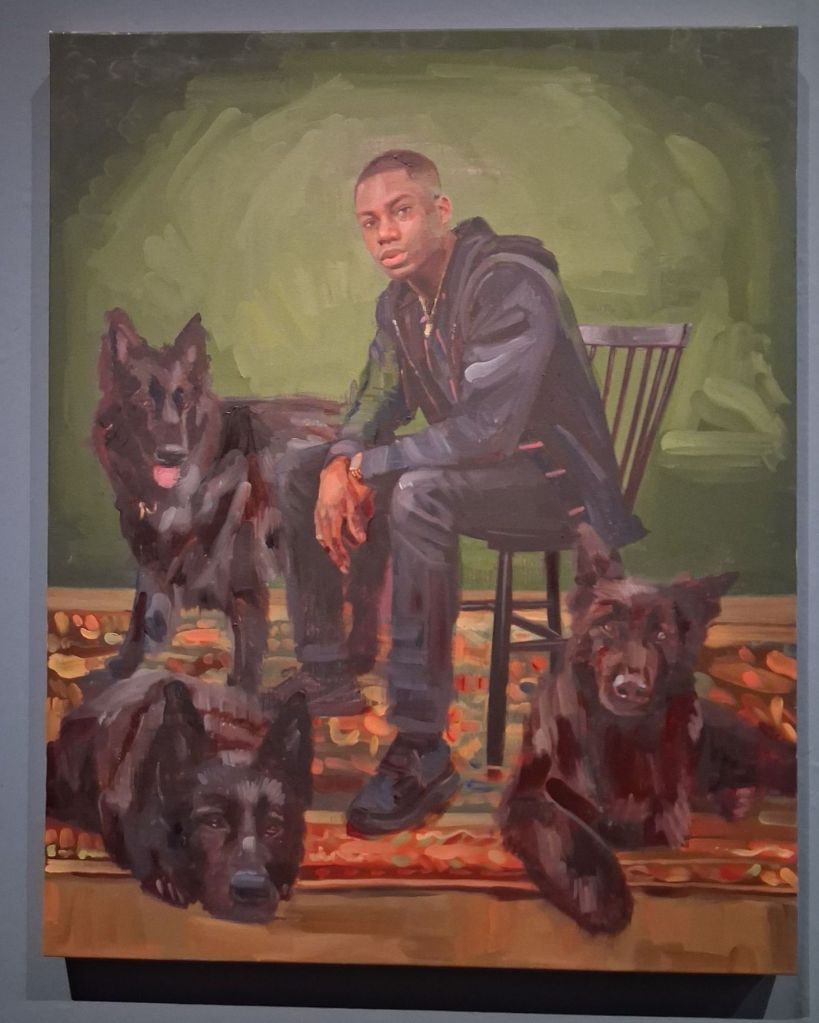
Vulnerable masculine figures figure a lot in this show, as in Ant Carver’s Old Friends and Familiar Faces of a model used by the artist many times since 2020, hence the reference to ‘Old’ and ‘Familiar’ in relation to the face of the boy, although it is also certin these adjectives describe the three black dogs (deliberately meant to be emblems of depression as well as real dogs), whose attitude to the viewer is, as often with dogs on gazing at them, hard to gauge. But as important as that is the ambiguous and unsettled back wall, which seems about to boil out green-lighted substance. The artist’s use of free and obvious huge brush-strokes is clearly a means of unsettling us further, such as the beauty of the young man seems about to be absorbed, whilst the dogs guard him – but perhaps from the wrong enemy. Again it’s a painting I need to see again:
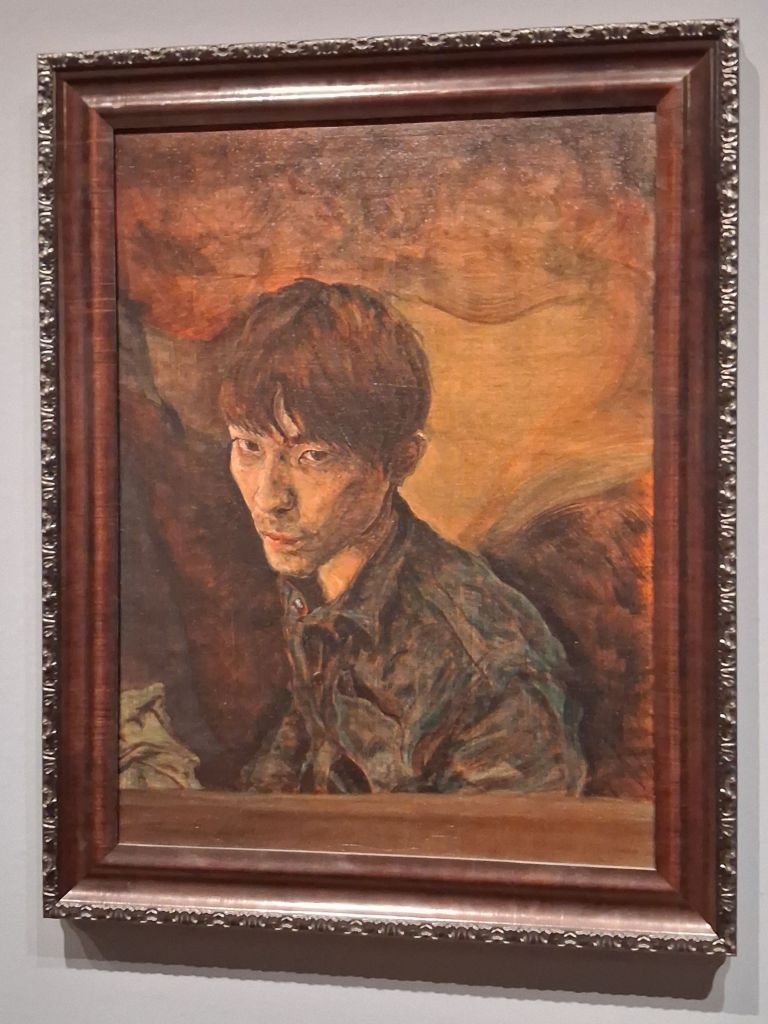
However, befor moving onto the winners of the Award, let’s contemplate other images of the shadowed masculine. Li Ning’s Portrait of K is obviously difficult to photograph for the version in the catalogue is so dark it renders its sitter virtually invisible. Certainly I don’t see what I did in situ and which does appear in my photograph – a background with the look of overlapping washes that might drown the sitter. The commentary on the catalogue says the picture draws ‘the viewer into the sitter’s penetrating gaze’ (ibid: 23). This illustrates again the ease with which portraits often permit rather empty speculation about what underlies appearance created by painted marks. The eyes we see look upwards and their mood can be variously interpreted – is it hope, fear, questioning of the other advancing down on him. Uncertainty, certainly but not penetrating – the whole coding of the look reduces the power of the sitter rather than increasing it to the level of one who penetrates the other – rather, I think, the reverse – the apprehension of being penetrated.
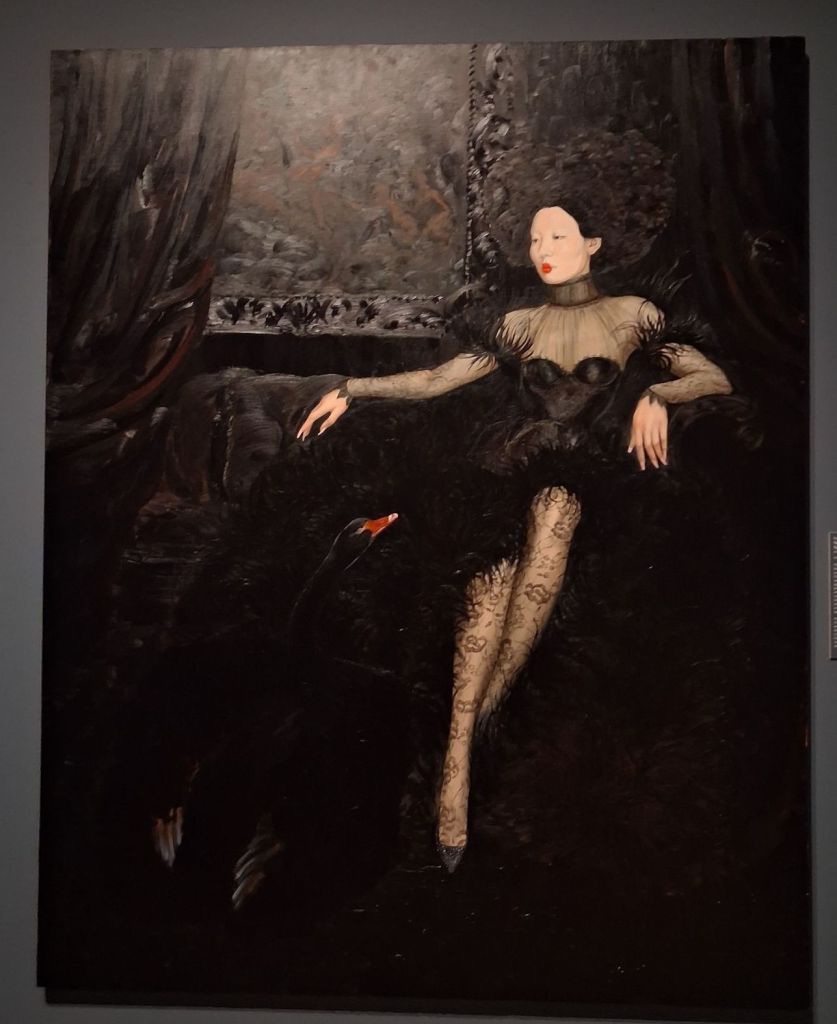
The last piece (before the winners) Xu Yang’s Tangled Waves: Leda and the Swan with Tang Dynasty Style Make-up. You need to see it in the flesh of course, but the whole issue is that of tangled communication channels. In the painting referred to Leda is being raped by Zeus in the form of a swan – her babies will include Helen of Troy. In this piece though the swan’s feathers get tangled into the rich black clothing (reminiscent of Sargent’s Madame X if in Chinese form at her groin to which the swan’s red beak points, the swan looks overpowered by Leda rather than is in the case with the motif in Baroque Art. this leda shed shadow over the black wan, the white tips of his wings pointing vaguely into the light on the bottom left, overpowered by the black silk-nylon covered legs of Leda
Enough has been said to show that this show is a delight – and believe there is more finesses in the rest, so I will only show most of the winners and linger only over the painting awarded 2nd prize. First is Moira Cameron’s A Life Lived.
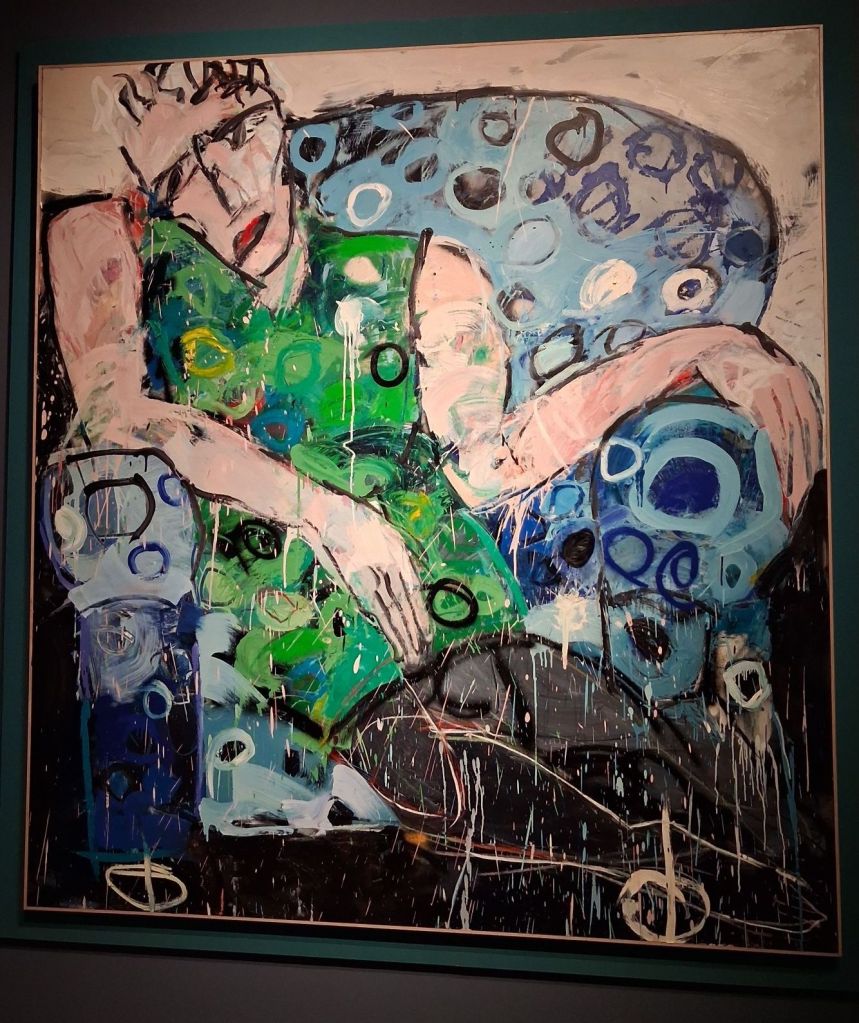
This work feels monumental to me, not least for its combination of techniques and manners of realisation of the figure. Not monumental but beautiful is the Young Artist Award to Michelle Liu for her Kofi.
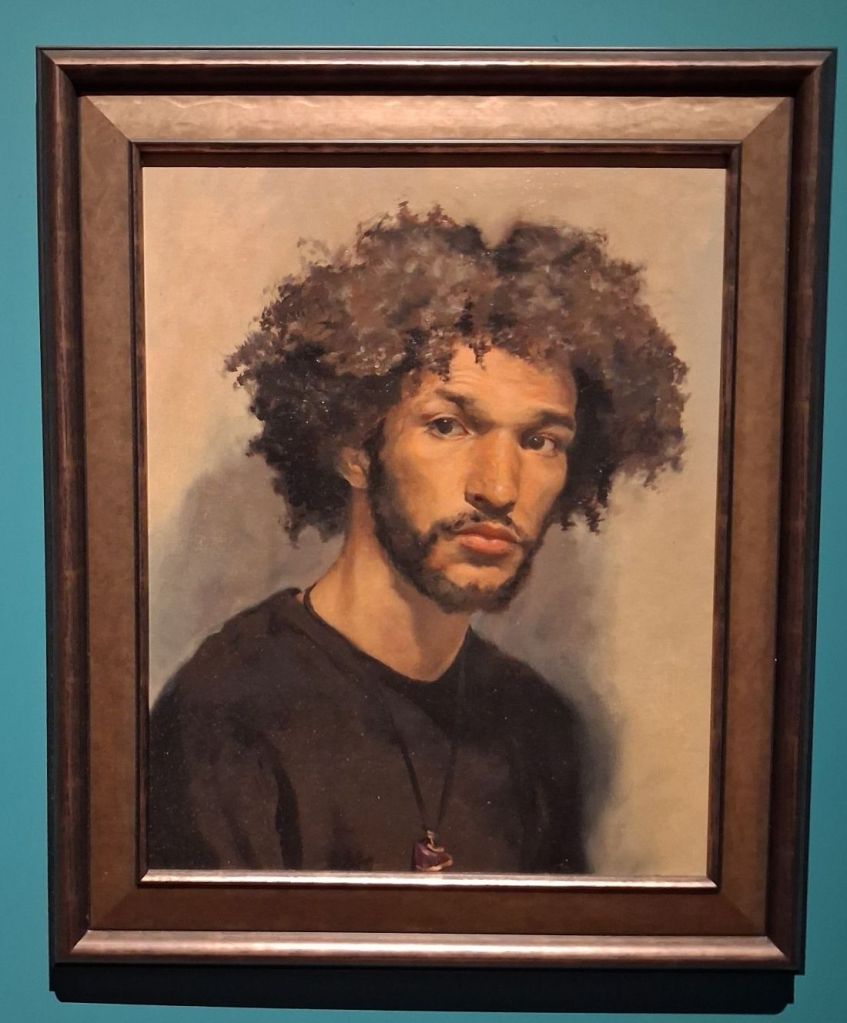
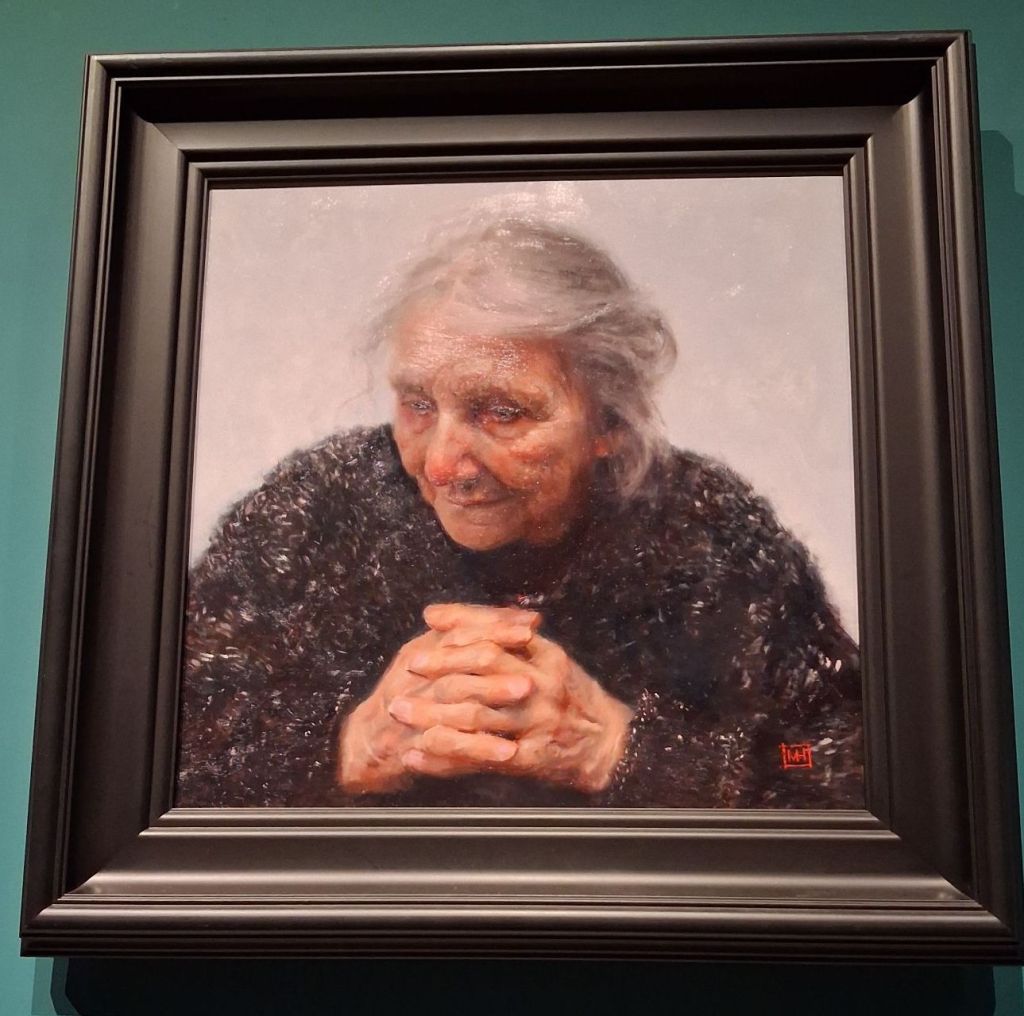
This is beautiful but it also technically brilliant. Though the face (and lips) have sensual volume the hair and bounds of the body melt into their surrounds aided by shadow. I was less convinced by the Third Prize in the main category Memories by Martyn Harris, which has un it everything I dislike about the portrait as a genre. It rather garners stereotypical ideas of aging from viewers in my reading rather than realising them in complex representation, though the redness of the sitter’s cheek and nose might be more subtle than that, but I don’t think so.
But finally, let’s look at the Second Prize painting, Cliff, Outreach Worker by Tim Benson. It works from distance and in close detil. Paint struggles to realise form distinctly in the huge nostrils of Cliff, but the point of marks is not to represent appearance but to complicate it. Cliff doesn’t return a viewer’s gaze – he looks aside at something the viewer ought to be seeing too – at something cruel in the human condition that others neither look at nor as silenced as he is – that huge whit mark over his lips seems to me the absence of speech . The face is composed like a poem might be so that shades of reference rhyme and assonate with each other. I am not sure Cliff wants us to feel good about ourselves. But I will leave him with you. I can’t guarantee he won’t judge you with an authority greater than that of his employers who also call themselves his ‘superiors’.
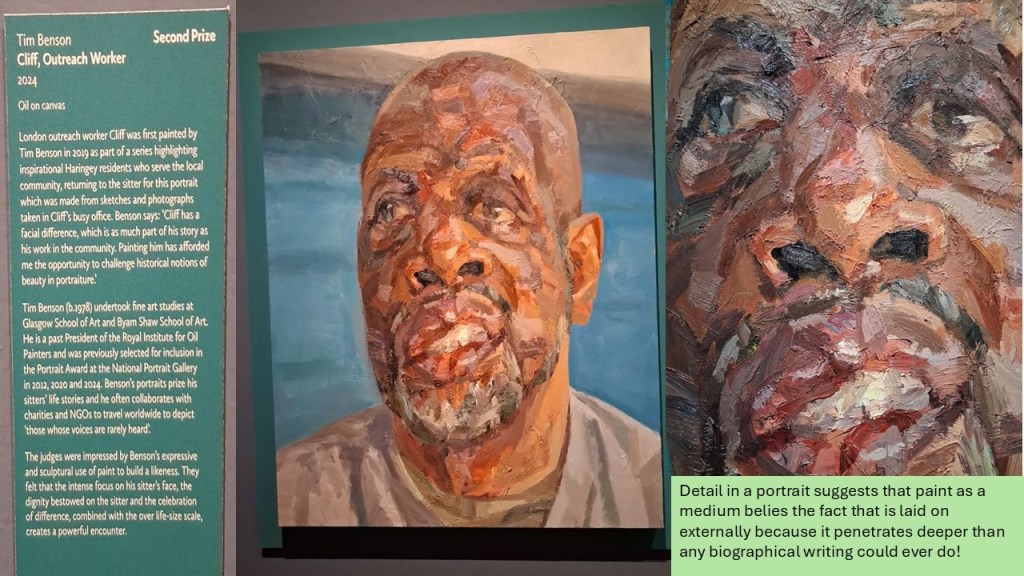
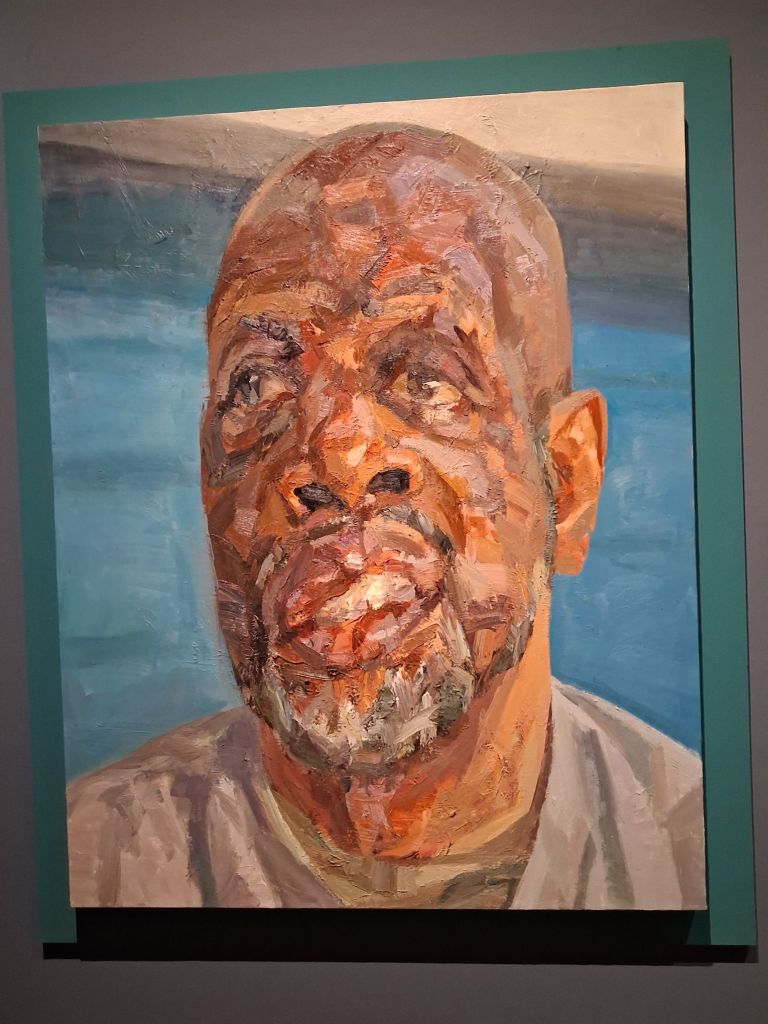
This was a good day, and I think, after all, it was the Laing exhibition that made it so. As for shifting my perspective: if I could see as Cliff does, I would be able to achieve that!
With love
Steven xxxxxxxxxxxx

