


Reframing is defined simply enough in a mental health page at this link. Here’;s the opening. For me, the power in it lies in the avoidance of the oft used but poor term ‘positive reframing’, which assumes that negativity is only and merely a mindset and not a reality in the external factors of people’s lives – and is designed to be of use only for those already well-heeled enough to afford positive bias in the status-quo. Let’s quote the first two paragraphs of that webpage.
Reframing is a powerful cognitive skill that involves viewing a problem, thought, or emotion from a more constructive angle. Unlike simple positive thinking, reframing doesn’t ignore or gloss over life’s challenges. Instead, it seeks to locate a perspective that is both realistic and empowering, expanding a person’s sense of choice and agency.
For example, consider the difference between “I failed at this task” and “This task didn’t go as planned, but it’s an opportunity to learn and improve.” The facts remain the same, but the emotional impact and potential next steps shift dramatically. Reframing is about finding new vantage points that validate the challenge while highlighting possible solutions or growth.
But no technique of thinking alone provides the best way forward: I have said in earlier blogs and lifelong for my own purposes that I think Thomas Hardy’s line from The Dynasts the best guide, for it does not place the negative in a purely mental space, ignoring rather than confronting it. It is often misquoted in order to replace the word ‘exacts’ that is precisely the right word to show that we cannot get anywhere merely by magical thinking alone, the desire without the hard work of seeing what is, however difficult it be to gaze at:
“If way to the better there be, it exacts a full look at the worst,”
Thomas Hardy
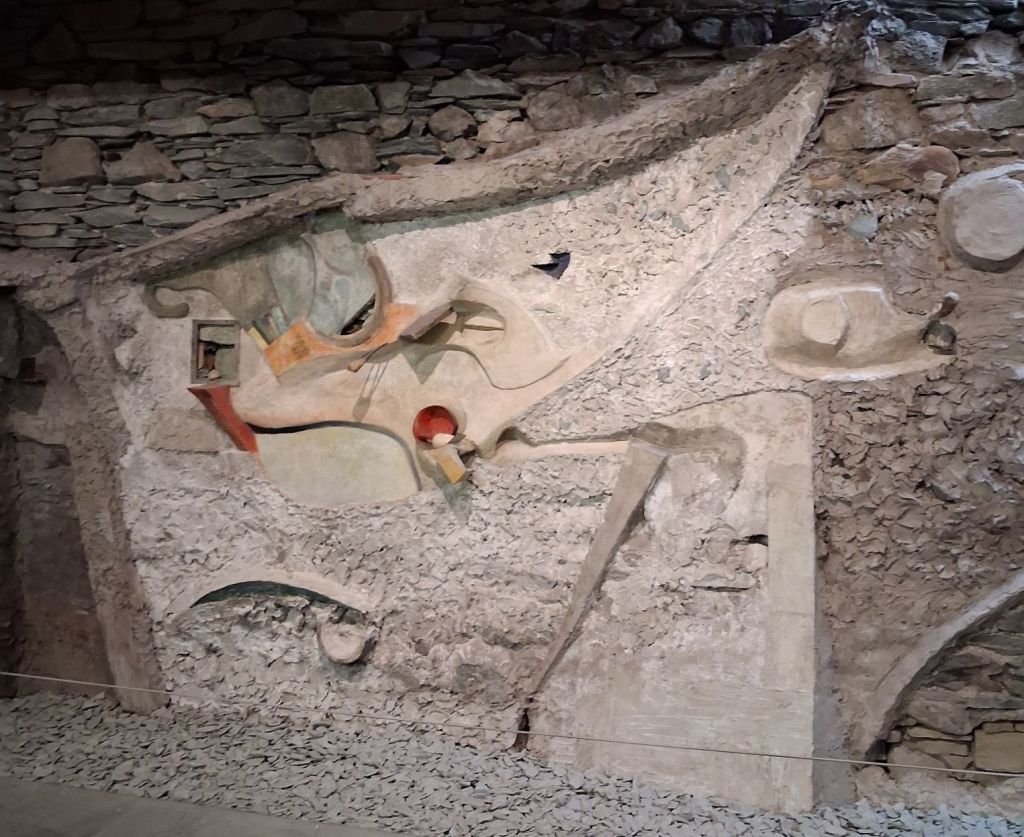
But the reason I want to look at this question was because ‘reframing’ is a metaphor from art, about the choice of picture that tou want to draw a line around (or build a material (wood, metal, or plastic) structural frame around). Frames are thought specific to two-dimensional art but it is clear that since that art itself plays with illusions of additional dimensionality (often attempting to suggest there can be more than three dimensions to objects), they can be reproduced in the content of art within its supposed containing frame – think, for instance of the trompe l’oeil architectural frames inside and outside (for sometimes actual architectural mason built frameworks are made to look as if they were on the cusp of the internal and external) church art especially in the Renaissance as well as Francis Bacon’s use of internal frames in his portraits – the Screaming Popes for instance. Yesterday, I decided to take the train to Newcastle to see the new exhibition (20th June to 1st August 2026) at the Hatton Gallery, the collection, now administered by Tyne and Wear Museums, but located in the department of Fine Art in The university of Newcastle, and the home, of course, of a natural and permanent exhibit, the Merz Barn Wall, the actual interior wall of a barn built by Kurt Schwitters in Cumbria and transported to the Museum to save it from destruction (I have blogged on this in the long past – see that piece here).I photographed the wall again on my way through the exhibitions parts in its two main exhibition halls. It anyway is art that plays with the dimensionality of frames and queers the relation of what is internal and external in and of them.
I had decided to go to Newcastle because framing was clearly a feature of the art on show or so it seemed. The webpage for it says:
The exhibition explores how artists utilise the ‘line’ in its most expanded sense as a central part of their creative process. Rather than focusing solely on preparatory sketches, this exhibition examines the ‘line’ as an organising principle. It highlights how artists use the line to provide structure, create ‘scores’ for subsequent works, record actions, and open spaces for memory.
The featured works demonstrate how an artist’s ‘line’ can organise time, thought, and space. These concepts are explored through a diverse range of media, including photography, painting, collage, printmaking, film, and sculpture.
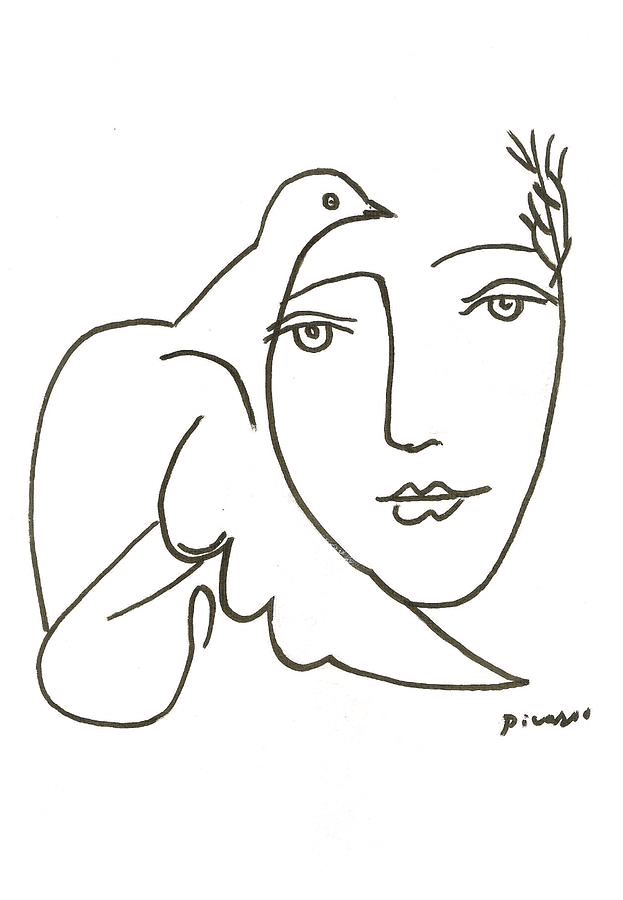
Interesting enough I thought. If a line seems simple, it is not so as ‘organising principle’, but if complicated as a thought, it is a fundamental of perceived and captured reality, for the eye can only see what is within its perceptual field, even though it might go outside its frame to complete meanings from clues in its perceptual vision that aren’t in themselves meaningful. We are used now to not relying on ideas of direct perception, what we see is framed conceptually as well as structurally sometimes by stored types of the things we, and other animals it seems, recognise as objects,- in the case of faces perhaps innately. But art forms because they capture images often go one further, building the thing to be seen within a frame we oft pretend not to see, even – if not always – in sculpture and architecture but necessarily in still or moving photography, painting and finished drawing. It is an idea Picasso often played with, even in highly functional artistic pieces like this concept of ‘Peace’:
However, we don’t always register consciously the lines that drive our framing of experience in ‘direct’ perception of in records of it – where we fall too easily into thinking we are seeing a facsimile reproduction, take this picture from the exhibition website of the north facing wall of the first exhibition hall, which we might think is given to us only to inform us of what might be in the exhibition. How many frames do we see here?
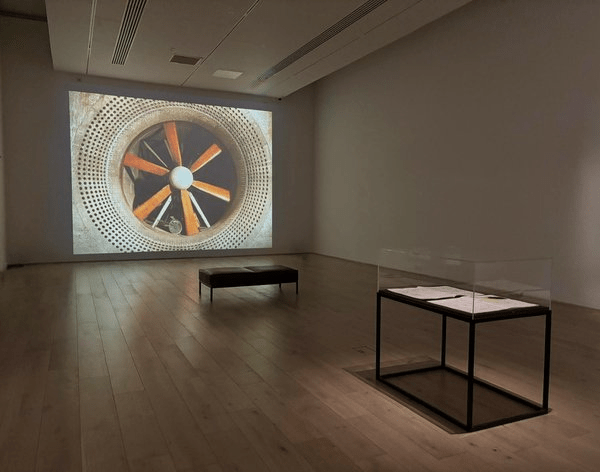
Some pose invisibly like the transparent vitrine frame over the drawn works on an ordinary enough table otherwise, but all this is framed too in shadows cast by light, artfully placed – it is, after all an art gallery,A seat has the same double framing, the room itself is framed twice – one in material, secondly in the illusions ctreated by light and shadow. Floors and ceilings are framed by walls and by their interior lamination or functions, such as air conditioning. A screen showing film is framed but within its two dimensional are pictures of objects with apparent three dimensions, even in their aspect to the eye, and in their patterns of solid and empty space, which might, as in the rotor blades we see in it move against a still frame holding it in place in its circular tunnel frame. The spaces frame figures – figures themselves being framed by lines we equate in solidity as skin and which as ‘wholes’, we sometimes call ‘people’, or frame as conceptual roles – as these who are actors / models dressed as soldiers.
That film, pictured in situ – playing on a loop with no defined beginning and ending – by the way would justified entirely the train trip had I not found delight at the Laing Gallery (of which more in a later blog), otherwise I found the exhibition uninviting. I found some joy in the line drawn cation graphics of ?? But otherwise I felt the art lacked any of the urgency promised by the write up, being more playful than actively making itself felt, sensed and thought beyond the boundaries of the expected. It may have been my fault but neither of the rooms after the first made an impression on me, with perhaps the exception of Simon English’s drawings, about whom the reproduced A4 sheets, in lieu of catalogue or wall plaques in explanation, says that he ‘explores the unconscious as raw material’, evolving works from his desktop to studio walls’.
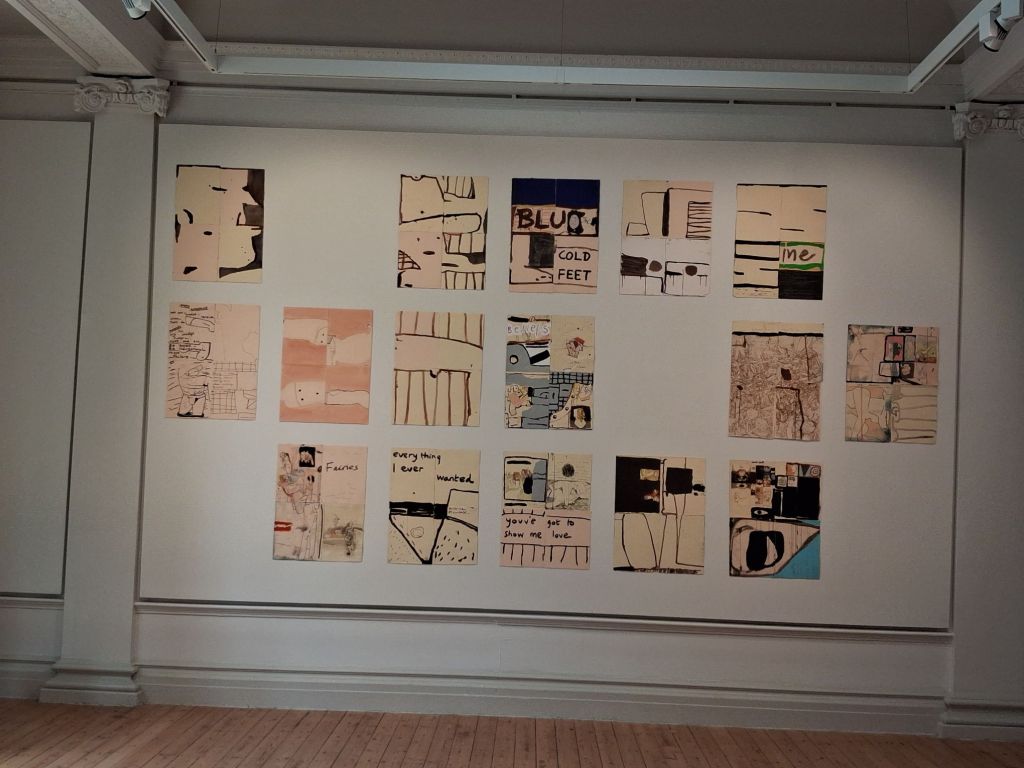
The Unconscious is more easily invoked by explanation than evoked by the art. The major work is represented by a studio wall representing a ‘workspace in constant flux’, which gets further elaborated as a work created by ‘serendipitous matchmaking’ so that ‘individual pieces become aligned to form larger narratives’, with sub-themes organised around statements about Doubles, Fairies and Simple. I neither understood those notes when I read them in the gallery nor now, but above you see the work reproduced, in the resting state it rests in on the gallery wall. Below are details which showed enough to interest me, evoking Cy Twombly and even later queer Art, whether that was their intention or not,:
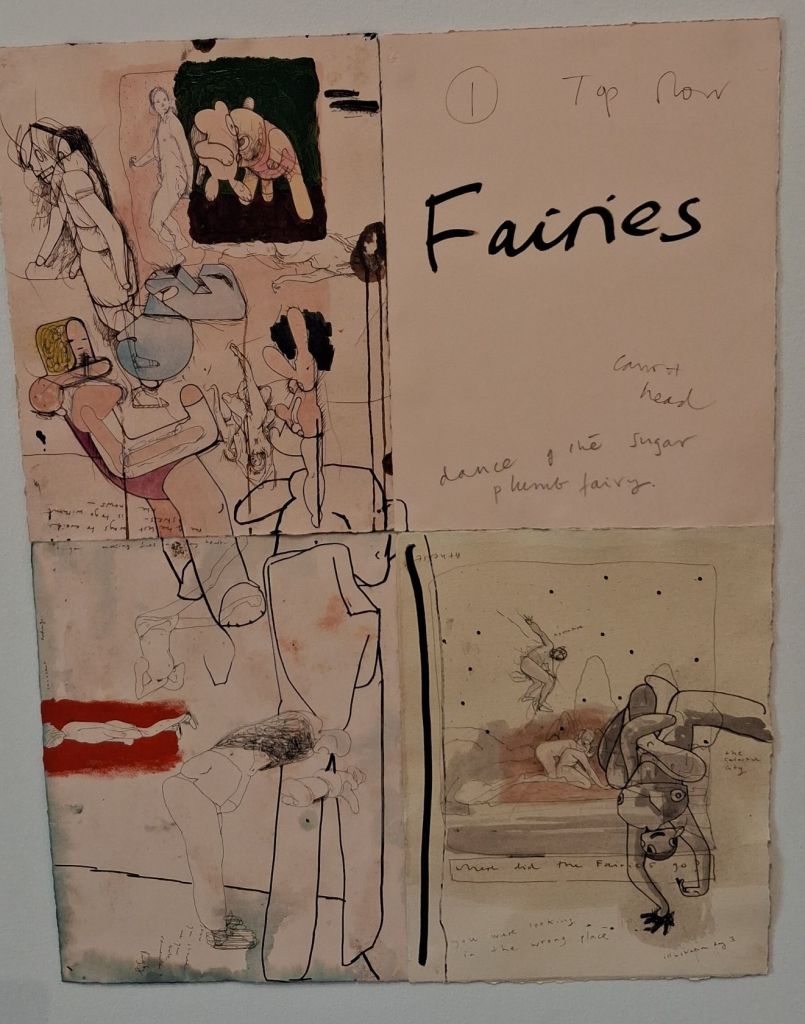
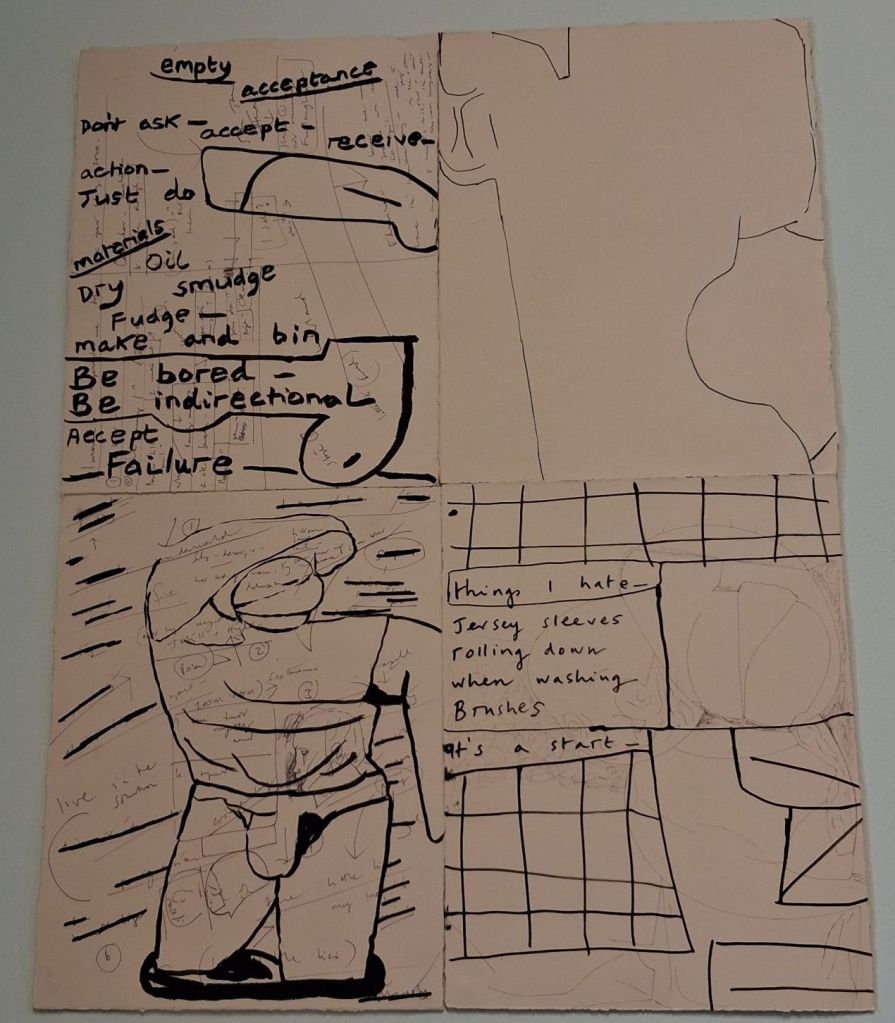
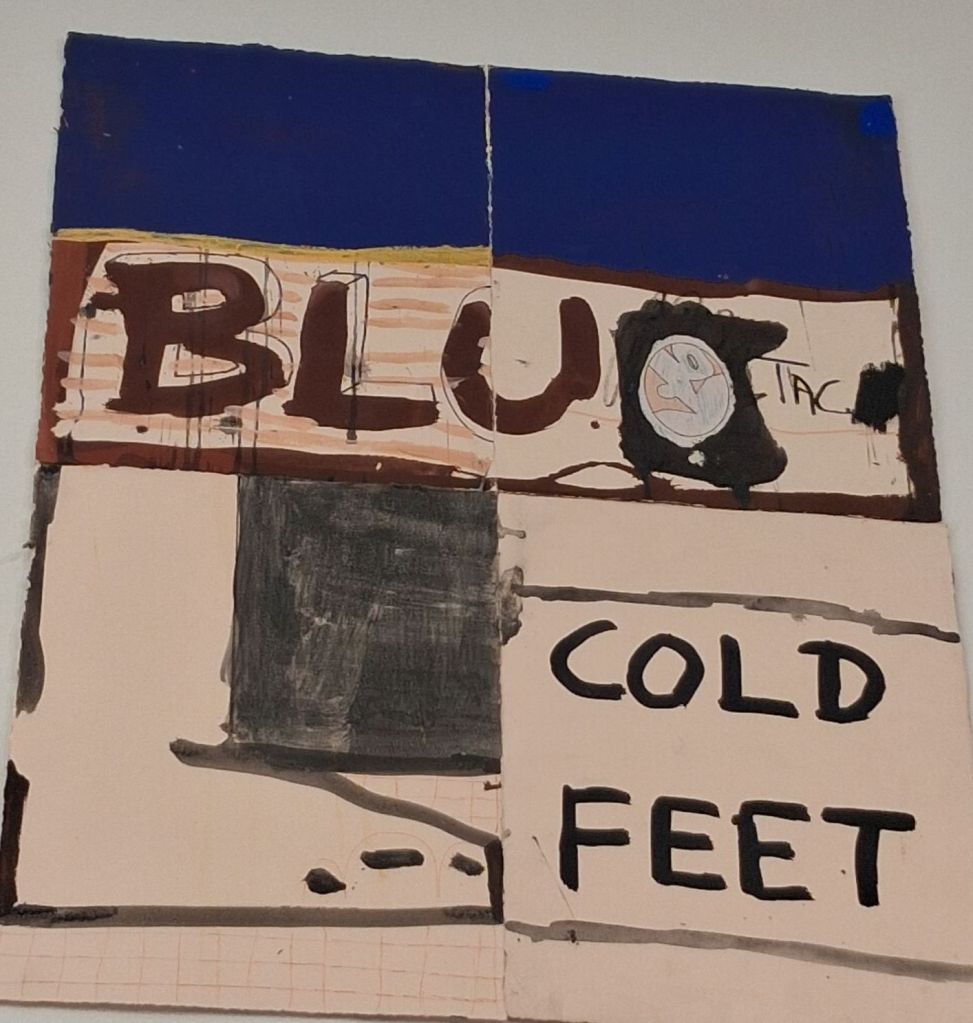
However, though I respect the right of the curator, Professor Louise Wilson (also one of the co-producers of the film of which more later) we are told, and artists right to allow art to speak for itself, I wonder if in most cases with art as based on reassembled fragments as this, this is enough. It makes it worse for me to invoke the Unconscious, for the concept itself is so contested. Guiding our senses is not dominating them. I do hope this fashion lasts not much longer
More so with work based on the supposed transformation of space by placement or or other ‘serendipitous matchmaking’. Take a look at my collage of some of these offerings below:
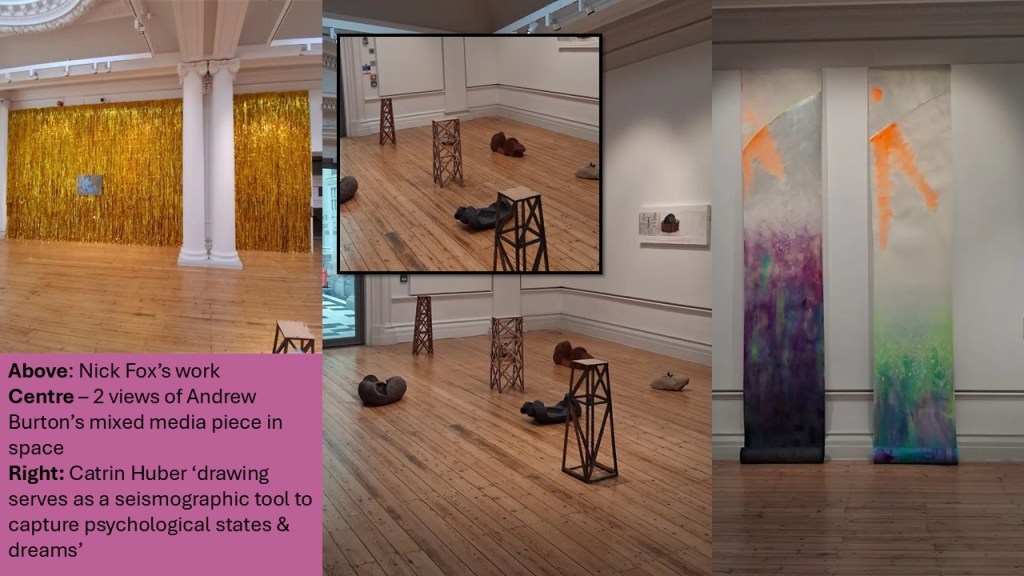
l should have stayed longer with these pieces my photographs suggest to me, but of others, I had little or no incentive to reproduce them. But you must decide for yourself. There is work by Uta Kogelsburger, Richard Talbot, Tracey Tofield, Theresa Easton, Richard Hamilton, Katie Cuddon, Rita Donagh, Lynn Hagan, Wolfgang Weileder and Georgina Starr to which I should have paid more attention.But this is not meant to be a review. I had been attracted by the title Lines of Action given as the theme of the show but Action in particular was missing from some of the marks or conceptually represented that I lost interest and saw only passive mark-making.
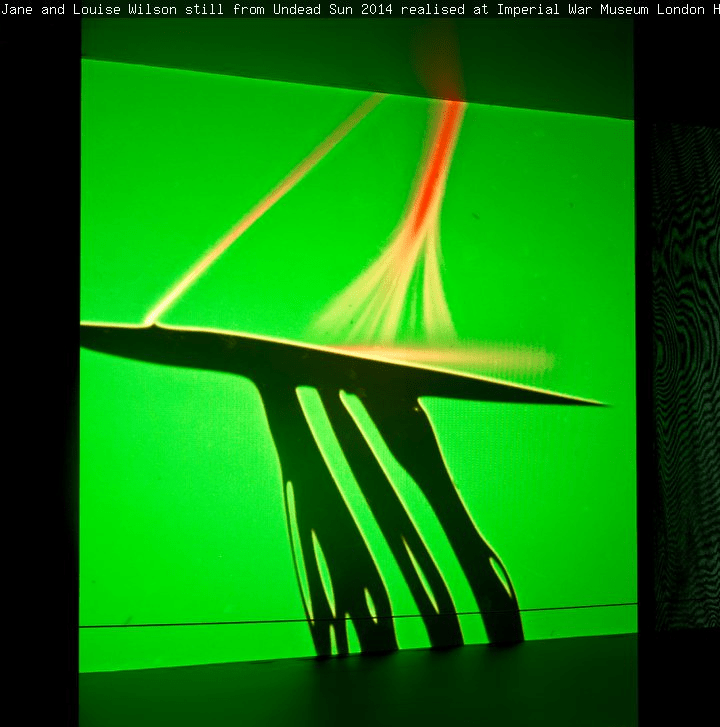
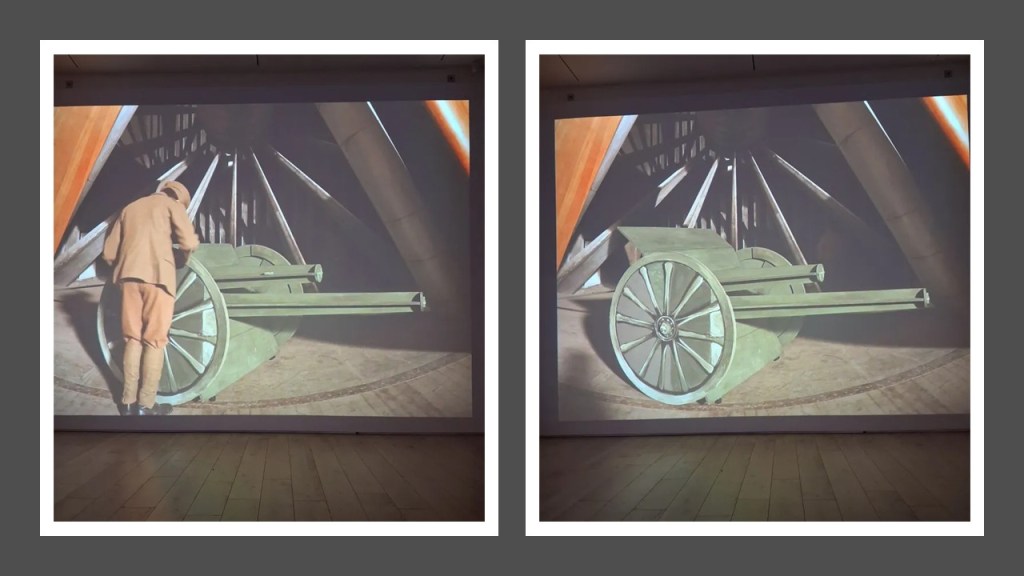
But the star of the show was the film already referred to, called The Undead Sun by Jane and Louise Wilson working together and made for the Imperial War Museumv (IWM). It is not though only because this is a film that I think ‘action’ appropriate to it and the interaction it makes with lines as elements of organisation of space, appearance or structure in time and space. In many ways it manifests the interest I already have in frames as containers in two or three dimensional space. One moment lingers over a textured skin that appears from details to be a dead war-horse, especially lain in grass, its volume half-buried. Though as the camera gaze pans out the material is soon recognized as an imitation of skin in texture cloth and possibly leather, and perhaps there related to a dead animal, although there seems something problematic in the proportions or strange about the seams between ‘flesh parts’. Later we see it resting on an obviously artificial frame semi-circular and with the dimensions of a fantastical piece of tunnel-architecture. Lying by it is the body of a man in khaki war gear. Suddenly he moves, and pulls himself, as it were out of the entrails of the horse, leaving it alone on the stage, its ‘entrails actually a box frame allowing for sniper to hide within it with a surprise advantage against an enemy expecting no fire aginst them. ‘Lines of Action’ suddenly morph in mind to lines created by military action, faced up against each other for the purposes of war – defensive and attacking they are boundaries meant to appropriate the others line in military action. As a metaphor for how lines operate to structure space-in-time, it works brilliantly:
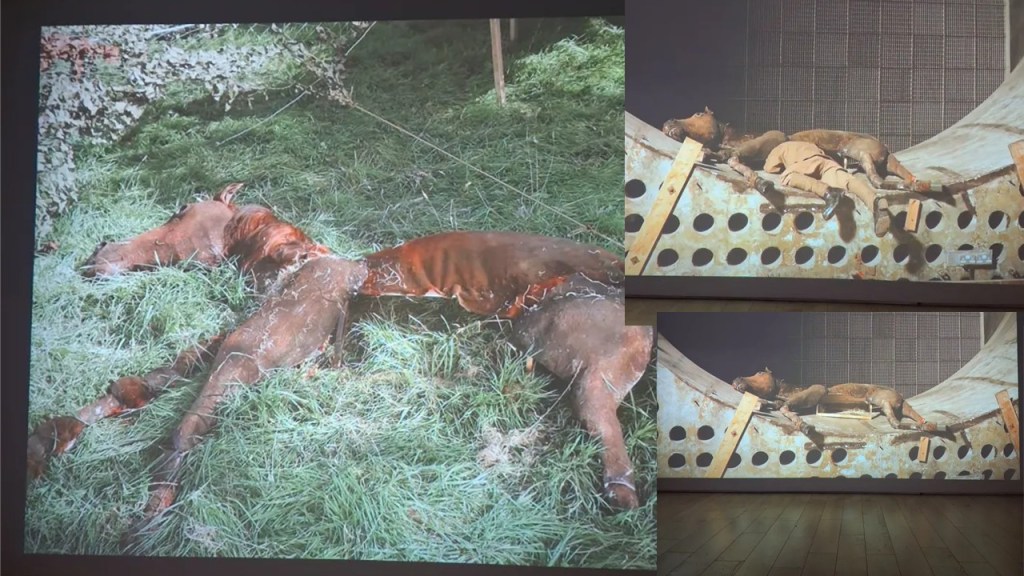
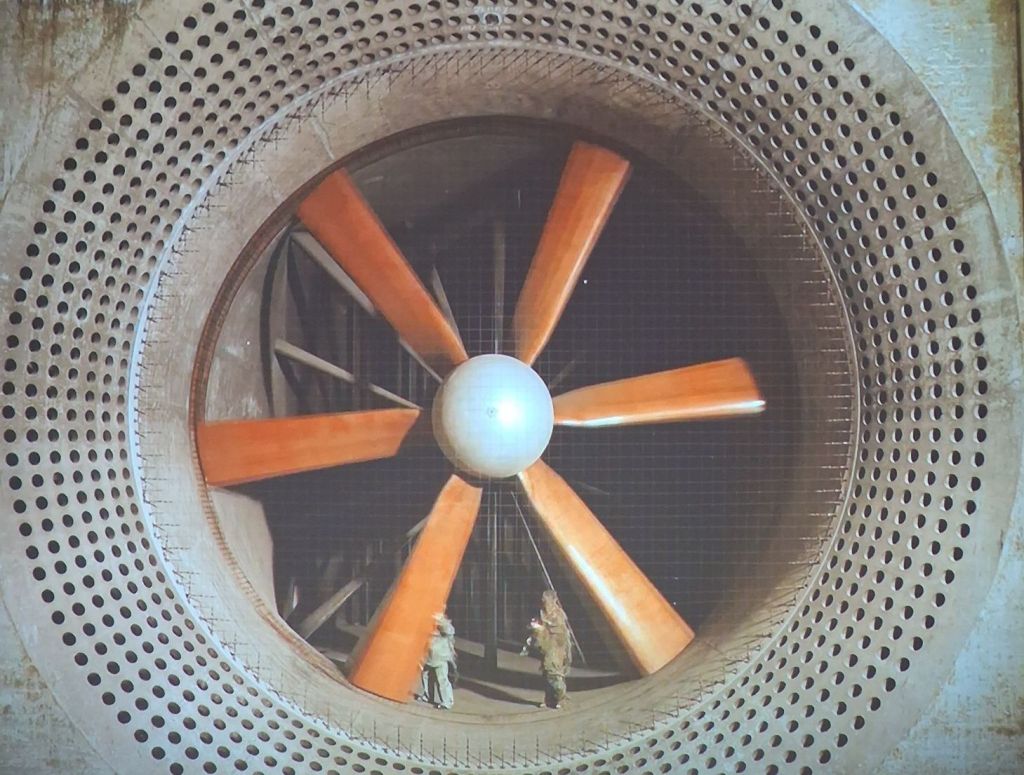
That semi-circular built structure is difficult to identify but one of the many shapes made of lines in two and three dimemsions in action in the film. It recalls a wind turbine, and is, most instances, very much that though turned most often not by mechanism by by the hand of men, soldiers. it acts often as a stage, as it does for the horse and sniper, consolidating that line of illusion theme of the film where things take on roles, wear masks – even of faces, or costume that either masks or reveals. Many scenes are played on such stages – wherein the blades of the turbine act in as frames for spaces for that action – often a space that has gaps in its appearance in motion like the frame breaks in a film were it not played at the requisite velocity. Figures of male soldiers either appear in that space or manipulate it by pushing the blades into motion:
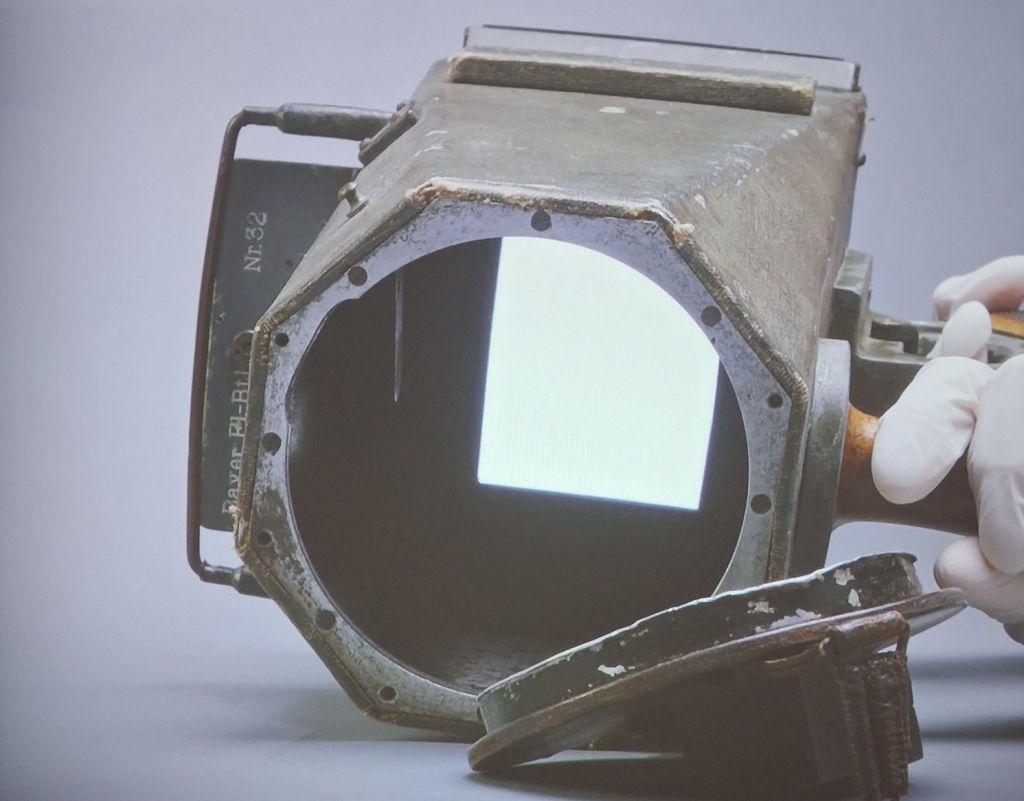
Yet such shapes are illusory in other ways – though huge mechanisms, they are replaced by others that may be tools or parts of machine like tools. The one below mirrors the other tunnel-like pieces with its variety of shaping into straight and curved lines. It is made in this still to look almost like a camera, being looked at, and perhaps looking back at the camera that films it. In fact the photocopied notes from the Gallery contain a brief essay by Melanie Vandenbrouck on the film points out that this has something to do with a paradox of war, that destruction brings progress – though both partake in the nature of other, Of the next still image (of a German aerial camera owned by the IWM) I use, she explains that:
the violence of the gaze is emphasised by the camera’s design: its handle is based on the shape of a gun, to make it easier to operate in flight.
, there is Though the wind turbine has an apparently circular shape at its frontage, it has, as we will see a regular many -sided shape within its tunnel, rather like the octagon that forms this tool’s (let’s say) outer casing.
A persistent returning image in the film is the interior of the turbine’s wind tunnel, entirely dark but for a light held by a dark male figure, invisible but in outline at first, whose huge torch-light catches the straight sides of the octagon’s walls, that light oft shales into a circle. The reflected colour of the walls creates shadows of colour like a halo around the man as in scene after scene, oft with breaks between, he progresses to wards us – presumably at the dark mouth of the tunnel with his blinding torch. In later scenes we see tangled barbed wire at this mouth. When the man reaches it – a well-built bearded man – he disrobes spreading his discarded clothese on the barbed wire, in ways that cover over his nakedness in part, as he fronts us as his pants are finally laid on the wire and as he turns and retreats back down the tunnel.
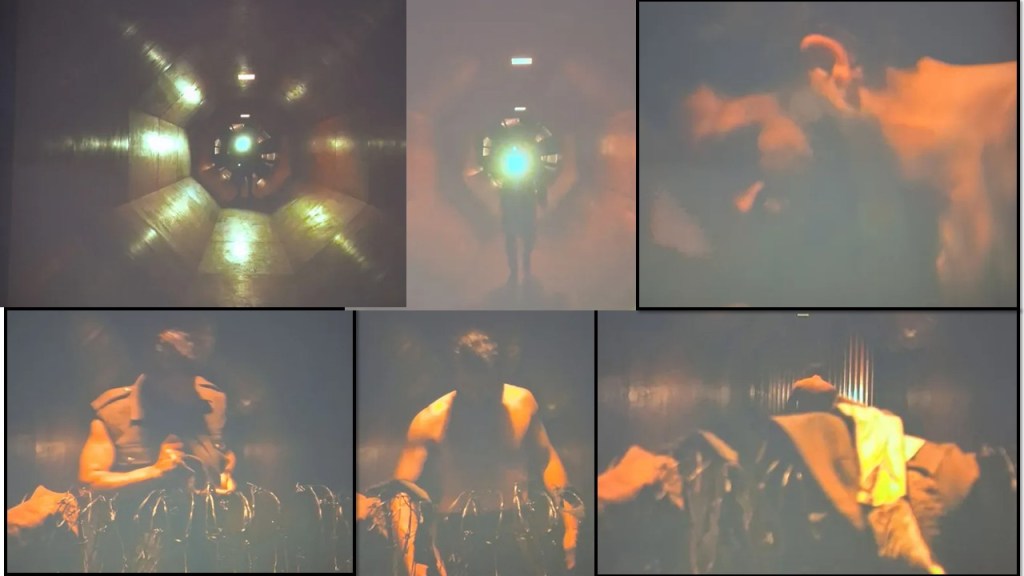
How the ‘line of narrative’ here works in the whole is far from clear to me. Clearly the man has followed a ‘line of action’ leading him to war and all its associations of violence, perhaps represented by the journey down the tunnel in the dark and in ‘methodically shedding his uniform’ he has rebelled ‘against a conflict he does not condone’ as Vandenbrouck says, but it feels more nuanced to me, as if having given up his disguise the man walks back to his origin like a child – is dropping the mask of performance actually condoned here, no other line of action is conceived that is not solely destuctive.
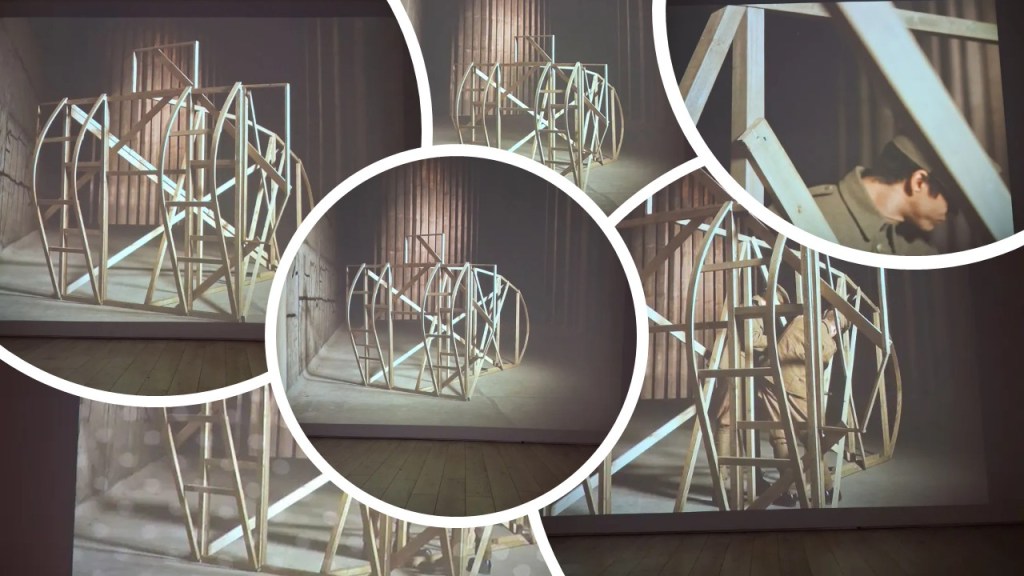
That may be because the ‘acting’ soldiers – models enacting soldiers as well as a narrative of real men in the First World War on the way to War are only seen as constructive – as building structure in the narrative, evening pushing the winds of time in the tunnel when dressed as soldiers. They build things behind the blades of the turbine, sometimes we see them from an angle in which we sit in the tunnel looking out to do so. They build things we cannot understand, though they are when the camera rotates around them seen to be made of lines that are in three dimensions but appear in two. Everything enacts itself, even the lines aiming at solidity, or solidity aiming at being seen as simple lines:
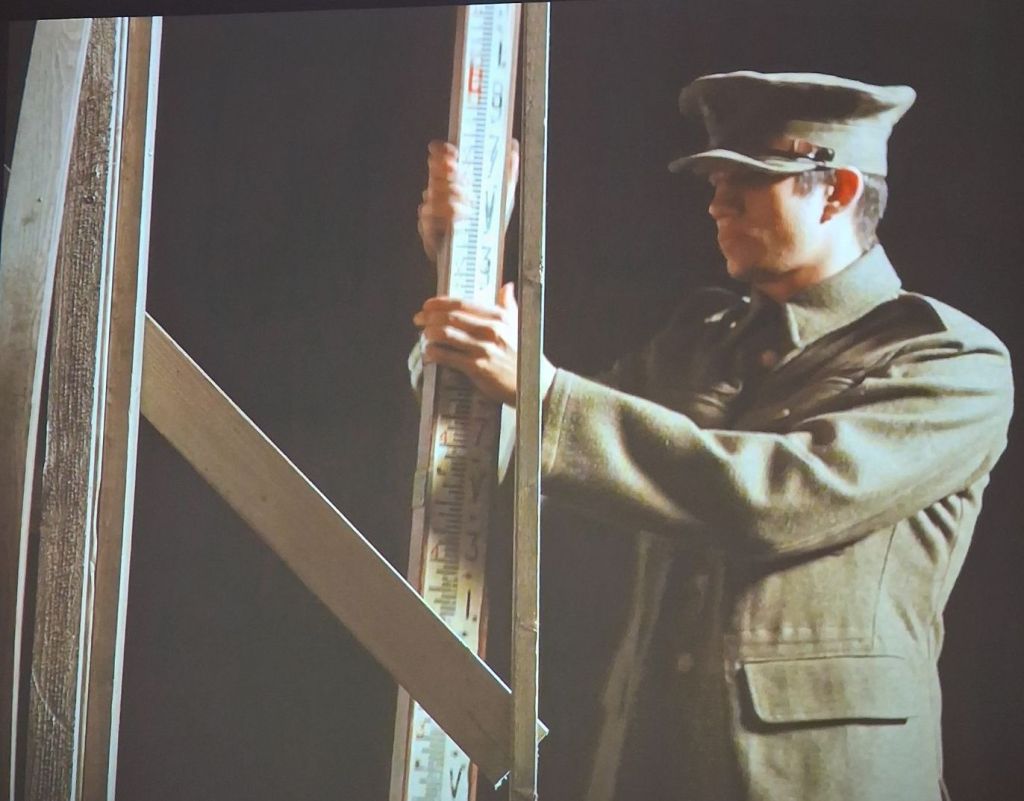
The structure whilst being built and containing the men working on and in it and once built allows the camera’s gaze to rotate around it, showing its lines and effects plastic to the eye. It might look like many things but it is first of an illusion such as art has always aimed at creating from its basic materials. Yes, you often see a frame of an airplane or the front of a tank, but it soon dissolves into illusions. This is not to argue that war is an illusion – far from it – but that war, that thing people call ‘real life’ is not far from narrative and visual allusion – perhaps a reference to the ideas of Tom McCarthy who is quoted in the film and, from C, by Vanderbrouck.
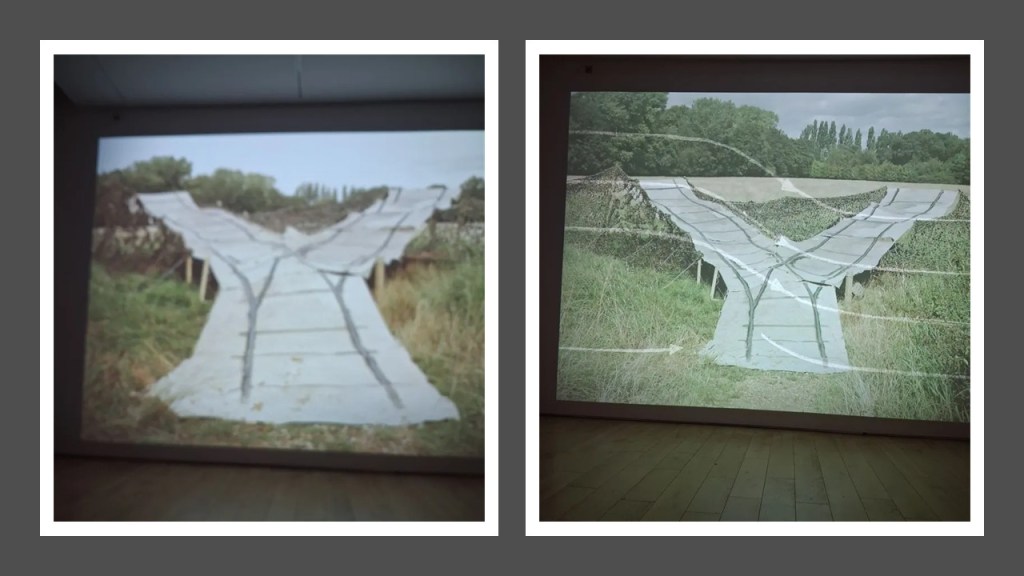
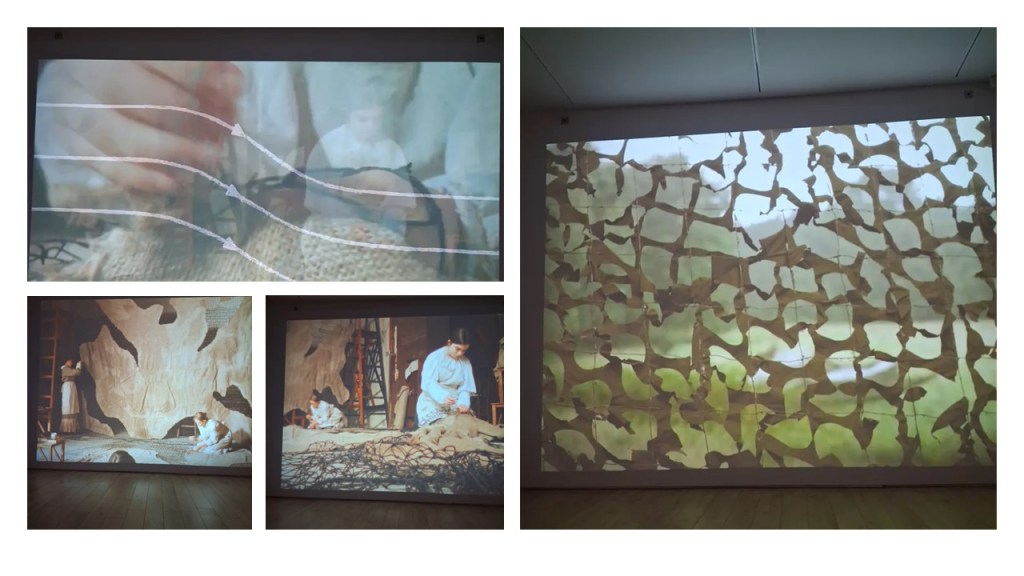
And hence, the film uses the means of illusion to show elements of illusion used in war, as does McCarthy, in which artists were used to create camouflage for real objects or images of real objects which might fool the hunting eye of war from the air, like this road system, used in the film naked and then traversed over by isobars to indicate the process of the remaking of nature in linear signals.
Even weaponry can be invented. One structure we can recognise – though it is flimsy enough – might have fooled a Nazi aircraft about the presence of anti-aircraft guns they must avoid. And note, it is built behind the turbine wheel in a space that clearly is not a tunnel. Lines deceive.
The role of women in camouflage production even enters the mix. The symbols that narrate are puzzling and beautful and move one in every way.
But what is reframing negative thoughts about most often – it seem I think to be about tht thing we call ‘losing face’, where we feel that our worth no longer can shine from that external organ, glow in the skin or shine from the eyes. it is about not looking directly at anything, let alone at other faces. In a film so obsessed by lines, the lines of the face matter, including the issue of facing the worst. In one part of the film as Vandenbrouck sees we see First World War black and white photographs (by Horace Nicholls) that show the sculptor Frances Derwent Wood involved in the fabrication of prosthetic faces for soldiers facially damaged in the War. We know, of course, especially if we read Pat Barker, of the artist Henry Tonks of the London Slade School of Art at UCL, who was also involved in this. The film approaches the destruction nd articial reconfiguration of the face in a really interesting way, in which the face really because a line drawn around the person, containing them where possible. The first introduction to the theme comes, as with other things, with the view of an object in an unusual rotational angle. We cannot recognise it. Can you? I saw a thin but uneven dark line, with lined spars and marks on top of it.
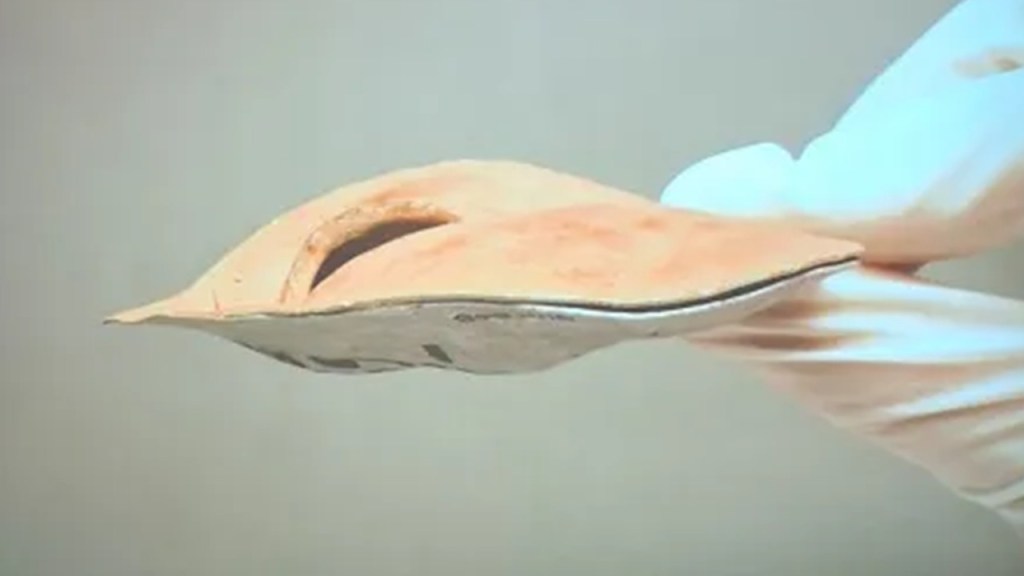
It gets rotated, but then pulled into a narrative of its making, down to its appearance as a face with an eye staring up at the exact angle of the man modelling for it, whose face is being masked – perhaps even smothered in line for its appearnce
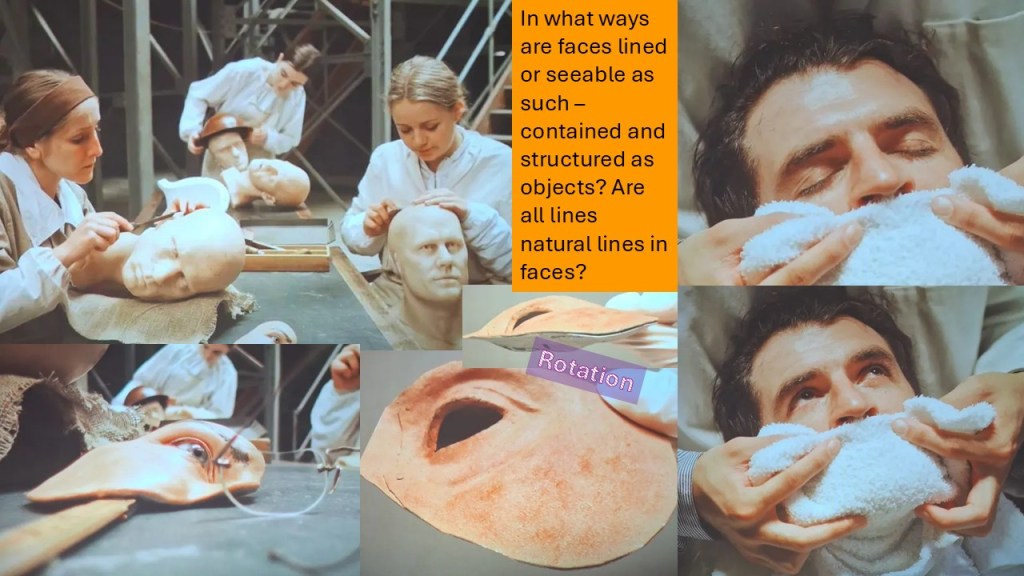
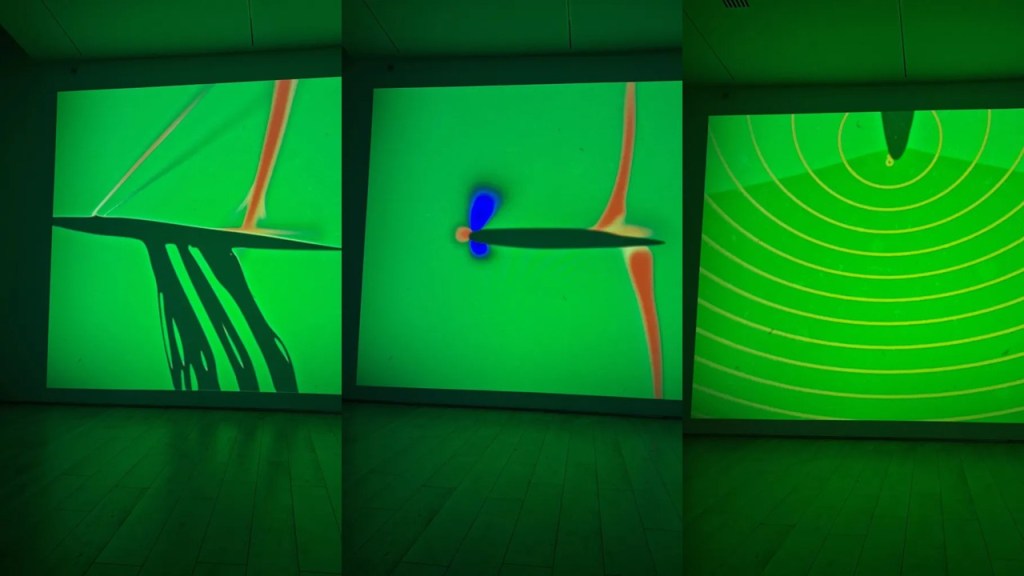
In ‘saving face’ we rebuild it through the illusions of art – in this case much nearer nature than in military camouflage work. But such reframing does not lose the Worst that might happen, it merely hides it. It might be posed as opportunity – perhaps for the sake of the survival of us all, it must, but it doesn’t posit a straight line to positivity. The film also works with two dimensional line sequences in order perhaps to play these themes in abstraction rather than surrealism, with that necessary hint of representation always present in abstraction – of patterns of wind, sound or other flows in waves. Especially beautiful are straight vertical lines with uneven frequencies across a page that seem to sing. It is very beautiful to me.
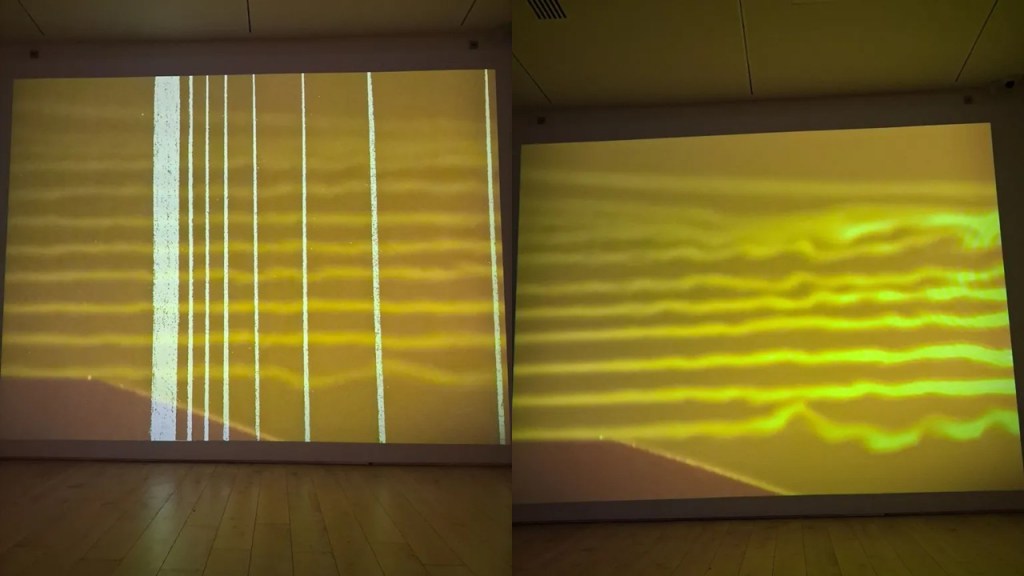
And then those odd animated figural diagrams which seem to mask both physical and invisible abstract things – from rotors on the one side to sound-making discs, and sometimes the most weird sound waves proceeding from a node.
Do go to this exhibition, if only for The Undead Son. But I am sure you will Simon English and indubitably get more from the rest than I did. And keep reframing – for without it, we will fall extinct sooner rather than later.
With love
Steven xxxxxxx


One thought on “Reframing your Lines of Action: Is Art a way a doing this?”