


Alfred Tennyson and Thomas Carlyle in a good representayion of the walled garden to 5 Cheyne Road the home of Thomas and Jane Carlyle., now visitable as ‘Carlyles’s House’
Thomas Carlyle, so little read today, was thought a Sage by those of his own time, and whether the quotation given above (from the usual dodgy internet sources, could have been said by him, even if it wasn’t. We think of Chaos as the extremest expression of disorder and for Carlyle any kind of work engaged in by ‘men’ (we probably need to stick with the term ‘man’ for Carlyle even without pretending it is used generically) presupposes some material that needs reorganising, re-ordering. In On Heroes and Hero Worship and the Heroic in History, Carlyle made it clear that he thought order was the base definition of human purpose – but that this was especially the role of the ‘Great Man’, making it plain that this ‘man’ was definitively ‘great’ merely because he is ‘more a man than we’. The pre-requisition of a over-determined definition of masculinity in terms of that person most capable of productive design and execution of great work with great shaping hands and brain both turned to the end-state of that production – a piece of work that is configured best as a tool for further work to produce ‘a thing ruled, regular’.When you think of ‘Man’, either generically or personally, do not think of Him as:
a son of Order, not of Disorder? It is a tragical position for a true man to work in revolutions. He seems an anarchist; and indeed a painful element of anarchy does encumber him at every step,—him to whose whole soul anarchy is hostile, hateful. His mission is Order; every man’s is. He is here to make what was disorderly, chaotic, into a thing ruled, regular. He is the missionary of Order. Is not all work of man in this world a making of Order? The carpenter finds rough trees; shapes them, constrains them into square fitness, into purpose and use. We are all born enemies of Disorder: it is tragical for us all to be concerned in image-breaking and down-pulling; for the Great Man, more a man than we, it is doubly tragical.
Note how everything points to the disposition of manliness as inheritor of the father’s command to do good – go forth and prosper. It refreshed the image of Carlyle’s own partly self-education from lowly roots in Ecclefechan towards the role of Sage of Chelsea. However, it also presupposes gradations beyond such self-making to those ‘Heroes’ lauded in his book who all moved from an experience of disorder at birth to the manufacture of an ordered thing, that for truly great Men was the Cosmos, not only a world but a universe. Based on a set of Lectures given in May 1840, the book is organized to claim that all realms of human praxis demand self-belief in one’s own efficacy in uniting the beliefs of many lesser men and holding them contained in its own products:
1. (5 May) The Hero as Divinity. Odin. Paganism: Scandinavian Mythology
2. (8 May) The Hero as Prophet. Mahomet: Islam
3. (12 May) The Hero as Poet. Dante; Shakespeare
4. (15 May) The Hero as Priest. Luther; Reformation: Knox; Puritanism
5. (19 May) The Hero as Man of Letters. Johnson, Rousseau, Burns
6. (22 May) The Hero as King. Cromwell. Napoleon: Modern Revolutionism
These ‘Man’ are as much the holy (and wholly ideological) idea of ‘man as his incarnation, given that they start with Odin fashioning the Nordic Cosmos and move on to Muhammad as the builder of a collective non-secular polity. Yet they are involved in re-configuring Chaos into Order too when old Orders become sterile and non-progressive – unworthy of belief, as in the case of the Protestant Reformers, and with emphasis as few English thinkers would have dared on John Knox in Scotland with the decaying Catholic religion and independent men capable of seeing the sterility of the Old Order in the Eighteenth Century. Some wrote thinks supposed to spark ‘revolutions’ in thinking, such as Rousseau, but more so Cromwell, and of course, Napoleon – the man who carved out of the Chaos of the French Revolution (a thing he had only just written at great length as a historian) , in Carlyle’s terms, the return to revisions of law and the invention of Order, even Kingship, without the necessity of a sterile legitimate line of monarchs. However, at base all men, who are men, do this when they act as working Men, Carlyle insists, as in that picture of his own father (heavily idealised as he will show himself in his late-life Reminiscences, but in 1840 the model of what :
every man’s is. He is here to make what was disorderly, chaotic, into a thing ruled, regular. He is the missionary of Order. Is not all work of man in this world a making of Order? The carpenter finds rough trees; shapes them, constrains them into square fitness, into purpose and use. We are all born enemies of Disorder:
That the world would be chaotic without belief that we can regulate it in a more meaningful way was a central idea for Carlyle. He though it less possible in the nineteenth-century for he saw materialism, as embodied in the engines and processes of Capitalism as the enemy of manly belief, and incapable of its own self-overthrow as was the Bourbon monarchy in France, and more evident in the manner in which men who believe organise other’s belief in them, as in the monastery studied in contrast to the present day, for Thomas, in Past and Present. That latter was a book much admired by Karl Marx who saw in it the same value given to Labour to undermine the false ideas propagated about itself by Capital, though without seeing in it, as a Marx did, a manner of harnessing materialism to the object of the revolution of Labour.
But return to that corridor of a garden at 5 Cheyne Road containing the two pipe-smoking Men of Letters, Tennyson and Carlyle. We have a nearer approach to that event, in an actual letter by Carlyle quoted in a scholarly essay. Here it is:
According to Sir Charles Tennyson, Carlyle met Tennyson at the Sterling Club as early as 1839, if not earlier. Previously, Sir Charles says, Carlyle had heard much about him from John Sterling, who had helped to found the Cambridge Apostles’ Club, of which Tennyson had also been a member. D. A. Wilson, however, in his multi-volumed life of Carlyle says that the two first met in Carlyle’s garden at Chelsea in the autumn of 1840. Sir Charles is more nearly right. Wilson’s date is too late, for on 5 September 1840 Carlyle wrote to his brother: “Some weeks ago, one night, the Poet Tennison [sic] and Matthew Allen were discovered here, sitting smoking in the garden. Tennison had been here before, but was still new to Jane,—who was alone for the first hour or two of it. A fine large-featured, dim-eyed, bronze-colored, shaggy-headed man is Alfred; dusty, smoky, free-and-easy: who swims, outwardly and inwardly, with great composure in an inarticulate element as of tranquil chaos and tobacco smoke; great now and then where he does emerge: a most restful, brotherly, solidhearted man.”
What attracts Carly to Tennyson (Tennyson in the same source is said to have reported that Carlyle ‘had taken a great fancy to me’) is the contradiction between outward order (composure) and the ‘inarticulate element as of tranquil chaos and tobacco smoke’. What emerges from all this are gleams of the same kind of man, spoken of in terms that almost ‘bromantic: ‘great now and then where he does emerge: a most restful, brotherly, solidhearted man’. Men with reserve, who had heart, even if you can’t spell their name, appeal to Carlyle’s hero-worshipping soul as ideals of something he longed for – that fatherly authority that inspired belief and contained your own chaos in their huge embrace, even though in metaphor. And all this has a lot to do with the proximity of homo-social hero-worship Carlyle and Tennyson and the romanticising of men as the makers of the tools that shape order or ‘composure’ (as in a composition in music or verse) or of products that prefigure that restful and desired Order in the bosom of a protector. Charles Richard Sanders (PMLA Vol. 76, No. 1 (Mar., 1961), pp. 82-97, Available online at: https://www.jstor.org/stable/460317) quotes a letter that it appears Tennyson held onto since its welcome to his early 1842cpoems were (re)-issued:

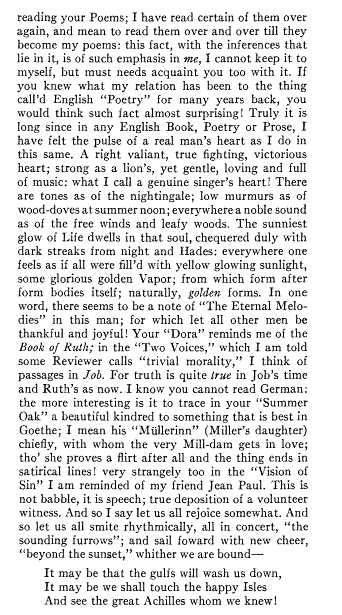
Comparisons to the German and French literature of which Carlyle was master, and even the quoting of the poem Ulysses as a personal guide to the sage would have been less than those words which speak of how men should love men: “… it is long since in any English Book, Poetry or Prose, I have felt the pulse of a real man’s pulse as I have felt in this. … strong as a lion’s, yet gentle, loving and full of music, …“. Of course, everyone will rush to say – everyone could speak of emotion between males in this physically tense manner – where we feel the pulse beneath the skin engaging bodies, then. But were too long in the tooth to talk of innocence and experience. The very order that Men imposed on the world (‘here to make what was disorderly, chaotic, into a thing ruled, regular’) is also an admission that we feel the disorder that is being contained (made regular and ruled) at the same time as we use it to feed our reserve and restraint, for they are both expressions of male love within boundaries imposed by order – available to us because its realisation physically is not. The closeness that is distance in that picture of the two men might make us feel a little more if we were to read the gestures of distance as an attempt to be close and keep the chaos of affection down.
It is certain that without knowledge of ongoing Chaos, thought sterile versions of Order persist, a remaking of that Oder to the needs of the present would not occur, as Carlyle claimed Muhammad did before all other examples. But the past is the past and, according to Tennyson’s dying King Arthur in Morte D’Arthur:
"The old order changeth, yielding place to new,
And God fulfils Himself in many ways,
Lest one good custom should corrupt the world.
And God consults Chaos before he allows new Order place to be. Since we have no God we must find the chaos in ourselves and use it to make what order is necessary in a world where all will remain uncertain, but not for that reason incapable of reconfiguration.
With love
Steven xxxxxxxxxxxxx

