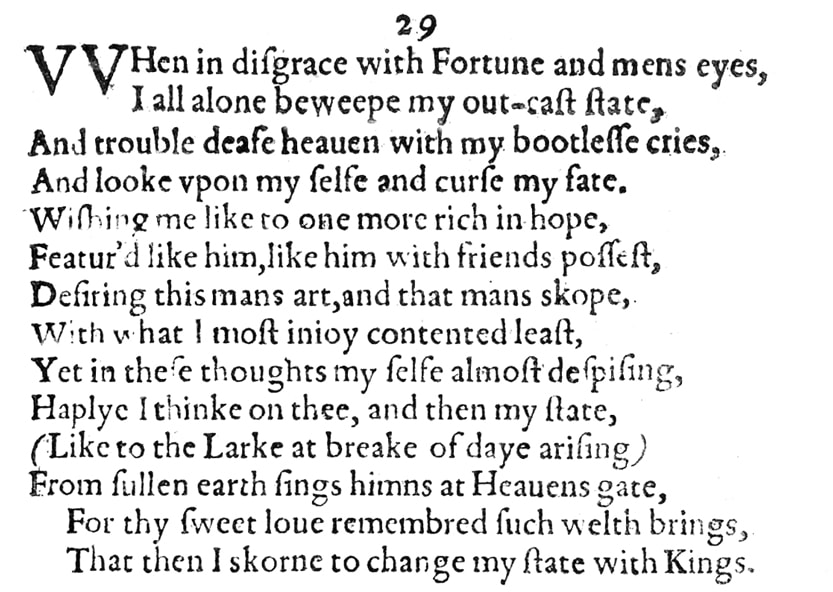
Sonnet 29 is used to provide the title, and is quoted in full as its message, by a non-binary character in prison named by inmates as ‘Mona’ (after Mona Lisa), of John Herbert’s Fortune and Men’s Eyes, an important if not a very good queer play, and in 1971 a minor film, no longer easily available.
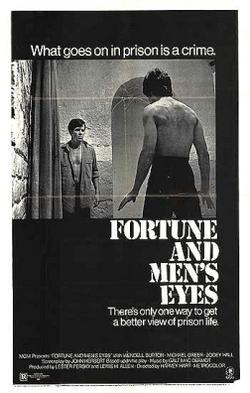
Before I look at this play and its importance in the life of James Baldwin as a play (one he directed in Istanbul staring a heterosexual man he loved in Turkish translation – a language he could not use effectively), to him, about masculine loneliness. Since he wrote on Gide, Baldwin saw the outcome of the sex/gender as a prison house of masculinity, for every man not just queer men, as the polar opposite of femininity. But I think the sonnet may be rather misrepresented – though I increasingly think it is not – for good reason in this usage. Hence here I am talking out how I see Shakespeare’s love sonnet – to me definitively a queer love sonnet nevertheless – before going onto to John Herbert and why Baldwin valued his play so much (I am very much influenced by Nicholas Boggs’ new Baldwin biography of course, once I take that step).
ĤùIn Sonnet 29, Shakespeare’s lyric voice appears to reject the benefits of financial fortune and social status, as this status looks in ‘men’s eyes’ in favour of his memory of his lover’s ‘sweet love’, yet he does so, apparently paradoxically, by claiming that this memory gives him ‘such wealth’, which could speak of a kind of monetary ‘fortune’ surely, and makes him feel more glorious than those kings of nation-states, usually the most attractive to the eyes of male lovers of status. It would appear, if we accept that there is a kind of paradox here; that the value system by which love has been evaluated is hardly different from the common evaluations of wealth and status it sets itself against or that each value-system is open to nuance. Indeed, some have seen the poem as autobiographical and the referenced lover as a rich and famed courtier, such as the Henry Wriothesley, 3rd Earl of Southampton, thus allowing the lover’s love to be read indeed as one that still allowed the poet access to money wealth and the fame accruing to political power less than a king but not therefore negligible and the usual fruits of lordly patronage rather than forcing their rejection. In such readings, Shakespeare can be imagined as saying your love is worth more than money and fame in order to get the handsome patron, some argue to be queer, to perhaps offer his devoted poet more money and access to the lor’s pathways to fame in men’s eyes.Is Shakespeare covertly cashing in on ‘thy sweet love’?
Yet surely, many others will say, the whole point of the poem is that what a lover’s love gives is necessarily very different from the hardness and horniness of riches and status conventionally acknowledged by others. Indeed the poem demands the idea that his lover’s love helps him, the singer, to adjust to relative poverty and low state. And yet we know (don’t we?) that Shakespeare works with paradox and irony. Paradox does not negate one reading in favour of another that gets cancelled in the process, for life itself is paradoxical.
The fact is that both ‘wealth’ and ‘state’ in the final couplet are probably meant to have the potentially different meanings in the poem from when they are used to denote amassed fortune or poor political status (‘out-cast state’) in the eyes of a conventional and hierarchical world at its opening. This case is facilitated by the fact that the terms were undergoing re-interpretation in order to apply to different circumstances in changing social values at the time of the poem’s writing. Let’s take the word wealth, an easier one to consider since it is a term that appears to be in transformation during the sixteenth century in England, from an older meaning, from the 12th to 14th century, that was more to do with ‘well-being’ as considered across a number of determinants of it than that that equated with being ‘well off’ financially. Shakespeare was a merchant’s son and a tradesperson – he would not deny that wealth as money mattered- far from it. Taking the chance of a life in the arts was not a sure path to riches, especially in the company of those ready to see you as an ‘upstart crow’.Here is etymology.com on ‘wealth’.
wealth (n.) mid-12c., welth, “state or condition of happiness, well-being, joy” (contrasted with care or woe, a sense now obsolete), also “valuable material possessions; prosperity in abundance,” from wele “well-being” (see weal (n.1)) on analogy of health (see -th (2)).
By 1590s as “plenty or abundance” of anything. Wealth of nations can be found in Dryden (1666); Adam Smith’s book is from 1776. Wealth-tax is by 1963.
Only when we remember this metamorphosis in the word does Shakespeare’s Sonnet 22 take on less ironic ambiguity, for by the time of the Sonnets the newer meaning was well established without having cancelled out the old one. Wealth, indeed, still is after all the potential antonym of the word, some see as a redundant coinage, ‘illth’. In fact, illth was introduced as if a word by John Ruskin in 1860 in order to resurrect the older medieval sense of ‘wealth’, in antagonism to the high capitalist ethics of the nineteenth century in his wonderful text, Unto This Last.
With the noun ‘state’ we are in a different arena, for it appears to have been ambiguously from early times to apply to a physical presentation of one’s ability to represent the person you want to appear physically to increasingly metaphorical uses to represent your ‘standing’ or ‘position’ in a hierarchically organised society. Here is etymology.com, which nevertheless distinguishes the word from it description of one existential ‘mode or form’ by virtue, as it were of a active standing up as oneself, to a position in a given social organisation, particularly a highly rated one, such as a lord or king of ‘high degree’:
state (n.1) [mode or form of existence] c. 1200, stat, “circumstances, position in society, temporary attributes of a person or thing, conditions,” from Old French estat “position, condition; status, stature, station,” and directly from Latin status “a station, position, place; way of standing, posture; order, arrangement, condition,” figuratively “standing, rank; public order, community organization.” / This is a noun of action from the past-participle stem of stare “to stand” (from PIE root *sta- “to stand, make or be firm”). Some Middle English senses are via Old French estat (French état; see estate). The Latin word was adopted into other modern Germanic languages (German, Dutch staat) but chiefly in the political senses only.
The meanings “physical condition as regards form or structure,” “particular condition or phase,” and “condition with reference to a norm” are attested from c. 1300. The meaning “mental or emotional condition” is attested from 1530s (the phrase state of mind is attested by 1749); the specific colloquial sense of “an agitated or perturbed condition” is from 1837. / The meaning “splendor of ceremony, etc., appropriate to high office; dignity and pomp befitting a person of high degree” is from early 14c. Hence to lie in state “be ceremoniously exposed to view before interment” (1705) and keep state “conduct oneself with pompous dignity” (1590s).
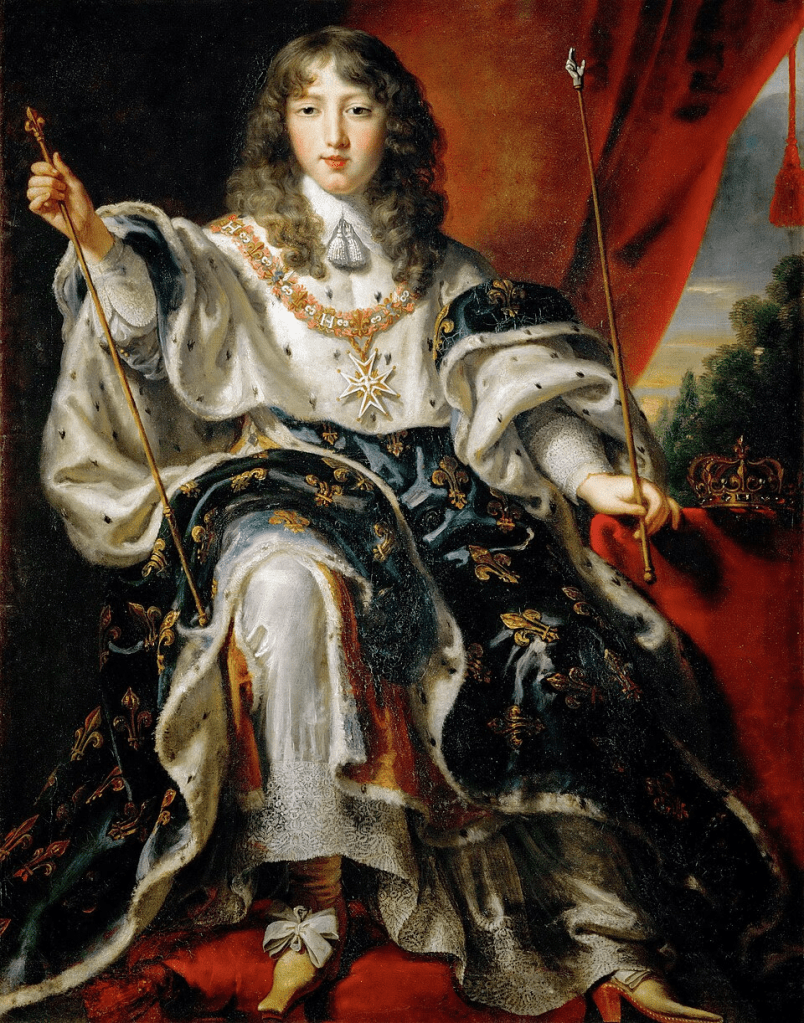
The final couplet of Sonnet 29 plays with all these meanings – from an assertion that one’s being as the beloved of your lover is a ‘mental or emotional condition’ more becoming a man than were he a ‘king’ however so pompously made to appear in ‘dignity and pomp befitting a high office’ or representative of the most modern form of a ‘state’, a nation. The state of a beloved is even perhaps the equal of the state represented by kings: Louis XIV , the grandest of kings, said, of course, ‘L’État, c’est moi‘, although Elizabeth I implied it at every point of her self-conscious state of being, in standing as it were on the very spread of the map of England, as an intermediary between the grace and wrath of the heavens.

So look at the poem again, where ‘state’ is made to rhyme with ‘fate’ in the first four lines, whilst in the last six lines, it rhymes with ‘gate’: but not any ‘gate’ – the access point to heaven to the ‘state’ ruled by kings.
When, in disgrace with fortune and men’s eyes,
I all alone beweep my outcast state,
And trouble deaf heaven with my bootless cries,
And look upon myself and curse my fate,
Wishing me like to one more rich in hope,
Featured like him, like him with friends possessed,
Desiring this man’s art and that man’s scope,
With what I most enjoy contented least;
Yet in these thoughts myself almost despising,
Haply I think on thee, and then my state,
(Like to the lark at break of day arising
From sullen earth) sings hymns at heaven’s gate;
       For thy sweet love remembered such wealth brings
       That then I scorn to change my state with kings.
The poem itself changes its state – from lament or plaint (‘I all alone beweep’ to a ‘hymn’). The poem keeps reminding us that ideas of wealth are powerful metaphors – you can it says be ‘rich’ in hope, and that poetry and song might bridge heaven and ‘sullen earth’, whilst still being in a mortal body ‘(Like to the lark at break of day arising / From sullen earth)’ . It is this concern with mortal bodies that makes this to me a definitive queer poem – for it characterises the common ‘state’of men’s desire as overbound up in notions of power. The things men seek are power by virtue of their appearance in physical looks, homosociality, power of artifice and scope of action: ‘Featured like him, like him with friends possessed, / Desiring this man’s art and that man’s scope,’. Yet the outcome here is self-despisal, a thing men loving me are most like to know, whether there be a category of ‘homosexuality’ in society or not. The important thing is love. In John Herbert’s play, the ur-masculine ‘Rocky’ (all in the name) starts by dominating the new young man ‘Smitty’ to become his protector by virtue of making the latter his favourite sex-object. Advised by the drag queen, ‘Queenie’ of course, Smitty learns that he has more physical power than Rocky, grinds Rocky’s face into the toilet floor during an attempt to have him sexually and becomes the dominant man.
However, during a Christmas concert, from which the Mona, the transsexual, is cast out (because they want to read from Shakespeare, as his Christmas act, Smitty stays behind, claiming sickness, and declares his wish to have Mona as his lover, because of the latter’s sensitivity to the brutal male world of the prison. However Mona refuses because all that is on offer is the binary of man and bitch, Daddy and Son roles, where Smitty retains dominance. Even Smitty is surprised that this is all he has to offer, surprised into seeing his own brutality come into action on Mona on their refusal of his love, in which he believes. As a result, he sees Mona take the beating punishment for making a pass at him (the reverse being true) despite his belated recantation, for both Rocky and Queenie know that their role as men is dependent on maintaining power unbalances – even when it means Rock must become himself a more powerful male’s boy in the shower, arranged by Queenie – and claim falsely they saw Mona making a pass at their ‘friend’. And to justify his refusal, Mona had read out Sonnet 29. Let’s explore that more in another blog and why it mattered to Baldwin during a period in which he believed his role as lover and Black male activist were at odds – his queerness used by Eldridge Cleaver against him to represent him as a traitor to other Black men.However, Mona does not ‘cash in’ on Smitty’s love – far from it. It prompts his even more ‘outcast state’.
Bye for now
Love Steven xxxxxxxxxxxxx


3 thoughts on “Cashing in on ‘Thy sweet love remembered’:Some preliminary thoughts on Shakespeare’s Sonnet 29 before some historical reflection on its use in queer literary culture in the twentieth century”