


If a work of art in words is worth reading, you will have never finally or completely read it – you will always be reading it. Deciding to continue reading ‘All My Sons’ by Arthur Miller in preparation for seeing Ivo Van Hove’s version of it live-streamed on 16th April 2026.

The reason I am drawn to this way of answering the prompt given is that on the 16th April, Geoff and I have booked to see the international streaming of the theatre production, directed by the innovative Ivo Van Hove and with Bryan Cranston as Joe Keller, of All My Sons by Arthur Miller. Of course I will blog on this streaming after the event (we are seeing it at the Reel Cinema, Bishop Auckland). And at this point I can make it plain that I am aware that collaborative performance adds more than just another reading of the play.But a text for reading is all it is for me here and Miller was careful with the words of his text, even down to the names he gave the characters in the script and the stage directions, which in this play build on the efgects of words in tne scripted exchanges.
I loved Arthur Miller when I was at school, introduced by our influential English teacher as a playwright to be studied, with The Crucible as our set text. The group of learners I was in, including my longest enduring friend, were avid readers around. We all read Death of A Salesman, All My Sons and A View From the Bridge as if we were opening up the seam of modern tragedy in what was, or more so than other material seemed, contemporary, though All My Sons was written 7 years before I was born, and marks itself as a post Second-World War play, an event that to us seemed old enough to be history, in the sense of something truly in the past (then youth is naive). But I do not remember Miller staying with me through university or thereafter and I did not reread him. It is as if Miller was now dead and dusted, another word for ‘read’, which meant then never to be picked up again with some exterior motivation.
Yet those influential English lessons though they began the need to read widely are now to be valued more for the more important lesson from that school, then known as Holme Valley Grammar School, now as Honley High School, it being now a comprehensive with a more local intake, that reading that was not deep holds no advantage in being wide, and depth cannot be garnered in one ‘finished’ reading but in the fact that what is truly ‘readable’ has to be something that will yield fruit as a continually read piece Sometimes continued in the head with the text stored there), for which even the word re-reading is unsuitable. For me the key examples, in works written for theatre at least, are plays by Shakespeare and, well, Miller had as much likelihood of being there with Shakespeare than George Bernard Shaw or Ibsen, though I learned soon that I was so wrong about Ibsen if not Shaw. But today I got All My Sons on my Kindle and surprised myself – this play is readable and continues to be read even without the text in my hand. And I learned that at ‘High School’. It is an invaluable lesson to know that you have never finished reading a great book, defined by Milton, probably for that reason, as ‘“A good book is the precious life-blood of a master spirit, embalmed and treasured up on purpose to a life beyond life.” (John Milton, Areopagitica‘), for once brought back to life by the imagined breath of the reader (for even silent readers depend on the imagined breathing of words in the head) from its ’embalmed’ corpse-like state, it demands its own source of blood ever circulates picking up what it needs from outside self to keep the heart and every other organ, the respiratory organs included.
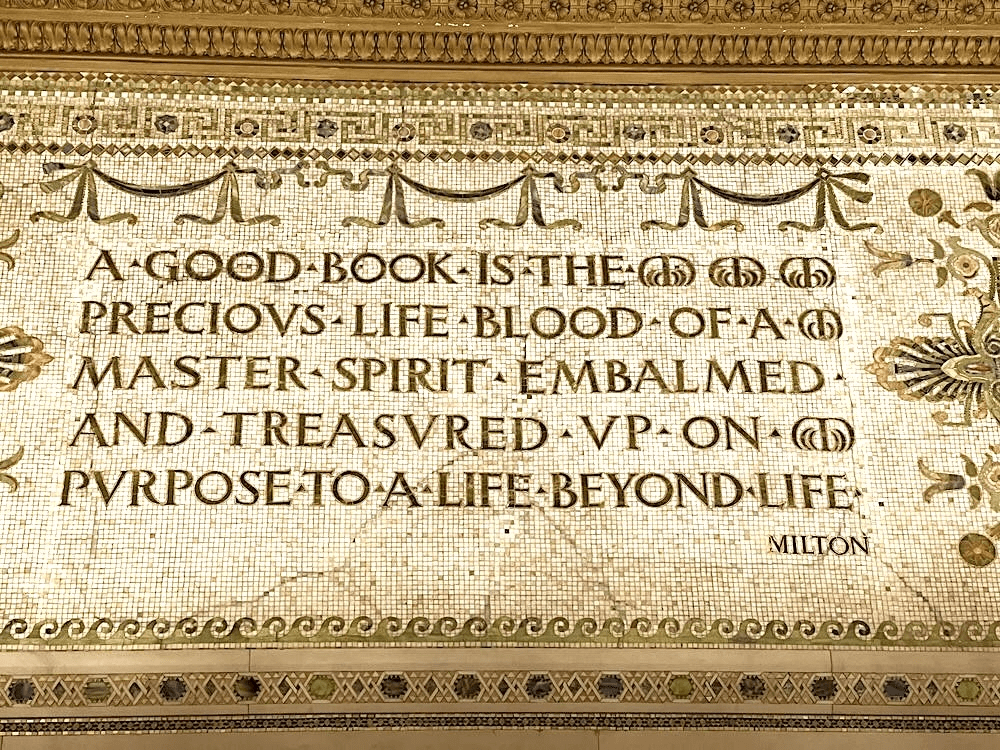
It is a wonderful image that of the dead revived, and more pertinent to reading than we know, without even invoking the ideology of the revivable ‘master-spirit’ of the original poet or storyteller – be it Milton, Shakespeare or Arthur Miller – for I think what lives and develops are words in concert with the body/mind’s processing thereof into relived form. Of course in theatre the mind is taking in more than performed words, already as it were processed by voice qualities, but the visual effect of bodies interacting, design of a framed setting with colour and light working with it. The metaphor of resurrection to life of an embalmed and inert thing hardly works in this case. But all that I have now is a book and to know it I can only continue my reading of it.
What that means is relationship to its words. Means of reading are many but one a sensitivity to the multi-valence of meaning in words, which in a passage or sometimes the whole text, seem prominent in either quantity or quality. What first alerted me to this was ‘High School immersion, again through that influential teacher, to the work of William Empson as a critic (though it applies to his poetry as well). Empson’s essay ‘Honest in Othello‘ was a landmark in showing how one word can illuminate a play in all its nuance, as well as that of the word. Would Arthur Miller yield to the same approach as Shakespeare? After readingagain this time two words stood out – the word ‘know’ and what it means to know something and to do so in a way that is asserted, the other is ‘fall’. I will concentrate on ‘know’ because, like the word ‘honest’ in Othello (repeated 52 times according to Empson), of its frequency of appearance. ‘Fall is not a frequent word though is is resonance is great in action – the story of the fall from the sky of F20 bombers is related, the fall in high winds of a tree in his parents’ garden commemorating the missing war hero Larry, the onset of the season as the play progression and falling light in the second Act (the Keller garden at ‘evening as light falls’), but as a ‘word’ I could only (to my surprise) find one resonance in a nevertheless vital passage of speech and stage direction attempting to point to the speech’s embodiment. But it is beautiful to read. Here it is. Kate Keller, referred to by Miller only as ‘MOTHER’ throughout the script, has slept ill because as she recounts to Chris, her son, and Joe, her husband, a dream:
MOTHER: I had a terrible night. [She stops moving.] I never had a night like that.
CHRIS [looks at KELLER]: What was it, Mom? Did you dream?
MOTHER: More, more than a dream.
CHRIS [hesitantly]: About Larry?
MOTHER: I was fast asleep, and … [Raising her arm over the audience] Remember the way he used to fly low past the house when he was in training? When we used to see his face in the cockpit going by? That’s the way I saw him. Only high up. Way, way up, where the clouds are. He was so real I could reach out and touch him. And suddenly he started to fall. And crying, crying to me … Mom, Mom! I could hear him like he was in the room. Mom! … it was his voice! If I could touch him I knew I could stop him, if I could only … [Breaks off, allowing her outstretched hand to fall] I woke up and it was so funny … The wind … it was like the roaring of his engine. I came out here … I must’ve still been half asleep. I could hear that roaring like he was going by. The tree snapped right in front of me … and I like … came awake. [She is looking at tree. She suddenly realizes something, turns with a reprimanding finger shaking slightly at KELLER.] See? We should never have planted that tree. I said so in the first place; It was too soon to plant a tree for him.
A reader voices that, outwardly or inwardly with the breath and breathless moments it requires, for each character to seem to live – things that on stage actors do for you. Imagine, for instance, Henry IV in the opening of 1 Henry IV embody the lines, ‘So shaken as we are, so wan with care, / Find we a space for frighted peace to pant …‘ and hear the nervous breath in the metaphoric ‘pant’ actually in the aging usurper Henry’s voice, not unlike the panting we hear constantly in the over-active Falstaff through his corpulence). I felt something similar in the prolonged feeling of vertigo in MOTHER‘s speech about the dream of the fall of Larry (perhaps from a plane or perhaps from the empyrean like the light-tinged Lucifer) and its resonance with the loud ‘fall’ of Larry’s commemorative tree in storm, though it is never itself called a ‘fall’ in text, except by analogy here in a mother’s imagination. But that word is spoken only once though in text it appears twice – the second in the stage direction and description wherein Kate ‘breaks off, allowing her outstretched hand to fall‘.That ‘fall’ fell with meaning to me, carrying the weight of the descent of Kate from the heavily sustained belief in Larry’s continuing survival (a belief she transforms to KNOWLEDGE, hence related to what I have to say on ”Know in All My Sons‘). It is a process not unlike the manner in which religious belief sustains beliefin eternal life despite the ‘fall’ of ‘Man’, a weighty context I believe to lie behind this speech. But note too that Kate speaks about how a voice imagined as heard becomes evidence for the life in someone: ‘ He was so real I could reach out and touch him. And suddenly he started to fall. And crying, crying to me … Mom, Mom! I could hear him like he was in the room. Mom! … it was his voice! If I could touch him I knew I could stop him, if I could only …‘. Suddenly an imagined voice is realised as embodied touchable presence. That is, in fact, how a good reader reads, without a dream to framework the reading – we ‘touch’ the sides of the organs that breathe and voice words, and as Milton suggests, resurrect the body from its words, wherein they were enbalmed.
But that is the only real presence of the word. Not so the work ‘know’. When I deduct those from Christopher Bigsby’s introduction in my Penguin Classic text on Kindle’s count (I don’t profess accuracy ) the word and its forms related to ‘knowing’ occur 198 times (13 of ‘knew’ can be added to that number like that one in the ‘fall’ speech above). In that latter speech Kate ‘knew’ she could stop Larry’s fall by the power of her maternal touch. It is a resonant use, just as her belief in her powers of belief prompt knowing elsewhere things for which there is no evidence. It occurs in the accusations Chris makes to his father, once he must finally acknowledge in Act III what all in the community ‘knew’, that Joe had knowingly sent out faulty plane parts when he in Chris’ words ‘knew they wouldn’t hold up in the air’, ‘knew they’d crash’. But look at the resonance of the word in this scene from Act III, the very opening when dawn has broken:
JIM [looks at window, then at her]: What’d Joe do, tell him?
MOTHER [she stops rocking]: Tell him what?
JIM: Don’t be afraid, Kate, I know. I’ve always known.
MOTHER: How?
JIM: It occurred to me a long time ago.
MOTHER: I always had the feeling that in the back of his head, Chris … almost knew. I didn’t think it would be such a shock.
JIM [ gets up]: Chris would never know how to live with a thing like that. It takes a certain talent … for lying. You have it, and I do. But not him.
MOTHER: What do you mean … he’s not coming back?
JIM: Oh, no, he’ll come back. We all come back, Kate. These private little revolutions always die. The compromise is always made. In a peculiar way. Frank is right—every man does have a star. The star of one’s honesty. And you spend your life groping for it, but once it’s out it never lights again. I don’t think he went very far. He probably just wanted to be alone to watch his star go out.
That beautiful exchange is a kind of recognition moment such as Aristotle ( who called it ἀναγνώρισις [anagnorisis]) believed to be necessary to tragedy as a genre. We discover, finally know what we suspected we knew beneath it all a dreadful truth – the classic example in extant Greek tragedy being Sophocles’ Oedipus Tyrranus, that everyone ‘knew’ Joe to have lied about his engine parts, knew that he had covered up his knowledge and blamed a scapegoat – his neighbour Steve, one of his workers – and thus escaped blame. Mother up to now thinks she has covered up her knowing, and to the audience she has, but also covered up her suspicion of ‘knowing’ that her son Chris ‘knew’ or ‘almost knew’ (a beautiful term) the truth too. Jim’s summary of his truth is painful _ chris does not know not because he did not want to know and hence pretended but because he had no ‘talent for lying’, was truly ‘honest’ (note how we come back to Empson’s Othello).
But note too that Jim believes that there is something undeveloped in Chris’ humanity – his knowledge that people always relinquish honesty in order to know themselves the postlapsarian human being they are (a person after the Fall). To mature as a human being has come to mean believing in lies and either not knowing (or appearing to know) that they are lies, the star of ‘honesty ‘ having extinguished, recognised as the prelapsiarian ideal it always was.
There are two things in the play that people profess to ‘know’ that will yield, if not to supposition based on livelihoods, then to irrefutable evidence (why trials so matter in Arthur Miller). Kate can keep knowing her son Larry to be alive when it is likely given the time he has been missing in war because of the exception that tests ( what the word ‘prove’ means in the usual phrase) the law. Young men keep returning whilst given up as lost, but faced with the letter that proves his suicidal intentions, she and Joe yield. Joe yields to even more proof of life-sustaing lies or mauvaise foi in the Sartrean terms Miller believed in, doubting that which he has previously said to know by committing suicide as Larry had done, Larry who he ‘knew’, till doubt becomes certainty of knowledge, that it is not so, to be the son who favoured his success as an American dreamer.
Those deeper dives into the ocean of knowing, or Cloud of Unkowing for the mystical, are not however unrelated to the constant use of people who talk to each other about what each of them knows, when the knowledge is not a Gnostic, arcane, mystical, repressed or intuitive concept of knowledge, but is using the word ‘know’, almost symphonically to register the changes when used by different people and societies by the same person at different times and circumstance even when used in stage directions to help tbose persons who ‘read’ plays outside their external and varied but repeated performances:
CHRIS: All right, all right, listen to me. [Slight pause. KELLER sits on settee.] You know why I asked Annie here, don’t you?
KELLER [he knows, but …]: Why?
CHRIS: You know.
KELLER: Well, I got an idea, but … What’s the story?
CHRIS: I’m going to ask her to marry me. [Slight pause.]
KELLER [nods]: Well, that’s only your business, Chris.
CHRIS: You know it’s not only my business.
KELLER: What do you want me to do? You’re old enough to know your own mind.
CHRIS [asking, annoyed]: Then it’s all right, I’ll go ahead with it?
KELLER: Well, you want to be sure Mother isn’t going to …
CHRIS: Then it isn’t just my business. KELLER: I’m just sayin’… . CHRIS: Sometimes you infuriate me, you know that? Isn’t it your business, too, if I tell this to Mother and she throws a fit about it? You have such a talent for ignoring things.
KELLER: I ignore what I gotta ignore. The girl is Larry’s girl …
CHRIS: She’s not Larry’s girl.
KELLER: From Mother’s point of view he is not dead and you have no right to take his girl. [Slight pause] Now you can go on from there if you know where to go, but I’m tellin’ you I don’t know where to go. See? I don’t know. Now what can I do for you?
CHRIS: I don’t know why it is, but every time I reach out for something I want, I have to pull back because other people will suffer. My whole bloody life, time after time after time..
And, of course, it is not true that Chris is ‘old enough to know’ his ‘own mind’,for after all what is harder to know, in the many ways necessary than one’s own psyche. And that li is too to why we desire to know at all. For we want to know things for which the evidence is absent or invisible, which is to say apparently absent, like God, the dead or the true being hiding within the person. To me, this links both to what Mulron told us of books in Areopagitica (cited above) and one theme of this play – the return of men from absence (it is always men) in their true being.
That return home, or nostos, is so often referred to, whether in the constant awaiting of the return of Larry, dead or otherwise; Steve, the father of Anne and George, and the scapegoat for keeping Joe out of the same prison Steve is in; and, even Chris, who, in Act III, Jim says will return to them, as he does, a changed man,now without honesty and a mere survivor of the fall from truth. These are all forms of the resurrection of an embodied knowledge that must be acknowledged by the characters and the audience of tbe play.
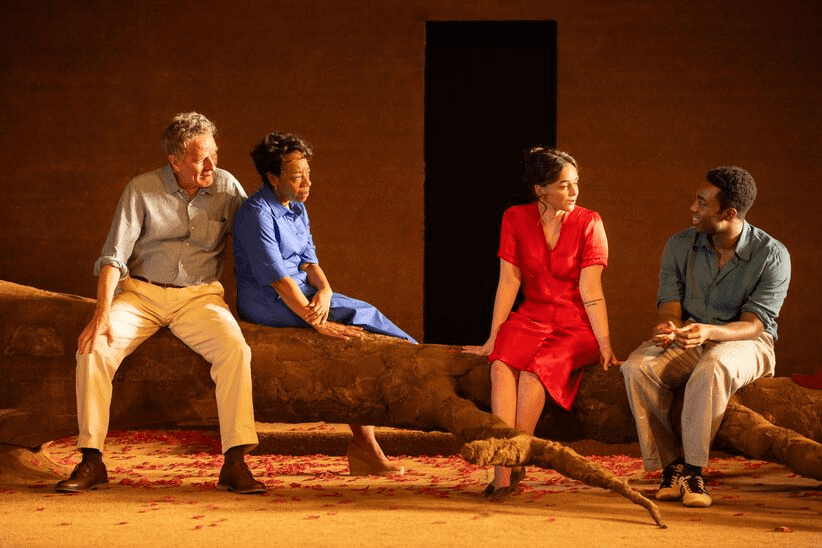
Joe Keller, Kate (Mother), Ann and Chris in the upcoming product on the fallen tree of Knowledge
Herein lies an issue. What can be certain about what an audience or reader knows in such a play where characters know things they don’t admit, often not even to themselves, or genuinely do not know about themselves. Some critics play fast and loose with this, as Chris Bigsby in the excellent Introduction to the Penguin Classics edition, quoted below:
Chris’s early statement, for example, that “I don’t know why it is, but every time I reach out for something I want, I have to pull back because other people will suffer. My whole bloody life, time after time after time” (16), seems to lack substance, outside of the immediate issue of his proposed marriage. What, precisely, has he reached for that he has been denied or required to relinquish so that others would not suffer? Chris, we begin to realize, is a man who sees himself as a martyr, an idealist; yet the suspicion grows that this is an image behind which he hides. Doubts are swallowed up in this self-conscious presentation of himself as an honest man doing nothing more than demanding honesty, a self-denier only now able to assert his rights. He presents himself, to himself, as serving truth, but truth not only places him at risk; it becomes a means of directing attention away from himself and his own moral failings.
Bigsby quite mysteriously attributes (in his footnote 16) this perception to ‘My interview with the Author’ (the words from the play have already quoted by me above) but in what form we aren’t told explicitly and thus can’t know precisely as critical readers ourselves. Yet what do either Miller, Bigsby, or both do here – they question whether Chris is at all in good faith in saying that of his self-identification as a person who refuses to hurt others that ‘he doesn’t know why it is’ he is telling a lie, even though Jim later says he is incapable of lying, at least until e knows his father’s guilt for certain. Let me be honest, I do not at this point, as Bigsby says I should that Chris is ‘a man who sees himself as a martyr, an idealist; yet the suspicion grows that this is an image behind which he hides’. For me suspicion is a condition of knowing that everything we know might be an illusion in relation to all characters but to pick out Chris here is possibly erroneous and a heavy lean towards a limited interpretation based on character analyses that don’t bear water. The audience literally can know nothing about anybody on stage (orin the text if the audience is a solitary reader) but what they are told – and in a play how a director and actor collaboratively interpret the embodiment of the words.
Even with small children people play games with what others know of various kinds of innocence or otherwise. To the ‘about eight’ year old Bert, Joe Keller says regarding the long enduring game of pretending Joe has made Bert a policeman and that he can imprison felons Bert finds:
BERT [pulls him down by the lapel and whispers in his ear]: Can I see the jail now?
KELLER: Seein’ the jail ain’t allowed, Bert. You know that.
BERT: Aw, I betcha there isn’t even a jail. I don’t see any bars on the cellar windows.
KELLER: Bert, on my word of honor, there’s a jail in the basement. I showed you my gun, didn’t I?
BERT: But that’s a hunting gun.
KELLER: That’s an arresting gun!
Bert is encouraged to believe he ‘knows‘ the rules of this game of pretence that he nevertheless finds means to believe in, but denied visual evidence, he is ready to evidence that ‘there isn’t even a jail’, and that it exists despite its barless windows and its association with a gun that is only an ‘arresting gun’ because Joe says so. Yet here indeed there is duplicity about knowing that MOTHER believes may go deeper into her husband’s consciousness:
MOTHER [with suddenness]: Stop that, Bert. Go home. [BERT backs up, as she advances.] There’s no jail here.
KELLER [As though to say, “Oh-what-the-hell-let-him-believe-there is”]: Kate …
MOTHER [turning on KELLER, furiously]: There’s no jail here! I want you to stop that jail business! [He turns, shamed, but peeved.]
…
[She is shaken. Her speech is bitten off, extremely urgent.] I want you to stop that, Joe. That whole jail business!
KELLER [alarmed, therefore angered]: Look at you, look at you shaking.
MOTHER [trying to control herself, moving about clasping her hands]: I can’t help it.
KELLER: What have I got to hide? What the hell is the matter with you, Kate?
MOTHER: I didn’t say you had anything to hide, I’m just telling you to stop it! Now stop it! [As ANN and CHRIS appear on porch. ANN is twenty-six, gentle but despite herself capable of holding fast to what she knows. CHRIS opens door for her.]
The stage directions do a lot of work. How is Ann to enact being ‘despite herself capable of holding fast to what she knows‘? We will only know later when she finally shows Kate the evidence that Larry is indeed dead and that he knew of his father’s guilt. But we do see people out of control about the problem of trying to convince others (even children) of things that you know not to be true. We again only know later Kate’s motive for anger here – that the fantasy of holding a ‘jail’ for anyone he thinks deserves it is suppressed guilt for having put Steve in prison for taking the blame for his responsibility and deliberate action in indirectly killing various airmen not unlike Larry.
We use our knowledge too to interpret things, but is it knowledge we use or merely our own desire that things be as we wish them to be, or fear that they are not, as in this brilliant exchange:
MOTHER [a warning and a question]: He’s not going to marry her.
KELLER: How do you know he’s even thinking of it?
MOTHER: It’s got that about it.
KELLER [sharply watching her reaction]: Well? So what?
MOTHER [alarmed]: What’s going on here, Joe?
KELLER: Now listen, kid …
MOTHER [avoiding contact with him]: She’s not his girl, Joe; she knows she’s not.
KELLER: You can’t read her mind.
MOTHER: Then why is she still single? New York is full of men, why isn’t she married? [Pause] Probably a hundred people told her she’s foolish, but she’s waited.
KELLER: How do you know why she waited?
MOTHER: She knows what I know, that’s why. She’s faithful as a rock. In my worst moments, I think of her waiting, and I know again that I’m right.
That really is stunning. We know Keller knows of Chris’s intention to marry Ann but still suppresses the fact of his knowing, as he does with so many other situations. That he infantilises his wife as ‘kid’ reminds us of his work with Bert, but likewise Kate is here able to admit her doubt about Larry whilst holding a belief, based on interpretation of the fact that she has married, about Ann that she does ‘know’ to be true as Joe says because Kate ‘can’t read‘ Ann’s mind. But neither can anyone though reading gives us this illusion so often and, without which, there would be no narrative art. And these exchanges of interpretation about what one person knows of another are deep. Chris throughout has claimed he knew his brother Larry to be dead but no-one believes him, and in this case there is room for deep doubt because that his Ann’s view too, who knows the truth must be confirmed before she marries him. Here Ann is speaking to Kate and Joe in Act III:
ANN: … you’re going to do something for me. [Directly to MOTHER] You made Chris feel guilty with me. Whether you wanted to or not, you’ve crippled him in front of me. I’d like you to tell him that Larry is dead and that you know it. You understand me? I’m not going out of here alone. There’s no life for me that way. I want you to set him free. And then I promise you, everything will end, and we’ll go away, and that’s all.
KELLER: You’ll do that. You’ll tell him.
ANN: I know what I’m asking, Kate. You had two sons. But you’ve only got one now.
KELLER: You’ll tell him …
ANN: And you’ve got to say it to him so he knows you mean it.
MOTHER: My dear, if the boy was dead, it wouldn’t depend on my words to make Chris know it… . The night he gets into your bed, his heart will dry up. Because he knows and you know. To his dying day he’ll wait for his brother!
This is about knowledge that devastate, knowing that hurts – even of the fear of your chosen husband’s emotionally driven impotence, in Ann’s case. That is as far as I intend to go, but I do want to return to some extraneous justication for the reason I started with attention to the word ‘fall’ before I turned to ‘know’, beyond the commonly known association of the Fall of humanity through the apple of the tree of Knowledge. Take this speech from Miller’s 1964 play After the Fall, as near as you get to showing and interest in the postlapsarian as a symbolic narrative of a descent from idealism about human potential. The underlining isn’t mine. I bought the book today from The People’s Bookshop in Durham, having long ago abandoned my own original copies of Miller.
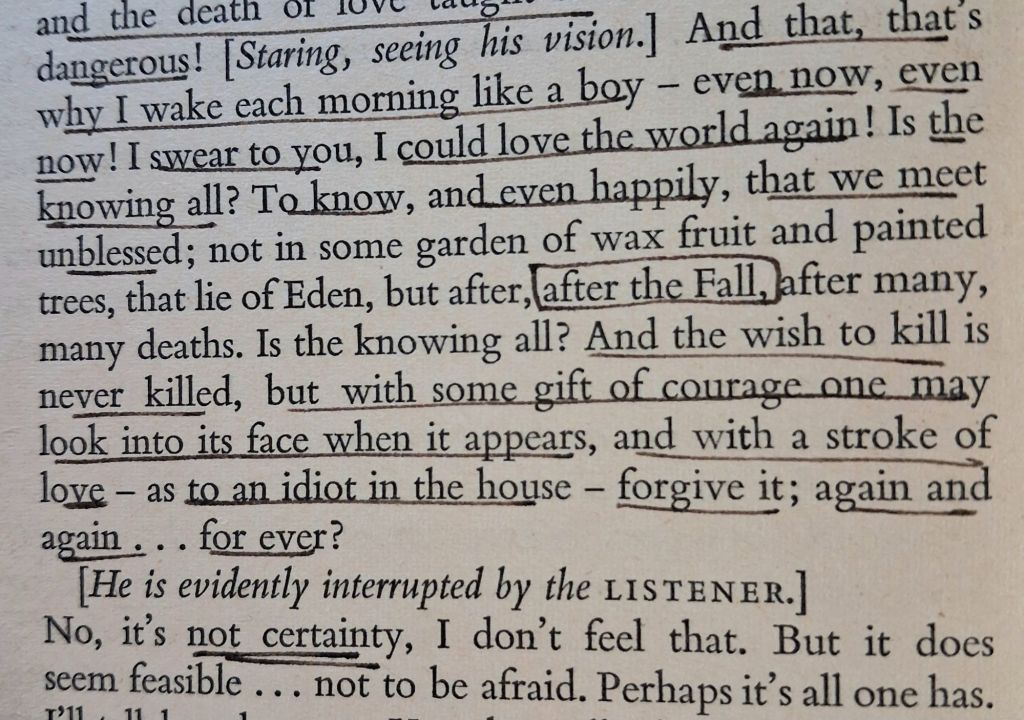
Consider that repeated question: ‘Is the knowing all?’ Clearly knowing matters to this dramatist, but also his allocation of the idea of the ‘Fall’ not to the ‘lie of Eden’ but to the Second World War and full knowledge of the Holocaust (‘many, many deaths, like the dead airmen in All My Sons) and the wars that followed this. Can we take the ‘unblessed’ state as ‘known’, ‘happily’ so, and progress without the need of certainty of knowing, which is all we know in truth. That later play has says Miller in the text its entire action taking ‘place in the mind, thought, and memory of the central character, QUENTIN. And look at the description, for Elia Kazan who first directed it:
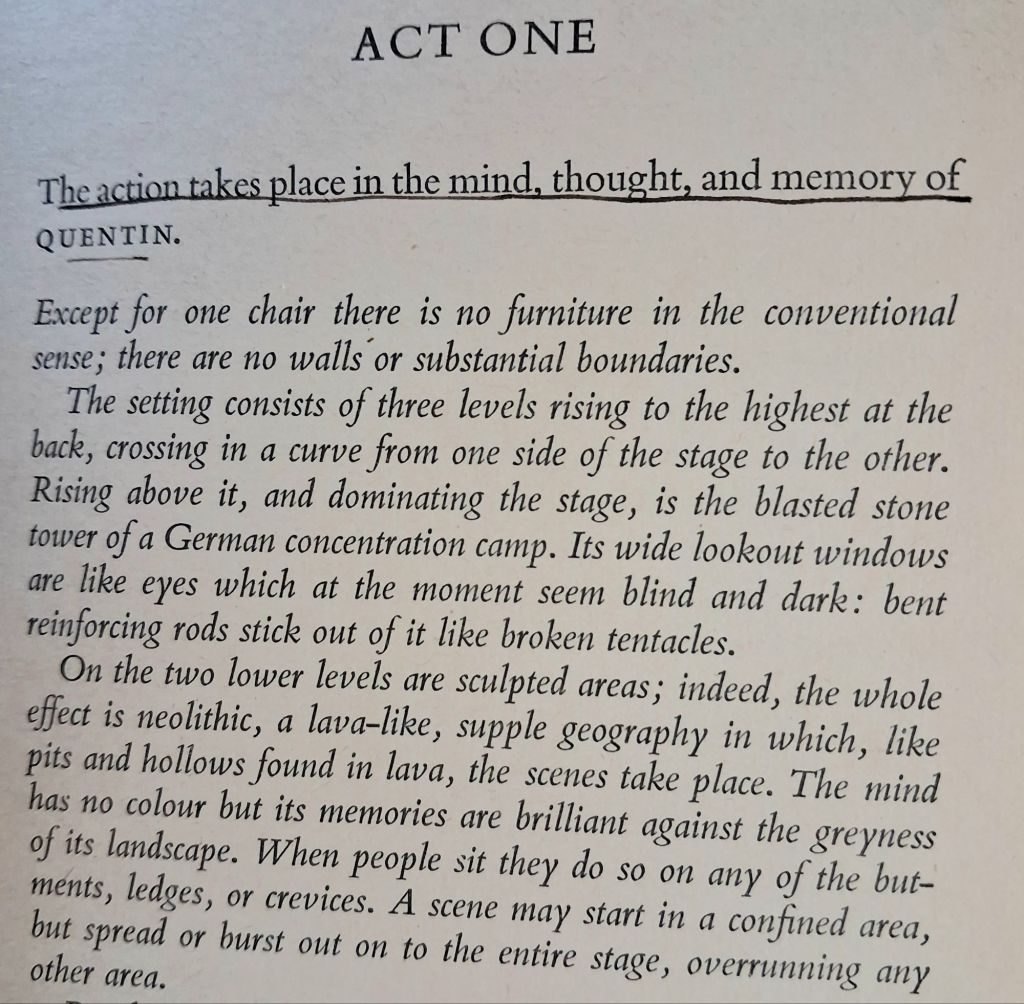
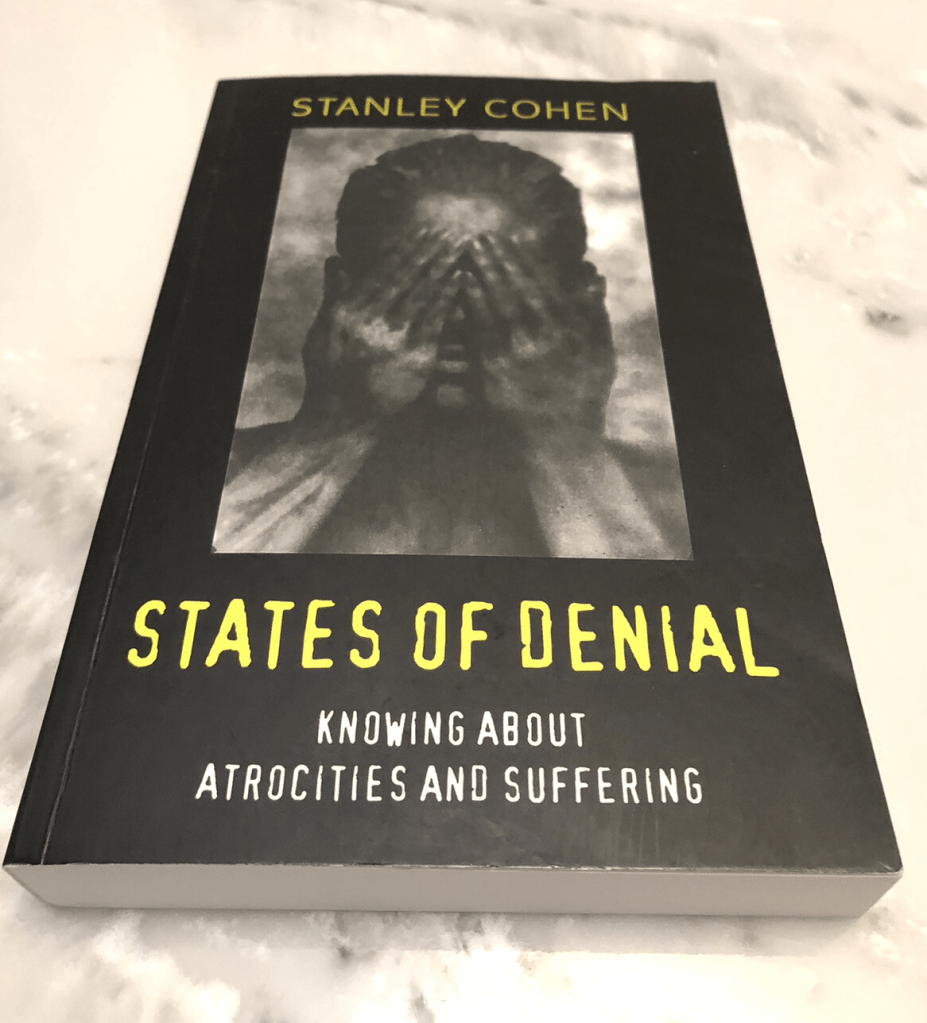
A mind without ‘walls or boundaries’ nevertheless contains discrete images of contemporary horror: the tower of a German concentration camp’. But that tower is a kind of reflection of the unknowing, the resistance to truths (‘denial’ in psychodynamic terms) ‘eyes which seem at the moment blind and dark’ and severed and penetrated by reinforcing rods, that are only like organic tentacles. What does such a mind ‘know’ and is the ‘knowing all’. Today in The people’s Bookshop, I also found, fortuitous;ly, a Verso book by Stanley Cohen in 2001, States of Denial: Knowing About Atrocities and Suffering. In the light of collusion and denial about Palestine, this is a book I need to read now. perhaps I will write about it as part of my review of the streamed production of All My Sons. But all for now:
With love
Steven xxxxxx
 Steve_Bamlett_blog