


Wordsworth was sometimes called an Egoist in religion, usually from an an extrapolation from the following ‘evidence’, although but from a sub-clause in his case against Unitarianism and plea for the staid doctrines of the Established Church. The Unitarian Henry Crabb Robinson in his 1812 journal reported that Wordsworth told him that:
“I can feel more sympathy with the orthodox believer who needs a Redeemer and who, sensible of his own
demerits, flies for refuge to Him (though perhaps I do not want one for myself) than with the cold and rational
notions of the Unitarian.”
I have seen that cited in the form of Wordsworth saying ‘I Myself need no Redeemer’ though I cannot remember where, but the conclusion is the same that the poet was in all things, what John Keats called him, the Egoistical Sublime.In most things that is, Wordsworth’s art was a means of ‘do-it-yourself’ for asserting that which saves us from a sordid materialism and self-interest and defines human being with grace not reason alone.
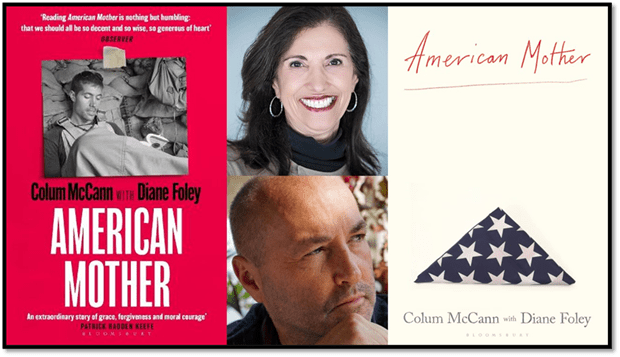
This blog is an entirely speculative look at a contemporary book by an artist, though far from egotism, who seems to make it his project and that of his art as a story-teller (and Wordsworth too was in essence a story-teller) the redemption of the loving nature of humanity through grace, though by clear admission of the complexity, ambiguity and incompletion of human love. The artist is Colum McCann, the book Colum McCann with Diane Foley (2024) ‘American Mother’ London, Bloomsbury Publishing. The puzzle of the book in some senses is in the author attribution, why is this a book described as written ‘with Diane Foley’ and not by them both collaboratively and equally. Diane Foley, the mother of James Foley, killed by ISIS rebels in Syria by beheading and performed by British converts to Islam, referred to in the press, after a report of hostages calling them that, as the ‘Beatles’ (because their beatings were savage). Foley is a staunch and devout Catholic, committed to the Trinity: the text often calling on God to redeem what can’t be simply forgotten and forgiven and for the love of Christ to mediate that process of redemption, again as Foley would see it. But I think McCann’s part in the book more complex and more involved with the art of story-telling and its potential to redeem. At the end of his ‘Acknowledgements’ section of the book (Foley has her own section) after a list of names, ending with all those at Narrative 4, an organisation based on the learning of human value through exchange of stories. he says simply: ‘Everyone, indeed, a story’, as if we might know and love ourselves individually and communally through storytelling alone. I do not know where McCann stands in relation to organised religion but I am sure that like Wordsworth he insists that narrative art means that he too does ‘not want’ a Redeemer for himself, for stories will do the trick. He writes of Diane in the book:
‘She is an American mother. It is not a story that often gets told. …The story sometimes forgets her. She is often invisible. She dissolves at the edge of someone else’s words’.[1]
The quotation I give in the title is from the final section of the book American Mother and it is narrated in the third person, though often from the point of view of Diane Foley, the eponymous American Mother. The first section of the book is also narrated like this though the intervening chapters, the majority of the story are told in the first person as if by Diane Foley. In her ‘Acknowledgements’ section, separate from McCann’s as I have already noted, Foley expresses deep gratitude to McCann ‘for helping me tell my story’ and speaks of him and his talented editor , and Jim’s dear friend Tom Durkin for patiently reading my edits’.[2]
Blake Morrison, who certainly knows something about writing and ghost-writing in his review of the book for The Guardian certainly seems to suggest that there is a reason why Diane Foley describes her contributions as ‘edits’ not writing or stories. His central paragraph on the process of making of the book talks mainly of ‘his’ (meaning McCann’s) ‘account, though here he is talking of the first and final sections in the book – both third-person accounts of encounters between mother and jihadist, Alexanda Kotey (and her son James’s killer), though he describes the intervening chapters too in ways that honour as writer, not Diane but Colum, speaking of the latter as ‘switching back in time to voice Diane in the first person’. Morrison writes:
The encounter between mother and murderer that opens the book is written in the third person, as narrated by the novelist Colum McCann, who agreed to help Diane tell her story. He’d been interested in the case since seeing a photo of James Foley in a military bunker reading one of his novels. And by sitting with Diane and her husband in their New Hampshire home, he became a kind of “story whisperer”, hoping to “thaw some of that frozen sea”. His account of her face-off with Kotey doesn’t stint on high drama; in places it reads like an excitable would-be screenplay. But thereafter he’s more measured, switching back in time to voice Diane in the first person.[3]
Diane is ‘voiced’ by McCann he says – the choice of words is strange. Does Blake suggest that all of the writing is ultimately owned by McCann. If so the description of a ‘story whisperer’ is a highly charged one, as is the idea of Diane’s story being a ‘frozen sea’ until thawed, a sea that does not otherwise flow. This reminds me somewhat of the novel McCann completed before this one, Apeirogon (blogged on by myself at this link), which voices stories told by two people across, but each trying to bridge, the divide between Israel and Occupied Palestine. As a novelist McCann has, in his most recent novel Twist (2025), turned to a narrator whom, tired of himself, wants to connect people up – find the commonality in division (Twist is about undersea cable connections – communication lines which break and must be repaired – see my blog on it at this link).
I had a feeling that I had exhausted myself, and that if I was ever to write again, I would have to go out into the world. What I needed was a story about connection, about grace, about repair.[4]
Is it possible, I wondered, as I completed reading American Mother, that this novel is part of the same project, where the mother of a journalist executed in a war-zone confronts one of his putative (for Kotey denied being at the execution though still claiming co-responsibility for it) and notorious killers. James Foley was indeed a journalist, having given up on both teaching and novel-writing but he was so much more than that – and the book makes this clear a teller of stories about real people, even though we also have to imagine real people as much as fictional ones in order to understand them. McCann may well see himself at the picture level of a recession of people trying to tell stories that bridge divides – even when they are not of war but of difference as McCann ‘voices’ a deeply earnest Catholic woman’s agony and decision to go beyond agony into ‘grace’ and ‘reparation’, into to understanding another she is told, and sometimes tells herself, that she should hate. McCann mounts a project to see if telling each other our stories (making literary books) is as much an act of grace as God’s redemptive grace is said to be. If there is any chance of this, McCann tells us, then we have to go beyond binary distinctions between truth and lies (for the truth as told by one person seems as if it could be a lie to another person), light and dark, love and hate, and endless other binaries, This is how the story opens:
She wakes in the hotel dark. A scattering of street lights through the thin curtains. There, in the distance, Washington DC – city of truths, half-truths, double truths, lies. One sure truth: her son is seven years gone now, and this morning she will sit with one of his killers.
The prospect ties a knot of nerves at the base of her neck. It is not simply that she has no idea of what to expect from him: it is just as much that she has little idea what to expect from herself. A symphony of confusion. Compassion. Revenge. Bitterness. Mercy. Loss. Grace.[5]
The stories in this book do contain only ‘one sure truth’ – the physical fact that persons will always find ways of telling stories that justify the death of others, as surely as Milton believes it is possible to ‘justifie the ways of God to Man’ through art. Likewise, even those stories, if told with enough authenticity as possible, and even when they justify what may be cruel means of proceeding, might show us that the way to ‘grace’ is bound up ‘hate’ and ‘revenge’, with ambiguities, contradictions, and even potential lies.And certainly with ‘darkness’ (even ‘hotel dark’) that has light scattered through it rather than a suffusion of impossible grace.
We hear Diane Foley’s voice in this book, however that voice was released and mediated, for certain but the burden of the book is not her faith, much as that is respected in its fully orthodox passages – even when she submits James’ life to Christ in the story of the eve of his execution, but of McCann’s insistence on the power of story exchange. We hear too Kotey’s voice, even see his manuscript letter using it – he preferred to write than to speak – and Diane’s sometimes shocked reaction to its formality of tone and register, and her feeling that there may be ‘lies’ woven into it, as she does with Barack Obama’s voice too.
The test for the book however is whether a mother’s authentic story gets told for, ” it is not a story that often gets told. …The story sometimes forgets her. She is often invisible”. In fact the true test is does Diane dissolve ‘at the edge of’ McCann’s “someone else’s words”.
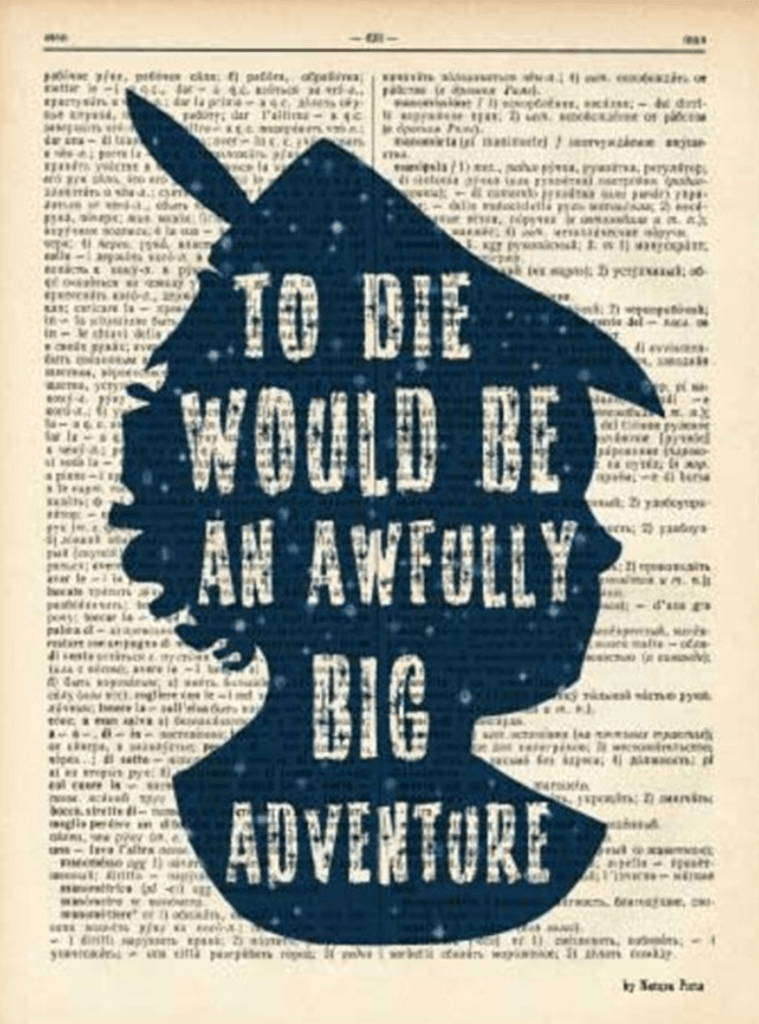
This is an important book that puts into practice the DIY redemption of humanity that is present in much more enfolded manner in McCann’s novels, especially Apeirogon and Twist. I read it but can’t keep it – the account too raw and personal in Diane Foley. I can’t do that myself for myself. See! I cannot even take that on. But what an ‘awfully Big Adventure’ that ambitious DIY project would be – to redeem human value from its present state.
With love
Steven xxxxxxxxxx
[1] Colum McCann with Diane Foley (2024: 209) American Mother London, Bloomsbury Publishing.
[2] Ibid: 230
[3] Blake Morrison (2024) ‘ Review: American Mother by Colum McCann with Diane Foley review – steeliness and sorrow’ in The Guardian (Thu 15 Feb 2024 09.00 GMT) Available at: https://www.theguardian.com/books/2024/feb/15/american-mother-by-colum-mccann-with-diane-foley-review-steeliness-and-sorrow
[4] Twist (2025: 5) cited in A great novel always takes the trouble to ‘bother me’. The example of Colum McCann (2025) ‘Twist’. – Steve_Bamlett_blog available https://livesteven.com/2025/07/11/a-great-novel-always-takes-the-trouble-to-bother-me-the-example-of-colum-mccann-2025-twist/
[5] Colum McCann with Diane Foley (2024: 3) American Mother London, Bloomsbury Publishing.
 Steve_Bamlett_blog