‘Sometimes home is a place you have to discover or construct’ [1]. This blog is a reflection on a memoir by Mark Haddon (2026)’Leaving Home’, London, Chatto & Windus.
I have blogged on Mark Haddon before, use the links to read these blogs if you wish: on the first chapter of The Porpoise, on The Porpoise as a whole, on Dogs and Monsters. Mark Haddon’s career as a novelist, and his latest memoir, are in a way a complete answer to this question, since they continually circle back to a teenage self, and earlier, to explore the themes of adolescence, especially that of leaving and returning to what we call ‘home’ and what we mean by that idea of ‘home’. I have already touched on one theme of the book in an earlier blog (use the link here to read) but this is a more general look at a book that haunts me. This concept of reconstructing ‘home’ is what these reflections will mainly cover, although I wanted to start with more generalised feelings about how and why Haddon’s book is necessarily innovative in its manner and form of bridging memories, thoughts and feelings between the self at different ages of its versions. In this case I was helped by a sympathetic review of the book in The Guardian by Alex Clark. This section of her review in particular is nerve-tinglingly appropriate; helping me to realise something quite awe-inspiring and shocking, in the sense of being helped out of the emotional deadness and sense-deprivation of a lazy reading of Haddon’s book into something that matters to us all more generally. My hard copy of the article has my notes on it, hence I will cite the ones from the digital publication, for I value them as they are:
The question remains: can you recover from – or even avenge – an unhappy childhood by dismantling and remaking it differently in adulthood? In one demonstrable sense, yes: not only has Haddon made a life in literature, he has his own family, and a strong and continuing bond with his sister, Fiona. But alongside the evident joy he finds in acts of creation, in personal relationships and in activities such as running, there is damage that the book suggests he needs to examine and catalogue, to somehow fix in place.
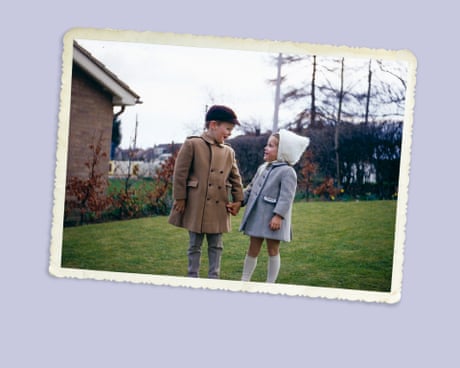
Mark and Fiona Haddon
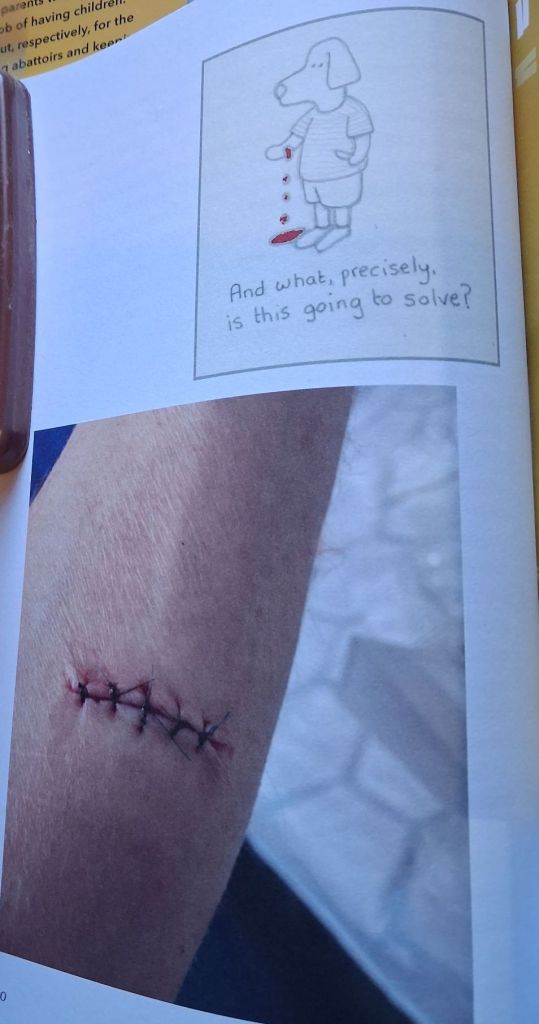
He does not gloss over it. Early on, the reader comes face to face with a photograph of a newly sutured arm; above it, a doodle of a dog, with bleeding forepaw, and the caption “And what, precisely, is this going to solve?” Two matter-of-fact paragraphs opposite describe Haddon’s visit to A&E: he cut himself deliberately, but “accidentally” chose a new scalpel “instead of the scissors I might normally use” and went too deep. He cuts when he is “uncontrollably angry” with himself; calm returns quickly, leaving him “embarrassed” (an emotion that recurs frequently) and “apologetic” to the hospital staff who care for him. Perhaps the most shocking thing for the reader is that this particular event happened in 2024; there is no statute of limitations on feeling desperate.[2]
We might expect the author of The Curious Incident of The Dog in the Night-Time to have a strangely emotionally distant manner of revisiting past emotion – one nearly everyone finds even more emotionally charged if they let the emotion in, of past and recurrent strategies for dealing with extreme stressors whose origins are a highly charged interaction between prompting events and internal drama from past trauma or other inheritance. But because this piece comes so soon in the memoir, I think it is possible to miss that it deals with a token of the type of of behaviour we call ‘cutting’ that occurred in 2024, relatively recently to the book’s appearance. It makes Clark’s phrase that there is ‘no statute of limitations on feeling desperate‘, immensely powerful and meaningful for me. Does it you? And that goes together with the mysteries in the passage Clark mentions – how could, for instance, ‘accidentally’ mistake a ‘scalpel’ for a ‘pair of scissors’, and why use only a cartoon and a photograph of the stitched cut to sit alongside those words to manifest, and in the case of the cartoon caption, critique those words. You need to see the latter to realise the manner in which it reverberates with the text, questioning the aetiology, purpose and ethics of the behaviour described in the prose on the facing page (the short section 20 of the book):
Mark Haddon (2026: 40) Leaving Home, London, Chatto & Windus
The book is written in sections that are sometimes episodic, and sometimes deal with life-themes or are interactive between the two – sometimes with a simple topic, like the cut in Section 20 but sometimes inviting multiple perspectives and analogous experiential examples or thoughts based on readings of literature (unsurprisingly, Jorge Luis Borges and Georges Perec but, more surprisingly, Jane Austen) or psychology into them. There is therefore no simple serially told story or consistency of memory or of distance between the even related and the present and past emotions and thoughts about that memory, desire or existential ennui and how they collide. To me, this has the puzzles of interpretation and validation of genuineness that you also feel in Tennyson’s In Memoriam, despite the poet’s rather facile epilogue which ties to convince us that:
For I myself with these have grown
To something greater than before;

Which makes appear the songs I made
As echoes out of weaker times,
As half but idle brawling rhymes,
The sport of random sun and shade. [3]
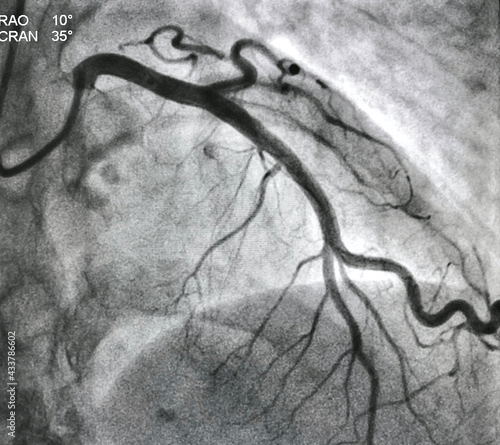
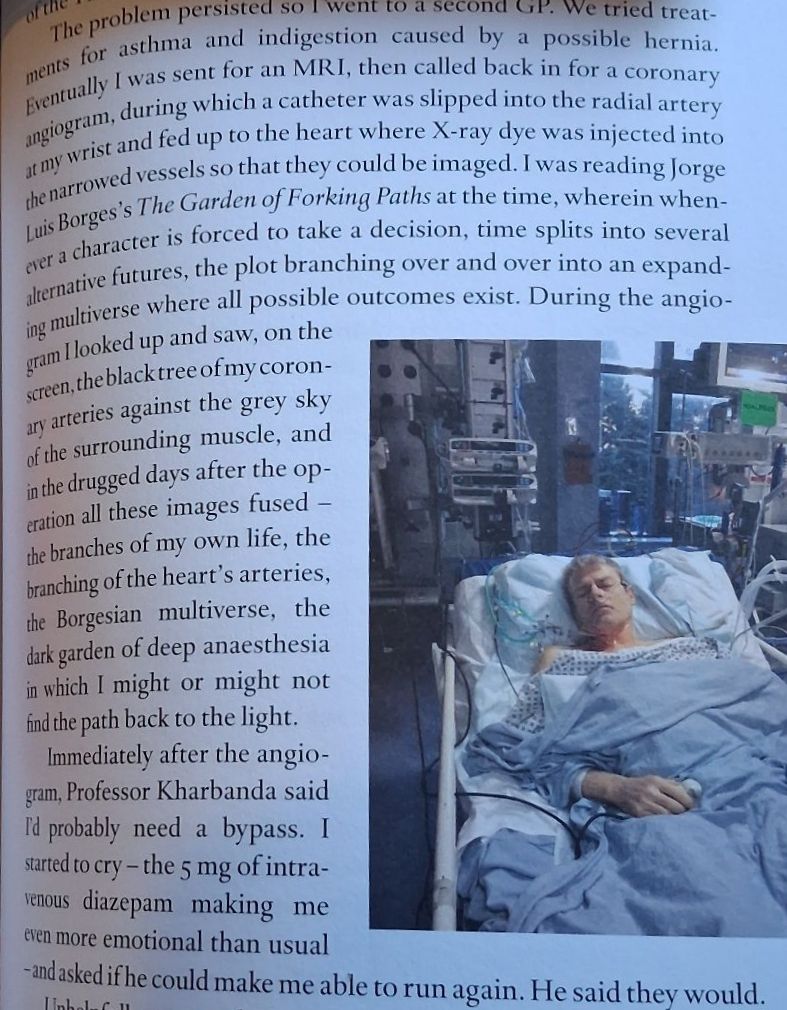
I think the important thing here is that it is common in autobiography to pretend to ‘growth’ that entitles the elder person to counsel the younger, though it was ever the case in practice, as Lewis Carroll knew and sang in his nonsense lyric about Old Father William being given guidance from a young man (the link has the wondrous Kei Miller reading the poem). But this presupposes a too unwise presumption that older persons always learn resilience, as Old Father William did, and Tennyson pretended thus to do. Haddon, at the point at which he evokes Borges, argues that life paths that are the stories of ourselves, factual and counterfactual, and can be read retrogressively as well as projected progressively (like a vision of both memory and projective future-gazing, are like the visual plotting of the heart’s networks in an angiogram:
Hear his words and see him in hospital attached to machines that read the timeline of his hope, fears and regrets or, in short the non- material heart, as it were:
Mark Haddon (2026: 85) Leaving Home, London, Chatto & Windus
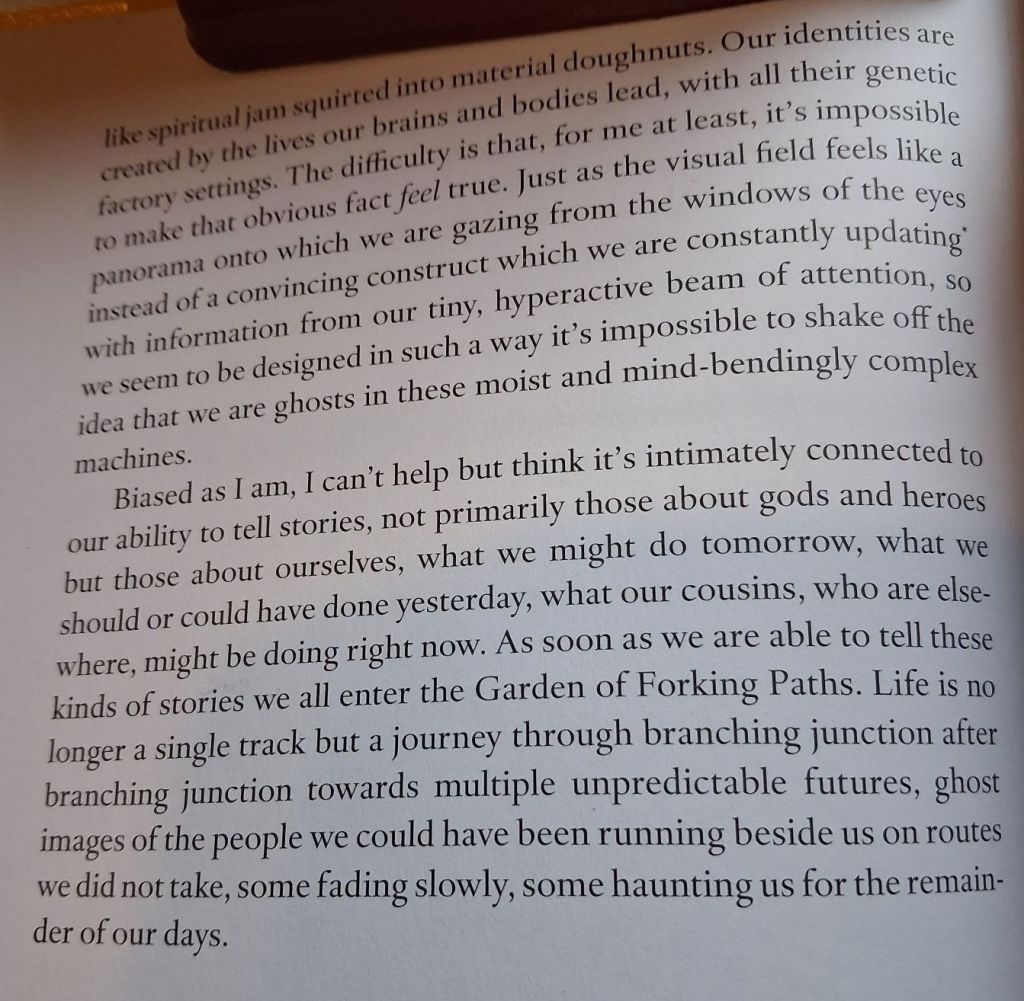
The Borgesian multiverse is not unlike a map of the heart (looking like a coronary angiogram) moulded by decisions throughout life and to be made in the near and distant future. The ‘light’ at the end of these paths has many meanings I believe: it might be continued life or secure death as in the many folk anecdotes of near-death experience as a journey into light. It might be a knowledge less dense than that in ‘the grey sky of surrounding muscle’ that is still lighter than the black trees we see it set behind. This is like the experience of reading this beautiful book, except that tree and sky keep fading into each other, as paths get lost, or we follow one we were not expecting to follow (there is an analogy to this in my blog on Robert Frost at this link). This is why Haddon keeps giving us passages from his earlier books to read, illustrating both the factual past from which they gained life and the adventures writing and reading took theses paths further towards alternative futures: see especially the re-reading of The Pier Falls in this respect. [4]
It is a book patterned by echoes and self-reference backward and forwards: for instance the Borges book returns
Mark Haddon (2026: 108) Leaving Home, London, Chatto & Windus
A passage like this tests a reader too, especially their capacity for seeing semantic networks across the time-space of their reading experience. This is not only in connecting the conceptual use of The Garden of Forking Paths to its use as the titles of his earlier reading material but to other discussions in the book about the nature, function and usage of telling stories or writing them, to their link to something purposive (the joke behind the book called The Porpoise – that is the queered ‘Purpose’ of life) and the link of the function of writing and storytelling to Haddon’s love of, and need for, being a runner, including that reference epigram from Paul Farley‘s poem I Ran All the Way Home in which the dogs ‘have the run of the streets’. Running (forgive me) runs through this book – running without overt (or known) purpose as well running away or running back to somewhere or something – often a home to run from or return to.
Home is linked to the use and discussion of nostalgia in the book, for the idea of the nostos (Ancient Greek: νόστος) is the story of home longing and, at the same time, delay from getting home for reasons not always known to the adventurer, or even examination of what ‘home’ actually means (see one of my riffs on this at the blog at this link), the classic narrative thereof is The Odyssey but Haddon writes many of his own during his career. The substance of this blog will be advise to a teenage self about what home is or can mean, assisted by Mark Haddon’s totally separate and better articulated ideas
There is too much in the book to capture its full range of play with the concept of ‘home’, though we can hint at some of its complexity and richness. Take a piece I cited in my last blog featuring this book, which describes:
… the sculptures made of cheap, easily available and perhaps vulnerable matter that he favours over high art and which former kind he makes himself:
Unlike sculptures made of glass or wood or stone, they have interiors, they have rooms and corridors, and their exterior surfaces are a function of those interior spaces. I look at them now and can’t help thinking of them as habitation, as buildings in which something lives. [5]
Homes at their simplest are ‘habitations: buildings in which something lives’, and at this simple level the theme of home- making implies too Haddon’s architect father, who could make homes, except for his own children, discussions of Bauhaus architecture and interiors and the difference between ‘houses’ and ‘homes’. But then in discussing all these Haddon suddenly tells us that the contents of his own head (‘daydreams, fears, puzzles, travels in imaginary worlds’), because they happened in physical interiors for him – in ‘rooms’ – made what lies in rooms analogous to ‘parts of my mind’: ‘By extension I came to think of all rooms, all houses, as extensions of other minds, ways in which other people might think or feel’. [6] And the complexities don’t stop there in these networks of imagery because ‘houses’ and ‘room’s can also be the mind engaged in a behaviour, like running or swimming as we shall see, such that ‘homes’ are born from engaging in those activities. Needless to say these activities include both telling or hearing stories or secondary versions of that in writing or reading them too.
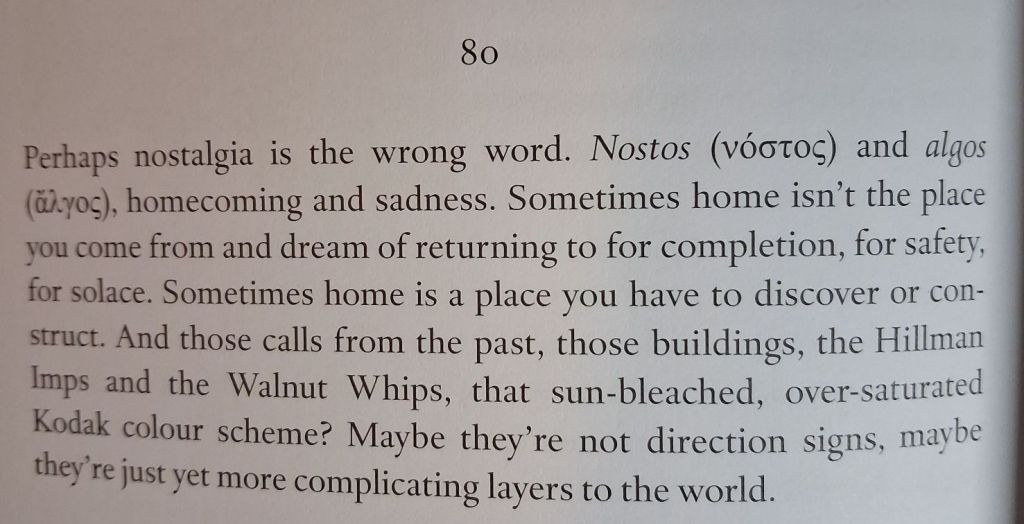
In one reflection Haddon almost begins to advise his ‘teenage self’ what ‘home’ is, and why not all things that call themselves ‘home’ are, in the Bowlby-derived term ‘safe places’ or ‘secure bases’. I use one sentence from the paragraph below, which begins with Haddon unpacking the term ‘nostalgia’, in my blog title:
Mark Haddon (2026: 170) Leaving Home, London, Chatto & Windus
Your home, my son, I say to my teenage self, may not be a thing encountered in your past or your memory at all, but a thing still in construction and discovery and isn’t therefore to be relied on if you want solace or a sense of safety and security. Hence the examinations of his father and all his ‘child-abuser’ social circle (not that ‘proof’ of this runs beyond the equivalent of gossip in fact but it renders one feeling unsafe) and a mother who never loved you, even when she needed you but would never ask.[7] Strangely, homes can be entirely imaginary time-spaces )for space and time are conjuncts) like the cosmic wall-chart on Mark’s bedroom wall. It can be, if not the ‘home’ of his Mum and Dad but certainly, in part, that shared in Oxford with his wife, Sos, ‘and the boys’ (their children) but it has to more too:
I feel properly at home in the world only when I am doing something, just as I feell at home in those landscapes when I’m walking, cycling or, best of all, running through them. [8]
And best of all that home is found in reading and sometimes writing (of his favoured reading he mentions some surprises like Ocean Vuong and Robert Jones Jr – i have blogs on each of these linked to their names above):
Reading is itself a miracle, but those passages where where the page becomes transparent and I enter an imaginary world so fully that I’m no longer aware of the room, my body, my day-to-day life, seem like miracles within that miracle. … – this imaginary world is a distinct and different place to which we have to travel and from which we have to travel back. [9]
We have no need of a nostos story other than this. However, this book appeals because it traces, as well as physical disruptions to the body of a writer’s active self but also to periods of intense mental breakdown, or passages near to it. And in acknowledging this Haddon explains why his ‘social circle’ is, if he has to have one, largely of people on the cusp of mental health, such as his Samaritans co-workers (‘an extraordinary range of human beings’) even in sacred books such as the Book of Job, where we enter ‘into the minds of its imaginary inhabitants’. [10]
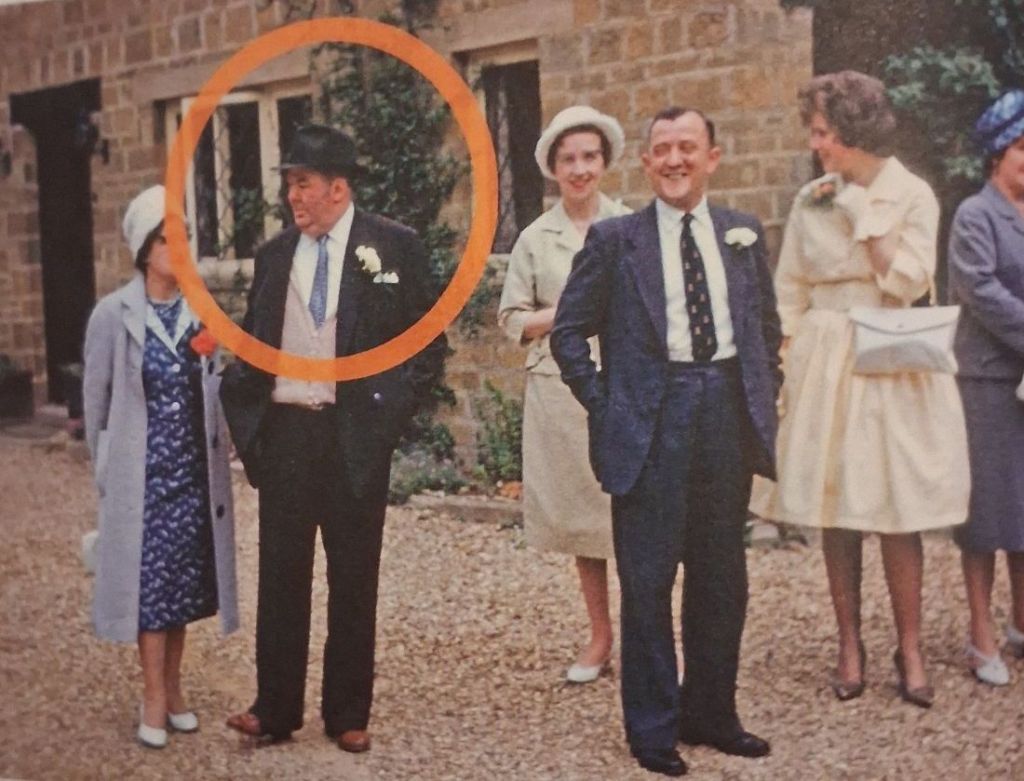
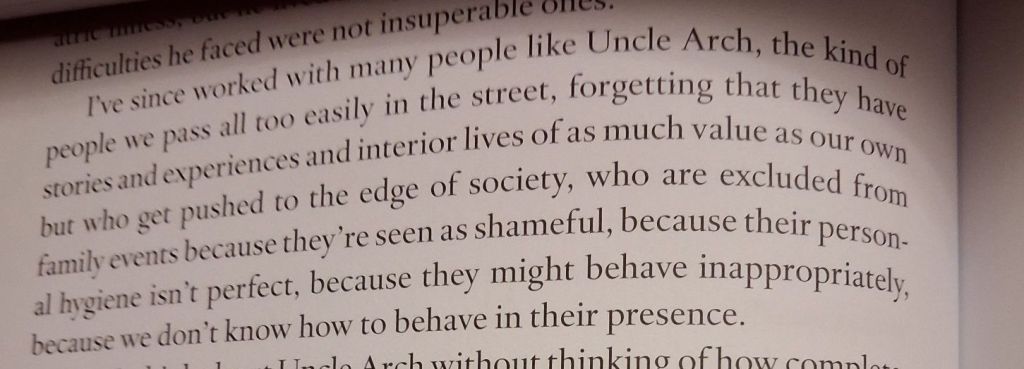
And the reading doesn’t stop at books but enters into interactions with others and reading the pictures of people circled on an old photograph like ‘Uncle Arch’, who ‘never married, never had children’.
Mark Haddon (2026: 64) Leaving Home, London, Chatto & Windus
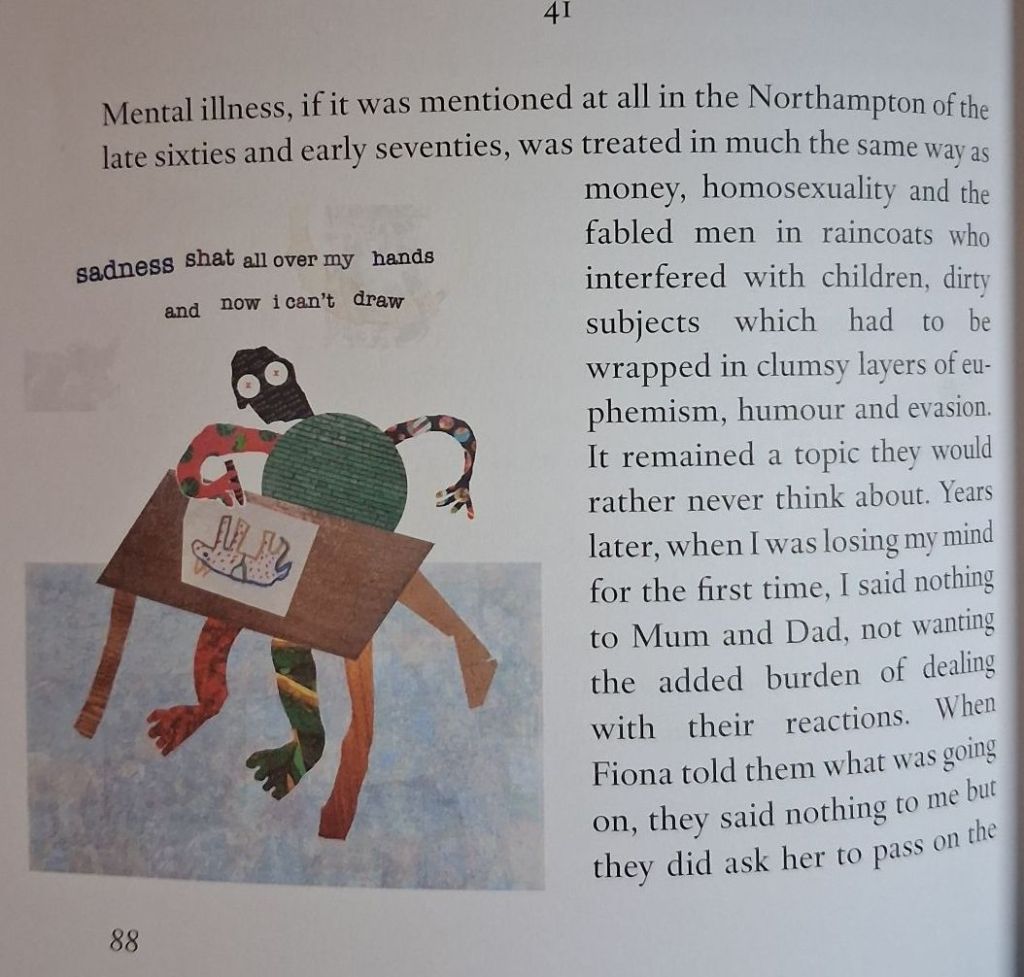
This book is a humane book that queries identity at the edge of alien places, including madness or total a-functional breakdown, because most concept we call ‘human’ are usually entirely exclusionary and exclusive concepts – exclusive of animals for instance including our true being as human animals. Usually it need not go to extremes, for much exclusion in society in concepts like community or family, which are supposed to have a fuzzy warm glow around them but as often have barbed-wire fences or forbidding borders. Haddon grew up in a profound version of this exclusion of the marginalised and unvoiced for if society treats people with mental illness badly, it is worse when those people are children and not only in Northampton in the 1960s and 1970s.
Mark Haddon (2026: 88) Leaving Home, London, Chatto & Windus
By the way, it is time we stopped using black dogs to represent depression. The caption to the picture above is an insider’s definition recognised by them as such: ‘Sadness shat all over my hands and now I can’t draw‘, or, in fact, do anything else at all. This book may appeal to few because so much it speaks of is usually confined to silence or described as subjective reponses to life at some extremity to norms. It is neither of those things. It is urgent as well as deeply deeply ‘sad’ in the fullest sense of this world – and like all true sadness is full of the capacity to see humour in the world.
Please read it, but more than that – keep discovering and building that ‘home’, leaving inadequate and oppressive alternatives behind, as unloved in truth as they were unloving like the brutal ending of Haddon’s Mum at the end of this work: ‘I sat by her bed and held her hand, I didn’t say that I loved her. I can’t remember ever having loved her’. [11]



 Steve_Bamlett_blog