Do you set personal goals for yourself?
Simon Armitage has published a new verse translation of The Epic of Gilgamesh. In it all personal goals entail love of another, perhaps ‘like a wife’, but definitely ‘another’ of some sort.. This blog is about Simon Armitage (2026) ‘Gilgamesh‘ , London, Faber & Faber
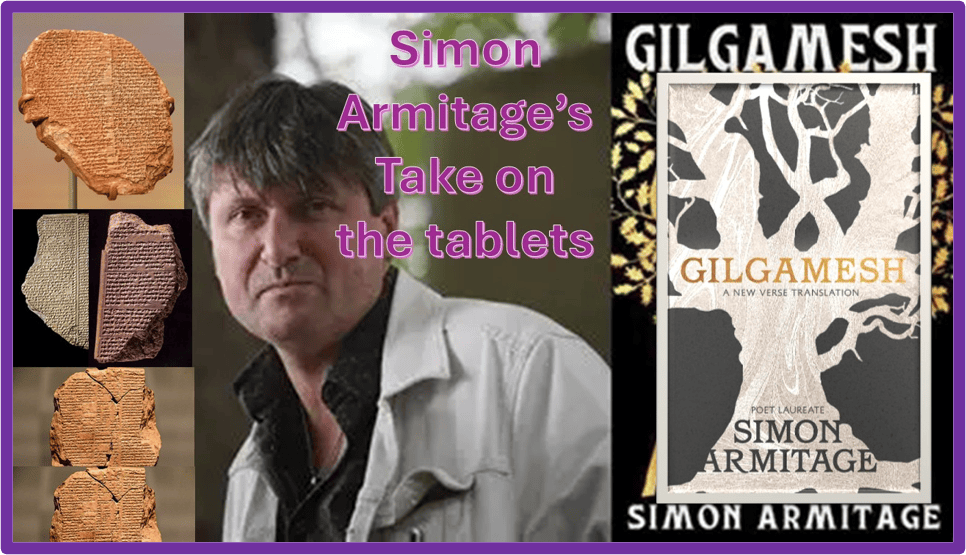
Despite immediate appearances, I do see this blog as an answer to the prompt question for it is an attempt to ‘kick against the pricks’ raided by the terrible cliche of our time: ‘personal goals’, by looking at where an ancient epic poem sees all goals deriving (which is the love of another), especially in the narcissistic young male, thinking himself before he ‘loves’ (whatever that means) formed internally and internally like a ‘bull’, not unlike ‘The Bull of Heaven’ indeed who appears in The Epic of Gilgamesh. But, of course, I want to talk about that using a new verse transltion of that epic, which itself needs a little introduction. I will get to what there is to say about goal-setting towards the end.
It is always the right time for another take on The Epic of Gilgmesh as I said about the bold one by Sophus Helle, a translation fuelled by queer theory and an understanding of the dangers of applying the contemporary binary distinctions about many matters to ancient languages, cultures and their texts (see my blog on Helle at this link). Yet Armitage’s introduction to his version only comments about Helle’s translation in terms of its treatment of gaps and omissions in the text not its take on the handling of binaries per se. Helle’s textual presentation decisions were he believed, in Armitages’s words and quotations from Helle, ‘an attempt to “stake out a middle way” between “poetic power” and “philosophical exactitude”‘. He continues by saying with his oft used sharpness of dismissal: ‘One person’s middle way is another person’s twisting chicane and what counts as middle ground will always be a nuanced matter including personal judgement and taste’. [1] This sentence contains the worst of what Armitage is cpable of in his critiques of culture (commented upon more in my blog on his specifically critical writing on poetics at this link) – a dependence in the belief of his command of ‘nuance’, ‘personal judgement and taste’ and a emarkable capacity to scorn innovation in technique that wanders too far from the traditional and consevative in poetics. Somehow, I think we may have to take a wide context in understanding this poem, and I will say no more about that but will quote a rich paragraph from a book I blogged about last year (at this link) about the strangeness to Western tradition of thinking and reding practice during the rich period of cultural flourish in Mesopotamia (an area roughly equivalent to modern Iraq) and which I often misleadingly call ‘Persia’). This passage, quoted in the earlier blog, by Wisnom (in Selena Wisnom [2025] The Library of Ancient Wisdom: Mesopotamia and the Making of History) elaborates on what she calls the ‘sheer joy’ in ‘seeing meaning proliferate’ in the literature read by Ashburnipal in his plce library:
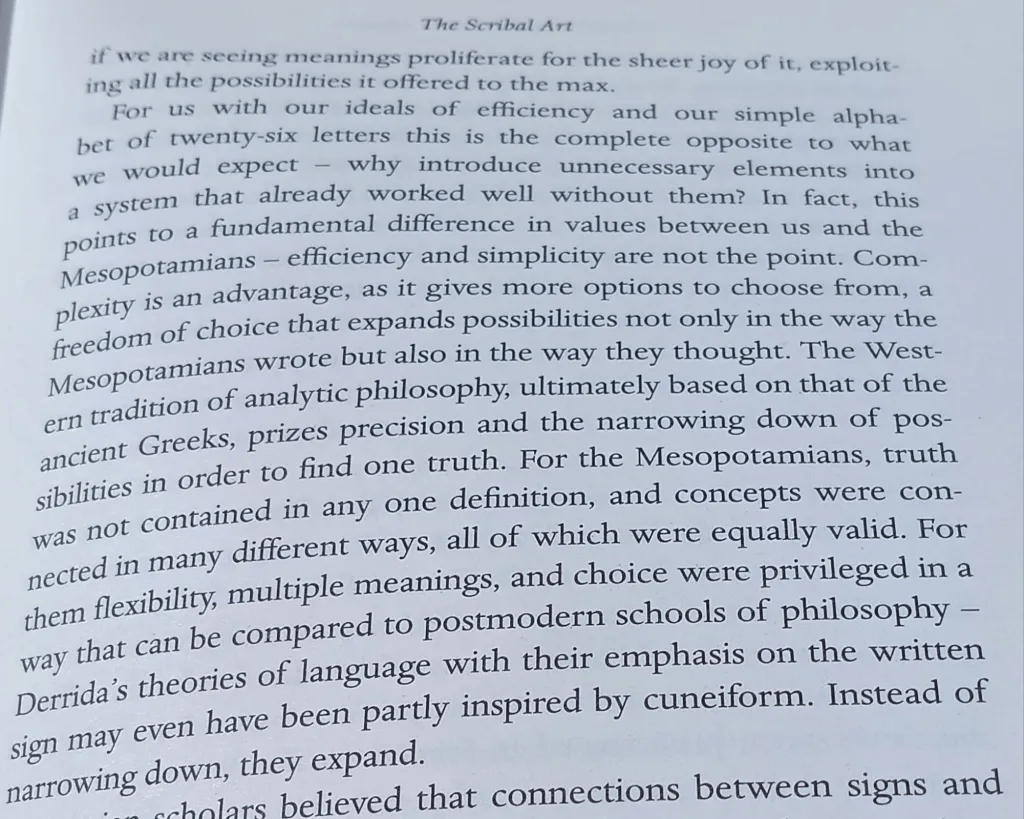
From Selena Wisnom [2025: 9] The Library of Ancient Wisdom: Mesopotamia and the Making of History, Penguin Books
In the end, we have to conclude, that though a considerable and masterly craftsman-poet, Armitage has little or no equivalent of a philosophy or belief about language other than in the pragmatics of its usage in beautiful and striking ways, that sometimes throw up remarkable acts of perception in details but has no desire to make thought itself that just blossoms, sometime in rich abandonment of the ‘narrowed down’ view of life’ that the ‘greats’ of Western thought have ploughed into a furrow. But that is unfair too, in some ways, for Armitage never sets great ambitions in his public pronouncements about poetry. However, a queer reader like myself might be assumed to want to know how Armitage deals with, in his words, the ‘actual nature of the relationship between Gilgamehs and Enkidu’ as a ‘much-debated subject’, except that I already begin to doubt Armitage’s right to do so when he uses the word ‘actual‘, a word that presupposes a binary rift between the real and the apparent. The thing about relationships is that they are never apparent or real, fact or fiction but a complex mesh of configured versions of objective and subjective intersubjective thoughts, sensations and feelings. Ther stands between this and Armitage’s poetic take on relationship the bluff persona of the Northern male, hard to remould in softer form, a person I fight in myself on regular basis.
All that applies only to Armitage the commentator, and eventhere that is not the only story for after Armitage has marshalled the arguments against a once-favoured (though not by the sophisticate queer theorist Helle) view herepresents thus: ;For some, Gilgamesh loving Enkidu ‘like a wife’ is an unequivocal declaration of a same-sex physical union, …’, he states his conclusion thus and somewhat beautifully, if still equivocally and still obsessed by boundaries and barriers:
In the end, we might decide that what the poem brings into play is a consideration of the word ‘love’, its definitions, its boundaries and its types, a subject still under discussion so many thousand years later. Ultimately the poem is enigmatic and vague in its meaning but prescient in its enduring themes, and whatever the connection between the two men, Ishtar has recognized the deep bond between them. [2]
In the end, this view is recognisably similat to Helle’s, who says, as quoted in my blog on his version of the poem, that the two protagonists ‘‘do not explicate the nature of their feelings for one another. …, it is as if they want to leave their bond undefined by words, shapeless in all its intensity”. However, talk of love must not eliminate bodily contact since, in Armitage’s beutiful translation’ of that part of the poem where Shamhat, the temple prostitute tells Enkidu of Gilgamessh’s foreknowledge of Enkidu’s coming. In this tale we see Gilgamesh telling his goddess-mother, Ninsun, of dreaming of an ‘axe being thrown down’ and setting this axe first at the feet of that mother, that goddess Ishtar, saying next:
" ...
then I loved that axe, held and touched it like a wife,
and you, my mother, declared it my equal.."
Ishtar without delay tells him the axe he fondles ‘is a man. / Like wife you will come to love him, and embrace him’. [3] Surely any English translator must note, that whether it is there in the Akkadian text at all, that that exchange fails to make it clear who or what acts or is acted upon, and what or who is described in the simile of ‘a wife’. Though we immediately, I suppose think of Gilgamesh describing the axe, which turns out to be a metaphor for ‘a man’, by a secondary simile,’like a wife’, it need not grammatically be the case. This is even clearer in Ishtar’s reply, in Armitage’s English, where the wife might, by a stretch, refer to the ‘man’ as the ‘wife’ but much more strongly (because of effects of contingency of the words) describes ‘you’, referring to Gilgamesh, her son, whom she addresses. For me that captures the non-binary fluidity of the poem where the ‘it’ that is pronominal for an axe, also is both ‘the man’ and ‘the wife’. How different is the approach of a female, but supposed Goddess, when she demands to be offered (a rather enforced offer of a gift therefore) ‘the gift of’ Gilgamesgh’s ‘fruits’: ‘You shall be my husband, I shall be your wife’. No boundary-crossing there then, for the Mesopotamian world-gogs seem thoroughly heteronormative. [4]
We just do not know if Armitge recognises that himself – though as the expert in English language that he is, he surely should. All of this may precisely move us nearer to understanding ‘love’ as an arena where things (abstract and concrete), persons, sex/genders, kings and wild men (who learn humanity from sex with a skilled sacred female priestess) play with each other’s being, and versions of possible relationship.
In the process of the poem many concepts are turned into words to try to vary the relationship. The truth is, though Enkidu does not know the fact, that he is literally ‘made’ for Gilgamesh. In order to regulate the narcissistic behaviour of that young king (symbolised though as that of a ‘bull’), who had ‘grown to become the epitome of perfection’ (‘By all earthly measures he was deemed beautiful’). He manifests his narcissism in taking all the time he needed from his male population regardles orfthe needs of their fathers or brides, and by commanding seigneurial rights from women on their marriage (that is, on their bridal night, he would be first to have sex with them). Anu, on behalf of the Gods, instructors the God-creator of humanking, Aruru, thus:
You, Aruru, who created humankind;
now shape a life to match Gilgamesh.
Let this being have an equal storm in his heart.
Aruru creates man who in his own mind has the purity, his word in this translation, of an animal that is not particularly human. Though he has coarse hair on his body, ‘the locks on his head were those of a woman’, where description need not evoke either metaphor or simile, so unformed in essential ways is Enkidu at this point. In what sense is he intended then as a match for Gilgamesh, in what sense does the heart have an ‘equal storm’ in it. The next line suggests an almost definitive nature for this match, but one belied in the progress of the relationship in the poem; ‘Let combat between them lead to peace in Uruk’. [5] By the way, when Enkidu curses Shamhat near his death it is one of the few moments I know in literture where a man blames a woman for the loss of his virginity / purity, making ‘him weak’. [6] But our concern now here is with relative male strength alone, anf for Gilgamesh and Enkidu, it is as if their equality was a parity in violent stength alone – needed to keep both happy expending energy in mutual combat to allow the ancient city of Uruk to thrive by its own resources, and freed of the greed of hungry superheroes, directed at it.
But if you know the poem or as you read on, the ‘match’ no longer is one of parity of strength or violence in the heart but some other quality recognised by the temple priestess and prostitute, Shamhat. Ehen Enkidu expresses his desire, clearly implanted by the gods, to ‘stare’ Gilgamesh ‘down, be a match for his power’, Shamhat begins to persuade Enkidu that Gilgames has ‘prodigious strength greater than yours’, and then tells him the stories of how mich more, he is, in metaphors of ‘ child’ and ‘an axe’ (already cited above) both of which can be by Gilgamesh ‘loved’ and touched or hugged ‘like a wife’.Shamhat reminds Enkidu that Gilgamesh is not only the God’s chosen type of force but a force in the gaze of another:
you will see his features, set eyes on his face.
His looks are striking, with a figure to be proud of.
the very embodiment of manliness and vigour.
That manly vigour has other functions, of embrace for instance, is the very burden of the words of Shamhat, wise in sex and religion of the spirit and body. Her key message is that she knows ‘that a bond between you exists’. [7] From hereon it is Shamhat who in the even in the reported speech (often dream narration in this tablet) of others stresses the metaphor that links the two men in a ‘like a wife’ simile’ which I see as double-edged as an Amazonian axe.Not everyone is content with the wife simile. The goddess Nimsun, the mother of Gilgamesh of whom Shamhat seems to be an earthlyand mortal priestess-avatar, rranges for the temple votives like Shamhat to be for Enkidu those who ‘foster and raise him’, whilst she ‘will love him as mother would love her son. / Let Gilgamesh treat him as a brother would’. [8] The ‘brother’ relationship and nomenclature persists but is lways somewhat inadequate, because its basis is always admitted as ‘chosen’ to replace an equal possibility of choosing a matching of ‘wives’ between the men. We still get other words for the other substituted, as here, especially when Ninsun urges her son to see Enkidu as a safequard to any vulnerability Gilgamesh may discover in himsel. Suddenly:
he is battle-hardened and a warrior to learn from,
may he keep his companion, his 'double'  safe,
bring him home in one piece to the comfort of his wives. [9]
Here, Armitage translates the relationship of one to his ‘double’, invoking all kinds of internalisation and projection of self, other and the name given to relationship mediating between them (including the doppelgänger tradition of much later literature and psychodynamic thougtht (although I can’t guess whether or how it can be justified in the Akkadian text). Helle does not us the word ‘double’, their translation being somewhat less boldly designated than in either of Armitages’s choices: ‘companion’ or ‘”double”‘ (note that Armitage puts the words in inverted commas). Helle does without these problems translating the same words as: ‘”… Enkidu shall save his froend, shield his ally. / and bring him back to the fields of his ally’. [10] Helle does not find cause in the Akkadian text in Tablet III to make reference to Gilgamesh’s hitherto unmentioned ‘wives’. Yet Armitage seems to want both that and the psychodynamic and folkloric associations of the ‘double’ to be invoked (with what source justification I do not know), though otherwise he is profligate with other terms such as ‘friend’, ‘equal’, ‘brother’ as well as in relationship ‘like a wife’ to someone (even if this last was really part of Shamat’s vision of the world not his directly. Later Enkidu, after his death, is constantly referred to in animal metaphors hard to account for by modern sensibilities, especially the ‘mountain donkey’ and ‘galloping mule’ in the list, but all of these seem cognate with the abstractions already mentioned that describe him
who I loved deeply, my brother in hardship,
my constant companion through struggles and sickness,
... [11]
Yet the notion of the relationship between the two men as two avatars of the same being, or as near to that as linkedlives can be, is made much of as the poem becomes much more a meditation on loss and mortality, as Enkidu’s death forces Gilgamesh primarily soon from grief for the other into narcissistic defence of himself against the possibility of his own death.
Gilgamesh wept for his friend Enkidu,
crying bitter tears as he roamed the land.
"Must I die too, just as Enkidu died? / ..." [12]
The visceral nature of this is clearer in the repeated refrain (a common method of poetry originally oral and certainly of Sumerian poetry), strangely enough as Enkidu’s death only becomes a reality when his body is in decay – and marked by a ‘maggot’ making egress from his internals via a nasal passageway:
I wept for six days and seven nights,
refused to hand over his body for burial
till a maggot came crawling out of his nose.
The upshot of this sudden disgust at the decaying body resores Enkidu to otherness, and Gilgamesh is left with the notion that he too is mereely a body preparing for its own decay: ‘I was suddenly afraid for my own life’. [13] In that sense id Enkidu a double to Gilgamesh, another life whose end prefigures one’s one, and a eduction of self to the other as object, fit only for burial. But how does all this relate to goal-setting?
Gilgamesh’s life prior to Enkidu’s arrival was entirely self-centred, he had no goals beyond the exploitation of his own population. His first goal is born in first flush of his relationship, that teaches both vulnerability for the first time. Armitage’s verse here is most beautiful as Nunsun, ‘She-Wild-Cow’, unites the pair, and they both weep and seem to lose power in thie own bodies, such as they need the other’s support::
Then the two men seized each other and hugged;
like interlocked hands the pair of them embraced.
Each experiences an inner fire that threatens to consume each but their cobodies are upheld only by fleshly interlocking (like that of hands – a most strange simile), though ‘fearfulness stirs in the pit of my stomach’, says Enkidu.Their response to learning vulnerability and cooperation as source of strength fires a goal – a goal being to appropriate, in a thoroughly colonial manner, resources that will make their own city powereful – the cedar forests protected for the gods by a fearsome monster, Humbaba: ‘his mouth is a fire god, his breath is death’. There is no doubt that Humbaba has right of protection of the forest and that he does his job well – but that is the challenge, the goal set. [14] It is in task that each becomes the other’s ‘double’, and ‘Tablet IV: A Journey To War’ is a romantic quest narrative for two, where relentless repetitions of ‘After forty leagues they stopped and broke bread. / After sixty leagues they stopped and piched camp’ in order to emphasise they travelled a hundred leagues EACH day and as a measure of their speed in the task; the task beung a demonstration of relentless sacrifice in the quest to each other in taking little rest on their way to the goal. [15] Yet that task which provides the raw materials for commodities exchanged in Uruk and especially ceremonial Cedar doors, is never quite celebrated as glorious, and it is to one of these doors (insensate and uncaring) that Enkidu addresses the plaint about his upcoming death later.
In his mind's eye he saw the great door,
and spoke to the door as if it could hear him. [16]
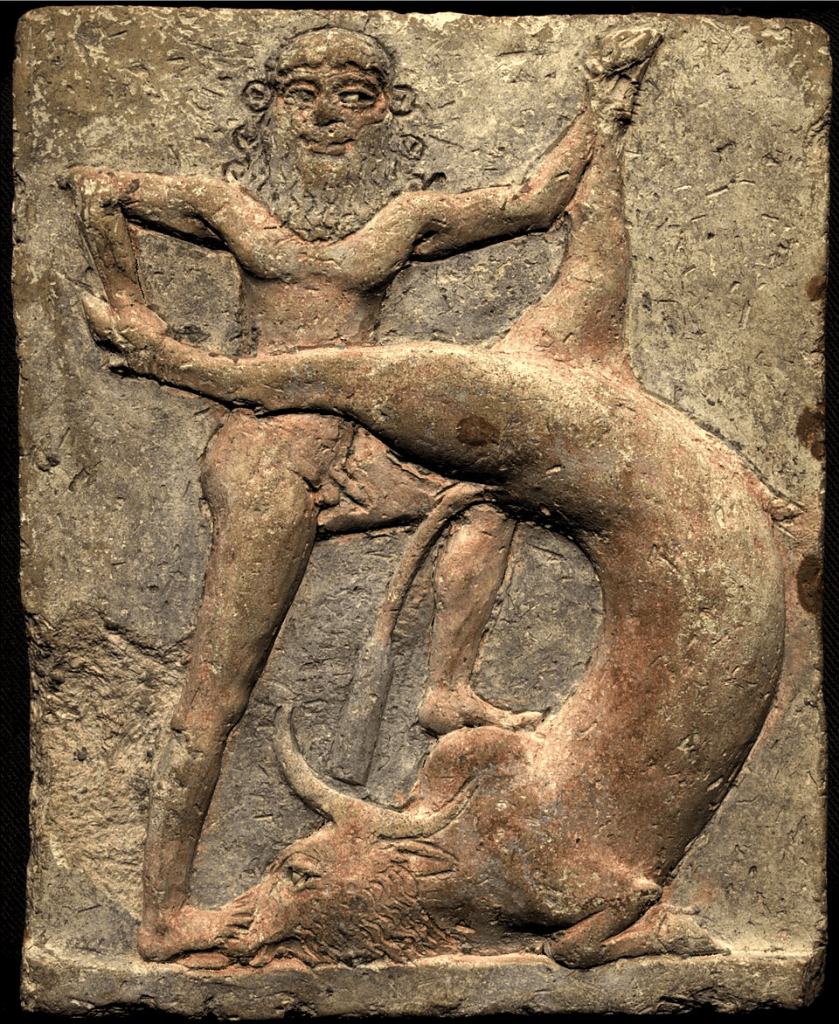
Gilgamesh slays the Bull of Heaven whilst displaying his penis.
The second task was to defeat The Bull of Heaven sent by Ishtar to revenge herself on Gilgamesh’s snubbing of her proposal to him to wed. Destined for death, Gilgamesh seems to accept it at first only because he really believes that it is not real. Thereafter he has one task – to ensure he does not meet the same fate, seeking advive from Uta-napishti, the epic’s version of the Torah’s Noah., who having survived the Great Flood, is given eternal life by Ea the God, lest other mortals get the wrong idea about the absoluteness of the apocalyptic potential of Gods. It is Uta-napishti that sets the next task – to gain the Flower of Life from deep under the sea.
Having made this his next ‘goal’ the insubstantial nature of this goal, that is not shared with nor references Enkidu, the poem barely blinks before a serpent steals the Flower of Life and makes that ct the origin of the supposed eternal life of the snake in Mesopotamian thinking – forever shedding its skin to renew itself as they believed. The repetition of the drive of the earlier quest motif applying to the journey to Humbaba with Enkidu is a fine come down, here referring only to a return home to praise the city of Uruk, still as it was when the poem opens, Gilgamesh having found the emptiness of ‘personal goals’:
"... My cause is lost;
I should never have sailed to the distnt cost."
At forty leagues they broke bread,
at sixty leagues they pitched camp. [17]
Do I then set ‘personal goals’ for myself? In my silly youth I suppose I did. But now I think what survives can, as in Gilgamesh, only be that that houses the only continuum – that of renewing life reborn from necessary ruins. No wonder I am a member now of the Green Party.
With all love
Steven xxxxxx
__________________________
[1] Simon Armitage (2026: xlvi) ‘Gilgamesh‘ , London, Faber & Faber
[2] ibid: xxix – xxx
[3] ibid: 14-15
[4] ibid: 67
[5] ibid: 6f.
[6] ibid: 81
[7] ibid: 12f.
[8] ibid: 35f.
[9] ibid: 31
[10] Sophus Helle (2021: 27) A New Translation of the Ancient Epic, GILGAMESH, with Essays on the Poem, its Past and its Passion New Haven & London, Yale University Press.
[11] Simon Armitage, op.cit: 109
[12] ibid: 99
[13] ibid: 109, 113, for two examples of the repetition of this incident to two sets of listeners.
[14] ibid: 24f.
[15] ibid: 41ff.
[16] ibid: 78
[17] ibid: 136

