When Alexander Pope warned that ‘a little learning is a dangerous thing,’ he was warning that, since error lies everywhere, we need exposure to all the evidence that supports the one and only version of knowledge of the world that is the truth. The real danger is that there are so many statements that claim to be truth in the world, that superficial learning acquaints us only with one or more of those not the one truth at the bottom of the well, or as he phrased drunk deep from the ‘Piraean spring’ [by which he meant the well of knowledge springing from Ancient Athens – or,well, its port, Piraeus].
The models of truth adopted from Ancient Greece, whether or not they reflected the real beliefs of that civilisation, have always stressed that we need to pare down the excess of ways of approaching truth to find the one way sufficient for its capture. When I was a young student first at university that was the kind of cry raised by the conventional thinkers in the academy regarding the thought we label postmodernism and especially that associated to Jacques Derrida. For Derrida, truths were multiple and accessible through many avenues, even from the surface features of language if read conscientiously enough and using the text as evidence of the ambiguities and contradictions it contained and which yielded a complex debate between different positions claiming each to be truth. But, as we learn more about Ancient civilisation well before the Greeks with their origin in the East, and whose defeat was meant to be represented by the defeat by the Greeks of the Persians at Salamis, we learn that Derrida was not so unique a thinker in that long-world-view. This idea is promoted in a book I have just read: Selena Wisnom [2025] The Library of Ancient Wisdom: Mesopotamia and the Making of History, Penguin Books. Her book starts proper, for it concerns the discovery of the library of Ashurbanipal at Nineveh (near modern Mosul), with a concern with theories of writing and reading consistent with the texts of the day, using cuneiform script impressed onto clay tablets – baked even harder by the fires that destroyed the library itself, as in the extract (Chapter 11 on the Flood) from Gilgamesh, the epic poen, below:
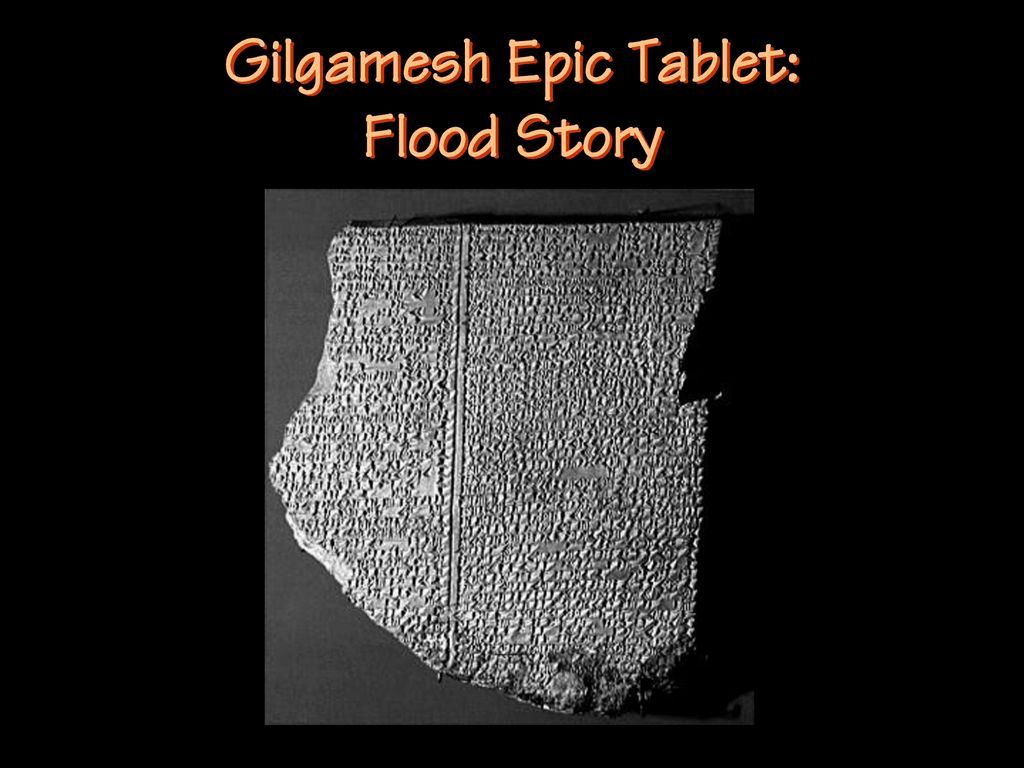
Wisnom argues that cuneiform script , whether using the Assyrian or later Akkadian alphabets, used many of the resources that went into the creation of a sophisticated language as it began to match a spoken as well as written form, adapted from syllabic words and pictograms, to develop a rich set of association to multiple contexts of meaning, even on its surface. It was language that grew from numerous influences (the effect of the syllabic language of Akkadian was added to Sumerian signs that were, at their root, visual pictograms (visual symbols of the thing they signified). The signs on the clay tablets therefore, as a result of this, was a developing thing accruing new meanings to older signs as they developed in usage in usage in both writing and speech as they were recorded and interpreted by court scribes. Wisnom says that ‘over the centuries signs continued to acquire more and more values, even when it was possible to write words without them’, This can only be explained, she says that this because the culture did not see disadvantage in ‘seeing meaning proliferate’ in their texts, even non-literary ones, because texts that were rich in association with differing meanings were the more valuable and gave more pleasure to them: She goes on – in the extract below (from ‘For us with ….’) to explain this:
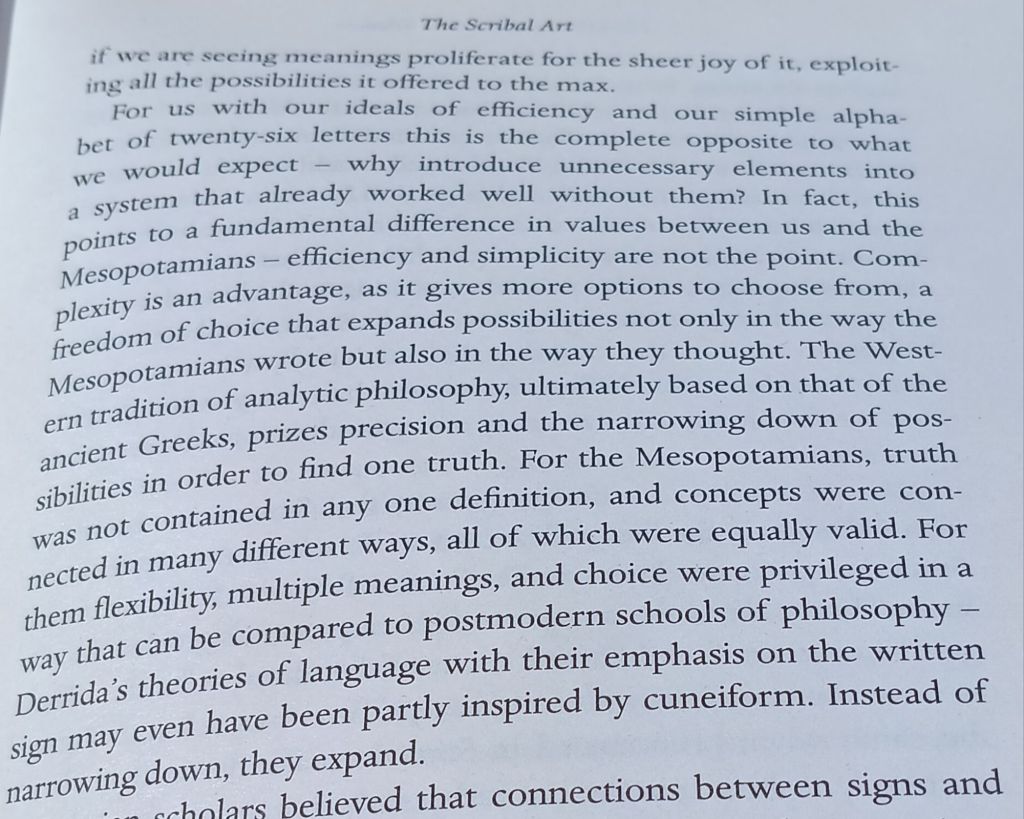
From Selena Wisnom [2025: 9] The Library of Ancient Wisdom: Mesopotamia and the Making of History, Penguin Books
I may have little learning in this area (though I did learn to write my name in Akkadian on a MOOC I did once on Zoroastrian culture – see my blog on that at this link– and the pictorial evidence below).
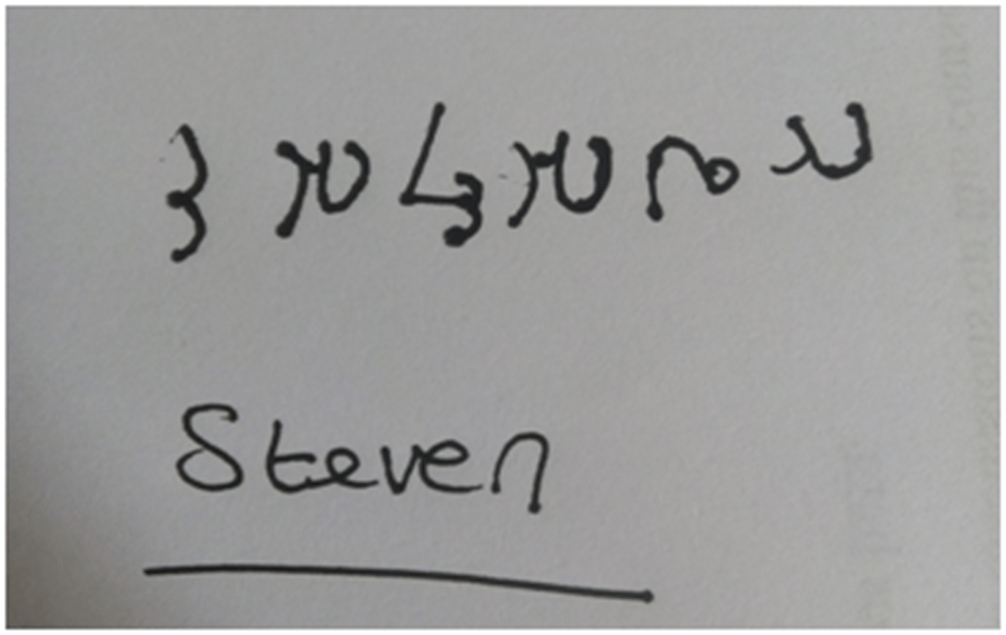
However, it excites me to see this idea in a popular text as this is on a complex area written by a scholar who is in no way shallow. Wisnom argues that the refusal of a belief that the truth is only unitary was feasible to these Ancient peoples and we are merely reminded of such thoughts by philosophers like Derrida.
Let’s admit it. The only reason I am reading this book is that I have booked to see the author give an illustrated talk on it on Sunday 4th May at the Queen’s Hall Library in Hexham, because this year it was the only event that remotely attracted me:
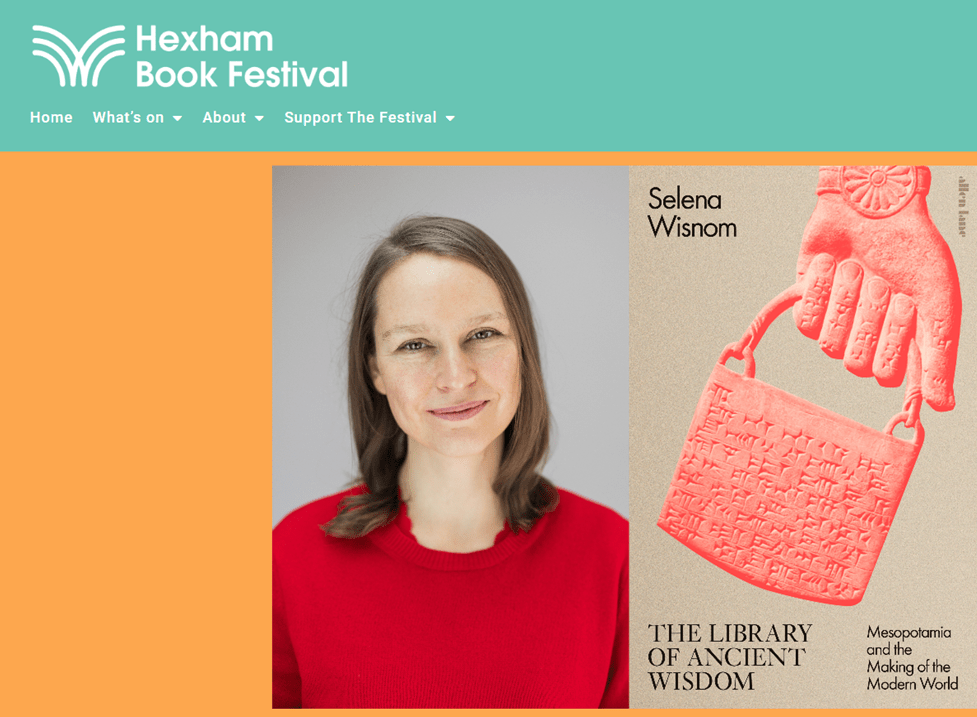
But now, what joy I expect and will blog upon having read her book a first time. A book on the nature of books and libraries (stored knowledge ans / or learning where the process of learning continues whilst the library stands) it begins with the nature of text , its genesis, maintenance and developmental interpretation through re-reading but takes that initial interest into spellbinding thought about the different ways in which Sumerians and their later generations thought in ways very different to us.
Hence though the openness to non-normative thinking created by postmodernism is here given new authority – examples of how the nature of thought about knowledge is constructed not a reflection of either deep study of the unchanging laws of nature or some transcendent authority for the unity of that thought. If different (and even contradictory) meanings subsist in language that is both spoken, written, read and reinterpreted then they can do so in the everyday and natural world without prioritising unitary truth claims. Now just because there many truths relating to a phenomenon does not mean that there are no untrue statements about tha phenomenon that can still be made. This is not simple relativism but a notion that truth can vary according to contextual issues. Thus did the Sumerians did ‘queer theory’ or did they already have it.
Fortunately this can be addressed from the examples of Wisnom’s reading from the Nineveh texts. For instance, sexuality is entirely queerly proposed in Sumerian thought. That sex is a means of the reproduction of the species does not therefore inscribe that as its sole and only meaning, though some texts cite sexual pleasure as a second and equal benefit of ‘the ‘heterosexual’ (not that they would have understood this term) sex for reproduction, otheres show the benefits to a society of having a king who has anal sex, provided he is the penetrator not the penetrated, because he shows he can lead men wherever he desires. One of the reasons moreover Wisnom believes that there is little point in asking whether Gilgamesh and Enkidu in The Epic of Gilgamesh were sexual lovers as well as romantically attached is because the question was not thought necessary provided that sex did not compromise the masculinity of either in more real terms than pledging the most complete kind of love for each other (I have discussed this issue in an earlier blog – at this link). Masturbation was thought wholesome in the culture and having overlong sex with a female goddess was the cause of Enkidu weakening into mortal status and the preference for Gilgamesh that came from it). It also meant he was no longer just a ‘wild man’.
The evidence for this is contained in chapters throughout this charming book, for that shows how linked the issue of social and individual, physical and mental health were in Mesopotamian thought. Wisnom insists that given belief in Gods that made mistakes the whole structure of thought that sustained the notion of correspondences in the political, religious, personal, interpersonal and social world, which seems to us irrational, was instead thoroughly rational. It meant that the literature more deeply reflected the ethical, medical and political world of the time and tied them together. And it meant that a day in the life of the great King Ashurbanipal involved much time either in the library or consulting its staff of diviners as well as lion hunting and going to war.
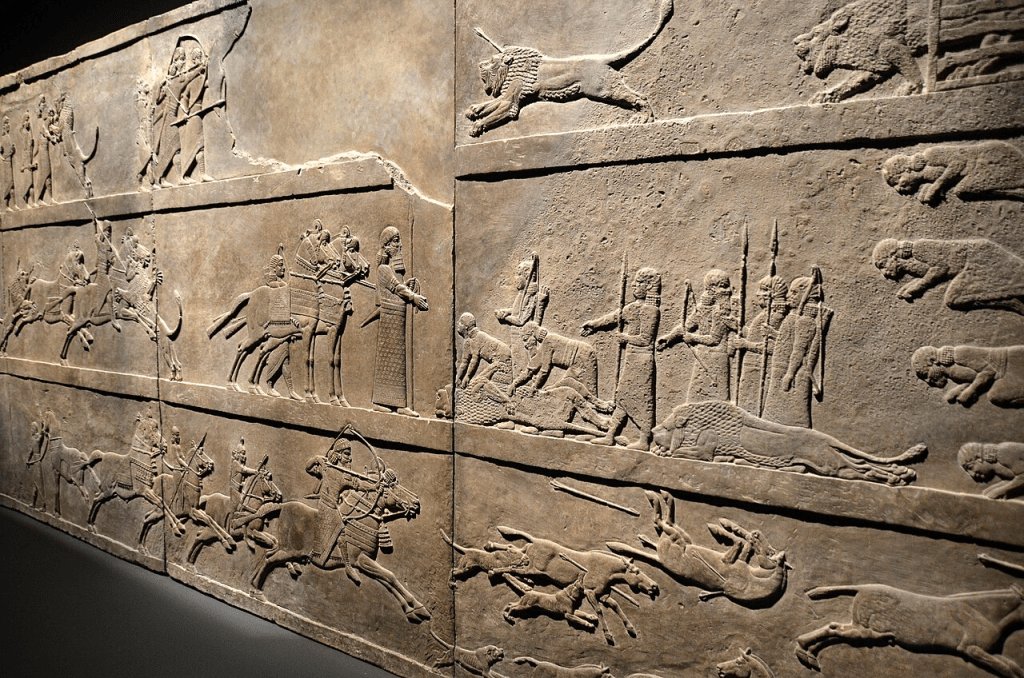
The lion hunt relief from Nineveh. By Carole Raddato from FRANKFURT, Germany – Exhibition: I am Ashurbanipal king of the world, king of Assyria, British Museum, CC BY-SA 2.0, https://commons.wikimedia.org/w/index.php?curid=74760602
Lion hunting anyway, Wisnom informs us evidenced from the texts of the library, was as much about the symbolic regulation of disorder (and akin to strong men proving they can control women) as about actually murdering beautiful animals, who could prey on his population.
I will report back after 4th May and will have re-read some parts of this fine book.
With love
Steven xxxxxxxxxxxxxxx

