


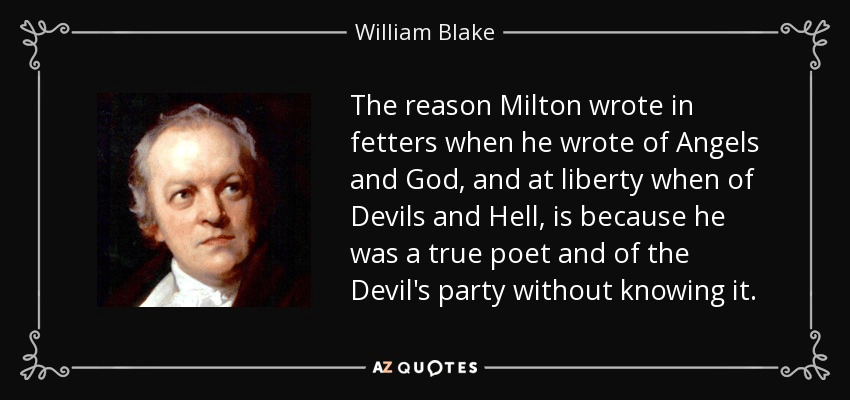
To like the ‘villain more than the hero’ is not an eccentric thing at all, neither is it a thing to be confessed, for without this trope of literature and literary readings it is doubtful story-telling or even the more numinous concept poetry as means of artistic and humane expression could exist at all. Usually William Blake’s reading of John Milton’s Paradise Lost gets lost in silliness, because it is taken too literally, such that most views of it, other than that in the truly wonderful book by William Empson Milton’s God, which takes the silliness as far as it can go as a superb expression of distaste for the authoritative form of institutionalised Christian myth, because it is so personal an expression of informed rebellion. However, there are other ways of reading Blake’s reading of the older poet thus rather than going far into Blake’s concept of the divinity of human energy for creating change of our earthly social substance into something more instinct with Godliness. That reading I point to is the rather obvious point that without Satan Milton’s poem would be bereft of the means of a story and even more bereft of the nuanced glance of life turned into a kind of song where contraries separate and come together in conflict and eternal bondage that poetry is, and is ever condemned and blessed to be at its best.
We can recognize villainous motivation without conforming to it or embracing it, as in Shakespeare’s Iago, the villain of Othello, but we cannot wish it gone, without wishing gone the fact that it alone levers poetry out of human agony and that kind of aspiration, we call temptation or corruption of static good. In fact Milton seemed to feel that this was true of life and politics too, a thing of energetic debate and conflict, where truth is only admirable covered by the ‘dust and heat’ raised from the floor and from within human sinew flexed to its limit by human conflict. This was his defence of free speech in Areopagitica, where even falsity and things we like to call evil are allowed a platform, to make sense of what goodness and virtue are.
I cannot praise a fugitive and cloistered virtue, unexercised and unbreathed, that never sallies out and sees her adversary but slinks out of the race, where that immortal garland is to be run for, not without dust and heat.
Good runs away from everything when it appears to stand and refuse to be touched in a cloister, like the Lady in Comus. The Attendant Spirit in that play from the moment he steps on stage shows that if virtue stayed where it believed it should be cloistered from any ‘taste’ or other sensation of the thing it defines itself against, in an Empyrean invisible, untouchable, inaudible, (even in a state of anosmia and ageusia, where smell and actual taste sensation do not exist either). Yet if we are to see, hear or read the play fully we need at least to imagine ‘smoak and stirr’ (not unlike dust and heat) of a world where smell the ‘rank’ and taste the ‘mould’ of decay and death in the flesh:
Before the starry threshold of Joves Court
My mansion is, where those immortal shapes
Of bright aëreal Spirits live insphear'd
In Regions milde of calm and serene Ayr,
Above the smoak and stirr of this dim spot, [ 5 ]
Which men call Earth, and with low-thoughted care
Confin'd, and pester'd in this pin-fold here,
Strive to keep up a frail, and Feaverish being
Unmindfull of the crown that Vertue gives
After this mortal change, to her true Servants [ 10 ]
Amongst the enthron'd gods on Sainted seats.
Yet som there be that by due steps aspire
To lay their just hands on that Golden Key
That ope's the Palace of Eternity:
To such my errand is, and but for such, [ 15 ]
I would not soil these pure Ambrosial weeds,
With the rank vapours of this Sin-worn mould.
‘Smell the ‘”rank” and taste the “mould” of decay and death in the flesh’, I say, because sensation is what excites life, not what is ‘milde of calm and serene Ayr’, which isn’t even ‘cool’, for to ‘cool’ or ‘chill’ requires that it is a release from heat and dust that exists as its opposed state. Hence Comus himself, once he has the Lady’s attention, uses sensation in poetry to evoke fleshly responses suchas poetry must, even the most ‘heightened’ :
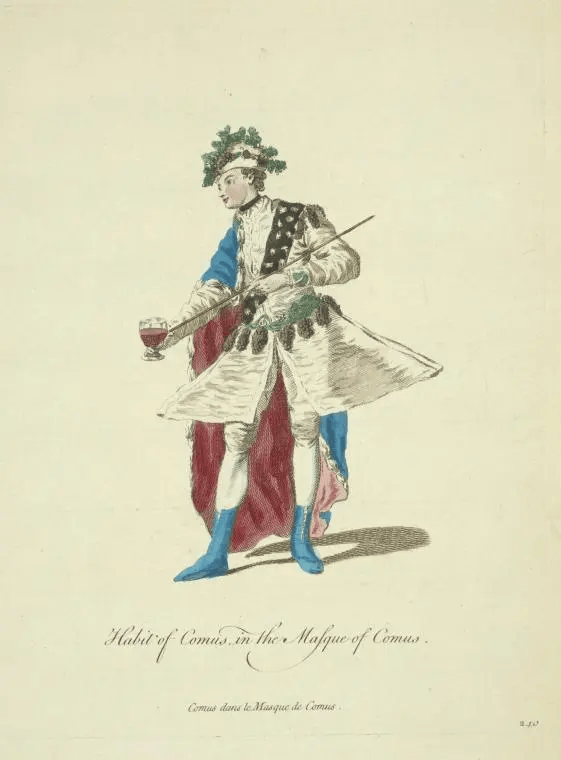
Wherefore did Nature powre her bounties forth, [ 710 ]
With such a full and unwithdrawing hand,
Covering the earth with odours, fruits, and flocks,
Thronging the Seas with spawn innumerable,
But all to please, and sate the curious taste?
And set to work millions of spinning Worms, [ 715 ]
That in their green shops weave the smooth-hair'd silk
To deck her Sons; and that no corner might
Be vacant of her plenty, in her own loyns
She hutch't th' all-worshipt ore and precious gems
To store her children with; if all the world [ 720 ]
Should in a pet of temperance feed on Pulse,
Drink the clear stream, and nothing wear but Frieze,
Poetry demands the mouth to cooperate, even if silent reading for imagination alerts the same nervous impulses of motion and mutual touch and flight of internal fricative-producing organs of the mouth from each that we simulate taste and smell, for in the nose too flesh and receptors in it are stimulated by air motion that can be imagined as nearly as effectively as when experienced, as other sensations. Try reading those lines from the ‘full and unwithdrawing hand’ to the ‘loyns’ (loins) where ‘ore is hutch’d without feeling the sensation’ of air movement needed to read aloud, even if you don’t read aloud. That is what poetry does and what poetry is. Hence I believe John Keats was referring to these lines when he urged Percy Bysshe Shelley to materialize his too empyrean poetry by loading ‘every rift of your subject with ore’, that ‘all-worshipt ore and precious gems/ To store her children with’ as he compares with the type of the angel, fallen or not.
You, I am sure, will forgive me for sincerely remarking that you might curb your magnanimity, and be more of an artist, and load every rift of your subject with ore. The thought of such discipline must fall like cold chains upon you, who perhaps never sat with your wings furled for six months together.
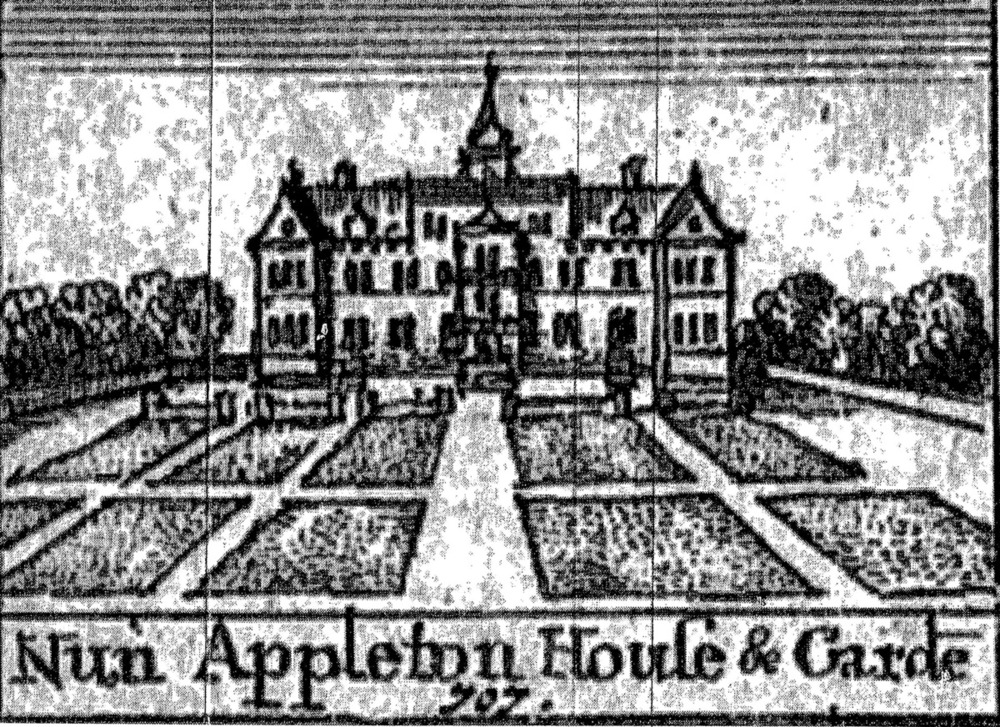
As Comus implies all this richness is also like the pleasure of sex really, which angels feel quite differently, but still need to feel even without flesh or sex/gender. No ‘fugitive and cloistered virtue’ here, that rums but only to shut itself up in a container that defends itself from human contact, though everyone knows the monasteries and convents weren’t quite like that, if not as lascivious as Andrew Marvell painted them in Upon Appleton House, wherein he imagines a lesbian orgy pretending to purity much like Comus (both after all, in part allegories of Roman Catholic temptation too – instinct with sense and incense).
xxii
“Nor is our Order yet so nice,
Delight to banish as a Vice.
Here Pleasure Piety doth meet;
One perfecting the other Sweet.
So through the mortal fruit we boyl
The Sugars uncorrupting Oyl:
And that which perisht while we pull,
Is thus preserved clear and full.
xxiii
“For such indeed are all our Arts;
Still handling Natures finest Parts.
Flow’rs dress the Altars; for the Clothes,
The Sea-born Amber we compose;
Balms for the griv’d we draw; and pasts
We mold, as Baits for curious tasts.
What need is here of Man? unless
These as sweet Sins we should confess.
And yet Comus, and the ‘Suttle Nuns in Marvell, are villains of their respective pieces, awaiting heroic redemption. Likewise, the Serpent into which Satan turns in Paradise Lost, has similar sense-provoking lines, amongst the best in English poetry, lines (whatever your estimation of Milton) most would rather read than the long explications of Heaven by Gabriel or Raphael, the Archangels.
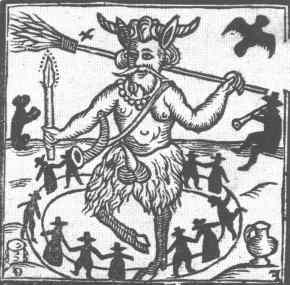
I wonder if not liking the villain more is a condition of literature, such that in romantic novels they often become hard to distinguish each from each – whether Mr B in Samuel Richardson’s Pamela, or more complex versions later – Rochester in Jane Eyre, Heathcliff in Wuthering Heights, and Max de Winter in Rebecca. For women writers the complication between hero and villain thus became a condition of them writing novels at all, if they were to be true to their conviction of female power and energy equivalent to the male. And let’s face it what would Batman, Superman, or Spider-Man be without villains (the Hulk is very complicated and double) – cardboard cutouts praising a world order that is not only unreal, its extremely boring.And literature does not decide to avoid boredom to please the ‘groundlings’ as used to be said of Shakespeare – it does it because poetry can not live in purity – for our organs of sensation s would be ‘numbed’ (you always have to select a single sense term unfortunately) . Art asks for our forgiveness with its tongue in its cheek, as Puck, a devil-like androgynous spirit, in A Midsummer Night’s Dream, a play where anyone can be a villain and a hero simultaneously
If we shadows have offended,
Think but this, and all is mended,
That you have but slumber’d here
While these visions did appear.
And this weak and idle theme,
No more yielding but a dream,
Gentles, do not reprehend:
if you pardon, we will mend:
And, as I am an honest Puck,
If we have unearned luck
Now to ‘scape the serpent’s tongue,
We will make amends ere long;
Else the Puck a liar call;
So, good night unto you all.
Give me your hands, if we be friends,
And Robin shall restore amends.
The role of art is to pretend it is insubstantial whilst cutting to the quick of ‘offence’ of a society that fears being disrupted and change. It is the same reason we place art between truth and lies, claiming neither. It is why it survives when the world is awry and why the Far Right in the form of Reform is destroying it in British coucil chambers and plans to do so in government if you ‘Gentles’ allow it.
Bye for now
With love
Steven xxxxxxxxxx

