


Can we measure the quality of witness to the processes and events of attempted genocide? Two new books that test that idea and challenge the horror.
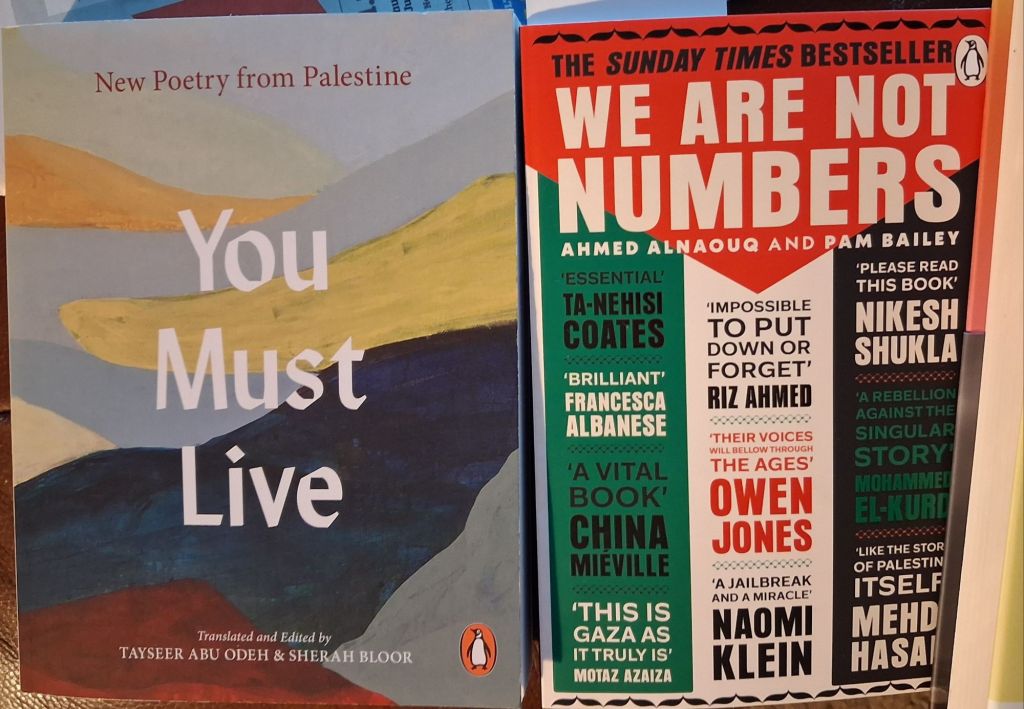
Tayseer Abu Odeh and Sherah Bloor (Trans. & Eds) & Jorie Graham (Guest ed.). [2026] You Must Live: New Poetry from Palestine Penguin Books Ltd..
Ahmed Alnaouq and Pam Bailey (Eds. 2026, paperback with new afterword after 2025 version) We Are Not Numbers: The Voices of Gaza’s Youth Penguin Books Ltd.
This blog is in no way a ‘review,’ of two new Penguin paperbacks, a wonderful new parallel page translation of new Palestinian poetry from poets largely still attempting to live in Gaza and the paper edition of the book We Are Not Numbers, named after the organisation of that name. It is based on having acquired both books at The People’s Bookshop in Durham and having read only their introductions and, of We Are Not Numbers, the first two contributions. I will read the whole books later and perhaps come back in a later blog.
My husband, Geoff, and I are planning too to go a event celebrating the paperback release of We Are Not Numbers organised by County Durham Palestine Solidarity Campaign and to be held at the People’s Bookshop:
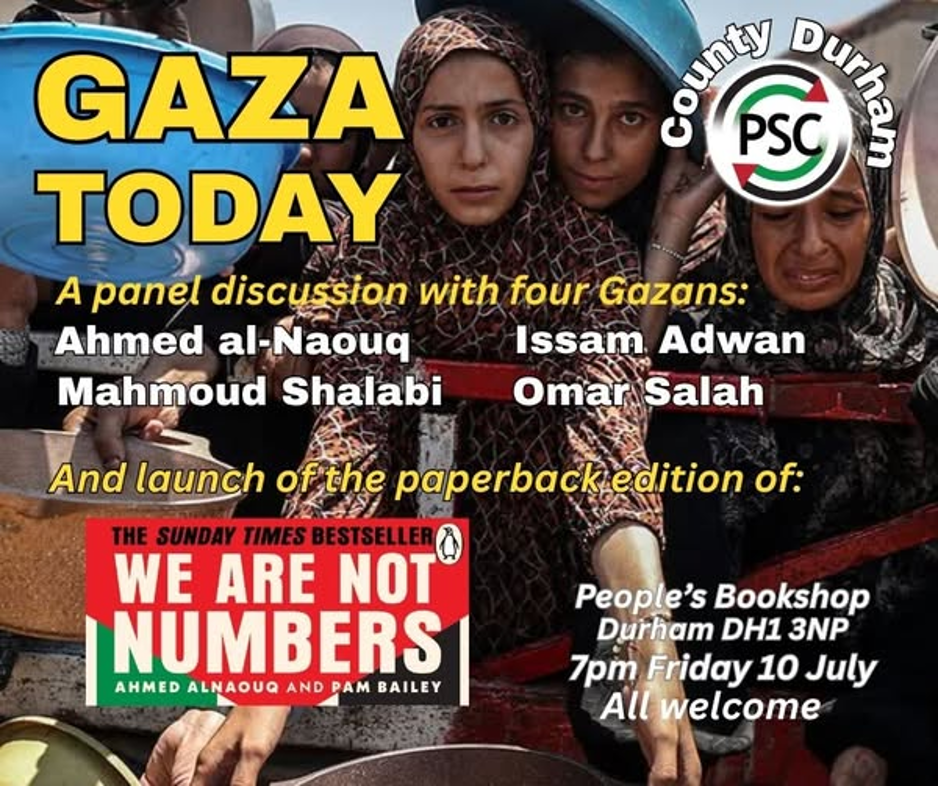
The official introduction to the event reads thus:
This event has a brilliant line-up of panelists to speak about the lives, experiences and prospects of Gazans:
Ahmed al-Naouq is a journalist, writer, human rights defender, founder of the organisation We Are Not Numbers (WANN), and editor of the book of the same name.
Issam Adwan is a teacher, journalist and translator, and now a PhD student with the Open University.
Mahmoud Shalabi was recently a director for Medical Aid for Palestinians in Gaza, and is now a PhD student in Durham.
Omar Salah, according to WANN, is ‘a 22-year-old young man on his way to finding his passions and personality,’ and is recently arrived from Gaza to study for a Master’s degree in Durham.
The evening will also include readings from the book We Are Not Numbers, recently published by Penguin in paberback.
This is an evening not to be missed by anyone concerned with the fate of Gazans.
But this blog is also about how we think about and assess the significance of events that are in one sense beyond assessment. Forced to often to make the false comparison between the vicious reactive but nevertheless unwarrantable murder of Israelis following the breach of the Israeli frontier barriers that have been the means of containment of Gaza on land to the ensuing campaign against the whole of the Gazan population trapped within those otherwise still effective land barriers and blockade by sea, the judgement has ever, just as in 2014 when WANN was first established, been to hold a discursive war about the adequacy of numbers to measure collective grief and reaction to murderous killing, which is voiced on both sides. At first shocked by the size of the massacre of Israelis in 2023, Israeli discourse has been forced to reject comparison of numbers between that and the killings organised by the Israeli Defence Force and Government, often led by the former, given the sheer disproportion of numbers, including most shockingly the immensity of numbers of children murdered by bombing of civilian targets, of course claimed to be bombings of Hamas units embedded in the population.Is this all about numbers? Is the only assessment of the effect of horror inflicted by violence and terror, including state terror, of quantity. The evolution of meaning in the word ‘quantity’ might be useful here from the Online Etymology Dictionary:
quantity (n.): early 14c., quantite, “amount, magnitude, the being so much in measure or extent,” from Old French quantite, cantite (12c., Modern French quantité) and directly from Latin quantitatem (nominative quantitas) “relative greatness or extent,” coined as a loan-translation of Greek posotes (from posos “how great? how much?”) from Latin quantus “of what size? how much? how great? what amount?,” correlative pronominal adjective (from PIE root *kwo-, stem of relative and interrogative pronouns). / From late 14c. as “that which has quantity, a concrete quantity;” from 1610s in the concrete sense of “an object regarded as more or less.” In prosody and metrics, “the relative time occupied in uttering a vowel or syllable” (distinguishing it as long or short) by 1560s. Latin quantitatem also is the source of Italian quantita, Spanish cantidad, Danish and Swedish kvantitet, German quantitat.
In the social sciences, many have argue that we need an assessment that deals not with countable (quantitative) measures of size as an estimate of effect and affect but (qualitative) ones based on the ‘quality’ of the intervention assessed. Let’s linger on that word ‘quality’, again from the Online Etymology Dictionary
quality (n.): c. 1300, qualite, “temperament, character, disposition,” from Old French calite, qualite “quality, nature, characteristic” (12c., Modern French qualité), from Latin qualitatem (nominative qualitas) “a quality, property; nature, state, condition” (said [Tucker, etc.] to have been coined by Cicero to translate Greek poiotēs), from qualis “what kind of a” (from PIE root *kwo-, stem of relative and interrogative pronouns). / In early use, and for long thereafter, with awareness of the word’s use in Aristotelian philosophy. From late 14c. as “an inherent attribute,” also “degree of goodness or excellence.” Meaning “social rank, position” is c. 1400, hence “nobility, gentry.” From 1580s as “a distinguished and characteristic excellence.”
Of course words are slippery even in social science and qualitative measures can still be quantitative when they measure (by some kind of numeric scale) a sub-characteristic or single state of many others of a phenomenon. The issue in the epistemology of social science lies mainly in asserting ways of ‘measuring’ things by tools that do not involve a count or other ‘measure’ of its sub-units but rather the nature, and sometimes the feel or even ‘appearance’, without focusing on size per se) of it. Thus the rather offside development of quality to distinguish people considered to be of of more intrinsic quality in society than others – the ‘quality’.
Most uses of quality however oft tend to yield to size as the best assertion of significance, even if only in metaphor. Nevertheless, quality is often associated with absolute values, those that assert themselves as transcendent of or in another realm than other ‘things’, like love, life and death, however. We assess the duration of life as if that countable facet of its appearance were primary, while holding life as a value that is absolute.
The choice of We Are Not Numbers, is an assertion of Gazan community, and of Palestinian identity that tries not to be quantified, and its symbol is the power of stories and each story that tells of being in Gaza. Both books I bought and began yesterday are ones that have to justify the limitations of a world of quantities – of the various ways of measuring their size and inclusiveness – with an absolute quality of being. Both cite as primary to their projects the name of the Palestinian poet and educator, Refaat Alareer, in particular the poem from the poetry collection takes its title, We Are Not Numbers quoting the bolded lines of it below as if one poem or continuous extract, whom we re told in the Introduction of the latter applied to join WANN in the early days, described by Wikipedia as its co-founder.
The poetry collection reminds us he was a lecturer in English Literature specialising in Shakespeare and John Donne but killed at age 44. Wikipedia writes: ‘ On 6 December 2023, Alareer was killed by an Israeli airstrike in northern Gaza, along with his brother, sister, and four of his nephews, during the Israeli invasion of the Gaza Strip‘:
If I must die,
you must live
to tell my story
to sell my things
to buy a piece of cloth
and some strings.
(make it white with a long tail)
so that a child, somewhere in Gaza
while looking heaven in the eye
awaiting his dad who left in a blaze -
and bid no one farewell
not even to his flesh
not even to himself -
see the kite, my kite you made, flying up above
and thinks for a moment an angel is there
bringing back love
If I must die
let it bring hope
let it be a tale.
The underlying motif of this poem is that although death happens, must happen – though not with the speed and purpose of his death – life is as much a necessity as death, justified by the living stories it tells of the dead. Who is this you? we can ask that ‘it be a tale’, which might be a story, a poem, a memorial of a loved one one or the ‘tale’ (that is also a tail) of a kite flying high. It is not the one thing nor about one person. It is about abandonment caused by anger – of a dad, or of the man he was – killed by the cold anger of the bombers who annihilated his flesh, whatever the cause of his leaving – of family and self that is never acknowledged but must be. The things sold of the poet’s remnant of things must be about the loss of the many and the few, who is death but can also be live resumed ‘bringing back love’. You can’t get more absolute than that and not, moreover, be, strictly speaking, the story of large numbers, even though we know it is.
I have yet to read beyond the second short contribution of We Are Not Numbers, and will report more when I have – and also visited the panel event at the People’s Bookshop. I have read only the introduction and dipped into a few poems of You Must Live and again I will read the whole and report back. They both harvest a huge constituency – of young people’s (18 – 29 in age years) voices in the first, of poets entering newly into the vocation and otherwise writers of many kinds, largely professional – and both constituencies had to cut the numbers represented within them by various criteria, not mentioned by name in the first, but numerously mentioned in the second – including for most current residence in Gaza and no large prior publishing history. But selection is about quality – not in choosing the ‘best’ necessarily but that quality in the voices that brings into being that essence of the Palestinian as a meaningful identity beyond the limitations set by those antagonistic to them – to the point of committing, supporting or colluding with genocide (which is still continuing). That genocide was often targeted at women and children as the usual source of numerical rebirth of a potential nation’s resources but it was also aimed at cultural institutions and practices, not least the act of story telling The following passage is crucial from the Introduction to You Must Live (page xviii).
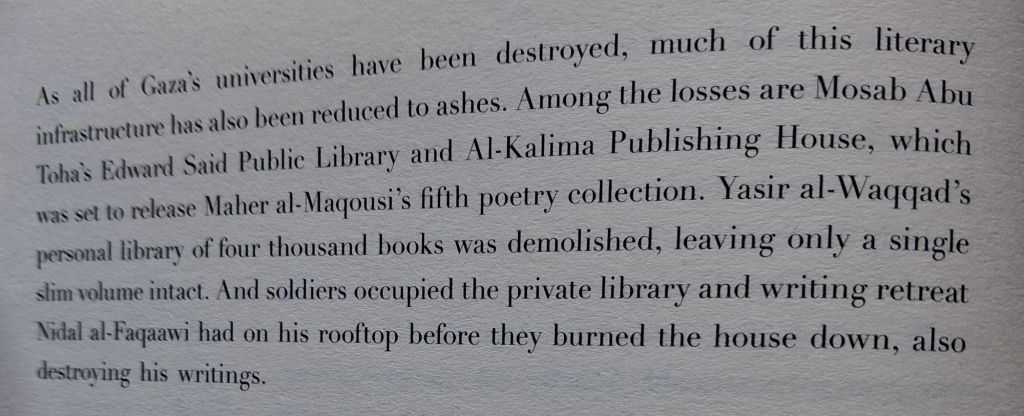
Even before you have chance to register shock at the grotesque mission spread of genocide into the mechanisms of independent voices in Palestine culture you hear the monotone IDF or still Israeli Cabinet voices proclaiming theze things reduced to rubble as nests of Hamas. The point is, as the organisation WANN points out, theze are the means of fostering non-ciolent responses to oppression, which once killed off leave only paths to violence.
This is a clear strategy of genocide, characterise the resistance to occupation and cultural takeover as violent, ensure all non- violent resistance is choked off and ensure a self-fulfilling prophecy of violence and violent reaction to it. Without using it as justification, this is the very dynamic that led to the toxic moment of tje Hamas breach of the Gazan wall by tunnels.
WANN still speaks of nonviolent resistance but merely reading two, of the more historical tales in the new paperback of young voices is yelling. The first is by a young man mourning his brother. That man felt unable to tell his story because it included his brother’s joining a military occupation-resistance organisation. He feared he and his whole family being branded a vile terrorist enclave even though the family had redisted the brother’s recruitment to violence. It took special care by Pam Bailey to coax out his story, and to encourage the education that brought him to the UK. Whilst here, the notes – they occur after each tale – at the end of his story tell us, and after the story was published 32 members of his wider family have been killed in Gaza including many other siblings. Had he still have been there it would have included himself.
There is more to say. Much more. Much later and after July 10th.
With love ❤️
Steven xxxxxxx


2 thoughts on “Can we measure the quality of witness to the processes and events of attempted genocide? Two new books that test that idea and challenge the horror.”