In Theories of Space and Time,the North American poet, Natasha Trethewey, translates human experience of Space and time over a lifetime, with an emphasis on ‘home’ as a starting point for journeys in life development, and hence also experience of time and space. Here is the poem:
You can get there from here, though
there’s no going home.

Everywhere you go will be somewhere
you’ve never been. Try this:

head south on Mississippi 49, one—
by—one mile markers ticking off

another minute of your life. Follow this
to its natural conclusion—dead end

at the coast, the pier at Gulfport where
riggings of shrimp boats are loose stitches

in a sky threatening rain. Cross over
the man-made beach, 26 miles of sand

dumped on a mangrove swamp—buried
terrain of the past. Bring only

what you must carry—tome of memory
its random blank pages. On the dock

where you board the boat for Ship Island,
someone will take your picture:

the photograph—who you were—
will be waiting when you return

"Theories of Time and Space" from Native Guard: Poems by Natasha Trethewey. Copyright © 2006 by Natasha Trethewey. Used by permission of Houghton Mifflin Company. All rights reserved.
We all travel distance in ways that make the concept inextricably one of both space and time, change of status in the one measured by change of status in the other, even to the ‘dead end’, a phrase that lingers over the gap of its enjambement (or run-on) onto the next stanza, but is for that moment referencing a finite life development – that of death:
head south on Mississippi 49, one—
by—one mile markers ticking off

another minute of your life. Follow this
to its natural conclusion—dead end
Miles are minutes and vary to longer in different modes of transport – of which the poem has many. But ‘distance’ does not take into account our myths of cyclic return – the Ithaca Odysseus returns to is NOT the one he left: ‘Everywhere you go will be somewhere / you’ve never been’. It’s a version of Heraclitus’ maxim that you cannot step into the same river twice, of course:
This poet has reasons for saying she cannot ‘return’ home, even though she traverses the distance between where she is now in her life to the place where she was once said to be ‘home’. For Trethewey, there are deeper reasons why home is more distanced than even difference of space and time can explain. Here is her biographical summary in Wikipedia
Natasha Trethewey was born in Gulfport, Mississippi, on April 26, 1966, to Eric Trethewey and Gwendolyn Ann Turnbough. Her parents traveled to Ohio to marry because their marriage was illegal in Mississippi at the time of Trethewey’s birth, a year before the U.S. Supreme Court struck down anti-miscegenation laws with Loving v. Virginia. Her birth certificate noted the race of her mother as “colored”, and the race of her father as “Canadian”.
Trethewey’s mother, Gwendolyn Ann Turnbough, was a social worker and part of the inspiration for Native Guard (2006), which is dedicated to her memory. Trethewey’s parents divorced when she was six; Turnbough was murdered in 1985 by her second husband, whom she had recently divorced, when Trethewey was 19 years old.[11] Recalling her reaction to her mother’s death, she said: “that was the moment when I both felt that I would become a poet and then immediately afterward felt that I would not. I turned to poetry to make sense of what had happened.”
The poem references Gulfport as a place where history is a thing of selective memory – many pages of whose tome are necessarily ‘blank’, ready for rewriting, just as her birth was a form of rewriting required by racist laws at that time in that place. Even from the beginning humans intervene to ensure no space is fixed across the long duration of time, but changes that space – dramatically from swamp to beach:
                     ...   the pier at Gulfport where
riggings of shrimp boats are loose stitches

in a sky threatening rain. Cross over
the man-made beach, 26 miles of sand

dumped on a mangrove swamp—buried
terrain of the past. Bring only

what you must carry—tome of memory
its random blank pages. .....
But imagine a home where the ‘man-made’ buries the meaning of distance in space-time in a more political manner, where distance between time and space differs for different people, depending on persisting laws of apartheid and barriers and routes divided on that basis. I first learned of this in the wonderful novel Enter Ghost by Palestinian artist, Isabella Hammad (see my blog on it at this link) in which transit between spaces involves various intermediary barriers depending on the citizenship status of the traveler and on political struggle against the fiat of those who assert control over a specific space and those who live in it, who may or may not have control over that space. Now the most simple formulation of this idea is in the sub-discipline of political geography, whose function as a discipline of Knowledge. Here is a simplistic definition, taken randomly from the webs collection of often anonymous teaching slides:
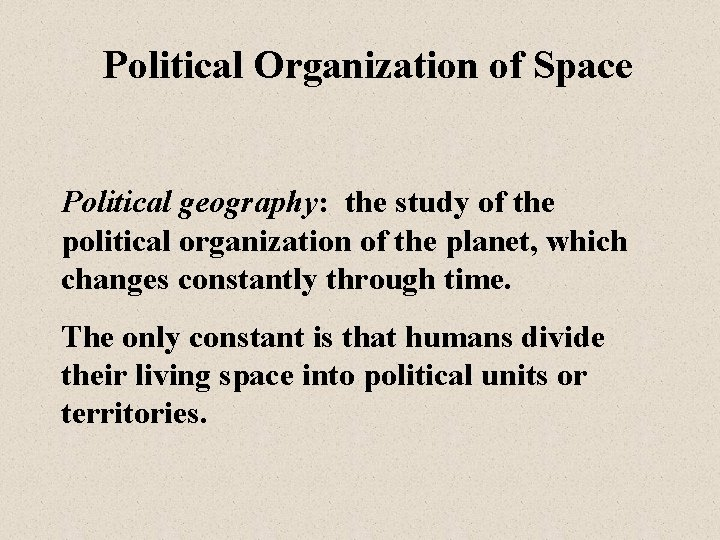
The most startling omission here is time, for political fiat, defining a space (as a nation, province, colony or even as ‘debatable lands‘ (see my blog on this as a metaphor in Pat Barker at this link) has everything to with the cusp that ties political history to political geography and will cover more comprehensively spatial areas whose political, national, or governance politics are still in process through time. Debatable lands existed between Scotland and England before the Act of Union, were a fact in the status of the territorial landowning Prince-Bishops of Durham, and are exampled best in the debatable lands of the West Bank and Gaza (and now again Lebanon), where international law has now no force in maintaining the status of their debatability between political and national claims as they are settled upon and by Israel and by one means or another become settled colonies. The control of space creeping through time as a ebb and flow, though more in the one direction enforced by the might of a superior military violence and force, is the experience of Palestinians in Palestine, forced to see the struggle as an existential one, even with or without an agreed belief that genocide is taking place (which seems to me most certain).
And this is recalled to me in one poem by Tariq Al-Arabi called Time and Distance, selected from the anthology I mentioned in yesterday’s blog (at this link); namely: Ahmed Alnaouq and Pam Bailey (Eds. 2026, paperback with new afterword after 2025 version) We Are Not Numbers: The Voices of Gaza’s Youth Penguin Books Ltd. Here is how the poem is printed (the Arabic on the page on the left, the translation into ‘cold English’ on the right, pp. 22f.):
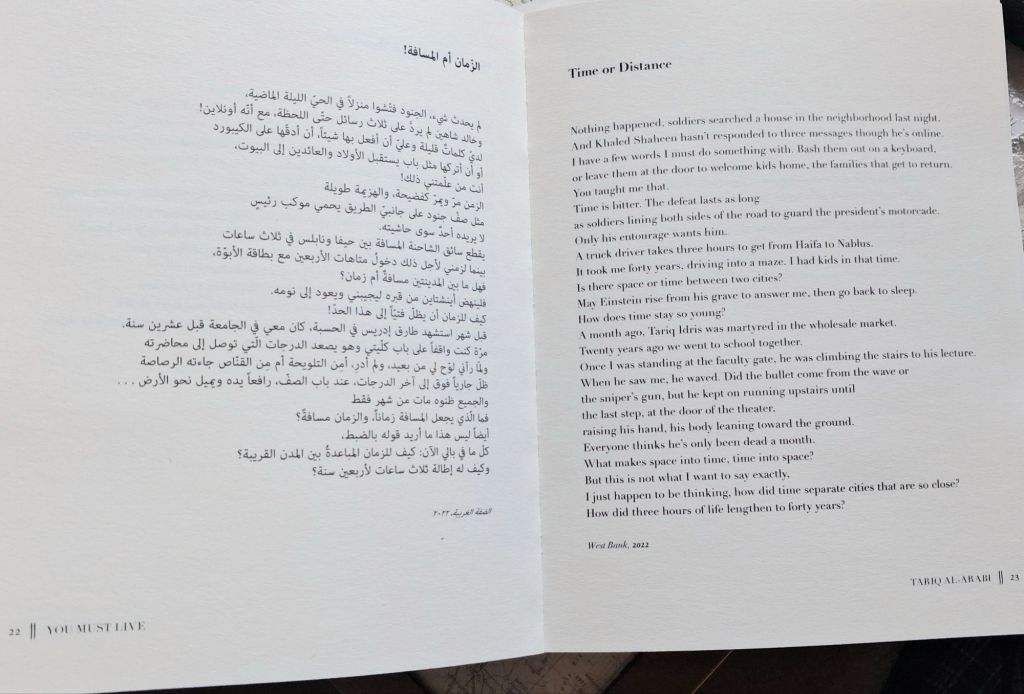
And here the poem just in English, in hope, it will be more easily readable:
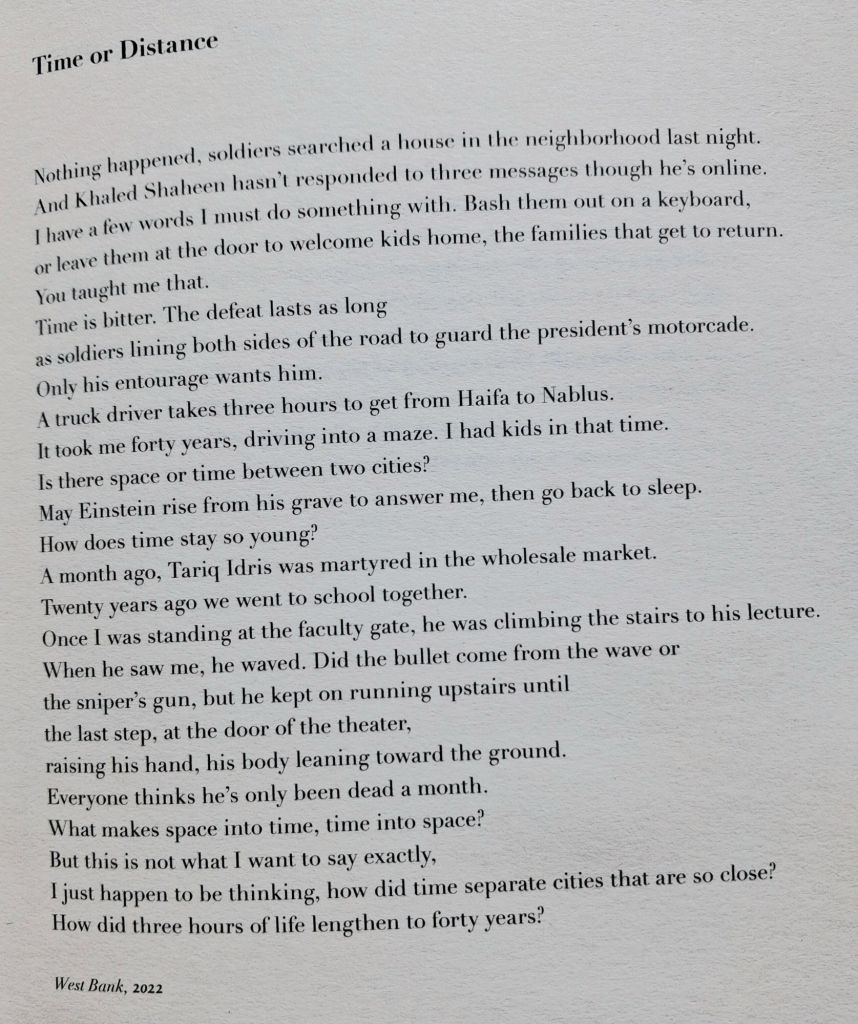
When I first read that, I had not read Trethewey’s poem which also queries if ‘home’ exists in space and time, other than as a debatable claim. But what moves me is how this poem imagines how the fact that ‘the soldiers searched a house in the neighbourhood’ becomes permissibly described as ‘Nothing happened’. It is this assertion as if fact that moves any reader who moves on in these long lines to the poet querying himself about what he should do with the ‘few words’ he has written by, for instance, typing them or leaving ‘them at the door to welcome kids home, the families that get to return’. It moves because we know that the searching of a house by an occupying army in the house my well mean that ‘house’ is now no longer ‘home’ for any kid or any family – and that many kids and families never get to return to present day Gaza. This poem asks the philosophical questions directly about space and time, even dragging Einsteinian relativity into the equation, but through the filter of a response to a politics that has become one of life and death. The ‘distance’ that becomes so thoroughly relative through is that between Haifa (within the undisputed control of Israel in international law but with a divided population of Palestinian Arabs and Israelis) and Nablus, still in the disputed West Bank, though claimed as much by Israel as other of the debatable territories – debatable at least in the pussy claws of international law, that ignores constant breach of its own regulations by the occupying power in the West Bank and their active settlers into what was once recognised as Palestinian.
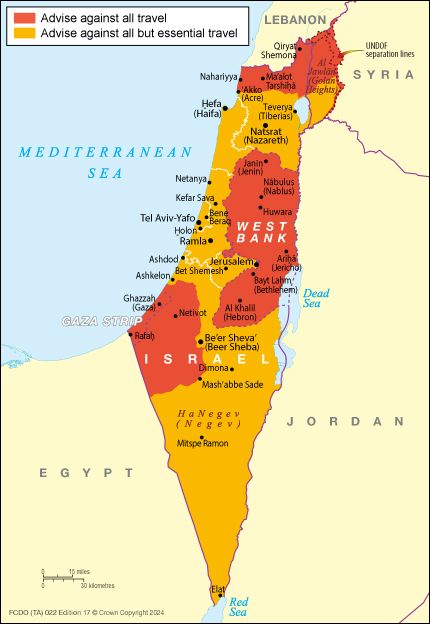
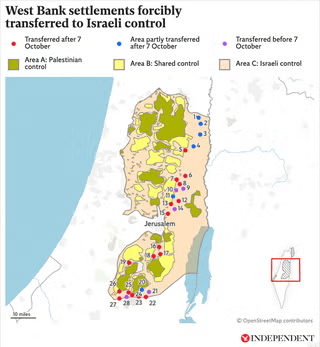
The colouring on the map above shows all the areas considered relatively a little safer (yellow) than those to be avoided by international travellers. For internal travellers however the distance between Haifa and Nablus is not only one of physical distance, and the time taken by different vehicles to cross that distance but the barriers relative to the status of the traveller – even Palestinians living in Haifa wishing to enter the West Bank (Isabella Hammad is brilliant on this). Note that it is hard to see the walled border of the tiny Gaza strip here because so much other territory has become a distance whose crossing is politically sensitive and based on relevant ‘political’ status of the traveller.
And, of course, our journeys differ, though the distance doesn’t (given of course there are different routes) of about 80 miles. When the poet says it took him 40 years to go the distance, compared to a truck driver’s journey of ‘three hours’, he is speaking of very different concepts of a journey. In his lifetime development journey, the distance includes so many events – the death of his friend by sniper bullet, the birth of his kids, and, of course the politico-geographical history of Palestine, especially after the Nakba of 1948. And it includes the fact that journeys, even ones so short in apparent distance, get lengthened by the variations caused by a politics of division on which the land’s very nature is currently based. The editors of the volume of poems throw in another confusion: ‘The Arabic word bayt means both “poetic line” and “home” (as stanza in Italian for “room”)’ (Introduction p. xxiii). Look back at the long poetic line at the opening of this poem that so disorientates one from the notion of ‘Home’ (and the word ‘House’ from ‘Home’) and see that the disharmony of political internal exile and banishment – as it were – has thrown even the poet’s craft into disorder. There are experiences in which the question is universal that asks:
What makes space into time, time into space?
If we had the answer to that question we would understand how creation goes on all the time being one of destructive division as well as of creative making of some desired whole experience that creates the illusion that that ‘time’ stays ‘s young’. It doesn’t, nevertheless distances grow painfully greater not lesser.
Do read these poems.
With love
Steven xxxxxxxxxxxxx


One thought on “Space and time under the stress of oppressive power.”