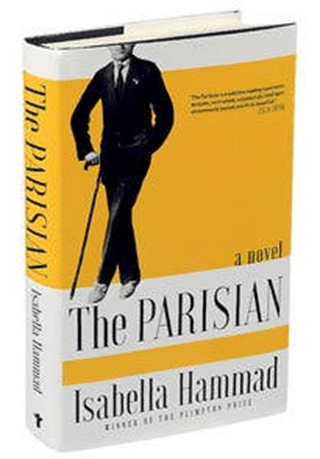
‘… I heard the wings of something enormous shuddering on the air. /…/ … The difference between this and the normal embodying of staged emotion was basically, I think, one of degree and duration. My fear was like a child’s play-fear, it had that prolonged innocent intensity, blending the unreal with the real . The way the body rehearses for danger. I was having the flight reaction I would have once had, a long time ago, to shadows in a bedroom. Now I was both the child and the shadows’.[1] This is a blog to show that ‘acting’, whatever we mean by that word, occurs on the cusp of what is outside and inside the body and the state in which it lives. This blog examines the phenomenology of a great novel: Isabella Hammad (2023) Enter Ghost London, Jonathan Cape.
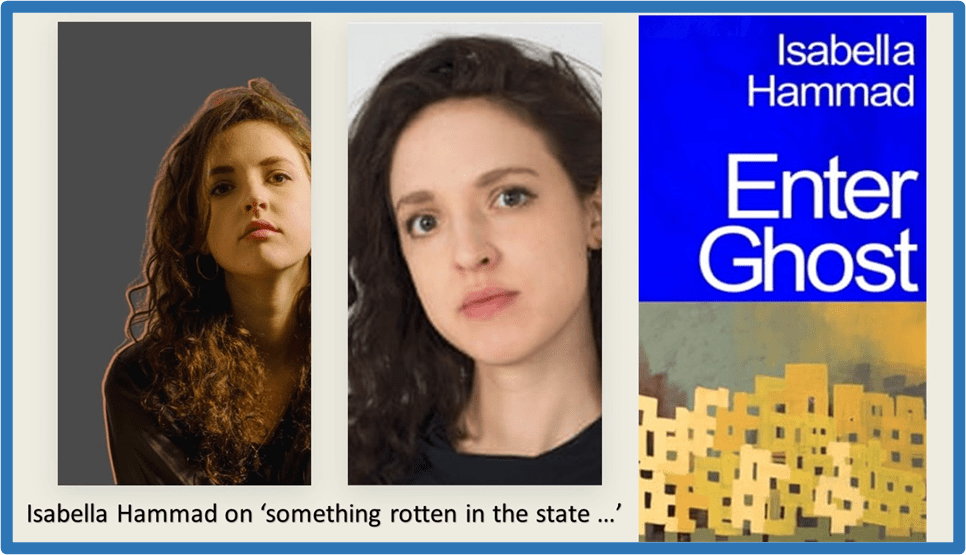
There Is something overwhelming about the subject matter of Isabella Hamad’s second novel Enter Ghost, that is perhaps predictable from the deep themes of her first novel The Parisian or EL-Barisi but not from the conventionality of the latter’s form. While the first novel could be seen as the extension of the great tradition of the Tolstoian-cum-George-Eliot multi-themed realist novel set in a time of historical turmoil in the identity of nations, the second seems to me a mix of the Gothic, the symbolic and the existential-philosophical-psychodynamic novel of the twentieth century (Kafka and Beckett together perhaps).
At the centre of Enter Ghost is a conventional enough centre of consciousness, that of a Westernised female actor named Sonia Nasir whose roots were torn out (in a much more obviously psychological family-drama than is the case for the male central character in The Parisian) of Palestine sometime after the first Palestinian Intifada. Both novels rely on many episodes of differently motivated‘ expulsion’, wherein motives play on the range of interactions between the kinds of voluntary and involuntary exile from Palestine possible for Palestinians.[2] But that consciousness of the reasons of one’s exile is often shadowed by uncertainties that hides from others as well as itself the full range of the reasoning leading to exile. This opens up a vast area of the unknown in this novel lying within the closed exteriors of things (bags, cases, and so on) or behind appearances that hide a reality (like faces, walls, frontages of all kinds). Therefore, whilst no Palestinian, of Israeli citizenship or otherwise, is unlikely to be interrogated about their reasons for first leaving and then returning to their homeland in or through Israeli airports, it is no accident that Enter Ghost opens with the consciousness of the narrative voice, an I-voice that is revealed to represent Sonia as we read on, is being interrogated about the relationship of who she is to notions of citizenship within the Israeli State, family links and histories, and, her motivation for entering Israel. To find answers state functionaries investigate what might lie within her possessions or beneath her clothing – even what is potentially secreted within the boundaries of her naked body surface:
They unzipped my bags, investigated my belongings, opened every play, flipped through my appointment diary with its blank summer months, and the two novels, one of which I’d finished on the plane, then led me into a different room for a strip search. Surely this isn’t necessary, I said in a haughty voice while a third woman officer ran her detector over my bare flesh, as though I might have hidden something under my skin, …[3]
We could read this innocently as a mere transcription of events but this is highly controlled prose, wherein ontological mysteries might lie under the surface, or contained within an empty vessel, unseen. I am myself persuaded that the two novels Sonia is reading in this passage might reference the two novels Hammad has written in the past, one ‘finished’ (the one we are reading) more recently than the other.
After all this is a book about ‘belongings’ of persons and the validity of their attribution in more than one sense, because all human beings are invested in not only geographical places but spoken about in the codes given off by our possessions. Yet the ‘state’ (or ‘The Palestinian Authority’ acting legitimately or not as ‘the state’) can freely question at its ‘checkpoints’ whether we really ‘belong’ to the places we cite as ours or truly own things we name as ours. Here Palestinian border officials query Mariam, the Palestinian -Israeli theatre entrepreneur:
“Do you spend a lot of time in the West Bank as, as an Israeli citizen?”
“As an Israeli citizen?” she laughed. “Jesus.”
“Sorry.”
“Yes, I have a house in Ramallah.”
“That’s legal?”
“Well … my mailing address is in Haifa.”[4]
To look through the things you read and write in one’s possession is to both ascertain true identity and simultaneously query it, to assert as border guardianship must that identity may be not all that it seems. It’s also a book where ‘plays’, like Hamlet enclose meaning in words that get unzipped by their performers, and where surface meanings can hide occulted meanings, where nearly all persons in fact have ‘hidden something under (their) skin’. Hamlet is that play in an exemplary way and its potential in that capacity is fully examined by the play, where what ‘seems’ and what ‘is’ are in constant debate:
“Seems,” madam? Nay, it is. I know not “seems.”
’Tis not alone my inky cloak, ⟨good⟩ mother,
Nor customary suits of solemn black,
Nor windy suspiration of forced breath,
No, nor the fruitful river in the eye,
Nor the dejected havior of the visage,
Together with all forms, moods, ⌜shapes⌝ of grief,
That can ⟨denote⟩ me truly. These indeed “seem,”
For they are actions that a man might play.[5]
Sonia will uncover secrets about nearly everyone in the play that were consciously or unconsciously secreted under guises or actions that may not be what they pretend to be. How we act may hide the intentions of our action or allow its secreted nuanced meanings (that may not be known by their actor – especially when superlatively enacted. If Hamlet is about how we act and how the actions of a player differ from those of what claims to be authentic then Enter Ghost is more so, with its constant discussions of the means and roots of acting – acting politically, in the pursuit of our everyday lifes or especially when such roles require acting (which roles however do not). Much more can be intended by Hamlet’s well known ‘To be or not to be’ speech than its surface reference to a consideration of attempting suicide or not. For the play Hamlet is, after all, a kind of artistic paradigm in itself, of art that is replete with ontological mysteries, wherein questions about how, when and whether we can ‘act’, referencing the multiple meanings of this word, about which this novel is pointed. For instance, it summarises how we need to be and perform, as political beings, in relation to violent quasi-military and military stalemates as so frequently happen in the Al-Aqsa Mosque in the novel. That Al-Aqsa mosque remains a centre of symbolic and real conflict in our own time too, as contemporary readers of the novel will become aware as the novel opens their eyes to wokeness (a word I use positively as intended). Here the issue is raised by Ibrahim the actor and political activist playing Old Hamlet’s Ghost:
“This stuff at Al-Aqsa, though he went on. “It’s not the way. The time for fighting with guns is over.”
“Right. It’s time for acting.”
“Acting, yes,” he said. “In English it is a nice play on words.” A belated smile burst forth, full of teeth. “Sometimes a play is like an operation from the old days.”[6]
Referencing ‘stuff at Al-Aqsa’ references not only any contemporary event there, for it is still as I write a flashpoint of conflict, but a whole history of Muslim activism against oppression, and was indeed the source-point of the second Palestinian Intifada. For Hammad to reference here the ambivalence of the word ‘acting’ in this context is central to the novel’s plot and structure and what it means to be an activist, or seem to be so, and distinguish between what ‘is’ and what ‘seems’. We will return to the phenomenology of the act, actor and acting later in this blog then since it is essential to the novel’s politics (and, indeed, of the play, Hamlet’s) including what some call ‘identity politics’ (personally I do not think either work of art is so amenable to such essentialisms as identity politics). However, before doing so we do need more background context of the historical events referenced silently or openly in the novel before that can be done.
In such a rich novel many themes emerge from Palestinian history itself and the ways it is discoursed about, distinguishing where possible what is and what seems to be the truth of that history whilst admitting that, if that task is possible at all and I have my doubts, it is extremely complex and difficult. My aim then here is to approach these issues in piecemeal. First by looking at how the play Hamlet has, in ways that seem to me highly relevant to the novel, linked to the pre-history of the novel’s making in the context, of course, of ongoing development in the generality of Israeli-Palestinian. Second, I will consider how ‘something rotten in the State of Demark’ as the lynchpin of that play’s politics plays into discourses in which the state is talked about, as something which either ‘is’ or ‘seems’ and the effect of that theme on discussion of the borders of a state, that which defines what is ‘inside’ constituted boundaries, political or military, and that which is ‘outside’ them.
The third transition in my argument is the most difficult transition of all. In this I will attempt to conceptualise how notions of outside and inside illuminate the discussions of cognitive and affective states of mind in relation to action in and on the world. This is probably the stuff of psychological enquiry, and touches in this most psychological of novels on acts of perception, memory, thinking, and feeling as well as how these shape behavioural action. This matters in terms of how characters in this novel both internalise (or introject) the matter of national, social, and familial conflict over a state which identifies them politically or externalise or project internal matter of the psyche onto their understanding of such events, matters outside their skin. Herein notions of identity, or at least personhood will play a part in what I try to show the novel is doing. Finally in this part of the argument, I will attempt to synthesise why this novel takes the fact of theatre and acting, even styles of acting, like Stanislavski’s formulation of method acting so important to Western acting professionals, so seriously in pursuing its complicated integration of these themes.
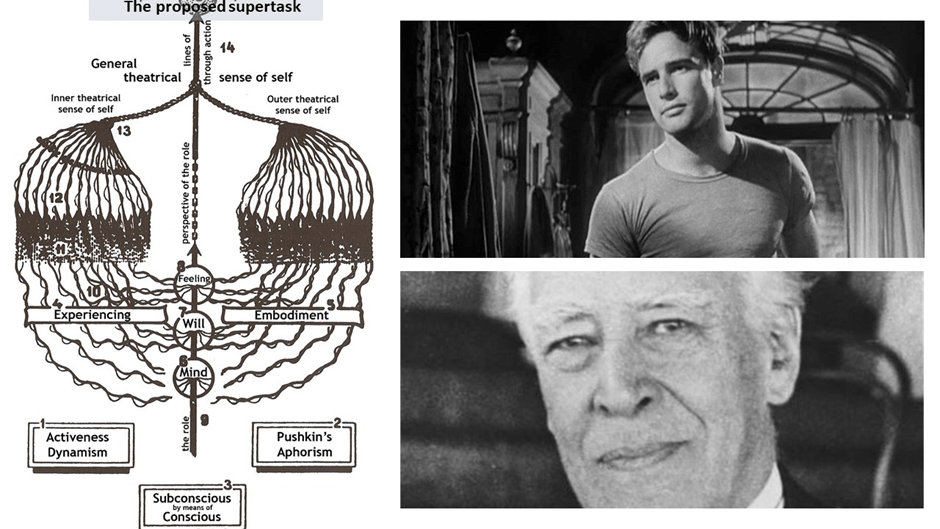
To illustrate Method Acting: Collage of cropped items: Left: A diagram of Stanislavski’s “system”, based on his “Plan of Experiencing” (1935) by DionysosProteus – Own work, Public Domain, https://commons.wikimedia.org/w/index.php?curid=10112359; Right Top: Marlon Brando‘s performance in Elia Kazan‘s film of A Streetcar Named Desire exemplifies the power of Stanislavski-based acting in cinema (Cropped screenshot of Marlon Brando from the trailer for the film A Streetcar Named Desire (1951)) & Right Bottom: Portrait of Stanislavski (Available at: https://commons.wikimedia.org/wiki/File:Bundesarchiv_Bild_183-18073-0003,_Konstantin_Sergejewitsch_Stanislawski.jpg)
Let’s start then by looking at the recent history of the play Hamlet enacted in Palestine. Hammad’s ‘Acknowledgements’ start with thanks to those ‘who shared their experience of working in theatre in Palestine’ including ‘members of The Freedom Theatre’. We must return to specific links of that last named theatre education situates in Jenin refugee camp in the West Bank, for its very existence and location speak out about the necessity of understanding border crossing. This refugee camp lives, as we shall see in the tension between borders. However, here theatre took up a home and, as we shall see, so did Hamlet.
Freedom Theatre did not begin the Palestinian association with Hamlet. In a 2023 essay on ‘The Revolutionary Power of Palestinian Theater’, Hammad reflecting on ‘How Art Can Still Effect Change’ utilises some facts about the history of Palestine theatre, mentioning that ‘Shakespeare’s Hamlet was first performed in Arabic in Gaza in 1911’ by the famous Lebanese actor/director, Jurj Abyad. The play exists in a contemporary Arabic translation, the one used by Hammad which she ‘freely translated back into the English Language’ (a case of reverse translation in order to merge the linguistic debt to a language existing between boundaries) was by Jabra Ibrahim Jabra.[7] More pertinently she explains that:
During the First Intifada, Hamlet was on the list of books banned in the West Bank because certain lines in the “To be or not to be” speech—including “to take arms against a sea of troubles / And by opposing end them”—were considered an incitement to violence.
Theatres were closed as a result of productions and she generalises, using a similar phrase about the ambiguity of the word ‘act’ in English as appears in the novel, and cited above. She concludes that this:
hostility to theater (sic.) perhaps had to do with its transitory nature: as a live, essentially unrepeatable art form, theater can be unpredictable and even volatile. It can incite action—the double meaning in the English word “act” is brought to life in the Palestinian context. It’s also an art form comprised of bodies occupying space. The backbone of the Israeli occupation is a military regime whose principal mechanism of power is the control of bodies in space.[8]
Hammad’s essay does not tie up the associations, that she surely knew, between the Freedom Theatre members, whom she interviewed and a specific production of Hamlet that involved them and about which an award-winning European documentary was made in 2017 (for the French version at least), Hamlet in Palestine. The film dealt with a collaboration between the Freedom Theatre and a German theatre Director. The former (as using the link will have shown) is a Palestinian education in theatre project situated in the West Bank refugee camp of Jenin. So much in the websites dedicated to this film even the title (in my collage above) ‘Mariam est Hamlet’, for this names an actress whose name is taken by theatre-director and actor of the Hamlet role herself in the novel, although no identity between these people is claimed by me (for I simply do not know, having never seen the film).
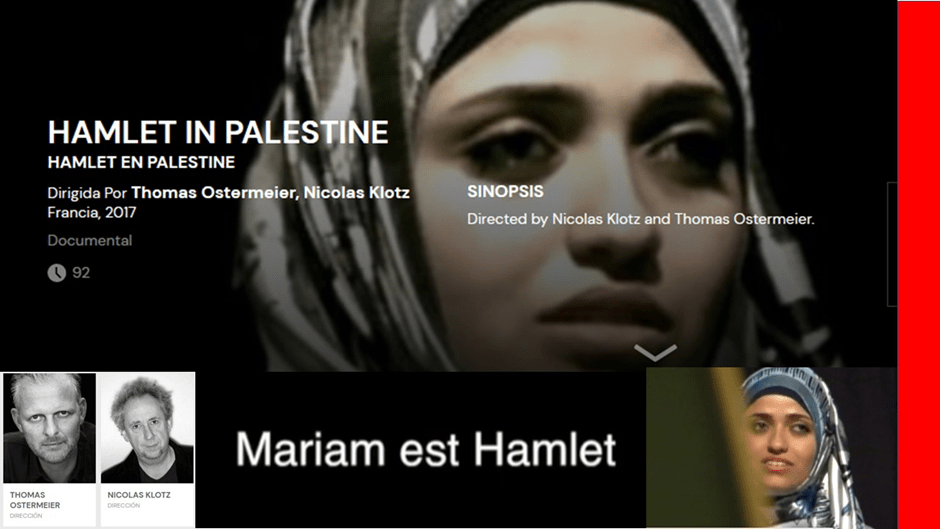
A collage relating to the documentary film Hamlet in Palestine
Hamlet is by necessity a play that evokes politics however persistently some directors of it in the twentieth-century have emphasised a depoliticised sexual family romance (a concept which in its origin in Freud is already political, about the very original of defensive psycho-social external authority and its representatives in social institutions and constructed psyche) or existential psychology devoid of social reference. Even before this novel it shows in the sets chosen for it. Look, for example, at the Arts Theatre production sets for the largely conventional (as I understand from descriptions of it which emphasise its ‘extraordinarily human quality’) Michael Warre version played immediately after the Second World War in London in 1945 before touring war-devastated Europe between then and 1947.[9] The sets alone however ensure that the context of any ‘extraordinarily human quality’, whatever the twentieth-century thought that meant, must be and focus political power and defensive oppression. The Graveyard setting seems to show how oppressive political war bred death. Forestalling medieval castle wall exteriors, limited the human to the few who ruled the many and the interiors (such as The Throne Room exhibited the symbolic grandiosity of an egotistic self-elevated to power, recalling even Leni Riefenstahl’s 1938 film of her 1936 Olympics coverage in service to Hitler.
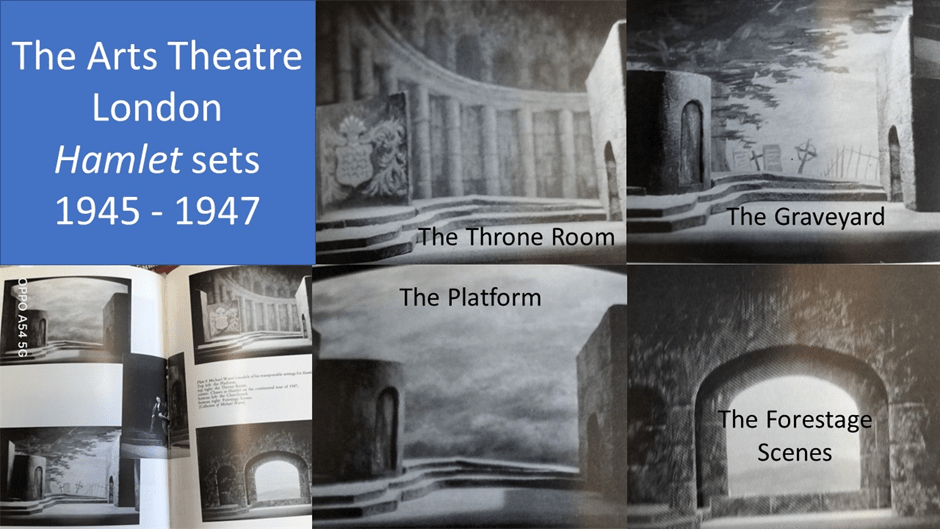
Collage of my photographs (from a book I have now abandoned) : Wendy & J.C. Trewin (1986: 2nd opening of monochrome illustrations between pp.40f.) The Arts Theatre London 1927 – 1981 London, The Society for Theatre Research
However, the qualities of the play itself and of its stage history, even in Palestine could not predict the issues which make the actors named in the Acknowledgements of this novel (including the Freedom Theatre per se) relevant to its story, although even a cursory glance at the names there (and of course Mariam who also played Hamlet from the Freedom Theatre – German coproduction) and those in will show in the novel will see some of the same names being used, if only partially: in both lists there is a Ibrahim and a Nasir. However, these parallels between fact and fiction suggest other shadow relationships between the histories of Hamlet in Palestine and Palestinian history. Nicolás Carrasco in a review of Hamlet in Palestine in 2017 relates the theme, associated with the character of Prince Hamlet. In Hamlet the Danish setting of the play can be imaginatively constructed to feel constrained and limited, whatever its actual size politically or geographically. Most famously this is seen in the discussion between Prince Hamlet and his friends, hired to take him to exile and death, Rosencrantz, and Guildenstern:
HAMLET Why, then, ’tis none to you, for there is
nothing either good or bad but thinking makes it
so. To me, it is a prison.
ROSENCRANTZ Why, then, your ambition makes it one.
’Tis too narrow for your mind.
HAMLET O God, I could be bounded in a nutshell and
count myself a king of infinite space, were it not
that I have bad dreams.
GUILDENSTERN Which dreams, indeed, are ambition,
for the very substance of the ambitious is merely
the shadow of a dream.[10]
Such a theme Carrasco associates with apprehension of the space which makes up the ‘State of Palestine’ and its relation to the State of Israel. This is all the more poignant in that the ‘state’ which calls itself ‘Palestine’ is itself a kind of imagined construct of which Carrasco says that it ‘has not belonged to any state since Jordan relinquished its sovereignty after its illegal annexation in 1948’. Carrasco continues by claiming that:
…, the final status of the entire area, along with the Gaza Strip, is yet to be determined in further negotiations between Israelis and Palestinians. In the absence of prior sovereignty, Israel considers it a “disputed territory” and not an “occupation regime”. The West Bank is, therefore, like a prison.[11]
The classical beauty of Hamlet as a play is that imagined space and relative freedoms ‘to be’, to exist or have a role, continually shift between ideas of the actual defined space of political ‘states’ and subjectively imagined versions of that space. Hence, even with the analogy that Carrasco makes between history and a play’s theme, it is clear that the relationship between the contending ‘states’ of Israel and Palestine which Mariam – an Israeli citizen acting who chooses to direct, and act within as Prince Hamlet, in the West Bank – to which it is difficult for her and others to set other than mental boundaries and borders. It is this which determines the key complex analogy here between play and novel – the differentiation between the ‘inside’ and ‘outside’ of both a political state and a mental state which defines identity and personhood in a manner that is comfortable to act out.
This is not just an intellectual analogy between the project of Freedom Theatre and Palestinian history. The theatre is in fact a school that facilitates for the refugees of Jenin camp to reimagine the space in which they might conceive themselves as free Palestinians. Invited to help build a production of Hamlet then was an easy leap into the play’s deep imagery uniting political states, like Denmark, Israel, and ‘Palestine’ with mental states of feeling free or bounded by the bars of a prison, or a ‘nutshell’. The freedom Theatre however also historically has to live out a similar loss of a father figure as Hamlet does. Carrasco points out that the film Hamlet in Palestine by Nicholas Klotz and Thomas Ostermeier blends footage of the making of the play with ‘the murder of Julian Mer-Khamis, the former director of Freedom Theatre, killed by an unknown assassin in April 2011’. That Juliano’s death had much to do with the fear the Israeli state constantly demonstrated at that time of a free Palestinian theatre enacting a kind of ‘artistic activism’ of a political nature is often suggested but still not proven. Thus Carrasco concludes thus: “Denmark is a prison,” Hamlet tells us. … this documentary {Hamlet in Palestine} reinforces the parallels between Shakespeare’s work and the Israeli-Palestinian conflict”.[12]
The situation of The Freedom Theatre continues to display that conflict not only in its results – as in the picture of devastation following an Israeli army visit in July 2011, but the fact that Israel continually denies the truth of Palestinian refugee accounts of state oppression, sometimes by Palestinian State forces too, considered an agent of those of Israel by some. To read Joseph Dana’s account of the contested versions of this event – a ‘raid’ according to The Freedom Theatre, a visit according to government sources, emphasis the analogy between psychological states and battles for political statehood and a personhood determined by such potential statehood.
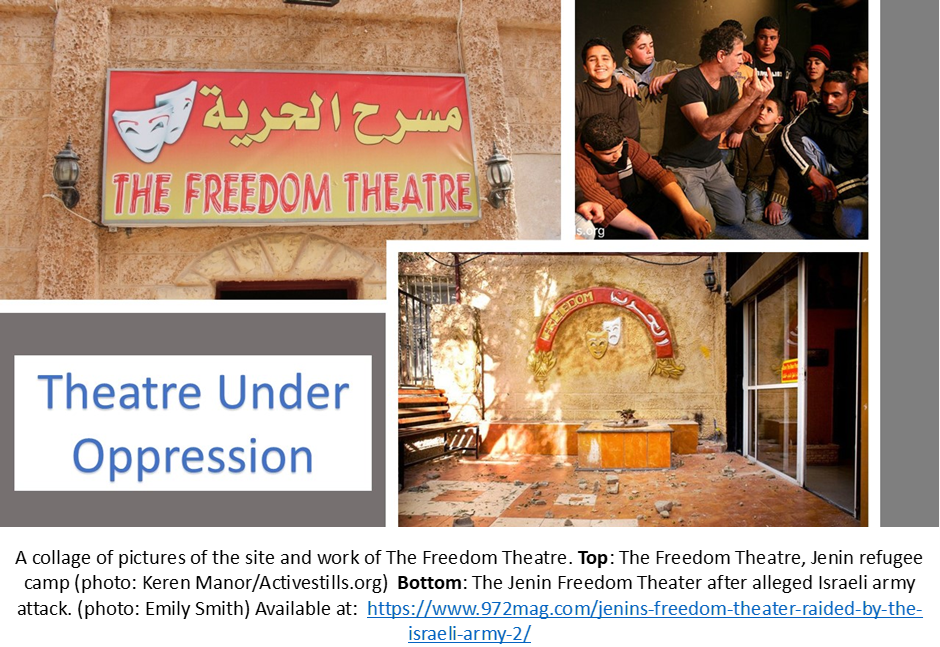
According to Jonatan Stanczak (the Swedish co-founder of Freedom Theatre), Israeli soldiers did not physically enter the theater but they attacked it with stones and sealed off the area around the theater while demanding that all inside come out. In the process of the operation, soldiers surrounded all entrances and arrested two people, both were inside the theater when soldiers arrived, Stanczak told +972 from Jenin this evening. “We have researched the definition of a raid, and while troops did not enter inside the theater, we believe what they did should be defined as a raid,” Stanczak noted.[13]
In summary therefore Hamlet as a partial subject of the novel Enter Ghost allows for a discussion of State and Nationhood that is socio-politically at the forefront. Indeed so much is so obvious that it gets mentioned in most reviews of the novel. Holly Williams in The Observer concentrates on the skill with which Hammad characterises the differences in two kinds of Palestinians, each living, apparently, in different states: ‘“48ers” – Palestinians who stayed within the newly drawn boundaries of Israel after 1948 – and those from the West Bank’.[14] That such distinctions result in mental dissociations for those subject to them, and that the novel explores this is not discussed by Williams. Sadie Jones in The Guardian is more alert to this psychological factor in the novel but instead of discussing this rests on the fact, probably true since people with dissociation are often unreliable narrators, that:
Moments of dissociation are common with Sonia, and Hammad herself often stands apart as the writing takes the form of a playscript. There is a certain opacity to Enter Ghost; geopolitical and linguistic clarifications are scant or obscured, adding to the sense of being locked out of the country, not always for the good of the storytelling. On a cassette tape of her grandparents from 1994, Sonia hears her grandmother’s disembodied voice say: “Even if I cannot live in it, my soul will reawaken if there is a Palestinian state.” It is a profoundly sad moment; one ghost listening to another.[15]
How much stronger would the novel appear if Jones had seen that it is precisely this sense of being ‘locked out’ of the nation that still insists on defining you that leads to mental and emotional dissociation and praised the psychological subtlety of the novel rather than mourned the absence of a clearer narrative. For state and nationhood is dissociative often for many for deep reasons of political exclusion buried in a nation’s history. The actors described in a playscript of their conversations in rehearsal show the dissociation in terms of never being able to fix analogies of statehood that link Hamlet and Palestinian history (Mariam will later say that Queen Gertrude – pointedly since played by Sonia in the event –‘stands for Palestine’).
MARIAM: You mean Hamlet is a martyr like a Palestinian martyr.
…
MAJED: but which nation is Hamlet liberating?
Pause.
GEORGE: Denmark. No?
MAJED: But are you sure killing Claudius liberates Denmark? Doesn’t killing Claudius give Denmark to Fortinbras?
MARIAM: Well –
MAJED: And then is Denmark supposed to be Palestine? Or is Denmark Israel? The time is out of joint thing, something rotten in the state – the state of Israel? …[16]
In this novel nationhood must be intersubjectively for all of the characters in the novel, as for the portrayed actors in Hamlet, a very complicated concept. Sonia Nasir represents part of the international diaspora of Palestinian communities whose return in this novel is to a state of being and personhood they can’t easily identify despite of associations of family and place, since these things in themselves have been torn apart (hence the story of Sonia’s grandparent’s house now owned, when visited by Sonia and her sister by a Jewish Israeli family. Some claim a state of Palestine which others reject as a fiction imposed by an oppressor. Within the old boundaries of Palestine, as within the short-lived British Mandate which is the setting of part of the novel The Parisian, there is even the problem of an internal diaspora even more complex than the international one. We have seen already that the lands of the supposed State of Palestine (the West Bank and the Gaza strip) are not acknowledged as binding in international law, hence even this version of Palestine is historically fragmented and in part at least fictious in international law. Hence part of the sense of psychological dissociation derives from the feeling it invokes in reader as well as characters of never knowing where you are in such a novel. Sadie Jones might have therefore praised the dislocations in the narrative as essential to the theme. They are obvious in any map of the state under question that provides the locales of the novel.
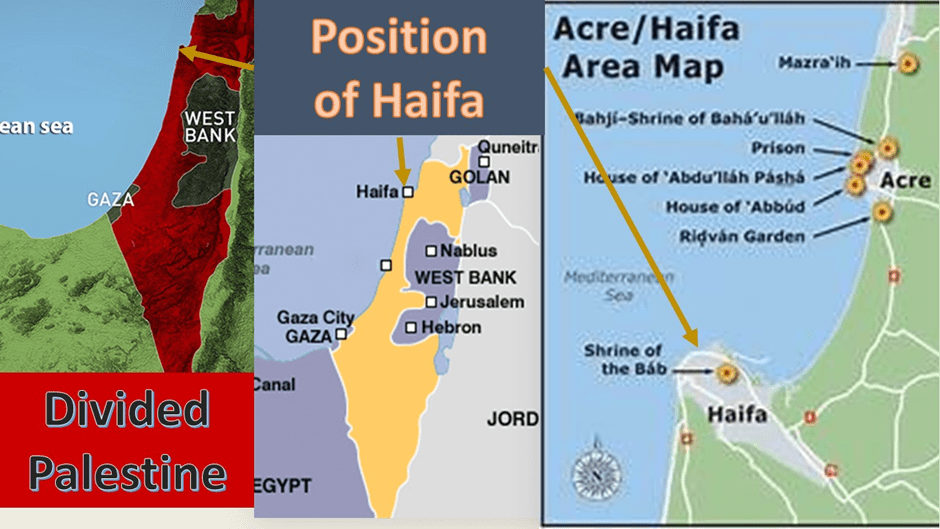
Sarah Cypher (an interesting name) in The Washington Post has a much more nuanced take on this theme in exploring the similarity of interest in Hamlet and Enter Ghost in the experience of ‘similar’ kinds of family and political ‘strife’:
… strife – between lovers, family members, and the Israeli “inside’ and West Bank “outside” – and it posits a spectral third way, which Hammad illustrates through a central motif of crossing between worlds’.[17]
I think Cypher might have extended the contrast of insides and outsides in defining phenomena for it is central to the analogy between the politic state and the state of being we call personhood or ‘identity’ (I prefer the former). For boundary crossing as identified by Cypher appears in both domains in the novel and not just around national identity. I noted numerous references (but no doubt that is not all of them), Examining her family Sonia early on notices a family history of ‘psychological interest’, in her Uncle Jad here: ‘… in the relations between Palestinians “inside”, our family included, and those in the West Bank’. Definitions of oneself as inside and outside determine even attitudes to belonging and freedom (as in The Parisian too) and to the politics of the period:
The PLO leaders had not mentioned the fate of Palestinians with Israeli citizenship. It looked like the Palestinian state they were fighting for would not include us. Include them. Include our family mean.[18]
The dislocations and dissociations here around the word ‘inclusion’ (a form of negotiation between outside and inside of any phenomenon are about the roots of identity in which we find, OR NOT, our sense of belonging and ‘being’ (To be OR not to be). This is mirrored in at least two (but probably more) features of this novel – its symbolic objects and its constant passage between the boundaries of different kinds of fiction: realism and fantasy, objective and subjective discourse, reason, and madness, waking and dream realities. Cypher is correct to see this liminal world as ‘spectral’ – like the entry of the Ghost foretold in the title taken from a Hamlet stage direction. Let’s start though with symbols. I will focus on walls. Walls, real or metaphoric, divide nations by creating solid borders with entry checkpoints that, but they also define and delimit the outside of homes and other houses, excluding what does not being the inside, although as prisons they also keep what is inside from escaping to the outside. Many borders are crossed in this novel, but we need to remind ourselves that the skin itself is the surface of a wall defining outside and inside and hence allowing for metaphoric leaps in a novel from considering objects in the external world to distinctions between internal psychological perception memory and cognition from external reality. Hammad had already employed this metaphor early in The Parisian to describe the aetiologies, onset, and symptoms of mental illness, here in the mother of the hero’s European female beloved, Jeanette. The symptoms of her mental illness are recorded thus in a diary after her death by suicide.
The walls of my father’s house were totally transformed. … It took a while to settle as my sleeping mind woke fully, and when it did, I saw the walls had vanished. Or rather, they had become simply walls, plaster and wood and brick, just a structure with no inside or outside. Inside and outside were an illusion’.[19]
Illusory walls and equally illusory contrasts of internal and external are handled in Enter Ghost by the use of stage sets to create walls that are not walls but which pass as such. The set of the Hamlet played at Bethlehem in the novel is focused around a wall on which illusory shadows are cast to loom large like that of Majed when he is playing the Ghost: ‘When Majed’s shadow appears on the stage wall. The Ghost’s voice booms from the speakers’. This wall may be somewhat like those !945 examples I showed in an earlier illustration perhaps miming the oppression and grandeur of a castellated seat of power, but here they describe that terrible cusp where persons and states experience either (or both) political exclusion, assassination, and imprisonment. They invite psychotic fantasy inside the solid and real, as with Jeannette’s mother. Take the quotation I use in my title, here somewhat lengthened. It describes a moment mid-performance when Majed enacting Old Hamlet’s Ghost appears (unseen to Gertrude (here Sonia) but seen by Hamlet (here Mariam)):
I was entering a fugue state, I watched myself being Gertrude.
…
Mirror-me gestured at the empty space in which Majed was standing.
And everything is there I see.
…
As I said this I heard the wings of something enormous shuddering on the air.
MARIAM: How strange. Look there. Look how it sneaks away from us.
Majed crept offstage. Terror of the Ghost coursed through me. Was it terror of the Ghost? The difference between this and the normal embodying of staged emotion was basically, I think, one of degree and duration. My fear was like a child’s play-fear, it had that prolonged innocent intensity, blending the unreal with the real . The way the body rehearses for danger. I was having the flight reaction I would have once had, a long time ago, to shadows in a bedroom. Now I was both the child and the shadows’.[20]
This is an incredibly rich passage in which binaries such as seen and unseen, real and imagined, inside and outside play and interact with each other creating multiple possibilities for meaning and experience. It starts with a moment of ‘entry’ into a dissociative fugue state, just as the novel opens with the entry of an innocent Sonia into a world that will fragment her reality – Israel-Palestine. The reality or otherwise of Ghosts is variously captured to represent memories of what is lost and our love and simultaneous fear of it, even tying this neurotic-cum-psychotic state of mind to its possible real genesis in the flight or fight reactions when first experienced by a child as an introduction to stress, which both teaches (and hence why children play at such fear and fugue states- imagining what they know will terrify them) and also shocks, and sometimes alienates the personality as in what we call ‘madness’.
What I want to draw attention to, for here I started off my thinking, is that the analysis of the human role on the cusp of what is outside and what inside enacts its identity and the means of its action – even political action in fear and enthusiasm. Sometimes it leads to destruction, as in the wonderfully moving story of the hunger-striker, who Sonia remembers visiting on an earlier visit to Palestine but whose real fate (death) had been hidden from her by her family. We all act and few of us know whether our action is authentic or playacted. This novel not only imagines all this but sets it going for us to watch – even our own ‘mirror-me’ in states of dissociation ( sublime or malign) – so that what we mean by action in response to political oppression is seen as wat it is – an amalgam of the unreal imagined and the real necessity (else why else would people choose to suffer and die for a cause). Why else would we, like Prince Hamlet and Sonia, delay to act, or even delay ‘to be or not to be’. And in looking at how a person might become the thing they cannot at other times imagine performing – a terrorist, freedom-fighter, hunger-striker, dead when we are still alive or in crossing gender, sexuality, and sex boundaries, as well as ‘state’ boundaries, as both Sonia and Mariam in some sense do. There is a good example of this queer crossing of boundaries, in fact many of them, in The Parisian that I have just reached in my reading of that great debut novel. In this Midhat Kamal, a Palestinian in French clothing and with French education, observes himself in early British Mandate Palestine:
…, he experienced a rare moment of self-perception. He felt his presence from the outside, not only in space, but also in time. In a flash he saw this part he played for the men of Nablus as a kind of inverse of his persona in Paris – the part he used to play for women. He was always marked by his difference.[21]
I find this passage magically brilliant. The magic is more clearly theatrical in Enter Ghost than here, though the word ‘part’ is used deliberately in the early novel. It utilises internal and external perception in a thoroughly educative way as acting does, and as the Freedom Theatre set out to do too in order to show that our politics and political openness, especially to change to the status quo requires that we understand acting as the ability to be self both in an inside and outside form and see the difference between these, whilst still acting as if one could not (Gertrude cannot, for instance, truly know what it is to be Gertrude though Hamlet could be anyone I think). This is why I believe Sonia’s late English lover, Michael, teachers her to act using the Stanislavskian method: “Your body’s got to react to two invisible forces.” These forces he goes on to say are either (i) internal (mental and intentional or based on ‘strong feeling’ or emotional) OR (ii) external where ‘something you cannot see is acting on the body’.[22] They are the world of Hamlet, where invisible ghosts (seen only by young warriors and princes) and political and psychological necessities externalise those motivations which Hamlet cannot realise internally. They are the world of Palestinian politics, even of Israeli settlers and soldiers whose cause of action is also examined in these terms, for this is a truly humane novel even if its sympathies, as they rarely are in art, is with an unrepresented group. Political necessities are ‘the wings of something enormous’ which might be a carrion bird or a stage, either way we need to act as if we can see the consciousness involved – believe in it and know it is also fictive. This is why so many of the cast of Hamlet in the play are ex-revolutionaries looking for another way, sometimes in the art of acting, whilst the only modern Israeli Palestinian, Wael can barely act. In that sense he is like Hamlet who can’t act either though he has strong motivation, except that Wael (popular singer extraordinaire) cannot act Prince Hamlet either. My favourite cross-reference though is to the analysis of the person who acts in collusion, in this case an ‘informant’ to Israeli authorities, with an apparent enemy, of which many are identified in this region by their fellow ‘citizens’ . One such is the theatre manager in Bethlehem Dawud, whom Sonia as such, and his alter ego, Yunes, taught by Sonia’s sister, Haneen. Once caught out in his double role, equally inauthentic in each, the irony of one being that it is a ‘theatre manager’:
“Oh my God,” she said. “He’s an informant.”
“We don’t know for sure,” I said. “but it was pretty unnerving. He started like a – like a guilty –“ (ibid: 259)
This is possibly one of the most knowing and satisfying echoes of Hamlet in the book, guessed only by those who know the text, as we know both Sonia and Haneen talking here do. It describes the traitor enacting, in yet another style, without majesty and with much of the ‘sneak’ (another word used in the play) the action of the Ghost of Old King Hamlet as described in Act 1, Scene 1 of the play:
BARNARDO
It was about to speak when the cock crew.
HORATIO
And then it started like a guilty thing
Upon a fearful summons.[23]
There is much more to say about this novel and it is my favourite for nomination at every level of the Booker this year. But let’s see if it gets even nominated – so scared are British institutions of the label Anti-Semite, even such that being pro-Palestinian in any degree, is seen as already proof of anti-Semitism, a circumstance I truly hate.
Please read this wondrous novel.
Love
Steve
[1] Isabella Hammad (2023a: 307) Enter Ghost London, Jonathan Cape.
[2] In a sense both Sonia Nasir and Midhat Kamal, ‘Al-Barisi’ which in Arabic means ‘The Parisian’, leave The Middle East in order to make a career in the more extensive resources for education and work available in the West, he as a researching doctor, she as an actor.
[3] Ibid: 1
[4] Ibid: 75f.
[5] William Shakespeare Hamlet Act 1, Scene II, lines 79ff. The online Folger Library text. Available at: https://www.folger.edu/explore/shakespeares-works/hamlet/read/
[6] Hammad 2023a op.cit.: 162
[7] ‘Explanatory Notes’ in ibid: 321
[8] Isabella Hammad (2023b) ‘The Revolutionary Power of Palestinian Theater: Isabella Hammad Reflects on How Art Can Still Effect Change’ 9n The Literary Hub (online) [April 4, 2023] available at: https://lithub.com/the-revolutionary-power-of-palestinian-theater/
[9] Cited Wendy & J.C. Trewin (1986: 23) The Arts Theatre London 1927 – 1981 London, The Society for Theatre Research
[10] Hamlet op. cit. II, ii, 268ff.
[11] Nicolás Carrasco (2017) ‘CINÉMA DU RÉEL 2017: HAMLET IN PALESTINE, BY NICOLAS KLOTZ AND THOMAS OSTERMEIER’ in desistfilm [online website] (2017.04.05) Available at: https://desistfilm.com/hamlet-in-palestine-by-nicolas-klotz-and-thomas-ostermeier/
[12] Ibid.
[13] Joseph Dana (2011) ‘Jenin’s Freedom Theater raided by the Israeli army’ in 972 Magazine (online) [July 26, 2011] Available at: https://www.972mag.com/jenins-freedom-theater-raided-by-the-israeli-army-2/ . Read the entire piece for better understanding.
[14] Holly Williams (2023) Review: ‘Enter Ghost by Isabella Hammad review – drama in the West Bank’ in The Observer [online] (Tue 28 Mar 2023 07.00 BST) Available at: https://www.theguardian.com/books/2023/mar/28/enter-ghost-by-isabella-hammad-review-drama-in-the-west-bank
[15] Sadie Jones (2023) ‘Review: Enter Ghost by Isabella Hammad review – Hamlet in Palestine’ in The Guardian [online] (Wed 29 Mar 2023 11.00 BST) Available at: https://www.theguardian.com/books/2023/mar/29/enter-ghost-by-isabella-hammad-review-hamlet-in-palestine
[16] Hammad 2023a op.cit.: 81ff. (Gertrude reference on p. 83)
[17] Sarah Cypher (2023) ‘Isabella Hammad tackles ‘Hamlet’ and politics in her clever new novel’ in The Washington Post (online) [April 4, 2023 at 7:00 a.m. EDT] Available at: https://www.washingtonpost.com/books/2023/04/04/isabella-hammad-enter-ghost-hamlet/
[18] Hammad 2023a op.cit.: 41.
[19] Isabella Hammad (2019: 103) The Parisian or Al-Barisi London, Vintage from Jonathan Cape (Kindle version)
[20] Isabella Hammad 2023a: 307.
[21] Isabella Hammad (2019: 335) The Parisian or Al-Barisi New York, Grove Press (I had transitioned from Kindle version to USA first edition by this point in my reading).
[22] Hammad 2023a: 275
[23] Hamlet op.cit. I, I, 162ff.
 Steve_Bamlett_blog

7 thoughts on “‘… I heard the wings of something enormous shuddering on the air. … The way the body rehearses for danger. I was having the flight reaction I would have once had, a long time ago, to shadows in a bedroom. Now I was both the child and the shadows’. This is a blog to show that ‘acting’, whatever we mean by that word, occurs on the cusp of what is outside and inside the body and the state in which it lives. This blog examines the phenomenology of a great novel: Isabella Hammad (2023) ‘Enter Ghost’.”