


… but that was in another country; / And besides the wench is dead.’ Let’s make our diversity our common unity and not ‘other’ those of ‘another country’, if that was ever possible. An answer based on a case study reading of the novel by James Baldwin, Another Country.
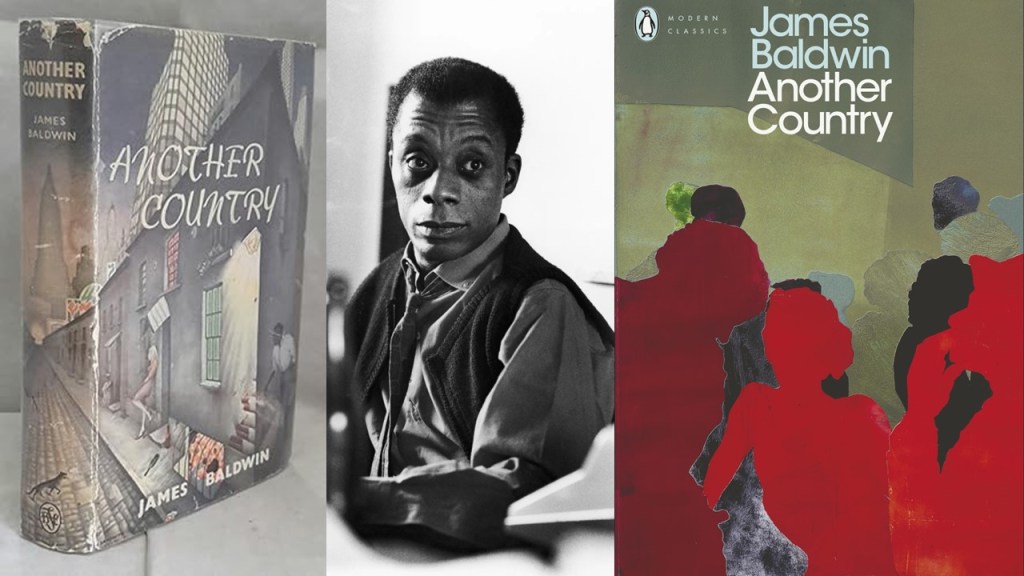
This will turn into an answer to this prompt based on a reading of James Baldwin’s Another Country but it might amble a little first – well perhaps more than a little. It lays its bets on a belief that Baldwin took his novel title from The Jew of Malta by Christopher Marlowe, a play which gives intra-community racism and othering its full force, and not just in its unrelenting antisemitism. The source, also used by T.S. Eliot in his poem Portrait Of A Lady is from near the beginning of Act IV of the play, where Barabas the Jew (named of course after the Jew chosen by the people of Jerusalem in the New Testament, to be saved from crucifixion rather than Jesus Christ, and thus tied to myths that fuel and ‘justify’ in the terms of that period some people’s religiously based antisemitism). Act IV of that problematic play for literary types like me begins with Barabbas rejoicing with his Jewish servant Ithamore at the latter’s poisoning of a whole community of Christian nuns, before he is interrupted by two Christian clerics, intent on accusing Barabas of some crime. Barabas however foils any attempt by the monks to name his crime by interrupting them at each appropriate moment by mentioning another ‘crime’ that he admits committing, like being a ‘Jew’ and a ‘usurer’, but this is his most famous interruption:

Barabas : I must needs say that I have been a great usurer.
Friar Barnadine : Thou hast committed—
Barabas: Fornication—but that was in another country;
And besides, the wench is dead.
None of these crimes will shock the Holy Fathers except in their expectedness, either as sins already known of Barabas or, in this case, of themselves (a little earlier Barabas tells Ithamore that there is no need to follow up the nun-poisoning by doing the same to the monks, for: ‘Thou shalt not need, for now the Nuns are dead / They’ll die with grief’). But what attracts others to these lines is the terrible manner in which Barabas excuses his sin of ‘fornication’ and clears himself of being due for punishment for it. We do not need to revenge that crime because she is now ‘dead’, but more coldly still, she is not of our ‘country’ but ‘another country’. And he expects the Friars to agree that this excuses not treating that ‘wench’ with respect, for that is, after all, their justification for oppressing, or ‘converting’ Maltese Jews to their own community; as they are doing – on her request – Barabas’ daughter, Abigail. The phrase ‘another country’ comes to later literature then full of resonance about the treatment of diverse sub-communities of one community (that of Malta in the play, Venice in Shakespeare’s version of a similar story in The Merchant of Venice, not quite so antisemitic as this one.
In answering this prompt I make certain assumptions about the term ‘community’. Hence my first visit today to etymology.com, but I’will return there later more than once:
community( n.): late 14c., communite, “a number of people associated together by the fact of residence in the same locality,” also “the common people” (not the rulers or the clergy), from Old French comunité “community, commonness, everybody” (Modern French communauté), from Latin communitatem (nominative communitas) “community, society, fellowship, friendly intercourse; courtesy, condescension, affability,” from communis “common, public, general, shared by all or many” (see common (adj.)). / Latin communitatem “was merely a noun of quality … meaning ‘fellowship, community of relations or feelings’ ” [OED, 1989], but in Medieval Latin it came to be used concretely to mean “a society, a division of people.” / In English, the meaning “common possession or enjoyment” is from c. 1400. The sense of “a society or association of persons having common interests or occupations” also is from c. 1400.
The word differs from ‘country’, although there are shared meanings as well as different ones in usage: the difference is that it derives from a word suggesting the ‘land’ contingent or ‘lying opposite’ to people (as in my country), or a political, with or without a sense of the political entity of a nation, or land of a ‘people’:
country (n.): mid-13c., “(one’s) native land;” c. 1300, “any geographic area,” sometimes with implications of political organization, from Old French contree, cuntrede “region, district, country,” from Vulgar Latin *(terra) contrata “(land) lying opposite,” or “(land) spread before one,” in Medieval Latin “country, region,” from Latin contra “opposite, against” (see contra-). The native word is land.
The idea of a community is complicated by the idea of ‘country’. The USA is and was a country of diasporic populations from various original ‘countries’nations in large, with only one wider ‘community (in fact a whole collective of communities’ capable of claiming ‘native’ rites in the long duration of history) but many who have the right to attempt to do so in relation to their origin, language, culture, race and ethnicity – some no longer trace their origins to ‘another country’ but many do (when we speak of Irish Americans, Hispanic Americans, African Americans, and so on). Complicating this further is the binary idea of White and Black Americans (adopted first negatively and then positively to mark the political realities of white colonial and settler-colonial racism) – wherein different origins in terms of countries and other diasporic national-cultural traditions apply within each set of that false binary. That is the reality of the novel Another Country. The novel uses only two different countries, as national political entities) as a setting for its characters’ interactions – the USA predominantly and France, both countries in which Baldwin lived for significant periods, the second wherein he honed his art from European cultural models. But other countries abound in reference to the whole novel but especially that in the USA – Poland (Richard Silenski), ‘Italians’ (and Italianate names like ‘Lorenzo’ and ‘Vivaldo’, Spain (with which, paradoxically Lorenzo identifies because he lived there, English Americans (in the awful character, Steve Ellis) and others. All this is possible to explore because the people identifying with a diasporic community are given national, racial or ethnic identity, over-ridden sometimes by the Black/White binary not simply. I will return to detailed look at the issue later. But I haven’t yet done with teasing out our prompt question, because sometimes I find I need to query the etymology of a word to clarify why a prompt question seems to make me feel uncomfortable.
‘How would you improve your community?’ is such a question, because it seems to assume that the thing acted upon by its verb (‘community’) is ‘yours‘ in the sense of being a possession rather than the relationship between you and it being one of related co-existence. The sense is there probably because of the presumption implied in the idea that an individual has the right, the power and sufficient agency to set about doing something to their community, without it saying it wanted that thing done, and consented that it be done by you. And then to the verb ‘improve’, where etymology might help. It, for instance, has a surprising etymology, explanatory of the discomfort this question causes. Given, of course, that etymology does not pretend to explain the current meaning of any word, it does help in explaining the history of the meaning becoming what it now is and, in doing so, opening up some of the assumptions of the word. Here is the etymology from etymonline.com:
improve (v.): late 15c., “to use to one’s profit, to increase (income),” from Anglo-French emprouwer “to turn to profit” (late 13c.), from Old French en-, a causative prefix or from em-, + prou “profit,” from Latin prode “advantageous” (see proud (adj.)). / Spelling with -v- was rare before 17c.; it apparently arose from confusion of –v– and -u-. Spelling otherwise deformed by influence of words in -prove. Meaning “make better, raise to a better quality or condition” first recorded 1610s. Intransitive sense “get better” is from 1727. Phrase improve the occasion retains the etymological sense. Meaning “to turn land to profit” (by clearing it, erecting buildings, etc.) was in Anglo-French (13c.) and survived or was revived in the American colonies and Australia. Hence, “make good use of, occupy (a place) and convert to some purpose.”
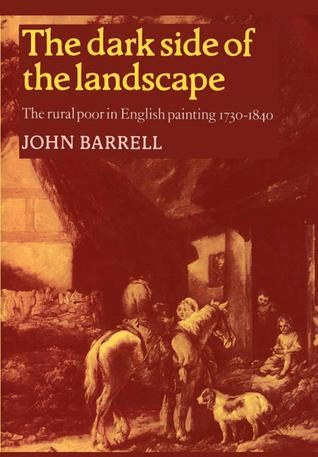
When this piece refers to the ‘etymological sense’, it cannot exclude the fact that land ‘improvement’ during the Agricultural Revolution, the Clearances in Scotland and land consolidation in the interests of major landowners in other subaltern nations of the Union, though sometimes aestheticised by the ideologies of both the picturesque (in landed lowland estates) and sublime (in land cleared of its populations for sheep or hunting) in landscapes, was also tied to someone who already possessed great power, wealth, land and income getting more of it to the cost of those without a share of either. The story is in John Barrel’s classic book – The dark side of the landscape: The rural poor in English painting 1730-1840.
The idea is not only in English landscape painting but also in the literature of the period by Goldsmith and Crabbe. But in some literature ‘improvers’ of landscape also seemed to consult social good. Dorothea in George Eliot’s Middlemarch wants to design cottages that will improve those on the estate of her father, the parsimonious baronet, Brooke. That he was causing his tenants to suffer is clear from the one cottage Dorothea visits called ‘Freedom’s End’, however Dorothea, as we know, is naive about the values of the world she lives in, despite her idealism. A better example of a novelist”s character’s take on improving landlords is General Tilney in Jane Austen’s Northanger Abbey. The General is a self-conscious improver of his estate, once an Abbey but now a privately owned power-house, supposedly in the interests of the local community, rather than a secluded monastic one but really the symbol of landed power.
The General has kept only tne very central domestic buildings of the aristocratic house once an Abbey proper eponymous with the novel’s title, Northanger Abbey. It is an entirely improved grounds and house, by his lights – if not Catherine Morland’s, who wants houses to be on a Gothic scale reminiscent of Mrs Radcliffe’s novels, where she can imagine urevenged murders and ghosts. Here is Austen’s description, which mocks Catherine’s point of view whilst still largely working, technically speaking, within it when necessary.Here is a telling section from Chapter 23 (with my emphases):
From the dining-room, of which, though already seen, and always to be seen at five o’clock, the general could not forgo the pleasure of pacing out the length, for the more certain information of Miss Morland, as to what she neither doubted nor cared for, they proceeded by quick communication to the kitchen—the ancient kitchen of the convent, rich in the massy walls and smoke of former days, and in the stoves and hot closets of the present. The General’s improving hand had not loitered here: every modern invention to facilitate the labour of the cooks had been adopted within this, their spacious theatre; and, when the genius of others had failed, his own had often produced the perfection wanted. ….
With the walls of the kitchen ended all the antiquity of the abbey; the fourth side of the quadrangle having, on account of its decaying state, been removed by the General’s father, and the present erected in its place. All that was venerable ceased here. The new building was not only new, but declared itself to be so; intended only for offices, and enclosed behind by stable-yards, no uniformity of architecture had been thought necessary. Catherine could have raved at the hand which had swept away what must have been beyond the value of all the rest, for the purposes of mere domestic economy; and would willingly have been spared the mortification of a walk through scenes so fallen, had the general allowed it; but if he had a vanity, it was in the arrangement of his offices; and as he was convinced that, to a mind like Miss Morland’s, a view of the accommodations and comforts by which the labours of her inferiors were softened, must always be gratifying, he should make no apology for leading her on. …
I love the manner in which the General assumes that Catherine, as an aspirant woman, must find gratifying the manner in which servants lives were improved by his architectural improvements whilst we know that, from her point of view she was not only NOT gratified but ‘could have raved at the hand which had swept away what must have been beyond the value of all the rest, for the purposes of mere domestic economy’. Mere domestic economy Is precisely what Catherine must learn in Austen’s view too, for it becomes her as the aspirant wife of Frederick Tilney, the General’s son, whilst her independent mind is being wasted by ridiculous Romantic literature of the Gothic novel type, which values the old merely because it sees the sight of modernity as ‘scenes so fallen’ from an antique standard. Austen I believe is all for improving things for the community, but personally I doubt whether those improvements were motivated by anything other than the ‘profit’ of the monied improver. Domestic economy means not only improving the quality of labour labouring in the kitchens, and the kitchen-gardens and hothouses the General shows her, but reducing its absolute quantity in the interests of economic efficiency. Though Catherine goes on to marvel at the mass of servants she sees working in these contexts, compared to her lower bourgeois standards, a critical reading of the novel shows that such servants are not merely for show but are made to feel they must always be at work, on sufferance of severance otherwise.
So how does this reflect on the aspiration for improved community in Baldwin’s Another Country. In its time-setting too, it reflects community, sometimes in terms of its absence, for each person seen in it is isolated, without relationship, or at least quality of relationship, to others. Take this description, on the novel’s second page of Seventh Avenue in New York seen from Times Square just past midnight, and in the dark from the viewpoint of Rufus, a young Black man born in Harlem of migrant parents from the Southern (‘slave’ and ‘Jim Crow laws‘ historied) States. [1]
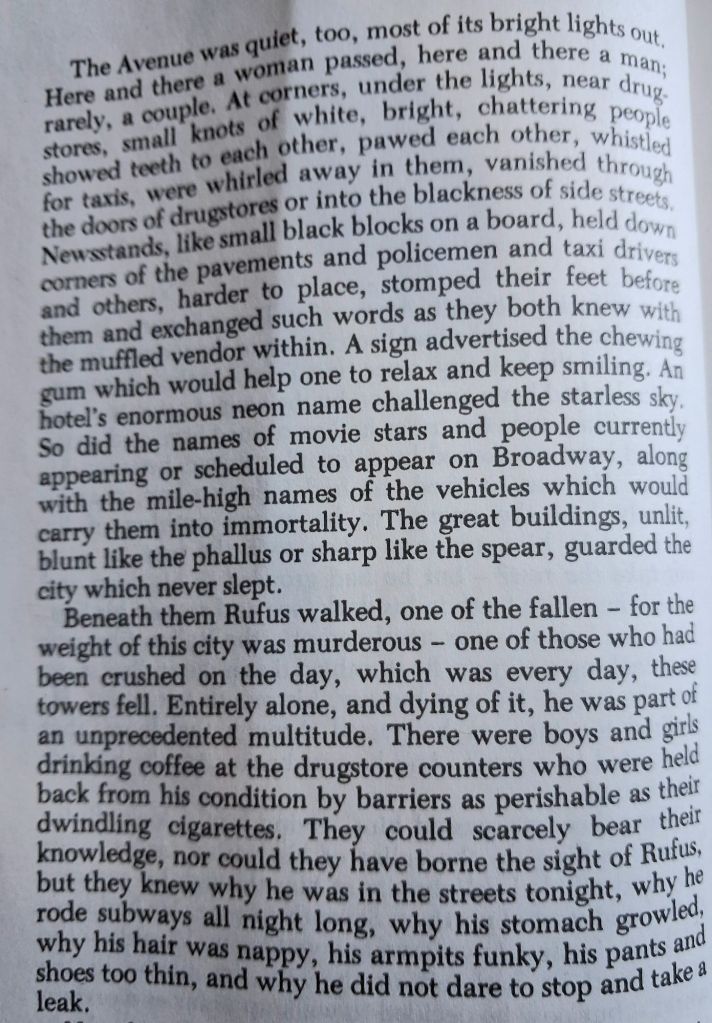
The reduction into the oneness of one’s own self explains the power here, of the phrase, ‘rarely a couple’, but not because the issue here, yet,is coupledom as a means of rescue from isolation but because no-one feels supported from being ‘fallen’ or falling, imaginatively with the skyscraper towers around them, for having fallen there is further to go – down to the position of Rufus, who will jump from the George Washington Bridge to his death soon after this part of his story is told. Support for life is reduced here to the lies of advertisements, for gum that aids you smile and relax, or so it says, its essence reduced to towers that might be a blunt phallus or a sharp spear, signs of male defence against vulnerability. And then the statement: ‘Entirely alone, and dying of it, he was part of an unprecedented multitude’. A multitude of lonely people with nothing to bind them together. People who are not policemen or taxi drivers are ‘others, harder to place’ whose only communication and communion is, at anonymous blank black newsstands to have ‘exchanged such words as they both knew with the muffled vendor within’. Think of that phrase – ‘such words as they both knew’. Communion is necessarily limited – by differing language perhaps, but perhaps not – perhaps knowledge itself has no common or communal means of exchange. This is indeed, more brilliant than the reader yet knows, for its glimpse of the Broadway show signs, which seems arbitrary here, a mere contingent sight, is not so but we, and perhaps Rufus, has no memory of its relevance. Even the story told up to his death does not reveal its relevance, though it does detail some details of his past as a boy in Harlem. By the end of the novel, we are introduced to Eric, who flees to France, escaping the shards of his break up with Rufus as his lover, but which, on his return and rise in theatrical circles helped by Steve Ellis, will gaze at the same legends fronting Broadway in the expectation that his name will soon join them – for he is an actor, though ‘resting’ from such labour in France when the novel opens – not that we know that until we are introduced to him in France with his French boyfriend Yves but only much later learning of his relation to Rufus, and other characters. The first full section on Rufus’ life does not even introduce to his queer being, except that he says at one point, he wishes her were ‘homosexual’ and talks of, in his misery, reluctantly ‘peddling his arse’ to make enough money to eat.

By then we realise how he forms part of a community that crosses every boundary but sex/gender. In the penultimate section of the book, Eric having left Yves and expecting him in the USA, has an unexpected affair with the wife, Cass, of the Polish origin Richard Silenski, only to find himself in a liaison with Vivaldo that matters before Yves does arrive. Vivaldo (who Baldwin once thought would be black, Toibin tells us in the Penguin Classic introduction) [2] who ‘loved’ Rufus without desiring him, has turned from isolation to an long intense affair with Vi Scott, Rufus’ younger sister, only eventually for this to be broken by a brief sexual affair, leading to professions of onward love but no future sex, with Eric, Rufus’ past lover. Rufus’s friend, Richard is married to Cass but is motivated by pursuit of the money consequent on writing potboiler novels to break his understanding of loving friendship with fellow literary (meaning unpublished) novelist Vivaldo. Steve Ellis, a white literary and theatrical impresario, sets Richard on this path and hopes to establish Ida Scott as a Harlem soul singer, only to have an elicit affair with her, suspected but not discovered until late by Vivaldo, by which time he has had an affair with Eric. If this criss-crossing of erotic, romantic and other bonds of affinity weren’t enough to complicate any idea of community of place (that inhabited by he New York intelligentsia, especially that of New York’s Greenwich Village) with community of identity, including those between Black and White characters and heteronormative versus all combinations of queer identity, then there is he issue I have already pointed to about ‘national’ diasporic ones. As Vivaldo walks Forty-Second Street to the ‘Village’ he sees ‘black-and-white couples’ (a deliberately ambiguous phrasing to allow for couple of the same skin colour or of mixed couples) :
defiantly white, flamboyantly black; and the Italians watched them hating them, hating, in fact, all the Villagers, who gave their streets a bad name. The Italians, after all,merely wished to be accepted as decent Americans and could not be blamed for feeling that they might have had an easier time of it if they had not been afflicted with so many Jews and junkies and drunkards and queers and spades, [3]
The condemnation of the Italian community’s racism and Euro-centrism is only in the irony and it is relatively light, for reasons I will suggest later. At Benno’s ba shortly after, Vivaldo meets Lorenzo, ‘the Canadian-born poet’, of obvious long-ago Italian met, his Texan girlfriend but finds he feels attached to the Spanish, ‘the grooviest people in the world’, except, of course for Franco. When Vivaldo thinks of Ida’s difficulties in living as Black in America, he returns a white man’s objection that he wouldn’t ‘want to be a Spaniard’ with: “I bet you wouldn’t want to be a nigger her, would you?” [4]
This is one of those moments that shocks contemporary readers, as much as they did Richard Wright and other liberation-oriented Black writers at the time but it, like the issue with New York Italian community antisemitism and the rest, has a reason for being like that, hard to reconstruct now, for Baldwin though he knew, felt and thought inevitable the extremity of oppression of Rufus and Ida, and their right to respond with thoughts of violence against all White people, the thing he saw in Richard Wright; let alone more radical Black Muslim movements. He saw this ‘rage’ as he called it as justified, but he felt it counter-productive, for he imagined a community of Americans, even of global populations , that felt the unity of a common and communal humanity. Toibin cites Baldwin thus: [5]
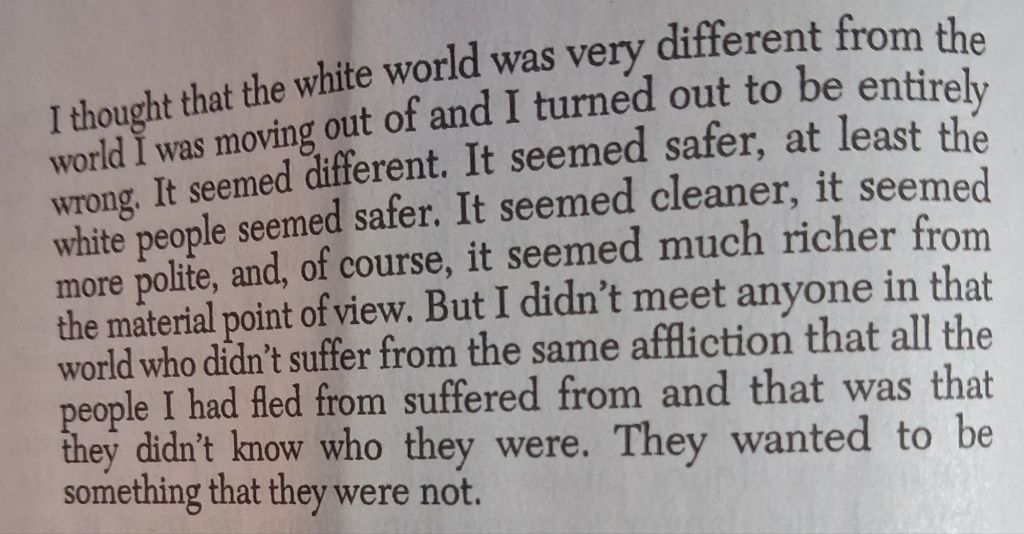
As a white man I find that difficult to read, and wonder, even now if it underplays the power of white hegemony and entitlement in the light of common human ‘affliction’ of not knowing who you are, a condition that seems to be related to the alienation and anomie that Baldwin learned to be common to humans from French existentialists. But it is the reason why Baldwin allows latitude to some of the symptoms of racism in White people, seeing them as symptoms at a deeper level of white people ‘not knowing who they are’ and reacting likewise with vengeance at those who did, or appeared to do, or couldn’t care less. The Baldwin who could examine Black community in Harlem in Go Tell It on the Mountain, and white queer community of a different kind in Europe in Giovanni’s Room, found it necessary in picturing the USA of Another Country as a blueprint of global community. In an earlier blog (see this link) I tried to show how Baldwin in his first novel aped the mission of St John, seen as Gospel writer and Apocalyptic Visionary (as one person probably wrongly), but there is something apocalyptic-visionary in the mission of Another Country too. Early in the novel, Baldwin describes Rufus’ flight from Harlem to ‘a boot canp in the South’ and Naval service. In this memory he remembers bringing back a shawl that seems to turn his beloved sister Ida into ‘the woman clothed in the Sun’ from Revelations Chapter 12 v. 1 (“And there appeared a great wonder in heaven; a woman clothed with the sun, and the moon under her feet, and upon her head a crown of twelve stars: …”). Though I see no moon in the passage below, the sun and its clothing effect (multi-coloured like a global community) and the ide of Ida as a monarch’ – presumably an African Queen, and therefore ‘crowned’, does: [6]
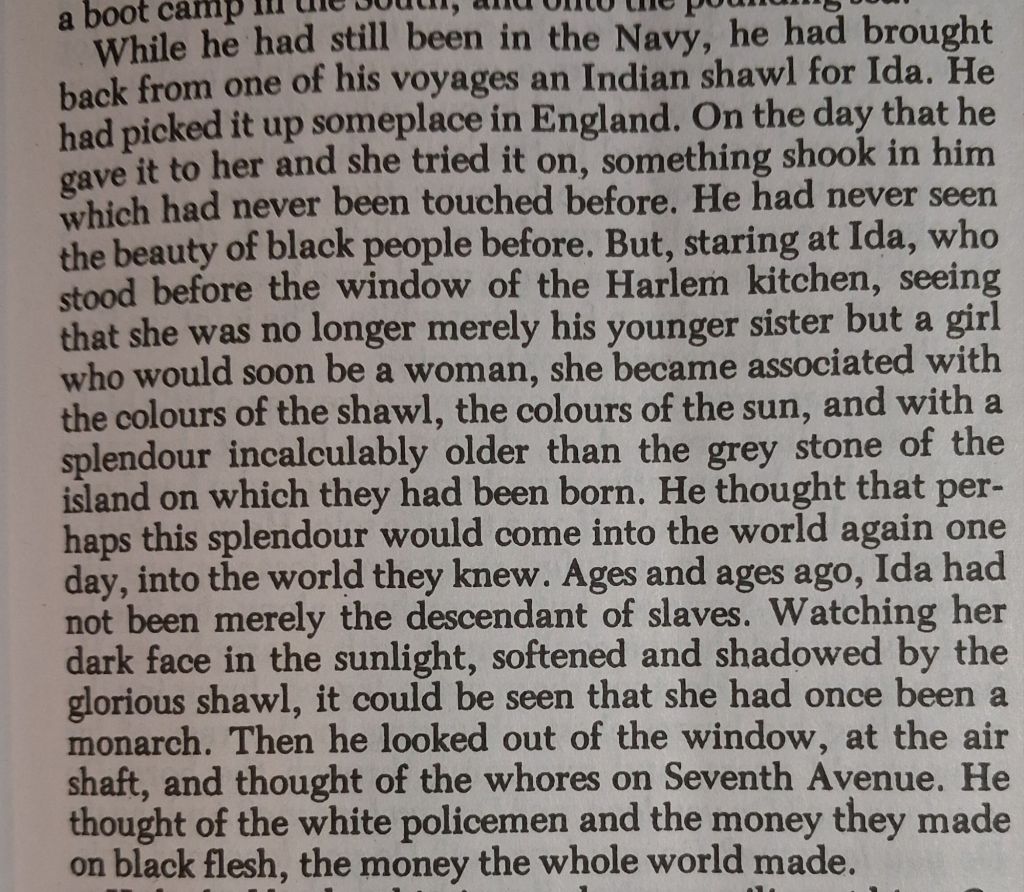
In this semi-religious passage the slavery and oppression, even the prostitution, of black women’s flesh appears to be magically redeemed in a memory. It is, for Baldwin is too honest, only an imaginary redemption for, as we have seen Rufus ends his life in a kind of Inferno-Hell, and Ida has to continue to serve white need, through both Vivaldo and Steve Ellis, to survive and sing, though like an angel. Vivaldo is not evil, as is Ellis, but he is not solid either – hence the wary ending of the novel wherein their fate as a couple is unresolved though the ‘clouds’ are clearing outside the window and some ‘stars’ appear. [7]
I so wish I had the energy and you the generosity (not doubted but you can hope for too much) for me to unfold this into other themes of community sought such that we transcend the issue of seeing our world as friction at the border of ‘another country’ but instead learned to break down barriers, but that is too much. In an earlier blog on social distance – a thing worth measuring in community or pretension to it – (at this link) I said that:
… I am left with a feeling that social distance is often more of a concern when its practitioners (that is all persons) see themselves as acting naturally, varying it by effect of folk knowledge or practice rather than by the impulse to meet across distances irrespective of the original symbolic difference distance from each other). I am reading James Baldwin’s Another Country at the moment. It is a very relevant novel. The prompts to ‘distance’, often allied to disgust reactions at their worst (or other entrained habitual ‘feelings and sensations – as in class prejudice where people feared the touch, smell and feel of other ‘lower’ classes or more ‘common people’.
Now the thing I wanted to show after I read this novel is the brilliance with which it plays with the varying different distances between its characters and groups, and the interaction of each different kind of distance with it each: physical-sexual, Touch (not the same as the latter because cognitively and affectively interpreted by persons), emotion, thought and contingent behaviours. But somehow I feel I must leave it with one small piece of writing. Here Eric is thinking of two different kinds of distance between he and Cass, with whom only yesterday he was locked into an affair, and his lover, Yves, on his way soon from France. He is prompted to it by distances within himself which will take so much closer, in so many ways – touch included, even sexual penetration – to Vivaldo. Just read it well from: ‘He had used her to dind out somerhing about himself. …’. It is definitive Baldwin: [9]
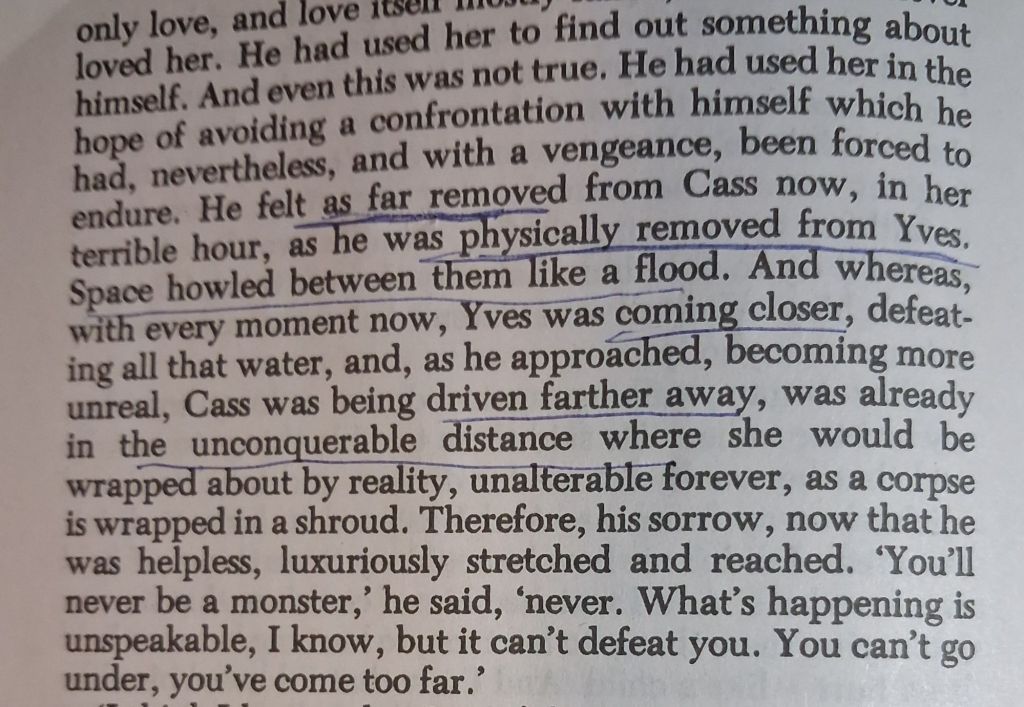
If you don’t like that passage, I think it is probable you don’t like Baldwin as a writer. But there is more of the same in even greater subtlety, not so marked in a way that I could underline some of its signifiers. it is a novel where bridges matter more than just because it is set mainly in New York and where towers are ominous shadows of something darker yet – in New York and Chartres (those of the Cathedral – I always thought it a brooding presence myself).
Goodbye for now. I would be delighted to converse with anyone who wanted who had different or similar ideas, but I am washed out right now.
With love
Steven xxxxxxxx
_____________________
[1] James Baldwin [intro. by Colm Toibin].(2001: 14, the novel was originally published in UK 1963) Another Country Penguin Classics
[2] In ibid: v – xii
[3] ibid: 292
[4] ibid: 298-301
[5] in ibid: viii
[6] from ibid: 17
[7] ibid: 420f.
[8] ibid: 396.
 Steve_Bamlett_blog