


Say No! Why should we give way and surrender all of our Delusions for the sake of order! ‘We are not asking for permission to belong any more, not from a silent universe …’ [1] The delusory command to ‘Abandon all Delusions all You who enter here’ and Processing who will ‘Pass’ Examination of their abandonment of delusion is so delusory in Jenni Fagan (2026) The Delusions, London, Hutchinson Heinemann.
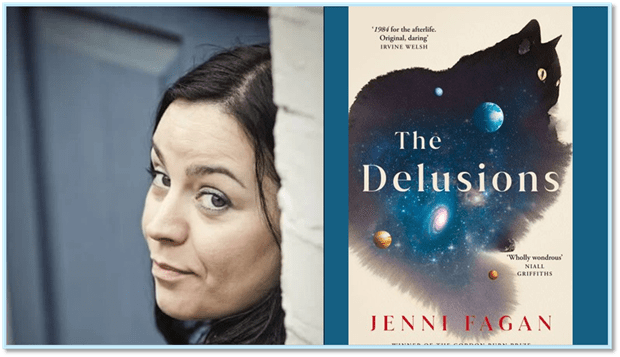
In a novel where separating human beings from their delusions is a process that takes a primary, and repetitive, role, for it to end questioning whether any of that processing is worthwhile is a challenging novelist’s trick and makes this novel the puzzle that it is and will, I suspect, always remain. M John Harrison in a good review of the book has a definitively finer conclusion about the book, its unreliable narrator and main character, Edi, and of his review:
At the beginning, it’s difficult not to think of The Delusions as a version of the Powell and Pressburger film A Matter of Life and Death, its paternalistic values and hierarchies slyly reversed. But soon the values of the afterlife, as Edi describes them, begin to seem delusory, a spectacle managed by shady, hypocritical overlords. As below, so above. Later, a kind of celebratory pathos replaces satire as the main engine of the novel, and we’re left with a momentary feeling that Edi has never been what she thought she was, and her delivery, with its rants and repetitions, has been the cleverly simulated monologue of a restless spirit who hasn’t yet cast off her own delusions. We’re uplifted, but it’s part of Fagan’s genius to make even the uplift seem fragile, uncertain, wishful.[2]
It is neat critical writing this, in that it depends on its reader catching the irony that the hunt for delusions in the newly-dead (which is the spine of the many stories told in it) is probably itself a process meant to delude. This is a ‘process’ that we see repeated throughout the novel, as monstrous beasts (oily eels and dragons) representing delusion are torn from the bodies of the newly-dead, if they can manage it, in ever more varied vignettes in which characters are exposed to moral satire, just as we might think we see in Chaucer’s The Canterbury Tales, or indeed Dante’s Divine Comedy (a book which she never got to start on Edi’s reading shelves in her revisited cottage on earth, specifically in North Berwick). The whole basis of the moral satire is however entirely overturned by the fact that this process is a ‘delusory’ one; it is, that is, itself a ‘delusion’. Moreover it’s a delusion that’s in some ways shared by Edi until the denouement of the novel itself at the ‘end-of-time’. To get beyond all delusion in a novel as is proposed in this structural overturn of the presumptions of its stories thus far, is indeed uplifting, and is accompanied by uplifting rhetoric about universal communal love being insisted on in the end, led by Edi’s decision that the only valid question to ask the newly-dead, in lieu of a Questionnaire serving the Processing of souls, is: ‘Who did you love?’. Yet, I think I agree with Harrison wholeheartedly that it is ‘part of Fagan’s genius to make even the uplift seem fragile, uncertain, wishful’. She is, after all, an amazingly subtle writer at her best – and she comes out with her best so frequently.
In what follows I don’t think I can better Harrison’s introduction although I don’t agree with quite a lot of it, because to me this novel is beautiful because it is more readable than any attempt to account for it would be. But I feel like I want to say – what a fine, surprising inclusive, even of contradictions and incoherence and delusion, this novel is. Here is Fagan’s version of a medieval morality satire with some redemptive characters, like Mahmoud, but severe at other men, in particular, like the graceless Wallaby. Yet it also has the feel of the apocalyptic novels of the late twentieth century, by Maggie Gee for instance – if much more ironically structured. If the world must end before your very eyes you need to be sure what it means to witness it (or stock-take it in the preferred word of the guides of the Admin class, HR), without falling into the vindictive mysticism of St. John of Patmos in Revelations about those who deserve their fate in Hell, for in this novel Hell is replaced by the Theatre of Cruelty for Lost Souls. There is also a domain under a glass floor of the place Edi works in (‘Processing’ it’s called) which is to its inhabitants a glass ceiling at which they claw to be given another chance at ‘Passing’ the test they got merely trapped in (they are the Trapped Souls – perhaps of Purgatory). Edi, unlike St John, is an immensely contradictory narrator. She might sound as judgemental as the saint and his God but everyone (Lost and Trapped Souls too) ends up bathed in the love suffusing all (again like Dante, except he confined paradise to the few).
When she is judgemental, she is to a fault; expressing an intense hatred for the delusion that tops all others in the dealing out of hurt to others as the price of one’s own well-being. The biggest delusion is that of those who benefit from top-down structures of oppression that blight the lives of the Many, both of the living and the dead, on Earth or in the place beyond life. However, in fact, Edi raises the issue of her own moral ambivalence throughout – at one point, using a Edinburgh Scots’ word (borrowed from the Romany) ‘radge’ (it means ‘uncontrollably or insanely angry’) – one favoured by Irvine Welsh, splitting herself entirely into a consciousness and self-as-an-object (the ideal paranoid-schizoid position of the self in Melanie Klein) which fuels her constant rages at polarised versions of good and bad others:
I had to learn how to be here. Even longer to learn how to accept it. Longer still to not just go radge from sheer claustrophobia at still being stuck as me – for fucking infinity (possibly) or beyond! That part fucked me off more than anything.
Being me is not something I ever totally wanted to be.
I don’t fucking like it
That’s the truth.
I have had to learn to live within the limitations of myself.
I am still fucking trying![3]
This is then a novel in which one seeks a moral centre at your peril, though its Fourierist idealism at the end is haunting, it can’t be absolute, any more than the nearly Calvinist binary doctrine in which delusion is seen primarily as the force that sustains the oppressive minority in its use of its control of resources (even Human Resources) to exploit and/or waste of the lives of the marginalised and disempowered. After all, what is Admin and the people who call themselves Admin in the vast terminus called Processing but the class of mindless slaves of an oppressive ideology, trying to nuance the instructions of a machine-like Process of separation of the masses into categories. It’s an ambivalently described Process. It is represented sometimes as based on belated justice for the oppressed or the victims of constant genocide and rape, wherein Edi can identify with the Process almost entirely:[4]
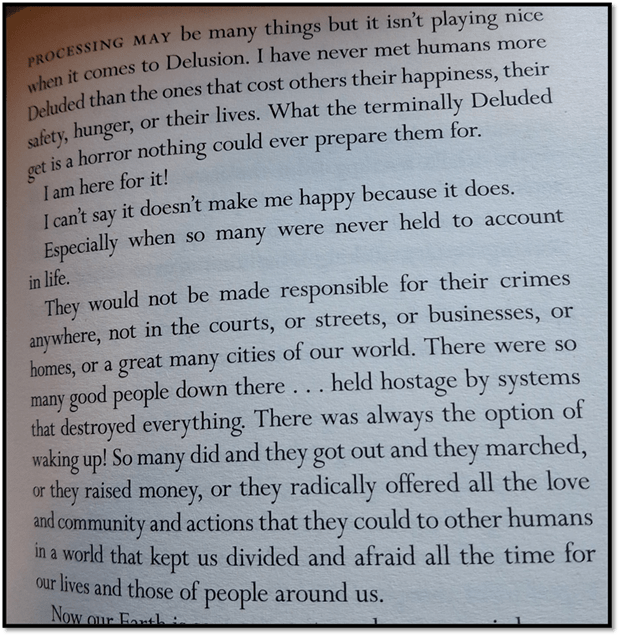
At other times Edi seems to realise (or is taught by wiser souls in Admin – notably her sometime lover (in a polyamorous framework) and friend, Batshiva, that her role serves entirely and only the needs of those in power in the universe (the ‘Universal Order’) for Universal Growth. In this respect the novel mocks the rhetoric of Liz Truss, and sometimes Keir Starmer (who comes out of this novel very poorly indeed but brilliantly accurately), as believers in Growth as the only good, tested by tools measuring economic progression or regression: ‘…each person that Passes – it turns out – helps the universe to either expand (with light) or retract (in Delusion)’, which is why, Batshiva implies, Admin so meticulously measures with their Questionnaire the loss of Delusion of entrants to Pass into another life, beyond the Process. Of course, the robustness of the Questionnaire is itself a delusion, even beyond the freedom people like Edi take to flout its questions when they so desire, with Mahmoud for instance, for HR themselves constantly change the number and quality of the questions to meet their targets and circumstances.
If Processing is a delusion, as great as any held by the characters processed in the novel – and we should note that we are to learn that Edi failed the Process many timespans over many past lives before taking on her role in Admin – then it is analogous to Fiction, which processes plot, character and settings, considered as a lie rather than as a pathway to higher truth, the latter case being what literary artists have insisted fiction is since Sir Philip Sidney’s Defence of Poesy. I am relatively certain that Fagan implies this analogy between Fiction as Processing, which can be entirely well-meaning or sometimes entirely built of ideological lies because of her concern in the novel with Edi’s role in libraries or as an archivist, and her brief description of the ‘life’ in books, which is a kind of life, like that Edi has in Processing (if not in her returns to Scotland) wherein she appears to live but does not breathe:[5]
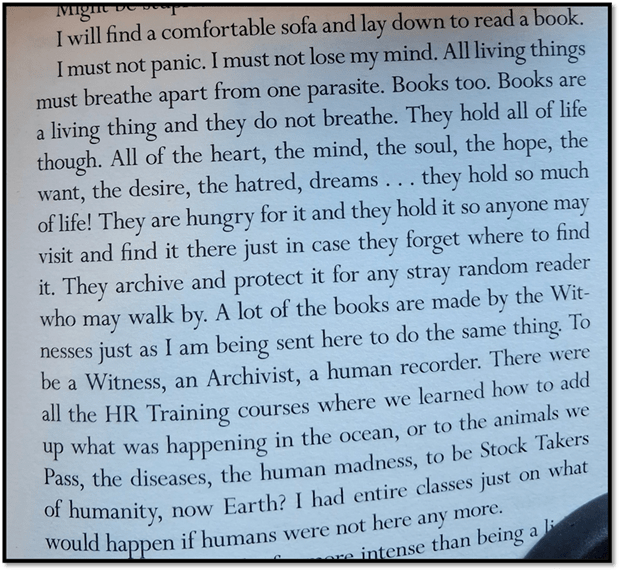
I wonder if ‘the heart, the mind, the soul, the hope, the want, the desire, the hatred, dreams …’ were not so much a mixture of lies (or fiction) and truth (or fiction) and delusions, which books as well as Admin witness and stock-take, and contain in their ambivalence as much of Delusion as of whatever is its opposite, as do of course the ‘witness, an Archivist, a human recorder’ that is a novelist or poet do and must continue to do until the end of time, by which we mean time as humans believe it to be in their continual delusory (or hopeful or wishful) manipulations of it.
It is just that novels involve administration and data processing as much as other vast termini of souls do, like airports or educational situations, all guarding the right to determine who or what will ‘Pass’ the standards by which a novelist determines things. Yet, a novelist has to be more than administration of human records – they must also be able to ‘hold all of life’, conserving and reserving it rather than merely categorising it.
That makes the judgement of fiction difficult. Let’s take an example from that good critic already cited, M John Harrison:
Edi is doing her best as a narrator, but she can become a little tiring. Her monologue is all we have, and it is so rammed with information about everything, from the details of Admin organisation to the ambivalent wooshy structures of the Universal Beyond. She has to act as agent for the author’s whole worldbuilding effort. Consequently, other characters can feel a bit thin and transparent, even for dead people. As earthbound readers, not even dead yet, we’d sometimes like Edi to take the odd breath, be less hectically determined to put everything into words, show us something we could look at directly. It would be easier to process it all. But generally we’re laughing or wincing too much to care.2
I keep wondering how self-conscious Harrison is of their writing. For instance, Edi can’t ‘take a breath’ as a processor, as readers can, for she is not a breathing being in that role, and hence is bound to narrate ‘breathlessly’ (and I think Fagan capable of that double-meaning) and she is not responsible, though given that role of helping the reader ‘to process it all’. The only process she can manage or be allowed to manage is that validated by HR, which she isn’t allowed to question. Readers may try to intuit the author as a life behind the narration but character, in as much as it slips through is a matter of finding holes in the narrator’s given purpose – hence, for Harrison isn’t right about all the characters, some of which are honestly loved and allowed to pass though they do not fulfil imposed criteria. The finest example is Mahmoud in Chapter 35. Though Batshiva feels he is merely example of humans – giving an example of a fully flat stereotype – who ‘clutch Delusion to them like a designer bag’, the narrative merely enjoys him, delusions included, giving them time, if not words necessarily but good writing reserves words too, to grow and expand whist still involved in their delusions about themselves:
Just like that sweet Mahmoud grows in courage before all of us and he starts brutally cleaving off a hundred or more years of Delusion from his body, all that he had taken in life and then after death, it is a lot of substance – I will him onwards, this is going to take some time.[6]
And once he completes his Questionnaire he remains solidly created as seen by Edi, who never unfolds her delusion fully, in this sentence, one surely Harrison could not have noticed: ‘Amazing curly black eyelashes frame deep brown eyes warm with humanity’.[7] Mahmoud isn’t the only one we love as a character and not just because suddenly we are told that ‘humanity’ remains a good thing to invoke love, although strangely I think Edi’s son, Ivor hard to realise as an adult character though totally realisable as a child in memory revisited in North Berwick (but maybe that’s the point – who knows?). The point is that Edi can only narrate within the framework given her – of Processing data on pro-formas.
And Fagan is surely right that the pursuit of abstract ‘process’ is at the heart of the failings of modernity – whether in airports, education or novels, where we set up standards we have the power to call ‘delusions’ and use them to defend our conceptions without any external validation of them outside the setting institution. Thus HR in employment issues everywhere, schools and universities setting up the power to ‘Pass’ or not to ‘Pass’ learners based on what they value as learning and that alone, or even publishing or literary institutions. I love the beautiful moment where we get the Admin staff using their ‘Dealing with Difficult Customers (or Conflict)’ training (believe me I have been on such courses in the NHS) where Edi establishes Calm in legitimately upset clients in her queue.[8] The novel is best at conveying Processing as a space in which the arbitrary occurs, sometimes illustrated by the attitude to animals – from great whales to cats. Though cats take up more space, my favourite is the dogs, beautifully typed. We are told that the ‘ability to Pass is different in animals’: ‘They only give information on pollution or climate changes on Earth and then they are through’. However: :The dogs are useless cos they want to make friends with everyone. They’ve been given section Q for a long time and they dilly-dally like loving idiots’.[9] Queue Q, for Questioning or Queer perhaps, is exactly where dogs belong, especially when allowed to Pass at last for to them the Process is the most nonsensical, because not one about love. HR sends nonsensical notes to Admin staff, like ‘Carry on as normal’ as the world ends and the technology of Processing fails (its leaderboard first until eventually walls and floors crack and break.
It only knows how to ‘contain’ people or animals, using ‘holding pens’ such as those used for cattle, but surely Fagan points her wicked pen at authors of the process novel (that which is only a novel by the standards set externally) when she writes: ‘Holding Pens fly up around Processing’, for it is literally true that writing turned into ‘process’ alone might allow almost anyone to hold a pen.[10] The truth is Processing, on its own is nonsensical: yet it only near the end before anyone asks, excepts those processed whose views are discounted and powerless: ‘What does Processing want?’[11] Processing is a nine-to-five thing even in the afterlife and once the space designated to it closes, it gets flexible in doing so and once ‘the floor clears’ and we see ‘the infinite trajectory of stars’, the newly-dead ‘settle’ because no longer harassed by Admin like Edi, and learn that their fear of each other and themselves might itself be delusory:
I often stay a little later at the end of my shift just to see the look on each of the newly dead’s faces. It’s the best part of my job. How they finally quieten down. They let go of all fear. Maybe for the first time ever! They settle in some peaceful way towards themselves, and the universe (ever a living thing) (the most living thing), and then finally at some point they even soften towards each other. [12]
This is a strange moment, when suddenly we realise that the ‘vast grey space’ of Processing is a Delusion, even before the novel resets itself going on its apparent endless process of being again. If peace is possible in these intermediate times, why did those in Processing realise that what unsettles peace is the constant demand to feel you should be always and forever processing that which enters into our experience, sorting it into specious and cruel categories. It is a moment, we ourselves forget as we move through the novel towards what it marks near its own end as the end-of-time as ‘the gnosis, the unseeing sense that we will still keen towards – like newborns’. That gnosis feels like being flooded with light (‘All across Processing light floods brighter and brighter’) as every living creature comes to be Processed simultaneously, for here is no more time for any of them to live, only to find that in coming together (in both sense of arriving together and being assembled together as one) they learn this: ‘We have never been less alone!’. We are all included because no-one above us has, any longer, the time or space to contain us and test our fidelity to their standards: ‘ HR memos arrive every second – ignored by everybody’. And suddenly we know some kins of union of all souls implied by human values: ‘This is not one individual standing before the universe asking if they can be part of it’. This includes that ‘one individual’ who is Edi.[13]
I don’t even intend that offering my account of the novel’s subject matter will succeed in clarifying or enlightening any reader or proposed reader of the novel – the gnosis at its end (Fagan chooses this word for a reason – that it is archaic) is not only deliberatively obscure (for too much light blinds like darkness – as in most versions of Gnosticism) but known really by its effects – as opening of the closed, lighting the dark and grey and softening of the hardened. But how does this cohere with the fact that previously Edi had delighted that Wallaby ended up amongst the Trapped Souls and that even the Theatre of Cruelty holding rapists and the genocidal (and a collusive person who seems like Keir Starmer) are freed into this open space together with the ancestors – those who had passed through Processing towards a place in the Universal Order because all their delusion was let go. It seems that Delusion no longer matters in this gnosis, or has been bypassed because it was always an evil built upon cultures of defensiveness and exclusion, but not necessarily in itself, evil! After all, amongst the Deluded is Elizabeth Bishop, the poet and one much beloved by Fagan.
Yet …. Surely we ought to miss the joyful fascination in this novel in seeing the pernicious monsters that lead and justify genocidal wars punished in a world that, unlike ours, lets them thrive. I think the issue is that the joy of books lies in the admission that fictions are a necessity. Hence, although fictions (‘fake news’ such as Donald Trump forever produces) are heinous, even the things that offer meaning o a pretty well evil world contain fictions. Just before, though dead and returned to Earth briefly, she reads the first page of Dante, Edi reflects:
I wonder what books would get to just Pass … if they had to go through Processing?
Not most of them …
Words printed.
Bound.[14]
No books would not pass the kind of Questionnaire that asked for all fictional matter to be dropped. Nor are they simplistic enough to abandon every myth in which they need to believe, at least during their duration – which for some is a very long time, if not forever. For even the infinite and endless is a kind of fiction
Do read it. It is wonderful – funny, serious, and moral, without doing all its moralising for you. Don’t say ‘No’ to this novel!
With love
Steven xxxxxx
[1] Jenni Fagan (2026: 299) The Delusions, London, Hutchinson Heinemann.
[2] M John Harrison (2026) ‘Review: The Delusions by Jenni Fagan review – an afterlife of queues and bureaucracy’ in The Guardian (Tue 17 Mar 2026 07.00 GMT) Available online at: https://www.theguardian.com/books/2026/mar/17/the-delusions-by-jenni-fagan-review-an-afterlife-of-queues-and-bureaucracy
[3] Jenni Fagan, op.cit: 175
[4] Passage below photographed from ibid: 261
[5] My photograph from ibid: 270
[6] Ibid: 207
[7] Ibid_ 211
[8] Ibid: 29
[9] Ibid: 193
[10] Ibid: 280
[11] Ibid: 289
[12] Ibid: 51f.
[13] Ibid: 279f.
[14] Ibid: 151
 Steve_Bamlett_blog