


Each day I wish I could find the will to write things ‘technically harder’ than is the norm in order to give me significantly ‘better practice’ in writing. This blog examines as a case study: Rupert Brooke’s one-act play: ‘Lithuania’ to show whether he could, as Maurice Bowra claims he wanted to in writing it, forefront ‘the expression of character, not of personal feeling, …’ [1]
For an online text of the play, see: https://babel.hathitrust.org/cgi/pt?id=uc1.$b56057&seq=9
It is a useful thing for someone so absorbed in reading as I am, but whose eyes are aging to frequent uselessness with small print in novels and other works over a long duration, to deliberately choose work by a minor writer (where it might not matter as much when something is missed) that has the primary trait of being very short.
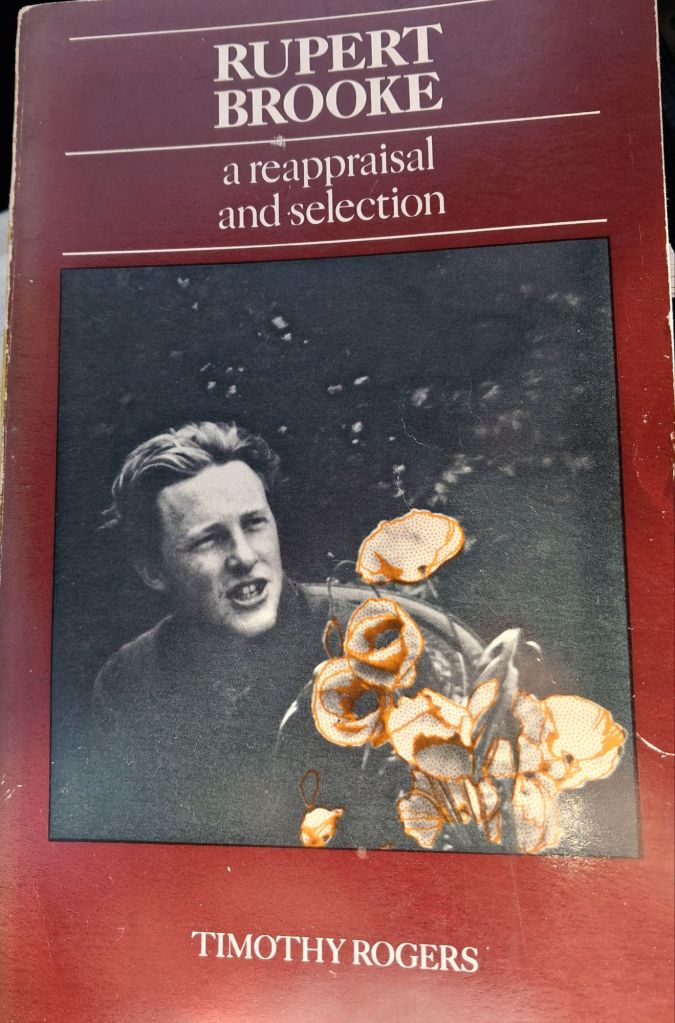
Hence when my eyes defeated me in trying to start Maurice Boggs’ new 720 page marathon biography of James Baldwin, I picked up a volume of short pieces anthologised by Timothy Rogers from Rupert Brooke, which i bought second-hand in The People’s Bookshop last week. I decided to read the only full dramatic piece by Brooke in there: a one-act play published in 1915 called Lithuania.
Timothy Rogers, who once started a biography of Brooke, but abandoned it when another was published by someone else, pulled together his notes from his abandoned biography, with stuff missing from that official biography he claimed, to devise a book with an introductory re-telling of the life together with pieces from Brooke, all organised in sections based on different genres of writing, and each with an able critical introduction.
The material in my blog title is from the chapter on drama which Rogers felt best represented by only Lithuania, which he calls, with Brooke’s authority of similar opinion, ‘slight’ but better than anything else he wrote, together with a verse playlet once appended to a novel. Lithuania is indeed ‘slight’ but not without interest. Maurice Bowra, the poet and classical scholar quoted by Rogers, famous for theorisation of Greek tragedy together with Gilbert Murray, and friend of Rupert Brooke as well as the queer circle around Dadie Rylands, saw it as an attempt to write a ‘stepping-stone toward tragedy’ of a modern kind but clearly aware of the model provided by Aeschylus. It seemed to me that, because it was new to me that plays by Brooke existed, and that it was both an ‘easy read’ and had significant claims behind it of, at least, tending towards significance, that it was a good choice to read it last night over my sore eyes. And I believe it was worth it.
The play concerns the visit of a male ‘stranger’ to a bare hut of a poverty-stricken family living in a remote part of a Lithuanian forest. When the scene opens, the stranger is already there finishing a meal given to him by the lady of the hut from the very last of her poor provisions, in the hope that feeding an apparently rich stranger lost in tne forest would pay dividends later in monetary expressions of the rich man’s gratitude. As he ends his meal, the older woman hears her husband returning home and leaves the man with her daughter momentarily. We get this conversation:
STRANGER {apparently with slight suppressed excitement) I suppose a fine young girl like you must sometimes be sick of a life of working, working, in this gloomy place, — beautiful as it is.
DAUGHTER {looks at him steadily) Um
STRANGER I’ll warrant there’s not much fun round here; not many young men, no dancing and so on; ah, you ought to be in a big town!
DAUGHTER {half to hcrsclf) I have my fun —
STRANGER It’s wonderful in a big city! The glare and the roar of the streets. Your blood swims with it. It’s a shame you should never know it. Don’t you see that you’ll only grow hard and worn here; stiffer and duller every day; working, working, working; then you’ll be like your mother; and at last you’ll shrivel and be ugly; and then you’ll die. Now, what’d you say (laughing a little rather hysterically) if some good fairy suddenly came (looking at her) and promised to take you to a big city and show you everything, and buy you dresses and jewels, and give you the best of everything, like a lady ?
{Pause.)
DAUGHTER {gets up suddenly, and crosses to him, limping slightly) I’m lame. A dog bit me. Would you like to see ? {Pulls up her skirt and down her stocking and shows place under knee.) Are ladies’ legs like that? See that cut. {Holding out her hand.) That’s a big nail did that. What’ld they say in cities to that hand? Feel! {She grips him with her right hand just above the left knee; and looks up, smiling slightly. He gives a little exclamation and draws back rather embarrassed]. Have you ever felt a lady’s hand like that? (A small pause. She lets go and goes swinging, across to the ladder and slowly up to it, and turning to the right, exit. / He sits down, his hand on his leg.
This presumably is an attempt at the illustration of character in a dramatic moment. Its focus is on the manner of interaction between a wealthy gentleman of the city and a rural young working woman with no personal advantages, and who must work if she is to live. The crucial moment is the girl’s powerful grasp of his leg above the knee, a grasp so muscular and ambivalently sexual, that the man guards his leg even after the woman exits.
Apparently the young woman is an addition to the well known and used story that Brooke worked with, a story in which a son returns to his family under disguise only to be murdered for the wealth he carries on his person. Rogers describes Brooke’s innovation as ‘the introduction of a bestial daughter to do the deed’; the deed being the murder of one’s brother (fratricide), owing to the failings of his father to be able to the deed without strong drink in him. It is clear to me that Brooke turned the story into one focused on the exploration of interactions of sex/gender, class, and, in my view, having read it, the agency of sexuality.
The ‘bestial daughter’ has the best and worst lines of the play. The best example of the second kind is the line which ends it: “They’ll put me in prison”. Could even Jessy Buckley deliver that line with nuance? But there are lines I would love to hear her deliver whilst using action and bodily display as part of her actorly armoury; , such as:
Are ladies’ legs like that? See that cut. (Holding out her hand.) That’s a big nail did that. What’ld they say in cities to that hand? Feel! (She grips him with her right hand just above the left knee; and looks up, smiling slightly. He gives a little exclamation and draws back rather embarrassed].
The whole point of this humorous exchange is in the reversal of gender roles, particularly in restrained theatrical display of what is intended to look like sexual seduction. If she is determined that her body parts are hardly those that look like a lady (a lady is, of course, here a class as well as gender- defining term) and that handle themselves as perhaps a lady of refinement should not. In contrast, the stage business of the Stranger and his language and delivery are coded as, not only talking about women as if he knows what it is to be one from within, but as spoken as a woman might be imagined to do so, feeling her fate lies in being courted by young men at society balls.
When she says, ‘half to herself’ that ‘I have my fun …’, even in the country, her active sexual nature is first mooted publicly, one that is cemented later by a visit to the house of a young poaching lad, Paul, with a hare for the table, and expectation of something fleshly and pleasant in return from the young, if not beautiful, young woman. He thinks he might get that drsired outcome by the warmth of the stove whilst the girl’s parents are elsewhere in the house. But once Paul is sent packing, her mother voices her suspicions of her daughters’ means of gaining a living, one she might not duplicate in town, to wit, prostitution:
MOTHER: A lot of young men smell you out, don’t they?
DAUGHTER: You fool! …. We must have the money. I want to get away from here.
MOTHER: Do you think anyone’d look at you in a town? They like them fine made there.
The substance of this conversation is almost that of the Stranger to the young woman, except he speaks of the city, emphasising the fancifully romantic chase of men and dancing, whilst this gets to the nitty-gritty of things that happen in ‘a town’ (any town note) where men purchase women to their fancy rather than being the fancy of women for some kind of playfulness. What Rogers calls a ‘bestial’ female innovation in the story is in fact merely the importation into fairy-story or myth of crude sexual and commercial-financial realities around sex/gender inequalities. Meanwhile the Stranger maintains himself on the level of ‘fairy-story’ literally, at least on the surface. Remember his speech to the young woman:
Now, what’d you say (laughing a little rather hysterically) if some good fairy suddenly came (looking at her) and promised to take you to a big city and show you everything, and buy you dresses and jewels, and give you the best of everything, like a lady ?
Good fairy! No-one is fooled, I think by this ‘fairy’ but it seems inappropriate for a stranger to propose that to her, as if he were that ‘fairy’ in disguise. And, the best of everything is that we will learn that the ‘Stranger’ is not a stranger but her brother, who left home (Mother tells ‘The Stranger’ by running ‘off when he was thirteen’). What psychological factors might Brooke want to invoke here. He knows the audience will like the Daughter, think the man propositioning the young woman.
The fact is that his disguised (for those proposed to do not know their true relationship to the Stranger yet) proposal is to take his sister (and parents) back to the city and house and clothe them, whilst bejeweling the ladies. This is a very different kind of fairy story from the one we thought was being proposed. But it is still odd. The Stranger clearly wishes to do for his sister that which is beyond her imagination taking her out of the burden of the most apparent weight of the the reality principle altogether, where we accept that time and work wears us down to sustain life: ‘stiffer and duller every day; working, working, working; then you’ll be like Mother, and at last you’ll shrivel and be ugly; and then you’ll die’.
But note here that he calls a woman he is not supposed to know ‘Mother’ as if giving away to sister their common relationship to her, but also explaining his own motivation as a thirteen year old leaving this home for his own city adventure, itself an unspoken story of getting rich from very poor beginnings.
Why did this son leave his home, family, forest living and small community? How did his motivation turn golden as it must have done for very few, Dick Whittingtons being rare – perhaps more so in Lithuania. When he tells his family the lies about his means of arriving there to the hut (from the west alone), leaving out his actual visit to the nearby hamlet he already knew to be there in the east to share his story of how he will surprise his father, he suddenly generalises his brief journey into an ‘imagination’ (or is it the contents of his fearful fantasies as a boy up to the age of thirteen?) of what it must be like to live in a forest where light was sparse:
It must be frightfully lonely here. I should think it would get on one’s nerves. To hear the wind in the branches, and watch the night coming on, month after month. I declare I began to feel quite queer today walking all day alone among the trees. A merry company for me!
The fear of nightly disturbance for a lonely boy is chilling, duration is tested by the fear of night ‘coming on’, ‘month after month’, as if the night held fears of one implacable to meet his needs. As I read it, I seem to feel the fears of the child sexually abused by his father, a man who even when rich and powerful, as the world and cities know it, has become excitable and ‘hysterical’ (the word most used to describe how he should speak in the stage directions, and used particularly when he proposes to his sister the agency of a ‘good fairy’ to make good by her).
The ‘bestial’ daughter knows she is more man than either her father or the Stranger (as yet unknown to be her brother). The Father is very misogynistic in attitude to both wife and daughter – he often calls them ‘dirty’; calls them indeed ‘filthy’, when he suspects that they might do for the man he does not know to be his son whilst he seeks alcohol enough to embolden him to do the deed to the man in the bed he has provided for him. Women are monsters, he thinks, because they desire men (is this projective identification?) as here, as in this swinish speech spoken through a full (and foul) mouth, offering the stranger with money to his own daughter, as if her appetite were obvious to him:
FATHER (eating): You’re always talking about men; there’s one for you. Why don’t you go to him? He was looking at you. And he’s drunk a lot.
DAUGHTER: He’s not a man. He’s little, weak, chattering half a man; like you.
(FATHER turns round savagely and catches her with a wrench by the upper arm. ….)
This is a family sexual romance dynamic with a vengeance’ where size and strength equate with masculinity but are inverted between the agents of each sex/gender on stage (the beefy daughter making the man aware of his lack of credentials and provoking the worst kind of violence – it happens between Paul and the daughter too). As the daughter says, the stranger is like the father because, as neither know yet, he is the father’s son, whom this time, when he climbs the ladder to the son/stranger’s bed, he cannot do the deed to, sending his daughter instead. They are both poor models of masculinity; the daughter says each is a ‘dirty little man’.
In fact, in little, this is precisely what happens in the murder offstage. Father goes out for Dutch courage to the point that he’d be ready to ‘knife anybody’, to the end degree where he’d ‘Stick Almighty God’ (164) – a piece of sodomitic as well as murderous practice of the ultimate degree. Before the two women (mother and daughter) fire each other up to kill the stranger themselves, they argue about which of them has had more men sexually till daughter says to mother: “It’s a dirty thing to be old and jealous’. (166).
At this point, the Stranger/Son arises, worried that he has not cleared things with his father, a thing that stokes the women up to discuss his queerness (‘queer all the time’ … ‘Men do queer things, restless things when they’re drunk-‘ 167). After that and Paul’s visit, they decide to discard the knives so ‘old and weak’ left in house (father having taken the best), and have to use instead an axe, incapacitating their prey’s arms with a woman’s skirt (significantly — the final feminisation of our son) that is held over him to kill him: ‘weak little man’ that he is. (171) The Daughter wields the axe in a frenzied series of hits whilst the ‘Stranger’ called out on his mother, whilst the Daughter ‘went on and on hitting’ (172).
The end of the play where the Father returns from the Vodka shop already aware that the stranger is his son, is as wooden and mechanical a denouement as you might get. He has the Vodka shopkeeper and his son with him to make it messy as well as wooden. However, for me at least. there is beauty and fear in the image of the stage direction in which, apprised of the frenzied murder and everyone aware that the murdered had called to his own mother not to any mother on his death whilst she was accomplice with it:
FATHER (vaguely, with immense air of mystery and determination): Very softly now. Quietly, quietly! Quietly – (Falls on to the ladder.)
Is that how a guilty incestuous Father admits his sins against the Son at the ladder he once climbed to defile him – last as a murderer , but first as an an incestuous abuser, quietening down the person who could most easily tell of his sins, had he not run away at thirteen.
I can’t get this reading of the play out of my head. Unpleasant as that is, it feels true to what it masks about the story of a boy who once fled to the forest for the ‘pleasant company’ of trees because there was no other, before a good fairy took him to the city and made his fortune, one way or another.
I wish I could write with such passion – for if the play is not good, it is felt in its psychodynamic nooks and crannies. And to write well would be an awfully big adventure, if not to have the knotty experience of Golden Boy Brooke.
With love
Steven xxxxxxxxxxxxxxxxxxx
________________________
[1] Timothy Rogers (1971: 155) Rupert Brooke: a reappraisal and selection London, Routledge and Kegan Paul
 Steve_Bamlett_blog