


I wish for that ‘extent of subtleties’ Virginia Woolf discerned in Vita Sackville-West’s Passenger to Teheran: ‘the sly, brooding thinking, evading Vita. The whole book is full of nooks and crannies, the very intimate things one says in print’. [1]
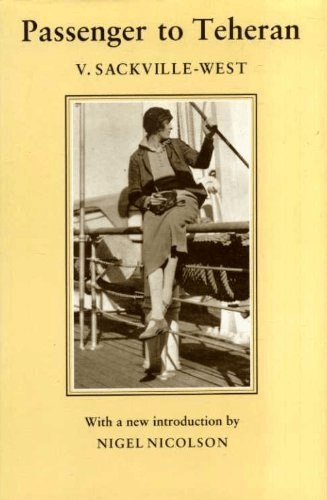
You glance at the photograph of Vita Sackville-West, taken on her own camera en route to Teheran (the spelling is the accepted one of the period for Tehran as we spell it now in the West) and placed on the cover of the reprint (the 2nd edition so long after the first) and you don’t discern ‘subtleties’, but rather the stereotype of the modish 1920s aristocratic woman of taste and fashion posed to show her command of the man’s world (of her time) of heroic travel adventures. But, according to Nigel Nicholson, her son to her marriage to British statesman, Harold Nicholson, neither did Virginia Woolf who acted for the publishing firm she owned, Hogarth Press, to publish the book’s first edition think her ‘subtle’ before she sent that letter as her publisher AND friend/lover. Woolf had written to her diary regarding Vita’s letters from the journey recounted in the book that: “She is not clever: but abundant and fruitful, truthful too. She taps so many sources of life: repose and variety”. [2] Of course Virginia was much more to Vita than a publisher, she was her most famous female lover and the model for her novel Orlando, that famed novel of transsexual metamorphosis, but her shocked discovery of the nuances of Vita’s travel prose as submitted for publication, as opposed to that she had written throughout the journey to her in letters is fascinating. And it lent me the duty to pay more attention to that prose after reading Nigel Nicholson’s introduction first.
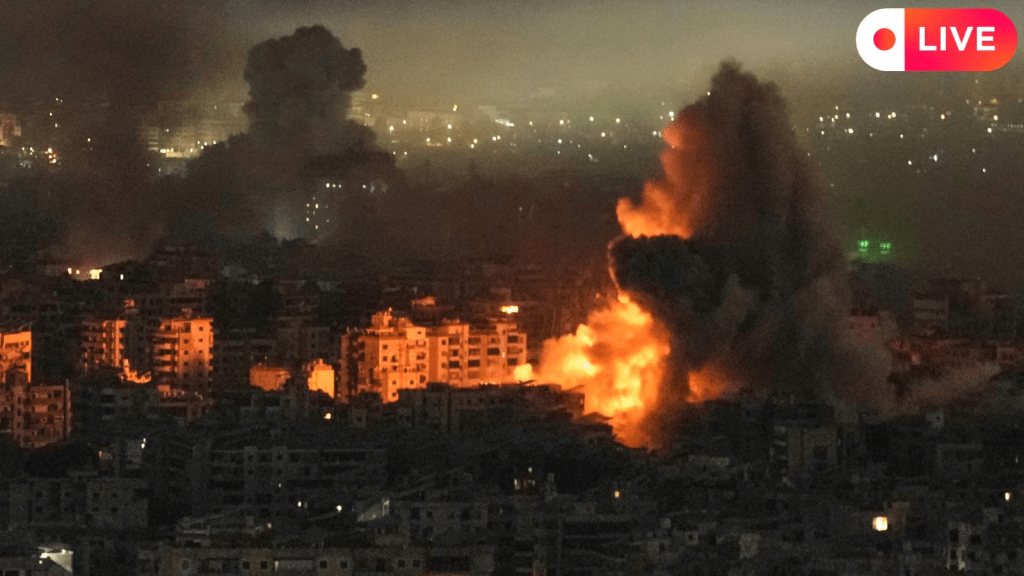
In truth I determined to read the book only because of the current daily news from Tehran, being bombed by Israel and the USA in an illegal war, and with already signs that civilians were bearing the cost of that war much more than the regime – a regime, we ought to remember first facilitated to power by the West. Below is what we were seeing daily of Tehran:
Hence to see the book in the window of The People’s Bookshop in Durham, in a display celebrating women writers, with the gorgeous old spelling in English of the name of the capital of what Vita knew as Persia was delightful: Teheran. i deliberately pronounced both ‘e’s’ to feel the Orientalism carried by the name by an age – the 1920s – so prone to mysticise the East, and Persia in particular, as a place of magic and the primitive. At one point as Vita experiences the snows on the mountains she travels across towards Teheran she reminiscences about the crowded sens of space and time of European cultures – marked by many of them:
But Persia had been left as it was before man’s advent. Here and there he had scraped a bit of the surface, and scattered a little grain; here and there, in an oasis of poplars and fruit trees outlining a stream, he had raised a village, and his black lambs skipped under the peach-blossom; but for miles there was no sign of him, nothing but the brown plains and the blue and white mountains, and the sense of space. [3]
We live in an age now were we don’t mysticise, or even Orientalise, the East but demonize it and the religions that have long served in its populous parts. The world has a ogre-like President wielding immense power who speaks of bombing Tehran and the religious centres of Istafhan ‘just for fun’. At the time when Vita speaks in that beautifully constructed sentence of the absence of ‘man’ (the times demanded that generalised masculine gender to note all persons) in Persian landscapes, she had not yet seen Teheran nor the more wondrous religious centres of Istafhan or Kum, but the sense of space was not just about the lack of population living in or crossing it, but also the resistance of the land to the sense of humans being so absurd as to profess to own it. Even when they did, they interpreted the rights and markers (boundaries and barriers) of property lightly. See this passage on the ‘gardens’ around Teheran, more tree-filled enclosures for repose and reflection such as you find in Omar Khayaam (see my blog thereon at this link) .
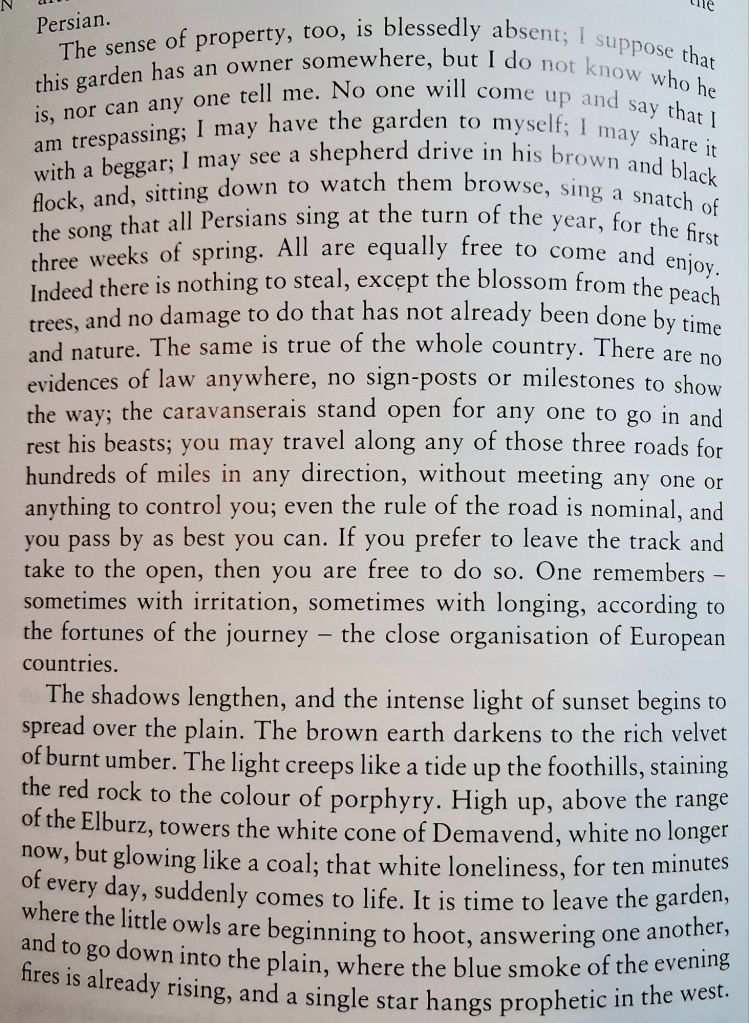
This passage has beauty because it equates ‘space’ with what is free and open, not servile and closed, like ‘the close organization of European countries’. This is not for any sympathy with political sharing of wealth or land, ill-fitting in an aristocrat, even a non-inheriting one, and lots of times Vita shows she has no patience with Lenin and Bolshevism – living facts of her historic circumstance and the end of the journey in this book where Russia and Moscow are not liked when seen, though a bit more than India is liked – which is not at all. Call it ‘purple prose’ if you wish, to me this prose is grounded in feelings I recognise though the idea of sharing, openness and freedom in it is strikingly really that felt by a privileged European – the wife of a senior stateman from the diplomatic legation in Teheran, Harold Nicholson, who had himself been born in the Legation House as son of the Chief of Staff.
But the freedom is not just of class but strikes with the Bloomsbury sense of freedom from the mores of bourgeois ideas like ‘property’, a thing examined in Woolf’s novels over and over, and freedom from rigid sex/gender regulation, which Vita hated – and which stopped her living in Teheran with her husband. She shows her hatred of the British expatriot classes – who keep themselves to their stuffy parlours and do not mix with the Persian populace, nor the poly-racial communities of what she calls the ‘bazaars’. The prose and sentiment remains one of that of E.M. Forster in A Passage to India, where vistas take the full force of British liberal interpretation of freedom and space to-be-as-you-are, for certain classes of people at least. As Nigel Nicholson says Vita constantly praises the Persians she meets in general, making excuses for what she does not like – such as the the treatment of animals which comes from a child-like ‘ignorance of suffering’ she says. Yet faced with specific people Vita remains as riddled through with racist representations as the worst of those people Bloomsbury hated:
Take this moment, when crossing the land in her vehicle at night through the Peitak Pass, driven by a British soldier, ‘a wild coloured figure on horseback came at full glare of our headlights’. The ‘glare’ is ambivalently optical and racial I think (that of a seer not just a car, for she receives it not just as threatening in its wildness but as exciting, almost thrilling, for as the vehicle in her story approaches civilisation, she reflects on thinking:
I was glad we had refused those escorts, for I would not have missed the brief encounter with that marauding apparition. I had felt, in seeing him, as one might feel who sees a wild animal suddenly revealed in the jungle. I was almost sorry when we saw ahead of us the lights of Kermanshah. [4]
Vita is not to my taste as a person, but, to me, her prose is as good as Woolf thinks it is, and her love of Teheran and its people as genuine as the inalienably entitled can ever make it. There are many passages I might give to reveal the ‘subtleties’ of the writing, but I don’t want to re-find them. Instead, I will just remember the pleasure of reading – and think that it has shown me that there are worse things than the attitude of the 1920s British who had absorbed colonialism, even as they objected to it – which they felt they genuinely did. There is the naked new imperialism – the destruction of peoples and civilisation: Gaza, Lebanon, The West Bank, Iran (for this is not only a battle against a regime) and heavens knows what next. It reminds you that the Third World War on its way will make us think the the first two just child’s play.
And let me revise my wish for the ability to write with the skill of Sackville-West. In the contemporary world the purpose of gilt will not be hide guilt but proclaim it.
______________________________________
[1] Woolf cited in Nigel Nicholson (1990: 22) ‘Introduction’ in Vita Sackville-West [2nd. ed – the first was 1926} Passenger to Teheran Heathfield, Cockbird Press.
[2] Woolf cited in ibid: 21.
[3] Vita Sackville-West [1990: 67, 2nd. ed – the first was 1926} Passenger to Teheran Heathfield, Cockbird Press.
[4] ibid: 70 – 71.
 Steve_Bamlett_blog