


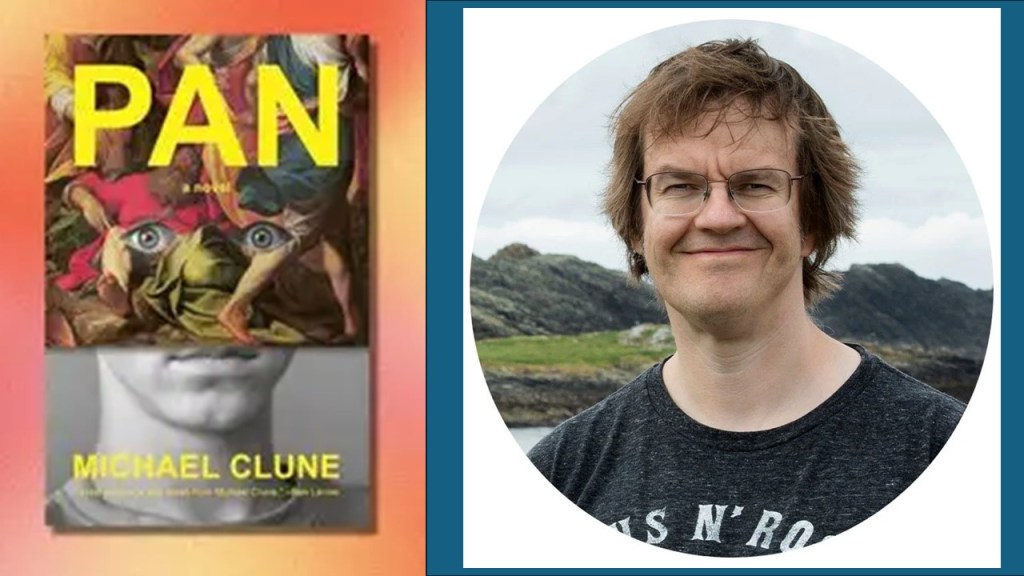
In Michael Clune’s 2025 novel Pan, the narrator sees that sometimes what we think of as negative, like the black ‘fly-tree’ he sees traced in a window pane’ and determines to be ‘Pan’s insight’, exists out there irrespective of our thoughts and strategies to deal with them, because, perhaps: “You can’t change the way you are“. [0]
Novels of mental illness that are both readable and significant across many areas of experience for many people are a rare thing. My favoured writer in this ‘genre’, if it is one, is the incomparable writer, Derek Owusu (see my blogs on his work at these links): That Reminds Me, Safe: On Black British Men Reclaiming Space, Losing The Plot, Kweku (draft chapter), Borderline Fiction, & The Recovery House (pre-publication draft). I talk a little about the problems reviewers (in this case a lay reviewer) have in my blog about Borderline Fiction, which has an intelligent grasp of the cusp between health status in psychiatric terminology (especially that of Borderline Personality Disorder {BPD} and human experience considered outside those labels and the notion that some fiction is forced into the margins – on the borderline – of general experience.
In my view, its means of dealing with this is to queer the prose, destablishing the assumptions of any reader (indeed all – including queer ones like myself): involving two brief episodes on a train, where Kweku meets a stranger, a man called Nana, on trains whilst withing each of the heterosexual relationships that structure the novel as a novel, and its handling of time perspectives:
The first meeting with Nana is with an unnamed and unrecognized stranger, who is woven into the unstable and collapsing feel of things and persons, such that Kweku takes some Zanax almost in response to the way the man’s proximity to him destabilises him:
On the train ride home, the carriage was full, but I’d managed to find a seat with someone looming above me preferring to stand, their knees buckling every so often, teasing a collapse into my lap, and I imagined them falling into me like a ghost inhabiting my body. His back was to me but I sometimes glimpsed the white of one eye followed by the dark pupil trying to turn and look at me. It was unnerving, and to elevate the feeling I imagined the eye turning all the way round into the back of his head, watching me above the closure of his hat. I took another .25 of Xanax and leaned my head against the window,…
I just don’t know how to read that ‘teasing a collapse into my lap’ for it is certainly over-warm in its homo-sociality, given these are strangers, and how then to read the notion of Nana ‘falling into me like a ghost inhabiting my body’, in the manner of the Gothic doppelgänger. I can’t help find the cusp normally in fantasy literature here between the homosocial and the homoerotic, though nothing else in the troubled exchange (on this occasion and its repeat near the end of the novel) evidences that in terms of described behaviours or conversation. Instability of perception and relationship, as sensed by Kweku, there certainly is. Do we call this symptomatic of BPD – a ‘borderline’ phenomenon between fictive and real? I don’t, but does the novel invite you to do so?
And if the behaviour on this occasion isn’t erotic it is certainly queered:
Calm down. He was looking at me like I was asking for something and he was disappointed he couldn’t offer it up, like someone else would help, he was sure, but he was saddened it couldn’t be him. His face was reflective, light entering the top corner of his window seat revealing whatever he used on his skin, handsome somehow, a face you couldn’t look at for too long, though, without giving yourself away by the silence, something secretive in its appeal, one of them faces you would be hesitant to show to others because you knew they wouldn’t see it. As he leaned forward towards me there was a ring swaying on a chain around his neck that caught the same window light and illuminated an engraved snake around the outside with its mouth open towards its tail.
Queered and romanticised in a very literary way, this paragraph ends with a close-up of the Ouroboros symbol hanging at Nana’s closely focused-upon, by Kweku, neck, that I imagine as beautiful. That there is something ‘secretive in its appeal’ may launch us back into queer readings of such encounters, where the queer is deliberately socially marginalised. [1]
This is the kind of thing the amateur critic, Blackman I mention (he is no more amateur than me, of course – I am not using that descriptor as a put-down) finds unfruitful as reading material. He says (cited in the old blog) clearly
Then we have the issue of spending an entire novel inside the head of someone with Borderline Personality Disorder. This is why I return to the line I started this post with: I found a lot to admire but not a lot to love. It’s worthwhile to see life through the eyes of someone with BPD, but it’s not very enjoyable. I found myself losing focus, forgetting which timeline I was in, and often not particularly caring what happened in either of them. Borderline Fiction was an interesting read, but not one I can honestly recommend. It was too uneven for me, too repetitive, too meandering. [2]
I go back to him because I found a review of Michael Clune’s Pan, by Sandra Newman in The Guardian. Alhough it is complementary of its prose style and the ‘the honesty of its treatment of both mental illness and adolescence’, it is much more cagey in its description of novels taking an experiential account of mental illness. It has, I think, disturbing similarities to Blackman which we get alerted to in the sentence: ‘But this is not really to criticise the book’. Just what, after all is the function of the modifying word ‘really’? Is it to tell us that in a ‘unreal’ way it is a criticism of the book, or just to save face against Guardian readers with a little empathy for the voice of those with a diagnosed mental illness and open to hear its voice.
Nicholas’s reality becomes fluid. Among his friends, he becomes the object of semi‑religious, semi-voyeuristic fascination. What is truly remarkable here is that the extravagance feels meticulously true to a certain state of altered consciousness. I doubt that anyone has had Nicholas’s exact experiences, or even ones that resemble them in obvious ways. Still, anyone who has experienced mental illness – and many who have just been 15 years old – will find even Clune’s most phantasmagoric pages uncannily familiar.
There are trade-offs to fiction that strives to be honest. Here, one is that the other characters never fully become people. They’re external experiences that inform the way Nicholas relates to his own mind, and it’s often very credible that they are “Hollows” with no real consciousness. This may be a truthful depiction of the isolation characteristic of extreme mental states. It also means the story is unrelentingly solipsistic. The plot centres on inner epiphanies. While these present themselves as life-saving answers, they all turn out to be brief respites, some evanescing so quickly that they’re forgotten seconds later. It’s no surprise that Sisyphus appears as a reference here. This is certainly true both of coping with mental illness and surviving adolescence. It also risks making the reader feel as if we’re going nowhere.
But this is not really to criticise the book: it’s just to say what it is and isn’t. A reader who approaches Pan expecting the usual rewards of a coming-of-age story will be sorely disappointed. It offers not answers but visions; not growth but lambent revelation; not closure but openings. [3]
I think the problem is that neither Clune nor Owusu write from a subjective position or point of view adequately defined by the symptom pathologies of mental illness, even though they both refer to these throughout. In Pan, the narrator, Nick, names his own situation as that of having a ‘mental illness’ but not in a manner that accepts the symptomatic descriptions of mental illness as authoritative. In that novel the mental illnesses are those of the description of episodic ‘Panic Attacks’ and ‘Generalised Anxiety Disorder’ with some hint of psychotic derealisation that is not labeled, and is often thought to be a common feature even in Panic Attack. But neither do they accept the conventions of the bildungsroman or coming-ofage story.
Nick copes with his symptoms, once the breathing into a paper-bag strategy fails, most often by learning to ‘redescribe’ the world, so that it matches what he sees, even if not what anyone else does, and which so normalises it that it is no longer symptomatic. The perception of the black ‘fly-tree’ to which I refer in my title, however, is one such episode where the authority that validates the description is based on the ‘this-ness’ of the experience; its validation from a difference experienced internally to him but which seeks external validation, which he, and some other characters call ‘Pan’, after the God’s name after whom panic got its meaning.
Newman is right that our access to the narrative consciousness of Nick may exclude any sense of rounded or believable ‘other’ characters he tells Alice story about as part of his own. These characters tend to be projections of the need to show that the inner being of others is inaccessible, except through a leaking of their avatars (their representations) inside the consciousness of the narrator into a representation of their objective being. This conundrum even extends to how a narrator makes himself into a character in his own story, which oft differs from his interpretation of his own character. No doubt Newman is correct to imply too that ‘that way madness lies’, but I think she is wrong to generalise from that idea thus:
Anyone who has experienced mental illness – and many who have just been 15 years old – will find Pan uncannily familiar ….
This claim that the novel gives communal insight into what it is like to have a mental illness is so untrue of how and why novels by novelists in that category, as far as the world knows. Clunes as a writer is so different from tbe manner in which Owusu works however, but both should be given credit for creating narrators who can only be judged in terms of the effects of their writing irrespective of how we feel mentally ill people,or adolescents, are.
In Clune’s narrator, redescription is a means of regulating the mismatch between their inner and outer worlds not to provide evidence of a specific mental illness. Ultimately, the means of such regulation, by redescription in words, fail him as a strategy too, shortly before the end of the novel and the literal end of the consciousness of Nick, which drops or falls out of his body to become a thing in itself, that can be described in no other way than as it is seen (though the reader cannot see it). That post descriptive self, we are told, is prefigured strangely in Renaissance visual art, especially Bellini (and especially in Doge Leonardo Loredon). At this point in the novel -its end as a thing composed of words, he leaves words behind him in his body; ‘Because I fell through my body. The solid world, the thing world opened, the gate opened, and I fell ‘. [4] But why does this follow on from that visual experience and the attempt to put it into words. He asks us to Google the Bellini picture. Here it is:
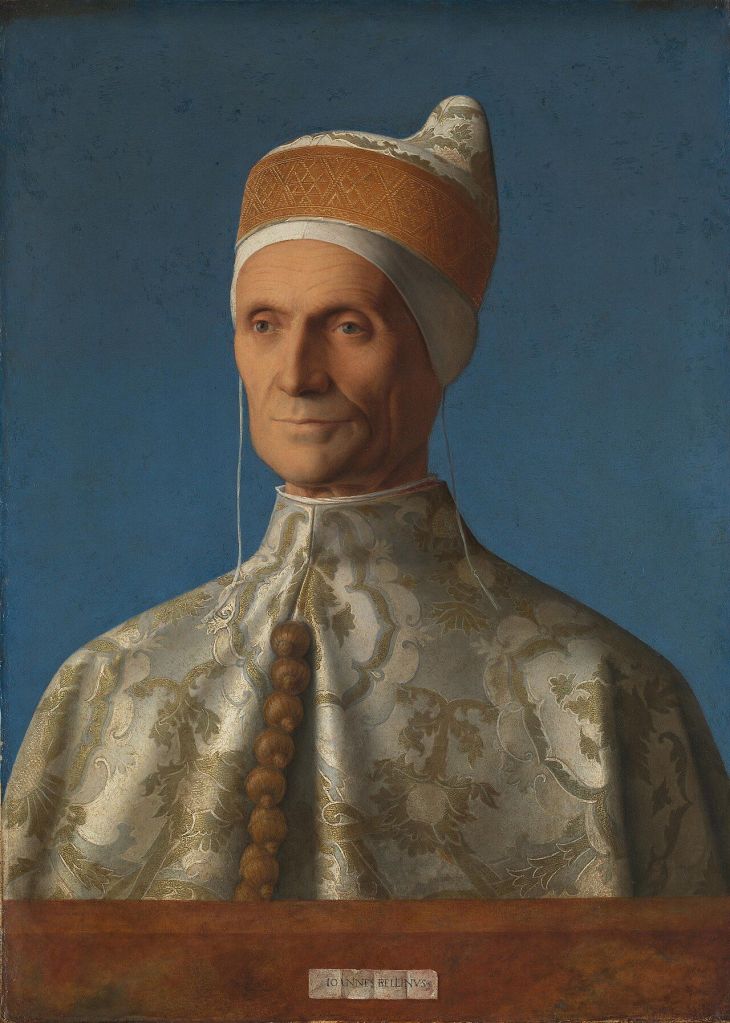
Staring at it, he feels ‘the strangeness of my looking’ that equates with the strangeness to which that head offers access, if it does [5]. This, just before his ‘Fall’, the sub-title of this last and third section of the novel, and is the last of minute returns to the picture first described thus: [6]
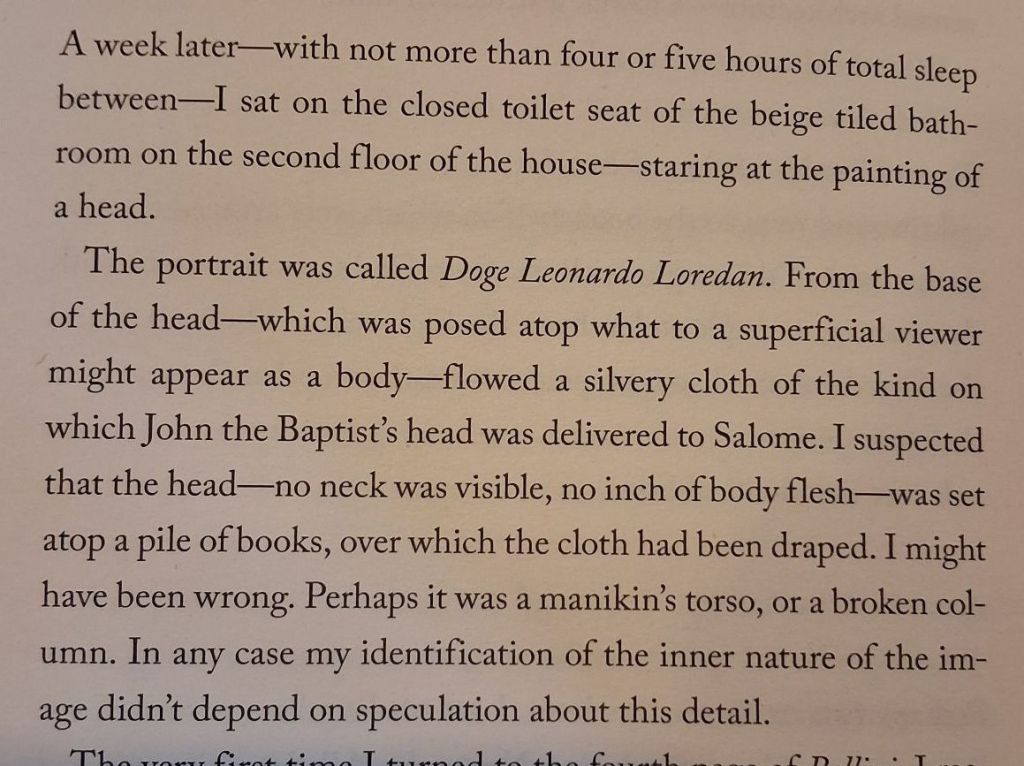
It derived, this ‘identification’ of the head with the severed head of John the Baptist ultimately from an earlier conversation, that he calls ‘ancient’ with the girl he had his only sexual relationship with (he is still only 15) and that was first prompted by Nick reading Oscar Wilde’s Salome.
However, the strangeness here is justified by an estranged act of looking that has robbed the picture entirely of any attempt to imagine a context contemporary to the making of the image; that context suggested, for instance, by the specific coding of the costume in the role of the sixteenth century Doges of Venice. The presumption that the picture shows the Doge with a body is one, Nick tells us, that for which only a ‘superficial viewer’ could find evidence. For him the image Bellini does not show to us that Bellini has a body, but that it is an excrescence of an inner horned Pan, with only one horn apparent.
As for the rest of the novel,there is virtue in Newman’s description but no sense of the way the novel works except as a picture of mental illness or adolescence. Here is what she says, although ‘animal sacrifice’ does not truly describe the scene in which a boy stamps out the lives of drugged mice, used as the live feed of a pet boa constrictor, because he, whilst on stimulants, enjoys it.
It shows more successfully than any other book I’ve read how (the symptoms of panic) can be experienced as black magic – indeed, it allows that they might be black magic. Nicholas successfully prophesies trivial events (the wind rising, someone saying the word “diabetes”) and is haunted by a dead mouse’s squeak. …. Even the pop anthem More Than a Feeling is a path to the uncanny; it’s a song with “a door in the middle of it … like the door on a UFO”. Nicholas becomes convinced that he is perpetually at risk of leaving his body – specifically, that his “looking/thinking could pour or leap out” of his head – and his friends, also being 15 years old, are ready to believe it, too. They are easy prey for Ian, a college-age man who sets himself up as a small-time cult leader among these high-school kids. Ian particularly targets Nicholas, telling him that only they are capable of real thoughts; the others in the group are “Hollows” who have “Solid Mind”, a deterministic mentality with no animating self. “The sound of words from a Hollow mouth,” says Ian, “contains an abyss.” Soon the group is staging rituals incorporating sex, drugs and animal sacrifice.
In fact, the play on the idea of open or closed experience, or the door that some sometimes in experience between worlds and domains – of things and feelings for instance, is much more an idea networked through the novel, another way of discoursing about the idea of outsides and insides, even as a definition of beauty as ‘open to feeling’. Similarly the concern with prophetic capacity regarding the future, often associated with anxiety symptoms, and memory plays throughout the novel but is eventually resolved into a attitude to things and time – the idea of a trans temporal world of things including bodies which age and then fall: ‘I saw that time was a part of the body after all, a part of things’. [7]
But I want to end by looking at that passage cited in my title. It concerns a moment when Nicholas is still trying to control his experience by redescription, bringing the inside and outside of which together, when he hears, but not sees yet, fly buzzing in the windowplane (not for the first time) and thinks of it as a paintbrush painting on that pane : [0]
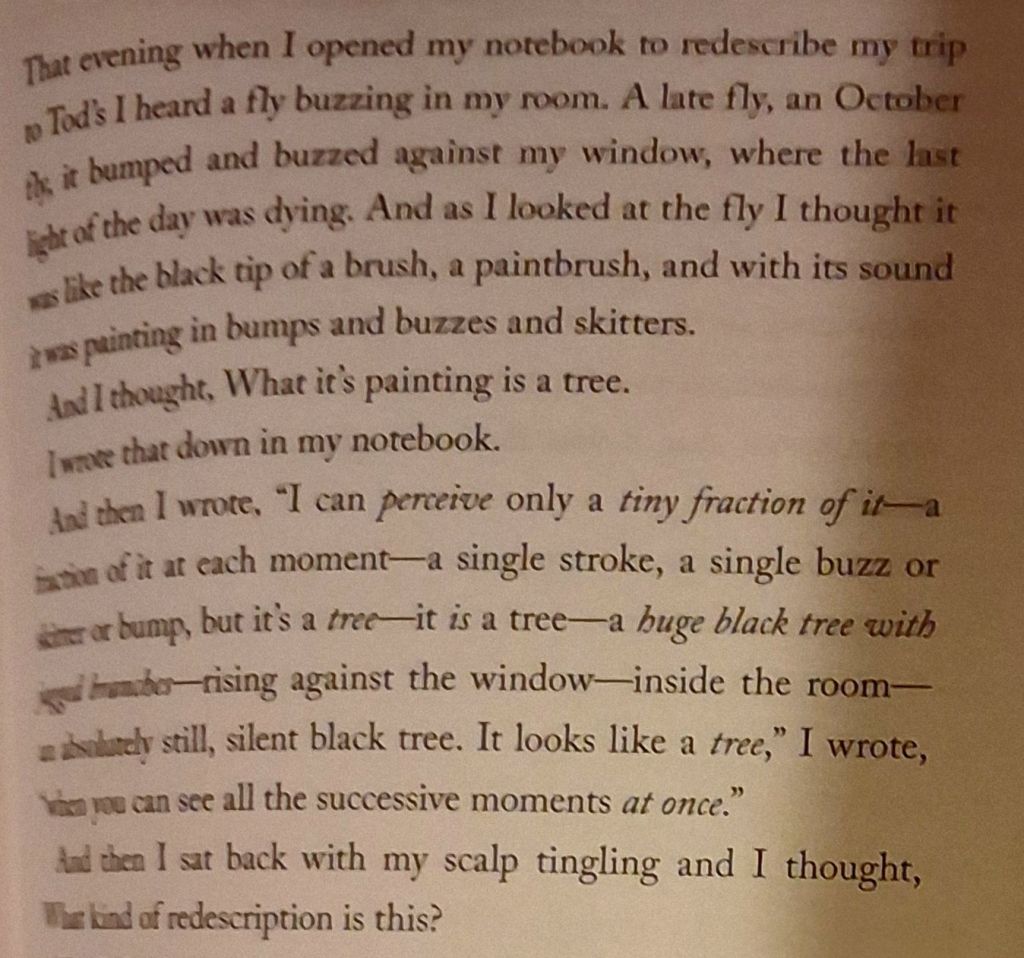
There is an answer to that description. To see the movement and sound of the flies as a black tree is to see the object created within time but time that appears as part of the object and complete with it: ‘a huge black tree with aged branches‘. It is the point of view from a ‘being that sees time all at once’. That being may well be Pan (a bein that is ‘all’ at ‘all times’ is what Pan is. It is he says: ‘Pan’s thought, Pan’s perspective, Pan’s insight’. Is a black silent old tree negative. No, it is what it is in all times. Panic happens like a flytree and runs through lives pf people and histories of groups: ‘it didn’t come from me. It wasn’t something I thought or imagined’. It is akin to understanding that ‘You can’t change what you are.’ [8]
Michael Clunes book is not for me a keeper and does not speak for me, whilst I think Derek Owusu does – except that it incarnates Black experience and I am not Black (except in political alliance). But it is a fine book and requires more than being seen as a picture of what ‘mental illness’ feels like, for mental illness feels to many like an insight into life, often missed by what the book calls ‘Hollows’, with a ‘Solid Mind’ in the reflection of the Hollows who cannot see inside their vacancy. Challenging that, ain’t it?
Bye for now
With all my love
Steven xxxxxxx
_________________________________
{0] Michael Clunes (2025:290) Pan London, Fern Press.
[1] From my blog on Borderline Fiction available at (where you fill find page references to quotations from novel too): https://livesteven.com/2025/11/12/a-pervasive-pattern-of-instability-of-relationships-self-image-and-affects-and-marked-impulsivity-are-dsm-5-tr-categorical-criteria-means-of-describing-a-person-a-character-an-author-or/
[2] Andrew Blackman (2025) ‘Reading Borderline Fiction by Derek Owusu: I wanted to like this novel, but I couldn’t. Here’s why.’ By avatar, Andrew Blackman, 7 October 2025,
8183, available at: https://andrewblackman.net/2025/10/borderline-fiction-by-derek-owusu/. The italicised quotations unpaginated in the quotation are from Derek Owusu (2025: 1 & 141 respectively) Borderline Fiction, Edinburgh, Canongate. Cited https://livesteven.com/2025/11/12/a-pervasive-pattern-of-instability-of-relationships-self-image-and-affects-and-marked-impulsivity-are-dsm-5-tr-categorical-criteria-means-of-describing-a-person-a-character-an-author-or/
[3] Sandra Newman (2025) ‘Pan by Michael Clune review – a stunning debut of teen psychosis’ in The Guardian (Wed 16 Jul 2025 07.00 BST) Available at: https://www.theguardian.com/books/2025/jul/16/pan-by-michael-clune-review-a-stunning-debut-of-teen-psychosis
[4] Michael Clunes op.cit: 320.
[5] ibid: 319
[6] ibid: 316
[7] ibid: 320
[8] ibid 289f.

