


I learned last what I ought to have learned first: that things connect most when they separate. Transit, Transition & Transfusion: Chiharu Shiota: Threads of Life and Yin Xiuzhen: Heart to Heart at the Hayward Gallery seen on the morning of the 5th March 2026.
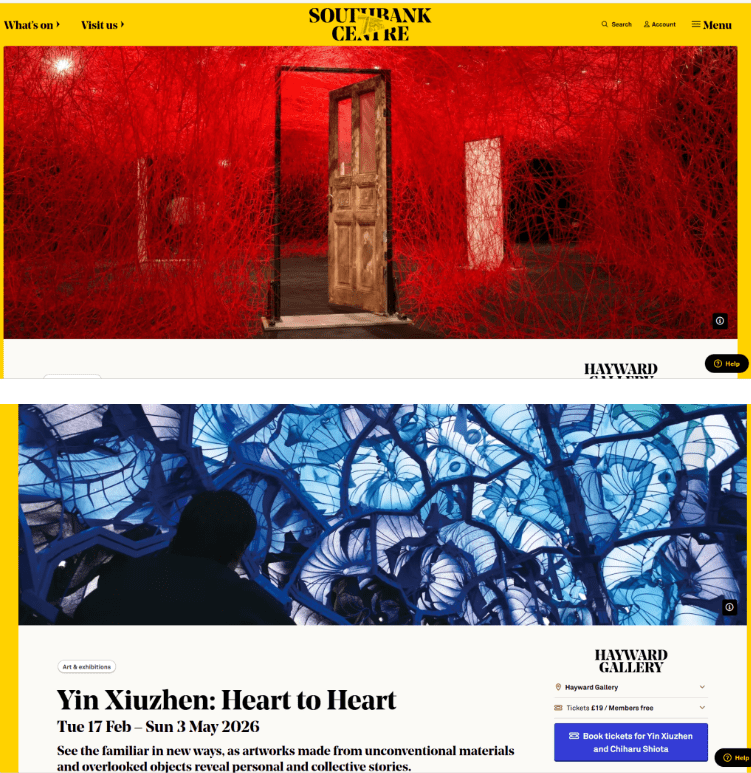
This is a prompt question response and a reflection on the dual exhibition currently on at the Hayward Gallery at the South Bank, but it connects so much to the other experiences of the day. First, I had a bad night’s sleep – hearing and sometimes feeling (as I thought anyway) the sway of the tube trains beneath me at my Kings Cross hotel – purchased for cheapness but a decent hotel nevertheless, and revolving in my mind the subject of my conversations with a friend on the evening before – some quite stressful and triggering for me, though my friend could not have guessed that and was not a fault (was even a support). I woke at 4 a.m. and could not sleep thereafter. Had breakfast around 10 after working on my blog on Neo-Romantic exhibitions seen yesterday and then caught the 73 bus from Russell Square to South Bank.
Much passed in a haze, thought two strong coffees helped. However, I visited the exhibitions in a haze, taking enough photographs to help me focus my hazy vision and to review later. I didn’t buy the exhibition catalogues, aware that times were tight for us financially but that has cost me in awareness of the titles of the pieces I saw. Reviewing my photographs for the collages I made for this blog, I wish I had been more careful in my mental notations, in the absence of a catalogue, of artwork titles, in which this blog is deficient – but impressions might I hope do for consolidating my learning from these artists, both obsessively concerned with memory and constructs of death and life within its limits of construction thereof, and of metaphors and figurative sculptural projections of what we mean by the ‘heart’ in art.
It may be, of course, that I allowed my memories of the show to blend with the production I saw of Kip Williams’ adapted Dracula in the afternoon after, or that the latter was influenced by the former. In my already offered blog on the Dracula (see this link) I wrote:
The dramatic principle in this production comes from Stoker’s themes of transit, including travel and flow between places and through spaces and times, transition of and between character and character traits, even Stoker’s obsession with masculinity and femininity in and between concepts of sex/ gender; and, of course, blood transfusion. The latter is a concept born in the obsession in vampirism with blood as a marker of race, class and sex/gende8r. Vampires transfuse and mix the blood of many in one person, but the many blood transfusions in the novel do the same for the living and just living as is the modus vivendi of the Undead (hence possibly more a modus undeadi perhaps).
Apart from the silly jokes in that, the themes are ones equally applicable to both of these exhibitions – in parts at least, especially Yin Xiuzhen’s, ‘Heart’, a huge sculptural frame ‘skinned’ up with red and purple dyed discarded clothes and the transition to the use of red threads, as if they were arteries in Chiharu Shiota. This will all be more visible later as I progress through this blog. But string, in this respect in particular, is a video artwork by Chiharu Shiota you meet as you mount the Brutalist concrete staircase of the Hayward in transit between exhibitions (my photographs all failed I am afraid) of the artist’s body surrounded by masses of mainly transparent plastic tubes, along which sequences of deep blood-red fluid pass sequenced with air bubbles that clear the tubes of fluid momentarily. The tubes appear to infuse into your body but cannot do, of course – the image is literally of self-transfusion in which one’s own life-blood is externalised and transfused back within – a constant exchange of interior and exterior, visible and invisible, past and passing present.
But those connections between separate experience could be my constructions, but I wonder if, in the world of artistic creation where maker and experience are in constant negotiation that matters so much. However, this piece intends to flit between the artists’ pieces, finding memorial connection where it can, although for both of them the experience of migration is vital – the theme of transit, as woven into their lives as the travels back and forth from native to alien space by Count Dracula – for he too is a ‘memory in transit’, carrying with him his own home-soil on which to rest.
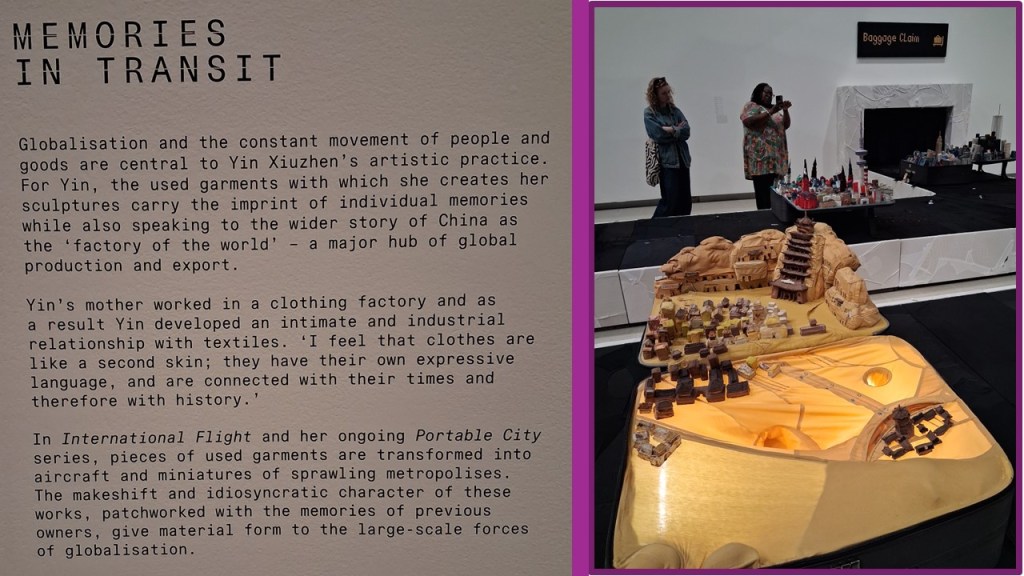
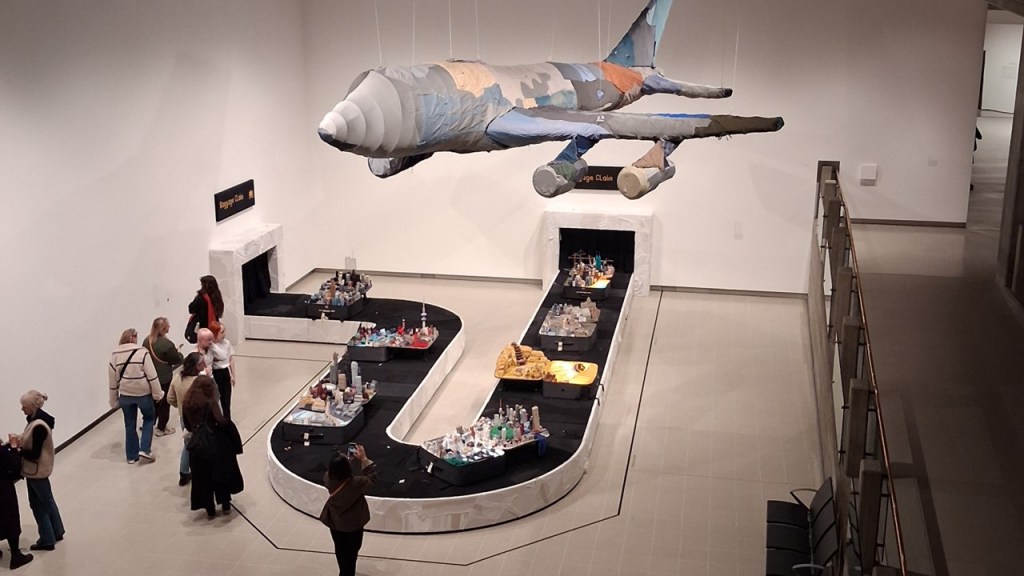
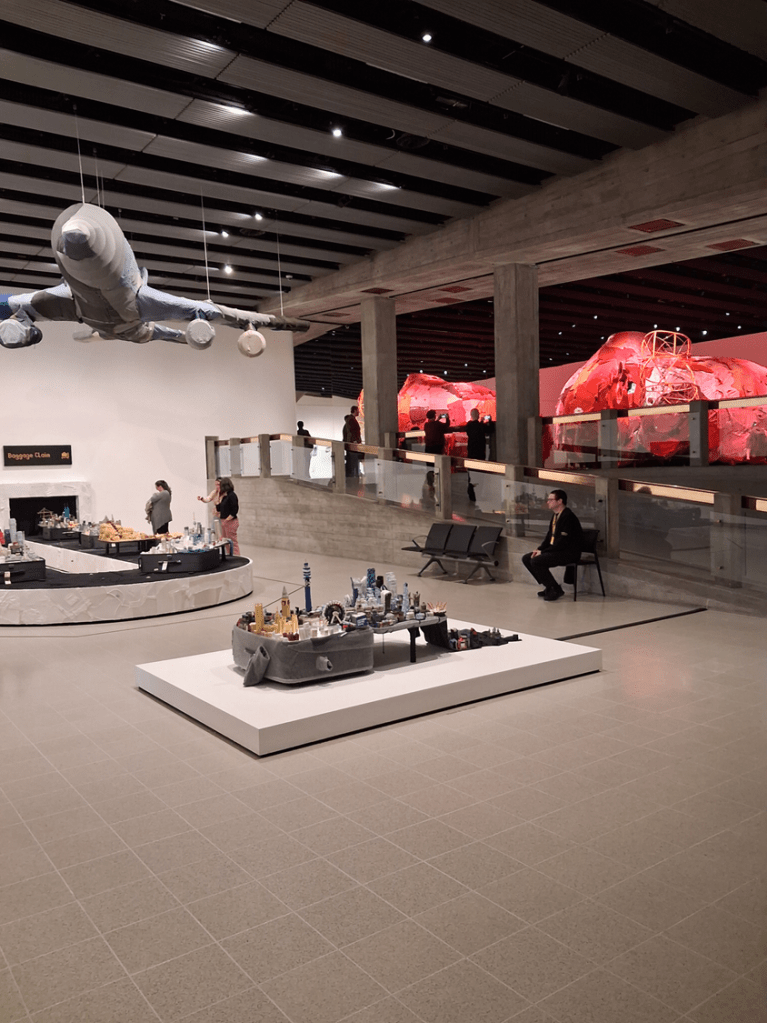
The first experience of Yin Xiuzhen’s work bears a plaque labelled ‘Memories in Transit’ (see below) but its vehicle is not a boat, as in Dracula, but a modern airplane, on which migrants carry not their own coffins but suitcases, sometimes quite so heavy as reality and metaphor, stuffed with memorials. The huge work International flight is a baggage handling carousel, though [perfectly still, on which stand suitcases that have been opened to display the cities involved in the transitions of their bearers, but usually scenes highly transfused with fantasy – either of exotic expectation or nostalgic memory.
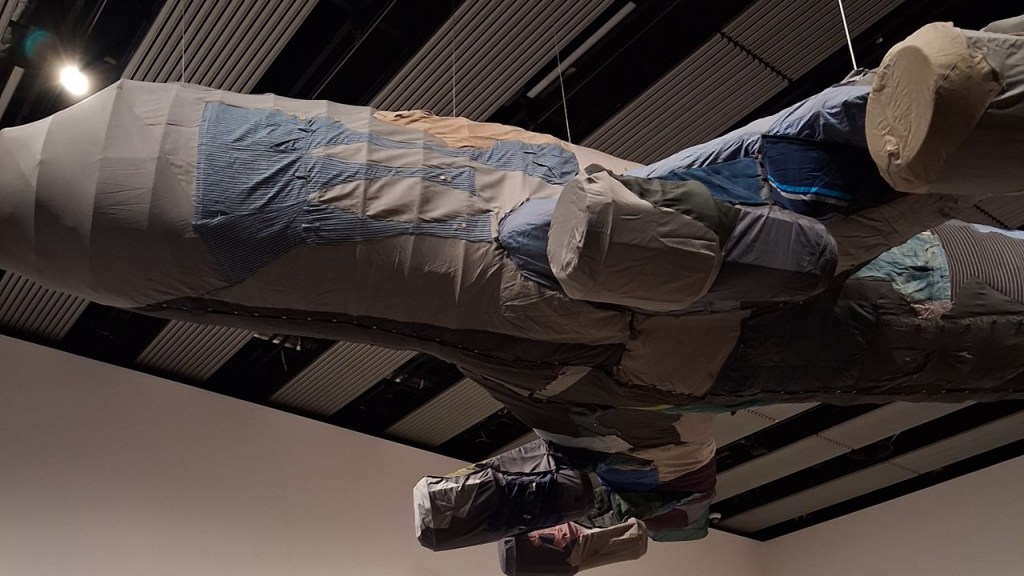
Above it, hangs a huge airplane frame whose skin is made of dyed fabric that separtely are the clothes of many, and many types of, people. Yet the clothes create a kind of camouflage effect that make the plane look as military as it is about peaceful transitions, as if every rason (and not just holidays, for migration are bound up in it. As on a real carousel, the memories encased fly between the guts of the airport where luggage is loaded or returns, if not picked up first time (or ever) unseen by the traveller. One beauty of this piuece is that no-one will ever pick up these cases. They are stilled and drained therefore of the use which is their life.
Keep thinking of that!
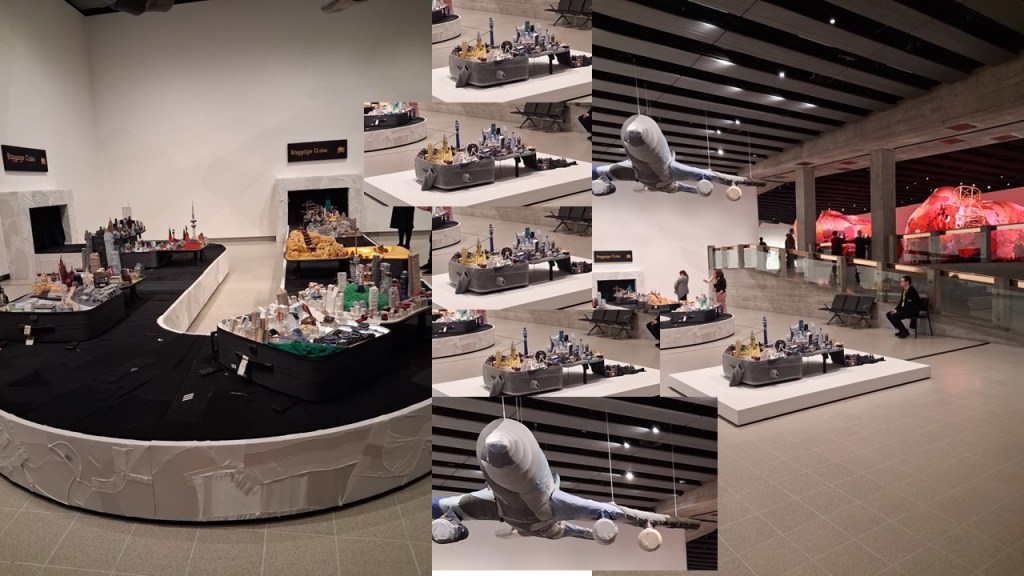
And then gaze at the plane, and the displayed lives in the improperly opened suitcases (by customs or migration officials perhaps) as you pass between floor levels of the museum. Near to it, the plane is much more military, its fuselage like bombs waiting to drop, than even its skin of human clothing cannot mitigate – for humans are killed by humans, after all.
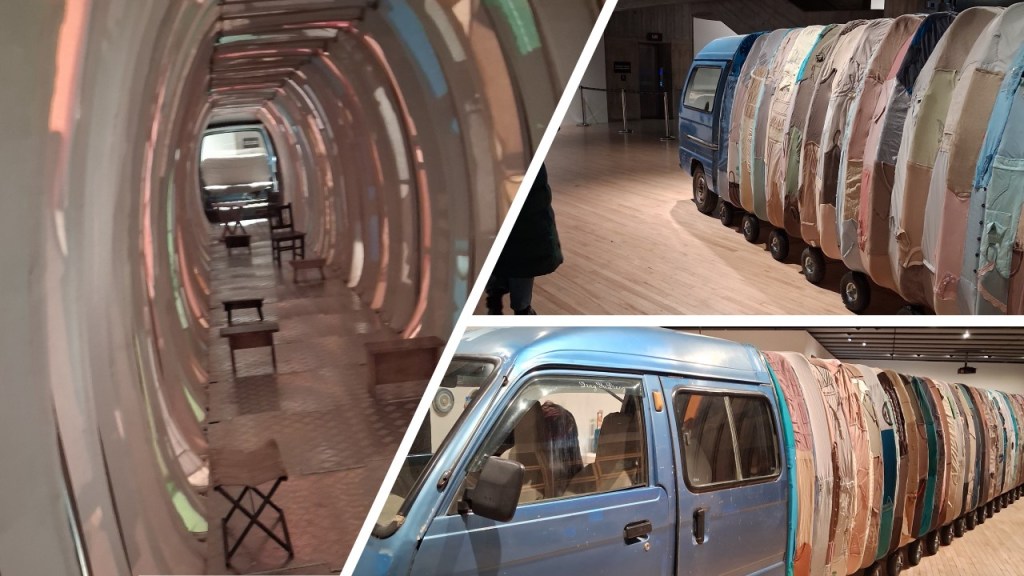
Transitions occur in small as well as large. In an adjacent room see a huge wheeled auto-tuk-tuk or auto-shuttle, but extended between its genuine vehicle ends with an a huge corridor like fitting walled by fabric clothing and containing seating like that provided for children. Transit / transition between times, space and within clothing after all is the fact of our constant shapeshifting identity in globalised worlds, for some at least – some who do it for pleasure and choice and not by coercion that is direct or indirect (indirect forms often mean a choice being going or staying and starving).
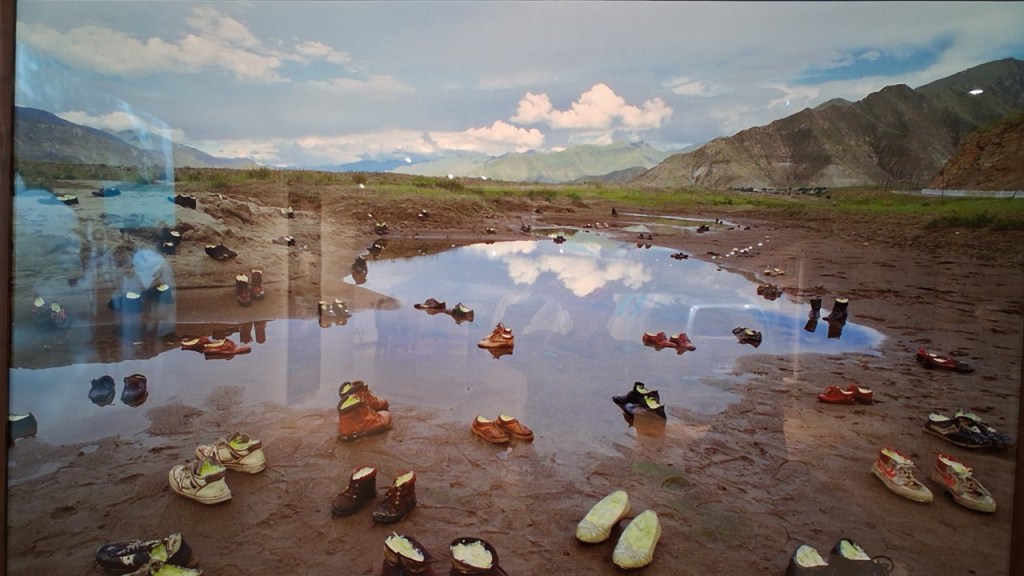
One past installation from the artist’s oeuvre exists now only as a photograph in which discarded shoes in transit are as full of memories in the form of cloud-like fabric stuffing as the sky of actual ones. Desire and disappointment and enormous losses and are encountered many times in many forms in human transit through spaces and times. I found that piece very moving.
It is very material the stuff of transit in the suitcases, vehicles and shoes above, except perhaps for the dream-like clouds. Chiharu Shiota shows such transits and transitions in materials that might pretend to the immaterial, though letters differ in materiality not only by virtue of the material upon which they are written by the purpose – a legal letter relating to transfer of possessions being in every which way ‘heavier’ than a love letter, or a letter from home – although sometimes the reverse is true in true migrant stories.
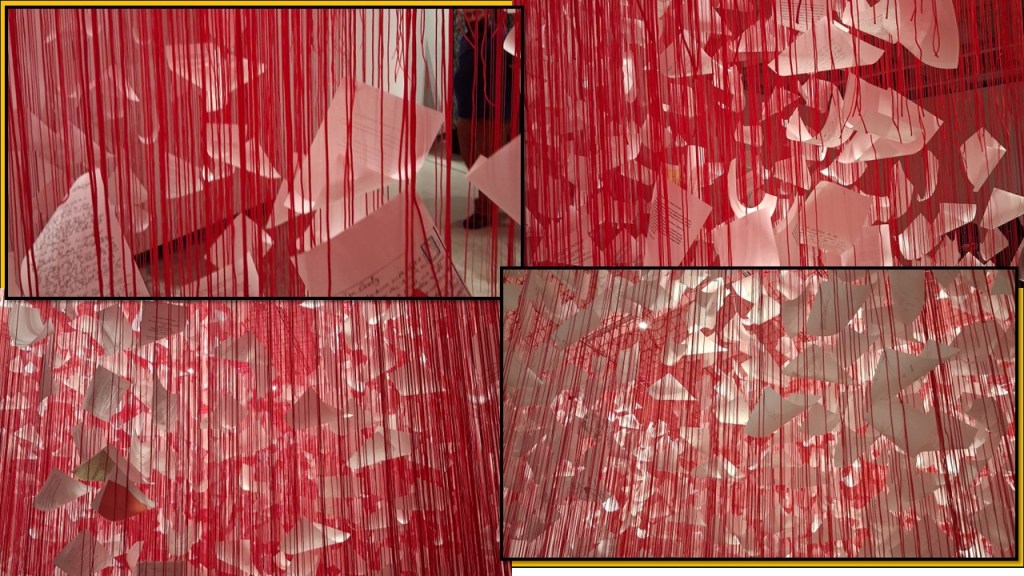
One work by Chiharu Shiota, you walk through in a snaking passage surrounded by densities of vertical thread. i call the densities because sometimes they are clustered more nearly to each other and are hard to see. Attached to the threads are papers easily seen as real letters relating to the artist’s migrant life (she was in Germany when she built this). Some, looking up, see flocks of ridsing doves of peace suggested by the piece, others (or the same at a different time) see cascades of storm and hale -toubles descending.
But before ending with Shiota’s haunting almost ethereal works (when not seen as they can be if you go at the right time, as sets for performance art where models use the pieces -see later my discussion of her new 2026 work for this exhibition During Sleep) lets get to the ‘heart of things and that wonderful elephantine heart created by Yin Xiuzhen. While we were gazing at International Flight, we were also looking beyond to the huge bulbous piece on the open intermezzine floor above, huger in look from here because mirrored in huge glass walls of the Hayward. Look again at a piece from an earlier collage:
But to walk up that raked path reveals all – at first, as always, from the outside:
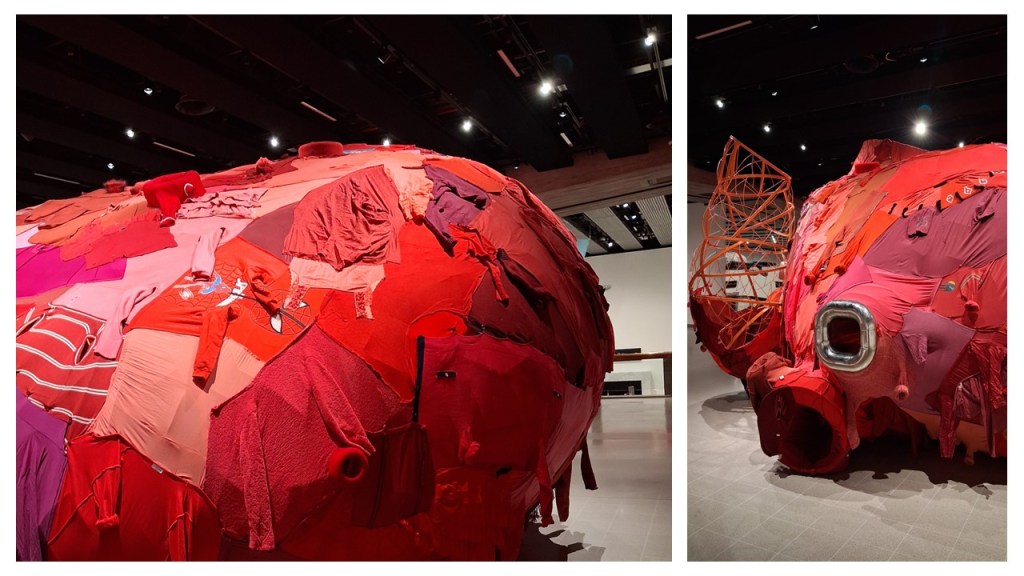
This heart is covered with dyed clothing in shades of pink to purple, with an overall blood red effect. The skin is fractured by seams between clothing, for no heart, or ar, is whole but dons many forms of skin, experiencing many areas of possible tear. What looks whole is multiple fragments and has many portals through which you might look.
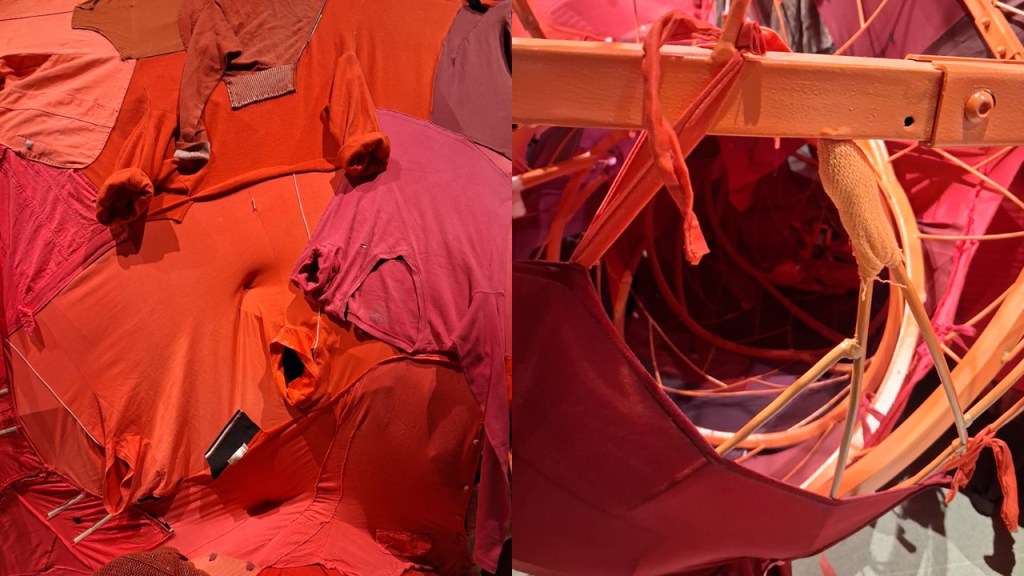
Some offer views only of the twisting interior walls, but sometimes you see parts of an interior chamber, which eventually you find access into through a ragged portal (below).
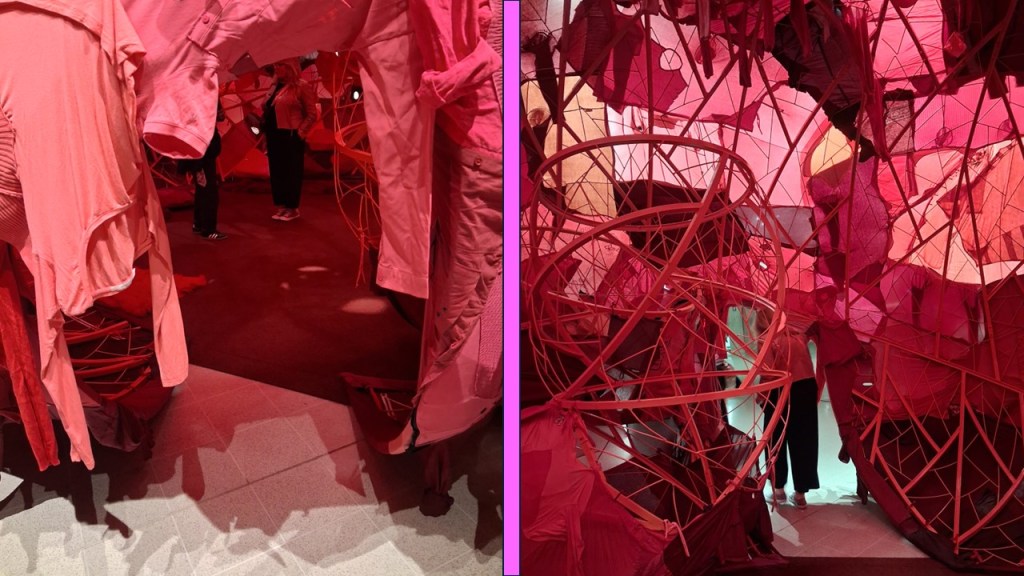
From without I heard voices in the chamber, entering I found two ladies chatting who then, as you see, exited still talking. Nothing is seen without the barrier of frameworks, possibly like arteries and hanging flesh, for thisbis an experienced heart. Inside the chamber the colours are not only totally varied, but richer as the are mediating tje external light, sometimes multiply filtering it, and criss-crossed by webs of what meight be veins and arteries. The heart here is a place of change, exchange and transfusion between identities.
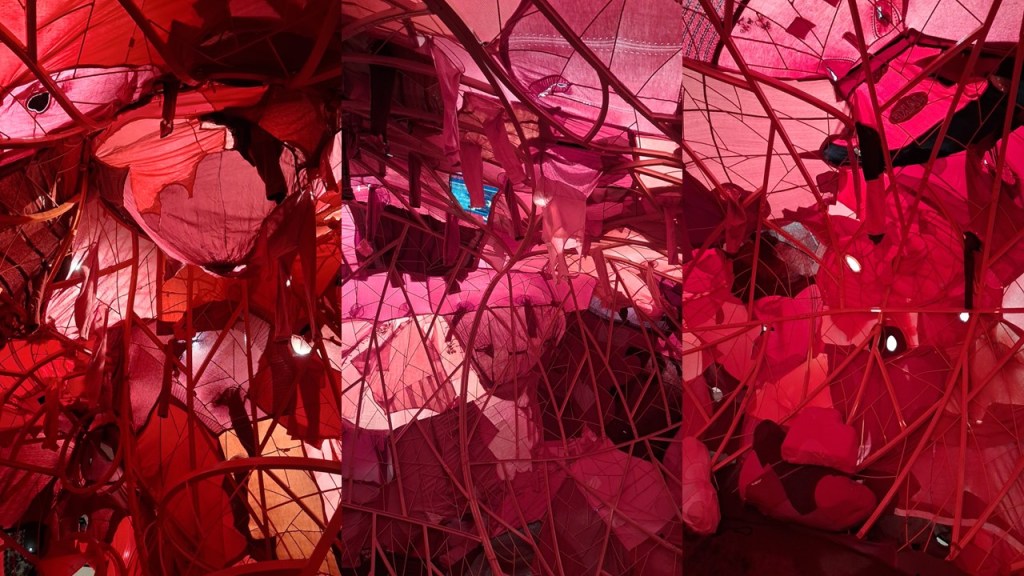
There seemed some parallel with the Threads of Life piece by Chiharu Shiota, partly because of its effect of immersing those who see it in red, but because, although entirely differently structured, the red caused by webs of red thread from ceiling to floor, or sometimes short of the mid- height of the room.
The threads fill and colour the room, even casting shadows in red, pink and purple on the floor. Hanging from them are various keys [perhaps to a code as well as a door by suggestion] but at the pieces centre is a double doorframe standing open, one door open on each of its sides which act variously as both a es and exit doors but arriving, it seems, in the ‘same’ place. The pictures in the collage below on my first pass through the piece noticing the shadowed floor but also the densities that partially bar some visual access to the lighted ceiling.
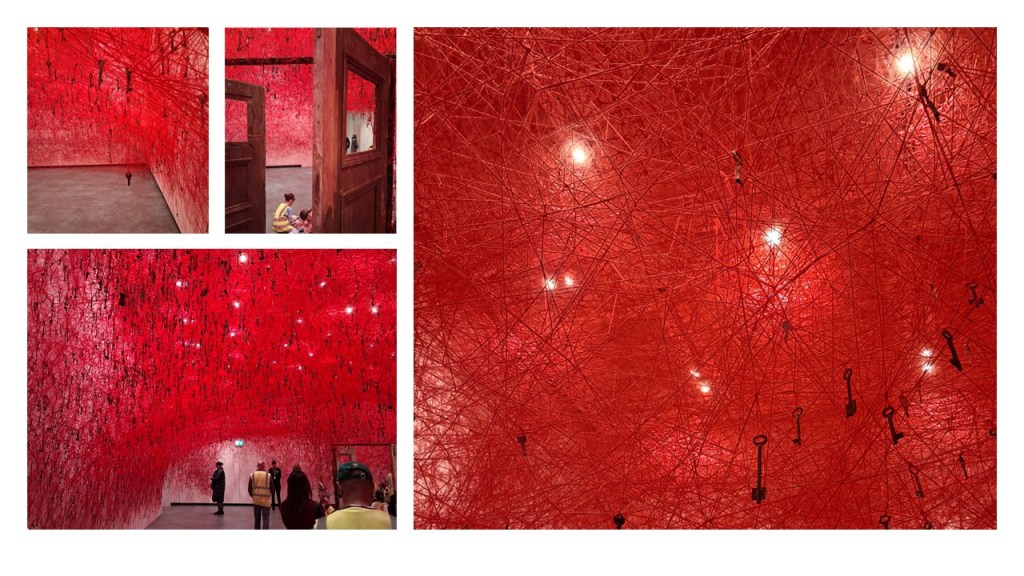
That ceiling is so moving, like a prison or a tomb, made of webs, that immediately suggest containment but have effect only through unevenness of desnsity. And yet from them hang those keys.
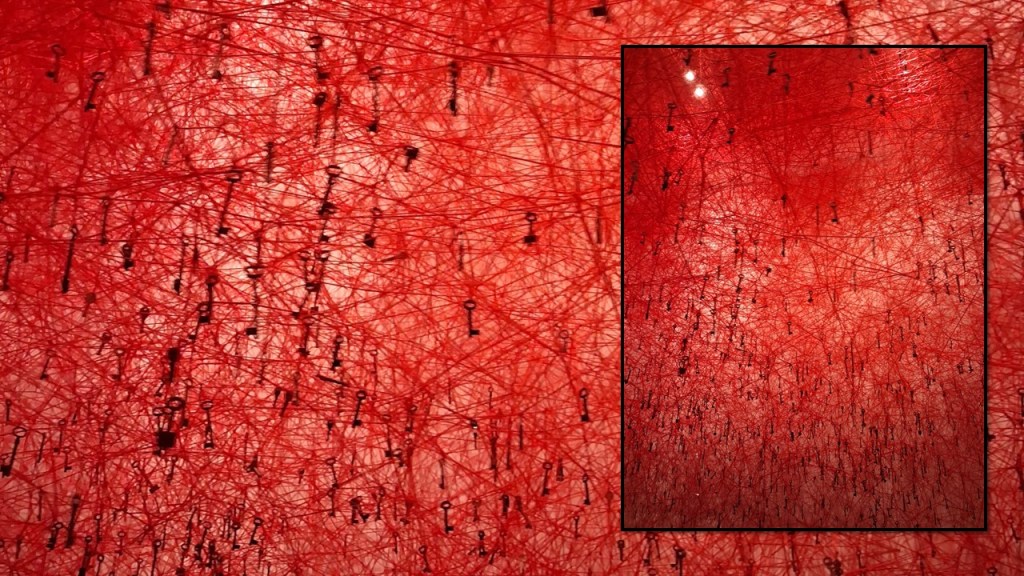
And some people chose not to use the doors, even avoided them, and walked under a sky of keys as if freedomwas to disobey the limitation set by someone else’s decision of where an entrance or exit might be.
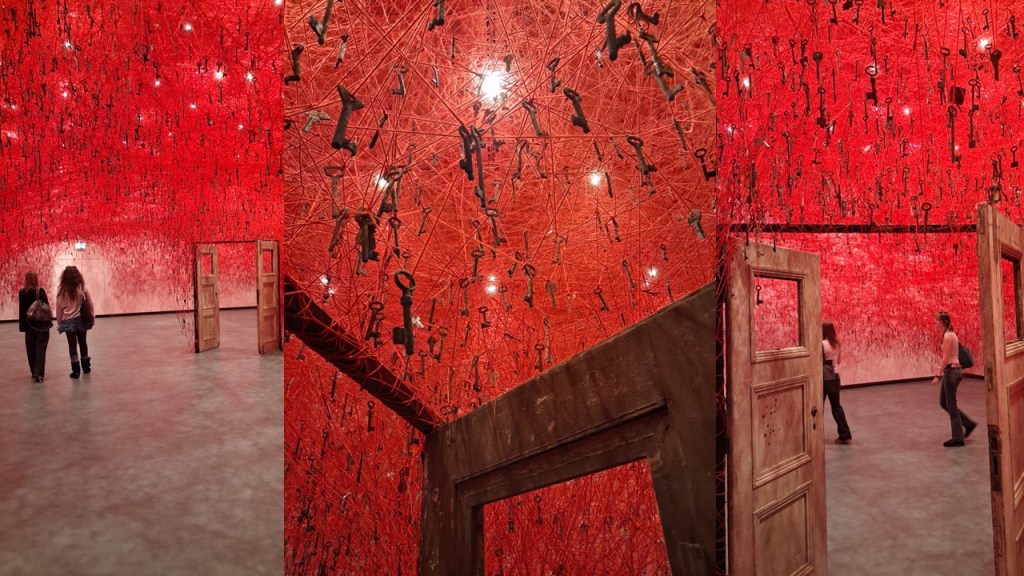
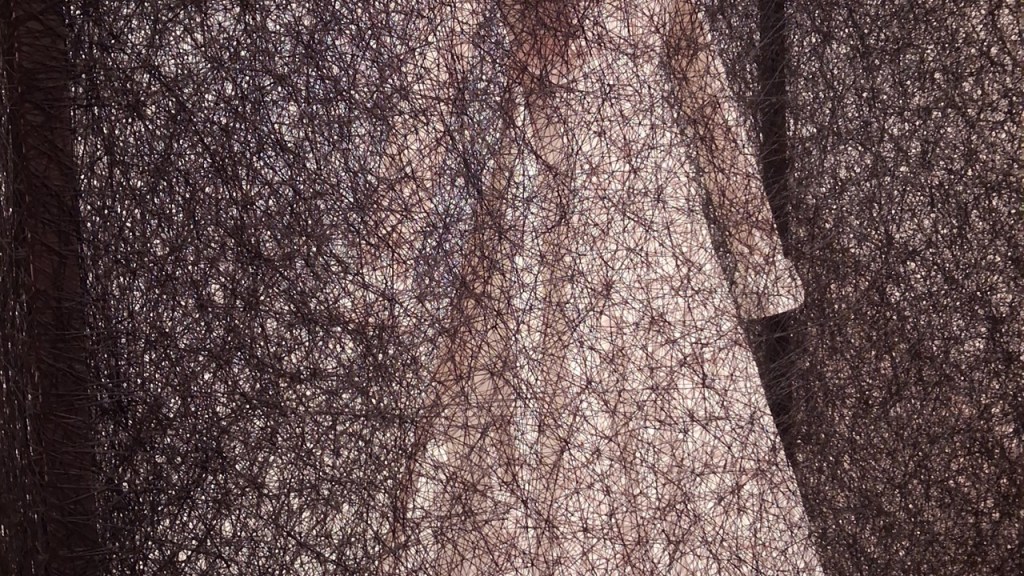
We tend to think of webs as containing prsons I suppose. Dickens makes it the motif of that queen Spider, Miss Havisham in Great Expectations. One artwor, The Bride, recalled Miss Havisham, and use the binary black and white of web and wedding dress respectively to speak this.
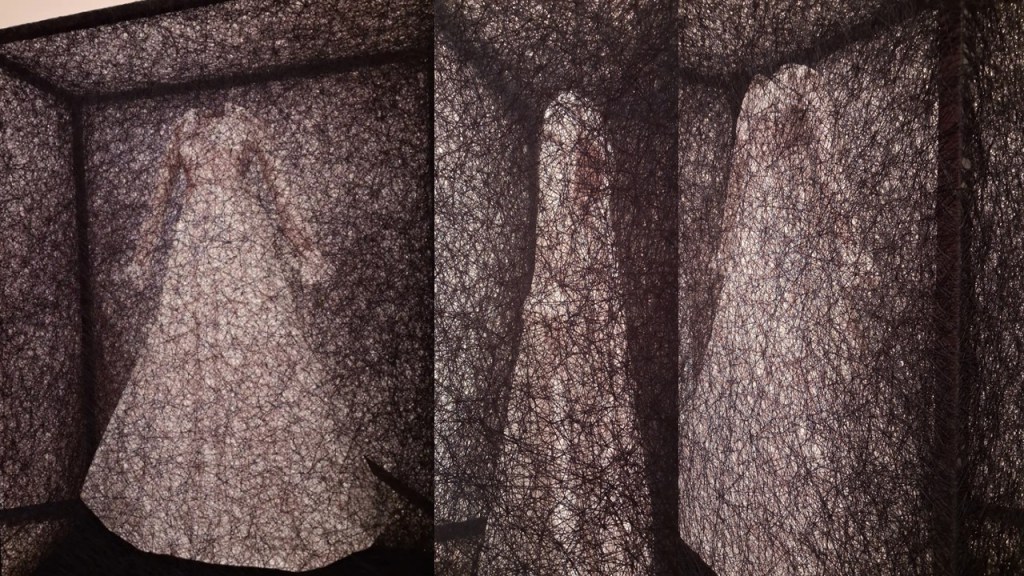
And yet in detail there is something moving about the space that lies in the being of webs,gaps of a certain freedom – if you choose to see it.
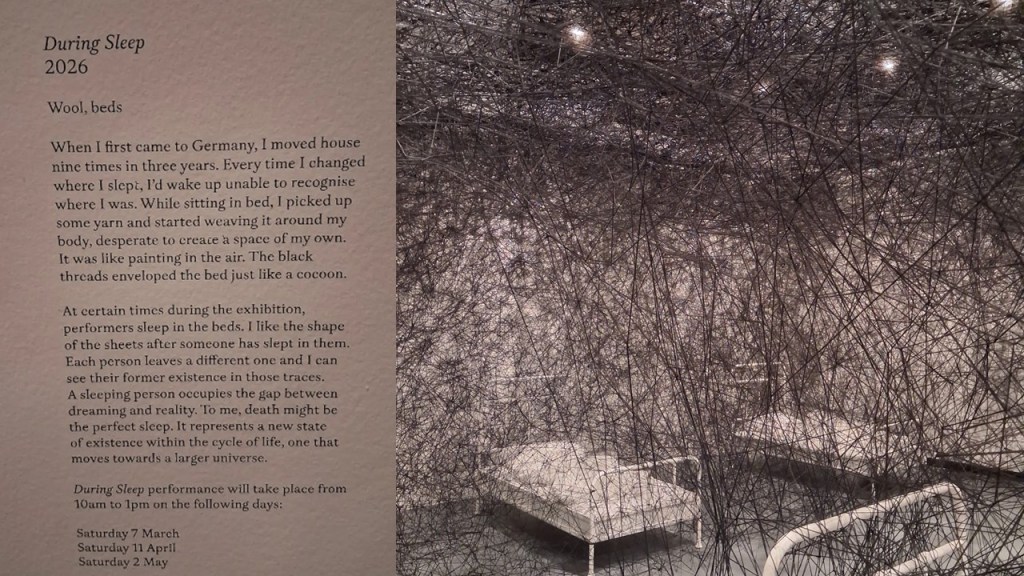
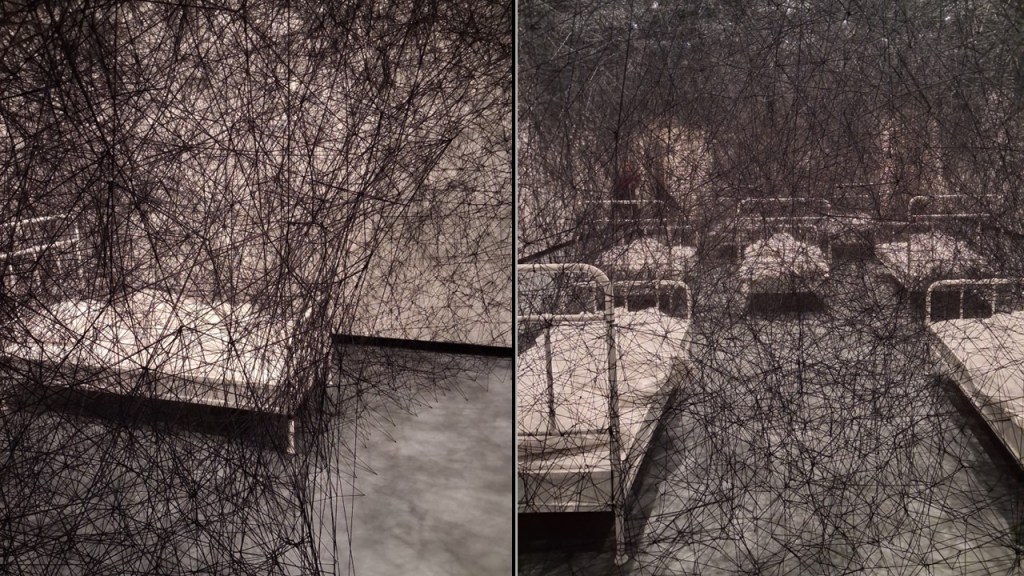
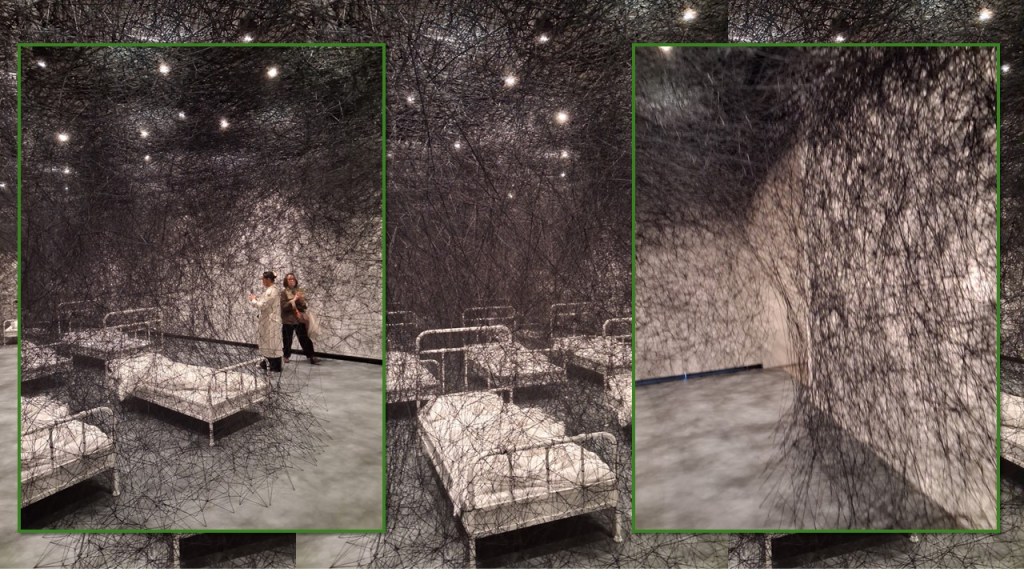
Of the new work During Sleep however, I have lest rust of the spaces and much more the sense of entrapment. I cannot know how this works as a set for a performance pice but the various photographs of theevent seem to show freedoms explouitation and a use of the piece to be about memories – those signs of themselves people leave in beds – even indentations on a mattress, a ruffle of sheets.
As a piece I could only think of the controls we name institutionalisation, particularly of mental institutions where even people walking around got absorbed behind density of layers of webbing, as on the left below.
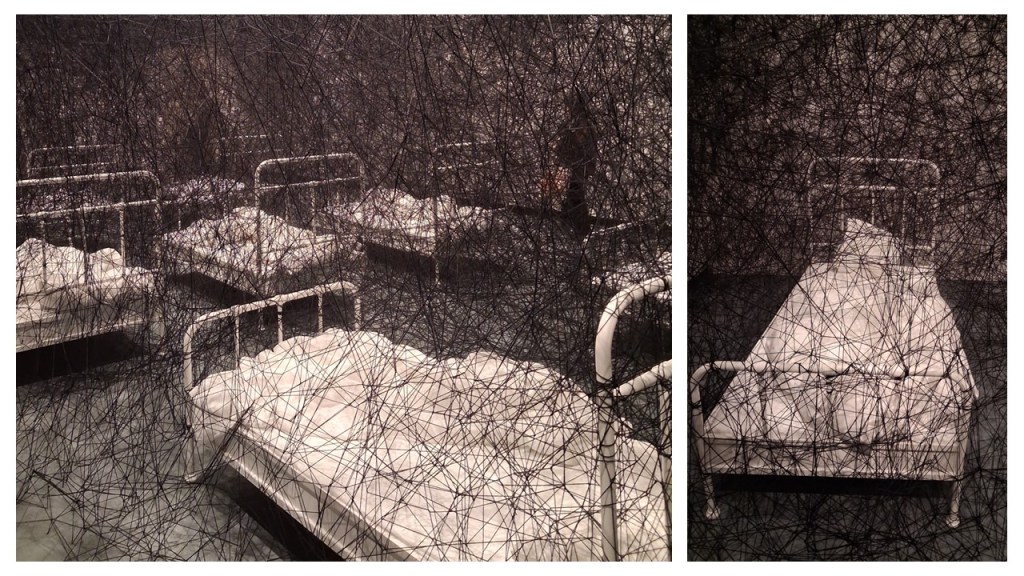
And gaps between beds seem uncrossable, or, at the best, difficult to negotiate. How is this negotiated in performance art versions of this a thing that feels like an untouchable museum piece to a visitor – the usual instructions not to touch are given on entrance – becomes something people walk, move and talk within, even though they be working to instruction.
You need to see – go in and out – of this piece more than once, though (to tell truth I didn’t and didn’t want to in the melancholy of my tiredness and with Dracula still to be seen.
But the last thing I learned, is that failures of learning – the accidents of tiredness and depression – are never final, for light oft enters when least you expect it and is as much a creature of variations of time, space and circumstance (for me in this exhibition this is represented as colour tonalities as well as physical things placed or shaping the spaces) as is dark – and that is a thing of hope – for though dark returns you learn that so does light.And it is in the non-binary variations that most hope lies.
All for now. With love
Steven xxxxxxxxxx
 Steve_Bamlett_blog