


The notion that I must have a book in me and write it. Some thoughts prompted by giving up on completing reading the whole of Sacha Coward’s (2024) ‘Queer as Folklore: The Hidden History of Myths and Monsters‘, Manchester, Manchester University Press.
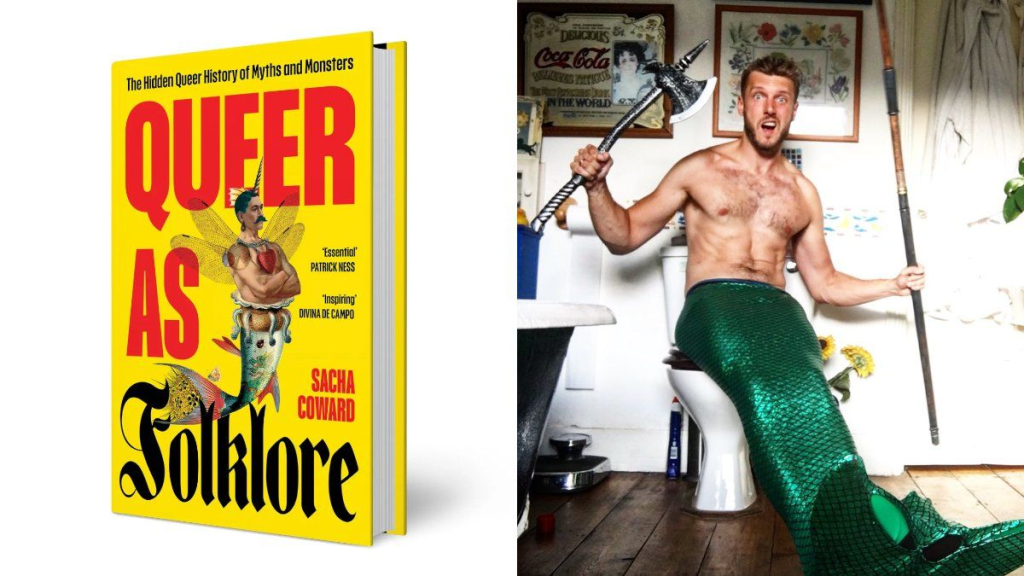
Sacha Coward is a beautiful man (even dressed as a Nordic mer-creature) and an inveterate blogger, as well as being, I believe, a museums professional and entertainer but Queer as Folklore is a difficult book to complete in a one-off serial reading. As I put it down I was reading its most irritating chapter ‘Demon Twinks’ which is mainly a chapter on the demonic post Aleister Crowley’s (the proto-fascist Crowley is always irritating) researches and popularisations with little or no relation to the vast area of demonology (as an explanation of superfluous and heterogeneous divine energy as in William Blake’s nuanced concept) it purports to illuminate or to the term ‘twink’ once important in social media as a reference yo young and available queer boys. It fits though with the book’s anarchic style. The book is apparently some kind of comprehensive compendium of odd remnants from history, ancient, modern and that entirely connected to the culture of social media, taking the latter as the equivalent of a contemporary archive of current equivalences to historical phenomena. And it is this despite the fact that Coward says he left a lot out that it ‘pains him’ (a tongue-in-cheek pain no doubt) to have done so because ‘the book is better for having been cut down’. [1] I think that may be so but it does not address the main problem – that this book has no coherent reason for being, other than as an ill-organised catalogue hung together by specious reasoning.
I first came across Coward as a speaker on the history of Bloomsbury and like Bloomsbury the real target of this over-long book is what Joanne Harris says it is in her ‘Foreword’ to the original Unbound edition: Victorianism as a shorthand for colonialism and missionary Christianity. But that fact alone maybe suggests that it needed some tighter grip on what ‘folklore’ could be. In psychology, folklore is a term that refers to unsubstantiated popular beliefs about the mind and its operations, but in various other accounts it purports to be beliefs that pass under the radar of the accounts that some powerful status-quo institutions do not wish people to believe or which they ridicule, in that sense in no way different from academic psychology.
What you will find in this book is endless beautiful nuggets – clusters of gems barely sifted out from baser materials but all interpreted continually as interesting ways of thinking of why there has always been a non-normative, aka queer, community. I rather loved the section on Lord Byron and his relationship to Polidori, the author of The Vampyre, but what it adds to more serious accounts, like those I referred to in a blog on Polidori’s quasi biography (use this link) is at most speculative, although I fully agree with the speculations. But these nuggets have dry desserts between them that feel like they take a vast eternity to travel, when we have not world enough or time.
But it is a book by a person who feels they have a book in them and goes ahead and gets it published by the sponsored publishers Unbound. It was republished by MUP because it was popular enough and I don’t deny that it deserves popularity. But it is not a ‘keeper’ I think, even as a reference book. There is too much of the author’s desire in it to be known. I don’t deny he deserves to be known but it reminds me that I am pleased I have got into my seventies by not seeking publication, for it is a stage that getting a book published might stick you in, as you attempt to justify the vast amounts of time you spent on it.
The world has missed nothing in the book I might have written, by the way. And now I just complete blogs for my own purposes – to keep my mind ticking over in whilst I consider how my light was spent in this obscure corner. Lol.
With love
Steven xxxxxxx
______________________
[1] Sacha Coward (2025 paper ed.: 324) ‘Queer as Folklore: The Hidden History of Myths and Monsters‘, Manchester, Manchester University Press.
 Steve_Bamlett_blog