


What if it were a Sandretto plastic injection moulding machine …? Some initial thoughts on first reading Matthew Rice’s Plastic.
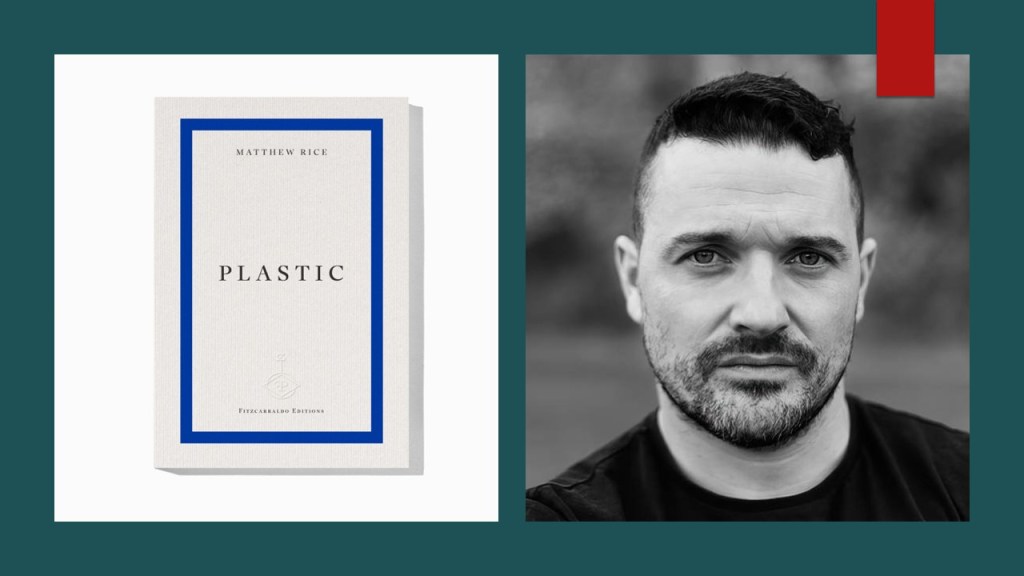
Perhaps the most intriguing poetry publication of this year is Matthew Rice’s volume, a narrative in a series of lyrics each dedicated to a single passing minute of a 12 hour night shift in a plastic injection moulding company in Carrickfergus, Northern Ireland, called simply Plastic. In itself, this book is a kind if invention; a means of querying the subjects and language of poetry, in ways that have preserved its validation of an unbridgeable difference between the working and intellectual classes, even in a fluid economy where traditional roots into the latter are denied by the demand that labour be flexible (particularly that downward social mobility’ become a fact more pertinent than movements upward) and not fixed in the manner it once was to its ‘place’ in a rigidly hierarchical class society.
As we read Matthew Rice, we may look on stupidly still inquiring how Matthew’s poetry can be – a thing replete with metaphysics and politics and at the same time, what Andrew McMillan calls it in his ‘publisher’s blurb’ : “the extraordinary ordinary. the real work of real people, sat alongside, and sung, and celebrated’. We want to know – is Matthew an intellectual ‘trying on’ manual labour for a theme in his poetry, or what…? I think McMillan’s word ‘celebrated’ here needs some nuancing, if you aren’t aware of how the quotidian imposed social movements, including those of ‘tragic fall’ of working-class lives are also represented in McMillan’s Pity, for amongst these poems is the story of what happened :
Once, in this building, a kid clocked off night shift
for good at the end of a rope,
another's hear gave out at 3 a.m.

20.00: p. 20 Matthew Rice 'Plastic'
But the invention is deep and intentional, it needs to exist because the book ties itself to Marxist theory of art and culture, notably the book from which some ‘of the poems in this sequence, as well as the preceding epigraph , borrow from Jacques Rancière’s seminal work Proletarian Nights: The worker’s Dream in Nineteenth Century France (1989) tr. John Drury’ (ibid: Notes, p. 95). The epigraph concerns what Rancière describes as a problematic question lying at the root of the kinds of class society maintained by capitalism:
A question of identity, of image, of the relationship of Self and Other, both involving and concealing the question of maintaining or transgressing the barrier that separates those who think from those who work with their hands.
Only the italicised part of this quotation above is the epigraph to Plastic, but it is worth knowing what categories of representation the question concerns – the identity, image and ‘relationship between Self and Other’ of the worker. The book, by looking at examples prior to the revolution of 1830 in France, shows that capitalist class society, and indeed class societies before capitalism became the hegemonic force it is, makes the expression of thought deriving from the working-class appear inauthentic or invalidated, in some way or other. There is a clearer expression of this in Rancière’s preface (translated by David Fernbach) to the reprinted English edition of his book in 2012:
In Book 3 of Plato’s Republic, Socrates asks his questioners to accept an unlikely story: if some people are philosophers and legislators while others are workers, this is because divine providence mixed gold in the soul of the former and iron in the soul of the latter. This unlikely story is necessary to give consistency to a world in which the difference in conditions has to be accepted as a difference of natures. The workers’ stories presented here are like countermyths, tales that muddy this difference of natures. That is why it mattered to me to unroll in its continuity this tissue of words in which tale, reverie, fiction, and argument are all part of the same work of overthrowing the order of things that puts individuals, classes, and discourses in their place. That is why it mattered to me to unroll in its continuity this tissue of words in which tale, reverie, fiction, and argument are all part of the same work of overthrowing the order of things that puts individuals, classes, and discourses in their place. There is not a popular intelligence concerned with practical things and a scholarly intelligence devoted to abstract thought. It is always the same intelligence at work.
What Plastic is a question of what maintains and transgresses ‘the barrier that separates those who think from those who work with their hands’, a question that disturbs the order of conventional and normative thinking. Hence my prime response to this prompt question about ‘the most important invention in your lifetime’: What if it were a Sandretto plastic injection moulding machine …? The Sandretto, or one of the range of that Italian manufacturers plastic injection moulding machines can be seen below:
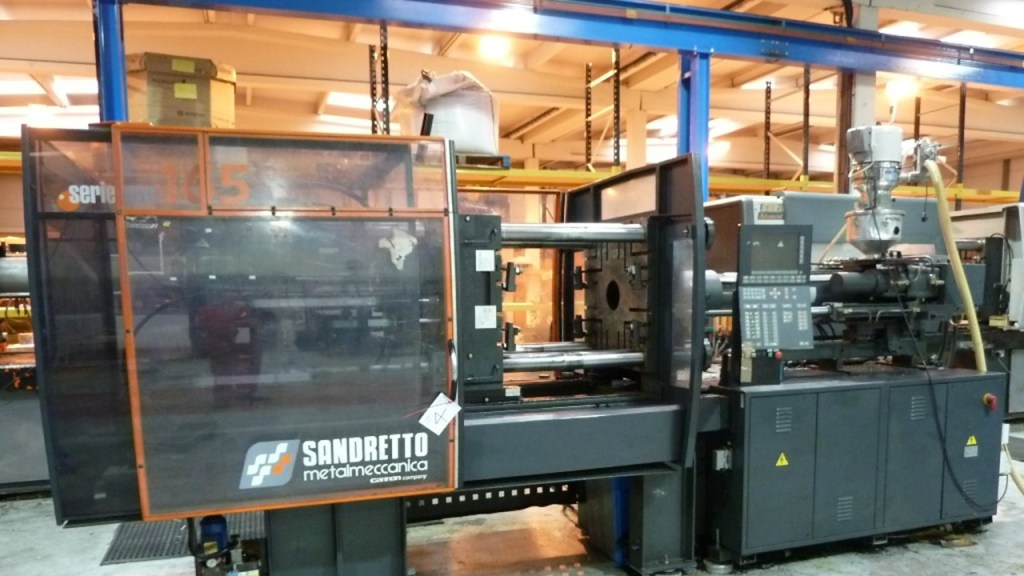
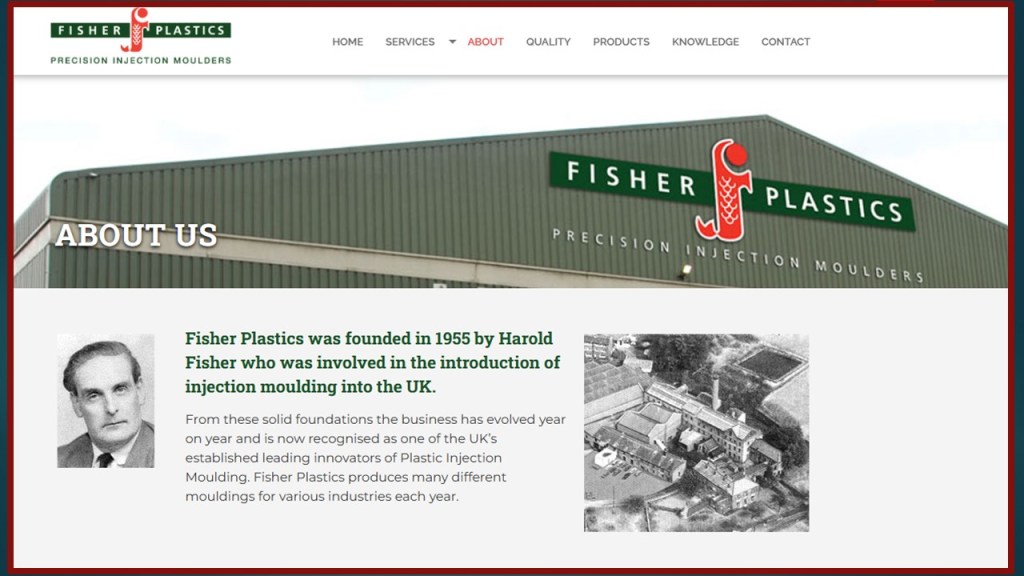
I don’t know if such a sight is significant to you. If so why? For me, it recalls the period between school and sixth form and then between sixth form and university, when I was urged to take a job at Fisher’s Plastics, then with a factory on the outskirts of Honley, where I lived, although now in the town of Holmfirth. fishers came into being the year after my birth and I certainly remember the face of Harold Fisher below, and the sweep of his Bentley.
But this life was always liminal in my imagination, an image of that to which I might live like lifelong had I not ‘escaped’ my class and its instabilities of identity as a worker that it then made a vision of a ring of the Inferno (comparisons to Hell and Dante’s version of it skim through this collection): where in one of Matthew’s best first lines, in parody of Marx and Engels, the dilemma of being a commodity in the market economy defines one’s potential:
Man is born free, and everywhere he is in supply-chains

it's a bit like this place,
tethered to the machine
with an option to go hungry, or find another factory
to feel the same in.

22.22: p. 33 Matthew Rice 'Plastic'
Of course ‘escape’ was not the issue. I was the beneficiary of a system that help working class young people then to go to university without incurring debt, with fees paid and a full maintenance grant. Now, such dreams, inspired by, if short of socialist ideals, no longer make that avenue secure, and for those who go to university passage to bourgeois occupational structures is no longer inevitable or an entitlement, as it seemed then, in the days when Michael Young argued about the disadvantages of the class system merely solidifying in new forms by The Rise of The Meritocracy. The liminal space in which Plastic fits is a much more troubling one than my sojourn in Fisher Hell, for it cannot be thought to be a temporary stage of development, as my brief sojourn could, and was by me. But the images and terminologies of the plastics factory stay with me – the health and safety dangers being much what they were in Plastic, where inadequacy of tools leads (and led then) to death and / or severe injury, as well as more minor cuts and burns. Fisher’s webpage names the range of tonnage of its machines but has no Sandretto marked amongst its machines. But see this lyric:
Last week, for fuck's sake,
six hours in a second-hand Sandretto
machine, shaped in brute force
with a steelhead sledge
to hammer free a single bolt
from the moulding tool,
glazed to the elbows in grease,
Jimmy and Jamie,
in the name of 'safety', watching.
22.32: p. 42 Matthew Rice ‘Plastic’
A plastics factory is a place where operators stay well behind a safety screen pulled over the moulding tools brutal heads holding in them the mould which will become the plastic item (Monopoly game Houses & Hotels I remember doing). The steelheads loudly slam together and the hot plastic is injected into them, opening and dispensing its product once formed. The product is pushed out of the mould and drops into a well from which it can be safely retrieved.That is unless the plastic malforms or sticks, when you have to look into the jaws of the beast under the safety cover, or if the bolts of the mould are dislodged, as in the poem above. The poem oozes threat, even when it invokes ‘safety’. A hand trapped in the moulds occurred whilst I was at Fishers, the effects of hot plastic on skin causing many burns. Of course there was a safety procedure, but it was often in competition with the need to maintain efficiency – for this was watched over and was a ground for disciplinary action. Major operations like that above were exempt and involved higher level employees then for me. Sometimes machine errors were longed for to avoid the otherwise monotony. Here this in another lyric:
The wind at the new steel shutter door
christens the echoes I hear
lost among the machines.
The machine rumbles on
and only pause when the programme permits
when the material won't galvanize:
'They said this was fucking fixed!'

00.19: p. 47 Matthew Rice 'Plastic
The haunting sounds of an external door are imagined as a kind of ritual baptism but of things you’ve ‘lost’, ‘echoes’ that do not form a communication but only the sound of its loss in noisy isolation. The effect of dealing with plastic that will ‘not galvanize’ (by which I understand forming a protective coating from a treating by zinc as part of the process) I have never dealt with but as a final end process on plastic it must go wrong frustratingly often. But should the operative care. Certainly they are told that this is part of their identity. Hear Fisher’s Plastics on this:
With our passionate team of highly experienced in house engineers, toolmakers & injection moulding teams we can transform your initial idea from concept stage, all the way through to a finished and assembled working product.
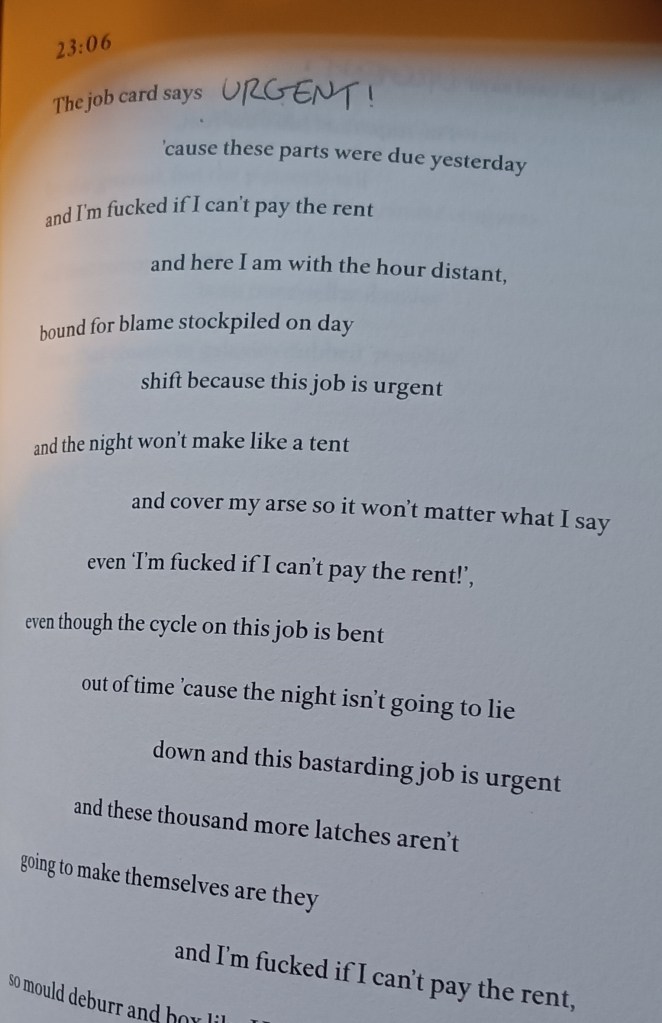
‘Passionate’ seems a quality of the common process, all geared to the ‘end-user’, as the jargon goes. But that ‘passion’ is enforced in these forms – and I don’t believe what is true of Carricfergus, isn’t rrue of Holmfirth manufacturers. Here is how ‘passion’ is inculcated. From 23.o6: p. 37f. Matthew Rice ‘Plastic.
These poems need much more thought – but the Sandretto (even when ‘second-hand’), what an invention!. For it manufactures people whose intelligence, as good as any, are tied to the exigency of those ‘supply-chains’. But to invent a means of making poetry no longer liminal on class boundaries – well! There’s an invention.
With love
Steven xxxxxxxx

