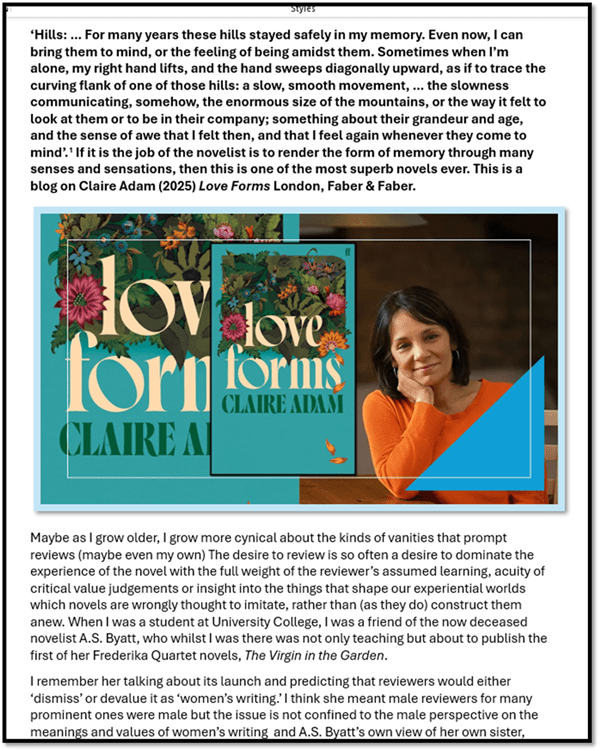
‘Hills: … For many years these hills stayed safely in my memory. Even now, I can bring them to mind, or the feeling of being amidst them. Sometimes when I’m alone, my right hand lifts, and the hand sweeps diagonally upward, as if to trace the curving flank of one of those hills: a slow, smooth movement, … the slowness communicating, somehow, the enormous size of the mountains, or the way it felt to look at them or to be in their company; something about their grandeur and age, and the sense of awe that I felt then, and that I feel again whenever they come to mind’.[1] If it is the job of the novelist is to render the form of memory through many aspects of mind and bodily sensations, then this is one of the most superb novels ever. This is a blog on Claire Adam (2025) Love Forms London, Faber & Faber.

Maybe as I grow older, I grow more cynical about the kinds of vanities that prompt reviews (maybe even my own) The desire to review is so often a desire to dominate the experience of the novel with the full weight of the reviewer’s assumed learning, acuity of critical value judgements or insight into the things that shape our experiential worlds which novels are wrongly thought to imitate, rather than (as they do) construct them anew. When I was a student at University College, I was a friend of the now deceased novelist A.S. Byatt, who whilst I was there was not only teaching but about to publish the first of her Frederika Quartet novels, The Virgin in the Garden.
I remember her talking about its launch and predicting that reviewers would either ‘dismiss’ or devalue it as ‘women’s writing.’ I think she meant male reviewers for many prominent ones were male but the issue is not confined to the male perspective on the meanings and values of women’s writing and A.S. Byatt’s own view of her own sister, Margaret Drabble’s output, at that time much better known than hers, was, I think, that this was definitively ‘women’s writing’. It was, I think she implied, self-limited by introjected patriarchal values, such that its significance as a sociological documentation in fiction of the limits on the quality of female lives recorded in them made such writing somewhat less than an art, a process of making that stood or fell by cognitive, emotional and aesthetic standards other (and more refined) than the stuff of representing authentic women voices (and just as importantly women’s ‘issues’) absented from earlier fiction. Her point about how that occurred might be reproduced in some of the struggles I went through to truly appreciate the strength of Claire Adam’s Love Forms.
Let’s take some critical commentary on the novel, which I will represent by Jade McGee’s review for Woman & Home (online). This is not because it is a bad review because it contains very useful insight, from which I was grateful to learn, into the book’s ‘architecture of memory’ and use of ‘emotional landscape’, but because of the more memorable statements in it of the book’s themes as:
- ‘a moving meditation on the many ways love endures – even when tested by time, distance, and regret’, and that she;
- ‘examines … the complexities of family, and the enduring nature of maternal love’, and, as she says later;
- ‘meditations on motherhood, migration, and memory’.[2]
These themes are amongst those that spring up with such regularity in everyday discourse about the special subject-matter of the ‘female voice’, despite the fact that many women treat such themes with broad irony, as, to be fair, did Margaret Drabble. Even Julie Myerson, who emphasise the ways in which the novel sometimes has the feel of a mystery ‘thriller’, and she should know, perhaps never quite engages closely enough with its text, to see that it is much richer than McGee’s ‘moving mediations’ on ‘motherhood, etc. …’ Take this extended moment from her review in The Guardian.
Still, Dawn’s abiding sense of loss, the instinctive feeling of her daughter’s absence, which “always arrived somewhere in my abdomen, the sudden shock, like remembering laundry left out in the rain or children not picked up from school”, is something whose power cannot be overestimated. Adam is great on the unsaid, the half-said, and the way feelings will unravel and morph over the years. “Mothers will fight off lions,” Dawn tells her father in a rare, late moment of reckoning. “Actually it was you I should have been fighting … you were the lion. I didn’t realise it back then.” It’s credit to this novel’s ability to wrongfoot you that at this moment you find yourself feeling a flicker of sympathy for her father.
And this sense of uncertainty and unease continues to the end. The final pages, which unfold at the family’s beach house on Tobago, are as gripping as any thriller, and the ending, when it comes, feels as right as it is devastating.[3]
This passage asserts that this novel is all about a woman’s assessment of what is lost and left behind in life, but in saying this surely Myerson misses the bathos of some of the prose wherein an ‘abiding sense of loss, the instinctive feeling of her daughter’s absence’ gets compared to other less august themes in the repertoire of human loss to which women’s lives might get reduced: ‘the sudden shock, like remembering laundry left out in the rain or children not picked up from school’, whatever the consequences of being late to school, they are not as certain as giving up a child to the adoption system.
Moreover, Myerson’s implicit statement that the ‘final pages’ are those which ‘unfold at the family’s beach house on Tobago’ are extremely misleading and reveal that Myerson looks at the book as primarily about family dynamics, for the ‘final pages’ unfold solely in the consciousness of Dawn herself, during ‘the return journey’ from Venezuela, ‘in the jeep and in the dented rattling airplane’. In her thoughts and feelings, she senses that:
Something had changed, although I couldn’t, at that stage, have fully articulated what it was. Pieces were beginning to settle in new patterns.[4]
Myerson’s admiration of the book rather dwindles in effect too via the uncritical reception she gives to its startling prose. This remains the case although she is clearly correct that the book is brilliant in its evocation of the psychological effects (on perception and memory) based on the characters’ refusal or incapacity to communicate about things better brought to surface, even if not ‘fully articulated’ than buried or drowned. That is the theme par excellence of art: most stunningly in Shakespeare’s The Tempest, but also of the deep undercurrents of Virginia Woolf’s fiction. In that respect, McGee, picks out much more vital structures in Adam’s writing that elevates its art:

- the first being landscape, of which McGee says:
- ‘These settings are not just decorative—they’re integral to the novel’s emotional landscape. Trinidad’s warmth, Venezuela’s disquiet, and London’s grey solitude all mirror different stages of Dawn’s emotional state’.
- the second, the deep self-exploration in an artwork of the foundations of its own architecture, and
- third, the nature of memory in relation to both of the former themes. In a section of her review she subtitles ‘A story told in fragments—memory as architecture’, she says:
- ‘Adam structures the novel with a fluidity that mirrors memory itself. Dawn’s reflections unfold gradually, drifting between past and present in a way that feels organic and authentic’.[5]
These hints are sufficient to take a reader much deeper even into the novel’s handing of the inarticulate and sometimes inarticulable foundations of cognitive, emotional, individual autobiographical memory, and group socio-cultural memory. This is the glory of a novel whose subtleties lie deep. Let’s take one of the key landscapes of memory in the novel – that of the geographical location in Venezuela of the home in which nuns, ‘all called “Hermana”, pronounced without the H, like ear-man-a’, attend to the birthing and aftercare of the babies of young and single Catholic girls.[6] Let’s quote it again, perhaps more fully:
Hills: to get to the house we had to climb a hill; and from the house, what we saw around us were hills. For many years these hills stayed safely in my memory. Even now, I can bring them to mind, or the feeling of being amidst them. Sometimes when I’m alone, my right hand lifts, and the hand sweeps diagonally upward, as if to trace the curving flank of one of those hills: a slow, smooth movement, like those old people you see in the park sometimes, doing their tai chi; the slowness communicating, somehow, the enormous size of the mountains, or the way it felt to look at them or to be in their company; something about their grandeur and age, and the sense of awe that I felt then, and that I feel again whenever they come to mind.[7]
Does this recall Lyric XL of The Shropshire Lad by A.E. Housman:
Into my heart an air that kills
  From yon far country blows:
What are those blue remembered hills,
  What spires, what farms are those?

That is the land of lost content,
  I see it shining plain,
The happy highways where I went
  And cannot come again.
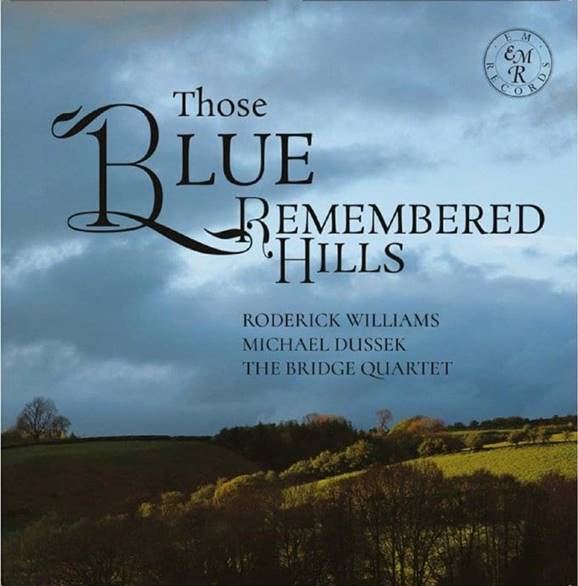
Whether it does or not, the point McGee makes that this setting is not just decorative – even when it becomes much more so after this point – is clear I think. Place and space exist, like an artwork exists. The landscape representing space and place is something pointed to or indexed as being in the outside world and represented in writing. But it exists in the first instance as something writing co-creates inside the reader by engaging cooperative functions of mind, sense and feeling – functions like those which are appealed to in cognitive recognition, emotional absorption, and registration of an object across multiple senses including those exercised in touch and the motion of all of our sensors – hands, eyes, ears etc. – across its surfaces.
The words that indicate that it is happening are those that designate the motion of the hand in drawing, tracing, and bodily touching a thing across different dimensions, like the dimensions of a ‘curving flank’. In this sense the image of the elders working with tai chi creates an analogy with the way the body in the practice mimes the object required to be represented in order to inhabit its inner being, emotionally and cognitively – mindfully.

We not only see the mental picture, we must feel as if we are within that picture and fill the space as its elements do with our own being: the feeling of being amidst them’. Time is infinite extensible – from the limited time of our knowing that image to some less articulable grandeur and old age, greater than in the invoked ‘old people in the park’. And the sensed pace of events is what communicates rather than people using language to do so: ‘slowness communicating, somehow, the enormous size of the mountains, or the way it felt to look at them or to be in their company’.
As an image coming from within time (a memory of what ‘I felt then’), it, later in sequential returns to that ‘then’, reinforces a sense of time itself (in sequential experience of a common image) being potentially an experience infinitely circling on itself. Tennyson’s In Memoriam contains passages where the pace of geological change is accelerated in a vision that represents an eye as old as the earth, witnessing the passage of time. Thus, lyric CXXIII appears to compress time into the present moment:
There rolls the deep where grew the tree.
      O earth, what changes hast thou seen!
      There where the long street roars, hath been
The stillness of the central sea.

The hills are shadows, and they flow
      From form to form, and nothing stands;
      They melt like mist, the solid lands,
Like clouds they shape themselves and go.

But in my spirit will I dwell,
      And dream my dream, and hold it true;
      For tho' my lips may breathe adieu,
I cannot think the thing farewell.
As such, the novel’s meditation on landscape and memory finds a striking resonance in the poetry of loss and transformation, where the external world—its hills, seas, and ancient trees—becomes a mirror for the mind’s capacity to hold, alter, and ultimately release what once seemed immutable. The boundaries of place and self blur as memory’s architecture proves both fragile and enduring, shaping itself in response to absence and longing, and allowing each return to a primal memory—whether through gesture, sensation, emotion, or the quiet persistence of thought—to deepen the meaning of what is remembered. It is within this space of inward dwelling, of landscapes both real and imagined, that the narrative aligns itself with something timeless: the continual shaping and reshaping of love and identity within the currents of remembrance and change.
This is also the beautiful message of Love Forms – that there are ‘forms’ carved out by love not by physical or social regulation – ‘hence ‘love forms’ – that require only a quest for them in order to become a sustaining memory. However, that baseline memory will only be met and recognised, as if for the first time in conscious memory, at the very end of the novel, in a most beautiful finale in which sense, emotion and thought come together in an infinitely repeatable memory of the bliss of Mother and Child combined: ‘The snug warmth of her body melting into my own. The softness of her head against my cheek. We had that time together’.[8]
This epiphany is what stands against the difficulty the novel feels when it suppresses talk of the young baby born in Venezuela, where it is ‘hard to account for all those years’ in the present moment.[9] It accounts for the gaps and deficits that people feel in their histories – even in the social, cultural and economic history of the Caribbean and Northern South America for all involve histories in which we are unaware of the true nature of the agency of others around us, such as the experience of Dawn in the cottage of woman storing her in her passage to the nunnery in which she will give birth which fits not at all the patterns of history and cultural entitlement she is used to: ‘The lady was old, black, poor; I was white, young, rich – she must have known who I was’. In this house where all previous markers of status are upset, ‘the sequence’ and duration ‘of events’ can only be her ‘reconstruction’ from ‘impressions – images, sounds, feelings.[10] Time is a space of transition that is almost entirely subjective and with objective measures of time and distance, like the boat trip to Venezuela: ‘Then: gaps, darkness; I just don’t remember’.[11]
These images of reconstruction are the source of a novel that feels like, at some points, an architectural composition, at other times a map. Whilst McGee relies more on the architectural with its useful metaphors of foundations, and levelled or layered vertical as well as lateral structure, the easiest metaphor to find in the book is the map – that recalls the functions of spatial memory that some psychologists call the ‘cognitive map’. Psychology finds it in the mental and neurological storage systems we call memory in many animal species other than humans since it requires no outward representation but seems to be hardwired. Near the end of the novel, Dawn even invokes this concept to help the reader understand how she locates the place where her daughter was born:
I don’t know if you’ve ever been in this sort of situation. A type of spatial memory, I guess. Somehow, you look around and you know which way to go.[12]
We see this process from a longer perspective in Dawn’s first attempts to locate the place, guided only by the memory of hills, that she uses to compare with images of Venezuela as represented in the memorial verbal accounts of her family’s business trips to Venezuela, not all being what they seem as we shall see, drawing her memories as a sketch but producing a ‘scribble’, photographs in National Geographic, and finally a physical map in which she can eradicate from her search all Venezuela’s flatlands, meanwhile marvelling that:
… a single tiny fragment of information I’d carried for so long with me, the memory of having been in the mountains, could yield a sort of power over a vast area of land. [13]
I myself marvel at Dawn glorying in that ‘power over a vast area of land’: for in this she is truly the inheritor of her family’s entrepreneurial and managing instincts which have lifted them into dominance in Trinidad and Tobago, and, to some extent, Venezuela as well, where Dawn’s father has a possible elicit second family.[14]
I think I have said enough to suggest why I feel that though this novel does type itself as ‘women’s writing’ in its concentration on child-bearing and the care function of family, its aim is to find in female experience a root to a much less narrative kind of art – one that binds experience in the evocation of interacting sensation, emotion and thought to create some structure that withstands time and change – one that invokes the fruit of Trinidad as a resource in writing as well as trade, and weaves it arounds its architecture and in the locations on its maps. It does so by starting with obscured fragments of knowledge at night and looking out for its namesake, Dawn, from within these darkest hours:
In this way, in the dark, with only a faint glimmer of moonlight through the curtain, these pieces of my life gradually come together.[15]
When I first finished this novel I still wondered why it was worthy of the longlist against some other contenders not on it. But now, I have no doubt of its worth. It is true and highly-wrought art. Whether it is art for me, I doubt, but it is worthy art nevertheless – superbly admirable.
Do read it
With love
Steven.
[1] Claire Adam (2025: 199) Love Forms London, Faber & Faber
[2] Jade McGee (2025) ‘Book Review: Love forms by Claire Adam’ in Woman & Home (online) [July 26, 2025] available at: https://www.womanandhomemagazine.co.za/books/book-review-love-forms-by-claire-adam/
[3] Julie Myerson (2025) ‘Love Forms by Claire Adam review – the power of a mother’s loss’ in The Guardian (Thu 12 Jun 2025 07.00 BST) available at: https://www.theguardian.com/books/2025/jun/12/love-forms-by-claire-adam-review-the-power-of-a-mothers-loss
[4] Claire Adam op.cit: 293
[5] Jade McGee op.cit.
[6] Claire Adam op.cit: 16
[7] ibid: 199
[8] Ibid: 295
[9] Ibid: 131
[10] Ibid: 8
[11] Ibid: 10
[12] Ibid: 289
[13] Ibid: 201
[14] See ibid: 274 – 276
[15] Ibid: 263
 Steve_Bamlett_blog
One thought on “If it is the job of the novelist is to render the form of memory through many aspects of mind and bodily sensations, then this is one of the most superb novels ever. This is a blog on Claire Adam (2025) ‘Love Forms’.”