“Working families, small communities, traditional British industries and jobs. We used to value these things”.[1]Sometimes we wonder if this was said by a fictional columnist or own present prime Minister (and I won’t answer ‘whether I have a problem with our prime minister’: Natasha Brown meant Rishi Sunak; I, of course, mean Sir Keir Starmer’s equation of those ‘valluus’ with the fictions he creates of the ‘true’ Labour Party).[2] What is it like to ‘hold so much “value” within’ your ‘two hands’ and know that that is an ‘obscene concept’.[3] This is a blog on Natasha Brown (2025) ‘Universality’, London, Faber & Faber.
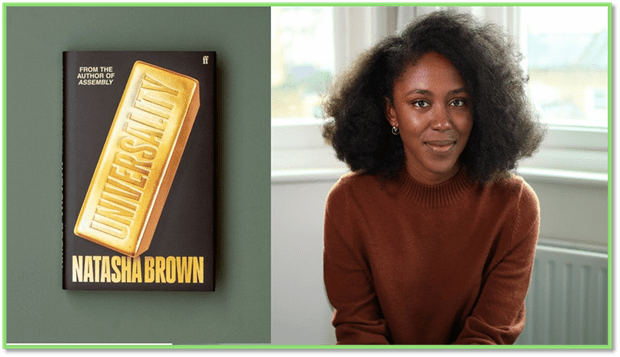
The way it is claimed Jonathan Swift wrote satire in the eighteenth century, especially A Modest Proposal is very like what Natasha Brown offers us in the twenty-first century but is so much more painful, whilst being, frankly , much cleverer than Swift, hardly needing to use hyperbole in characterising the horror of journalistic social commentary and the opportunism that characterises its often best-known exemplars. However, speaking to Kate Rosseinsky in The Independent about the columnist character in the book, Miriam (Lenny) Leonard, before the novel’s publication, Rosseinsky says Brown refused to:
be drawn on whether she drew inspiration for Lenny from any real-life names (are there shades of Katie Hopkins? Or a female Laurence Fox?) “I really wanted her to be her own thing,” she says, noting that she decided to make the character “half a generation younger than the big Nineties women journalists who still have an impact today – how would someone who grew up seeing those women, and felt she didn’t have the same opportunities, see the world?”[4]
Of course this matters – and more than any potential satire to be gained from opportunist right-wing female journalists, of the Nineties or now – for if it didn’t the novel would fail to be a novel – a realisation of different fictional accounts semi-integrated into one and be as hard to categorise as was A Modest Proposal. Lenny is not the only journalist in the novel – though her first-person voice takes over the narration entirely in the wonderful third and fourth parts of the novel: ‘Cartmel’ and ‘Showtime’. The opening section ‘A Fool’s Gold’ is claimed in the novel’s fictional attributions to have appeared first in the fictional Alazon Magazine for 17 June 2021. However in truth a shorter version of this piece, appeared, without that subtitle, in the Spring 2023 edition of Granta, dedicated to that decades ‘Best of Young British Novelists’. I will come later to how we might see that fact to matter.
But first let’s linger on the fictional title of the magazine Brown chooses, Alazon, which is is a loaded word in the history of genres of comedy. Wikipedia derives it thus from the Greek, which is its origin and the comic theatre that is its context (good for a novel that ends with ‘Showtime’:
Alazṓn (Ancient Greek: ἀλαζών) is one of three stock characters in comedy of the theatre of ancient Greece. He is the opponent of the eirôn. The alazṓn is an impostor that sees himself as greater than he actually is.
The type is often also called the ‘boaster’, and it is common to see Falstaff as such a character in the two Henry IV plays by Shakespeare, brought to destruction by a dissembling Prince Hal, whatever the value of the latter’s motivation. For – again citing the appropriate Wikipedia entry:
the eirōn (Ancient Greek: εἴρων, “dissembler”) was one of various stock characters in comedy. The eirōn usually succeeded by bringing down his braggart opponent (the alazṓn “boaster”) by understating his own abilities. The eiron lends his name to the related concept of irony.
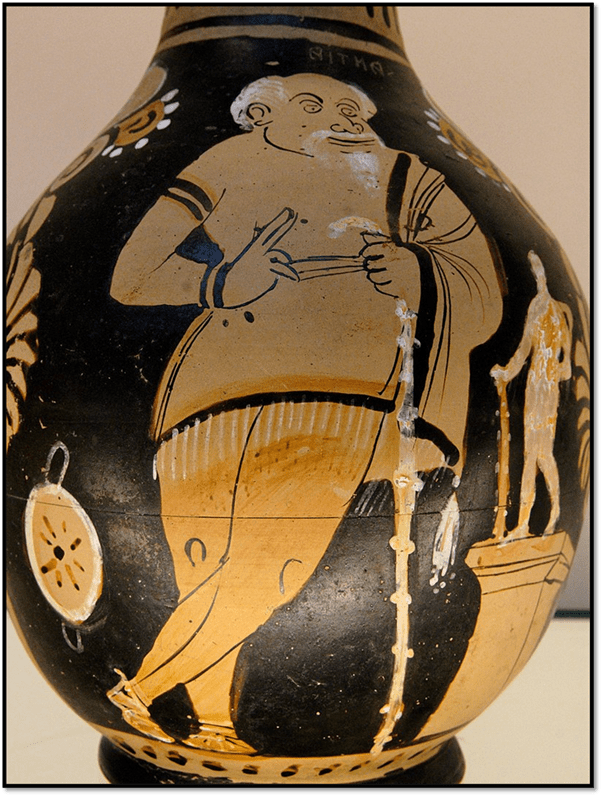
The eirōn character type in Aristophanes’ The Frogs By Seated Nike Painter (Spotted Rock Group) – Jastrow (2007), CC BY 2.5, https://commons.wikimedia.org/w/index.php?curid=2585754
Now I do not want to propose that Brown merely uses these types as the basis of her characters Hannah and Lenny respectively, for you would be hard pushed to interpret either as just a boaster and a dissembler – each contains element of each stereotype, with different degrees of ethical justification (or ‘excuse’ if you prefer) for those behaviours. However, Hannah is in a way ‘brought down’ by Lenny – though maybe for her benefit in the end, for it pulls her out of the networks of social and mainstream media that emphasise both dissembling and boasting, often in support of each other. Moreover, the person we are all delighted that Lenny ‘brings down’ is the appallingly self-centred Martin who interviews her at the fictional Cartmel Book Festival. But the quieter, less public, way that Hannah is ‘brought down’ by Lenny is typical of the latter – she is, by her but also by other of her past bourgeois fiends, ghosted. In the link on the word I give one contemporary meaning, as recorded ‘officially’ in a dictionary, of the term ‘ghosting’, from the jargon of twentieth century social media – it means abandoning someone without explanation or notice.
However, there is a sense in which a ghost is a good way of mediating our understanding of the two media writers, each looking for something like renown. A ghost is the shade of an identity – a doppelgänger or double, and I am certain Brown sees such a relationship between her characters, although engineered in contemporary ways like professional tutelage. Read the following carefully and you will see that the whole structure of the word ‘ghosted’ allows it to have this ambiguous reference. At this point we have been told that Martin, who is Lenny’s interviewer in the Book festival event retailed in ‘Showtime’ later, has realised that her one good article that had raised her profile, that in Alazon, had been co-researched by Hannah with Lenny and thus: ‘Hannah was exploitable again’ by Martin. The story continues by telling that Hannah:[5]
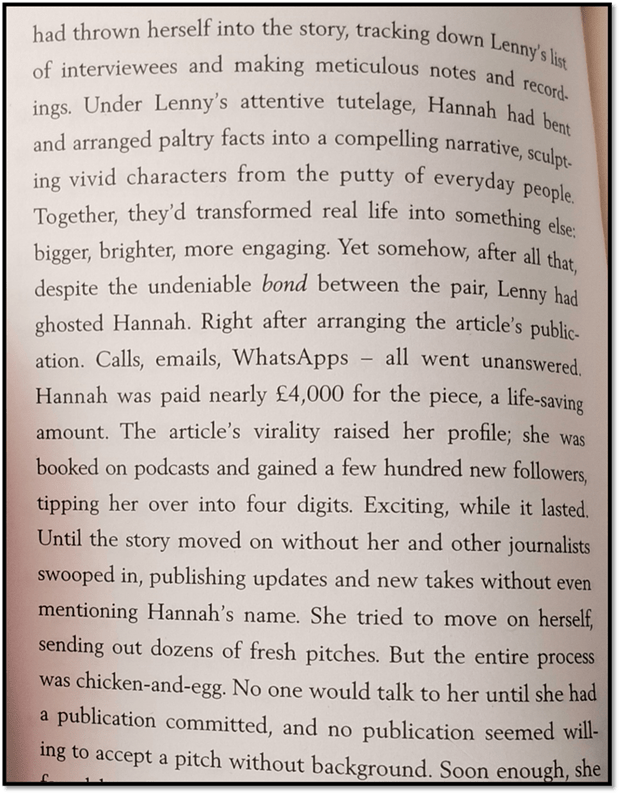
The bond here is an attachment of doubles, and it seems to offer the ghost, that Hannah turns out to be, the opportunity of a saved life. Thus is the value of the public role of bending and arranging ‘paltry facts into a compelling narrative, sculpting vivid characters from the putty of everyday people’. But I said that I would return to the fact that a version of ‘A Fools Gold’ without that title was published in Granta. Indeed I saw Natasha Brown at Edinburgh speaking to this Granta publication with other writers I like (I did not know Natasha’s work then and really attended to see Derek Owusu – see my blog on his contribution at this link). But here surely was a new talent and I bought her first novel Assembly there and then. I wish now I had kept my copy and that I hadn’t needed to really limit my book holdings because of space, because Assembly is clearly a book that addresses lacunae that are deliberately built into Universality as well as being very good, the washing out of black lives from the record in the name of the ‘universal truth that ‘all lives matter’, even by the radical anarcho-syndicalist ‘Universalists’ depicted in the latter.
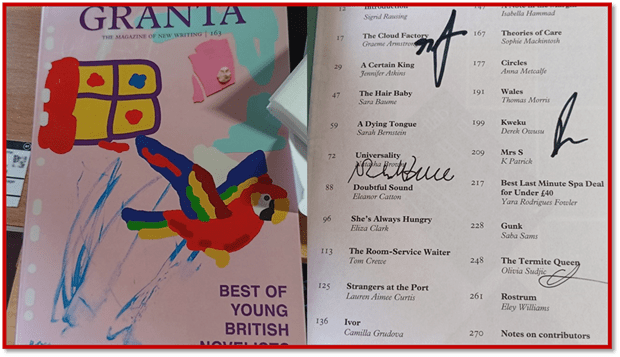
Now, I do not think that Granta is Alazon magazine, nor was the Edinburgh Book Festival a direct model for Cartmel’s – it sounds much more like the Borders or Hay Book Festival – but I do think that there is autobiographical mirroring in the doubles of this book, that may be the reason that Brown told Rosseinsky that, although Lenny’s arguments against ‘corporate diversity, equity and inclusion’ with regard to the under-represented are “just noise”, such “noise” seems endemic in the structure and content of contemporary institutional ‘literary’ culture (the press, publishing, the media of all kinds) and that, this is:
the reason why I don’t see my life as being forever in writing, why I think I’ll go back to Stem [science, technology, engineering and mathematics] and why I really spend a lot of my time encouraging young people to pursue it, is it makes this a non-issue,” she adds, in reference to the debate about DEI policies. “You get a qualification, and you can demonstrate clearly whether or not you’re capable of doing a job, and the results speak for themselves. There’s no subjectivity in assessing the output. And I think that’s really powerful.”
There is a reason, I think, why Assembly, also according to Rosseinsky is, in summary, the story of:
an unnamed narrator, a Black British woman who has made a “metric s*** ton” of money in finance, attends a garden party hosted at the country house owned by her white boyfriend’s (ancestrally) wealthy parents. Myths about class, race, meritocracy, and belonging are set up only to be shattered. At the time, Brown said she wanted to explore what a story about someone who “has it all” and still feels dissatisfied might look like from the perspective of a person of colour. [6]
In brief does not that earlier novel address the question of what makes life of ‘value’, outside of monetary or status measures, too but does it from the usually excluded perspective of a successful Black Briton. In Universality, the issue of what is universally the case in such questions has wiped out perspectives of people who are forced to be the exception to the universal standard – the second novel has everything to say about class and sex/gender (but mainly class I think) but can’t quite address head on ‘race’ except in contingent conversations by white people. And that is the subtlety of its satire – it is a painful subtlety to the anti-racist. That the pain of the absent is itself a theme of the novel – focused around Hannah’s class origins in Queensbury, near Bradford and Halifax, in West Yorkshire, not far from my own mother’s family origins, but also where the Universalists found their commune in Richard Spencer’s ‘property’, and the fact that her tenure on a public status of value must fade and jade – renders the racial absences the more poignantly clear, as in this passage:
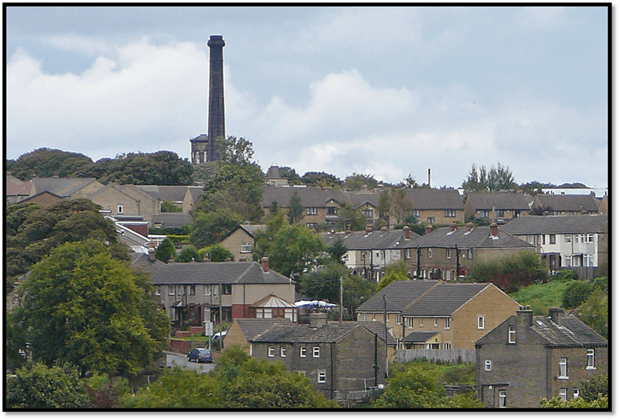
The chimney of the former Black Dyke Mills in Queensbury, Bradford, West Yorkshire. Taken on Saturday the 18th of September 2010 by Flickr user: Tim Green aka atouch – https://www.flickr.com/photos/atoach/5009603994/CC BY 2.0
Dimly, faint and unacknowledged, Hannah understood that this was it. She was drifting away from the established social strata and into absence. A return to the undistinguished class of people the news happened to, not the people who made the news or, at the very least, commented on it. Back to the world of her parents. It would mean losing her voice, her importance and, she was embarrassed to admit it but yes, also, losing her friends.[7]
Of course, one could argue that the experience of absence is ‘universal’ but that isn’t quite the case. The story of oppression that constitutes the life of Lenny’s son, Jake, is told to emphasise the brutality of bourgeois active values – not only in Lenny but even in literary capitalism’s servants like Amanda, the girl student appointed as liaison to Lenny at Cartmel festival, who admires and identifies, without explicit politics, with Lenny as one of a list of forceful public white women including ‘Jess Phillips, Angela Raynor, Penny Mordaunt … even Liz Truss. I have tons of admiration for you all’. When Lenny turns viciously on her ‘pathetic’ son, Amanda merely mildly protests but sticks to the remit of her ‘job’, ‘uncertain where her responsibilities lay’. She hence chooses passivity and silence, at least in the short term, as a response to the oppression of others by those more powerful than her.[8]
In the novel too a TV film adaptation is proposed of ‘A Fool’s Gold’ and the idea is, as Hannah explains it to guests (first timers in unfashionable Edmonton) John, Martin and Guin – the nightmare party to end all nightmare parties – to make the story ‘much more diverse’, cut Lenny out of it (as mother of Jake). make the mother working-class and ‘casting Jake as black’. John takes on the Lenny perspective, here angrily demanding why she is ‘shoehorning identity politics in this?’. Hannah, taking a hint from Martin but actually mouthing the views of her literary agent, argues that even if the real Jake is white, a story with a Black Jake ‘speaks to a wider audience this way’ because the ‘original piece’ was ‘very white’. The following speech from Hannah trying to ‘remember more of what her agent had said about the changes’ is even more problematic, saying that the fiction of a Black Jake:
… kind of resolves some of the inconsistencies in Jake’s character. I don’t know. It’s hard to explain, but Jake makes more sense, his struggles and arc feel more representative, when you know he’s black.[9]
This is excruciating in part because it has the flavour of some guidance on inclusion and yet trades in rank myths and stereotypes – let alone lies. The failure here is to see the specificity of lives as they matter because the need for representativeness trumps the specific realisation of those lives, and yet gets us no nearer to understanding the experience of speaking from a dark void of absence of any representation at all for Black characters. And it does not mean to plead positively for such representation because, perhaps, art cannot do that while its remit is formally part of an institution whose values are hegemonically those of white culture.
In the final magnificent chapter, Lenny is so focused on being a universal representative of a white Britain, secure in its universal normality, arguing that: “Specificity and lived experience, that’s for the others’. And it is this otherness that literary culture can so rarely reach when it sees its appeal as to the ‘universal’. Does such literature address people at all? On the stage at Cartmel, the audience resolves (well dissolves)into ‘milky darkness’.[10] Later Lenny as speaker will ‘squint up into the audience’s dark void’.[11] And at the end, as she gazes at the audience, preaching the universality of real people she can ‘smile sweetly upwards into the darkness’ but see very little: ‘I can’t make out any human forms from here, where I sit, illuminated on the centre stage. Maybe there aren’t any. Maybe I’m the only real person in the world’.[12]
The pain in this novel – it’s one that grows on me – is that there is no counter-voice to the absenting of Black Lives, the dematerialisation of them. Even the binary opposite of the capitalism of Richard Spencer, obsessed with his banker status, and so easily taken in, every inch of him in fact, by Lenny so that he owes her a favour, is the Universalist anarcho-syndicalist sect he thereby houses.[13] But they too exclude ‘identity politics’. Although most had ‘not had any experience of Black Lives Matter activism’ and preferred ‘universal’ environmental issues they were ‘sympathetic to many of BLM’s stated aims’ despite some concerns about the group’s divisive rhetoric’:
“Their demands are to the benefit of all of us, all humans,’ he says. “but focusing on race puts people off the message. What we need now is unity”.
“That’s why we’re called the Universalists,”…
“We’re open to everyone,” Indiya agrees. That said, the Universalists are a noticeably homogeneous group: young, middle-class and white. ….[14]
That said banker Richard Spencer too is a man who thinks his life has been stolen and that he wants it back, another ghost without the only trait that matters to him – abnormal power. Hannah’s narrative paints him as ‘stripped of’ his ‘immense power, influence and wealth’ that he see concentrated in a gold bar: “a grounded giant, cut off from his castle in the sky”. And if his Beanstalk is cut to get him back there, that is, he thinks because his Jack of the Beanstalk is Jake, Lenny’s son.
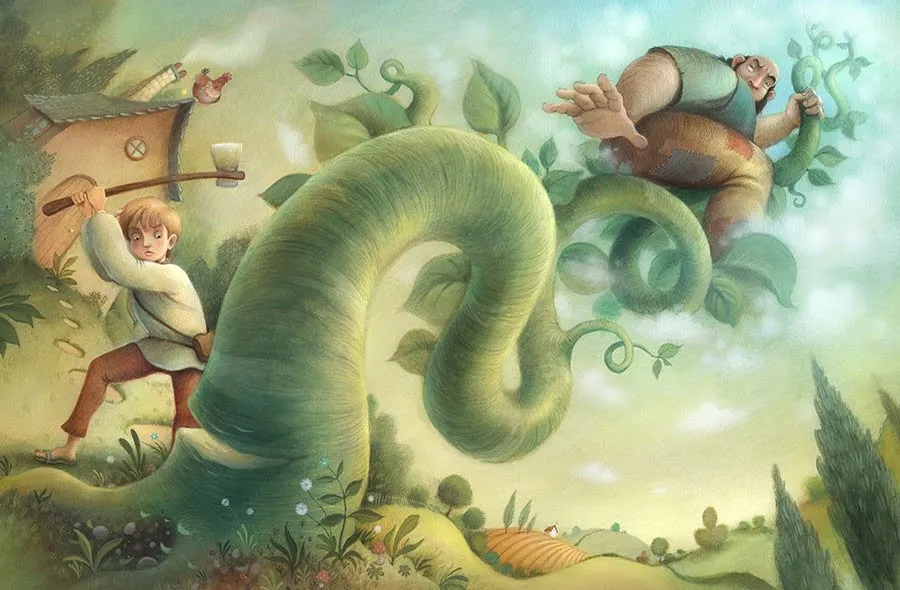
But are either Jake or Richard credible types of the idiocy in the power of self-centred capitalist ideology and of white middle-class rebellion, based on the absence of good parenting, respectively. They are tough types of a world that oversimplifies power and resistance to power and that builds in its stead a vision (that of Lenny) not unlike that Sir Keir Starmer now equates to the responsibility of the Labour Party, saying (and this is why I literally hate him – though it is a feeling I find it difficult to accommodate) this has always been the case:
“Working families, small communities, traditional British industries and jobs. We used to value these things”.[15]
Such dreams are neither symbols of concrete planned objectives real nor Utopian ideals, but ideological and meant to exclude the specifics of human life, even despair, which like that of Jake, who has, in his mother’s words, no right to her time: ‘a mass of wild hair, shambolic clothing and lifelong unaccountability’. He is a person of whom no account can be made that matters and who deserves ‘no place’ in the world of ‘working families’. It is terribly cruel but only because it never realises human voices that proceed from the specific – the real cause behind Black Lives Matter. Hence I take umbrage at the mention, by The Observer‘s Alex Clark, of the anarcho-syndicalist leader, whom Jake batters with his gold bar because he is rejected yet again: ‘Pegasus, the aspiring communard whose utopian dream has irretrievably fractured’.[16] What this gets wrong is that the actual ‘utopian dream’ of the novel is Lenny’s and really a nightmare not a dream. It is the aim in life of Lenny’s and other ‘talking heads’, and, unfortunately, the current Labour Party, to drive that nightmare home into its foreseeable consequences of all excluded from its adjective ‘working’ or who refuse universalisation as honorary white Britons. Real community, let me say assertively – but only personally – must accept diversity and divisive potential. Community is not a given but a worked-for good,

Natasha Brown. Photograph: Alice Zoo
I do so agree with Brown that what is fearsome about current ideology is the confluence of ideas pulled out of thin understandings of biological science (genetics in particular), AI [promotion, Skinnerian behaviourism, meritocracy and sociobiological engineering. I am going to listen to Natasha Brown in Edinburgh on Sunday. I will report back. What matters about her as a writer is that that she has focused on the meeting-point of the libel, lie and fiction and realised that the responsibility of being a novelist isn’t always in safe hands. In hers, true value lies (for even truth has a fictive vehicle) in writing that needs careful reading without loss of its comedy: at the moment, though, she speaks through fearsome avatars to show ‘it is all done’truth’ is often a symbol that requires our suspicion of it most of the time.
With love
Steven xxxxxxx
[1] Natasha Brown (2025: 145) ‘Universality’, London, Faber & Faber
[2] Ibid: 142
[3] Ibid: 3
[4] Katie Rosseinsky INTERVIEW (2025) ‘Natasha Brown on her razor-sharp satire Universality: “There was absolutely a lot of cringe”’ in The Independent (Tuesday 11 March 2025 06:00 GMT)
[5] Natasha Brown (2025) op.cit: 84
[6] Katie Rosseinsky, op.cit.
[7] Natasha Brown (2025) op.cit: 64
[8] Ibid respectively 130, 122f.
[9] Ibid: 55 – 58
[10] Ibid: 139
[11] Ibid: 145
[12] Ibid: 156
[13] See the very funny scene of oral sex, ibid: 109f.
[14] Ibid: 19f.
[15] ibid: 145
[16] Alex Clark (2025) ‘Universality by Natasha Brown review – a fabulous fable about the politics of storytelling’ In The Observer (Sun 23 Mar 2025 08.00 GMT)


2 thoughts on “This is a blog on Natasha Brown (2025) ‘Universality’.”