What’s one thing that makes you proud of your country?
View all responses
Some linguists believe the word ‘pride’ came originally from Old French but that in that early state of the French language it had no negative association of inflated self-esteem. Some also speculate that it gained tbat negative association only by virtue of its use by Anglo-Saxons to characterise their overmighty and arrogant Norman French overlords and landowners by, as they perceived them. Perhaps you could be proud of that response to the class arrogance of feudal Europe, if that were not potentially racist too.
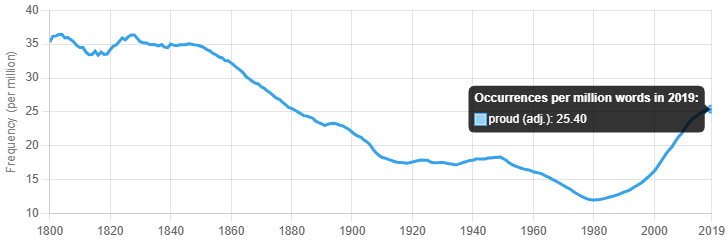
Google n-gram (not considered statistically reliable but an indication of frequency of word usage) foe ‘proud as an adjective from https://www.etymonline.com/word/proud
I will return to the ideas I state (not my own) in my title later. But they are only part of the problem with the word as used in this prompt. The n-gram above only starts at frequencies of usage in English in 1800, by which time the word had primarily ethical nd social valence, as registerd best perhaps in Jane Austen’s best-known novel Pride and Prejudice, published in 1813. Pride is attached to personal qualities, rightly and wrongly and with the validation or condemnation of it according to the implicit values of the novel, to many characters in it; but mainly to Mr. Darcy.
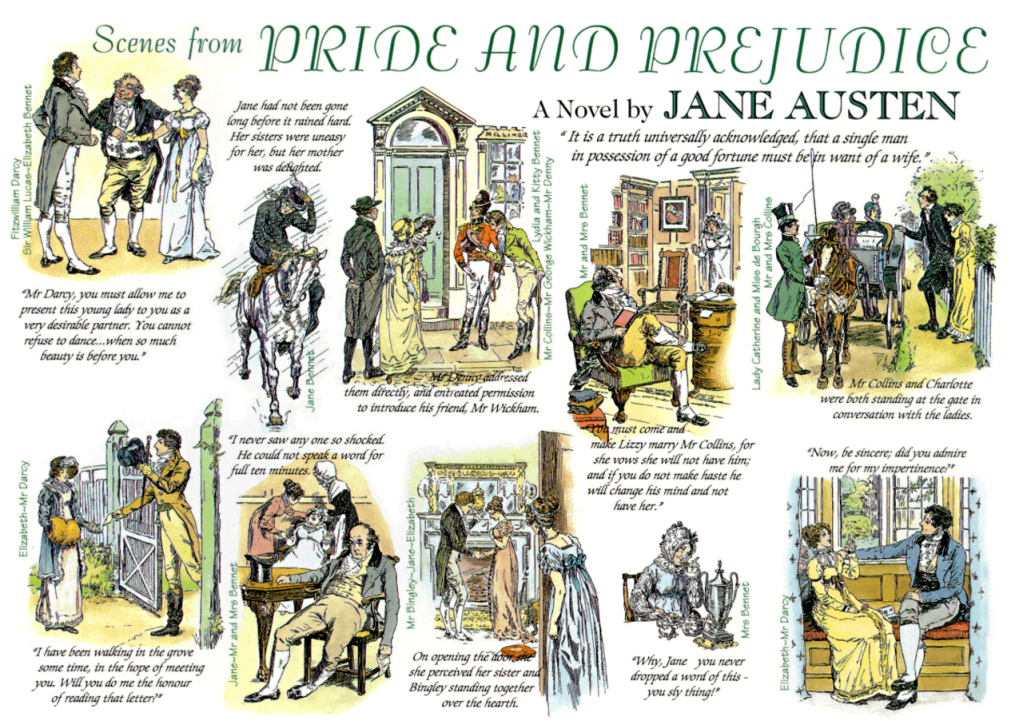
Now Darcy is a considerable landowner and his pride may derive from that same base as seemed apparent in Norman knights who, allocated land by Domesday Book in the 11th century, used its feudal values to enserf populations on their land, though not all at once. But Darcy’s ‘pride’, in so far as it makes him obnoxious at the first to Elizabeth Bennet is in fact a misreading, based on ‘prejudice’ about the moral nature of wealthy landowners that actually misrepresents the reasons he is thought so, which have much more to do with ‘reserve’ in public. But the moral debate is intrinsic by then.
This itself is probably an inheritance from the fact the medieval church had classed Pride not only as a sin but the greatest of the seven deadly sins from which all the other six deadly sins flowed. Pride was the sin of Lucifer, that angel who, first among angels in heaven, believed himself to be the sole source of everything that was superior, whereas that source should have been acknowledged by him to be God. Pride thence gets tied up with a self reluctant to look to any source of value but itself, that thing it names to itself and others, I; later to be conflated in secular models with the grossly unpleasnt trait in society of individual egotism, or narcissism (after Narcissus, a model of self-love).
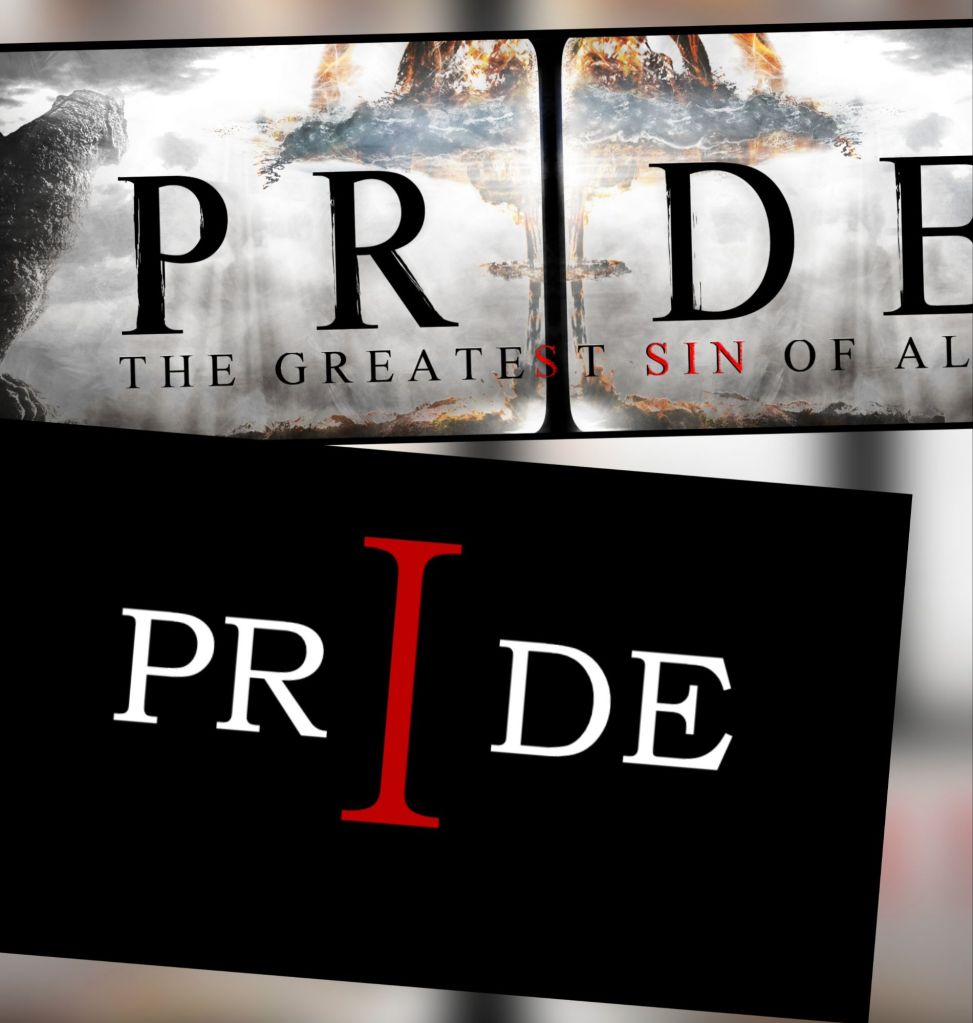
However, even in Wycliffe’s Bible, ‘pride’ not only betokens a religious ‘fall’, like the fall of Lucifer, and later of Adanm and Eve. The beautiful abstracts in the language, translated from the Greek of the Septuagint, and possibly the Hebrew, but a fall from every kind of grace and human value.
Pride goþ befor contricioun, & befor falling þe spirit shall ben enhauncid. [Proverbs xvi.18, Wycliffe Bible, 1382. The new International Version has ‘Pride goes before destruction, / a haughty spirit before a fall‘, which rather misses the point about being able to redeem one’s ‘destruction’ by being contrite – Middle English had access to both meanings of contricioun, as destruction or penance for sin, not only one of them.]
It’s worth consulting the Online Etymology Dictionary however, to get a full sense of the tension between various available meanings of the word even from the eleventh century:
proud (adj.): late Old English prud, prute “excellent, splendid; arrogant, haughty, having or cherishing a high opinion of one’s own merits; guilty of the sin of Pride,” from Old French prud, oblique case of adjective prouz “brave, valiant” (11c., Modern French preux; compare prud’homme “brave man”), from Late Latin prode “advantageous, profitable” (source also of Italian prode “valiant”), a back-formation from Latin prodesse “be useful.”
This is a compound of pro- “before, for, instead of” (from PIE root *per- (1) “forward,” hence “in front of, before, first, chief”) + esse “to be” (from PIE root *es- “to be”). Also see pride (n.), prowess. “The -d- in prodesse is probably due to the influence of forms like red-eo-, ‘I go back,’ red-imo- ‘I buy back,’ etc.” [OED]. The Old English form with -te probably is from or influenced by pride (Old English pryto).
Meaning “elated by some act, fact, or thing” is from mid-13c. The sense of “of fearless or untamable spirit” is by c. 1400; that of “ostentatious, grand, giving reason for pride” is by mid-14c. To do (someone) proud is attested by 1819. The surname Proudfoot is attested from c. 1200 (Prudfot). A Middle English term for “drunk and belligerent” was pitcher-proud (early 15c.).
The sense of “having a high opinion of oneself,” not found in Old French, might reflect the Anglo-Saxons’ opinion of the Norman knights who called themselves “proud.” Old Norse pruðr, either from the same French source or borrowed from Old English, had only the sense “brave, gallant, magnificent, stately” (compare Icelandic pruður, Middle Swedish prudh, Middle Danish prud).
Likewise a group of “pride” words in the Romance languages — such as French orgueil, Italian orgoglio, Spanish orgullo — are borrowings from Germanic, where they had positive senses (Old High German urgol “distinguished”).
Most Indo-European languages use the same word for “proud” in its good and bad senses, but in many the bad sense seems to be the earlier one. The usual way to form the word is by some compound of terms for “over” or “high” and words for “heart,” “mood,” “thought,” or “appearance;” such as Greek hyperephanos, literally “over-appearing;” Gothic hauhþuhts, literally “high-conscience.” Old English had ofermodig “over-moody” (“mood” in Anglo-Saxon was a much more potent word than presently) and heahheort “high-heart.”
Words for “proud” in other Indo-European languages sometimes reflect a physical sense of being swollen or puffed up; such as Welsh balch, probably from a root meaning “to swell,” and Modern Greek kamari, from ancient Greek kamarou “furnish with a vault or arched cover,” with a sense evolution via “make an arch,” to “puff out the chest,” to “be puffed up” (compare English slang chesty).
It is clear that English adopted the word from their French speaking conquerors but then brought it into line with the ambivalence in other PIE descended languages, except Old French and Old Norse, where the negative use was possibly the primary one. Yet none of this in all probability explains that n-gram, should it be valid at all, in showing how and why ‘proud’ descends in frequency of usage in written text after 1800. Is this because the word is more used in tandem with another concept – not pride in self but pride in being part of a wider group, which my explain the Norman attitude related to tht social class of armed knights, aristocratic military horsemen, but certainly afterwards to nation.
Pride in groups is in vogue again in England, it seems from the n-gram, but again it may not be because of pride in country, although the levelling out of the decline of frequency in the World War and inter-war years may give succour to the notion that pride in nation is part of the mix. However, like all forms of pride that requires identification with others, it is a fairly unstable phenomenon.
That’s perhaps because pride is a slippery customer, depending on the group. I have no hesitation in thinking the rise in frequency in use of the word Pride is a reflection of the usage, Wikipedia describes here: ‘It can also be used by members of marginalized groups to signal a celebration of their unique cultural identity, such as in Black pride, Mad pride, or especially LGBTQ Pride movements’.
As for national pride, the willingness to identify with it is sometimes in these days of MAGA and Trump (or Reform and Restore in Britain) akin to racism directed not only at marginalised but vulnerable sub-groups, especially ‘alien’ migrants, a category rightwing parties are always ready to expand outrageously, although usually excluding English migrants (Farage lives in Germany, Richard Tice in Dubai), despite the fact that they refuse to pay just taxes based on their own considerable assets, stored out of reach, from the country they supposedly love.
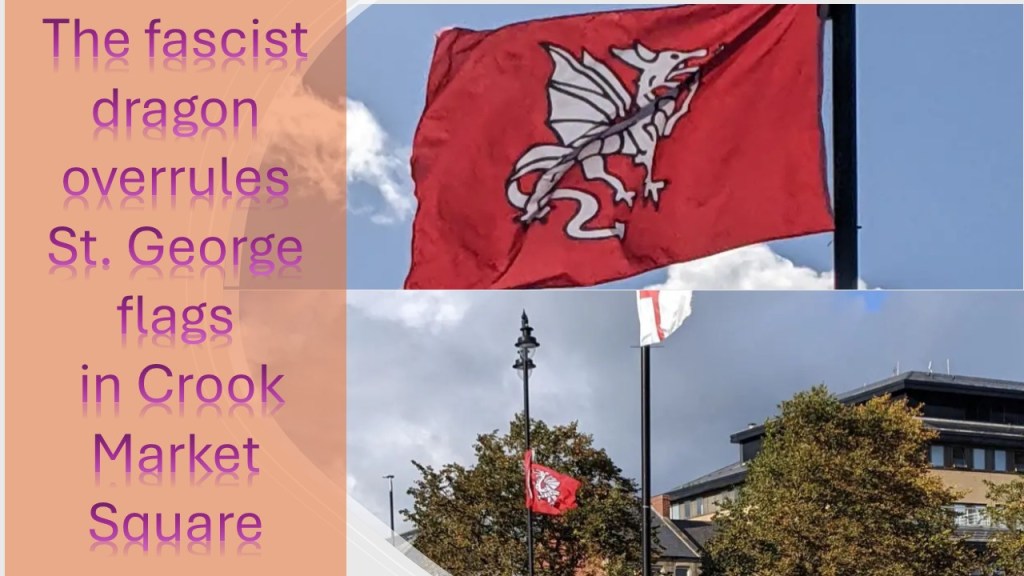
Personally I am left unwilling to identify even one thing today in which I am proud in my country, not because these things don’t exist but because national pride in England is sullied by a nationalism so narrow, it can be nothing but racist, asserting superiority and exclusiveness not equality, diversity and inclusiveness. Those last words are banned in Reform Councils like mine in County Durham, which allows the flying of fascist flags belonging to Reform and Restore in Crook Market Square but has banned from all council builings LGBTQI+ Pride flags, or any other kind of flag but those of region, country or nation.
Bye for now.
In love with the idea of a renewed open nation
Steven xxxxxxxxxx

