


So here I am at the age of fifty unemployable. Two weans. Nae savings. Nae pernsion. Shiteing myself. / So it does make you question some of your life choices. / But is that not what we are all doing? Are we no all questioning some of our choices? Are we no all worrying about our futures, or our finances, or our marriages, or our children, or our careers, or our alcohol intake? Are we no all trying to get through our day without crying, or dying, or just fucking falling down and giving up?[1] Seeing Alan Bissett as himself, Billy Connolly and a heart-breaking Alasdair Gray. Edinburgh Day one

This is Day one in Edinburgh, the journey gruelling, Geoff gave up on seeing Alan Bissett and rested in the flat in Leith as I number 16 bussed it to the Scottish Storytelling Centre to see Alan Bissett, always my hero as a Scottish writer and performer of his own very Scottish one-person shows, whether as Moira monologuing, a set of spiders but tonight himself sandwiched between his own hero set, Billy Connolly and Alasdair Gray.


Alan is as he says in the speech as himself quoted in my title in When Billy Met Alasdair (first performed in 2025), now in his fifties and has two ‘weans’ (‘wee ones’ or children for us Englanders) and with the despair of his heroes’ (but not his for tne following reason) related to their brutal and loveless upbringing (Alan’s Dad was in the audience and introduced to us), yet also not with the success that we mistakenly only identify them with. Though Connolly became fabulously rich and happy in his marriage to Pamela Stephenson, Gray rarely made profit feom his books and continued to feel unworthy of the women in his life, even the wonderful Morag whom he died still mourning. Bissett’s last novel was long ago and has won him no worldly fortune.
The play focuses around the evidence of a photograph used to pay Rodge Glass, once secretary to Gray, in penniless week and subsequently gifted to his friend, Alan Bissett, both then beginning novelists. It was taken at the launch of the first edition of the four volume-in-one Lanark,the first time all of it was agreed for publication – by Canongate of course – when Gray was signing the book for Billy. To Connolly, Gray was the genius of modern Scottish literature, as he still is to many of us. Here is the photograph from the published Bissett play, wherein Billy has a passing resemblance to how I imagine Rasputin to have been.

The play begins and ends with Alasdair Gray, in Bissett’s words, contemplating the false images upon which art is on necessity based, especially in the representation of what we call ‘real people in the throes of building images of themselves for projection to whatever audience and viewers they may have:

It is enough, at least, until at the end of the play, Bissett’ssimalacrum of Alasdair is introduced by the end of the Connolly simalacrum talking about how Gray guided him, or so Bissett imagined, towards the light, the dawn that Lanark sees in Unthank, the fictitious portrayal of Glasgow as a version of a City of the Dead, wherein Scottish writers retire after death. But the writerly themes are all there, and all as the novelist, dramatist and visual artist Gray represented as false images who need to be falsified to reveal deeper truths otherwise invisible to many – beautiful and ugly truths of love-in-action and the evil pressed upon us by anti- human ideologies centred on selfish accumulation at the cost of community. At the end of the play, Gray ponders on why a play might represent his as an exemplum of the ‘lives of artists’ that is meant to force the present audience to consider why they decidex to come to a play about the lives of Scottish artists, famed by being overhung by alcohol.

There is an awful truth in the manner in which artists are either venerated or despised because they exist solely to bear relation to those selves who crowd around them and either gawp at, or pretend to understand, them without, as it were that what they see is a constructed public image on the whole, with no authoritative relationship to truth. Artists in fact take license with literal truth or fact, sometimes claiming that the truths they tell are superior to fact or literal truth. Artists who ‘advance their own purposes’ do not do so by the use of ‘lies’ though do make use, as Bissett playing himself within tbe play agrees (with a job interviewer with no empathy for art), pretence.
And though Conolly, as Bissett interprets him, does say he was taught to see the light by Gray, Bissett’s Gray holds the spotlight only, after speaking of his death, till, in the voice of another, he says farewell and the whole of the Netherbow Theatre space at the Scottish Storytelling Centre is plunged into total darkness, somewhat uncomfortably protracted. Though a play a out finding light, as the dedication Bissett wrote for me on his play, says, it is play rounded by darkness in spaces of the thanklessness, Unthank, of the artist’s lot.

The message about the light is the one in which in the part of the play that imagines, or creates a false image, of the time ‘When Billy Met Alasdair’. When I requested that Alan sign my copy of his play I tried to say to him, but as usual cocked it up, that it was this part of his embodiment of the play that recalled the many times I approached Alasdair to sign things for me, especially those where he referred to his own work to witness some truth or other: ‘Now let me see …it’s in (here) somewhere’ ringing in my ear. To Billy, Alasdair is supposedly saying that most artists, Connolly included, have alter=ego like the one that is both John Thaw and Lanark in the novel Lanark: ‘One man is seeking for love, the other is searching for the light’. Bissett has Billy say: ‘That’s very profound, Alastair’, but it is already that in the direct quotation where one dawn looks like two.
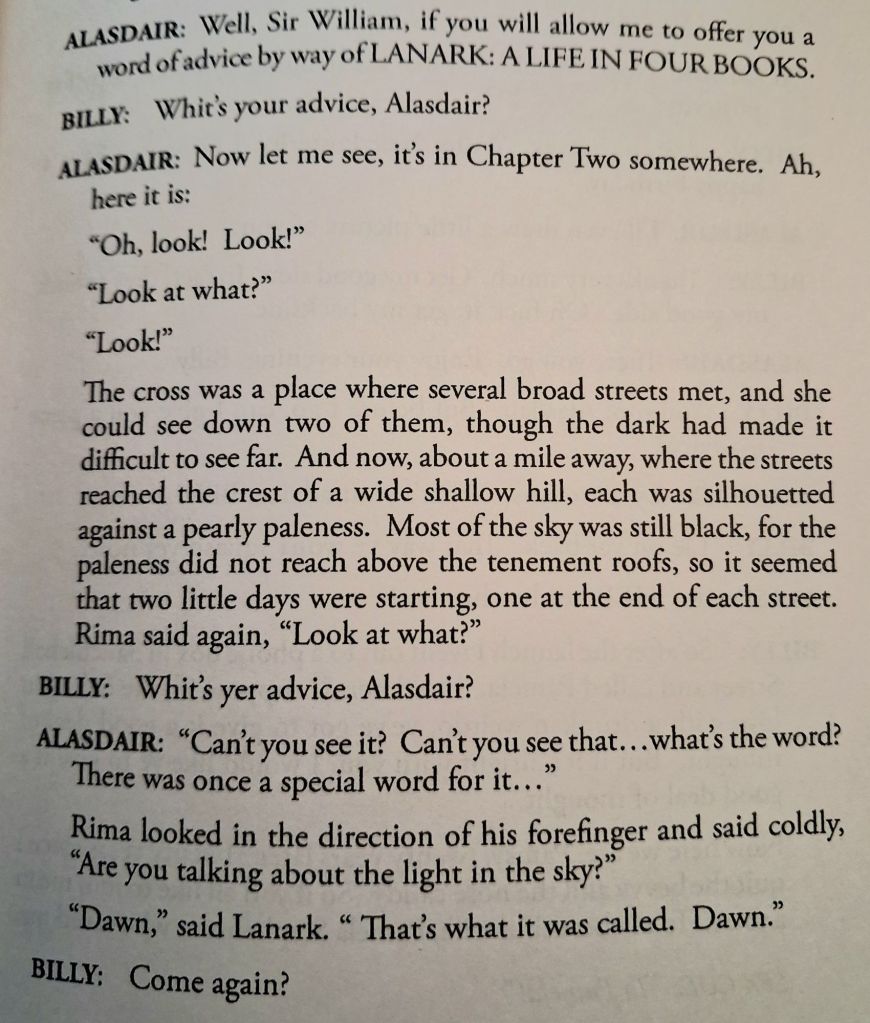
The character ‘Alan Bissett’ in the play explains that the play in which he appears, a ‘false image’ of the author perhaps, is created from his response on ‘reading about’ Gray and Connolly’s lives where he ‘realised that theirs was also a story of perseverance. Against incredible odds’. And that’s the perseverance, the waiting till we get to see the dawn again, that Bissett sees in the fact that both hero artists of his ‘just kept going’ even when ‘they felt overwhelmed’ about what was stacked against them.
Now, what not keeping going means is represented in the play not just by Gray’s obscure hues but by Connolly’s humour and the underlying belief that made him think from the beginning the ‘wasn’t sure’ that he’d ‘make it sixteen let alone sixty, after a Glasgow upbringing. That is best represented by the stories of his, and his young friends, pastimes when they were 9 years of age. It involved jumping the gap between high abandoned air-raid shelters, one gap was much wider and scarier than the the other: the boys called them “The Wee Sui (‘sui’ meaning suicide)” and “The Big Sui”.
WE returned back to the riverside flat at Leith, just by Leith Water in an old Barrel warehouse, sober and sombre but after a good night. It is late on Sunday as I finish this and I am thinking how I will write about today’s wonderful events (see the schedule above). I think the daily habit might receive a great Knock on the head.
With love
Steven xxxxxxxxxx
[1] Alan Bissett (2026: 19f.) When Billy met Alasdair Salamander Street, Wordville.

