What villain actually had a good point?
Iago in William Shakespeare’s ‘Othello’ says ‘I am not what I am’. Is anybody?
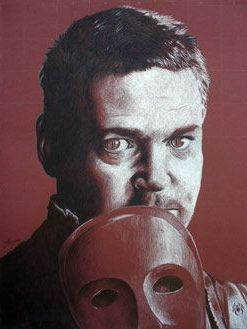
At least no-one doubts that Iago is a villain. The phase ‘motiveless malignity’ was a phrase designed by the Romantic poet, Samuel Taylor Coleridge to describe him, thus not only attempting to simplify the stereotype of the villain but to ascribe any ‘motives’ the villain may use to excuse their behaviour, driven by who knows what, to the inexplicable or if not merely to the fact that villains thus once designated just act villainously. Here is what Coleridge says of the motives Iago does use to explain his behaviour calling them mere acts of:
the motive-hunting of motiveless Malignity—how awful! In itself fiendish—while yet he was allowed to bear the divine image, too fiendish for his own steady View.—A being next to Devil—only not quite Devil—& this Shakespeare has attempted—executed—without disgust, without Scandal!—
(Lectures 1808-1819 On Literature 2: 315)
He was speaking of a speech in Act 1, scene III, but I want to look at his first explanation in Act 1, scene I. Iago and his foolish follower Roderigo, have entered mid conversation; Iago clearly having said something to make Rderigo doubt Iago in speaking of his hate of his employing general, Othello. Clearly, Iago has to double up on his reasons for claiming that he has well founded hate of his superior officer. Here, is Roderigo’s question and Iago’s answer:
RODERIGO
Thou told'st me thou didst hold him in thy hate.
IAGO
Despise me, if I do not. Three great ones of the city,
In personal suit to make me his lieutenant,
Off-capp'd to him: and, by the faith of man,
I know my price, I am worth no worse a place:
But he; as loving his own pride and purposes,
Evades them, with a bombast circumstance
Horribly stuff'd with epithets of war;
And, in conclusion,
Nonsuits my mediators; for, 'Certes,' says he,
I have already chose my officer.'
And what was he?
Forsooth, a great arithmetician,
One Michael Cassio, a Florentine,
A fellow almost damn'd in a fair wife;
That never set a squadron in the field,
Nor the division of a battle knows
More than a spinster; unless the bookish theoric,
Wherein the toged consuls can propose
As masterly as he: mere prattle, without practise,
Is all his soldiership. But he, sir, had the election:
And I, of whom his eyes had seen the proof
At Rhodes, at Cyprus and on other grounds
Christian and heathen, must be be-lee'd and calm'd
By debitor and creditor: this counter-caster,
He, in good time, must his lieutenant be,
And I--God bless the mark!--his Moorship's ancient.
RODERIGO
By heaven, I rather would have been his hangman.
IAGO
Why, there's no remedy; 'tis the curse of service,
Preferment goes by letter and affection,
And not by old gradation, where each second
Stood heir to the first. Now, sir, be judge yourself,
Whether I in any just term am affined To love the Moor. 2
RODERIGO
I would not follow him then.
IAGO
O, sir, content you;
I follow him to serve my turn upon him:
We cannot all be masters, nor all masters
Cannot be truly follow'd. You shall mark
Many a duteous and knee-crooking knave,
That, doting on his own obsequious bondage,
Wears out his time, much like his master's ass,
For nought but provender, and when he's old, cashier'd:
Whip me such honest knaves. Others there are
Who, trimm'd in forms and visages of duty,
Keep yet their hearts attending on themselves,
And, throwing but shows of service on their lords,
Do well thrive by them and when they have lined
their coats
Do themselves homage: these fellows have some soul;
And such a one do I profess myself. For, sir,
It is as sure as you are Roderigo,
Were I the Moor, I would not be Iago:
In following him, I follow but myself;
Heaven is my judge, not I for love and duty,
But seeming so, for my peculiar end:
For when my outward action doth demonstrate
The native act and figure of my heart
In compliment extern, 'tis not long after
But I will wear my heart upon my sleeve
For daws to peck at: I am not what I am.
But is Iago here merely inventing a reason and a self-description? Or is his ‘reasoning’ based on at least something we might think of a truth spoken by a villain, and containing a ‘good point’ or two along the way. The point of that discussion seems to be that people are only the interests they serve, the role they play in following those interests being a mere appearance. The entire motive of life, it seems to be argued, is not forever proving yourself a character made of the things characters are made of, but merely a negation of identifiable character underlying its appearance: ‘I am not what I am’.
Now we frequently underestimate Coleridge. In saying of Iago that he hunts motives and that, in that, he is like the Devil, he is saying something about the premise of what holds the notion of character, and personal identity, stable, so much as to be divine image of God implanted there. It is divine because God shows us that it too is the description of God of Himself – without context but definitive nevertheless: ‘I am that I am’, the phrase God used to describe himself and his motives to Abraham.
Coleridge thought this equivalent to the principle of true creativity, describing the Primary Imagination in Biograhia Literaria as the ‘ living Power and prime Agent of all human Perception“. He calls it further, a “repetition in the finite mind of the eternal act of creation in the infinite I AM”. The idea is based on Plato’s insistence that humans having finite minds cannot understand the things that make God God or indeed any entity the entity it is, and must rely on repetition to mimic the operation of the infinite.
When Iago says ‘I am not what I am’, he both negates that repetition and hence the idea of infinity in finite minds and insists that there is no basis for describing character, except the promotion of self-interest without motive other than doing homage to that absent self, that knows itself only by its appearances, and will not be contradicted in that knowledge’s certainty, no other solid principle being available.
In fact for most of us today that truth is possibly the only one we have and has become the means by which truth manifests itself as indistinguishable from show and display. That truth keeps on appealing to Heaven to judge it merely because it is certain Heaven does not exist, except as another superior to call upon to mask self-interest.
This alone explaims a world in which Donald Trump or Nigel Farage is an object of belief: either can be anything that serves his self-interests. Neither can be what he is, but what pays homage to that thing he appears to be. Villains have ‘good points’ to make because they to have a way of explaining the world that sustains them and their villainy, fiddling while the world burns or is bombed to rubble under the negation of all imaginable creation, with no motive but self-assertion as negation.
Bye for now
With love
Steven xxxxxxx

