


The art of the unfinished: Betrayal, Revenge and Reparation. I reflect in this blog on what it means to ‘forge through’ an unfinished love story. It may be the biggest forgery of all, but does that matter? It certainly doesn’t if you act the role well enough and with attention to that love. This is my reflection on Steven Soderbergh’s The Christophers, seen on Friday 15th May 2026 at Screen 4, Odeon Deluxe, Durham City.
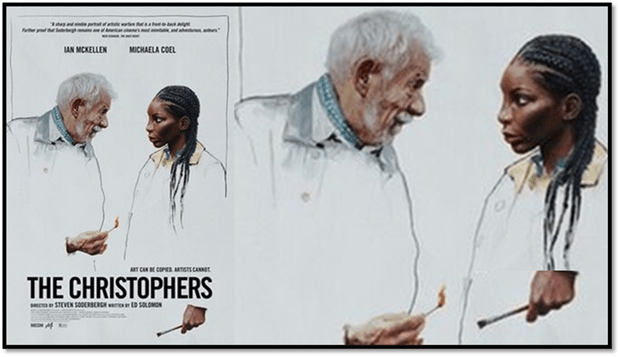
It must have been a thankless task to play the two children of a fictional artist Julian Sklar for their role is merely to illustrate how much the discourse of visual art can be reduced to the discourse of making a quick buck in the short term. Peter Bradshaw’s admiring review of the film tries to give the roles substance by comparing them to minor characters in a Dickens novel, describing them as Julian’s ‘grasping adult children Barnaby (James Corden) and Sallie (Jessica Gunning); the latter pair are heartily disliked by Julian himself, figures of Dickensian mediocrity and greed’.[1] But when Bradshaw says ‘Dickensian’ of these characters, he means they are thin (indeed paper-flat) characters who merely vary the tone of the film between its high points made up beautifully written, directed and acted scenes of what, a better film critic, Kate Stables names as the art director, Steven Soderbergh ‘returning to the spare template of “two people in a room, talking”’. Her mention of the minor characters is accurate, although a little unnecessarily judgemental of writer and actors who perfectly show the virtue of register variations in dramatic art – think not of Dickens but Shakespeare. Speaking of the two main characters’ superb realisation by Ian McKellen and Michaela Coel, she says:
Despite their age-gap, the two actors feel beautifully attuned here – in contrast to Gunning and Corden’s appearances as the squabbling one-note siblings, which push the film periodically into a broader comic register.[2]
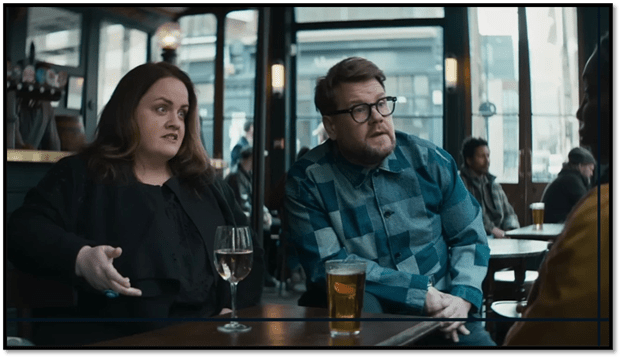
Although, I am no great fan of James Corden (Gunning is more broadly laugh-out-loud funny but thinner in character), I felt he did justice to this role and to its Dogberry humour, not least in the speech in a pub (shown above) that stuck with me. When asked by the Coel character, Lori Butler, outright whether what the adult children of Sklar want is for her to forge their father’s unfinished paintings, he enacts so understatedly and well a bumbling play on words to the effect that he does not want Butler to forge paintings as to forge through their unfinished nature, and to forge on the redemption of his father’s reputation as an artist. It is played, as the best comedy is, so that you barely notice its relevance to the major themes of the enacted script.
When a film of this stature appears from a director well known for artistic direction, it is wont to be praised highly before it is thought out with any depth of consideration. Peter Bradshaw is typical – his praise appropriate but his statements about the film’s purpose thinner than a Dickensian character as he sees them:
The Christophers is a movie about contemporary art and about what Alan Bennett in his play about Anthony Blunt called “a question of attribution”, and it puts new life and wit into the (perhaps) tiresome subject of movies on this subject: what has value and what does not.[2]
I usually steer clear of statements of what an artwork is ‘about’, for they are, like the word itself, just approximations in the case of nuanced works like this. As Bradshaw and Stables both point out, the film turns on the juxtaposition of an actor at the top of his game with another of very different style. McKellen’s every facial gesture strikes a tragic tone without any overly pointing towards the fact that this is what he is doing – even down to the production of tears so genuine, I felt them rising in me too.
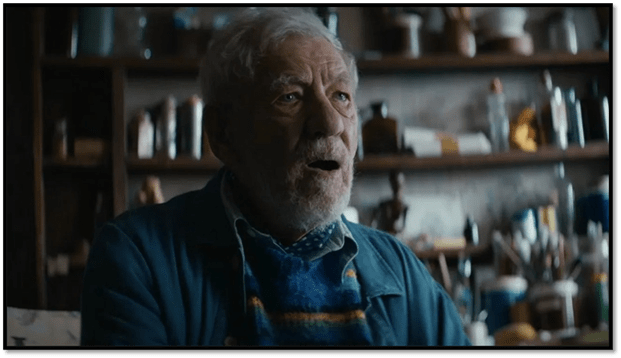
As readable as his face is, he is not a simple singular emotion we read of in his face and actions and every playfully wicked whim carried through, as in the still below where the actor has the facial freshness and playfulness of a six-year-old:
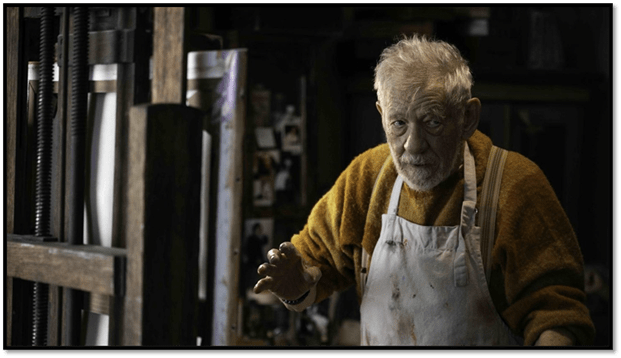
Both Bradshaw and Stables use the same word of Coel’s enactment of Lori Butler: that she is ‘unreadable’. Here is Bradshaw:
Opposite McKellen, Michaela Coel is at the top of her game as Lori Butler, a charismatically self-controlled former art student fallen on hard times. Coel contains anger and passion within an opaquely polite and unreadable manner … [2]
I stole the cliché. ‘top of (their) game’ to apply to McKellen above not Coel, for Coel has many years in which to show us that even such a fine performance as this can be bettered. Kate Stables elaborates what she means by ‘unreadable’ better, speaking of:
Coel’s compelling steely stare, sphinx-like stillness and tersely devastating delivery of Lori’s truths, to powerful effect. There’s a delicate theme about performance running through the film – Julian, deprived of painting, has made being ‘Julian Sklar’ into a kind of performance art. Lori, fascinated by “the art of becoming someone else”, is hiding her true self on canvas, and in life. [3]
Stables has it right here: McKellen communicates most when being foxed by a character’s incapacity to communicate just what he would like to do, either in conversation or in his ‘relationship’ as Sklar calls it, with his canvas. She says that you ‘glimpse McKellen’s skill most vividly, though, in the poignant moments where Julian is wounded by his inability to communicate with a bare canvas’ That is so though in the scene in the still above this is nuanced with the frank boldness of his attempts to still the canvas after he is failed to do so with physical destruction by an agent (Lori) or by fire in a pit, by throwing feathers, paint and glue at it – only to realise that he ought to have known that you can’t throw feathers by hand, if you already have glue on them.
That stare is wrongly however generalised as ‘steely’ (no performance could survive on the consistency of steel alone. Here Bradshaw gives us a stronger clue of why Coel’s performance so stuns and is so appropriate – her role vis-à-vis Sklar’s is so very multivalent. He tells her she must not be an ‘artist, nor his greatest fan’, only to later say that he that he only said that because people play these roles so badly that their falsity rings through. We have to believe that Butler is capable of many roles: artist, criminal forger, understander of artistic process and therefore great copyist and genuine recreator of another’s vision, once that vision has been lost. Below, her facial gesture is so rich that it stuns with the multiplicity of emotion and response that remains ‘unreadable’ at this point, and, indeed, throughout the film, but it isn’t just ‘steely’.
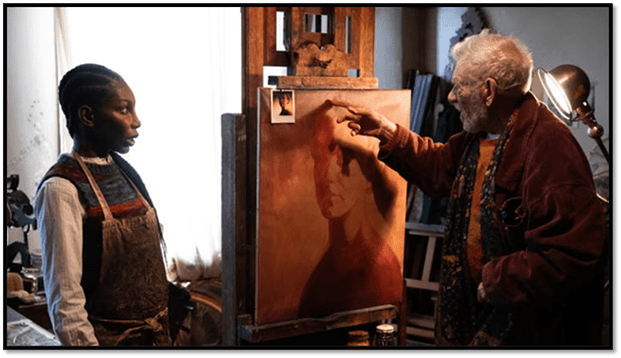
I think this still is so indicative of her rich enactments because it shows the actor realising how the touch of an artist on a unfinished portrait may reveal things she cannot yet interpret or act upon, but which she will, with stealth and unrevealed secreted planning in the progress of the film, when she comes most near to fining a subject (other than Untitled VI – a title mocked significantly by Sklar with long consequence for Butler) by precisely being a forger, who, in Sklar’s disparaging description, “squats in others’ creativity”. Except, eventually she squats exactly where forgery becomes nearest to creation, and artist making their subject ‘in their own image’. The near touch of McKellen’s hand on his portrait of Christopher above, barred by the fact of paint, is so like that neat-touch of Michelangelo’s God on his creation’s finger.
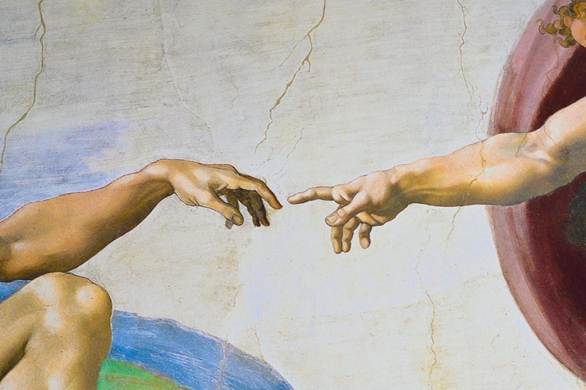
The portraits of Christopher play a huge silent part in this film. They are in Bradshaw’s words: ‘a series of much talked-about paintings that Julian began showing in the 1990s while he was still a big name but then withdrew from sight and hid somewhere in the house; these are passionate studies of his then beautiful lover, Christopher’. I would like to think Bradshaw is being reflexive here. It is not only the paintings that get withdrawn from sight, and ‘hid somewhere in the house’ but the artist too. And that house is a Gothic creation, like Dracula’s castle, made up of two barely communicating halves. And, as for hiding things in the film, that is to say nothing of the mystery of the art’s model, Owen Christopher Appleton (played as an adult by Ferdy Roberts), who Butler unearths at the end of the film as now the owner of a frame maker’s business to ‘restore’ to him, images of him as no-one has ever seen them before, even the supposed artist Sklar. At the end of the film we see Christopher talking about the paintings in a gallery exhibition but never hear his words.
I think the issues of the film lie here. Restoration and reparation of art has become Butler’s job, although it is clear that, her reputation ruined by Sklar on a talk show called Art Fight (precisely over his ignorant – by his own admission to Butler in the current time of the film – dismissal of her work Untitled VI) she harbours feelings of trying to inflict as much damage on Sklar as he did to her. The characters played by Corden and Gunning speak of her getting her just ‘revenge’ for the earlier betrayal of her art.
Yet the film has many instances of such betrayal: Kate Stables speaks of film writer Ed Solomon’s ‘dexterous script’ finding for us ‘twisty, unexpected outcomes in a string of unlikely alliances and betrayals’. Sklar finds an essay of Butler’s in which she joined in the destruction of Sklar’s reputation was at its lowest (about the same time of John Minton’s reputational loss and his suicide) and then asks her, without betraying the fact,: ‘Have you ever been betrayed’. The theme of duplicitous betrayals thickens even to the point of whether forgery (or even ‘restoration’ – another fiction) is a betrayal of art. She has, of course, haven’t we all – even in a world of, in Sklar’s witty repost to her ‘throuples’, which, he adds, were in his time called ‘infidelity’.
But the issue of betrayal is most poignantly played over the reason for the non-finito state of what are supposed to be the third-series of ‘The Christophers’, those Butler is commissioned to forge into completion. We learn circuitously that they were unfinished because, near the time when Sklar came out as gay, his lover, a young man who helped him frame pictures, left him without explanation. We feel in Sklar a lifetime of fely betrayal in this story, except that it is not the whole story. Sklar later tells Butler that he cannot touch the painting to destroy them, and if he does, his efforts make them stronger, because it is he who had betrayed ‘Christopher’, not the other way round. He had ‘destroyed his life’. Had he? How? These are questions of moment in queer history. Owen does not appear destroyed in the film when we see him as an adult but the point remains that Sklar felt that as strongly as he felt betrayed and this explained why he would not touch them and thinks he is commissioning Butler to destroy them.
When, after Sklar’s death, Butler paints them – using feathers as part of her resources, they are clearly an attempt to restore not forge or fake something with the status of art – a story of love as achievement not failure. The whole film becomes one of reparation, as the psychodynamic philosophers since Melanie Klein and theologians speak of that concept. This film is less about questions of attribution as Bradshaw says as the fact in Kate Stables’ words that ‘forgery’s act of creation makes it a valid artform’. It is also about the idea of what constitutes a legitimate end to one’s life, whether we mean ‘finish’ or purpose, and that feeds off the theory behind the concept of the non-finito in art, as practiced by Michelangelo and Picasso for different reasons. Kate Stables cleverly sees an inverse link between Soderbergh and his main character Thus regarding what constitutes ‘success’ in art:
There’s a certain irony in a film about a stalled artist and his disputed legacy being made by Steven Soderbergh, one of cinema’s most prolific creators. Soderbergh, who once admitted that “a success, to me, is the ability to keep working”, has made at least 37 films, as well as prestige TV. He’s released three features in the UK in the last 14 months alone, busy with what we might term his bold Late Middle period.
By contrast, the subject of his latest film, the elderly and long-inactive bad-boy painter Julian Sklar (a garrulous Ian McKellen) has been creatively barren since the late 1990s, when he abruptly abandoned the third set of his famous portrait series ‘The Christophers’. [3]
Success and quality – are they issues of what is ‘finished’ or what is ‘unfinished’ in our creative lives and remains gloriously imperfect, its lost lines pleading for realisation. Are they compacted in the glory of continuity whatever the answer to that last question. In fact, this film is gloriously unfinished and that is why it matters. The story continues, even perhaps to Butler’s exposure. It is not a necessary end for the film pokes fun at the very means by which authentication is guaranteed scientifically, as Fiona Bruce often smirks over in that series of lost masters being refound.
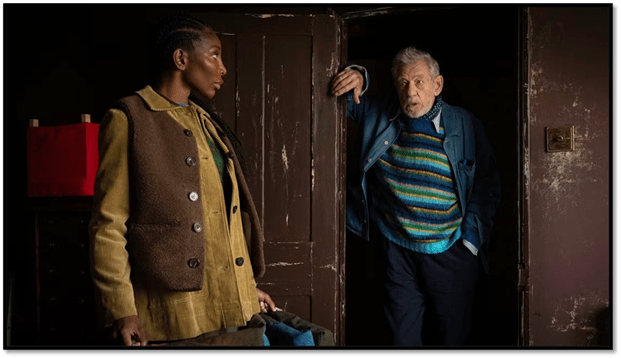
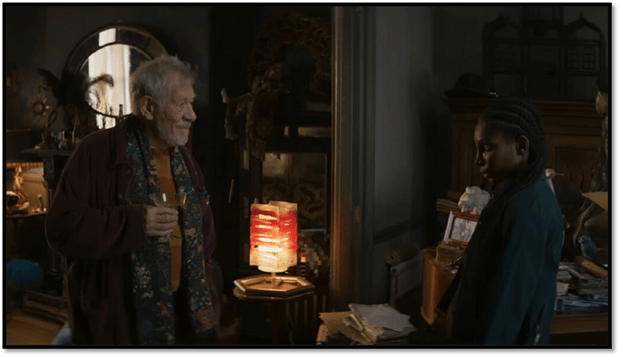
And meanwhile we rediscover that two people talking can make great filmic art, where mise-en-scene communicates a lot too.
See this great film.
With love
Steven xxxxxxxxxxxxxxxxxxxx
[1] Peter Bradshaw (2026) ‘The Christophers review – Ian McKellen and Michaela Coel are the double act of the year’ in The Guardian (Thu 14 May 2026 09.00 BST) available: https://www.theguardian.com/film/2026/may/14/the-christophers-review-ian-mckellen-michaela-coel
[2] Bradshaw, op.cit.
[3] Kate Stables (2026) ‘The Christophers: Steven Soderbergh pits Ian McKellen against Michaela Coel for a film rich with ideas about art, criticism and forgery’ in Sight and Sound (BFI) (7 May 2026) Available: https://www.bfi.org.uk/sight-and-sound/reviews/christophers-steven-soderbergh-pits-ian-mckellen-against-michaela-coel-film-rich-with-ideas-about-art-criticism-forgery

