


The idea of the exception that stands out from a plethora of forgettable random encounters should be now recognised as the trope of what we used to call the sexual revolution in the short term or the ‘Crisis of Faith’ in the longer term.
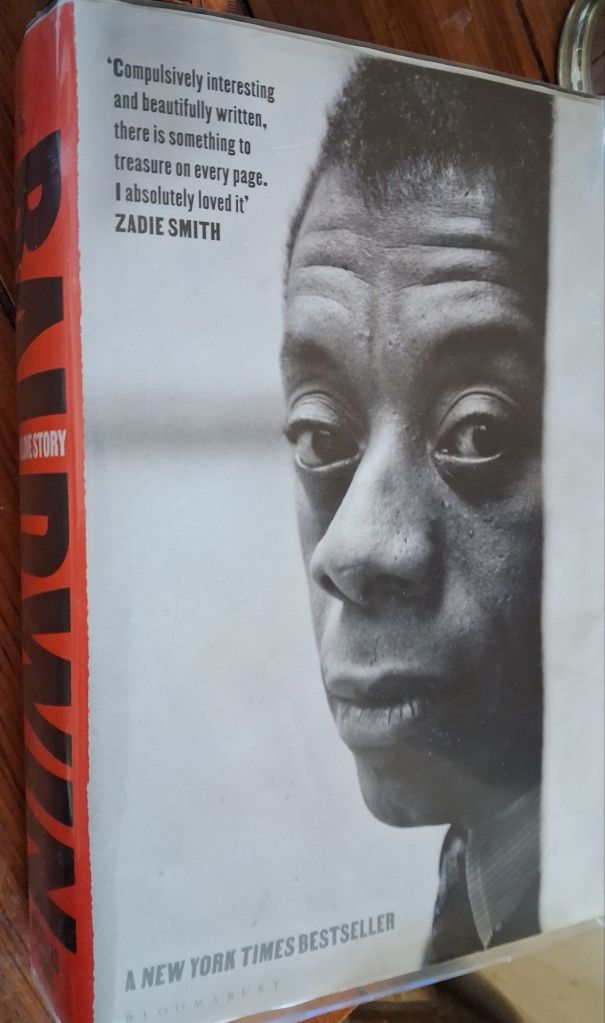
This blog should, perhaps, be treated as an interim reader’s ‘report’ based on reading Nicholas Bogg’s remarkable and wonderful long biography of James Baldwin, for Baldwin stood at the cusp of so many changes in psychosocial dynamics and reported without resolution on many of them. Necessarily therefore this book touches on the debris of ongoing change in ways of living our lives that have not yet been theorised, or perhaps overtheorised in simplistic ways. In a sense no writer, from whatever age does not stand on this cusp and this report is based on one commentary on this from the examination of the links Boggs makes of Baldwin’s fascination with the life of Matthew Arnold.
Arnold is thought by many to be a stolid Victorian sage standing upon the shoulders of outdated ideas, even in his own time, in their most timeless state of expression, in his great essay Culture and Anarchy. He can be read as forcefully denying the significance of some sociocultural change, whilst indicating in his poetry a kind of crisis in the world, not least in his prompting of the idea (that perhaps reached fruition in E.M. Forster of the use of a belief in the elevated values of personal relationships to offset cultural losses in the realm of overlong believed but false certainties. That is certainly how I read, and I think Baldwin read, Arnold’s greatest poem Dover Beach.
I do not know, not knowing all the past biographical literature, if the idea is new to Boggs, but what strikes me as I read is a strand of references to the early storytelling work of Baldwin and the vast import to him of lines from the end, especially, of Dover Beach. I am now just beginning Part III of the biography, but the last reference to this issue was in Boggs’ account of the long duration of break up between Baldwin and his lover, Arnold, the first young black man, though not the first young man per se, mainly orientated towards sexual attraction to women and therefore, in Baldwin’s then pained and contradictory understanding, a real ‘man’ in the making though yet a boy. Such love-objects were, when matured, the type he favoured, tbe model for whom is the white Italian, Giovanni, in Giovanni’s Room. After Arold’s loss, his next elevation of this kind of lover was the mature Turkish colleague and lover (recruited by Baldwin as his favourite to play Giovanni in a stage play he was writing of that novel with a suggestion he would play against Marlon Brando), Engin Cezzar.
As Arnold had increasingly turned into a drain on his income rather than his heart, Baldwin wrote the short story Come Out the Wilderness dealing with Ruth and the end of her relationship with lover Paul and her eventual determination to ‘get out from under’ him. The inevitable question “What then?” arises for Ruth as she returns to drinking in Greenwich Village, as it does for Baldwin.
In the story, she sees a “stranger at the bar” of one such Village drinking venue. Boggs picks out the significance of that ‘random encounter with a stranger’ as an emblem of how choices of romantic partner are made, but only in the vision of a long duration of many ‘false’ choices, or indeed encounters of a shorter duration but close bodily contact, that could not even be described as thoze of chosen by anyone. Here, is Boggs’ commentary, that I quote in full because it picks up the theme that Baldwin related to Matthew Arnold.
But first an important piece of knowledge new to me, or at least not known it this significance to tje shaping of his early story writing, from his debut novel Go Tell It On The Mountain to Another Country, the latter of which was still under gestation as a separate novel at the time of which I spoke above. I had not, for instance, known that the germ of Giovanni’s Room was part of the same peoject as other germs, mainly about Vivaldo then proje ted as a black male, that became Another Country. Tje stories of both novels had originally been intended to be part of one novel, significantly to be entitled Ignorant Armies, taking its title from Dover Beach, of which more later. [1] Here then is what Boggs says of Come Out the Wilderness.
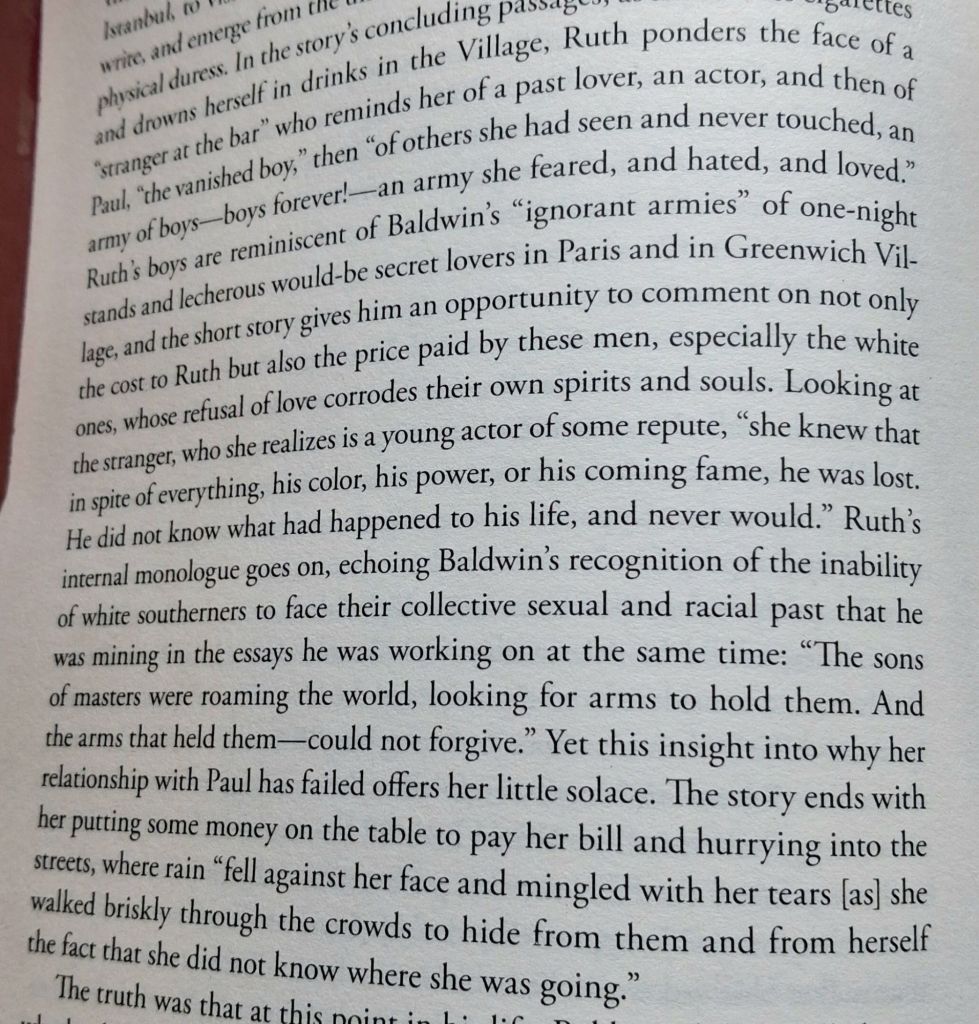
Ruth’s random encounter with one young male face can only be known to be ‘random’ because she sees in it all the other faces that she may or may not have chosen for some kind of alliance, of whatever duration, in tje past. In suggesting that all of these faces (an ‘army of boys – boys forever – an army she feared, and loved, and hated’. Boys, of course, not men, for maturity too counted in determining a ‘real man’ as well as discounted signs of feminisation and softness, although those too mattered as might be guessed in the role of Elisha in Go Tell It On The Mountain. Boggs is clear that this field of lovers to be ‘chosen’ was an army because Baldwin aligned them, in another sense (perhaps) that that intended by Matthew Arnold in first using the phrase ‘ignorant armies who clash by night’, for the idea that men – hardened bodies with the feel of defensive armour – have a kind of sex that can be more easily though of the ‘clash’ of hard things together, a thing he both ‘feared, and loved, and hated’ about male-to-male sexual partnership, as well as the sheer multiplicity of possibilities he knew to available in Greenwich Village bars, and amongst which available boys he had been one, just as, we know in Book One of Another Country, the beautiful Rufus was – for sale even sometimes as he kept himself alive by ‘peddling his arse’.
Now the use of Arnold is not as bizarre as some might think. Here is the last section of Dover Beach.
Ah, love, let us be true
To one another! for the world, which seems
To lie before us like a land of dreams,
So various, so beautiful, so new,
Hath really neither joy, nor love, nor light,
Nor certitude, nor peace, nor help for pain;
And we are here as on a darkling plain
Swept with confused alarms of struggle and flight,
Where ignorant armies clash by night.
For Arnold that ‘darkling plain’ was such a one as wars were fought (based no doubt on the plain of Troy) but also a place of non-differentiation of the special or ideal from the common, a world without culture, “The best that has been thought and said”. For in the ‘dark’ all cats are the same as they say of multiple sexual liaisons. Personal love relationships might seem to be build a culture that might pass as a new truth for a new world but only if, like love of God, it builds into it the role of faith in the thing we love. That’s why the poem jumps from a consideration of the diminishing ‘Sea of Faith’ in modernity to the call to his loved one, always assumed to be Arnold’s wife, to be true / To one another’, a call for not only truth in speech but loyalty and fidelity (‘faith with a small ‘f”). There is no doubt that these shifts in register and context of the poem tie the attempt to bind lovers in vows that are certain where in the generalised failure otherwise of a global ‘Sea of Faith’ sensed by the poet when he listens to the world as he now listens to the sound of the action of the tides on Dover Beach:
But now I only hear
Its melancholy, long, withdrawing roar,
Retreating, to the breath
Of the night-wind, down the vast edges drear
And naked shingles of the world.
In the past I have thrilled at the evocation of the ‘night’ in this poem but not given it its human due, too ready to see it as vaguely pointing to the dark night of a soul which God seems to have deserted, but it is a ‘night’ in which, sight being diminished, we listen closely to the breath in our ear from the ‘naked shingles’. There is here a strong sense of radical guilt about the body and the sense that militates against the ‘sea of Faith’ and human fidelity and loyalty. That Baldwin felt all that, none of us could prove but it seems that it may explain why Baldwin tried to explore love across boundaries of sex/gender and sexuality in the two novels that were once one (without then the character of Rufus from Another Country) and call it Ignorant Armies in prospect. Earlier in his biography, when he deals with the writing of that latter projected novel, Boggs ties down the themes that emerged after Baldwin’s debut novel as related to the writer’s attempt to realise why it was such a struggle to birth the novel that would understand queer male love, even finding the problems such a project would encounter in the novels of André Gide. Boggs explains that the purpose of exploring Gide and in somewhat damning his explorations of ‘homosexuality’ (being the term he uses in 1954) because, if he was going to do that ‘he ought, in a word, to have sounded a little less disturbed’. Later Boggs tells us, rather taken aback by the fact that people saw this as an attack on Gide, Baldwin addressed that issue thus: ‘”that was meant as a commentary on myself,” he said in an interview, “I was accusing myself, perhaps not directly enough, of a certain fear and hypocrisy'”‘. And the thing that made him afraid was that the cause of both of their failures to avoid hypocrisy in examining ‘homosexual’ relationships in men was that they both had ‘a powerful masculinity’ but, at the same time ‘found no way to escape the “prison house of that masculinity”. [2] There was, Baldwin thought something wrong with men – not ‘homosexual men’ but all men – that needed to loosen itself from the excuses of biological sex and choose different ways of being and relating as men with women and other men, that might include a redefinition of masculinity. This is explored in Rufus’ experiences of ‘peddling his arse’ in Book I of Another Country, though later we learn that Rufus had failed to cement his love for Eric in response to his turn to hegemonically straight form of bisexuality. Boggs however picks out another section about Eric’s love-life as a man bisexual but hegemonically gay to illustrate this from Another Country. As I came across it, I remember reading it in the novel itself, when I first noticed the use of Dover Beach.
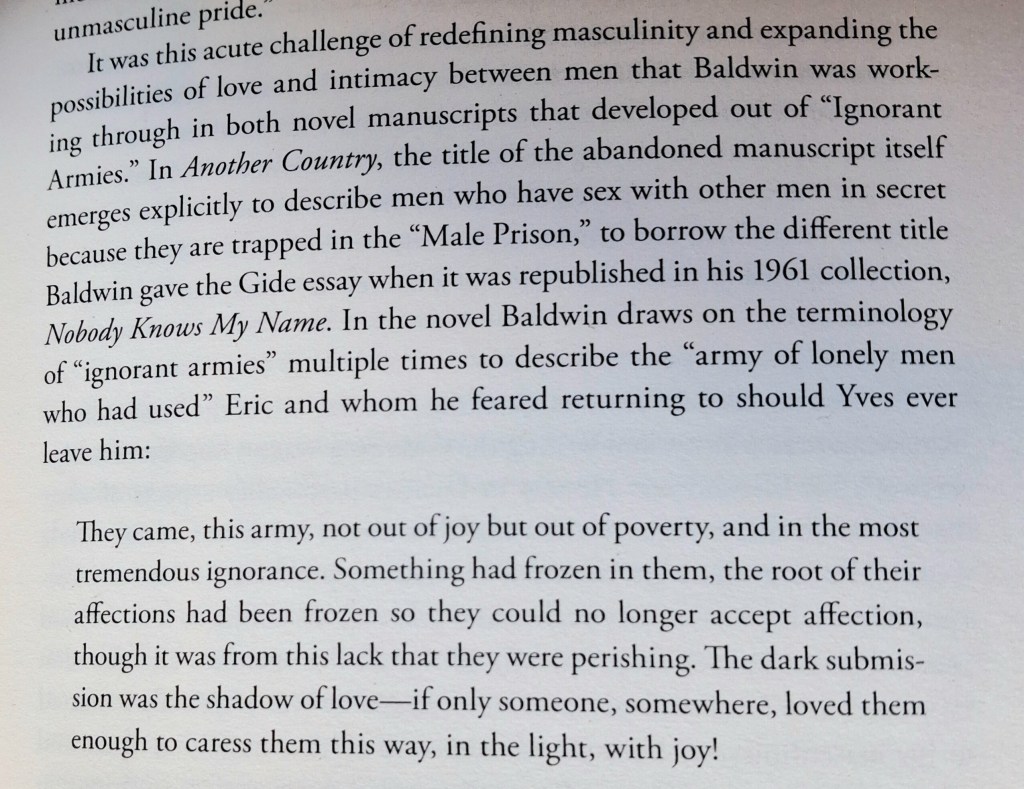
Reading this again now I register the same shock at the way the queer novel might have developed following the lines suggested here – perhaps has I suggested they were developed by Colm Tóibín in my recent blog on his new short stories (see this link for that). It would have been a novel not about hard defences of static identities but of loose and soft boundaries in the multiplicity of ways, manners and styles that people express themselves relationally to and with each other – something about ethics but a soft ethics, accepting of all difference, nut not accepting of all abuse and aggressive taking of others without account of the person. When John Rechy’s novel Numbers came out, the chance of such a novel became less. To accept our queerness we were asked to accept a world where issues like faith and belief in each other (not one tied to institutions) did not matter and was outdated and there was no longer an issue with sexual narcissism. Had anyone not noticed that men had been trained to be thus forever and that new worlds of love relationship needed reconfiguration not abandonment of the values of mutuality. I mourn this but, it is not too late. Colm Tóibín shows me it is not too late. Poverty and ignorance covers in Baldwin’s formulation the links between economic poverty and emotional-cognitive poverty, whilst ignorance are those kinds of conscious and unconscious negation that fail to allow love to thrive and see it as irrelevant. Baldwin uses organic metaphors – the frost has taken the thing whose roots must be cherished if affection is to leaf, bud and flower. It is akin to that night where all cats are black. Baldwin wanted an openness I think we have not yet achieved and hat queer culture even sometimes scorns.
I wonder how much we, as a queer community, realise the importance of a visible tangible ‘caress. in demonstration of love, that happened ‘in light, with joy’ is or that light and joy might be two aspects of the same touch without the clash of the armour of the ignorant armies of the night.Or do we see all that as sentimental trash – the residue of heteronormativity. I hope not. Bye for now. Let your random encounters have the wherewithal to grow not perish into insignificance. This is not about positivity on the scale of self-satisfaction but the attachment, whatever its duration and intensity, that is mutual. We need our faith in people back, without feeling hat we always need conventional codes for it.
With love
Steven xxxxxxxxxxxxxx
____________________
[1] My photograph below is of a passage from Nicholas Boggs (2026: 246) Baldwin: A Love Story, London, Bloomsbury Circus
[2] ibid: 150f. The photograph of text below the note is from ibid: 151.
 Steve_Bamlett_blog