


Whilst we like to think children have no conception of death, the evidence seems to be that from the age of 5 upwards, children begin to develop an idea of death as and end, of worldly life at least, though their views of this still contain elements of magical thinking as to cause of death – as a punishment of the person or another person who needs them – or its mitigation. My own memories, when I try to recall them can’t, of course, be trusted for childhood memories are necessarily confabulated from half-understood data, but I remember the fear of ‘stopping’, of coming to a ‘full stop’, period. This sense of vulnerability to being consumed totally is I think almost certainly linked to child ideas of hunger, and the relationship of hunger in yourself or another to fantasies of consuming others or being consumed. Dickens’ character Mr Silas Wegg in Our Mutual Friend, has a surviving version of that myth: ‘Scrunch or be scrunched’, the root of competitiveness in the relations of capitalism. I remember feeling so vulnerable at 5. Would I live, or would life consume me, before I had a chance of growth. In my piece on The Gathering below, I feel images of hunger and consumption in play with images of pause, silence and ending. I feel the hangover of the ‘full stop’ in British English, ‘period’ in USA English, ‘period’ (the sense of something ending – at least for a moment that is significant and about more than just taking a pause for breath.But let’s start with some background to Boswell Partridge’s poem.
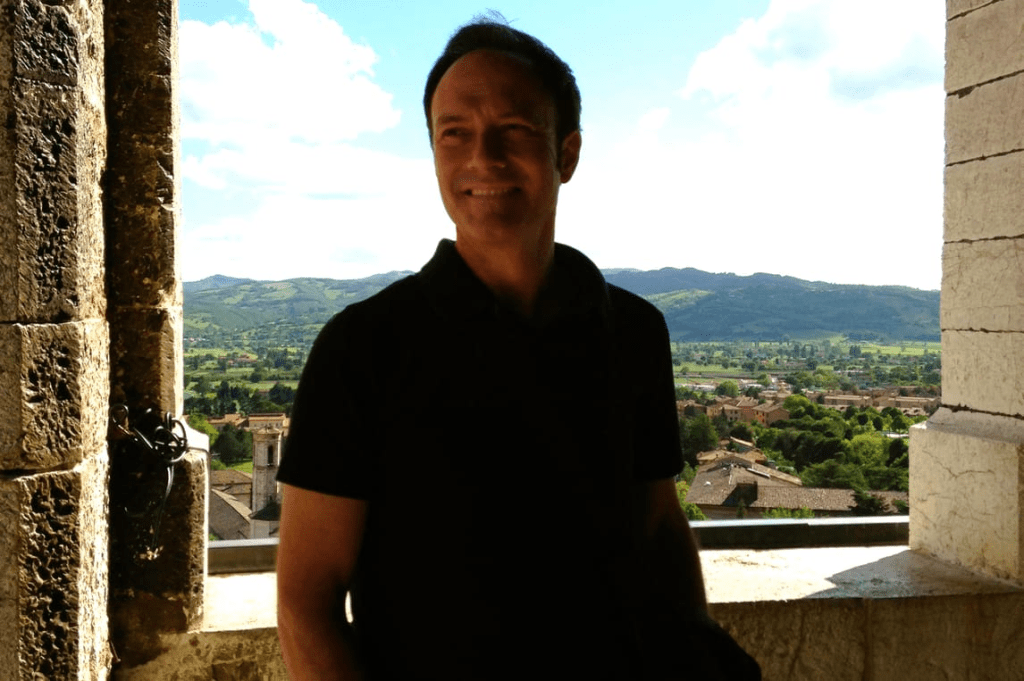
In an earlier post (at this link) I simply noticed, without significant comment, the uniqueness of a poem by American-Irish poet (he lives in Vermont), Partridge Boswell (above) – I repeat the poem in an appendix to this blog, so you don’t need to consult the earlier blog. He is a poet I did not then know and am only now am I beginning to read him, awaiting still a copy of his debut volume, Some Far Country (Grolier Poetry Press, 2013), and beginning to read his Fool for Poetry Prize-winning chapbook Levis Corner House, which is print-on-request I believe.
The Poetry Society for their publication Poetry News, talked to him about his poem The Gathering. Their online record of the conversation starts off with querying what it meant to win a prize of this stature. Here I will quote the central part of their conversation as they record it.
Partridge said of his win: ‘Funny how this works: one minute, I’m spacing out, staring at the ceiling. Next, I’m on a flight to London…to gather no less, around poetry’s communal fire. What can I say? For this poem to receive such recognition is a humbling and massively “affirming flame” in a dark winter. That our hopes, hungers, and pleas for connection are heard not merely as echoes but a shared resonance, renews my faith in human love.’
When talking to The Poetry Society’s newspaper Poetry News, Partridge talked about what drew him to the themes explored in his winning poem: ‘Some hungers feed us while others devour us. I followed the media for a long while, writing elegies, parodies and rants to unpack my discomfort and disbelief, until the psychic toll became too great. To extend that Icarus analogy, the themes we are drawn to as poets are indeed flames. Writing poetry allows us to get a bit closer to them, to even harness and transfer some of that heat and light to others, but there’s always the risk of getting too close, of not keeping the flame in perspective. I found I was not attending to the world I love. Suffering may be, to paraphrase Carlos Drummond de Andrade, the key to the world’s unity, but still it ceaselessly astounds me that we have to fight for the right to love – that love comes so late, as an afterthought or last resort.’
The judges said of the winning poem: ‘From my first reading, we were blown away by this poem, and we couldn’t resist returning to it again and again, each reading yielding more insights into its ambition, the emotional stakes and philosophical perspicacity of its ideas. With its striking opening image of cows on a “blank page of ceiling”, the poem slowly unfurls, becoming an ever more expansive interrogation of language and morality. The blurring of the ontological boundaries between these “tiny cows” and the punctuation marks they resemble from a distance pushes the reader to think about the lives we only learn about through signifiers, the marks on the page that make those lives known to us, all too often after they have been lost. The speaker reflects on the tensions of personal grief against the backdrop of state violence in Gaza and elsewhere – how do we maintain language’s potency amidst the anaesthetising relentlessness of the news cycle? How do we resist false narratives, eclipsed histories? This poem both diagnoses the failures of our collective conscience and proposes through its logophilia the potential of language to challenge those failures.’
This is not the first volume of poetry to focus on analogies between punctuation as a means of dividing up recorded experience with different signs of a kind of silence between words. The one I feel might still overshadow this poem, though weighted down into silence is that volume of the great Fady Joudah, […]. When I blogged on it [see it at this link] in preparation for attending the Forward Prize Awards, for which it was a contender (and should – with no disrespect to the actual winner – have won), I quoted a question asked in an interview for The New Inquiry by Boris Drayluk, repeated here without Joudah’s stunning answer, for it is not of him I speak.
It is impossible to ignore the double erasure figured by the title of the book and of many of its individual poems: an ellipsis, bracketed. I can fill in the blank with any number of words, but the blankness appears to be the point. “Daily you wake up to the killing of my people,” you write, and then ask, “Do you?” Could you speak about the silence, or the silencing, the title indicates?
l noticed in other reviews that that people tended to name the volume ‘Ellipsis’ in order to name in language the otherwise silent punctuation convention for the kind of omission (defined here in Wikipedia) that occurs in cited writing or record of speech – or as a sign of speechlessness recorded from the speech of witnesses to events. That ellipsis does a lot of work in commenting upon in silence, the silent omission of the record of the suffering of Gaza, and of Joudah’s family there as an example, as well as the point that even when you begin to speak where you aren’t silenced by others, the pain becomes beyond words and is a trailing silence – like an ‘horizontal ellipsis’ (see the variations listed in the Wikipedia article).
But ellipses are referenced in The Gathering too, which in passing shows that there is a more basic function in punctuation even than ellipsis when it comes to marking the process by which silence enters recorded language; ‘recorded language’ being in its primary form before direct voice reproduction on recording devices, like Krapp’s Last Tape (see my blogs on this – on silent stage direction, on Gary Oldman’s performance thereof), ‘writing’. Boswell starts by identifying his subject as, as identified by the award judges as punctuation marks made into a them of the blurred boundaries between signifying marks in writing and unclear, blurred perceptions:
The blurring of the ontological boundaries between these “tiny cows” and the punctuation marks they resemble from a distance pushes the reader to think about the lives we only learn about through signifiers, the marks on the page that make those lives known to us, all too often after they have been lost’.
It is tightly written that. The judges decided it seems that the theme hung on the metaphor of seeing dots as ‘cows’, but they don’t’s say ‘dots’, they say ‘punctuation’. I prefer the ‘dot’, for all of the marks of punctuation Boswell mentions are dots, single or multiple, vertical or horizontally placed: used not only in punctuation but in identification of a particular letter in writing as it slips from its egoistic upper case (I) to its subjugated lower case (‘i’). Note in the last example, it only the dot we are interested in – and in this case it is not punctuation, though it does have a value as a written signifier of the weight of the letter transcribed. Similarly with exclamation marks and question marks – only the ‘dot interests us, which would otherwise make those marks look lie, when you are in the mood of feeling death around you, a machete or a killing and cutting scythe (consider ! and ? without the lower dot).
                                     ... next lower case i,
period, ellipsis or umlaut… interrogating the bare expanse
upside-down, a pair here and there posing as colons—
brave pacifists of summer’s coda, ensuring exclamation

and question won’t end in pointless machete and scythe.
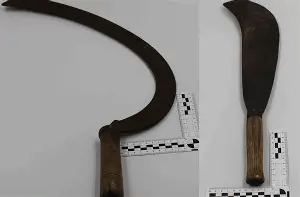
An umlaut (‘a name for the two dots diacritical mark (◌̈) as used to indicate in writing (as part of the letters ⟨ä⟩, ⟨ö⟩, and ⟨ü⟩) the result of the historical sound shift due to which former back vowels are now pronounced as front vowels (for example [a], [ɔ], and [ʊ] as [ɛ], [œ], and [ʏ]) is not just a convention like the ‘lower case i’ but something that indicates a difference in the sound value of a letter, not just in German of course, and helps us know how to pronounce a signifier, so that it will be recognised as what it is:
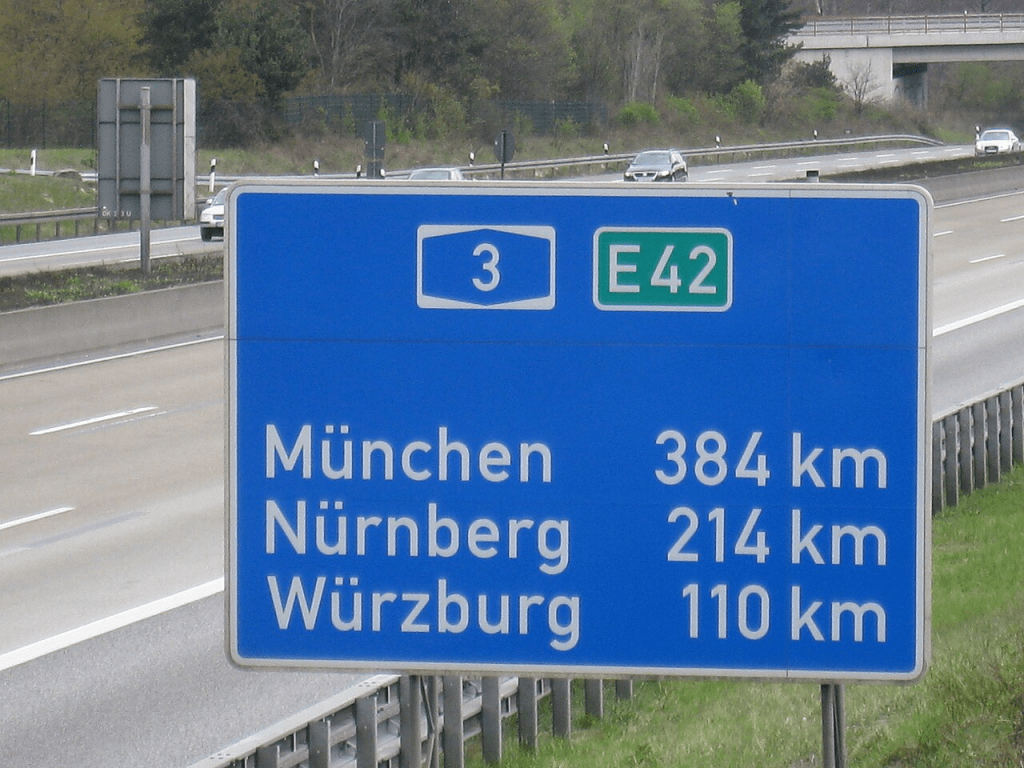
German traffic sign: photograph by Martinvl – Own work, CC BY-SA 4.0, https://commons.wikimedia.org/w/index.php?curid=50061425
But look at all the instances cited – they are versions of the mark in writing I have called ‘dot’ but can be called ‘point’ and in punctuation (when singular and unaccompanied by others of its kind (except in the dot on an ‘i’ but that is in itself related to a singularity – modifying the name of self in language when spoken by the self), as colons (;), umlauts (◌̈), or ellipses (…), as indications of the ending of a unit of meaning, or if there is a ‘coda’, a unit of meaning and its repetition in short form or appropriate extension. Full stop ends everything, though period is less apocalyptic as a name. None of these marks include marks other than dots however – and it is their relation to ending, pause and silence that matters. And yet we see these singular dots as ‘tiny cows’ (cows seen at a distance, that once they come nearer will be at close quarters as they eat away at the ‘blank page of the ceiling’. When cows eat they graze, but they come themselves from ‘seams’ in a world that is therefore not whole, that feel like ‘cracks’ as they widen, and like mouths when they ‘swallow our hungers’ whole. An efficient feeder will put an end to any feeding but its own, and though it might give a ‘point’ to something that might look like machete or scythe otherwise, it still comes at the end of a killing or evacuating tool. A scythe brings down grass faster than a cow, And what do these cows eat – they eat ‘our hungers’ before they can fulfilled: They scrunch you so you can’t scrunch them.
                                                                  ... Foraging air,

do they miss their dirt and grass? Diapaused in stark sterile
contrast to the fermenting carnival of sweet decay coloring
autumn’s kaleidoscope a glass pane away… did they cross
the border with families and dreams intact ahead of a killing

frost? How we continue to innocently decimate each other
and blame gravity, god knows. God who drifts now nowhere
and everywhere again, sleeping in the churches of our cars,
insisting every story still ends in love and ones that don’t

are so starved they’ve lost their appetite for what feeds a soul
on its famished flight from an Gorta mór to the salted shore
of Gaza.
It is possible too that the cows owe something, being ‘god’s’ to the myths of impetuous stealing of a god’s cattle – Hermes of Apollo, the Odyssean sailors from Helios and so on, certainly they are carried across border and are themselves at threat of ‘killing’, at a line ending that only reveals in the next stanza the singular idea that they will be killed by ‘killing //frost’.Aren’t they also, as things that wander across ‘borders’, fantasy migrants who horrific ch as by setting fire to a benefits hotel. Eating metaphors consume this poem, in relation to what satisfies hunger or does not. Cows, who are really ‘dots’ (marks used in language to show how meaning is structured and for other reasons), might be satisfied by a diet of ‘air’, rather than ‘grass’ and the ‘dirt’ that is ingested with it. Diapause in insects allows for a moment in life of stopping without the need to eat in order to develop further, at least yet, but real cows aren’t like dots or insects – neither are humans, they must forage on land to eat, croosing borders like other nomads, now downgraded as ‘migrants’ in modern parlance and refused the right to settle. Yet these metaphors remind us of a natural cycle about fading and decaying – the process of ‘fermenting’ akin to autumn and digestion between a number of cows stomachs. Hunger impels migrancy and fear of hunger, in those who do not need thus to fear, feed hatred of migrants. The Irish by descent, especially old immigrant families to North America, never forget the Gaelic term, ‘an Gorta mór‘ (literally ‘the Great Hunger’). the trigger to mass famine and death from 1840s Ireland and to mass migration – the kind of migration known now as ‘economic migration’ but as political a genocide as that of the salted shore / of Gaza’. Blamed on failed potato crops, it was as much a likely sequelae of the deliberate creation of an impoverished class by Anglo-Irish (more Anglo than Irish in Iris eyes) overlords and rentiers.
What the poem suggests here is that our hunger for stories with a pleasurable ending (in ‘love’ forget some stops genuinely are ‘full stops’, a period whose end-outcome (and perhaps ‘point’) is death of surplus population, according to theorists of the magic operation of natural economies. No-one wants a story or a poem or art of other kinds about our own willingness to contribute to the starvation of others, yet we proved we found ourselves capable of being complicit in Gaza now, just as the British did in 1840s Ireland. Maybe writing and reading a poem might be a complicity too, as the poem’s end about endings suggests:. We claim to hep things that we down instead because of our willful ignorance, we try to ‘sweeten’ our own lives and sour others: we watch deaths from whatever reason in summer fires and suicides of ‘friends who leave by their own design’, and have no agency in putting a stop to it. Yet we find endings (and the ‘impending’ they stimulate whilst we read – expectations of that end, resounding in imp-ending) . We enjoy a skillfully created ‘threnody‘ (a mourning song’) whilst hiding that we know that since 1840 (or indeed the wars in Archaic Greece that fostered the literary genre) there has been more than enough to ‘wail’ about without refining our wailing into song or verse.
The honey water you set on a sill last year, they
drowned in. No, seasons can’t be sweetened with intention

yet in a week when summer’s still putting up high numbers
and two friends leave by their own design, it seems an illicit ill-
timed conceit to reckon a wish to euthanize with a will to survive—
while conducting a threnody for yet another ending / impending
And if we are complicit in present death, surely create out of our conceit (meaning pride) a ‘conceit’ meaning verse simile in pretending ‘our will to survive’ equals the suppressed ‘wish to euthanize’ elsewhere – Somali-land, Gaza, and so on.
So this is my blog for Toyoda. The full poem follows again. I feel a child again, remembering learning the ‘will to survive’ and being informed by the unnecessary corollary, unnecessary if I reject it, that my survival is not based on the will to make or let others die, because it is not my business, and besides I have my love of poetry to prove me human – if not humane. And, after all I am concerned about global war aimed at populations – it puts up my oil and gas prices. Is that all we should say?
With love
Steven xxxxxxxxxxxxxx
The Gathering
Above my meditating head, a record herd of god’s tiny cows
grazes on the blank page of ceiling. How they slipped in via
crevices, god only knows. Yet another testament to a seamed
world where cracks widen and swallow our hungers whole.
A thousand or so volunteering for the next lower case i,
period, ellipsis or umlaut… interrogating the bare expanse
upside-down, a pair here and there posing as colons—
brave pacifists of summer’s coda, ensuring exclamation
and question won’t end in pointless machete and scythe.
Losing count of gaunt warmer days, all placidly repair
to a colorless gulag of ceiling pristine as the sky after 9/11
or Gandhi’s mind, banished of muddy boots. Foraging air,
do they miss their dirt and grass? Diapaused in stark sterile
contrast to the fermenting carnival of sweet decay coloring
autumn’s kaleidoscope a glass pane away… did they cross
the border with families and dreams intact ahead of a killing
frost? How we continue to innocently decimate each other
and blame gravity, god knows. God who drifts now nowhere
and everywhere again, sleeping in the churches of our cars,
insisting every story still ends in love and ones that don’t
are so starved they’ve lost their appetite for what feeds a soul
on its famished flight from an Gorta mór to the salted shore
of Gaza. The honey water you set on a sill last year, they
drowned in. No, seasons can’t be sweetened with intention
yet in a week when summer’s still putting up high numbers
and two friends leave by their own design, it seems an illicit ill-
timed conceit to reckon a wish to euthanize with a will to survive—
while conducting a threnody for yet another ending / impending
 Steve_Bamlett_blog