


“It’s a poetic way of thinking about history, where materials themselves tell the story of power, fragility, and change”. Ali Cherri speaks of his art as ‘speaking through materiality’ in order to ‘reclaim the space of storytelling’. [1] Losing ‘track of time’ is really a phrase we use when we track time not by the clock but by the qualitative meaure of its process in the way we tell stories, even hi-story.
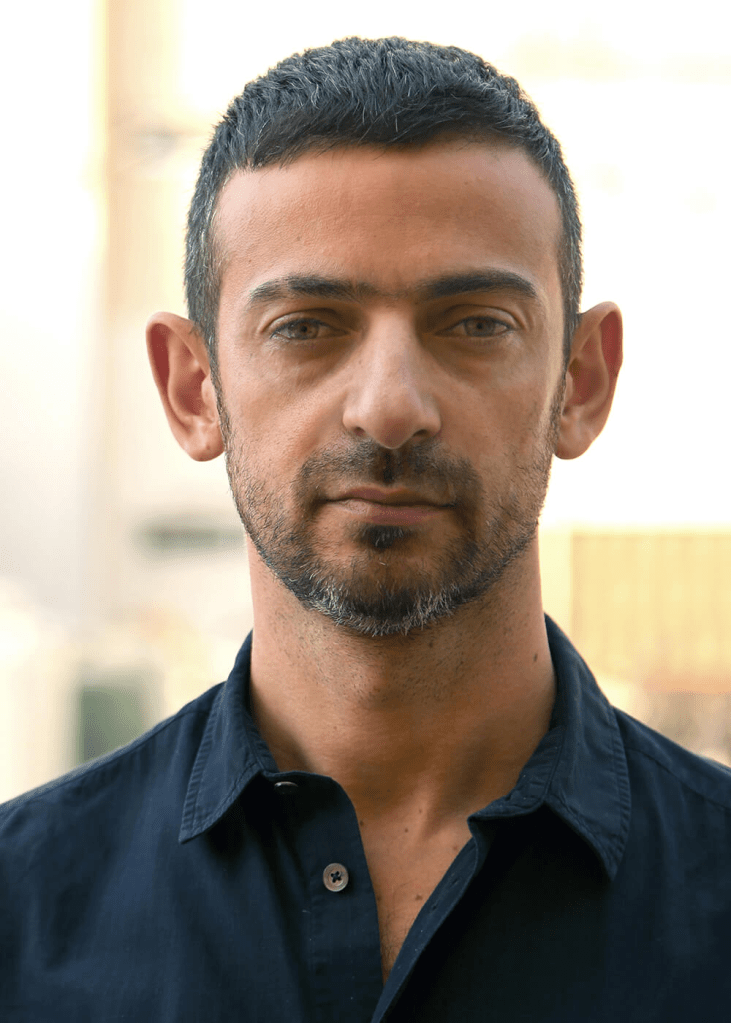
Ali Cherri
This response to a question much more complex than it intends to be is based on visiting the exhibition How I Am Monument (running from 12th April to 12 October 2025) at the Baltic Gallery of Modern Art in Gateshead on Sunday 6th July 2025. It is an exhibition described as the ‘second chapter’ of one that started at the Secession and ran from 6th December 2024 to 23rd February 2025. My response also includes reference to the book commemorating that chaptered exhibition, Jeanette Pacher (Ed.) Secession, Verlag der Buchhandlung Walther und Franz König, Köln. This book, like all art, is also the story of its configured materials. It is a flimsy glossy paperback book with a green cover and covered by a white dustcover.
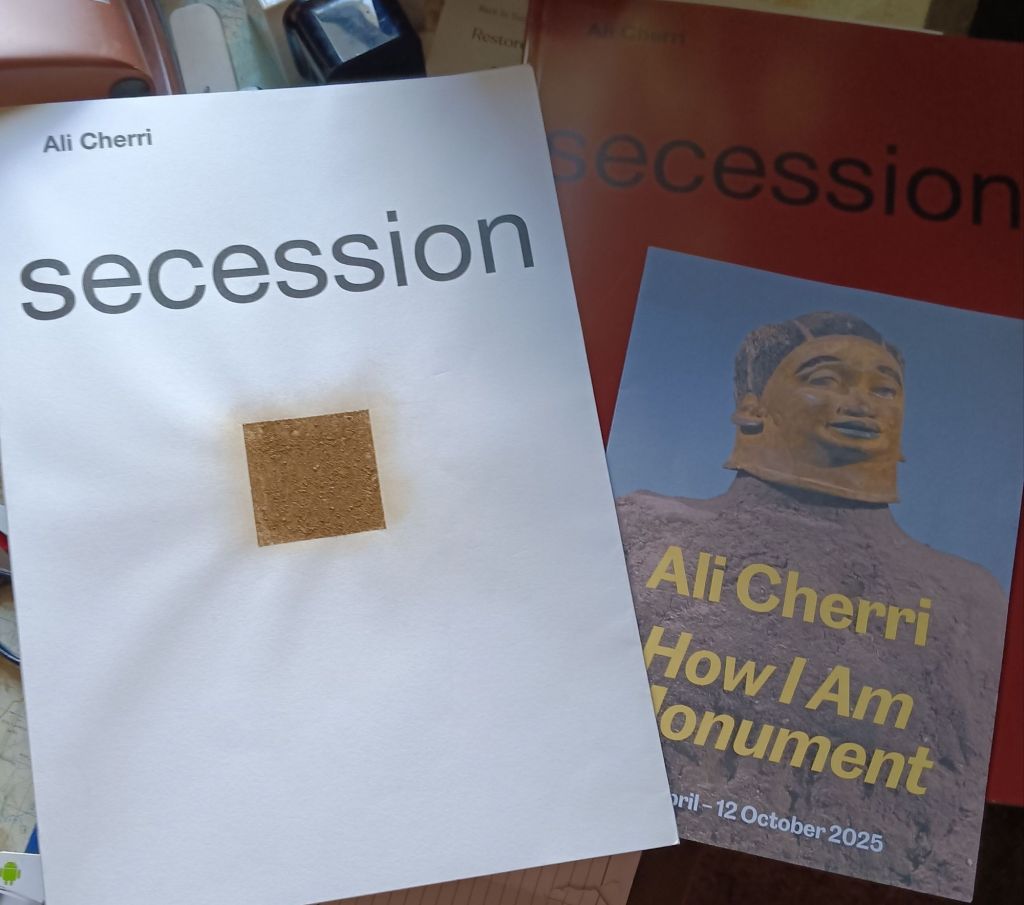
Each dust jacket of each book has on it a unique (because each is worked by Cherri individually) brown variably-toned square with an uneven surface and an aura where the brown material has apparently spilt or been rubbed laterally by design or accident (possibly both) out of its central square. The only explanation is in tiny font on the book’s copyright page. Here it is, rather enlarged by my photograph:
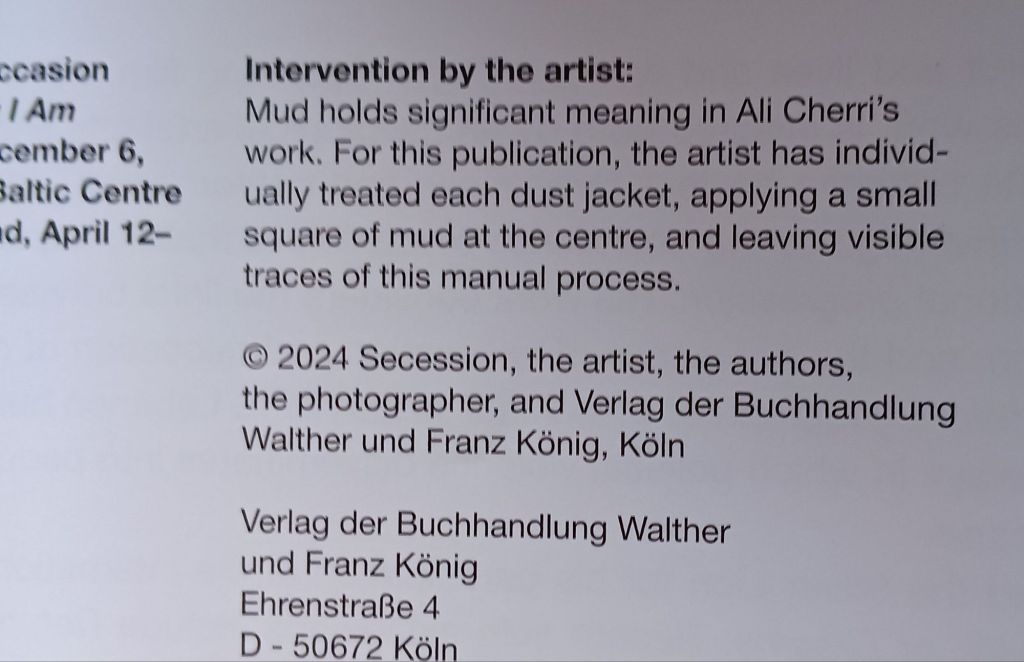
How full of ironies this is – Dust Jackets are intended to preserve the book from the effect of dust – particles of waste material and disturbed earth content in the air that can have a toxic effect on the book but here mud (which is but wet dust after all) is deliberately applied and attributed not only meaning but value because of the interaction of that material with the ‘manual process’ applied by individuals we still conventionally except from normal evaluations of status – artists. The welding and pressing together of elements attributed their value by very different systems of graded evaluation spreads through the show and is rather well described by that rare thing – a review of art in the national press that sets itself the task of empathetic explanation of an artist’s work seen for the first time in the UK, and the issues that arise from it. The review is by Alan Moffit of The Guardian.
Mud predominates in Ali Cherri’s exhibition at Baltic. It fills the top, vaulted gallery of the former flour mill with a loamy scent while light glinting off the material casts an ochre glow. It forms the bodies of five strange figures standing sentinel in the front half of the space like guardians to a lost necropolis. Cherri has embedded archaic masks and vessels snagged from online auctions in their cracked, dusty bodies to phantasmic effect. Wall labels offer clues to the origins of these acquired objects – a Maya cult vase, a Makonde mask from Tanzania – but repurposed, they seem more like benevolent spirits roused from slumber by an archaeological dig. [2]
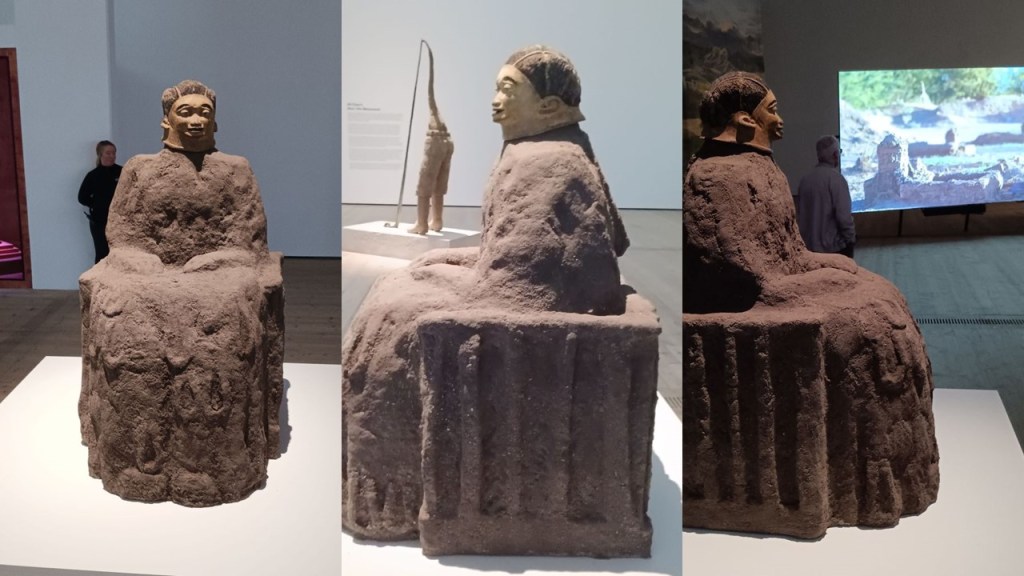
The figure with the Makonde mask from Tanzania (which seems to be titled Seated Figure) you see below in the collage I created after my visit. However, it is worth looking at the link to the Makonde Museum in my previous sentence to see the correctness of Alan Moffit’s point that Cherri is not attempting to ‘rescue’ Makonde, or any other original, art he buys selectively at auction – usually regardless of provenance and sometimes in full knowledge that the piece is a fake made for either the tourist market or to fool supposed connoisseur of original art.
As we shall see Cherri say below, the point is not in the revival of the ancient or even original in terms of either appearance or meanings. Moffit says it thus:
The Makonde mask in Seated Figure, for instance, sits atop an inchoate mound of hardened earth, where crudely shaped arms and a lap lend it an air of wizened repose. The figure’s form has nothing to do with the Makonde people, and Cherri’s appropriation might be an anthropologist’s idea of vandalism were it not for the fact that his sculptures snatch antiquities from the private market and sneak them back into museums under his name.
Rather than the bringing back of meaning from lost time, meaning is discovered in terms of the interaction of found fragments and binding materials, as mud is par excellence – in terms of the materials themselves, meanings and effect: of its new life born of the process Cherri still calls ‘grafting‘. Grafting is the process by which Golems were made in Jewish tradition, and Enkidu in the Persian, and the process is itself ancient, though that too gets new meanings. It is moreover not about reconstituting something once whole but a kind of vital empathy with the ‘broken or damaged object’ considered for that reason to lack value or to be too ‘degraded for display’ to the collector, connoisseur (and the markets in which they operate as consumers) or museum. But the broken (especially that broken by violent war – as Cherri’s own family as well as his completed artefacts about and shown in war zones is) is itself meaningful to us and terribly (in its fullest sense) contemporary:
Today we all carry our own fractures and thus seek connection with other beings and communities who share similar experiences, from whom we can learn and with whom we can empathise. This is why my work often focuses on fragility and what is deemed unimportant.
……; I rarely concern myself with origins. …
To revisit the idea of broken bodies coming together to form new life, I borrow the concept of grafting – both from botany and human organ transplants, where grafting enables survival and renewal.[3]
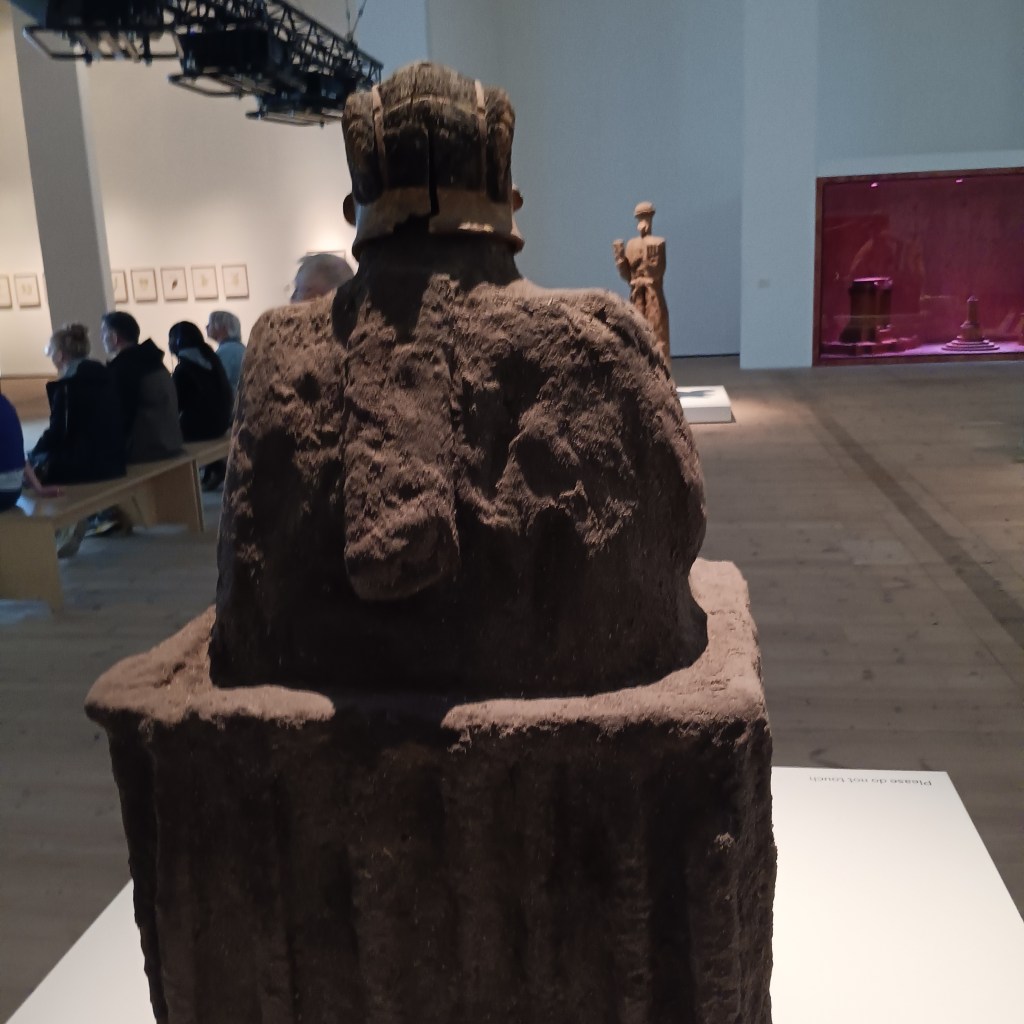
It is not enough with Moffit to say the Makonde mask sits atop of a ‘mound of earth’, for the moulding of that earth is itself full of anachronisms of culture, time and space. The moulding of the seat is Classical in style if not execution, yet the folds of the draped clothing is Baroque in every sense. This figure sits in time but is full of fragments of its sequence – the mask head sits on top as if it had been severed and replaced with some trepidation. The whole mixes a sense of stability with one of fracture and expected fragmentation – vulnerability that shakes through the weight of the piece. As I turned around it to gaze at it from a back view, it interpreted the space of its location by chiming with the backs of those spectating the first of the films that Cherri shows us – that described by Moffit thus::
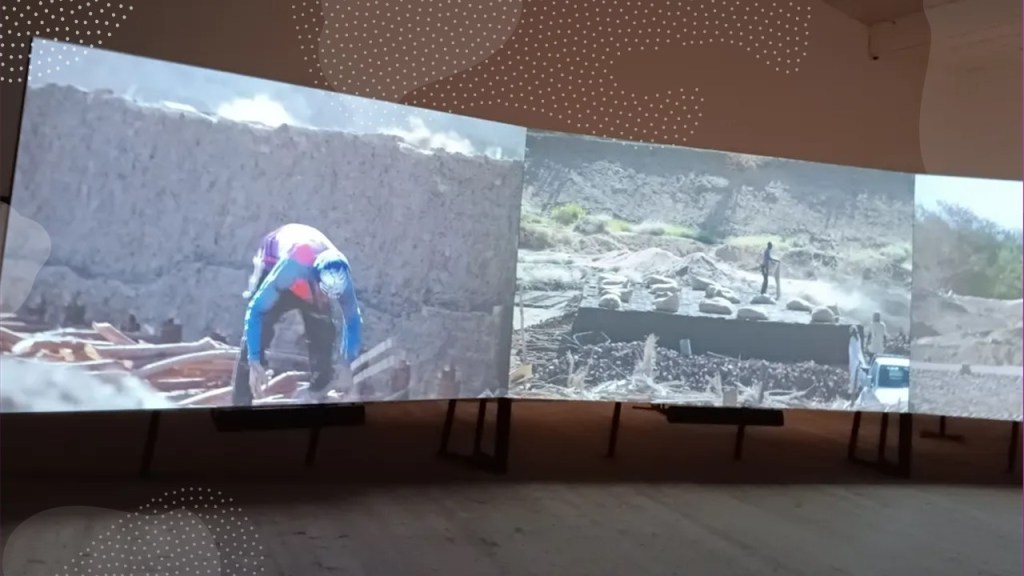
… A voiceover recalls that in many creation myths, man was made of primeval ooze, from Adam with his clay rib to Gilgamesh’s dust-borne companion Enkidu. “Out of mud we were made, out of mud we dreamed we were made. Then we forgot or sought to forget,” voices say in alternating English and Arabic. Such hubris recalls Percy Shelley’s Ozymandias, a vast statue of a tyrannical pharaoh swallowed up by desert sands; in Cherri’s work we find “the hand that mocked them and the heart that fed”.
Now look at the backs of the watchers of that film behind the Seated Figure and ponder why the space was configured thus. It is as if the audience were being challenged to identify, or be identified by some of its members reflecting on the rest from the position of my phone-camera lens, to be still the earth substance from which they were created. From the front and sides the Seated Figure (remind yourself in the collage above) is comfortably placed in the recess of a throne, from the back, like the rest of the audience, the figure’s ample bottom merely uses whatever flat surface as a seat from which its back hunches forward in a gaze at what lies in front of it.
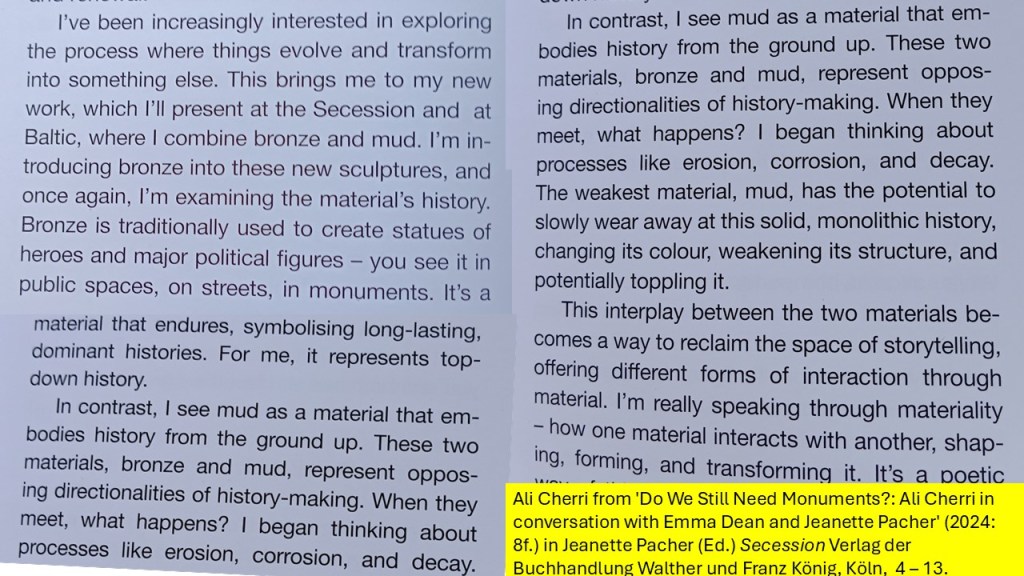
What Cherri insists on in his interview with the curators of Secession and the Baltic art Gallery that in working with contradictory materials, and I think this goes for concepts and styles in art history too. a story can be told that challenges those from the top of the power structure with ones from the bottom. In that case where the Seated Figure‘s bottom is might matter! Cherri says:
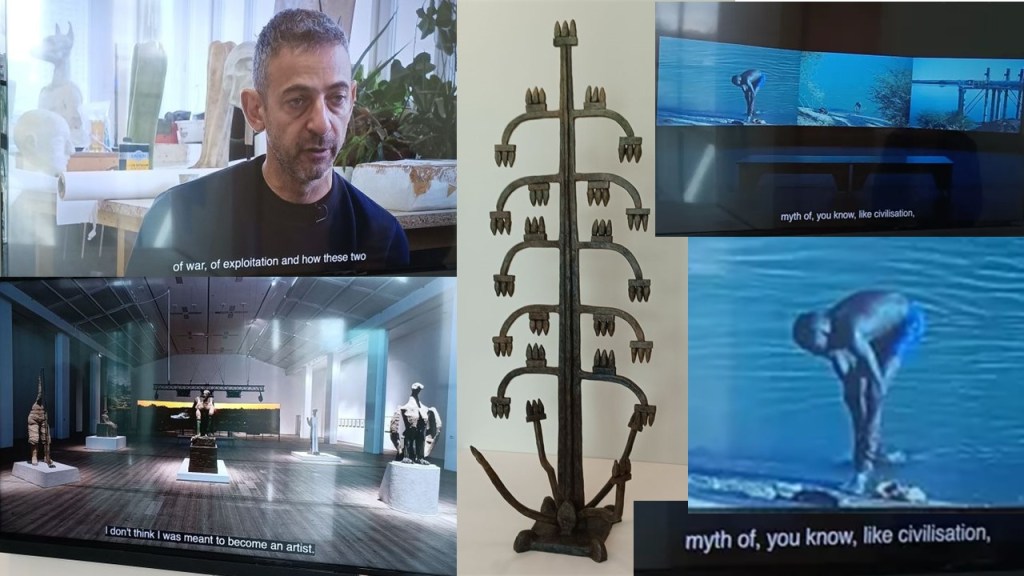
As we enter the exhibition we meet a fine explanatory film, where Cherri locates his art in response to the experience of those supposed to be at the bottom of society and the receivers of a history, from the top of war, exploitation and their interaction, and deconstructs the assumed pieties that define terms like ‘art’, ‘artist’ and ‘civilisation’, and even icons like The Tree of Life. Though a symbol in a legion of cultures, in each it can be interpreted top-down as a vindication of order imposed from the top or as representing the superior significance of the bottom as root or earth.
Cherri’s Tree of Life is one of the first pieces we see though a later one and made in bronze, the material of politically rigid and frigid monuments, supposedly unchallengeable through time and claiming to represent history. We see this work too at the entrance (as it was at The Secession). Although entirely bronze, its base represents the mud in which real trees grow,. A bronze Tree of Life may be conceived as a parable of the myths it promotes top-down – as did the cultures that venerated and reproduced it – the glory of what is at the top crowned, and the right of such crowns to turn upside down and oppress those below it. But look at that base. It is sprouting new life, less less rigid and more organic, in form and concept at least if not material. It is the artist claiming his right not to ‘become an artist’ as people thought of art as oppressive but with the workers in his film – building the bricks that formed ‘civilisations’. or as Pacher says to Cherri’s approval: the tree is ‘about knowledge and life and the imagination of something growing and extending that you have with the mud in mythologies’. [5]
Inside we will see other figures: The Seated Figure sits across and gazes at another figure with a mask as its face and head but a bottom made of mud and non-binary in socio-cultural gender and perhaps biological sex markers.
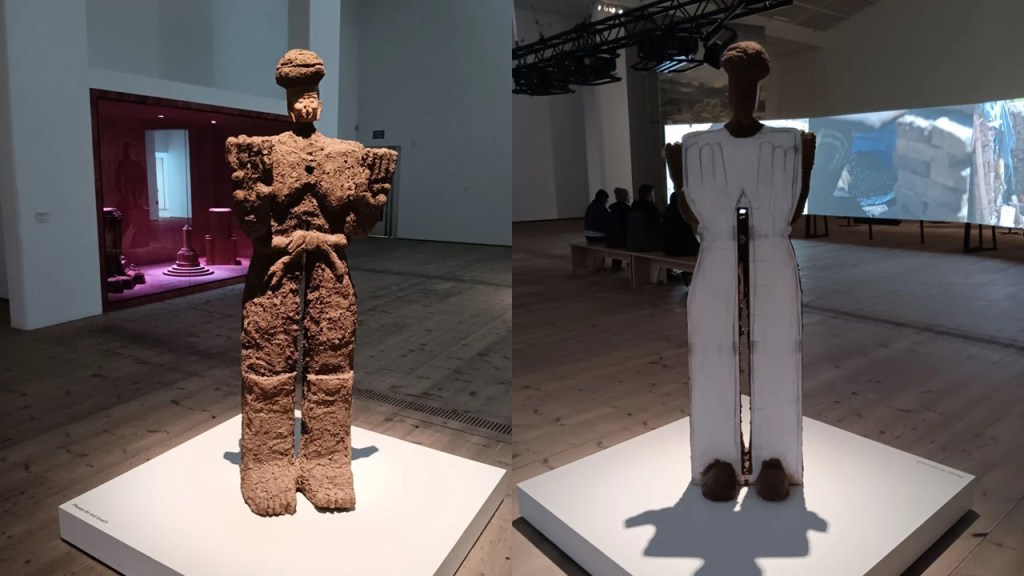
Note how this figure is meaningful in terms of both its frontal and rear view, and faces out on each of these perspectives on it with forward facing feet. However,. the rear view has on it a plan for grafted reconstruction – the kind of plan Tim Yeo has shown us that plastic surgeons use in graft surgery in his Skin Deep exhibition and book.
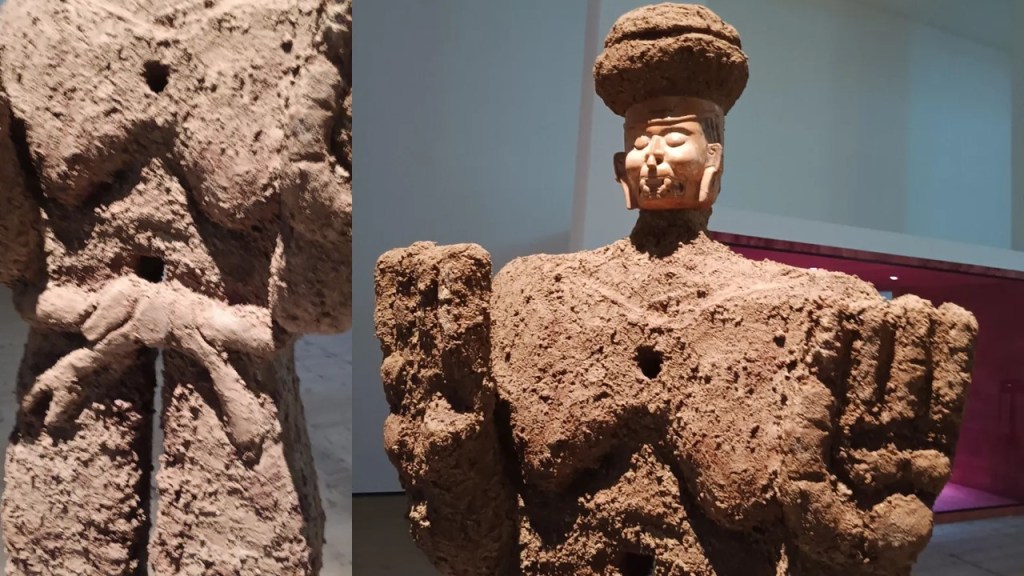
This figure is not even mended but rather still being planned and still bearing wounds innate to the vulnerability of all of its materials – though wounds that differ precisely because the vulnerabilities of different materials differ. Its a figure that tells a story of being inadequately defended and unsure where both its fractures matter most and how best to bind them into a workable piece, sufficient for the moment, It seems to forbid and guard against us becoming nearer to it or opening up, whilst still being and feeling exposed – compare, for instance, those heavy boots for use in mud to to the petite shoes at its rear, its liminal position between the naked and the adorned or of gender markers that cannot be queried and queered. After all the man grafted in mud – ’embodying the potential for life to emerge from the most basic of elements’ – from Persian culture was Enkidu. [4] Enkidu was that wild man who became the lover of King Gilgamesh in that wondrous Epic of Gilgamesh (see my blog on a new translation of this at this link).
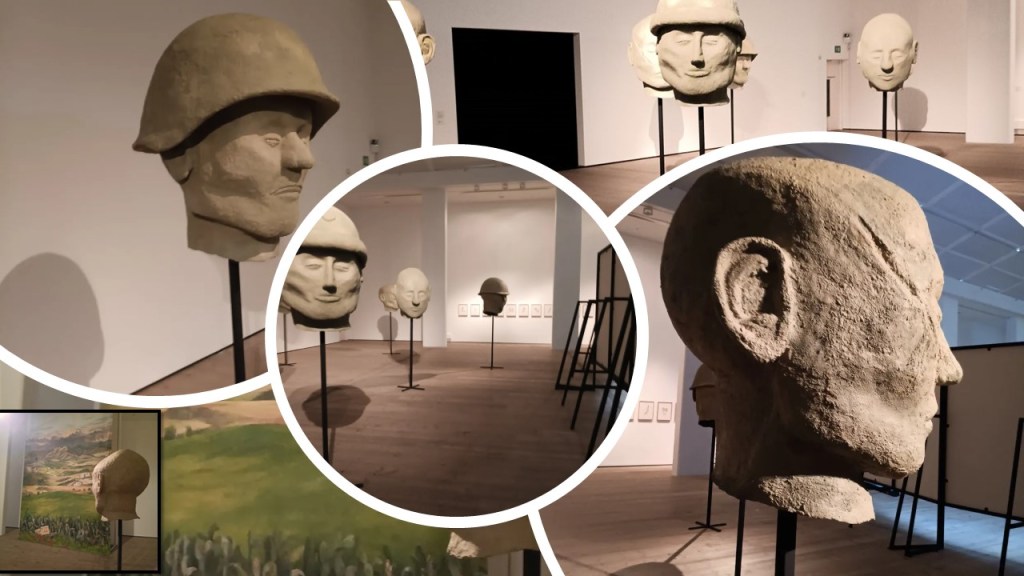
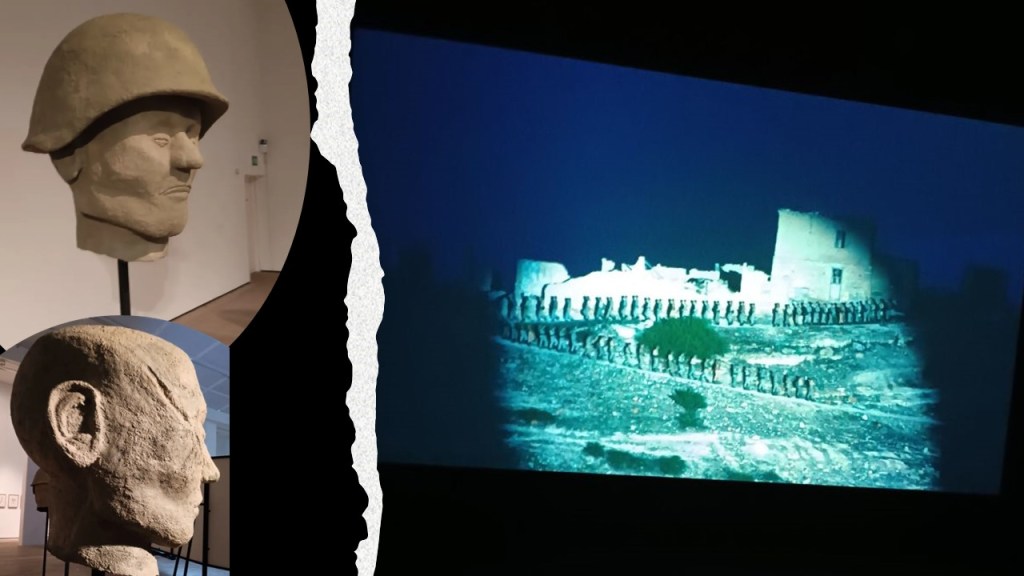
However, Alan Moffit was asute above in another respect. He speaks of the effect of our entrance into the large hall on the 4th floor of the Baltic, and seeing first ‘the bodies of five strange figures standing sentinel in the front half of the space like guardians to a lost necropolis’. The necropolis is associational with the many monuments but the place guarded covers many more spaces and times to which we pass through some portal. As you can below, there are portals at each end of the hall. The entrance is lighted, but the final portal is squat and dark, but also guarded by the heads of blind soldiers – or at least soldiers who keep their eyes closed though their armour on. These soldiers and the stage scene flat on their left will mean more to us when we exit the mausoleum like gate, having seen the film The Watchman, about which more later. What unites all these things is that either side of any portal is guarded in the time-spaces of this exhibition, and guarded by symbols of potential violence, terror and perhaps cruelty. From the beginning (and this is prepared for in the entry video) we cross through boundaries – sometimes walls with portals but sometimes more symbolic ones. And this is in part symbolised by the drawings (only one example below) of the prickly pear plant, which Cherri explains is used in the Middle East and the Mediterranean (in Cyprus for instance) to symbolise a barrier guarded by the threshold of pain threatened by this hostile pear.
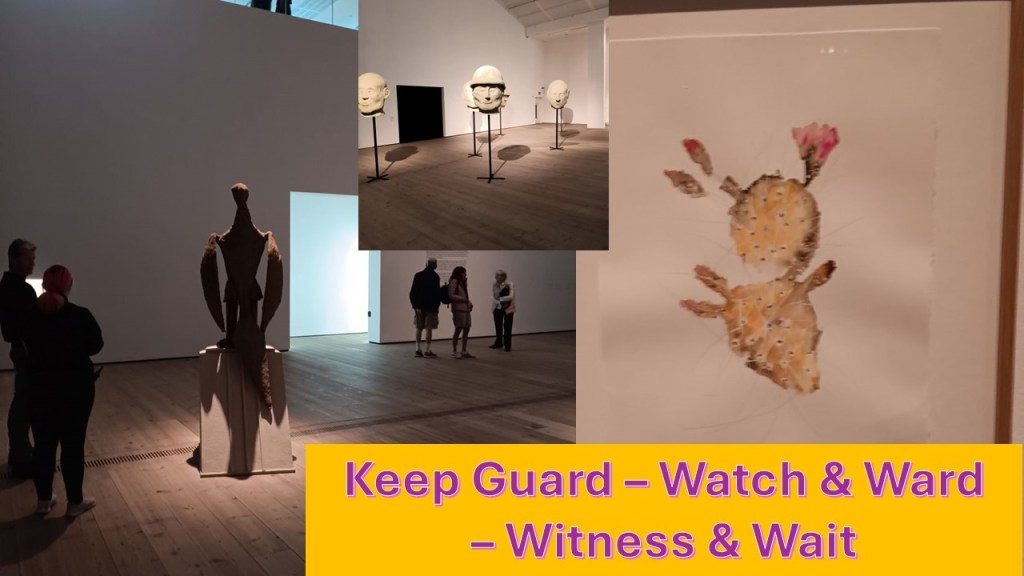
A painted prickly pear edge guards ‘No Mans Land’, the painting of the area of Cyprus in which Greek (and NATO) forces gaze across at Turkish guards, and the subject of the film, Ali Cherri’s The Watchman, 2023, yet to be seen.
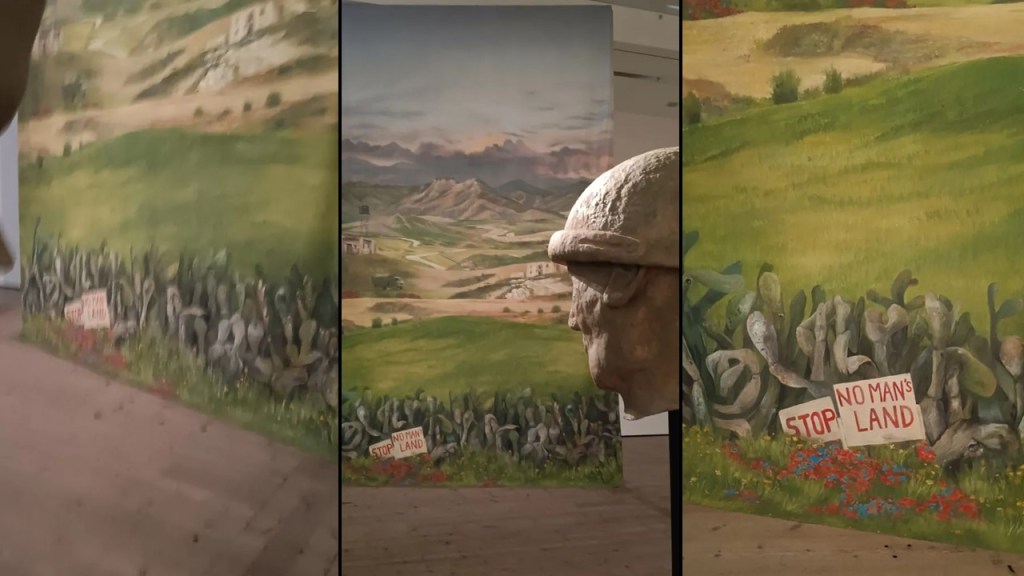
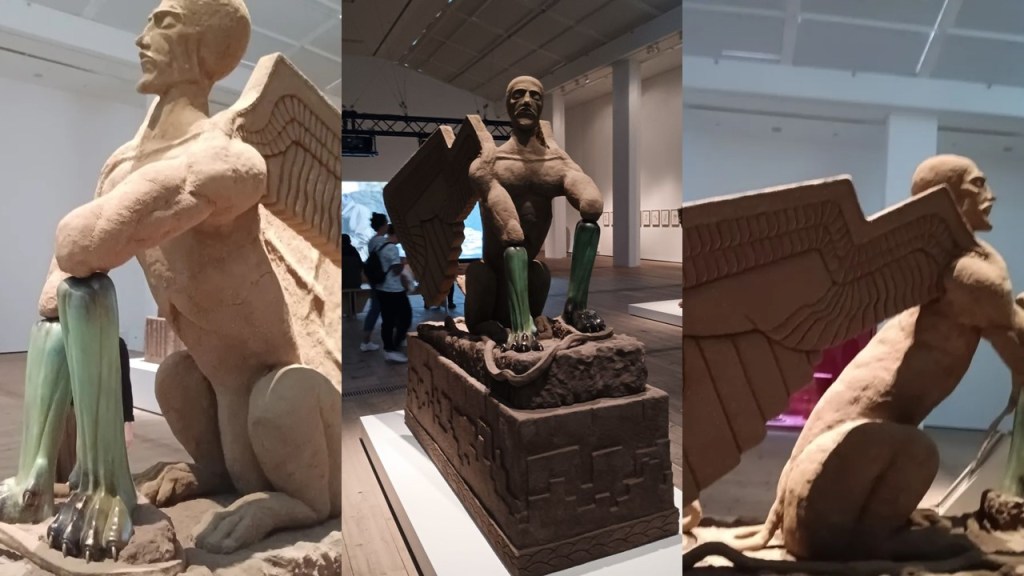
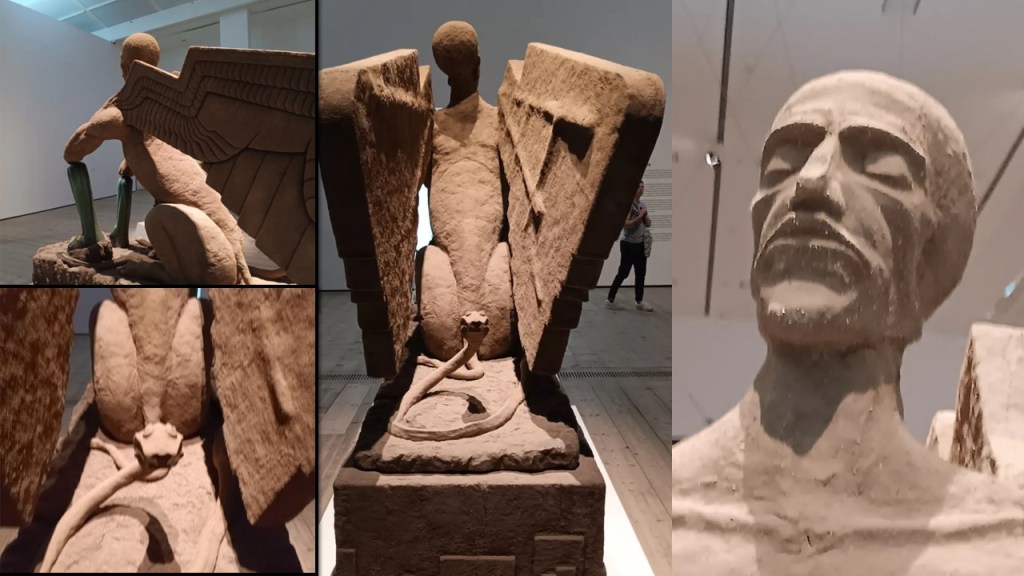
This is a theme that is pertinent to all versions of history – one Cherri calls bearing ‘witness’ in common with the language of many religions, the principles of evidence in jurisprudence and war, especially the guarding of borders and boundaries, including that between life and death: one’s own or those of others, or both. The English term ‘watch and ward‘ has long represented the duty of citizens – well-to-do citizens initially – to watch over entities of governance to preserve it from threat from either without or within. Milton speaks of people who ‘also serve who only stand and wait’, turning a joke on the idea of a servant of the rich being also a servant of Godly truth and liberty. Such people witness to truths – even the necessity of killing unjust rulers like Charles I. These ideas interpret all of Cherri’s ‘sentinels’. Take the two below, one whom you have met before. Everyone and everything gazes, and employs an underling where it cannot watch itself, in the case of the Sphinx in the left side of the collage below, If not seen by the Sphinx, you are watched by his snake curled protectively around the Sphinx. His eyes are like the Carbuncles described by Milton in the Snake in Eden (Paradise Lost Book IV).
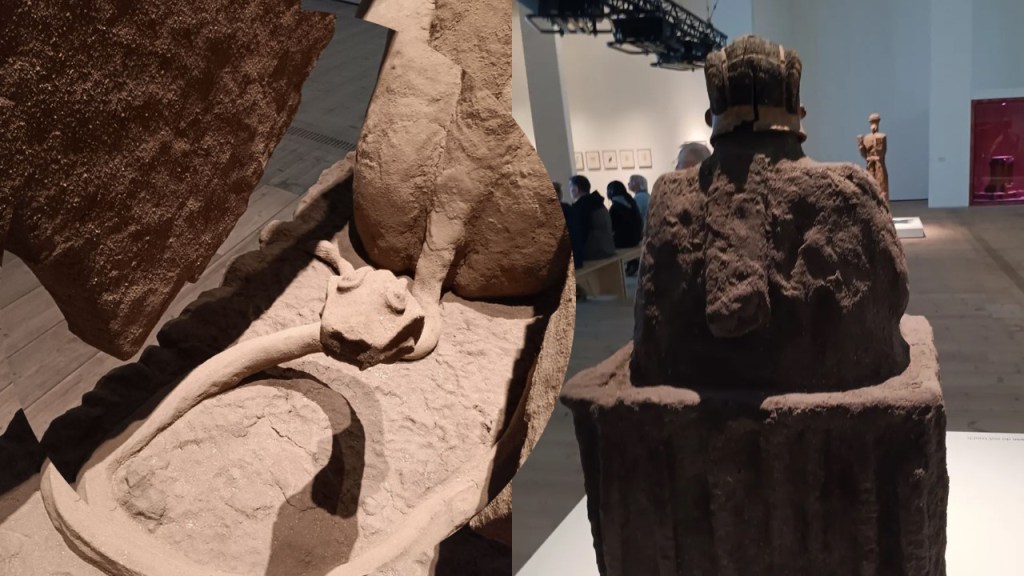
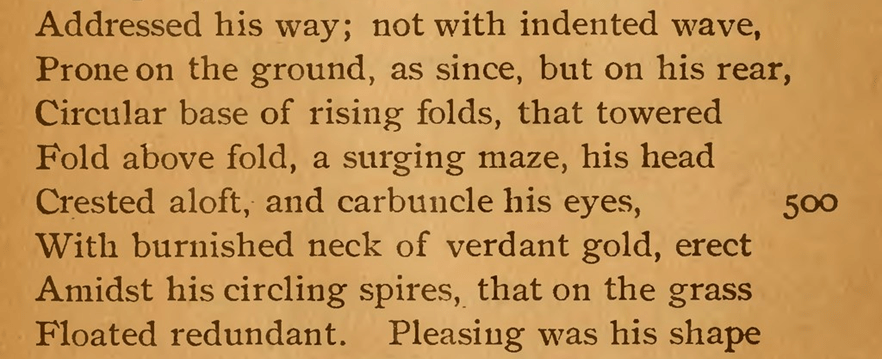
The serpent is the more alert in that the head of the great man which has replaced the original, a male head possibly from a Soviet-era statue, has closed its eye – momentarily, or perhaps forever, as if worn out by witnessing the cruelties of historical power.
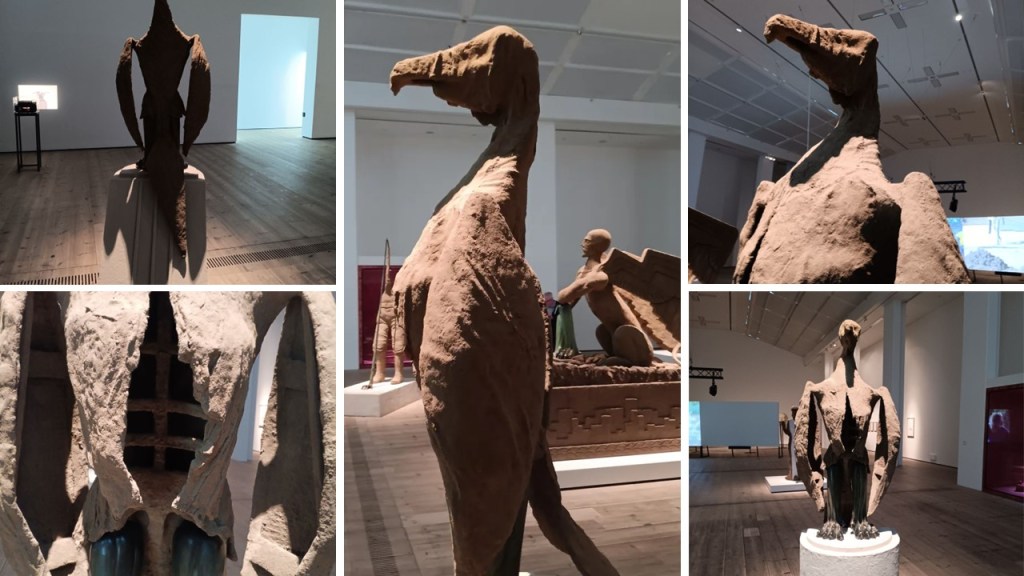
The most telling sculpture of witness of sentinel witness – a huge fallen angel with the head of a vulture, a Persian Zoroastrian symbol of the passage from life to death – is hollowed out at its torso, despite its martial stance from the front, and seems also blind, or asleep, or dead.
The things that ought to be the sentries to the maintenance of order and peace are often thus blind, because they are not allowed to see the perfidy of the power they serve, and what they represent. In The Watchman in one of the besrt scenes in it, the sentry gazes through the frame of his spy window in his watchtower but sees himself as a barrier to the nothing occurring in the scene without. We see him gaze with his eyes through those eyes reflected back at him at a scene so empty it prefers to imagine the horrors of attack to seeing itself. Somehow my camera would not focus on it.
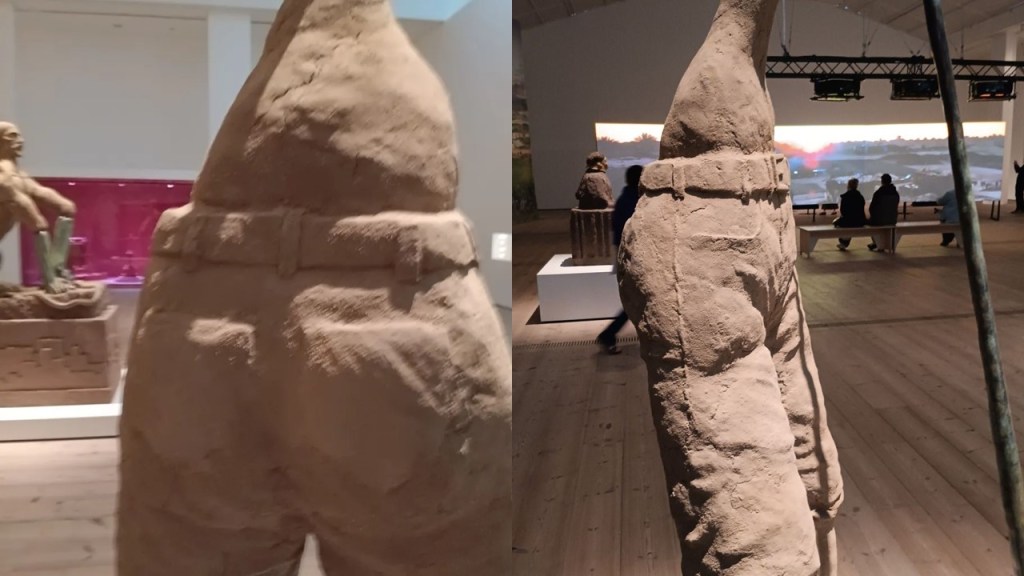
And see this soldier, in army pants and boots but whose upper body has become so attenuated it tapers into nothing but a perch to hold its own hand, scraping the ground in obeisance as a tool of a power without a real head, let alone eyes. I find this piece frightening and beautiful.
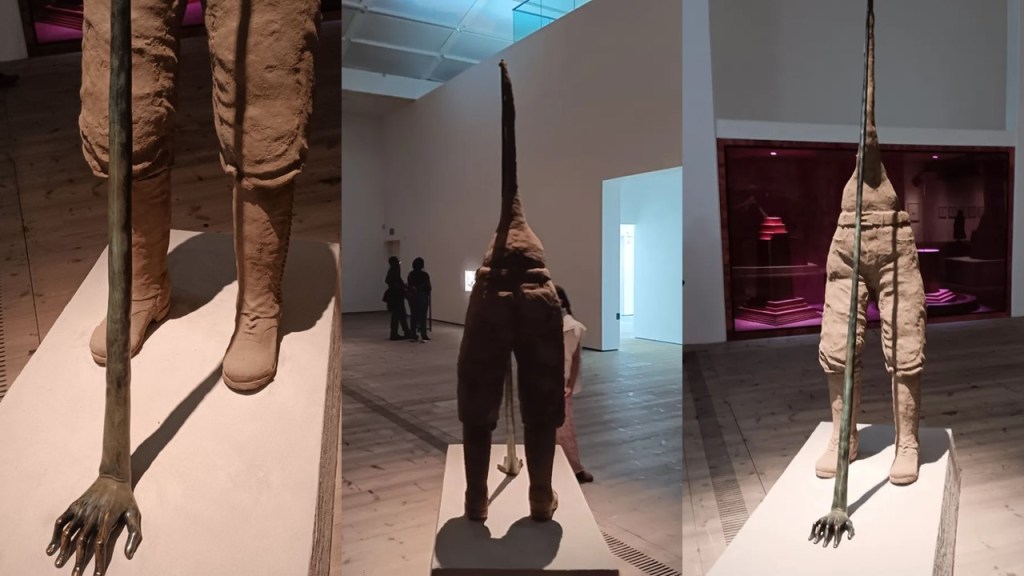
I even find its appeal erotic in the way that parts of the body that attract the eye are. The belted wasist below a waist that ought to lead to a naked torso has trousers that hug the boy’s anus, his slim body filling out tight jeans, =despite the proletarian sufficiency of his booted feet. Why I should feel that I cannot justify but it too falls into a paradigm where power speaks both ways, and is domesticated by the soldier being unable to speak power through his eyes.
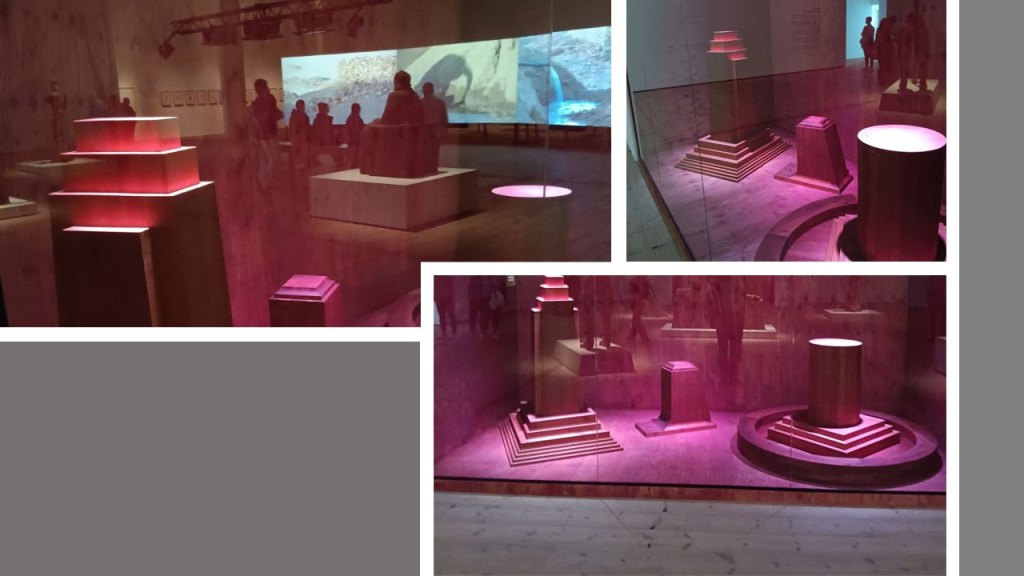
The project at the Secession was built on an observation about the recent contention about monuments of the vanguard of the status quo. On either side of the sentinels before described are huge room=size vitrines painted and lighted in dark red where the empty plinths of monuments squat bereaved of meaning – including the plinth on which stood Edward Colston in Bristol, dragged out of Bristol harbour full of mud.
The VITRINEs are brilliantly described by Moffit:
Fittingly the gallery is flanked by two high vitrines, set into its north and south walls, which Cherri has filled with miniaturised pedestals that once supported now toppled monuments. Painted the same dark red as the vitrine’s wooden interior, they look like jewellery shop window displays after a heist. The pedestals’ titles list their place of origin, each summoning scenes of riot and revolution: Kharkiv, Aleppo, Baghdad. The plinth that held the statue of slave trader Edward Colston in Bristol, torn down by Black Lives Matter protesters in 2020, is here too; when city workers fished the statue from the bottom of the harbour, they found it full of mud
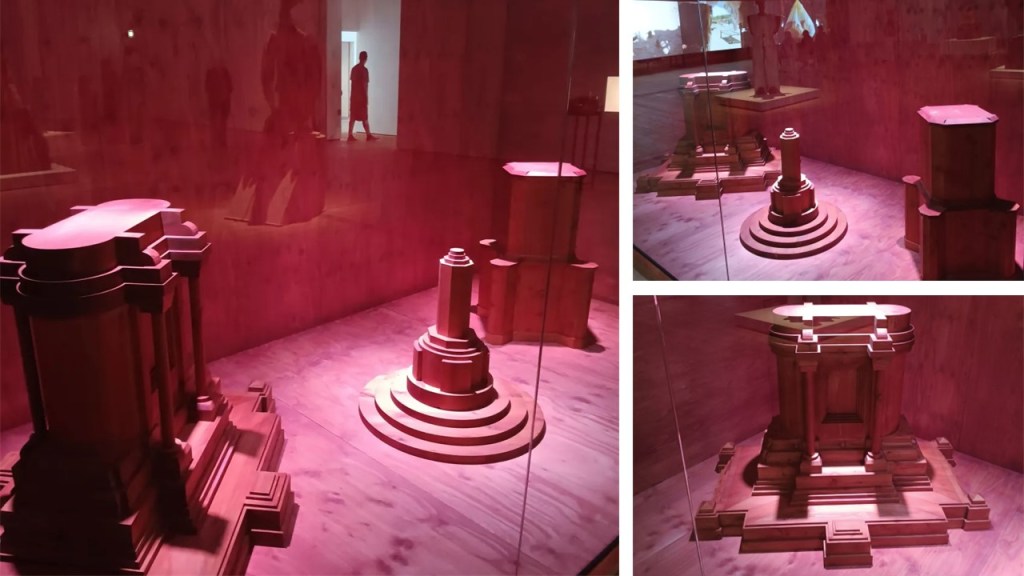
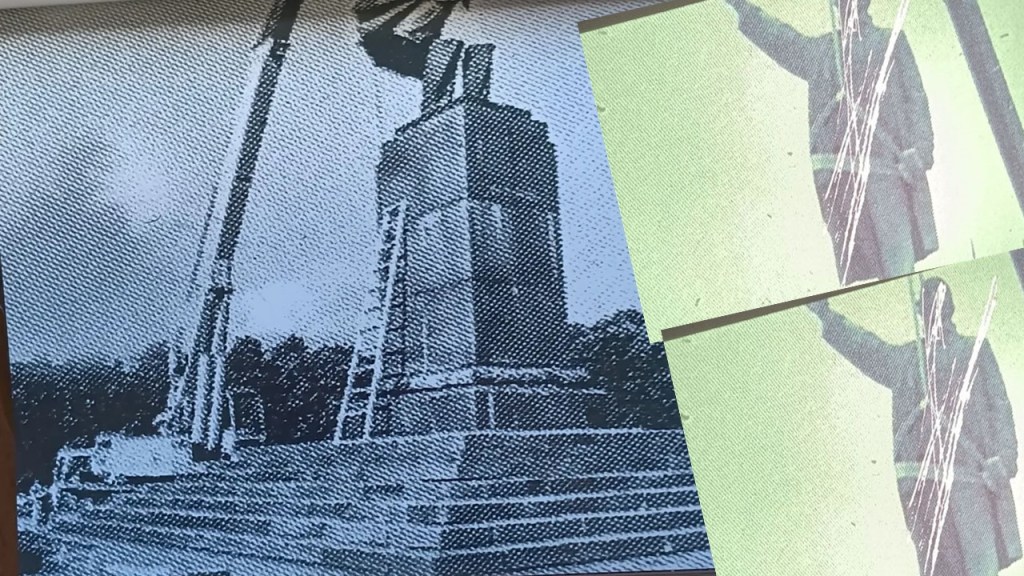
However what for me these plinths witness is the reflection in them of passing witnesses to art, refusing to stop and look – to genuinely witness, for it misses the icons it expected, and sees literally nothing. Yet the same people do not show concern, not that I think they should, and the subject of Cherri’s artworks A Monument to Subtle Rot (2024), over the thousands of statues removed in The Soviet Union, and shown as a continual slide-show cycle in the exhibition. They re also reproduced in the book Secession, from which the example on the left of the collage comes:
Of the film about mud, I (or Moffit at least) have said enough above.
On the verso of the projected film, projected over three screens, are the blind soldiers and the portal to The Watchman.
The Watchman is 26 minutes long and can be purchased on Amazon Prime. The area inhabited by the sentry who is its focus has a town in which the sentries but few local Turkish people can live. The truck that takes the sentry into the village passes by a female elder, a widow who has lost her sons and husband to war and is a true witness though she does not look even ahead. At one point later, when she does, she invites the sentry in for tea and we share her witness to war and watch and ward over a life without good in it.
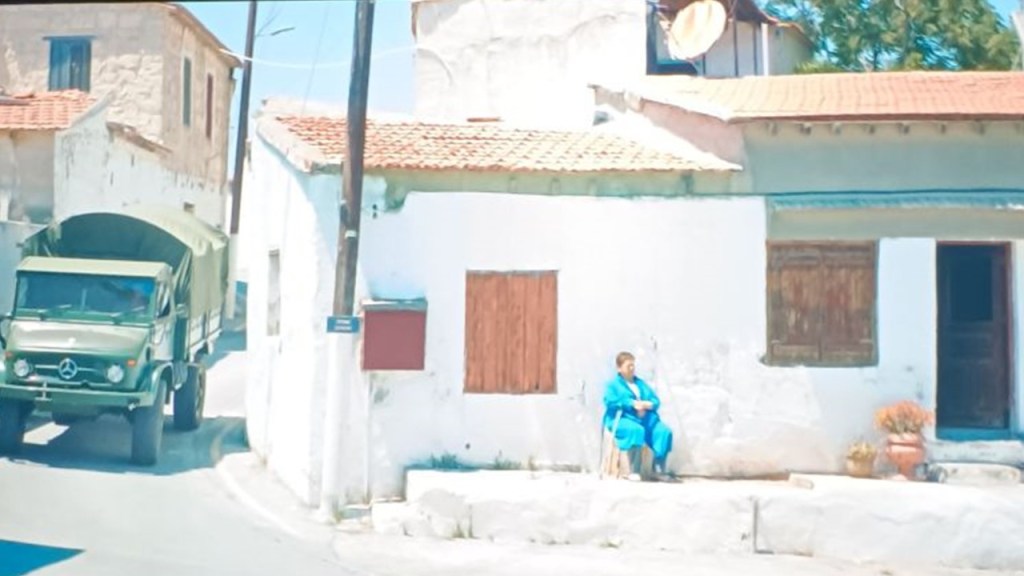
Otherwise the army truck takes the sentry up to his watchtower an away from it. We see two cycles of this but can intuit many more:
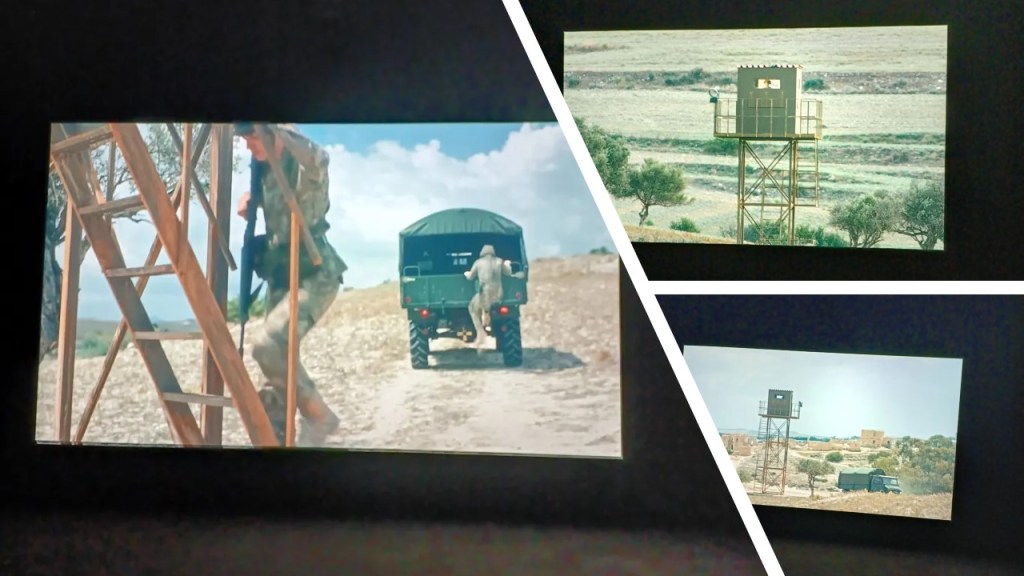
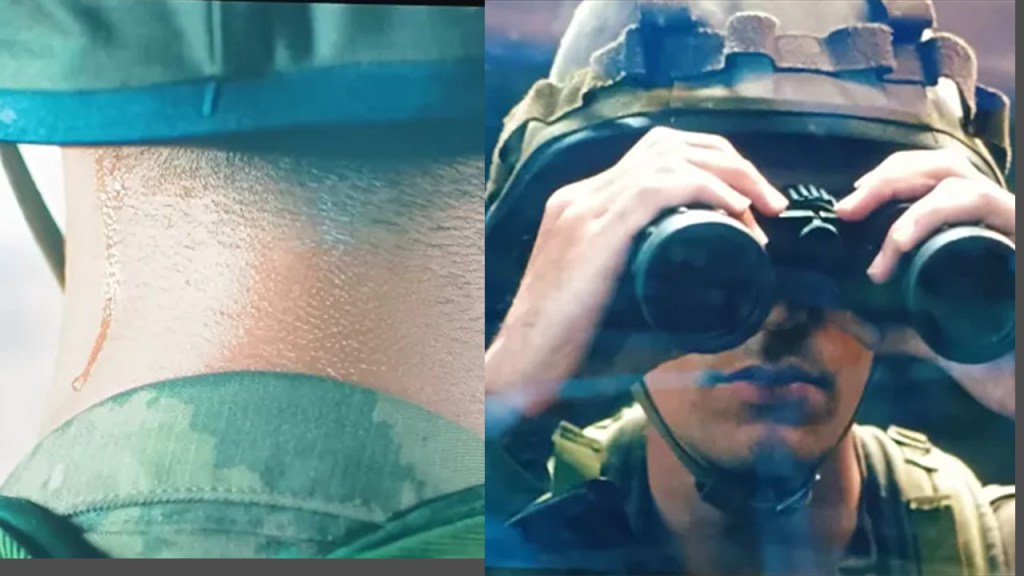
Watching and waiting, watch and ward and the bearing of witness occur to the point of nervous tedium. We watch sweat pour down the sentry’s neck in one take.
He does guard some life – a tiny gecko we see him collect from the window ledge outside his window, smeared with mud to make its otherwise transparency opaque at one point – or a dying songbird, which when dead he immurs in a wall, even allowing us to believe it may not be entirely dead.
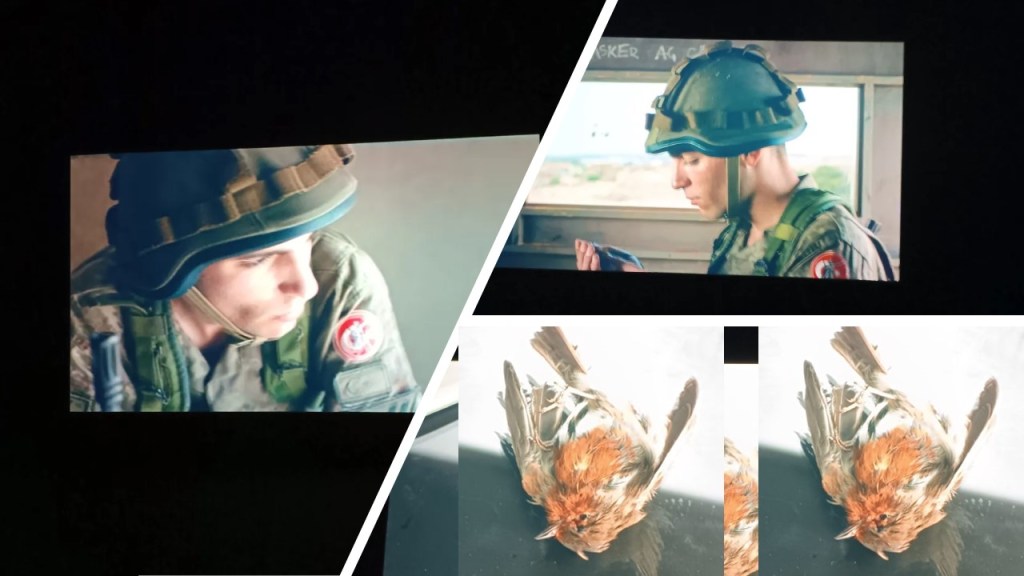
Otherwise his life is entirely framed by his duty – symbolised by the series of frames through we access his life and business, of watching, witnessing.

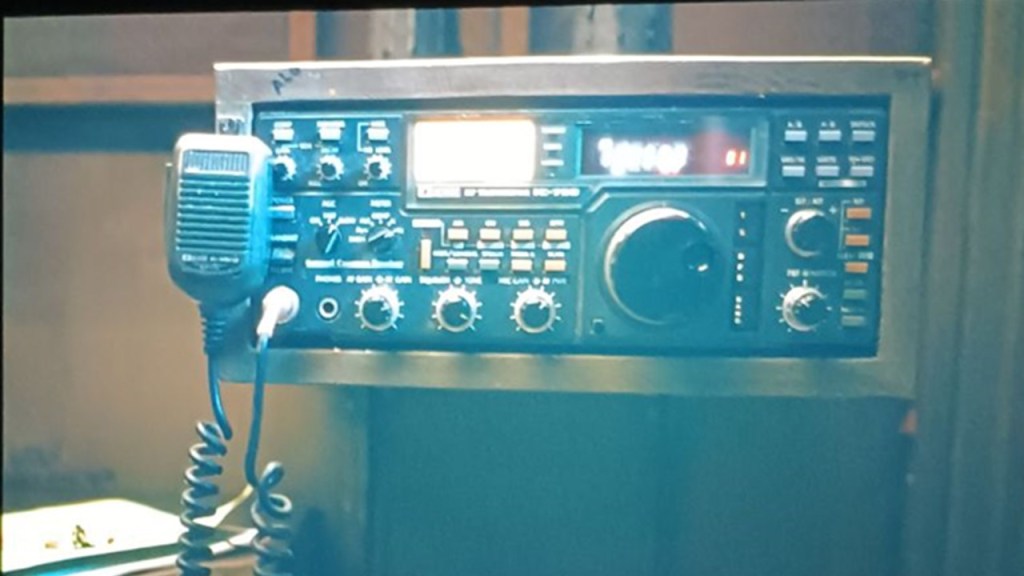
of course there is a radio portal to central command where Sergeant Buttul confirms that this sentry is always ready to confirm this sentry is a problem – so attentive he sees things unlikely to be there.
He tells them he sees lights that search the horizon twice. The final night we see an army cross the horizon of framed gaze (framed now by binoculars). Going out to meet them he meets a ghost army – speaking in language only he understands – who ask him to join them but set no duration on his service. This army has eyes that seem as seeled as those of hawks were in days past. The dangers we watch for may be forever inexplicable. In his interview he says:
Exhaustion is our condition of being witnesses. Today we’re witnessing all sorts of atrocities, the massacres in Lebanon, the ongoing genocide in Palestine. What does all this violence do to our bodies? This is a question I keep on returning to.
An artist of this subtlety needs our ongoing interest. See this exhibition if you can. It’s not huge but it matters. As for our question:
What activities make you lose track of time?
Why it is being part of a project in time where time itself becomes numinous together with space and the distinction between outer and inner experience of all measurements are made by the experience of the story alone – and the story both always ends in its token forms and never does in its type (see another blog at this link for the more explicit use of this distinction) except by exhaustion.
With love
Steven xxxxxxxx
_______________________________________
[1] Ali Cherri from ‘Do We Still Need Monuments?: Ali Cherri in conversation with Emma Dean and Jeanette Pacher’ (2024: 9) in Jeanette Pacher (Ed.) Secession Verlag der Buchhandlung Walther und Franz König, Köln, 4 – 13.
[2] Evan Moffitt (2025) ‘Mud, masks and heads on spikes: Ali Cherri – How I Am Monument review’ I. The Guardian [Mon 21 Apr 2025 09.01 BST]. Available at: https://www.theguardian.com/artanddesign/2025/apr/21/ali-cherri-how-i-am-monument-review-baltic-gateshead.
[3] Ali Cherri from ‘Do We Still Need Monuments? …’ op.cit.: 6 & 8.
[4] ibid: 8
[5] ibid: 9

