



Young people are portrayed in literature, as inordinately fond of things they can’t quite digest or understand. In another blog I mentioned the summary given by Mr Venus, the aged taxidermist in Charles Dickens’ Our Mutual Friend, seeing off a young man who checks the change too carefully (for old men’s teeth substituted for the desired sixpences) Venus gives him for the stuffed canary he is picking up:
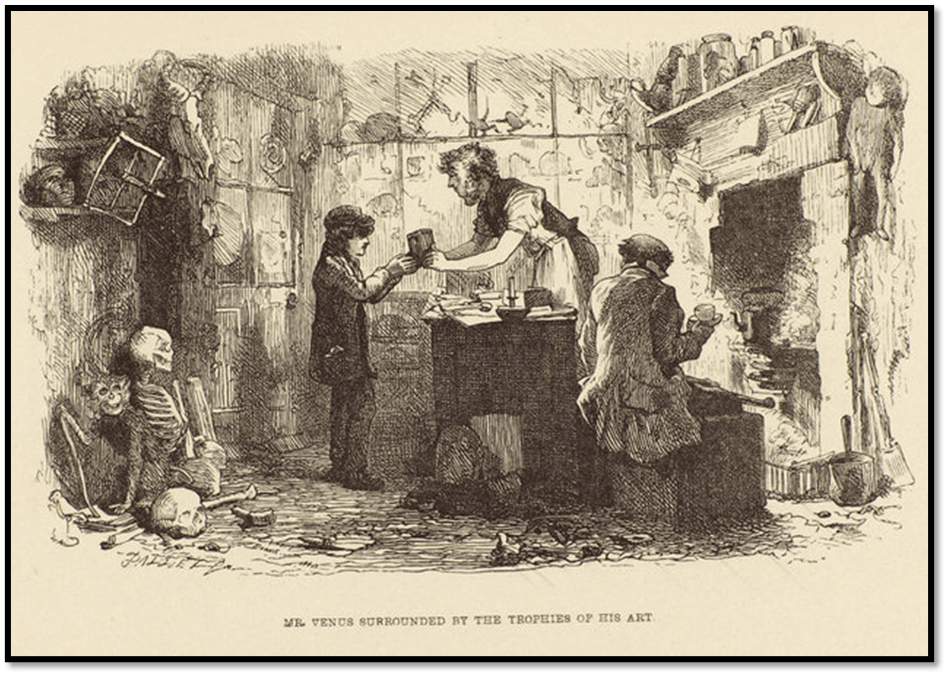
.. Mr Venus only replies, shaking his shock of dusty hair, and winking his weak eyes, ‘Don’t sauce ME, in the wicious pride of your youth; don’t hit ME, because you see I’m down. You’ve no idea how small you’d come out, if I had the articulating of you.’
This consideration seems to have its effect on the boy, for he goes out grumbling.
Thus Dickens in a late novel delights in showing the disempowered and agéd men (for their hair is ‘dusty’ and eyes ‘weak’) getting one up on younger men with smaller resources, though it is difficult to convince them of such. All the young lad can do is go out grumbling, aware he has not Venus’ powers of articulation, nor Dickens’ powers’ of the same kind either, who no doubt as young Boz would still have had a witty riposte.
But surely the best consideration of the weight and worth of youthful possession, including self-possession and the ‘attachments’ they boast (youngsters do so ‘fall in love’ with things or persons) is Cleopatra’s self judgement of her earlier attachments and the words she said about them then in her:
... salad days,
When I was green in judgment: cold in blood,
To say as I said then!
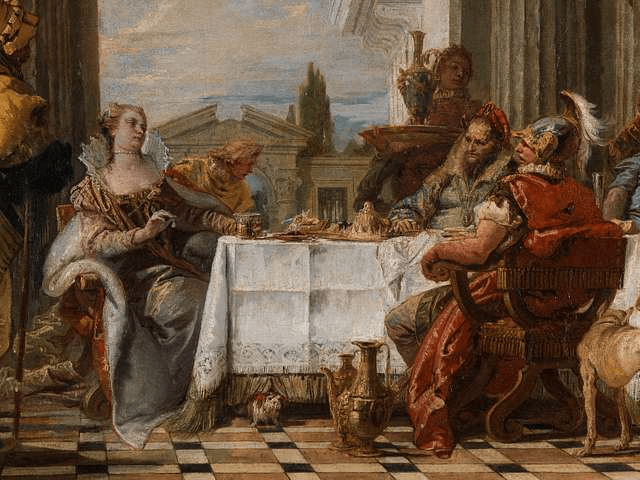
Here she is talking of her taste in men; comparing Julius Caesar, who has become in her memory a rather insubstantial raw green salad vegetable, to the considerable heft and weight of ‘meat’ (the word need not be spoken) itbis easy to see in big-muscled Mark Anthony. It became a famous unsaid thing, did Mark Anthony’s ‘meat’, with even the gorgeous Giambattista Tiepolo painting the scene of Cleopatra about to dissolve a hard pearl in vinegary wine with Mark Anthony’s back to us, but his legs spread deliciously wide to accommodate that meat she desired.
In Shakespeare’s take, in Antony and Cleopatra (Act 1, scene V), Cleopatra opens the scene in idle talk with her court eunuch, Charmian. Her talk is sexually very frank, homing in on male sexual equipment by speaking first of the fact that she takes ‘no pleasure / In aught an eunuch has’ to the delightful Charmian. Of course, she moves to ask him or them if he or they has ‘affections’, truly wondering if male emotions are rendered as impotent as is their castrated body in this transexual event.
This is one of the most illuminating scenes regarding the representation of sex/gender that are common in Shakespearean drama. What does Cleopatra quiz Charmian about? It is to find if Charmian realises the power of desire proceeding towards and not from the phallus, as if the whole of sexual ideology were being unpacked in front of us. That is necessitated in that culture and ours precisely because there are fewer ways of articulating female than male desire, psychosocual symbols of desire organised as they are around the erect penis. Isn’t that why Cleopatra shows strength by showing she can dissolve a pearl in Tiepolo’s great picture, taking his cue from Shakespeare? No hardness can stand to her power to soften and melt it.
Charmian must delight her when he, as a castrato, imagines sex as if he were a woman and still the active partner in sex, in a little-noticed inversion in his references to Roman mythology:
Cleopatra. ... Hast thou affections?
Mardian. Yes, gracious madam.
Cleopatra. Indeed!
Mardian. Not in deed, madam; for I can do nothing
But what indeed is honest to be done: (540)
Yet have I fierce affections, and think
What Venus did with Mars.
That female sexual power can be considered ‘passive’ because the phallus is seen as the engine of sexual ‘deeds’ (those that are not publicly ‘honest’ and in the usually private sexual sphere – William Empson has already shown us long ago how rich the word ‘honest’ is in sexual contexts regarding its use in Othello) – is what this short speech assumes. Yet, says Charmian, if implicitly, female desire is a field where power, and even violence, range imaginatively in ways that outstrip men.
When Charmian imagines sex he imagines ‘fierce affections’ by thinking ‘What Venus did with Mars’. We fail to react to this at our peril. Mars’ warlike persona – his ‘fierceness’ is taken over by the castrato, unarmed as he is in deed, and the active sexual agent in the mythical pairing of male military virtue and femal love is now commandeered by the very symbol of female love – it is what Venus ‘did’ that matters not the supernatural miltary male, Mars. No wonder this sets Cleopatra off into fancies about the feel of Anthony as a man and to revel in her old power to make herself the survivor of whatever male power tries on her, and has tried to make of her, whether as the sun [Phoebus], time or the martial heroes, Pompey and Caesar.
However, let’s cut to the point! Charmian remembers and dares to remind Cleopatra that Julius Caesar was ‘an item’ she was ‘incredibly attached to, in her youth’. When the Queen asks her servant eunuch whether she ever loved ‘Caesar so’, so as to to send him messages of love daily as she now does Mark Anthony, she is not expecting that eunuch to mimic her early attachment to Caesar, but he does. But what amuses is that her playful assessment of old attachment and new as the subject of discourse is so oral.
Cleopatra’s aggression, playful or not, rages against Charmian’s mouth in uttering words about a lesser man, in her current estimation not the one she currently favours and who, for that reason has no ‘paragon’. Charmian’s mouth will be bloodied by the violence Cleopatra threatens. However, most of all, in comparing her ‘man of men’ to an older weaker number, she says that Charmian’s mouth should be ‘chok’d with such another emphasis! / Say, the brave Anthony’. Brave is a badge of physical endurance but every inch of it in the talk here is that which makes a man a man. And a true man gags one:
Cleopatra. Who's born that day
When I forget to send to Antony,
Shall die a beggar. Ink and paper, Charmian. (595)
Welcome, my good Alexas. Did I, Charmian,
Ever love Caesar so?

Charmian. O that brave Caesar!

Cleopatra. Be choked with such another emphasis!
Say, the brave Antony. (600)

Charmian. The valiant Caesar!

Cleopatra. By Isis, I will give thee bloody teeth,
If thou with Caesar paragon again
My man of men.

Charmian. By your most gracious pardon, (605)
I sing but after you.

Cleopatra. My salad days,
When I was green in judgment: cold in blood,
To say as I said then! But, come, away;
Get me ink and paper: (610)
He shall have every day a several greeting,
Or I'll unpeople Egypt.
But then come the famous lines which indicate that, to Cleopatra, Caesar was vegetarian refreshment, and at that a mere cold salad. Its greenness and coldness become the tokens of a woman who is not yet a fully adult woman – a woman who did not yet know that her imaginative reach was more fierce and more active than anything even the best of men can do with his body. For even if he just sits or stands, Cleopatra can articulate that passive weight into an answering resistance more powerful – whether that of his horse or her answering body and its orifices.
And for Dickens’s Venus and Shakespeare’s Cleopatra, the strength of early attachments (sping torrents as Turgenev wrote them) is an illusory one [a product of youthful vanity], that is remembered in age at peril and with the danger of action replay, for we never really give up the illusion of their endurance, we just exchange their object only to learn again about our own needs and their greater power of persistence when admitted as being such.
In responding to the question in the prompt directly, I can remember no item of my youthful attachment more than an image of the youthful beloved in the eyes of a youthful lover, and usually an unresponsive (heterosexual male) item except for – on their side – a bit of fun. Where they went and what happened to them was their business. But that they can come back in a new Mark Anthony is certain, for who makes Mark Anthonys but the desirous imagination alone – and imagination can dissolve those men (‘real men’ in particular) too, however hard they seem, in its vinegary swirls.

But my husband. We have been together now so long that at last I have learned mutuality. Perhaps, without the asp, Cleopatra might have grown up too and not just feed herself, ‘With the most delicious poison’. (Act 1, Sc. V, line 552).
With love
Steven xxxxxxx


One thought on “What are youthful attachments worth? In my ‘salad days’ I knew no ‘meat’. And now I am a pescatarian.”