A performance of Pat Barker’s art in ‘The Voyage Home’ merges the voice of the Durham working class and rich music.
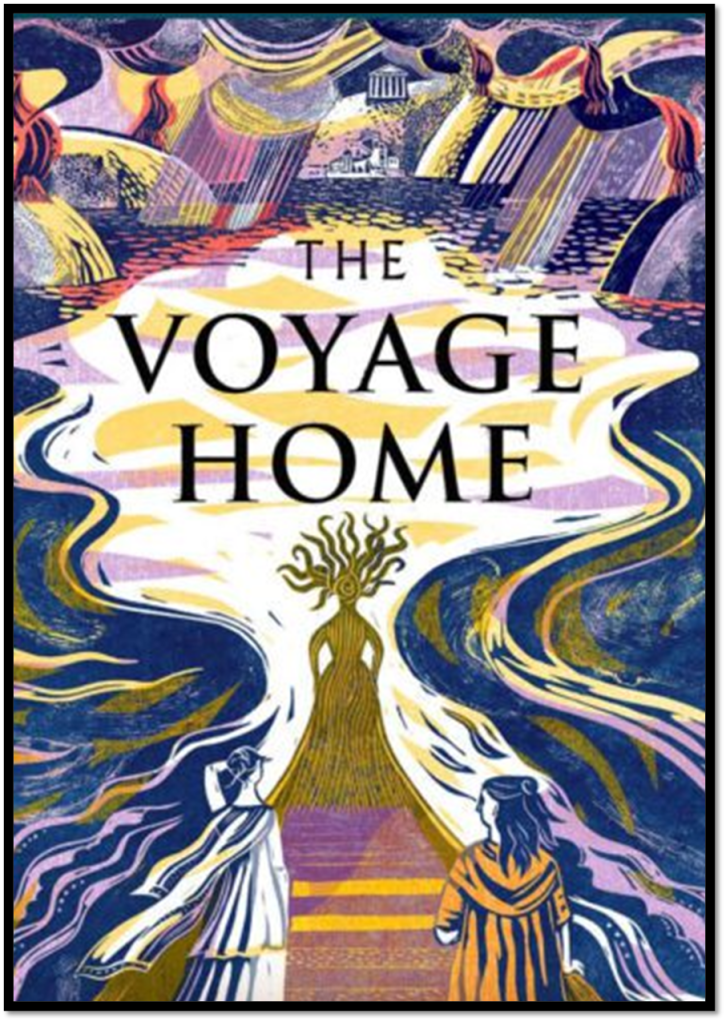
I have blogged on The Voyage Home in preparation for this event (see the blog at this link) and had it been for the fairly run-of-the mill interview with Barker conducted by Adelle Stripe provided by the Durham Book festival last night, I might have rested happy with my own reading. I did get the chance to ask a question and Barker’s answer showed me that I got one important factual context wrong. In my blog I had been fairly confident that the architecture and topography of the royal place and city of Mycenae were based on having surveyed them herself. I asked how much was researched of her descriptions of that place were researched and how much invented. In the blog I said this, rather cockily:
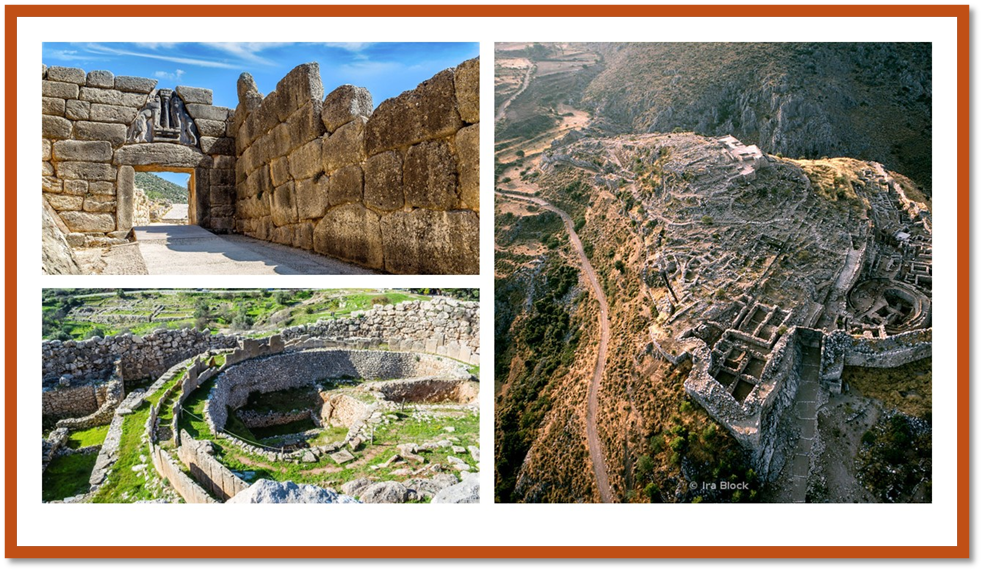
I have, I think, said enough, except to point out that the way in which the palace of Atreus is psychologised by Aeschylus in Agamemnon is unpacked as a product of strange male symbolic architectures in Barker that are ‘real’. Unlike Aeschylus, Barker has clearly trod round the hot ruins of Mycenae as I have. It has been, unlike the Mycenaean architecture of Minoan Knossos (over-exposed by Arthur Evans), carefully excavated with many of its dark passages leading to infernal depths (or so it seems) retained. Its magnificence is also a physical constraint, its ‘labyrinth of corridors’ conducive in their darkness to fantasy of self-loss.[20] Everything is smaller than the grandness you expect, even the ritual lustral basins – the baths in which Agamemnon meets his end. But we see here that the small mindedness of power was a material thing for Bronze Age Greeks. Even the Lion Gate, seen often in the novel, is smaller than expectation. Barker absorbed that and realised how else could one think but in near-Gothic insanity in such circumstances. This is a book that still puzzles in the ‘debatable land’ between the real and the unreal, as in life we all have to.
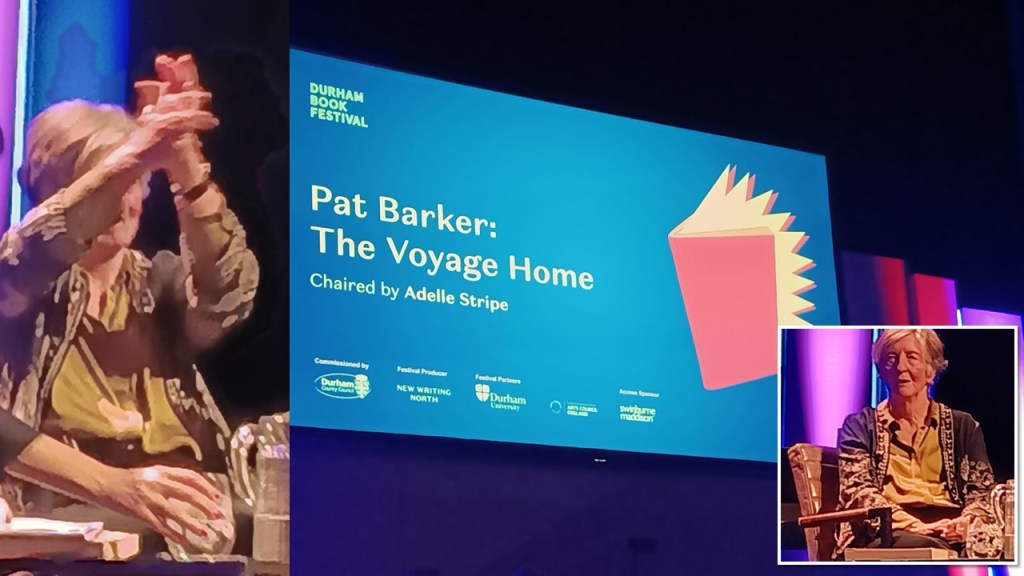
At the event, Pat Barker pointed out that it was largely an invented city-scape and topography, and that this was the gift given her by re-writing myth, rather than history as in her earlier work. In myth invention is centrally important to the project of the revision in a modern story. Moreover, Barker pointed out that the state of her physical stability and mobility currently meant she couldn’t anyway have walked the ruins in research and hence that function of myth was doubly blessed for the creator of visions of the youth of the world. When Pat Barker entered and left the stage, assisted sensitively with her arm by Adelle Stripe, it felt like, for a moment, seeing Antigone leading the elder Oedipus towards the huge vision about to occur to him in Oedipus at Colonus. There was something of the feel of mortality in the answer despite the wondrous ability to imagine youthful embodiment that always characterises Barker’s writing.
Business-like enough, the rest of the interview seemed to point out all the deficiencies of the book festival interview as a genre, even seeming to ignore the fact that that the audience had just seen a fine piece of art about which they were supposedly conversing metamorphosed into performance of the voiced words, sound and music of the highest order. It was never mentioned by Stripe, who even recounted the story of The Voyage Home as if that performance we had seen had not done this for us an audience better than any bald summary. But no! The prepared notes had to be recited.
It was however a delight to see Barker and to hear her and her answers nevertheless. Stripe observed that the contemporaneity of the voices of the servant class in the book might have been overheard in any street in Durham. Barker replied that the voices of working-class women, as in Ritsa, her narrator, were those she heard from her past life in Durham and Stockton, and that her ability to transpose them to Troy, Mycenae or into the innards of the Medusa, were another gift of the freedoms gifted to retelling of myth; freedoms used by Homer from older retelling of the Troy story and later tellers, not least the dramatists, though strangely enough these were not mentioned (not even Aeschylus).
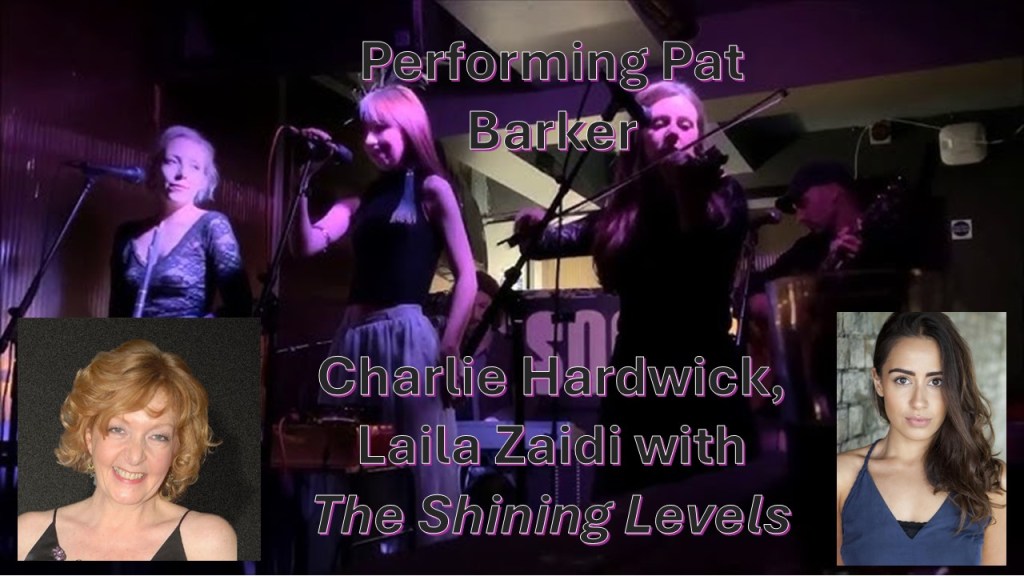
But the performance was what made the evening. The point about the voice could have been intuited from Charlie Hardwick’s masterly Durham accent in taking on the voice of Ritsa in the opening reading from the very start of the book.
Hardwick captured the tone, words and even, to my ear at least, the left-wing leaning of the female voices that raised Barker, and of which she spoke, including unconsciousness about the effect of the use of terms deemed to be popular usage, such as the phrase ‘catch-fart’ which Barker must have imagined from the parlance of slaves in the service of an aristocracy not even allowed to notice their farts. In the auditorium an embarrassed laugh rippled, like a fart one might say, as this phrase came so naturally from the stage in Hardwick’s voicing. The reading brought out everything important in the opening text – Ritsa’s antagonism to the way the entitled, like Cassandra for whom ‘home had been first a palace, then a temple, both now in ruins, like my house’, see themselves as ‘victims’, for instance. There was the most extreme beauty in hearing Ritsa speaking, as a woman of working class regional language and of a sensitivity greater than that of her masters, of Cassandra’s ‘sunlit’ eyes and mourning the fact, as working class feminists must oft have still to do that, as with Ritsa and Cassandra, ‘a shared misfortune’ (those brought about by patriarchal capitalism) where things that ‘should probably have brought us closer than it did’ just don’t. Hardwick’s performance was wonderful.
With cuts, she brought us to the point of the women mounting the Medusa, the personal vessel of Agamemnon, whose slave-wife Cassandra had become, as mistress with her ‘catch-fart’ at the rear. I was delighted then that the next reading concerned Cassandra’s musings, read by Leila Zaida about Agamemnon in bed, comparing the states of psychosis and neurosis in their mental health presentation, if not in those terms, for it included a section I prioritised in my blog, and used in its title:
… Agamemnon’s fallen asleep on top of her, as he often does. Wriggling, she manages to free the fingers of one hand, … She waits, tries again, this time gets a whole hand free and begins to explore, a mouse venturing out in the vastness of the night. All she can see are purple and orange flashes on the inside of her lids, but they’re not real, they’re not like this patch of bedsheet she’s managed to recover – that’s real, that’s outside herself. Real, unreal; inner, outer – always debatable land to her. She can only marvel at the lives of others for whom these are clearly established undisputed borders.
And Agamemnon? How does he experience these things? Is he secure in the world of touch and smell? Lying underneath him in the dark, his fuck-sweat clammy on her skin, she finds it difficult to credit him with any kind of inner life. But he obviously has one. He sees his dead daughter. What’s that if not a disputed boundary? ’
Enacted, the point of this scene in prioritising a debate about the imagined and invented against the real is powerfully conveyed. The speech even gives another entry into how Barker must invent the spaces in which myth takes place – whether they be in the bowels of ship or palace or on the ‘plains of Troy’ which the bed she shares with Agamemnon sometimes looks like. Yet in the passage that bed is less like Troy than a prison, constricted as in the passage above, just as Barker has Cassandra say to herself. These places are as much internal spaces of the mind, heart and bowels – with viscera and blood too sometimes – of Barker’s fictive vision as a myth re-teller. Zaida did all this justice.
Hardwick, as Ritsa, sees us coming to the shore, before the actors exchange seats to mark a shift of place from Troy and ship to ‘home’, the coastal plains that serve Mycenae. In the shift, Zaida becomes Clytemnestra – brilliantly. The actors take the story up to the point of the meeting at the royal summer Palace on the coast next to the tomb of Iphigenia, their daughter, slayed by Agamemnon as a sacrifice to appease the Gods to look fair upon his military adventure to Troy and to turn the parlous condition in the military camp to those in which old king Nestor can have a comfortable shit. Clytemnestra’s view of all this is expertly handled in the prose and was brilliantly speaking to Agamemnon. The latter role was read by Hardwick with no attempt to stereotype his ultra-male discourse- and thus making it more deadly. Clytemnestra tells him that tomorrow will be a long day – with a beautifully timed additional ‘aside’ in Barker’s prose, marked as Clytemnestra just thinking the words:
“You’d better get some sleep,” she says. “Long day tomorrow.”
“Yes”
Though not as long as you think.
(The Voyage Home page 131)
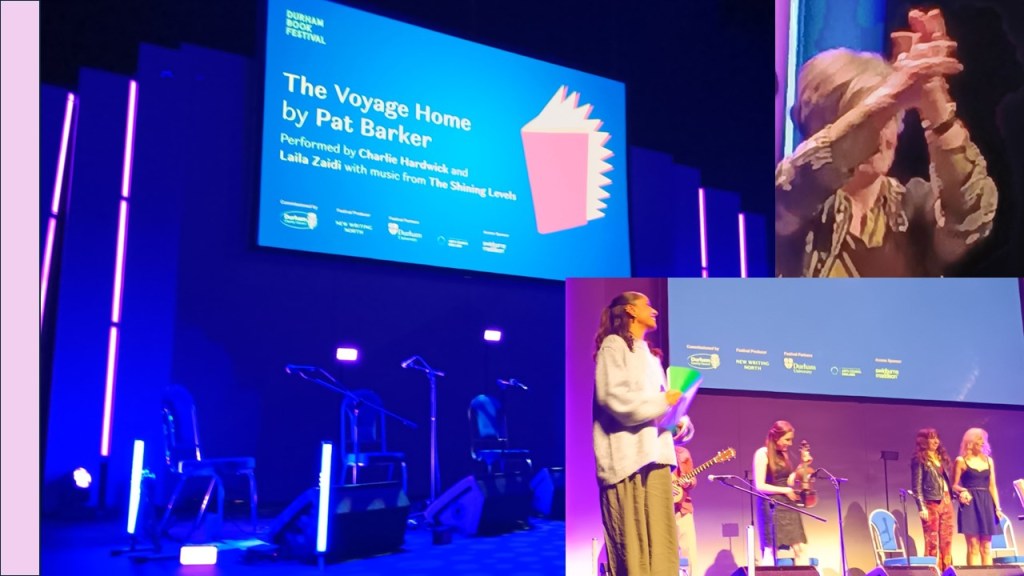
In my collage below, I show (top right) Barker applauding). She was in fact applauding her readers at the end of her talk but I have tried to show it as if she were applauding our actors (from my side of the auditorium I could only catch Zaida in shot not Hardwick but both deserved applause from the author) which I am sure in some darker corner of the auditorium was actually fulsomely given by Barker. Certainly the applause that they got rousingly from the packed audience at the Gala was as full of thanks for their skills.
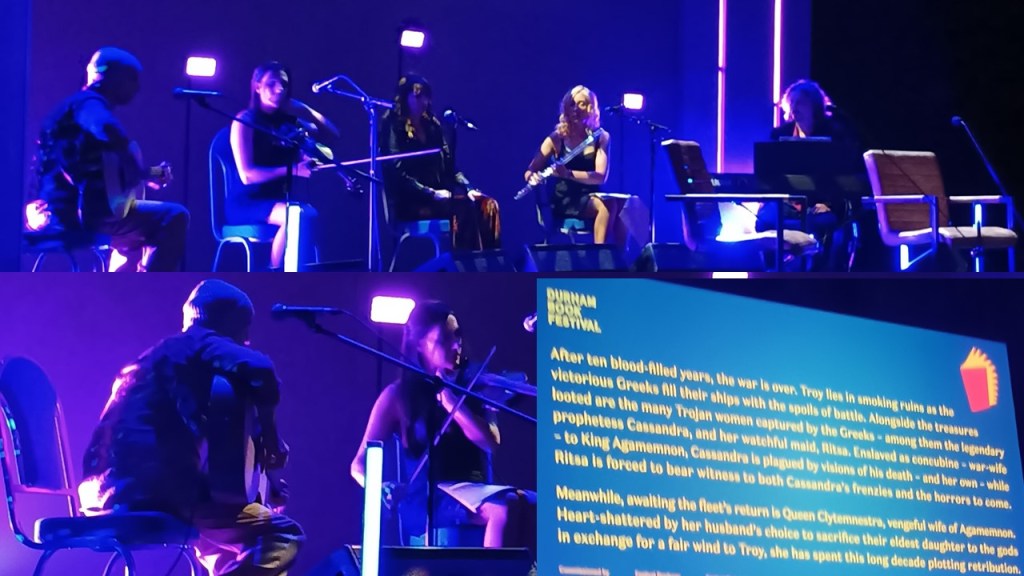
But in the dark background The Shining Levels, whose genre-mix of folk, classical and hybrid song also shone.
The composed songs captured exactly the inarticulate mood behind Barker’s scenarios, whether it be longing for a home that is stable, safe and welcoming, or, in the song I loved best, capturing the delusory mind of Cassandra and its roots in more common experience, oft pre-selected as female by our binary world. That feeling was of a selection by THE OTHER so profound, it feels like one could ‘kiss a god, walk the waves’ before disappointment, as in the descending notes of that song one realises that such heights are temporary. They fade existing as we feel them characterising only a short duration: To begin with anyway’.
When these beauties occurred, the actors were in shadow allowing the mood behind their words to envelop them. The Shining Levels may be misnamed or perhaps not. Too often you see and hear their ‘shining heights’ but ‘levels’ does record too how, like lithium, they subdue the mania they evoke in order to restore balance. Balance sounds dull, and with lithium I am told it is – hence the use of anti-psychotics these day – but shining levels still shine because you can still feel the tremendous forces (uppers and downers) keeping you on balance at the level as you listen to the harmonies of lyric breaking and reforming.
Let it come, hot and strong.
Let it come, hot and strong
Well it feels amazing
To begin with anyway.
Like I could do anything,
Kiss a god, walk the waves
Well it feels amazing -
To begin with anyway.
Verse that skims the feeling of sexual triumph felt by a young woman (Apollo kissed Cassandra to give her the godlike power of prophecy and then ‘spat in her mouth’ to ensure no-one thereafter believed her prophecies) in all its ambivalence (for it is a mistake to see the spitting as no less ‘hot and strong’ despite the disgust momently evoked). Narcissistic power was sung with every ambivalence of both longing AND DESPAIR in it. Despair because patriarchy reserves true narcissism, beyond the ‘begin with anyway’ to young men. They too will despairs the loss of the ‘magic’ of their socially fostered self-esteem, but only over a much longer time-span that that women are forced by patriarchy to experience. But loss of magic is at the root of Agamemnon’s depression surely and complicates the fact in mourning his daughter, he mourns his amour-propretoo.
What a superb evening. Readings are not usually like this.

 Steve_Bamlett_blog