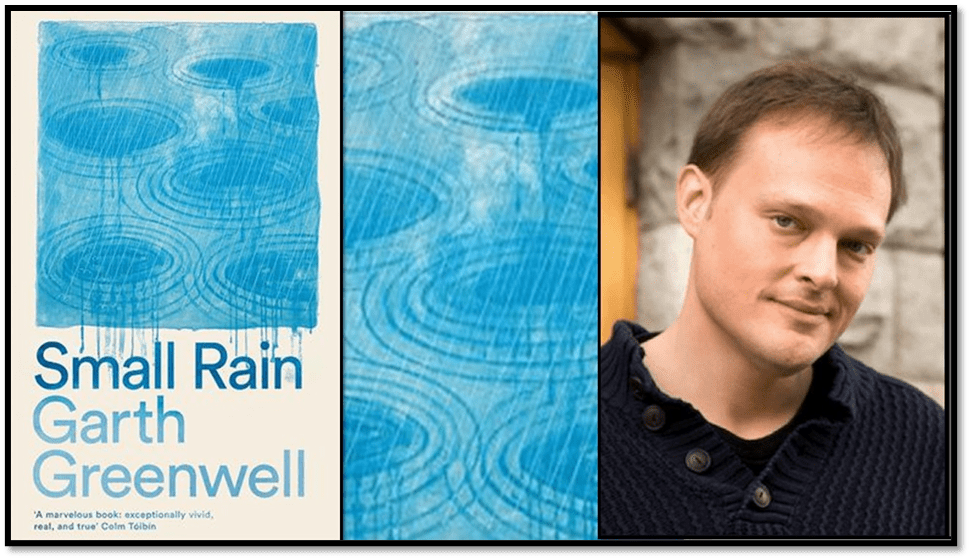
There are no answers in this novel about ‘how to live’ other than the possibility that there might be, but possibly too there aren’t, ‘provisional truths’. Sometimes wisdom looks like the realisation that: ‘Maybe it wasn’t true that there were no arts of living’.[1] In this novel Garth Greenwell leaps from the queered description of queer lives in his earlier work into the world of the universal and normative about which all you can say is: ‘I don’t believe that either’. This is a blog on Garth Greenwell (2024) Small Rain, London & Dublin, Picador.
This novel feels to me of such significance and to take an entirely new trajectory for the author. Greenwell’s early novels (see my blog on Cleannessat this link) had made the grasp of the relation of body to consciousness central to the art of narration and the aesthetic structure of his art at the level of the whole work and its basic units, which we can consider to be its sentences. In some ways I have thought as I read that the new direction Greenwell takes is in fact back to older European Romantic traditions edging of the late eighteenth and early-and-mid-nineteenth century, with the same degree of intensity about the key role of consciousness and the imagination as the levers of literary art as could be recognised by Wordsworth, Coleridge and Keats.
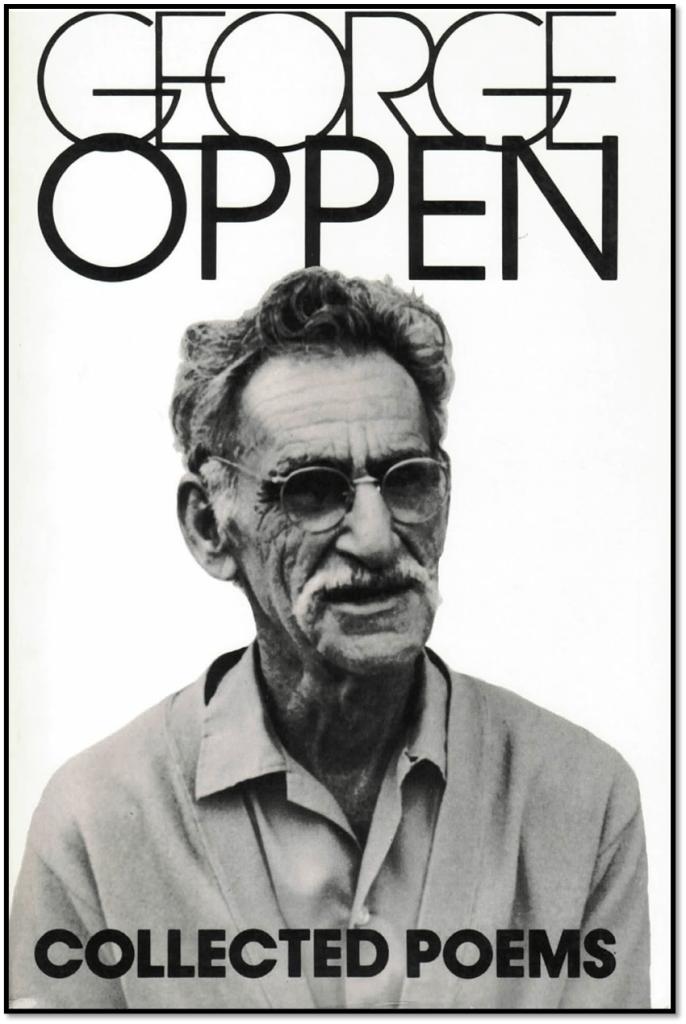
But of course that backward glance is itself only itself part of the seriousness with which the narrator of this novel apply to the history of poetic art from examples of medieval to modern writing that become absorbed into its self-conscious writing about the responsibility of the artist. In an earlier blog, I referred to the treatment of George Oppen and his own references back to Chaucer and through Wyatt and Spenser, which the narrator explains as an epiphenomenon of poetic art’s very being, its ontology as I will call it by necessity later. He uses Keats’ Ode to A Nightingale to do so, telling us that a poet ‘wants to cherish an object in time and also nail it outside time (that was a poem too, an image from a poem, I couldn’t remember which), nail it to eternity; it was a tension you could never resolve, you had to make the tension resonate too’. [2] And ways of asking it resonate are limited like Keats in that poem you might have to take the tension as that between the embodied instance of mortality in the present, and why not oneself when a health crisis strikes, and an iconic image of something, even poets and poetry themselves but also perhaps children, birds and other reproducing types of natural ontology. And in its concern for art it will return also to the language of the spiritual and redemptive in time. It is this fact that makes Grace Byron’s perception in The Guardian so correct that the narrator will urge us to believe that it is in our lives, it is the ‘(s)mall, redemptive moments that make life worth living’.[3]
The central issues in the art of narrative are bound up in others related to the technique of the novelist. Plot and character could be resolved in modernist examples admired by Greenwell like Henry James to the manner of narration, particularly its tendency to inhabit a limited point of view or perspective on the novel’s events through one, or multiple narrative points of view, though James specialised in the use of one, for the main part to make the consciousness of the narrator his focus. Consciousness always flexibility to writers – clearly single points of view of a person like Isabel Archer or Maisie will combine an attempt to see what is actually going on in the world as it passes me and I pass through it, but the subjectivity of my view allows me to introduce deeper, older structure of both psychology and my absorption in culture, including the cultures of the past, and perhaps[s even my subjective constructs of the future. If we needed any more evidence for the fact that Greenwell is in this tradition take his conversation with Katie Fraser of The Bookseller, before publication of the novel:
This stream of consciousness, which moves between the hyper-real and surreal, enables Greenwell to delve into the intricacies of the human mind. “That’s been the project of all my books,” he says: “To try to get the experience of consciousness or one’s experience of consciousness onto the page.”[4]
Alessia Degraeve, a very acute reader (from The Los Angeles Times), shows us – without referencing the modernist influences on Greenwell, which he often speaks of (even on Twitter – or at least he used to) that the use of the limited point of view of a single narrator, sometimes called an ‘unreliable narrator’, for we have only their view of events as a framework, except in the dialogue they allow other dramatis personae, that this is how Small Rain works, even by filtering, as she calls it, the talk of others through his subjective consciousness:
Greenwell doesn’t use dialogue but filters it instead through first-person narration. Language, and the glorious music within it, is a mechanism he uses to stabilize himself; it is the cord that connects him to life. He holds onto it with the urgency of a person attempting to save themself: …[5]
And all the critics of this book might have started here, for it is the only avenue of making the narrator’s sentences the tool and substance of both the novel’s sentences, its plot and its symbolisation or generalisation of character, even animal characters (perhaps even plant life too), which matter too throughout the book.
This technique of filtering ensures too the self-consciousness of the book about the seriousness of its project. The narrator can be challenged by the internal shifts in his consciousness to query himself thus: ‘Where is your philosophy now, I asked myself’. The shifts are very fast. The next sentence contradicts the basis of this question: ‘But human beings aren’t ever philosophical, I don’t think, at least I was the opposite of philosophical, …’. Yet to support that last assertion he sees himself in the manner of a philosopher’s though experiment, as a ‘a bit of matter terribly afraid’. It is a philosopher’s means of proceeding when all the rigour has gone from their methodologies, but is nothing but philosophical and a particular branch of philosophy: metaphysics in which the ‘basic questions’ are asked..
I made so many false starts to this blog however because I could not work this issue out to my own satisfaction. I thought it might be my title that was to blame. That isn’t because it is in error about the existence of a debate in the novel about the ethics of ‘how to live’ (or love come to that) or of the possibility that there may be, or not be, helpful ‘arts for living’ that can be learned. The point is however that the prose in which such ideas are explored never maintains a clarity of position on such questions nor even a consistent direction of travel. It is as if there is an insistence on the uncertainty underlying both our belief that such notions exist or, if we admit they might, how we could ever know anything about them. No wonder I struggled, forgetting perhaps that novels are not philosophical tracts (and neither are philosophical tracts in Wittgenstein).
However the questions in this novel are the basic questions of metaphysics underlying ethical investigation: those respectively of ontology and epistemology. The novel ends with what sounds like an assertion that an example of ‘pure life’ for instance has been demonstrated in the actions of a dog, Leia, owned by his sister G, in negotiating the process of returning a ball to him. It asserts the fact that there is ‘pure life’ here without us ever being clear how we know that it is present and if it is indeed present, other than in its description of something the reader cannot see, except in the memory of other instances of nearly-the-same thing in their own family pets.
Is it ‘pure life’ because Leia sustains ‘pleasure’ and ‘pride’ in her achievement, despite the technical failure in part of the task, or is it the sum of her physical traits indicative of health and efficiency as a body. We will never know and perhaps we never need to. The only thing I am sure about is that the novel insists on the impossibility of ever characterising the meaning of the issues that constitute whether there IS a thing that is in ‘essence,’ pure life’ , let alone know what it is in order to, at another remove in the debate, live a ‘good life’. And the novel needn’t deal with abstracts such as might be thought to be referenced in the adjective ‘pure’ (as in ‘pure mathematics’) but even the meaning of the ‘human’ and ‘humanness’ of which I hope more later. Not even this though can be said, for it assumes the same knowledge of which it doubts the existence. Hence nothing can be said without any certainty, nothing that cannot be both refined, reformulated or, even, denied later and sometimes simultaneously.
One example of this that is less taxing than others is based on a fairly simple form of the narrator turning a character whose filtered dialogue and human actions will be transformed even from the first introduction of her in writing his experiences, the character Alivia. The name is not well known in the UK and so I looked up the name Alivia in a baby names dictionary. James used the name ‘Archer’ in The Portrait of a Lady to indicate the goddess Diana, as a huntress, and her peculiarly ‘arch’ manner of acting and speaking.
Alivia has developed in America as a modern variation of Olivia. Olivia originates from the Latin word ‘oliva’ for an ‘Olive’. Olivia was made popular by Shakespeare in his play ‘Twelfth Night’, and is currently one of the most popular girl’s names. Alivia has perhaps come about as a way to give the name new originality.[6]
Now an unreliable narrator can do anything with their characters name, both subtly and less. Alivia has lots of potential, as we can see both in the olive tree pathway to her name and in other echoes. I think, for instance, her name chimes with Milton’s poem, L’Allegro, which the narrator references – of which more later, a poem about the choice of ‘Mirth’ or cheerfulness as an attitude to life.
Alivia enters the novel as the narrator’s allocated primary nurse and the introduction is given over entirely to play with the possible meanings or associations (even if just of sound) of her name: ‘Her name was Alivia, with an A, she said, as she wrote it on the whiteboard; Alivia, alleviate, allegory, alive, I thought’.[7] The only echo not given is ‘Allegro’, though it is cognate. I suspect that this happens because the narrator will make Alivia central to some of the questions of social morality in the novel – how we live life and what life is and means is central. But these questions of ‘how to live’ and how to think about life get diverted through metaphysics often to questions touched by theology and myth. Take this puzzling episode where the narrator invokes the ‘line everyone quotes’ from the non-canonical text of the New Testament, The Gospel of Thomas. I checked on the internet and it is indeed the line everyone quotes as in this example:
The narrator handles the quotation as he does character dialogue by inserting his own interpretations and associations. His version comes in a sentence within a very long paragraph in which he contemplates dying and how this relates to his lifelong evaluations of life and what we do with it and how it has changed. The period of this contemplation he denominates as: ‘that time’ in which he thinks about ‘the life my life was preparing me for’.
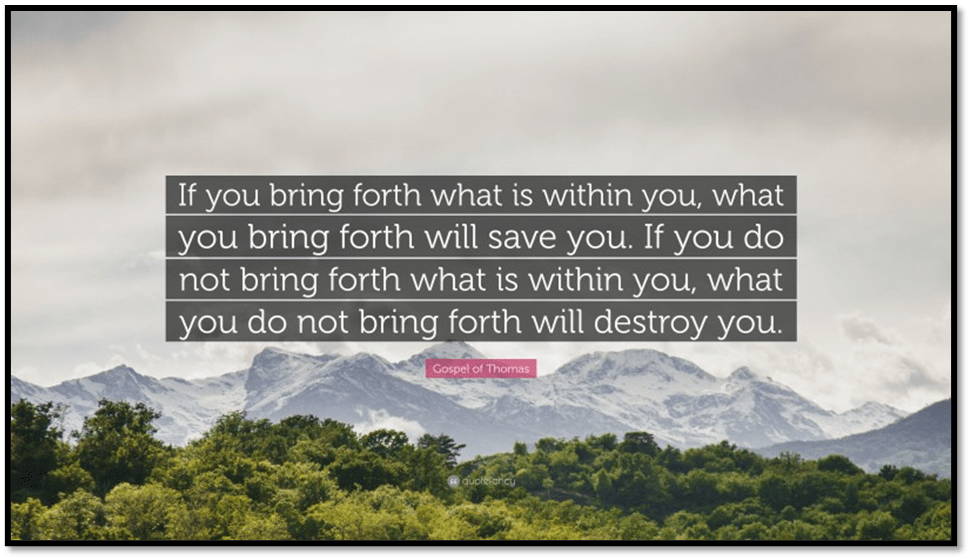
I wanted to see what I could do. I mean the poems I could write, and also the life I would make with L. I thought of the gospel of Thomas, the line everyone quotes about being saved by what is inside you, by bringing it forth, but there’s its corollary, that darker promise Jesus makes that what you do not bring forth will destroy you. They were terms I could understand, being lost or saved by what one made or failed to make; and I had brought forth so little, I had laid up all my treasures for that future time I wouldn’t have now, maybe, the time that had been cut short.[8]
The exegesis of the Coptic Gospel here turns out to be nothing like a clarification of the Gospel text, rather its involution into the narrator’s obsession with syntax and association, finding a meaning for the quote from Thomas from the better known one, but here unacknowledged, from the text of the canonical Gospel of Matthew
Do not lay up for yourselves treasures on earth, where moth and rust destroy and where thieves break in and steal; but lay up for yourselves treasures in heaven, where neither moth nor rust destroys and where thieves do no break in and steal. For where your treasure is, there your heart will be also” (Matthew 6:19-21).
Interpreting the things ‘within you’ that you do not ‘bring forth’ as the ‘laying up’ of wealth for a future day gives no evidence either that there is anything at all within you, or whether, if there ever were, it has not itself been lost in time, already destroyed by moth and rust, as Matthew says. The narrator’s chance of being ‘saved’, and of living a ‘good life’ may depend on realising the poems he has within and his capacity of for making a life with L, but none of it can be evidenced. In the end the sentence not only curls in on itself’, it devours its own tail but unlike the alchemical symbol of the Ouroboros never stops doing so until it is inverted within itself, swallowed without trace or perhaps ever recircling into and out of itself.[9]
This is particularly galling in this section of the novel for the narrator is merely reacting to his online reading about the survival rates from the kind of aneurysm that has been diagnosed as in his body. His anxieties which have required the comparative exegesis of two ‘Biblical;’ texts can be summarised in the end by his frustration that there no propositions that help us to live life in a good and productive way or even know what such a way of living life would be. At the back of his ponderings is a memory of Alivia, pointing out the tower on the hospital campus that marks the children’s oncology ward. There is almost the ‘allegory’ here the narrator guessed might be in Alivia – life is not the stuff of circulated weighty pondering but of going ahead and living, thinking it through as you go.
His imagination never moved on into life but circles around it (like the Romantic imagination) never making a beginning because he is afraid of the end awaiting him. All he can do with his thoughts is wonder in which way he is being ‘stupid’ in them, being either complacent about life continuing or being over catastrophic about its oncoming pace.
…: planning for the future or living for the moment, nobody knows how to live, there’s no way to know, anything anyone says is bullshit, entirely arbitrary, true or false by chance. There are no arts of living, I thought. I looked to the window, though the shade was drawn. Beyond it was the tower where I knew children’s oncology was housed, Alivia has told me when I asked her earlier in the day.[10]
The presence of Alivia at the last part of my quotation comes as a reminder of life, of peace (if you want of the olive branch of God’s covenant with Moses) that is as determinant as the narrator’s endless circular imaginative process of asking questions ontological, epistemological and ethical. And beyond that, of course like the political questions implied in social moralities that involve the interests of the Many not just the ONE person making communion with himself. To Fraser before the book came out, Greenwell said that, as in his past work, his interest in solitary consciousness was not a flight from social consciousness and political realities. Fraser comments that though the novel is set at the time of political crises, especially around public healthcare, exacerbated by the COVID pandemic, its relation of the personal and political was not directly through that link:
Although the narrator is not suffering from Covid-19, the action is set during the pandemic, which provided a “background of heightened urgency”. The effects of the pandemic are pronounced in Small Rain: hospitals are overwhelmed with the living and the dead, families and relationships are threatened by hysteria and fake news and interactions are marked by face masks, gloves and sanitiser, which bring into sharp relief both the fallibility of the human body and the precarity at the centre of American life. “I think all my books are concerned with political reality, but this is a book that is explicitly concerned with political reality in a new way.”
And the crises that the novel contemplates do not stop with a narrow or clinical view of health but extend to questions of housing, well-being, employment and the relations of empowerment and disempowerment in social relations (for he remembers that to make a building contractor feel small is not a virtue when challenged by him. It involves questions of relationships, the function of marriage and family, the care of animals and the ecological disasters on the human horizon. It strikes me that Alessia Degraeve makes many points much greater in substance in the issues inferred from them than on the surface (the sign of a subtle mind). I had noticed in the novel a continual reference to the durations of time in which, action being impossible, we just wait – and perhaps think and feel and sense from the focus of a stilled body. They don’t always seem significant at first as in this instance as the narrator leaves the hospital via the pharmacy to collect medication: ‘The pharmacy was across a large open space the stairwell opened into, a kind of lobby, a place for passing through’.[11] That sentence is beautiful – its potential for the reference to the vaguely metaphysical and religious fulsome despite this, For this novel, is, as to be fait I understood only on reading Degraeve who says:
In a series of liminal spaces—waiting rooms and doctor’s offices, long hallways, and hospital beds—the narrator reflects on a life that has become, at some indeterminable point, his life: a writer’s life, an obdurate life, a life suspended between a search for meaning and a confrontation with its lack. … / Once in the hospital, his illness places him on exhibit. He becomes a problem to be solved, a body to be learned from.[12]
Liminal spaces are places where ontology is uncertain and our epistemologies unreliable – ‘passing places’ where things transform their appearance and / or nature. But this is a larger issue, It does however relate to the political vision of the work that is desperate for new light to fall on it. To return to a simpler level, let’s point out that Grace Byron rightly says:
Set against the beginning of the Covid pandemic, it asks poignant questions about care, connectivity and community. What do we owe one another in “the project of being a human being”? / Greenwell is fascinated by our collective performance of morality.
At a later point she says that this extends to the ethics of political intervention or not, and, if so, how one intervenes:
Political discourse is “that weird intellectual weather”. He tries to shield himself from the ideologies of separation, wondering how we can come together despite our differences. Sometimes this reads as a bit too romantic, leaning heavily into an amorphous ideal without touching on the history of disability and vulnerability.[13]
Those are the equivalents in politics of a desire for attitude change. Byron makes a useful point at the end of her last piece too. There is a sense that the narrator might have realised earlier, had he been awake to various ‘vulnerabilities’ in the ecological systems of networked life that come new to him because he experiences them for the first time, though this is a point the narrator makes in their recurrent episodes of self-questioning. And Byron, as with other critics, fails to see that the narrator is not Garth Greenwell, even though he lives some elements and episodes of his life, but a fictional character who gets things terribly wrong, something Greenwell wants us to see.
I think one area where we might examine this in the comparison (a moral one at its root) the narrator makes between himself and his partner, L, on the basis of their relative status with regard to the psychological trait we call ‘optimism/pessimism’. I state the name of that supposed trait in the psychology but psychology itself does not unanimously support the notion that optimism and pessimism constitute one system of thinking and feeling in humans naming variations between their polar extremes. Christian Jarrett in 2015 asserts that the optimism trait-system is a significantly different trait to that of pessimism-trait system, even from the evidence of genetic origins of the systems.[14] Now whether or not Greenwell is familiar with such evidence in an ’unresolved debate’, difficulty in using the contrast is paramount. He starts off by showing the verbal evidence that comparatively L is optimistic whilst he pessimistic, even allowing some latitude for exaggeration of the trait on each side. He eventually characterises L and self as, respectively: ‘L’ Allegro and Il Penseroso’, often glossed as in translation from Milton’s Italian titles as meaning ‘The Cheerful Man’ and ‘The Thoughtful Man’.[15]
All of this is conveyed through a complex sentient sentence that fails to make a single uncontradicted proposition but does make us feel that somehow the narrator’s belief in his own modicum lightness of spirit is overly weighed down by his inability to stop thinking and explaining ponderously (pr ‘penserously’ to coin a term from Il Penseroso):
L’Allegro and Il Penseroso, I thought sometimes, except that was unfair to us both, and to our life together, which was marked more than anything by laughter, by lover’s games and teasing, by cracking each other up, as when I strung together all the insults and bad words I knew in Spanish, joder gilipollas sinvergüenza caradura, when he tried to pronounce the difference between sheet and shit, impossible for him to hear, or between beach and bitch, it’s a question not just of vowel sounds but of quantity, the weight of the syllable.[16]
Never has a joke been so laboured and the potential lightness within it turned into the densest kind of weighty sludge, not only in the sense of this sentence but in its laboured feel and the pettiness of the attitudes. It is all in the feel of the sentence. My sense is that just as Milton stays Milton, this narrator will never quite cotton on not to be ponderous, let alone ‘penserous’. L’Allegro is characterised by the line: ‘The folic wind that breathes the spring’ [line 18]) and both echo in the novel as we shall see sparrows and deer do too, but with the character and the name of the nurse called Alivia and in the blessedly life-enhancing behaviour at the end of the novel of a fast think dog, Leia.
There is that in the narrator that cannot easily share with us the virtue of the cheerful and the fast movement to something we might call ‘happiness’, and we are meant to see that in him and not identify with it – entirely at least. After all, those companion poems by John Milton have like the trait debate in psychology already mentioned often been compared as either conflicting, complementary or even reconcilable pictures of a poet’s characteristics, a debate there is no doubt this time that the narrator would know, but he immediately qualifies his use of it as similar companion relation to that of L and himself by saying the comparison was ‘unfair to us both’. In what way it is ‘unfair’ remains unclear but is clearer perhaps if I must return, as promised earlier, to Milton’s L’Allegro and its companion-work, Il Penseroso as works in their own right. For they too are poems about the philosophy of life and its connection to the conduct of art and to love in the life of an artist. Both, but especially L’Allegro cite openly their debt to Christopher Marlowe’s The Passionate Shepherd To His Love, and the poetic debate around it in Walter Raleigh ( I explore it in the linked blog) and John Donne, cited throughout L’Allegro, querying the substance in nature of a life of pleasure and a poetry of optimism apparently on offer, and Il Penseroso, apparently refuting it for a life of reflective pessimism.[17]
This matters for two reasons for the narrator must know from the scholar Dorian in 1935, noted in the major edition of Milton’s poems, that the two poems were discussed as if they were an ”autobiographical record of an important step in Milton’s development – his consideration of the question whether he should suppress either the lighter or the more serious side of his nature, as man and poet, for the fuller development of the other”.[18] And consideration of what, if anything, in the forms of both poet and liberal queer man he is will arise from bed after this health episode is very much an issue in Small Rain. But there is a second reason.
Greenwell himself would know, with or without various new applications of queer theory to Milton’s oeuvre (see my blog at this link on this question) that the ‘poem grew out of the contrast, as Milton saw it, between [Charles] Diodati and himself, and that this might explain the Italian titles’.[19] He would have known that because the idea of Diodati as the queer other half of Milton, as L (for LIFE perhaps) is for the narrator – merry where Milton was thoughtful, has now become enshrined in criticism and makes total sense in terms of the narrator – a poet – comparing himself to L – another poet and beloved. And just as Milton avoids any issue relating to his undoubted physical (if not necessarily sexual – they aren’t the same) love of Diodati’s body and mind by Diodati’s convenient death, his Lycidas, so the narrator can background L’s claims to a personality of more value than his.
Although the narrator shows, in order to make the Milton reference seem ‘unfair’, how they as a couple joke together, he immediately then uses the framework of the comparison to illustrate how soon L can ‘imagine the worst thing’ about his health condition and then ‘confront it and then turn away’. And look at the form of words with which L’s reaction is described. It is a version of the device poets call ‘chiasmus’, two different terms cross over each other that are apparently two ways of saying the same thing without duplicating the same verbal expression previously used. Note in every chiasmus, although the criss-crossed terms apparently say the same thing, they do not quite do so. And in this example to ‘confront’ can easily be thought of as the opposite of to ‘turn away’ and not a repetition at all but a contradiction. What we find here then is layered with uncertainty of reference and meaning, or even of attitude, for if your lover turns away, they may minimise the fears you feel and hurt you, even confront you with a poor reflection of yourself.
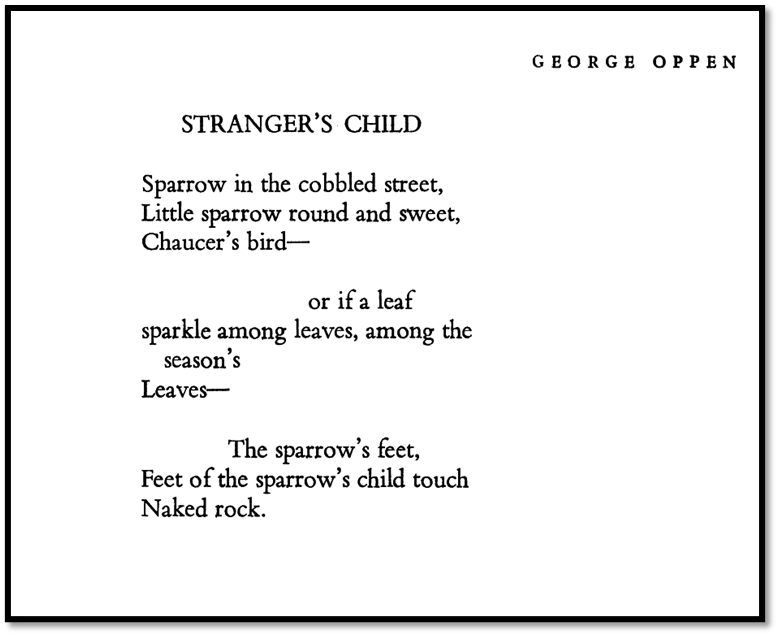
At this point every non-literary person says – ‘but hold on a minute! Surely the writing could not intend to convey all of that. I will stay with this thought a while but I am not so sure that Greenwell does not write with such compressed attention because this book also contains a moment where the narrator speaks openly of the use the chiasmus. What he says is full of shifting foci of interest that fail to work consistently together – at one moment talking of the example in the poem, at the other of the concept as a thing he teaches to others. He is speaking of George Oppen’s poem Stranger’s Child, which I have referred to in an earlier blog (at this link). Even in telling us about what a chiasmus is the narrator does not avoid complexity of attitude and cognitive clarity, although his example is a brilliant one, as he turns to it from a comment about its use of repetition which causes ‘the feeling of lilting’:
… especially at the beginning of the third stanza, with its two repetitions, interlocked, sparrow’s, feet, feet, sparrow’s, It’s a crossing repetition, a chiasmus, one of the five or six figures I made my students learn, which was something they liked, concrete and findable, a label they could place, making a poem a puzzle they could solve, a treasure hunt.[20]
Note how he ends this last sentence with another rather complicating chiasmus. But the point he is making about his students veers in a direction opposed to his attempt to be clear about the Oppen poem and indeed becomes rather dismissive about the tendency of students to want to simplify and reduce the effects of a poem to its effects that can be labelled. We know he thinks this is NOT the way to understand or like a poem.
Moreover the very next sentence then complicates things even further, for the narrator then retreats from calling this feature of the poem a chiasmus at all, or, if it is a chiasmus, one that ‘doesn’t really feel like a chiasmus here’. It is he says a three-term figure not a two term one, dialectical in Hegel’s terms rather than binary. such that, ‘after the two interlocking terms there’s a third term, immediate, bound by a genitive, so that looked at another way it’s a figure of transformation’: if the first term is sparrow’s feet the second is sparrow’s child’. No proposition in this discussion has other than ‘provisional truth’, if that. Instead of being a commentary on something knowable and of whose existence we can be sure, it does what he, within a page of writing, says is, ‘something else art can do, it can be a laboratory for thinking, for trying out ideas, not just abstractly but feelingly, so that we can live with them and see them through’.[21] After all, a dialectical space is a liminal space where nothing enters to emerge the same as it went in.
And then in the next paragraph he relates all this to Kantian metaphysics in relation to ‘faculties, ways of being’, which then argues its case on the basis of a conditional: ‘If it’s true what Kant says about the kingdom of ends, …’. I certainly don’t know whether the narrator’s learners, whom he has already introduced as a fairly intellectually limited bunch, know what it is that ‘Kant says about the kingdom of ends’, but I think we need to be clear reading this that the narrator does not believe that his object of all this discourse is the clarity of his propositions about either art or ethics, Kant’s subject here referred to.
And this is because Small Rain is meant to act like the art the narrator tries to describe here. Art he says a little later demands ‘disciplined attention’ and such disciplined attention is:
a moral discipline, even when the content of the morality isn’t obvious, in the way Cézanne paints an apple, say, or the bowl that gathers the apples, the hundreds of strokes he makes, each an act of seeing, a judgement, each an attempt to activate in us that awareness we nearly always shut down.[22]
I find this beautiful but I find it troubling too. Take the word ‘say’ inserted to the argument. AS we read it first we are inclined to read it as advancing the beginning of an examination of the evidence for the proposition that art tends to demand the activation of ‘a moral discipline’ called forth by the ‘way Cézanne paints’, and indeed it does so as the sentence elaborates that each brush stroke is an ethical judgement about what reality is. But ‘say’ is syntactically ambiguous. The addition after it of the clause, ‘or the bowl …’, suggests that the ‘say’ refers only to the initial choice of the apple on which to focus our attention, which could be varied, say, by choosing to focus on another object painted within the artwork. Such ambiguities make the intentions of the language used fuzzy. I think they do so deliberately.
That the thinking has its boundaries made fuzzy by the prose is vital to the work of poetry and some would say (me for instance) of the prose-poem, although it may be the effect of any refined prose, even, say, that of Samuel Johnson, though this is never in order to deny the value of logical, ordered and clear thought but in order to assert that this is not the object which art desires us, unlike academic philosophy, to see within it – not clear arguments with refutations and refinements of nuance but a clear image of what human processes of thought and feeling feel like, look like and mean in contemplating absolutes like life, love, and ‘the good’. It is not far this from the label objectivism used of George Oppen to describe his poetry. I talked about that in passing in an earlier blog (at this link). There I said:
Oppen often appropriates quotations from others to interpret purely as they suit his own purposes and argument including his major reference here to a poem by Bertolt Brecht. He uses quotation freely to define an area not truly that referenced in the text he is quoting. And this is true of the words of Milton’s Satan too [from whom he takes the piece’s title], who Oppen uses as his base to assert that poetry guides the mind as the interpreter of how the senses, emotions and thoughts deal with the problem of perceiving the world as it is.
Seeing Heaven and Hell here may for Oppen be political issues strung out on the scale to those he references in my quotation below, the left of politics looking for a better world, in Brecht, and the right, in their own version of Hitler’s self-image. The mind has a duty that stands outside place, even if that place is ‘Heaven’ or if it ‘Hell’. It can spend its energies making ITSELF a replica of heaven or hell or it can recognize that:
…the definition of the good life is necessarily an aesthetic definition, and the mere fact of democracy has not formulated it, nor, if it is achieved, will the mere fact of an extension of democracy, though I do not mean of course that restriction would do better. Suffering can be recognized; to argue its definition is an evasion, a contemptible thing. But the good life, the thing wanted for itself, the aesthetic, will be defined outside of anybody’s politics, or defined wrongly.
Oppen argues, I think, that there is a moment where the perception of the aesthetic – what beauty (and he included happiness in that) is – is independent of our concern and responsibility for the whole community to eradicate, or at least mitigate, social and individual suffering and make to bloom, or help towards that end, an age of psychosocial justice and love. Greenwell helps put this into context amid his narrator’s reflection in his hospital bed – his sight diminished and his hope uncertain, but still reflecting:
Maybe it helps to know more about Oppen, not that I know very much: the career-long worrying over the relationship between the one and the many. the communal claim of politics – he was a communist, he and his wife, Mary, they were hounded out of the country after the war and spent years in Mexico – the communal claims of politics and the individualizing claims of poems. (page 179)
What an odd thing to find in art I thought – but how shallow that immediate thought of mine! If I think of how I read his wonderful debut What Belongs to You and his great second novel Cleanness (see my blog on the latter as a link here), I think of the intensity of joy I find in that a mind so much speaking out of a tradition and yet making it new seems to find place to articulate a complex intersectional queer politics that is communal whilst not disrespecting the body of the individual as well as the social body. That is. perhaps, another way of saying that is a ‘worrying over the relationship between the one and the many’, the latter asserting itself in Pride politics and a prompting belief in communalism, if not communism.
And Oppen looks at that head-on in his essay, of which I place an excerpt here. For the Peace Marches of Oppen’s time replace the Pride and social justice and peace marches of ours.
The people … in the Peace Marches are the sane people of the country. But it is not a way of life, or should not be. It is a terrifying necessity. Bertolt Brecht once wrote that there are times when it can be almost a crime to write of trees. I happen to think that the statement is valid as he meant it.(4) There are situations which cannot honourably be met by art, and surely no one need fiddle precisely at the moment that the house next door is burning. If one goes on to imagine a direct call for help, then surely to refuse it would be a kind of treason to one’s neighbours. Or so I think. But the bad fiddling could hardly help, and similarly the question can only be whether one intends, at a given time, to write poetry or not.(5)
It happens, though, that Brecht’s statement cannot be taken literally. There is no crisis in which political poets and orators may not speak of trees, though it is more common for them, in this symbolic usage, to speak of “flowers.” “We want bread and roses”: “Let a thousand flowers bloom” on the left: on the right, the photograph once famous in Germany of Handsome Adolph sniffing the rose. (6) Flowers stand for simple and undefined human happiness and are frequently mentioned in all political circles. The actually forbidden word Brecht, of course, could not write. It would be something like aesthetic. But the definition of the good life is necessarily an aesthetic definition, and the mere fact of democracy has not formulated it, nor, if it is achieved, will the mere fact of an extension of democracy, though I do not mean of course that restriction would do better. Suffering can be recognized; to argue its definition is an evasion, a contemptible thing. But the good life, the thing wanted for itself, the aesthetic, will be defined outside of anybody’s politics, or defined wrongly. William Stafford ends a poem titled “Vocation” (he is speaking of the poet’s vocation) with the line: “Your job is to find what the world is trying to be.”(7) And though it may be presumptuous in a man elected to nothing at all, the poet does undertake just about that, certainly nothing less, and the younger poets’ judgment of society is, in the words of Robert Duncan, “I mean, of course, that happiness itself is a forest in which we are bewildered, turn wild, or dwell like Robin Hood, outlawed and at home.”
I find those two sentences about the assertion of a just politics electrifying: ‘But it is not a way of life, or should not be. It is a terrifying necessity’. They electrify for I can begin to see how this novel, for surely Small Rain is that, puts art back into the search for a way through ‘a forest in which we are bewildered, turn wild, or dwell like Robin Hood, outlawed and at home’. We need to dwell somewhere and even outlaws need a home in the beautiful that sustains and that may be art, and which is not political nor apolitical but asserts the need to act, write and reflect in the parameters of a ‘definition of the good life’. Where do I take this reflection? What do you think?
Now, at this later date, I think that we know where to take this, which is to not reduce art, even art in the prose of the narrator (especially when he is imagined as a poet not a novelist) to propositions about knowledge at all. For art proposes that we don’t think without also sensing and in some feeling what we think, as we think it in its process of mental usage. Only then do we get the four-dimensional picture of what we mean by things we wrongly refer to as abstract qualities: happiness, love, fear, life and the arts of living. My own feeling about that matches some other more professional critics, that everything about this novel is about a transforming consciousness, whose contents must include senses, feelings and cognition but all felt through the medium of the body, especially sensitive when it is an ailing body. Fraser summarises her conversation with Greenwell, with some citations thus:
This is very much a book about the body in crisis, and about an extreme physical experience,” …
… The crisis divides the narrator’s life into before and after, the hospital acting as both a borderland between life and death and also the site of the narrator’s emotional transformation. Greenwell explains: “It’s not that the narrator comes to think: ‘Oh well, I guess this life is good enough’. Instead, he comes to realise: ‘Oh this life is actually wondrous, and I have not been adequate to the wonder of this life’.” …[23]
And what makes it wonderful is the body considered as the site of wonder – not necessarily sexual but as a medium through touch connects person. The narrator has to learn about the value of ‘touch’ and it is done most beautifully in a place where institutionally touch is countermanded and distance between persons, physic , emotional and social is the norm. But the equivalent of touch and the touching in language – in the building of the sentences through which we communicate is its tentacular connection not to propositional reason, philosophy as it is to most, but to the confrontation of emotion and the articulated senses in talk. And this happens not when language is seen as a transparent window through which the truth of propositions is seen but in the opacity of the medium of talk – in its associative emotion laden form in art. In fact again Degraeve gets there before us: she refers us to the discussion of the anonymous medieval poem from which the book’s title derives: ‘the narrator says. “It was one of my favourite poems, authorless, mysterious, the first two lines unparsable: Westron wynde, when wyll Thow blow, The smalle rayne down can Rayne”.[24] Degraeve continues by citing how the narrator, characteristically goes on to parse the ‘unparsable lines’ of the poem:
The phrase itself is a vestige of emotion, interesting for its impermeability. Literature holds the powerful capacity to probe the opaque for meaning but also to protect the meaning of the opaque. / “[I]sn’t the poem more beautiful for it,” the narrator pointedly wonders, “for the difficulty, for the way we can’t quite make sense of it”? Complexity holds literary and aesthetic value, Greenwell argues. It invites rereading, more alive somehow, for it buzzes with the contained energy of a riddle whose solution has been lost. … / “It had been my whole life, puzzling over phrases, trying to account for the unaccountable in what art makes us feel,” the narrator continues. “[I]t had been my whole life, sometimes it had seemed a full life and sometimes a wasted one, it had felt full and wasted at once.” Searching for the answer to the unanswerable, as writers and readers do, bears an inescapable sense of futility, not only within a world that does not economically incentivize artistic practice but also for the artist, who, wading in complexity, loses faith in his own pursuit of beauty.
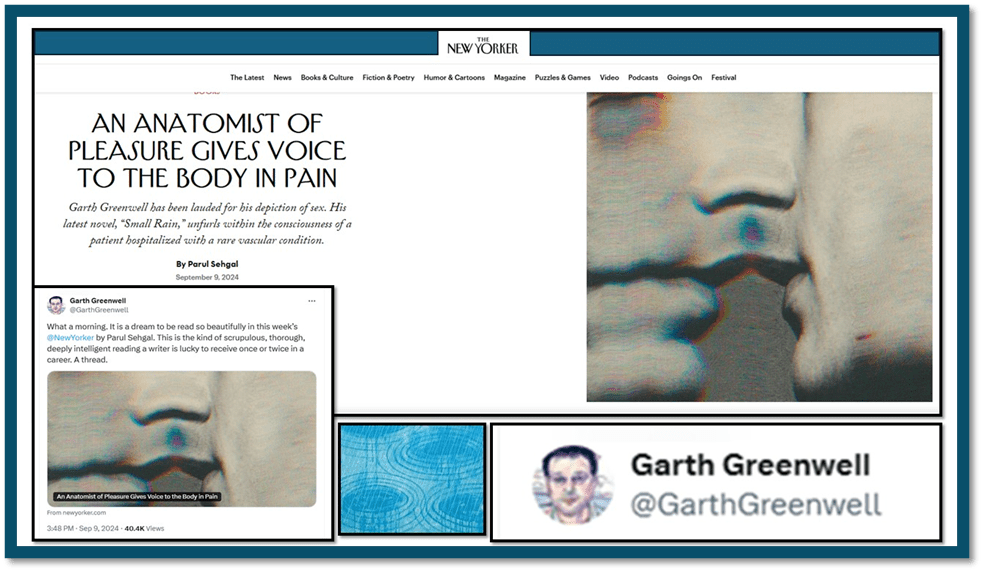
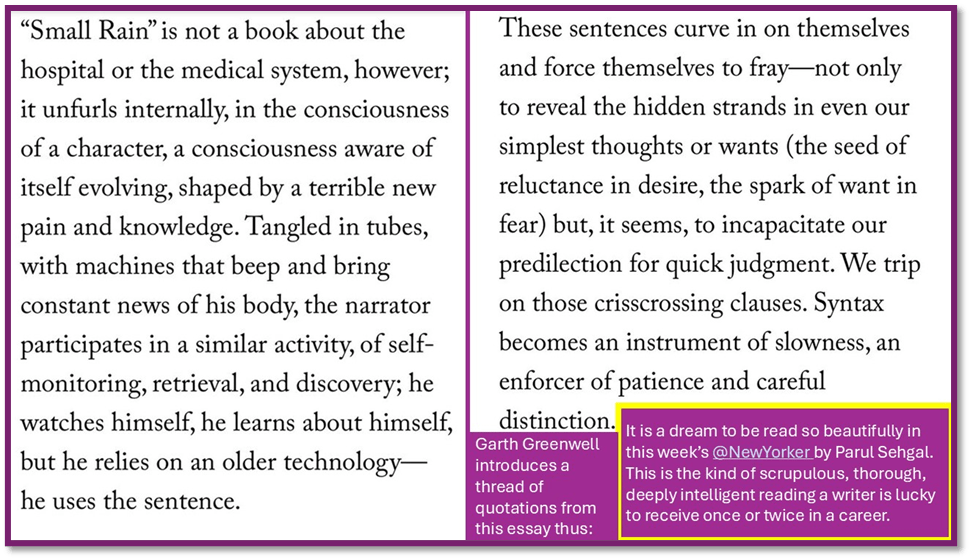
Beautiful as Degraeve’s final perception is it is not the entire story for I think the opaque an ambivalent thing in the novel. It offers paths to beauty that is not that of philosophy but it also sets barriers up to the perception and expression of a life fully lived. Hence the narrator is correct to say his life is both ‘a full life and a wasted one’. She is not the only critic to overplay that hand. Recently Greenwell has commented on Twitter about a review of his work by Parul Sehgal in The New Yorker, and even placed excerpts from that article in a thread following his tweet, which I will use below.[25]
Seghal’s review is an extraordinarily beautiful one amongst many great reviews of this book, each often with a different take on the novel. But Greenwell liked this one he says through his thread, because the ‘attention she gives the book’s formal ambitions is deeply moving—she reads it as if from the inside, a remarkable demonstration of critical sympathy’. In particular he picks out the attentions to the base structure Greenwell has long seen as the key one in fiction, the sentence: ‘ I love this description of sentences—and also that Sehgal takes the time to consider how formal resources and moral inquiry are linked’. I include both extracts for which each of the above comments are appended below:
No doubt Sehgal is particularly impressive because even when she describes what the book is not centrally about, ‘the hospital and the medical system’, her description of that how we know that system is not the central focus uses metaphors from medical practice as perceived by a patient to describe how we know about it. The sentences she uses to explore consciousness as a topic are also, to speak metaphorically ‘(t)angled in tubes, with machines that beep and bring constant news of the body’. The second column in my collage is the description of sentences that Greenwell lauds and for which he is grateful. The even refer within them to the technique of chiasmus but not just to that. And more importantly density and tangles slow us down and that is part of the mechanisms this book advances for ‘moral enquiry’ and that differ from the early novels where pace is more varied by context than in this book’s constant reminders to relax and go more slowly, even in the urgency of matters of mutability and mortality.
The issue of moving fast and slow in the act of absorbing art or hearing the messages of the body are paramount in this novel, with too many instances to account for but a telling one is the first body examination of the narrator by Dr. Ferrier, the consultant surgeon. They are aesthetically beautifully but at the same time reveal those areas where the narrator is deeply locked in.
Dr Ferrier’s name recalls both the soprano Kathleen Ferrier to the narrator as well as the auditing of various lieder by Mahler (Das Lied von der Erde and three Rückert Lieder(Songs after Rückert)) in Ferrier’s versions. The sentences describing the features of these perfect examples of opaque aesthetic performance intersect with those describing the body examination. Both sets of sentences obsess about pace, tone and aural quality expressed as differentiation of pressure of touch. Feel these sentences for instance:
The surgeon began her examination just below my ribs, pressing very hard, first with the palm of her hand and then shifting the pressure to her fingers. She repeated this, moving slowly, asking each time if it hurt. It didn’t at first, not really, but I stiffened anyway; she wasn’t causing pain but she was seeking it, that was her goal, and she continued until I finally gasped. She lifted her hand, just releasing the pressure.
The sentences here could not be more controlled and yet more apparently unsure of their direction, for that direction belongs to the thing under examination – the body in sickness, whose rationale must be understood. The play with tempo in the sentences is similar to that in the examination and like that in describing Ferrier. There is a precise, or so it seems to me, description of the modulation of Kathleen Ferrier’s voice which emphasises sudden jolts of simultaneous meeting of sounds in the orchestration of the piece that yet maintain a holding stillness (the word ‘holding’ is vital here) that eventually get interrupted and interpreted in their keening slowness by Dr Ferrier’s promise to be ‘quick’. It is exquisite stuff: ‘… the violin’s G is an octave below the voice, and their holding the note from the previous bar, they don’t reassert it. I’ll be quick, the surgeon promised. And she was, though she wasn’t any more gentle, maybe she couldn’t be’.[26]
Now I hope here I have conveyed that there is a counter-current to the theme of slowing down sentences so lauded as a tool by Sehgal for it never distinguishes in the novel the complex reaction to these sentences based on whether and how we the author Greenwell or the unnamed narrator in them. In the latter we often see something obtuse as well as opaque: something Greenwell can distance himself as Shakespeare does from Othello or King Lear.
And for me the sentences work so beautifully in order to mediate something else, the respect for othernesses, which constantly come to attention. I think L stands for life – partly we love him because his pijamas de cuervos connect him to the harmonic references to deer, an endangered species in the novel, including those in the ravine near their home.
But more important for me is the presence of sparrows in the novel. These are birds his mother encouraged him to see as ‘dirty birds’[27] Early in the novel the narrator sees sparrows on the window sill of his hospital room. He rushes to catch sight of it when it retreats his gaze because, he says, sparrow populations like all bird and ‘all flying things, birds, butterflies, bees’ populations are all declining. He says:
It was part of the terrible slow catastrophe happening everywhere, … the planet was becoming less accommodating of life, …[28]
The quick perception of what must have been a slow movement is of a piece with the novel’s absorption of a political theme into its ever-varied music. It occurs right to the end where the narrator in rehabilitation exercise, is moved ‘shuffling along’ in a park but sees the motion of a beautiful dog, ‘his back legs pounding the grass, fearsomely strong and fast’.[29] We are back with the capacity of sentences in narrative here to slow or speech up the relation of events to its reflection in language. This gets us nearer to how the tools of artists – sound and language relate to political realities like ecological change caused by an unthinking humanity. Later we will wonder, for sparrows are ubiquitous in the novel even though we are told their populations are at risk from ecological disaster, whether this sparrow sings together with George Oppen’s one referenced in Part IV of the book which recalls the origins of a certain kind of nature poetry. Oppen’s bird is a:
Little sparrow round and sweet,
Chaucer’s bird –
That reference to Chaucer, he will say later (that I have previously referred to) opens up ‘the abyss of history and seeing a light shimmering there, a voice one recognizes; that’s something else art does for us, finally, it makes the abyssal less abyssal’. [30] No way of quoting the part sentence I give here will make it less broken-backed and less opaque in meaning, for we need to appreciates the difference between clauses that contain propositions about at and the sentence that makes us feel the variation of our human fears. But what makes the ‘abyssal less abyssal’ is art’s capacity to negotiate the needs of the Many and the One, as he actually explains in this section and referencing George Oppen’s notion that there is an apolitical aesthetic is the presence of the HUMAN with it, a point Browning continually made.
What makes us ‘human’ is another ontological and epistemological issue in this book, and is extended to an ethical and political one in the process, and relates human animals to other animals not as a matter of separation of kinds but variation of genus type. The narrator is continually despairing for the survival of the essence of what is human, without defining it. He sees ‘American unreason’, the discourse of the Trump generation being an extreme for, as related to the breakdown of human interaction in digital scrolling:
It was like we had outsourced consciousness, turned inwardness inside out, we thought now in other people’s memes it made me despair for my country, not just my country, for the endeavour of humanness – something of which it had become impossible to think of unironically, an idea that could only be mocked.[31]
It is a feeling – of being dehumanised, he has if not touched, ever, or if not listened to, as all the nurses and doctors don’t listen to him, even Alivia, though she is the best, reading you as the set of codes containing the answer of a problem a problem.[32] If humanity and mortality are banal, then everyone ‘is ridiculous’.[33] But this is where art enters the equation if you can believe in it, especially the arts of living, guided by philosophy and religion once and a determination to take seriously the question of how to live whilst not taking it, like Il Penseroso ponderously, and the narrator at his worst. Quoting Louise Glück’s The Seven Ages (attributed only in the Acknowledgments) he eventually says of the arts of living of which he had previously said there were none, ‘Maybe it wasn’t true that there were no arts of living, with L’s hand in mine it seemed that maybe there were, …’.[34]
This is the most complex of novels, all of its propositional content edged with conditionals and probabilities (ifs and maybes) and its beauty has a raven through it like the home estate L and the narrator live on. One conditional is that community may fail entirely and be replaced by ‘Discourse’ as he calls the scrolling online habit or that species, including human animals (if in quality not numbers for them) Its approach to these ethical and political realities is as oblique as it is opaque, but they are approached and they have urgency.
I love this book but I find myself unable to do it justice. Do Read. It may burn you inwardly but some fires sometimes burn not flesh and viscera but the conventions that sustain difference and distance.
All my love
Steven
[1] Garth Greenwell (2024:300f.) Small Rain, London & Dublin, Picador.
[9] My metaphor here is the related symbol of the Ouroboros, used in Romantic theory of art and after. I am forever in a quandary about Greenwell – about what exactly he knows and what exactly he wants us to know, but let’s imagine for a moment that he is aware of the use of the snake with its tail in its mouth as an image of endless creative production. Coleridge invokes the idea in relation to Shakespeare:
Shakespeare goes on creating and evolving, B out of A, and C out of B, and so on, just as a serpent moves, which makes a fulcrum out of its own body and seems forever twisting and untwisting in its own strength’ (March 1815, Collected Letters IV 545).
.He wrote to Joseph Cottle in March 1915 that:
The common end of all narrative, nay, of all Poems is to convert a series into a Whole: to make those events, which in real or imagined History move on in a strait Line, assume to our Understandings, a circular motion—the snake with its Tail in its Mouth. (Coleridge, Table Talk, 2 vols, ed. Carl Woodring (Princeton University Press, 1990) 1. 464).
[18] D.C. Dorian cited in the introduction to the poems in John Carey & Alastair Fowler (eds.) [1968: 132] The Poems of John Milton London & Harlow, Longmans, Green & Co. Ltd.


 Steve_Bamlett_blog