


Being a ‘character from a book’ may be not be enough, unless you can also re-write your own story. A case study of the brilliant TV series,’The Other Bennet Sister’.
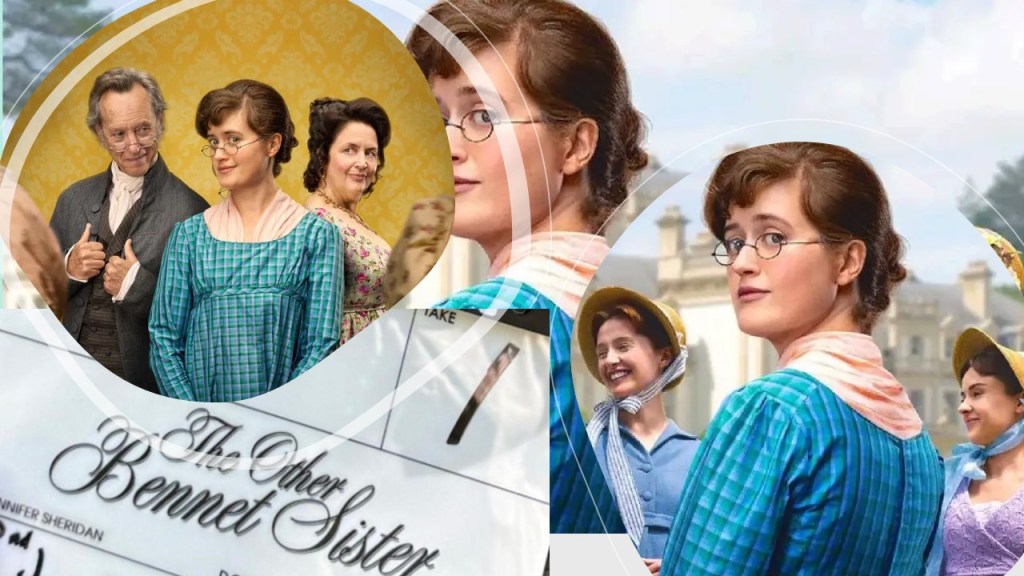
There are clear reasons for wanting to be, if a anyone in Jane Austen’s Pride and Prejudice, Mary Bennet, but perhaps very ‘other’ than Austen wrote her, and in a time-scale expanded much beyond that book. In fact, the whole of the story, as told in that classic book, is done and dusted by the end of the 2nd episode of The Other Bennett Sister, and the story of Mary Bennet’s life only truly begins once Austen has already shown that Mary can only be abandoned to the fate of largely untalented and, in monetary terms, unmarriageable young women (one thinks of Miss Bates in Emma but with the great burden of book learning and no space for books).
Austen never quite gives her a thought once she has disposed of the sisters that matter for good or ill in the realms of love, money and the exercise of choice, and the need to bind these first two motives for accomplishment in women without independent fortune or other prospects together lest they endure the pitfalls of an untutored version of the last. Work, of course, is out of the question – if largely for reasons outside the young women’s control – that opportunitiesfor female employment were few and those few ill-paying and considered socially demeaning.
The series however has its own story to tell, rewritten to compromise with an age of heeoines who appear, at last, to be seeking freedom from futures bounded only by marriage and where choice of partner is secondary to economic circumstances. The story is based on a novel by Janice Hadlow and tbough, I have to admit, I have no relish for reading that novel, I think Hadlow has prospered from the BBC interest in it and she clearly is responsible for many of the delights of the TV series. Hadlow may be responsible for some of the wicked backward glances on Austen too.
There is a delightful moments in The Other Bennett Sister, when Mary tells Mrs Gardiner, her aunt, as she contemplates seeing the delights of Darcy and Lizzie’s estate at Pemberley, as part of her mission to ease her mother’s distress in what she has been told is a grave illness, that Lizzie had confided to her that she had not truly discovered she loved Mr Darcy until she saw the grandeur and size his landed estate. It is one of those moments wherein this story shows its teeth and snarls prettily at Jane Austen’s value system, half in hock to the social dynamics of the society she both satirises and satisfies herself with enough to collude with it in the interests of her heroine’s growing wisdom in handling the vulnerability it entails for women.
Although Mary, in this series, bows to the achievements of her sisters, even Kitty and Lydia, who remain as vacant (though not as morally ambiguous) as Austen made them, her ambition is to rewrite her story on the basis, if need be, of either an independent life as a sort of higher education governess (no such role existed in reality and the pretension would have seemed to Austen ridiculous) or a marriage of love in relative working poverty with an unproven solicitor.
In those first two episodes, however, the series gives ample time to an issue that is also dispatched with clear and judgmental promptitude in Austen. It involves a scenario which shows us both how little empathetic interest Austen has in Mary and her view that the tragedy of women in her position. Mary spens time and labour in the series rehearsing, inexorably at the piano and mouthing painful notes as a plot to win favour by her singing and pianoforte playing in the party that is to be at Longbourn, Mr Bingley’s estate-home. Austen deals with the resulting scene, with none of the lead up, by telling it in a few sentences in two short paragraphs, based on comparison of Mary’s efforts to Lizzie’s less than talented, if rightly modestly self-aware and unshowy, performance (in Chapter VI of Pride and Prejudice).
Her performance was pleasing, though by no means capital. After a song or two, and before she could reply to the entreaties of several that she would sing again, she was eagerly succeeded at the instrument by her sister Mary, who having, in consequence of being the only plain one in the family, worked hard for knowledge and accomplishments, was always impatient for display.
Mary had neither genius nor taste; and though vanity had given her application, it had given her likewise a pedantic air and conceited manner, which would have injured a higher degree of excellence than she had reached. Elizabeth, easy and unaffected, had been listened to with much more pleasure, though not playing half so well; and Mary, at the end of a long concerto, was glad to purchase praise and gratitude by Scotch and Irish airs, at the request of her younger sisters, who with some of the Lucases, and two or three officers, joined eagerly in dancing at one end of the room.
That careful admission that Lizzie’s performance is ‘by no means capital’ is fascinating. Pianoforte playing can be seen as a means of social capital on which some attractive young women might make play for a partner in marriage. Some of them may be penniless, such as Jane Fairfax in Emma. I found today a rather plucky and good undergraduate essay by Josephine M. Roy (which won 3rd place in an essay competition online) that argued, Roy says in her conclusion:
In Austen’s novels, the pianoforte is a symbol of social mobility. The instrument itself is a physical display of wealth and the upper-class lifestyle, but it takes a heroine with charm, taste, and a high-class education to put the pianoforte to good use. Austen’s heroines’ piano-playing showcases their characteristics that make them suited to (or, in Mary Bennet’s case, not suited to) the social high life. Musical performance is inherently a social act, and, in Austen’s time, it was distinctly upper-class and feminine as well. By using the pianoforte as an instrument of social change, Austen subverts the trivialization of women’s activities and achievements. [1]
I doubt the last sentence. Jane Fairfax’s playing and possession of an instrument, for instance, is tied up with such secrecy and subterfuge that it almost ruins her prospects and shows her up as a potential plotter for gain with motives for marriage that seem less than moral. But that aside, please notice that Roy is as unempathetic to Mary as is Austen, making this scene an example of her unfittedness for ‘social high life’, a rather inelegant reference to the working of the class system and the implications of that for women attempting a financially and socially rewarding marriage choice – a Bingley, or better, a Knightley or better still – or,if you like your aristocrats of national importance, a Darcy.
I read that admission of Lizzie not being a ‘capital’ rather widely however, from Austen’s probable overt meaning. Lizzie can not make social capital (in the sense that term is used in Bourdieu as a personal possion investable in one’s social progression) any more than Mary, but the point of the comparison is not to show Lizzie as the superior artist. Just as Mary is described, Lizzie is also clearly no ‘genius’ (indeed she is said not to ‘play as well’ as her sister). However, she does have what her sister, Mary, is also said to lack, ‘taste’. ‘Taste’ is, of course, a nebulous thing. Taste, though often described as a ‘new word’ in eighteenth century Britain, was a much looser term that referred to a discernment refined through the standards of class, status, and education (sometimes despite education of course), though not without exceptions, like Sir Ealter Elliott in Persuasion with his overly tasteless substitute for ‘taste’, vanity. James Noggle puts it well if not with any lack of nuance:
… the culture of taste and its philosophy in Britain …. tended to normalize rather than challenge existing social relations. Hume and most others took privilege and socioeconomic inequality for granted and assumed that poor, illiterate, uneducated classes, by definition, could not have a refined taste in literature and the fine arts. Socioeconomic inequalities must have seemed less worth mentioning than other factors determinative of a culture’s taste (again, “government, manners, finances, arms, trade, learning,” as the list runs in Hume’s History). We may think a belief in human nature ought to promote a “project of a foundational naturalistic, class-free aesthetics” (Shusterman, 99), but the insistence on education and “culture” as essential to taste accounts for divergences among those with differing opportunities, human though they all are. So that great fund of common sentiment, Gray’s Elegy (1751), both levels the natural endowments of the poor with those of the rich and observes that “Chill Penury” drastically constrains not only the opportunities afforded the poor but also their abilities, by freezing “the genial Current of the Soul”… [2]
Taken all in all that is as good as statement as you might find of the fact that taste was almost the spiritual equivalent of class, not unlike the more contemporary term.used to praise others, even in democracies like the USA of ‘having class’. Too much seriousness about art is, in fact, and fault. It shows a showy lack of natural ‘taste. Reading about Mary’s performance shows that she is taking the whole idea of playing the piano far too seriously for her context, a house party for the landed gentry. She treats her playing as a thing in itself, a concern that Noggle says was to emerge as an interest, passed to Britain from German philosophy, only very much later in the nineteenth century as ‘aesthetics’. The latter is was a much more precise and focused interest in what constitutes good discernment in matters of art and, on the surface at least, free of the class qualities that speak through taste.
Mary continues playing without care for the needs of an audience much more powerful than her to determine what will or will not happen in a house-party’s entertainment. She is blamed for subjecting her audience to a ‘long concerto’ that she should have judged as an inappropriate offering to a social party. Eventually, instead of using her own limited degree of social capital profitably, she spends it by ‘purchasing’ the role of someone serving the dangerous fancies of the young with populist folk art: the mere accompaniment by ‘Scotch and Irish airs’ to the dancing of younger women with army officers. These airs are dangerous for we know what might happen between immature girls and army officers, especially of the Wickham type, and this is a pertinent issue in the novel. Mary could not be more tasteless.
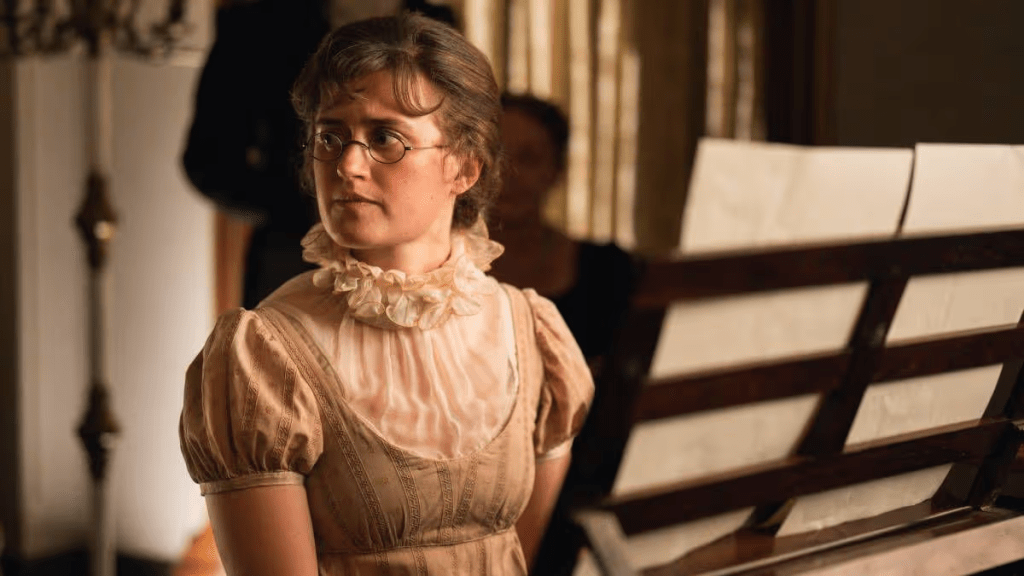
In the TV series in contrast, Mary’s performance is laughable and embarrassing not just because it not appropriate socially but because it is ludicrous and embarrassing as a performance: we laugh at Mary. I hope I have suggested that was not Austen’s point (TV is not always good at refined moral distinction such as Jane Austen’s). Moreover, there is no doubt that we see the selfishness implied in Elizabeth’s motivation (Poppy Gilbert is remarkable) in stopping Mary playing, with open sarcasm about having ‘delighted us long enough’ in the series.
Austen blames Mary for a failure in social judgement and taste about what her audience in tbeir current context. Her judgement fails because her choices and the performance of them, like Sir Walter Elliot’s and Mary Crawford, in Persuasion and Mansfield Park respectively, was the result of vanity not the moderate but self-aware accomplishment becoming a women of society, whose interest was to please men in command of social situations and to aid them in keeping that command. It goes deeper. Discussing the party later and particularly the behaviour of Mr Darcy, a man Mrs Bennet feels to be ‘eat up with pride’, the nature of ‘pride’ is discussed, in relation to men of fortune. Mary’s definition thereof is surely that of Austen but Mary us given credit for that neither by the other players in the scene nor the author, who treats her with cutting irony, describing her as someone who ‘piqued herself upon the solidity of her reflections’:
“His pride,” said Miss Lucas, “does not offend me so much as pride often does, because there is an excuse for it. One cannot wonder that so very fine a young man, with family, fortune, everything in his favour, should think highly of himself. If I may so express it, he has a right to be proud.”
“That is very true,” replied Elizabeth, “and I could easily forgive his pride, if he had not mortified mine.”
“Pride,” observed Mary, who piqued herself upon the solidity of her reflections, “is a very common failing, I believe. By all that I have ever read, I am convinced that it is very common indeed; that human nature is particularly prone to it, and that there are very few of us who do not cherish a feeling of self-complacency on the score of some quality or other, real or imaginary. Vanity and pride are different things, though the words are often used synonymously. A person may be proud without being vain. Pride relates more to our opinion of ourselves; vanity to what we would have others think of us.”
“If I were as rich as Mr. Darcy,” cried a young Lucas, who came with his sisters, “I should not care how proud I was. I would keep a pack of foxhounds, and drink a bottle of wine every day.”
Of course, however ‘solid’ her reflection (solid is a quality hardly fitting something as changing as reflections), Mary cannot apply them. Only in the chapters before her singing at the piano had been based on ‘vanity’: vanity had given her application, it had given her likewise a pedantic air and conceited manner, which would have injured a higher degree of excellence than she had reached’. To be ‘pedantic and conceited’ in manner is precisely the quality of solidity she has – but only in the book. Austen represents her as a woman unable to truly reflect, only to pontificate. There is no doubt that Austen knows that she is not to blame for the consequences following on from ‘being the only plain one in the family’ and I believe credits Mary for having ‘worked hard for knowledge and accomplishments’ but damns her being ‘always impatient for display’,; in this she is like Sir Walter Elliot and Mary Crawford who can see nothing in natural scenes as pleasing as ‘seeing herself in it’. Vain people turn the world into a mirror.
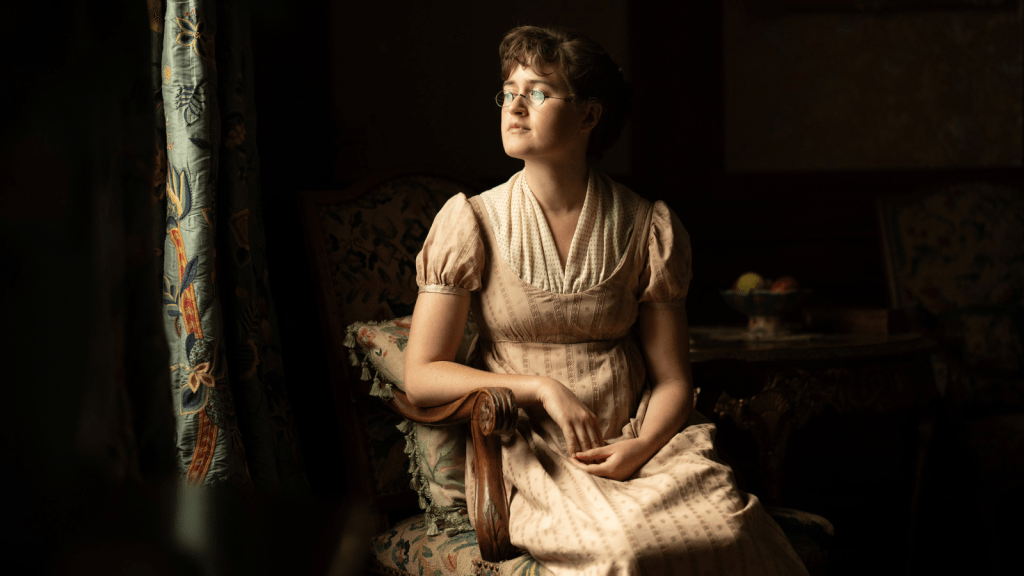
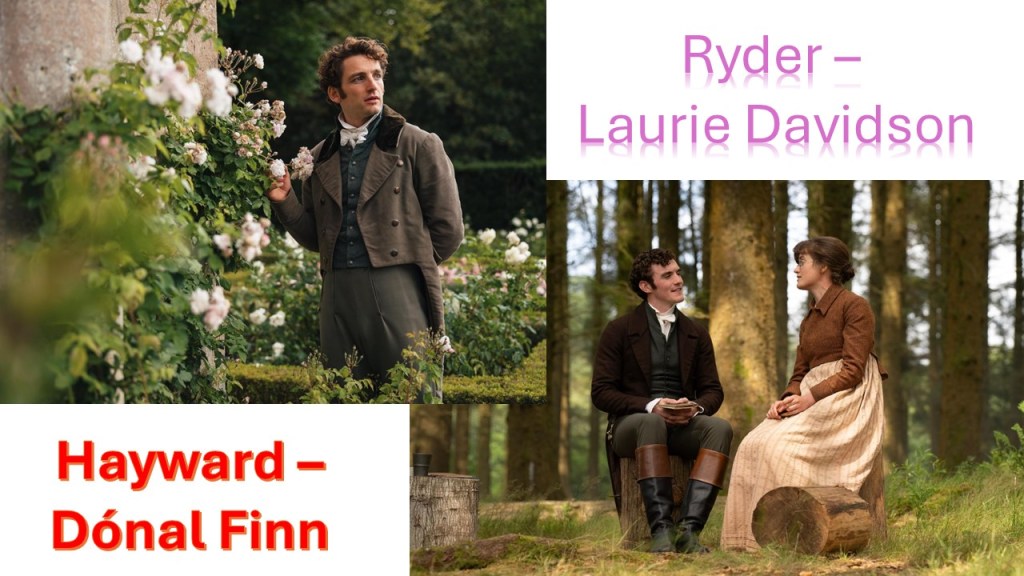
Not so the TV series. Mary (played brilliantly by Ella Bruccoleri) here looks out into the world to find something that might answer, through a window not a mirror. There is involved in this a discussion of women of the period that Austen misses entirely. Her interim suitor, Mr Ryder is, he claims a radical. He does not want to bind women to marriage and threaten their freedom, a thought that was known well to Mary Wollstonecraft and the radicals around her and her husband, William Godwin. Ryder offers Mary the chance to live with him outside marriage and ‘free’. Mary turns this down just as if she were any other Austen heroine, aware of the vulnerability of sexualised unmarried women (the kind of vulnerability gossip nearly turns Jane Fairfax into, and which is played out by Kitty and Lydia). But this is not in Austen ever presented as a thing that intelligent women could even contemplate, yet Mary clearly does. Plumping for Mr Hayward she accepts a man with only expectations to offer, and even Anne Elliot cannot live on ‘expectations’ and is thus persuade to turn a man down on that basis. Hayward is also a lover of Romantic poetry (as is Ryder) – especially Wordsworth – and this too is so unlike Austen. The only man who likes such things in her books (Captain Benwick in Persuasion) barely passes as a man in her writing.
The thing is that Ella, in Mary’s guise) rewrites Mary, as a woman of independence – her continuing vulnerability rather tuned down as Austen never could – it was too real for her. We are used to heroines who claim independence, as various ones in novels by the Brontes do. In Austen people catch dangerous chills walking around in Hertfordshire (actually to Lizzie’s benefit) but Mary only succumbs by being stranded on Scafell in the Lake District, looking at the view below – with storm clouds massing, with Wordsworth’s Guide to the Lakes her introduction, and whilst being read Wordsworth’s poetry by Ryder and Hayward. Her dangerous illness comes unsurprisingly from having to walk down Scafell in a storm whilst supporting the odious Caroline Bingley, who has a sprained ankle.

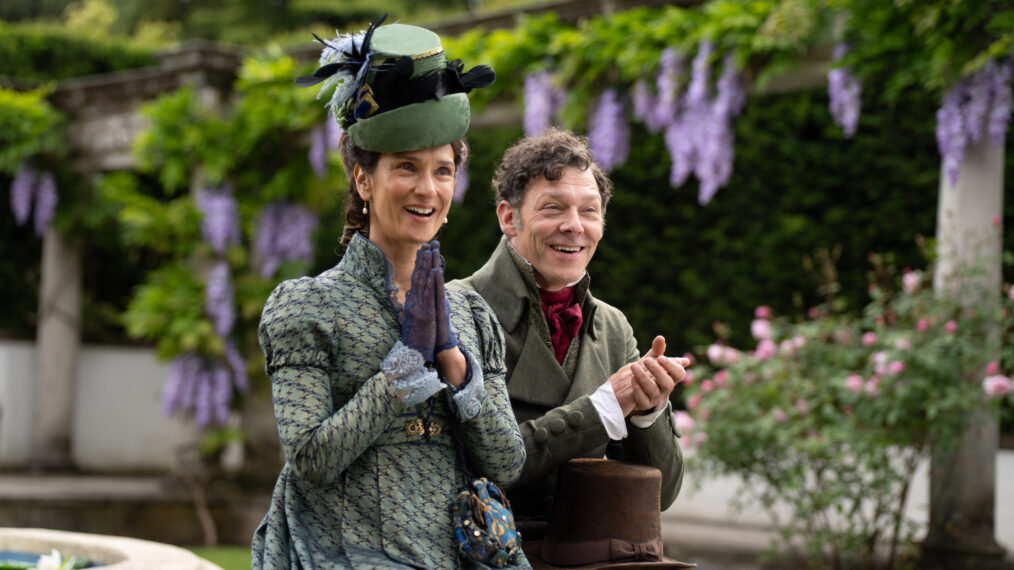
If I would want to be Mary in Pride and Prejudice (and why not I love reading and feel pretty attracted to Dónal Finn), it would have to be by casting that novel aside soon (much as I admire it) and acting not unlike Ella Bruccoleri, who has a wonderful way of showing her joy in edgy situations. Well, let’s admit it – I could like being Indira Varma’s Mrs Gardiner too.
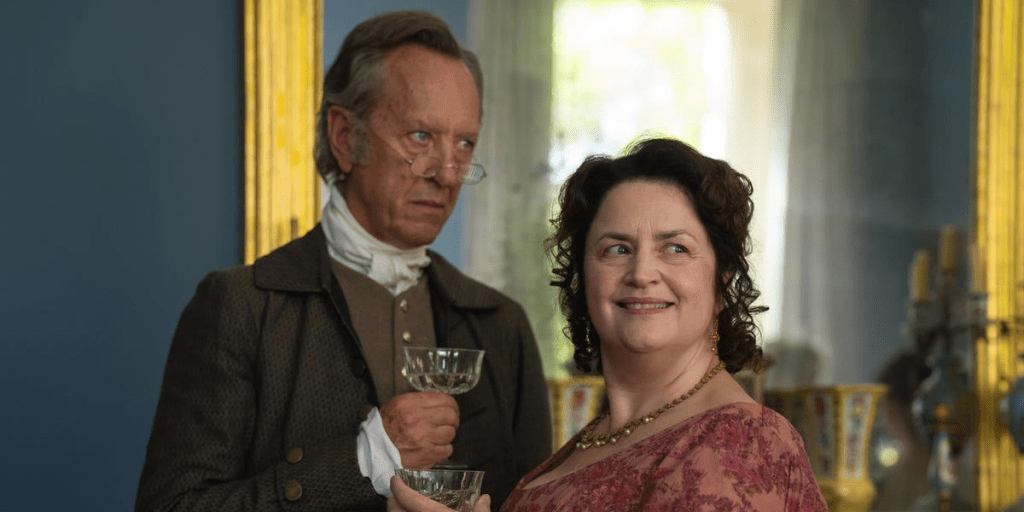
I an ordinary adaptation of the novel Ruth Jones would have stolen all the prizes as Mrs Bennet. However, in this story, Mary takes them off her by her style of resistance – funny and determined.
Bye for now
With love
Steven xxxxxx
____________________________________________________
[1] Josephine M. Roy (2021) ‘Mistresses of Music: The Pianoforte and Social Mobility in Jane Austen’s Novels’ in Jane Austen Society of North America (JASNA) 2021 Essay Contest — Winning Entries (Division: College/University, Place: 3rd Place) Available at: https://jasna.org/publications-2/essay-contest-winning-entries/2021-essay-contest/roy/
[2] James Noggle (2015) ‘Literature and Taste, 1700–1800’ from Oxford Handbooks available at https://doi.org/10.1093/oxfordhb/9780199935338.013.108
 Steve_Bamlett_blog