What do you do to grow your blog?
View all responses
Become greener not just bigger! When growth really was organic and healthy.
I have reacted badly to the use of the verb ‘grow’ in this prompt question, yet it appears the usage of the verb to mean, spelled out more fully, ’cause to grow’ is attributed to late eighteenth century English by the Online Etymology Dictionary (the date of attestation being 1774 – I will quote the entire entry below), so this could not be the cause of my negative rection. Is it something to do then with the use of the verb with a non-organic entity, a kind of generalised abstraction even of the the vontinuous product, rather than any any one blog-post one might produce, of the act of blogging. Perhaps. Yet I don’t feel comfortable eith other test cases either: like, for instance, ”What do you do to grow your positive bank balance?’ Is it that I think of ‘growth as a natural process, organic rather than the result of human manipulation, although I do agree that human manipulation can achieve change in how organic things too can grow. But are you comfortable with: ‘What do you do to grow your puppies’ or ‘What do you do to grow your children?’ Would we accept the question neutrally. Would there be a difference from the second and the first of the last two examples? We hate the thought that children, unlike puppies. Puppies on a puppy farm are, perhaps more easily thought of as a commodity unfortunately, than children. We seem okay though with ”What do you do to grow your pied carnations?’ Well, except for Perdita, that lost girl child in Shakespeare.
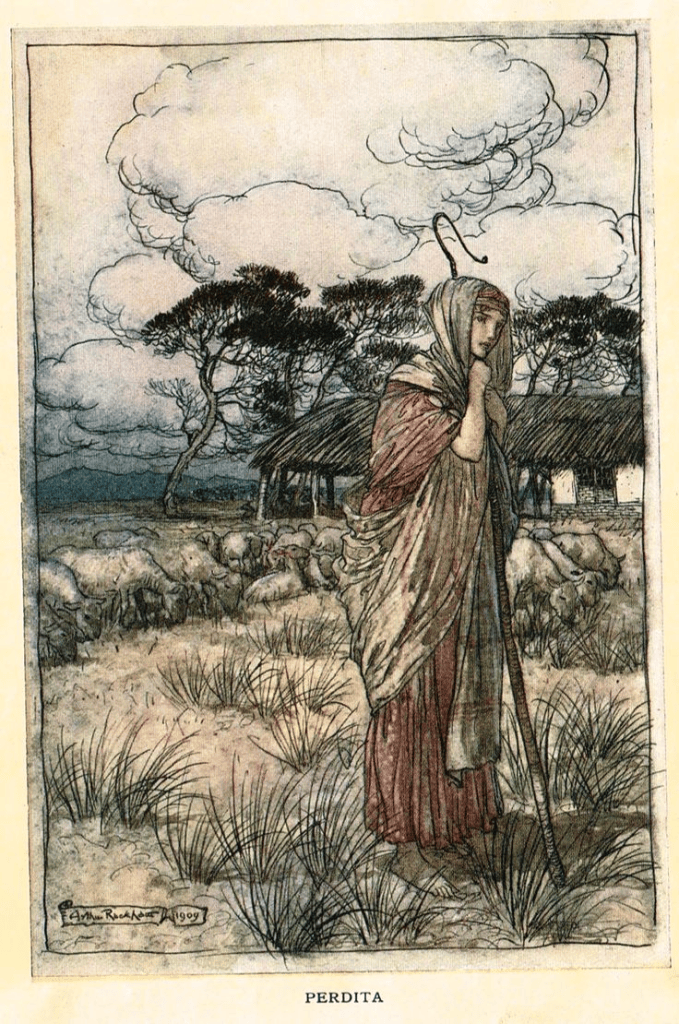
Because, don’t we hate the thought of manipulations of the organic that can be called unnatural or artificial? One of the strangest exchanges in Shakespeare is on this topic, from The Winter’s Tale, Act 4, Scene 4. Perdita says there is something wrong with flowers like pied carnations grown to suit human fancies of what is beautiful – such as having mixed colours in one flower – that might not all be due to nature. She sees it as perhaps artifice or at best an unlawful (considering God to have created the laws of lawful conception) nature. It is as if someone has asked her ‘What would you do to grown a carnation or ‘gillyvors’ :
PERDITA  Sir, the year growing ancient,
Not yet on summer’s death nor on the birth
Of trembling winter, the fairest flowers o’ th’ season
Are our carnations and streaked gillyvors,
Which some call nature’s bastards. Of that kind
Our rustic garden’s barren, and I care not
To get slips of them.
POLIXENES  Wherefore, gentle maiden,
Do you neglect them?
PERDITA  For I have heard it said
There is an art which in their piedness shares
With great creating nature.
POLIXENES  Say there be;
Yet nature is made better by no mean
But nature makes that mean. So, over that art
Which you say adds to nature is an art
That nature makes. You see, sweet maid, we marry
A gentler scion to the wildest stock,
And make conceive a bark of baser kind
By bud of nobler race. This is an art
Which does mend nature, change it rather, but
The art itself is nature.
PERDITA  So it is.
POLIXENES
Then make your garden rich in gillyvors,
And do not call them bastards.
PERDITA  I’ll not put
The dibble in earth to set one slip of them,
No more than, were I painted, I would wish
This youth should say ’twere well, and only therefore
Desire to breed by me. Here’s flowers for you:
Hot lavender, mints, savory, marjoram,
The marigold, that goes to bed wi’ th’ sun
And with him rises weeping. ....
Perdita has a hot imagination of what men, and especially older men, want of young women and girls. To her growth induced by human arifice is like sex out of marriage, dangerous to the young girl, which even kings dressup as a kind of marriage as Polixenes does but is not. She is determined that she will not ‘grow’ flowers thought to be ‘nature’s bastards’. Her stance is protective, as she imagines herdelf as a virgin marigold, tempted to bed by the old wily sun but having cause to weep when she works. Well, isn’t there a lesson here, despite the terrible legitimitidation of the othering of the children of the unmarried. You should not, Perdita says set out to ‘grow’ what cannot grow to good fulfilment. She knows ‘art’ is powerful but keeps a strong hold on its desire to bed with nature.
I think for me, I am still not at what disturbs me at the idea of ‘growing my blog’! I turn as ever to etymology.com.
grow (v.) :Middle English grouen, from Old English growan (of plants) “to flourish, increase, develop, get bigger” (class VII strong verb; past tense greow, past participle growen), from Proto-Germanic *gro-, from PIE root *ghre- “to grow, become green” (see grass).
Applied in Middle English to human beings (c. 1300) and animals (early 15c.) and their parts, supplanting Old English weaxan (see wax (v.)) in the general sense of “to increase.”
The transitive sense “cause to grow” is attested from 1774. To grow on “gain in the estimation of” is from 1712.
Germanic cognates include Old Norse groa “to grow” (of vegetation), Old Frisian groia, Dutch groeien, Old High German gruoen.
Applied in Middle English to human beings (c. 1300) and animals (early 15c.) and their parts, sup
Don’t rush through or you will miss it. The Proto-Indian-European (PIE) root has the fuller meaning ‘ “to grow, become green” (see grass). Do follow the link on ‘grass’ for it is clear that the greenness uimplicit in growth is fundamental, and the word applied to human and animals (in that order it is believed). That greenness nd nature are linked has many reasons behind it but not least that absence of green is a sign of temporary or permanent standing back from nature. Is that why I hate the question – that I know grow now means just ‘increase’ in size or number of a quality of a blog, usually its readership but not of its justice to what needs to be said. What needs to be said and helped flourish is a motivation so green, it stands gainst the barons ogf increased production of immediate riches – fossil fuels namely. It does not want to validate the continual waxing of the size o things but the beauty of their small utility.
Of course, this is no argument. It is as illogical as Perdita is (though her reasons are defensive of how men view her availability and disposability) but it is meant as much too. The only way forward must be a ‘greening’ one, and better support that, however illogically, than the too prevalent notion that we want ‘growth’ at all cost.
With love
Steven xxxxxxx

