What’s the worst piece of advice you’ve ever received?
View all responses
‘Just ignore it and it will go away!’ is terrible advice, especially from the point of view behind a cataract. This is a series of reflections prior to considering Tom Overton’s biography of John Berger named ‘John Berger: From Life‘ with recollections of reading / seeing and a re-reading / re-seeing of Berger’s autobiographical reflection in ‘Cataract‘.
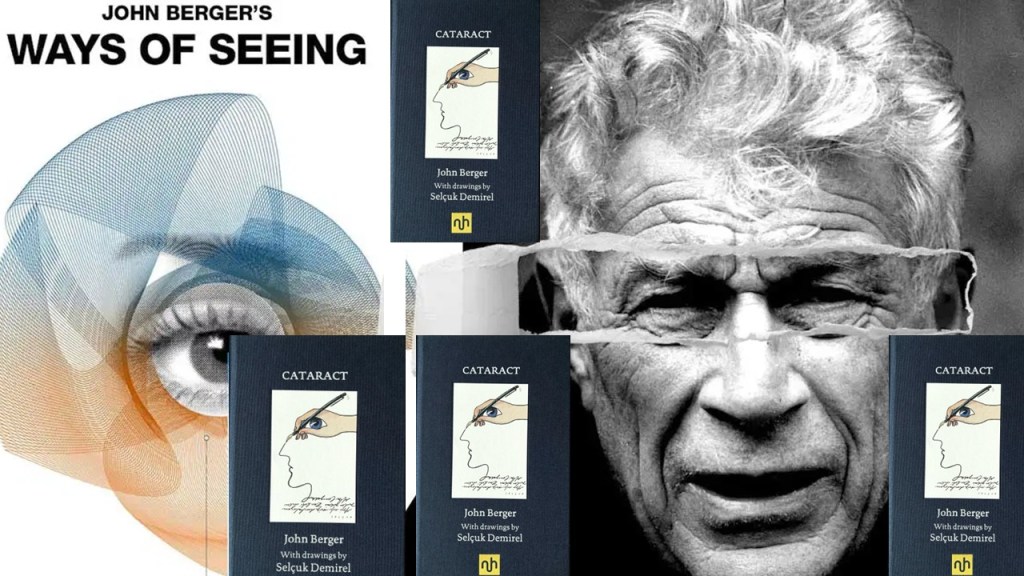
I have just finished Tom Overton’s biography of John Berger named John Berger: From Life. It is a biography I will learn to cherish more than on first reading I hope, for this was a reading hampered by constant barriers to the processes involved, for me at this moment in time and space at least, in what Wolfgang Iser called the act of reading, but in ways not usually consider part of Iser’s birthing of what we now call reception theory, a repertoire of theory concerning the socio-cultural sciences and humanities (with less distinction between these than in theories it displaced in both realms, which focus on the the processes and hermeneutics of interpretation. In all probability, John Berger should be listed amongst those who added to that theory, especially in the realm of popular discourse through the TV series Ways of Seeing. Reading and seeing are not distinct ideas after all, and after the book on the TV series Berger concentrated much more on reading, and indeed listening, as means of reception than on the gaze on things for which no mediate words exist, except mentally in the constructive cognitive process of seeing.
When I write on that book, with the help of a couple of good reviews it attracted, I will say more about how complex that process of reading felt for me, particularly in relation to the presence of Tom Overton both as an agent in John’s life whilst alive and as his interrogator when dead, a process he is convinced John Berger enters into in both states, both to deflect the biographer from seeing what was there in those parts of his life that Berger found it harder to look at and what is emerging as Berger becomes the living presence of tbe dead man in his works – and, as we shall see being dead is no more a passive process than being alive, even in the dead themselves. This last theory is too one of the barriers I found to smooth reading (not a thing I necessarily expect) of this biography, which strains to resurrect a focus we might call autobiographical.
But now I want to look at another process in my reading that marked my capacity to receive it or scarred what was received, though not necessarily as a distortion. Xan Brooks is usually a cinema critic for The Guardian and Berger’s contribution to cinema practice and theory was itself not inconsiderable, but it is he who reviews this book in that same newspaper. Brooks is fascinated enough by one statement of Berger’s that he uses it to show how Overton uses it reflexivelty to characterise his own biographical method or uses it himself for the purpose to unearth Overton’s method. In part that ambiguity is important, for there is much about Overton’s method that is never made totally explicit, however much he refers to himself. The statement is: ‘
“We never look at just one thing,” he said. “We are always looking at the relation between things and ourselves.”
John Berger cited by Tom Overton
Looking and seeing are not the same things but part of the same process, whering wrongly ‘seeing’ is seen as more passive than ‘looking’ as an activity. We see because we cannot help but see what is there except in exceptional circumstances, a theory Wilfred Gibson called ‘direct perception’. But it is a controversial theory, because many would argue (as I would – but see the same Wikipedia source last referenced to) that no vision id bottom-up entirely – proceeding from the things seen and moving up towards the receptivebrain – but is a multiple seters of botton-up and top-down processs where the brain areas responsible for vision organize and interpret what is seen unconsciously as well as consciously, But Berger means more in his statement than to state a ‘theory of perception’, he is invoking a network within vision, comprehensively understood, that subjects the seen world to the reflection of relationships between and to the things seen not just a closed process of interpretation of the thing seen as being the thing we say it is.
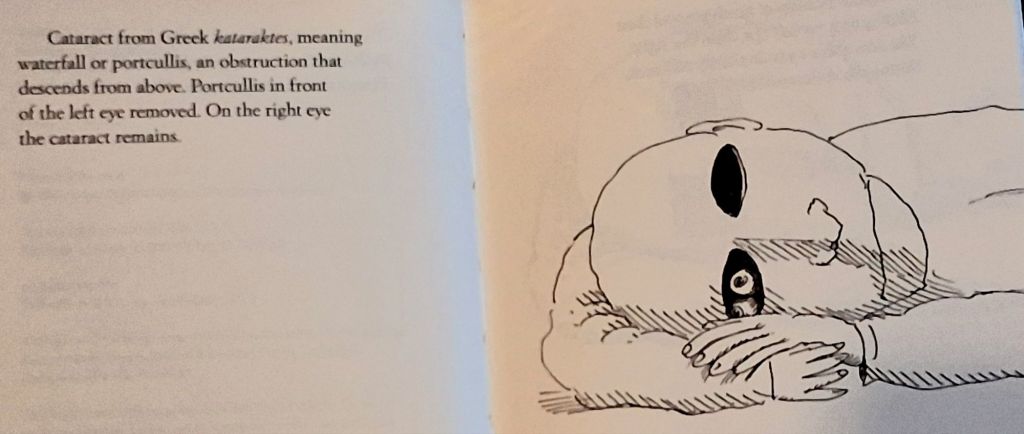
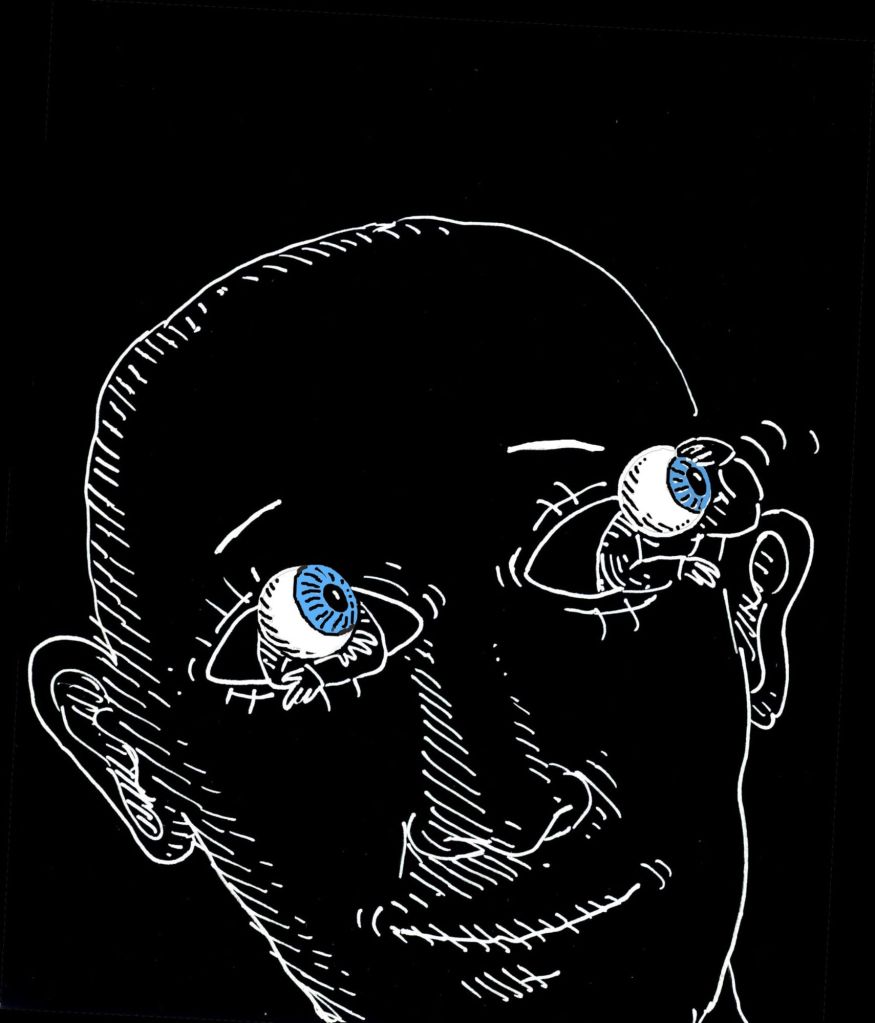
And one way in which he realised that again in his age is when he had cataracts removed in both eyes, which fuelled his collaboration with the artist, Selçuk Demirel, on a tiny book, more quantitatively rich in illustration than text but qualitatively rich in both on his experience of a cataract, which he opens the book by driving the word to its Greek root and meaning ‘portcullis’ or ‘waterfall’, something that falls from some top down in its work of obscuring what lies in front or behind it. Demirel’s illustration guides us the top-down nature of the descent of a darkness like unto a portcullis or waterfall by showing darkness filling the head from top to bottom. The figure’s left eye as he would describe it already fully dark, the right one, since it lies lower than the left not yet opaque.
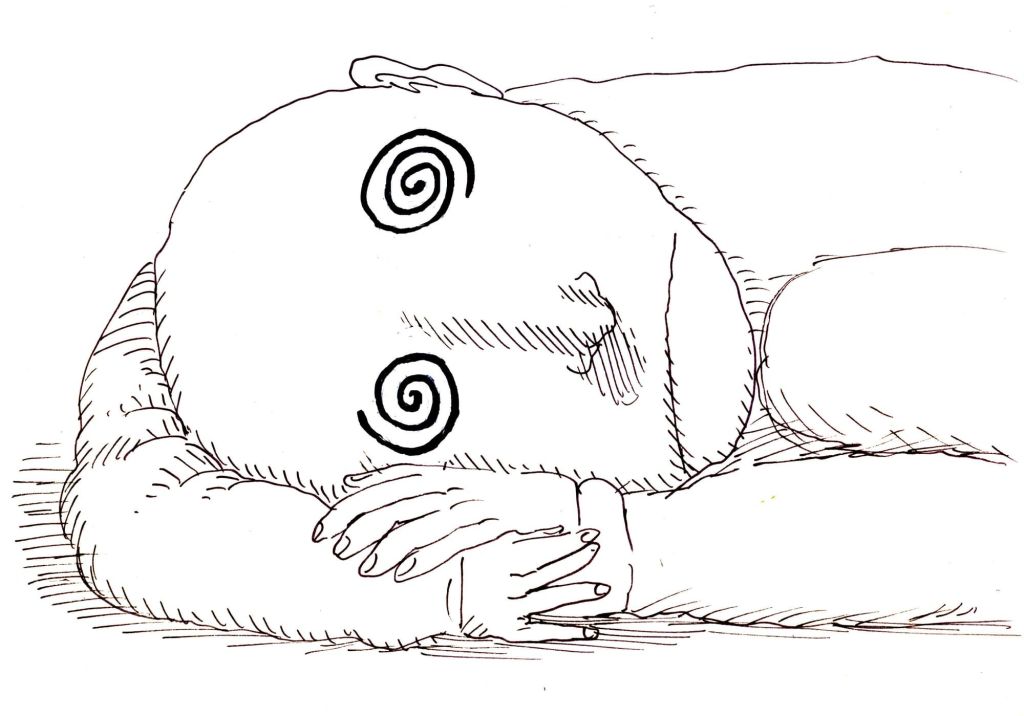
Yet the text of the book does not envisage darkness and obscurity of vision s a negative, or at least not as the opposite of a binary positive. Overton tells us the text of the book was originally written for The British Journal of General Practice, as we shall see later. Nevertheless, one reason I read Overton’s book more slowly than usual and with more hardships in passing my eyes over the text, which seemed to me in a smaller font than I wanted, is that my eyes felt obstructed unevenly. I needed to shift physical position of my pupils on the book , sometimes negating the band widths of my varicocele glasses so it was more comfortable not to have them on. However bright the ambient or even directed light, I saw shadows and gaps sometimes that, together with the shifts of positioning going on in my eyes and sometimes interactively for better or worse in trying to shift my whole body to receive more benefit from some light source, made those self-refering interactions too much the subject that I saw. Anotner of Selçuk Demirel’s illustration captures well the effect on tne body:
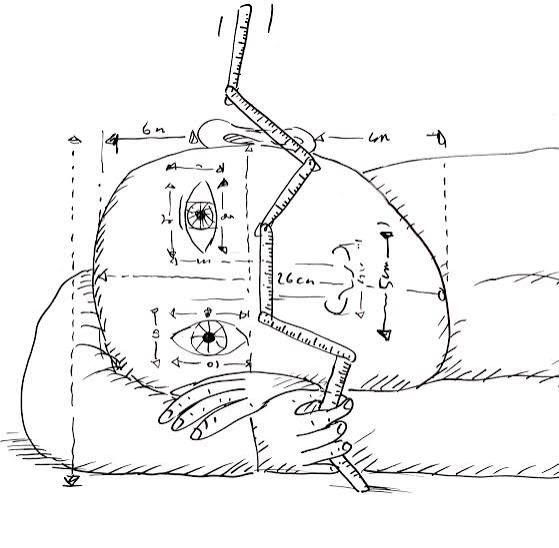
It was while I was reading this book, but also because of a visit to a retinopathy clinic which concluded that though any deterioration of eyesight caused by diabetic retinopathy was not evidenced, my ‘sight was poorer than expected’ suggesting I schedule an eye test earlier than already scheduled (they are every 2 years with my next due in May 2027). I did this. The technician at the retinopathy clinic had said the sight reduction could either be from deterioration of the functional criteria measuring eyesight or the growth of cataracts greater than expected. The suspicion of cataract had, I found as John had done and Demirel had represented graphically (below), had to pass through a portal.of measures of various physical dimensions to which ‘sight’ can be reduced into a series of ‘facts’.
At the Specsavers optician I saw a graduate trainee who somewhat confused me about the result of her thorough examination. My eyesight had deteriorated, especially in tne evidence of my reading prescription, but she was uncertain whether cataract growth warranted intervention. In the end (I was at Specsavers over 3 hours), she consulted her supervisor who advised cataract surgery referral. She also informed me that I had for a long time had a scar film over one retina, whose origin she could not explain, that would require a preliminary operation before removal of tne cataract from the lens in that eye.
None of this seemed straightforward, especially since the clinician still advised I get new glasses, glasses whose functionality to me would become nil after any operation and would require a new assessment. Thankfully, the technician put me into a better space by saying I should only get new reading glasses for now (only £15) to help with reading and persevere with my current varifocals s or long sight issues which had deteriorated less. The resolution was perfect, but I am left with questionsd about the process that lead up to this referral. Moreover, I fel a bit like Selçuk Demirel pictures Berger as feeling, as if my eyes had identity of their own, even in their managing of deterioration over time and circumstances, seeking to look beyond the darkness or obscurity into which the holder of vision has been plunged. Demirel’s eye figures try to escape the limitations of self to see for themselves.
The retinal problem it appears had been in my notes for ‘a long time’ as specific as the clinician got, but I had never been informed. Why? There are lots of possible reasons but none of them are that satisfactory on reflection, seeming to suggest that the knowledge of how my eyes function, or function in deficit or otherness, belongs solely to those capable of reading the diagnostic signs of it not to me. After all, I reflected I was only told about the cataracts many years ago when I went to another provider of eye (Vision Express) services, now no longer available to me, not by Specsavers or the Diabetic Retinopathy service which I attended for screenings and assessmemt annually.
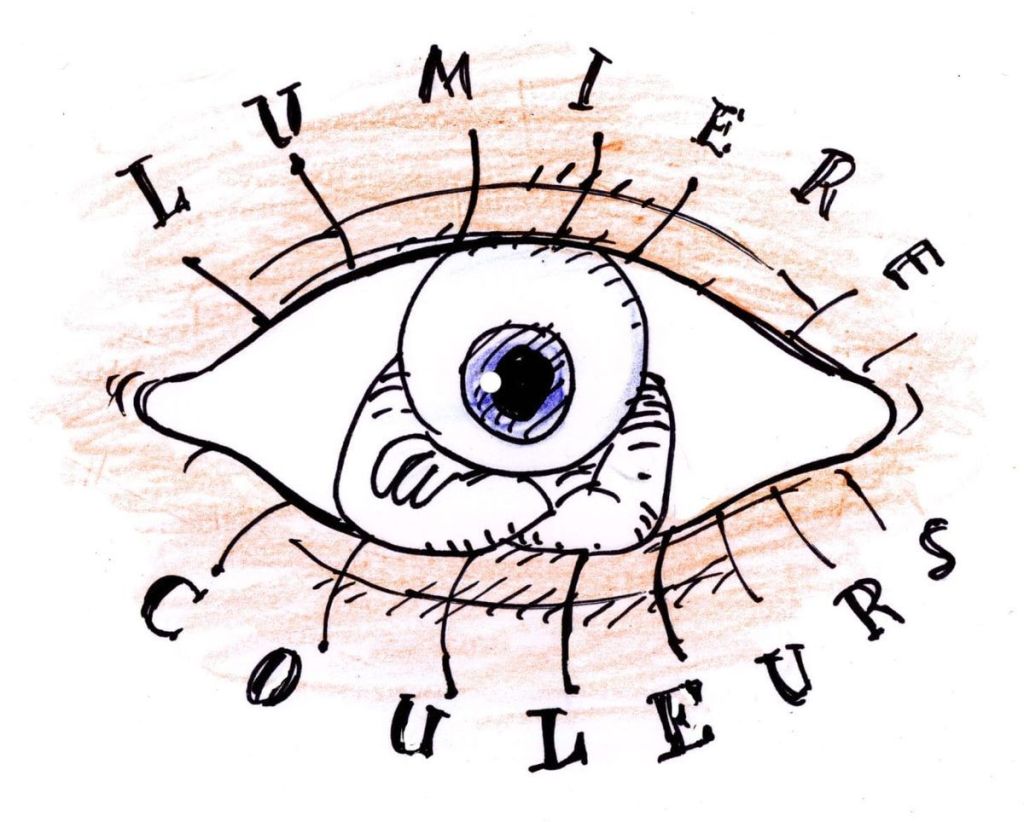
At best, the enforced ignorance of a progressive eye condition, can only be justified by advice, given tacitly and acted upon before it was ever spoken by professionals,that it was better not to know (the root meaning of ignore – see this link) than to know since whatever my knowledge of it, it was not for me to decide on how I acted on that knowledge; professionals having prescribed ‘No Futher Action’ (NFA, a deadly judgement when used after social work assessments and often covering up what required more light shed upon it). This principle is used explicitly in the idea that if we ignore an issue, it will eventually go away of its own accord. After all, whistleblowers amd advocates of change die or leave their post and the problem gets hidden again like the One Ring in The Lord of the Rings, hopefully never to be unearthed again, or,if so, by a figure as deprived of agency as Gollum. Gollum resurfaces to try and regain his ‘precious’ but so do Berger’s eyes (who become perky figural types in Demirel’s illustrations), aware that some process has drained their capacity to access the most beautiful visibles in culture and experience: the colours enabled by light. But the eye, Demirel shows us greedily looks for colour first as it awakens and looks out from its vantage point down upon the world that rises to greet it. Light will flood it later only to remind it of its absence under the obstructions to it that cataracts are:
This was a principle of management in some past employment for me, particularly when I was supposedly and for s long as it was possible for me Subject Leader of Social Work at the School of Health and Social Care at the University of Teesside. Sometimes expressed overtly as a means of dealing with issues, such as when I reported foreknowledge of assessment irregularities in the assement of knowledge of Social Work Law, (namely that the answers to test questions were presupplied by the home-written textbook for the course by its teacher). The consequences of not ignoring this dangerous abuse in the training of people whose knowledge of approprite law is role-defining, was more pertinent when I reported this on my own responsibility to the External. Examiner, who demanded the practice be stopped and facilitated my capacity to reform the course and its assessment which the School management resisted. It was not long after this that School managers made my position in the Department untenable, feeding off the chagrin of the student body and staff at the extra rigour required in learning, teaching, and assessment. Despite this, I have continued to resist the tempting advice to ignore (to pretend, that is not to know) of issues and problems in the hope that habitation eases the demand for rigour in matters of reparation of error or faults in systems.
And then for John Berger, and now for me comes the necessity of recognition that what I may not match what others see and in a way that makes me want to see my aging body adjusted to its decline. I will be doing it at a much earlier stage of cataract development than Berger’s (he was in his nineties before he considered an operation or recognised the difference cataracts made to him) and thus, for me, the recognition that a top-down portcullis over my vision is not what I want and has effects I do not wish to become accustomed to. In Catacact, Berger says that it is only when the cataracts are removed that the person awakes to the wonder of ‘first time’ seeing of things as your ‘eyes begin to re-remember’ them, experiencing as in history before ‘a kind of visual renaissance’, perhaps such as mde Giotto’s painting possible. We realise at such moments that renaissance happens cyclically through time, and can be experienced not only by founding new vision but remembering past renewals of vision. Historical ideologies likewise obscure freshness – its why the drearest forms of capitalism survives to organise the social order to-down.But late in his life-course, Bergerwas not simple-minded about light and dark – they are basis of chiaroscuro, even of the wonder of colour tones and sometimes we need conscious experience, even if retrospective consciousness, of darkness and obscurity, or as Overton quotes it from Cataract:
“Light exists as a continuous everlating beginning”, you write. “Darkness, by contrast, is not, as often assumed a finality, but a prelude”.
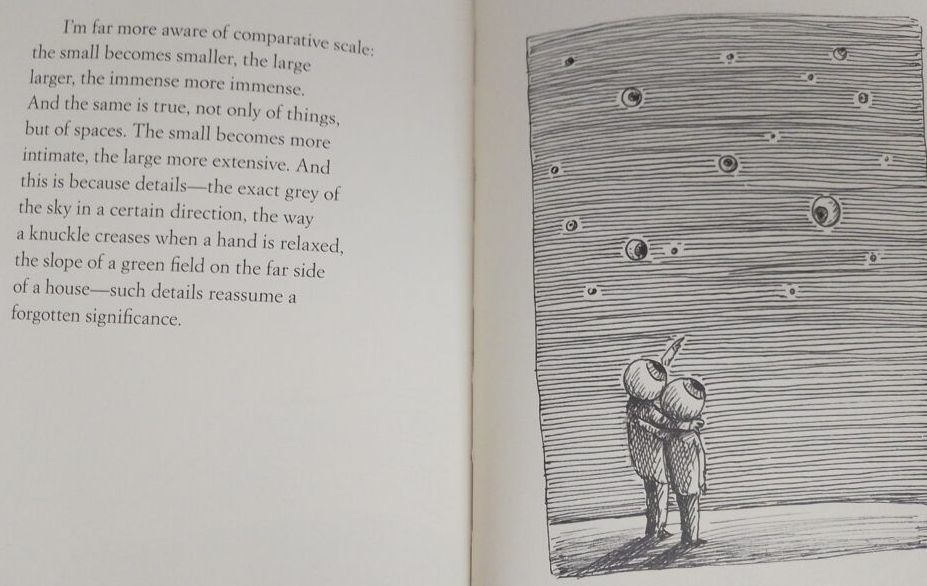
I quote this from Overton (page 302) not Berger directly, to see if you see as I do, more of an impetus to reflection from Overton’s transformation of text into quoted direct speech, the indirection and pauses fof mediation, as in ‘you write’, almost begging us to read ourselves and puzzle at this conundrum and not stay on its ‘poetic’ surface. Overton earlier makes the point that there is an irony in a man famed for the popularisation of the concept of there being multiple, sometimes simultaneous ‘ways of seeing’ in confronting in advanced older age a physical version of the barriers to seeing more rounded, through a notion of communalised gaze typified but held together with its internal diversities alson on show, vision could attack him too and from within his own body – for cataract growth is not seen but sensed as a mediate barrier to vision like ideology proceeding top-down from within in the brain’s attempt to compensate for it. In a sense this too is the effect of the ideologies of capitalism that mask themselves as products of the nature of things, even selves who believe themselves in competition with other selves. Demirel shows the figure representing an eye attempting to use a clear eye to see upwards to the stars and ‘holding itself’ with loving hands as it realises like Pascal that what it sees is as much dark space between those lights as the stars and their configurations and those spaces are part of our reality too. What Berger’s text says about the picture below, is that the cleansed door of perception that is the renewed eye, (I am using using words from William Blake cited in the epigram to the book, of course) reflects that:
The unstarling heterogeneous of the existent has marvelloously returned. And the two eyes, portcullises removed, again and again register surprise.
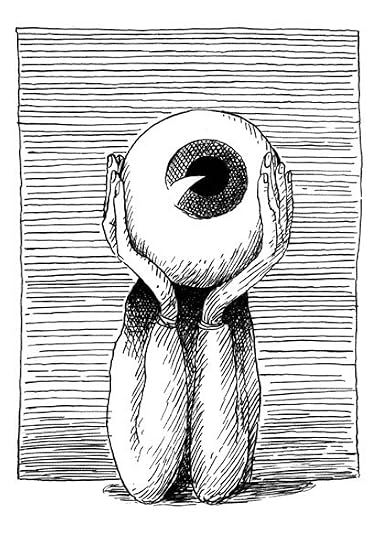
The point about ‘spaces’ precedes that quotation by one reverse book opening only; Where we see not only the ‘forgotten significance’ of visible stars, but of the plenitudes obscured in the spaces between them, less penetrableand less enabling of the capacity to point.
Berger captures something about cataracts I had read before but not related to myself, nor to the perceptual and cognitive processes that the idea of ‘vision’ brings together: that need to keep looking not only at what we see but the relationships between the known and unknown they illustrate, and its pertinence to the meaning of personal survival – not in the sense of an afterlife but of the hope for the realisation of one’s best vision, even if not as a result of one’s own agency – its a realisation, after all, that we don’t create, but re-create and can be recreated again in the spirals of history as Berge, through Giambattistta Vico (Berger knew him as Bento as if he too were a contemporary friend who also used that name to speak to him), imagined it.
But the point I want to make here is much simpler. Berger make huge mistakes in the interpretation of history – in backing the Soviet invasions of Eastern Europe for instance, that he later regretted. But we make larger mistakes if we follow the advise to ‘ignore the events in life that pose problems’, for they don’t go away though they can be repressed. And like therepressed they return from the obscurity in which you thought them into clearer colours and greater light. But this is so only if you take the risk anyway to face these issues, even to suffer from them. I look forward I think to my operation when once I hear when its scheduled on my cataracts, for the altenative is a loss of reading, And for that reason one has to feel grateful massively to the advances in optical science that allows it to be addressed, as it could not be by Milton. Yet his sonnet On His Blindness, more truly named Sonnet 19, is as ambivalent about dark obscurity as Berger is. Here’s the whole of the sonnet but, after reading it – now:
When I consider how my light is spent,
Ere half my days, in this dark world and wide,
And that one Talent which is death to hide
Lodged with me useless, though my Soul more bent
To serve therewith my Maker, and present
My true account, lest he returning chide;
“Doth God exact day-labour, light denied?”
I fondly ask. But patience, to prevent
That murmur, soon replies, “God doth not need
Either man’s work or his own gifts; who best
Bear his mild yoke, they serve him best. His state
Is Kingly. Thousands at his bidding speed
And post o’er Land and Ocean without rest:
They also serve who only stand and wait.”
Consider its first line: ‘When I consider how my light is spent’, which uses the ambiguity in the word ‘spent’ to suggest the depressive knowledge of something gone (‘spent’ in that sense od a past perfect) balance against that continuous present where ‘spent’ means how I use my time and light, whether that light be present in the moment or not. It is a poem about ‘service’, all the more beautiful in its comparison of over-busy workers travelling to and fro in the world to anotjer kind of ‘service’: that of the retainer of a servant;;s office at a master’s table whose work is to ‘stand wait’, whering waiting is the activity of my service at the same table, The point is you don’t hide a talent by displaying in finished verse of the finest quality, like this poem, where Milton’s lric voice realises he is not just ‘resting’ or desiring rest not service but one of those who ‘also serve’. It really works only when we realise whay a ‘waiter’s’ tole at table is named thus: waiting is the space filled between other activity when I ‘also serve’. This is not unlike the strange moment in Cataract where Berger rationalises why the pain he experienced after his last operation was to him a form of joy at an ‘achievement’, a kind of labour of acceptance of the need to renew the sources of ‘that one Talent which is death to hide / Lodged with me useless’, the talent of being as John so much was, a Seer, or a diviner. Berger’s version is this:
A surgical intervention to remove cataracts gives back to the eyes much of their lost talent. Talent, however, invariably implies a certain amount of effort and endurance as well as grace and benefit. And so the new visibility represented for me not only a gift but an achievement. principally the achievement of the doctors and nurses who carried out the intervention, and also, to some small degree, the achievement of my own body.
The pain made me aware of this.
Berger saw art as continually shedding light, even pradoxically when it is spent in labour (hence the title After Their Labours – and that even without a cataract operation available, it involves some ‘small degree’ of a large role in the history of the community around you – as in the decision to sign the death warrant of Charles I was for Milton Berger too felt called to equally large decisions – as a Jew finding the correct placement of truth in relation to Palestine, for instance.
Hopefully there is more on this book in a later blog. But for now I’ll wait upon the chance to serve later, even though the wuss in me does not welcome the reminde that there will be pain. But it’s worth it for it restores looking and, after all; “We never look at just one thing,” he said. “We are always looking at the relation between things and ourselves.”
Bye for now
With love
Steven xxxxxxxxxx

