What’s a song that changed your life?
View all responses
No song ever on its own changes your life, but when I heard Jonas Patrick Marvin speak about his 2026 book, The Breaking of the English Working Class, I thought afterwards the song might break me up further we, my class, are broken.This is really a blog on Jonas Patrick Marvin (2026) The Breaking of the English Working Class London & New York, Verso.

When Paramore sing We Are Broken, the idea of representing a class abandoned by the stakeholders in the social contract (in which only a small part of the class who are home-owning workers get a voice) and stratified, fragmented and at war with itself is possibly a long way from the group’s intentions. But I can take this song as representative enough of a ‘change in my life’ for which it was not responsible and supplied only the articulation of feelings that haven’t been rationalised. But If I had to have a song representing changes in class identity – from a ‘we’ who I hoped and dreamed to be a part to an atomised part of we in civil war inside itself.
'Cause we are broken
What must we do to restore
Our innocence
And all the promise we adored?
Give us life again
'Cause we just wanna be whole
…
We're at war
We live like this
….
And when I began to hear it, that atomised self, in a state of Durkheimian anomie, even spoke of only of its inability to find a language to talk of itself:
I've seen worlds that don't belong
My mouth is dry with words I cannot verbalize
I don’t think I have enough musical power of analysis or performance in me to either use the song further in this blog, or to make a video of me singing it, so its relevance, or otherwise, will be left to a reader who might be bold enough to feedback. I would be grateful whatever your take. But more moving than the song was to see Jonas live in a favourite place of mine , The People’s Bookshop in Durham City. (photographs from the Bookshop’s Facebook page).

I had read only about two chapters of the book when I went to the event but that was enough to introduce me to the startling range in the way Jonas writes the sociopolitical history of the time through which I have lived myself and how this range of historical phenomena, that, even before I completed the book and even longer before I began to understand it in a way to which I could relate to it.
That wasn’t true of other audience members, one who introduced himself as a retired union administrator claimed to have read it twice and though he picked out many of its qualities as political history, clearly had major issues with its ideas. One of these, from a largely older male constituency like myself, expressed itself as a disagreement with how the book, as the respondent said, underrepresented the leverage exerted by modern workers in private retail, instancing a checkout worker at Lidl. Only today did I reach the passage referred to.
In it Jonas speaks of a difference in the kind of groups of workers which constitute the ‘working class’ of today in comparison with workers who sit amidst a network of chains of supply and demand in a capitalist economy. Here it is, from Chapter 5 and part of a summary of the potential of workers to become, in Marx’s term, the ‘gravediggers’ of the capitalist system which brought them about s a class – if it did not ‘make’ them in toto:
…, large groups of workers across Britain’s service economy find themselves at the end of supply chains, incapable of the kind of disruptive, endemic power achieved by steelworkers, autoworkers and potters. The Lidl checkout worker who you purchase groceries from on the supermarket floor may have associated power, but compared to the miner, their structural power is limited. They do not hold levers over a vast network of supply chains swarming in multiple geographical directions, of which they are at the centre, extracting and producing commodities. This doesn’t mean workers are powerless.[1]
The debate didn’t progress, though Jonas reminded his critic that he used the Lidl worker example as a comparator with older forms of industrial production worker only in terms of their leverage in an economy for significant change in the lifestyle of a class. The respondent seemed unsatisfied as was another who spoke of a need to return to Marx to see that the proletariat was in fact globally much larger than in the socioeconomic political philosopher’s day. All this, reminding me of the old arguments that committed Eurocommunists as I was once reminded some representatives of the trade union movement or its remnants who spoke of change in ways that Lenin dubbed economism. And here I wish I had read the book to the end then, because I now see that its importance was greater than his critics allowed it to be, resisting its larger arguments about how classes ‘break’ or decompose (another metaphor in the book) in ways that take on the level of what it means to the person within those classes to claim that identity, objectively in external measures and tokens, and subjectively, for the latter matters precisely.
Since Louis Althusser’s great work based largely on the theories of psychodynamic intellectual Jaques Lacan, was shelved by the British left (from E.P. Thompson onwards) as being too glum about the ubiquity of capitalist ideology, even operating in the interpellation of individual subjects within a class group, debate on the left may have shied away from the topic this book places centre-stage, without overmuch reliance on European Continental Marxist input. But Jonas Marvin restores this topic, by returning to, amongst other things an older British intellectual tradition, that of Raymond Williams amongst others who looked to how ruling class management of the classes under its rule use ‘changing forms of population management’ to “consider, personally and collectively, what these have done to our thinking”’, and that requires recognition of ‘fundamental crisis in class subjectivity’. A key summary sentence in his conclusion is this: one that follows that about Raymond Wiiliams specifically, above in his text:‘
An insight driving this book has been the claim that the neoliberal social contract and its subsequent breakdown have produced a crisis of class subject formation.[2]
This return to Williams on the components of the subjective, co-determined by a range of agencies including relatively less powerful personal ones, including ‘structures of feeling’, invoked in his Preface, with William’s assertion cited that such an internalised psychic structure (with much external validation in the structured instruments of lived culture, even that of a highly engineered ‘common-sense’, often evoked strangely enough by those who represent in population terms only the ‘very few’ entitled people in it) captures “the felt sense of the quality of life at a particular place and time: a sense of the ways in which the particular activities combined into a way of thinking and living”.[3]
This enrichment of the anti-capitalist critique into the realm of structures of feeling is not at all common on the left since the days of the New Left Review’s star, Stuart Hall, though the evidence for a necessary struggle on that domain seems gripping, not least as represented in this beautifully crafted short book, which even critics at the event I attended called richly comprehensive. However, the theme that breaks through the rich surface of the book is a product of the physical breaking, organic decomposition (for the idea of a class being left to rot when it is not being actively abandoned is a commonplace one in the book’s rhetoric), and structural decomposition of the class, is that of ‘shit-life syndrome’; a term based on street parlance, it’s a development in this book from a concept Mark Fisher calls ‘depressive hedonia’ to describe the feeling and its paradoxical outbursts into short-lived alternative near delerious, and often damaging, excitements like drugs [4]. It’s immediate prior causation lies not only in increased abjection in precaritised work situations but also in the means of living even beyond the effects of wage poverty, neglected rented housing and ‘sink’ community estates, rentier capitalism in housing into a psychology of hopelessness, feeling under attack in the sources of what was once personal pol;itical agency, ‘their bodies, their lifeworlds, their morl norms and their sense of political possibility’. [5] The concept of lifeworlds is one from phenomenology, again showing the rich theoretical harvest that feeds this book.
How much these concepts addressing the construction of the interaction of perceptions of the interior and exterior lifeworlds were the objects of state policy is considered under the terminology for active work by the state in orde to achieve the reconfiguration of class in the concepts organised abandonment, and its secondary passive, from the point of view of the absence of policy initiative only) version unorganised abandonment, concepts from Ruth Wilson Gilmore, the radical prison abolitionist, and is brilliantly addressed by a situated readin from Jonas Marvin’s migration from London working abandonment to the abandoned town amalgamam of Stoke-on-Trent, described as a ‘testing ground for wves of neoliberal policymaking’. [6] from the time of Thatcherism to its more sinister forms, because less open in important ways, under the New Labour project of Tony Blair and Gordon Brown, where marketisation and commoditisation of the raw materils of lifeworlds were rife, from water, transport to culture.
That ‘shit-life syndrome’ was the way change was experienced only by some levels of the newly further stratified working-class – under Thatcherite ‘revolutions’ of ‘share-owning democracy’ under privatisation, which fell rather flat in the Lady’s image of its function, but more importantly ‘home-owning democracy’, that led from subsidised council-house sales, which ensured that the proletariat, had rather more to ‘lose than their chains’, when the term was used by Marx, for those out of work or working in the gig economy, where even a rented place to live was as precarious as ones’s employment status. Thatcher engineered this change in a way that made her sound visionary as Marvin shows, as he describes her pursuit for what she called the ‘personal society’: where only the personal was accounted real and society was thought of as mere aggregation of persons. Her phrasing of her intent was this in promoting the neoliberal revolution in economics: ‘Economics re the method; the object is to change the heart and soul’. [7] If heart and soul were convertable to ownership, the consequence she hope was a lower class committed to work as a means to ownership and to the capitalist system that promoted personal and individual ownership and part-ownership. [8] The inevitable corallory was an ‘underclass’ (the term was rife) marginalised in the hobs, home and leisure market. These were the embodiment types of what they experienced as ‘shit-life syndrome’, where the world seems something in which ‘nothing works any more’ (health, transport, acessible cultural provision) at least for them unable to source privatised alternatives and everything is in ‘dcline’. This idea of ‘declinism’ becme the favoured political perception of Nigel Farage, and the rationale of Reform as a part and name, and the reason, like it or not Reform became a popular party, but of the right leaning to the far Right but not the left. [9]
One interesting, but very disturbing, way in which the right captured that part of the working class that felt disenfranchised, as well as those who had begun to have a minimal stake in capital through home ownership was the weaponisation of race to further stratify the working class and fragment it, in response to the ‘race riots’ that responded to structual discrimination and oppression on racial grounds. [10] But more problematic still was the intent of New Labour to to ‘institutionalise’ and ‘managerialise’ anti-oppressive practice under its social inclusion project. I found this an illuminating reflection on my experience in health and social care – as a social worker, mental health worker nd later social work teacher, for it infected all those roles drawing out the political edge of the social work theory of anti-oppressive practice (AOP) we had once believed in. Read this for instance: [11]
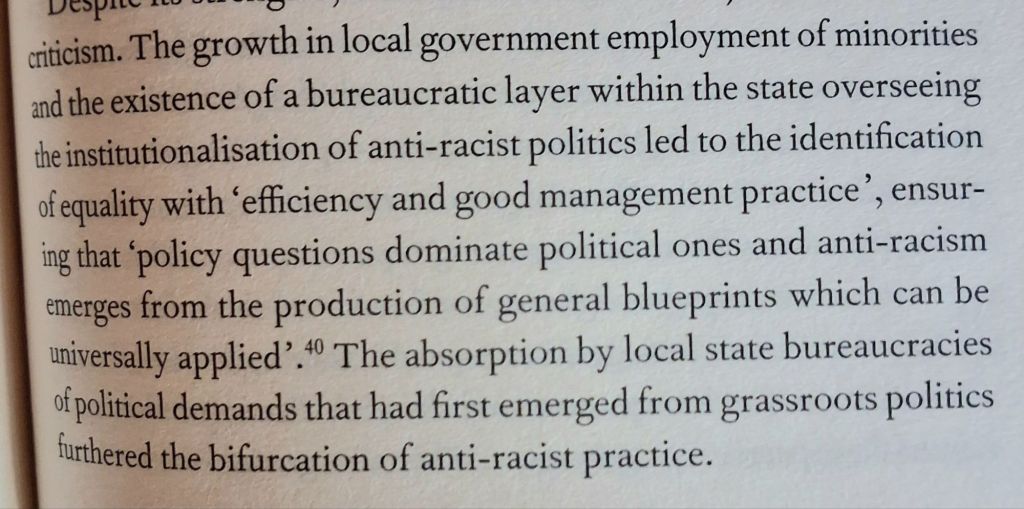
The process began with the Greater London Council, but, in the hands of the magagerialist Blairites it became in all its avators a range of policies that it has been easy for Reform to sweep away in all the places it could, maximising in their rhetoric its effect on greater employment of marginalised populations: women, black & brown people, queegr people and gays and lesbians, with little effect other than on a few ‘chmpions’ of equal rights. Bureucratic as all New Labour innovation was, it never ran deep – and even when it was deeper as in the creation of ‘Sure Start’, it was so easy to dismantle, for it had not really addressed the structural nor the ideological barriers it needed so to do. Stratification emplains theories ment to be more comprehensive than they were – such as the embourgeoisment thesis and that of the underclass, which even Marx believed in as the ‘lumpenproletariat’.Enemies of the category of ‘eworking families’ were found in new types loved by the dirty media: ‘benefit scroungers’ or ‘the sick-note culture’ as Blair named it,ANti-Social Behaviour Order (ASBO) recipientsa ‘Not in Education, Emplyment or Training’ (NEET) subclass of wasted youth – still blamed now by Andy Burnham for the faults of capitalist production cycles. A ‘culture of poverty’ was blamed on those who were being made poor and ridiculous with it – in therm ‘chavs’ picked up by Owen Jones for examination, in which media monsters reigned like ‘welfare queens’, or those disabled by obesity, draining working families resources in taxes because they were irresponsible.
In the minds of New Labour intellectuls like Andrew Adonis, the logic rthat a rising tide lifts all boats meant that ‘the old labels of “working-” and “middle-class” make less and less sense’. But in reality, the conscious ideologicl erosion of these categories by Blairism’s spin doctors recreated notions of who was included in the national community.[12]
This onslaught ws accompanied by policy aimed at diminished ‘power of those powerful workers which hd outlasted Thatcher’.[13] I rember saying to a friend in the audience how depressing I found reading books like these, However good. Jonas overheard me and reorted: ‘Imagine what it felt like writing it’. However, there is some ttempt at hope, especially in activist projects in which Jonas is currentlyinvolved in Stoke-on-trent, where capaigns do not stop at the boundaries of working situations but address issues of housing, estate environments, leisure, artistic expression mking new raw materials for activism that might be able to link to opportunities, not yet visible on our horizons, for a national, and international, programme aimed at reductions in working hours and the quality of group work and leisure in the places where community, engagement in it and agency might regrow – aimed at ‘shit life syndrome and ‘depressive anhedonia’ both and the production and reproduction of ‘Good Life Syndrome’.: a ‘how we live’ politics, that addresses head on issues of the subjectivities of the working class lifting their potential if inhabted from those ‘ypes of unappealing subjectivities produced by social democracy’s disintegration’, on which Thatcher in her autobiography The Path to Power connected to familial and social declinism, blaming every aspect of social liberatoion ideologies for the fall of the family and commitment to financial independence of the state.
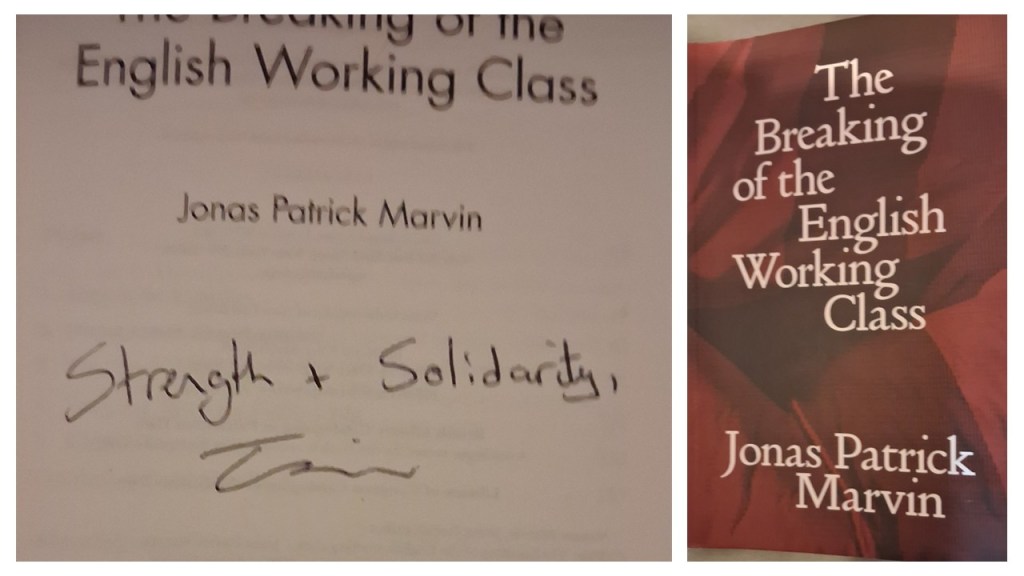
This was a rich evening opening a great book to me. Thank you People’s Bookshop and Jonas Patrick Marvin. I had to leave early to check on Geoff at home so I apologise for doing that to Jonas and bothering him to sign my book at the beginning of the event. Iwill work now to achieve that ‘we’ that’s broken in my clss identity, especially, as Paramore sing:
... all the promise we adored?
Give us life again
'Cause we just wanna be whole
With love
Steven xxxxx
[1] Jonas Patrick Marvin (2026: 136f.) The Breaking of the English Working Class London & New York, Verso
[2] Ibid: 158. For the ‘fundamental crisis’ see ibid: ix
[3] Williams cited ibid: xiii
[4] Mark Fisher cited ibid: 53
[5] ibid: 160
[6] ibid: 20
[7] ibid: 83
[8] ibid: c. 75
[9] ibid: xiv
[10] ibid: 93 – 95
[11] ibid: 97
[12] ibid: 118
[13] ibid: 114
[14] ibid: 92-93

