


Apparently the word ‘coincidence’ was possibly used earliest by Sir Thomas Browne, and thus is better left to rest in his Baroque prose as another supposed certainty in a world that is more uncertain than that.
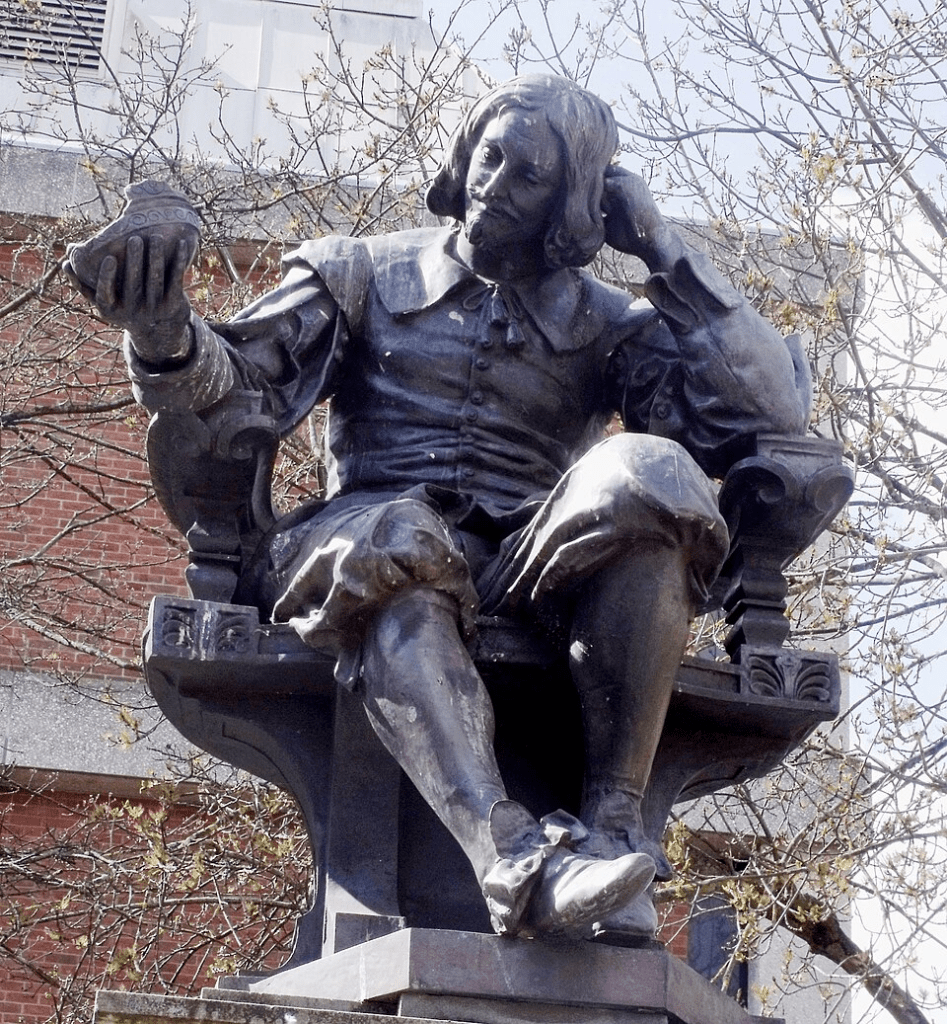
Statue of Browne in Norwich by ell brown – https://www.flickr.com/photos/ell-r-brown/4582394924/sizes/o/in/photostream/, CC BY 2.0, https://commons.wikimedia.org/w/index.php?curid=25718189
The Online Etymological Website tells me that Sir Thomas Browne may have been the first to use the term ‘coincidence’, certainly with any regularity:
coincidence (n.): c. 1600, “exact correspondence in substance or nature,” from French coincidence, from coincider, from Medieval Latin coincidere, literally “to fall upon together,” from assimilated form of Latin com “with, together” (see com-) + incidere “to fall upon” (from in- “upon” + combining form of cadere “to fall,” from PIE root *kad- “to fall”).
From 1640s as “occurrence or existence during the same time.” Meaning “a concurrence of events with no apparent connection, accidental or incidental agreement” is from 1680s, perhaps first in writings of Thomas Browne.
As a term it is full of contradictions. We are most likely today to use it to assert that that things happen together (at the same time or in the same place, or both) such as when clusters of the same disease happen may not have the same determining factors but occur accidentally, and that people who think otherwise are prone to ‘magical thinking’, an improper interpretation of internal fears or wishes (and imagination based on these) as determinants of actual events in the external world. Yet —! The etymological explanation above appears to suggest that the full meaning of the word as we know it now was only later in the word’s ‘birth’ in the seventeenth century – that is – that it raised the possibility that the simplistic connections we might like to make about concurrent or co-located events were just matters of chance. We still might talk about the appearance of connection between these events but not of them as established fact, without, of course, ruling out that the co-occurrences were not accidental at all on further research and testing. Some believers in the occult powers (of prediction or agency in events from supernatural forces) still hang upon that last possibility, whilst others claim that the events they refer to cannot be tested because the happen in a super-scientific realm (one where scientific research has no role nor efficacy in establishing these higher truths). Yet we do know that clusters of disease in witnesses to atomic explosions may have a cause in the unseen effects of that explosion, though there are those in whose interest it is to deny them.
The best example I think from Thomas Browne that I have found is from his 1690 Letter to A Friend (available online), wherein this is a characteristic paragraph of its Baroque prose, wherein (to the surprise of modern eyes) ‘Astrology’ takes the role of science – a science too then to Browne, though with the scepticism about claims of co-occurrence of different kinds of events that can’t be established by astrological inquiry, as science has for us today. My feeling is that Browne’s sentence structures are never ornamental Baroque but full of the same metaphysical ambition as his imagery and symbols: the signs of his belief in a world where truth is and must be deliberately obscured to worldly eyes, as the great master of his Neo-Plaonism (Plato in fact) dictated in his analogy of worldly knowledge being a shimmering reality reflected onto a cave wall by events outside the cave we shall not ever see directly but only in involved obscures signs ( I blogged about Brown’s sentences earlier – use this link).
That Charles the Fifth was Crowned upon the day of his Nativity, it being in his own power so to order it, makes no singular Animadversion; but that he should also take King Francis Prisoner upon that day, was an unexpected Coincidence, which made the same remarkable. Antipater who had an Anniversary Fever every Year upon his Birth day, needed no Astrological Revolution to know what day he should dye on. When the fixed Stars have made a Revolution unto the points from whence they first set out, some of the Ancients thought the World would have an end; which was a kind of dying upon the day of its Nativity. Now the Disease prevailing and swiftly advancing about the time of his Nativity, some were of Opinion, that he would leave the World on the day he entred into it: but this being a lingring Disease, and creeping softly on, nothing critical was found or expected, and he died not before fifteen days after. Nothing is more common with Infants than to dye on the day of their Nativity, to behold the worldly Hours and but the Fractions thereof; and even to perish before their Nativity in the hidden World of the Womb, and before their good Angel is conceived to undertake them.But in Persons who out-live many Years, and when there are no less than three hundred sixty five days to determine their Lives in every Year; that the first day should make the last, that the Tail of the Snake should return into its Mouth precisely at that time,and they should wind up upon the day of their Nativity, is indeed a remarkable Coincidence, which tho Astrology hath taken witty pains to salve, yet hath it been very wary in making Predictions of it. [1]
The difficulty Browne creates for us to discover his statement of either a singular or literal truth in his sentences is obvious, and this is sometimes attributed to deficiency in his style, especially the use of complex periodic sentences, but such sentences are not a stylistic characteristic as an insight into how truth must be understood. Of course interpretation comes easily at first in this paragraph – Browne merely establishes that there are clear reasons why the co-occurrence of events occur – Because Charles V had the power to hold his coronation when he wanted to place it on his birthday already explains how two events with differing determinations occur together. Yet that a politico-military event like the capture of a French King happening on the same date is remarkable for there is no simple or singular reason that would make it so. Yet even events that can be explained are not easily explained – hence the import of the long story of Antipater. By the time we reach the end of the story we doubt what exactly it illustrates or even when exactly Antipater died – was it on his birthday and thus, as might be expected given his recurring illness on that date, or was it nothing of the sort – an event not even coincidental but which happened outside our expectations and outside coincidence, having more to do with the nature of his disease, though near enough to his birth date otherwise: ‘some were of Opinion, that he would leave the World on the day he entred (sic.) into it: but this being a lingring (sic.) Disease, and creeping softly on, nothing critical was found or expected, and he died not before fifteen days after’. How Browne must have laughed as he wrote ‘He died not before fifteen days after’, that is he died 15 days after his birthday or even after that, though the reason for this indeterminacy is unclear.
I suspect Browne wanted to make it clear that nothing is clear about coincidence: all is obscure even if certain ones are worthy of remark (that is, remarkable). To use the magical symbol from alchemy of the Ouroboros, in the middle of this is exemplary of his writing and his sentences, which end up eating themselves (with their tails beginning to disappear into their mouths, making plain speech impossible).
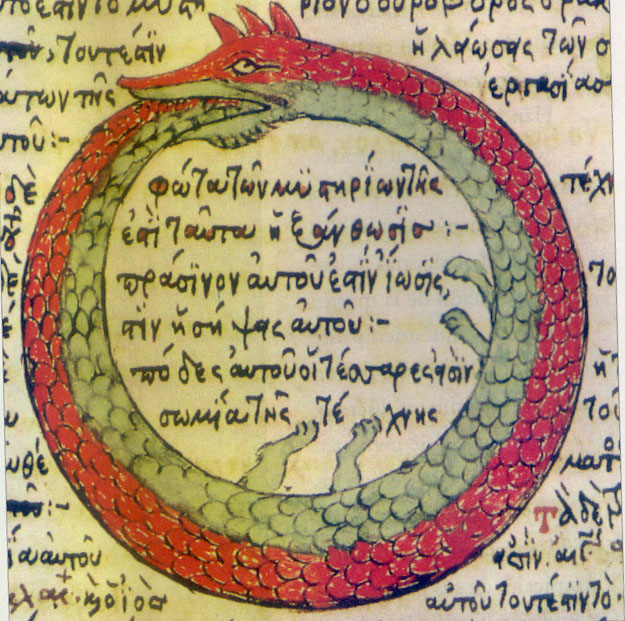
A dragon-like ouroboros in a 1478 drawing in an alchemical tract
To say of the death of the ‘intimate friend’ of his friend in this latter, that: ‘But in Persons who out-live many Years, and when there are no less than three hundred sixty five days to determine their Lives in every Year; that the first day should make the last, that the Tail of the Snake should return into its Mouth precisely at that time,and they should wind up upon the day of their Nativity, is indeed a remarkable Coincidence, which tho Astrology hath taken witty pains to salve, yet hath it been very wary in making Predictions of it’. All that is said here is yes – it is ‘remarkable‘ that they died on their birthday given the odds (which he spells out in numbers) but the coincidence still must make us wary that there is truth in the co-determination (in the magic behind the ouroboros symbol, already for some the symbol of an ‘Astrological Revolution‘) of these things only of their coincidentality.
Many things are remarkable which do not lead to established truths. Browne does not say this plainly but in convolutions, because he does not want to contradict the potential of more knowledge of interactive factors in the meaning and aetiology of events. However, the tendency of his thought and his sentences is that truths are multiply determined, perhaps even if over-determined by one factor as Freud said of the role of sexuality in the determination of dreams or as Marx said of the role of economic factors in the determination of historic events. Browne made the point better than I can by employment of uncertainty in his complex sentence structures.
I can think of no coincidences (though some were ‘remarkable’ at the time of their occurrence – but forgettable so I can’t share them) that shake my patience in understanding that I, and others, are ignorant of too much in too many domains of knowledge and feeling to make that one coincidence or even many coincidences have a meaning in supernatural terms. Those that do use it as a defence, do so because their enemy is the anxiety raised by the uncertainty prevailing in the physical, emotional and moral world. And indeed sometimes I need that defence too – but not to establish a set of beliefs more damaging than that they defend against.
That’s all for today
With love
Steven xxxxxx
_______________________
[1] Thomas Browne ‘(1690) TO A F R I E N D,Upon occasion of the Death of his Intimate Friend’ available https://penelope.uchicago.edu/letter/letter.html

