


‘Stell dir dein Leben vor wie ein großes Haus mit vielen Zimmern, Phil. … Manche sind groß und voller Licht und wieder andere sind dunkel, sie verbergen Schrecken und Kummer. Und ab und zu – nur ab und zu, hörst du ? – öffnet sich zu einem dieser schrecklichen Zimmer und du musst hineinsehen, ob du willst oder nicht. (Imagine your life like a big house with many rooms, Phil. … Some are large and full of light, and others are dark, hiding terror and sorrow. And every now and then – only once in a while, you hear? – it opens up one of those horrible rooms and you have to look inside whether you want to or not.)’ Some films are like fables or parables, in which the lives of previously unimaginable people, become the citizens of your naked, and perhaps self-indulgent, emotions. No wonder I felt tears watching Jakob M. Erwa’s 2016 film,Die Mitte der Welt (Centre of My World) based on the 1998 best-selling novel The Centre of the World by Andreas Steinhöfel, quoted above – words used in the film (with a note on Rachel Mason’s ‘The Circus of Books’).
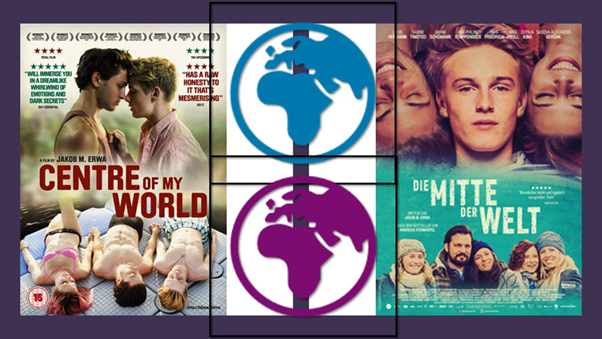
The words from the Andreas Steinhöfel novel that I quote above. They constitute a type of lyrical prose that would perhaps horrify me, in far from the manner of a Gothic work, if I had read them first in English, and not heard them spoken by Inka Friedrich playing Tereza, the lesbian friend of Glass, and unofficial ‘aunt’ of Glass’s son, Phil, whose ‘coming out’ she helps smooth into a path of lesser and more comprehensible pain.
But before beginning, I have to admit that since beginning this piece, Geoff and I watched another film that made me cry real tears over the complexities of the riumph of love in, and almost despite, family. This film should perhaps be the one blogged upon here but I need to see it again, but I feel a missionary zeal that others should see this film. It is Rachel Mason’s family-biographical film The Circus of Books (available on Netflix) but it’s fabulous poster will have to stand now as a prompt (below, and I will return to the film of less substantial, aesthetic, but not the less real tears at the Centre of My World.
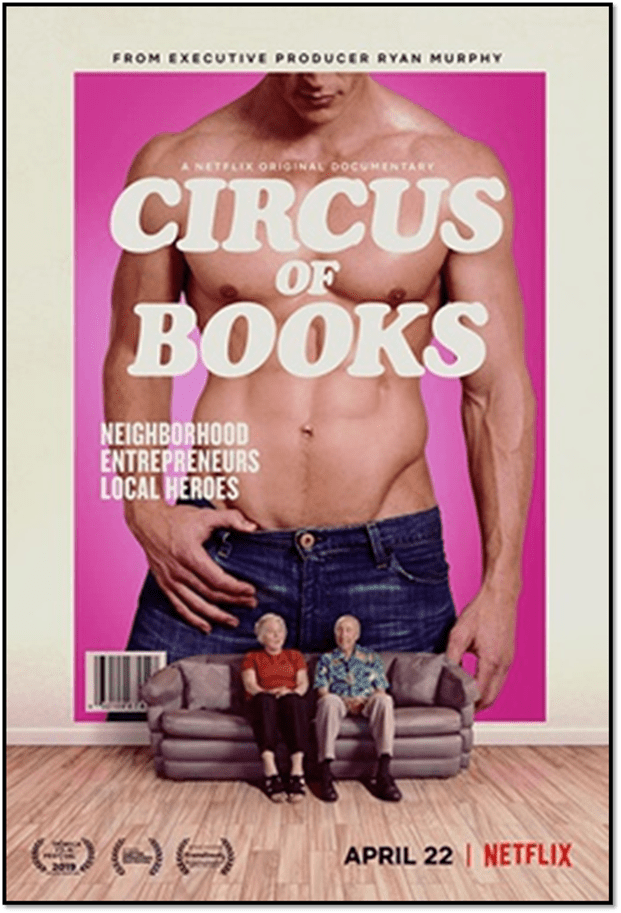
Official Poster: by https://www.imdb.com/title/tt8727582/, Fair use, https://en.wikipedia.org/w/index.php?curid=64324126
And both films rest on the urgency of how queer love is represented, and tangentially in The Circus of Books, but extremely movingly, in the coming out story of Rachel Mason’s brother – the gay son of the Mason couple, the head of a small empire of queer sex pornography bookshops, whose orthodox Jewish mother struggled with accepting that her son was gay and speaks in the film of living with the regret at the words she spoke to him when he did come out. This is, of course from a woman who, without self-praise and a sense of genuine religious humility before God, was loved by her queer employees and a hero to those many she knew that died of AIDS through the darkest period of its cull of the beautiful, Rachel cries as she interviews her brother about this moment of his coming out and his life through the AIDS pandemic where governments welcomed a justice performed on ‘abomination’. As a Torah Jew, Rachel’s wonderful mother speaks beautifully of her attempts to understand that term ‘abomination’ in the too well-known phrase in Leviticus (18:22): ‘Thou shalt not lie with mankind, as with womankind: it is abomination’.
The very real dilemmas that circle around faith in what is taken as God’s word, family ethics, love and empathy in Circus of Books is still present in a more secular form in Centre of My World. However, the issues about the representation of queer love are more absorbed into more abstracted forms of portrayed familial and communal relationships, with another kind of absorption also present. The queer film critic, Victor Fraga, writing in a more kindly time than the present for the acceptance of open queer destinies for young people who choose them, said of the film in 2017 (how the tide has changed with the rise again of the right-wing social psychology of hatred of those outside narrow norms):
As homosexuality becomes increasingly acceptable, coming-out dramas are gradually replaced by same-sex coming-of-age stories with little regard to the sexuality of the characters. Such is the case with the German teenage romance Centre of my World, where the gay plot is entirely devoid of the subject of homophobia and any sort social taboo attached to gayness.[1]
Much in this is questionable in my eyes – certainly no queer man or woman will agree with the idea that there is ‘little regard to the sexuality of the characters’, for the core moral centre of the film is represented by the lesbian couple Tereza (played by Inka Friedrich) and the harder Nina Proll as Pascal. It is as if Pascal embodies a corrective to Tereza’s functionality as moral voice in the film, but still as true in support for Phil as he seeks to understand sexual relationships and the notions of value appropriate to them. When he asks how she sees her relationship to Tereza, she says that sometimes she loves her more than is clearly understandable, but sometimes less.
The film is also, I think, much fairer to the polyamorous (even when conducted through deception of one of the lovers) and open bisexual queer than Fraga even tries to communicate. I saw a profound understanding of homophobia, or at least part of its grounds and appearance, in the scene where the bourgeois population gaze out of the screen at us, as we become those people whose divergence draws looks of distaste, disapproval and / or hostility, if we don’t already know we are in this role as queer people.
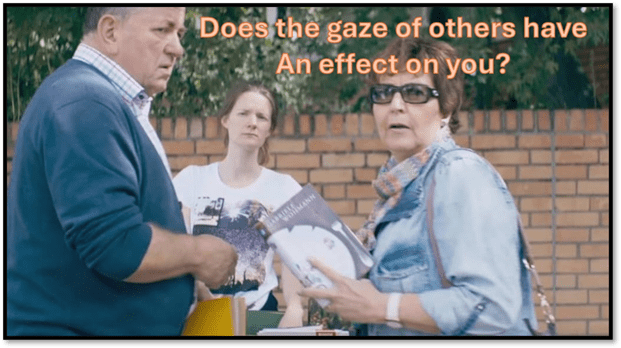
Yet are these persons looking at the person in their gaze as a moral entity (‘abomination’ or otherwise) or merely at the effects of identification upon chose appearance – such as the use of hair dyes, face jewellery, flamboyant costume or make up that defies sex/gender and other norms and overt norm-defying behaviour.
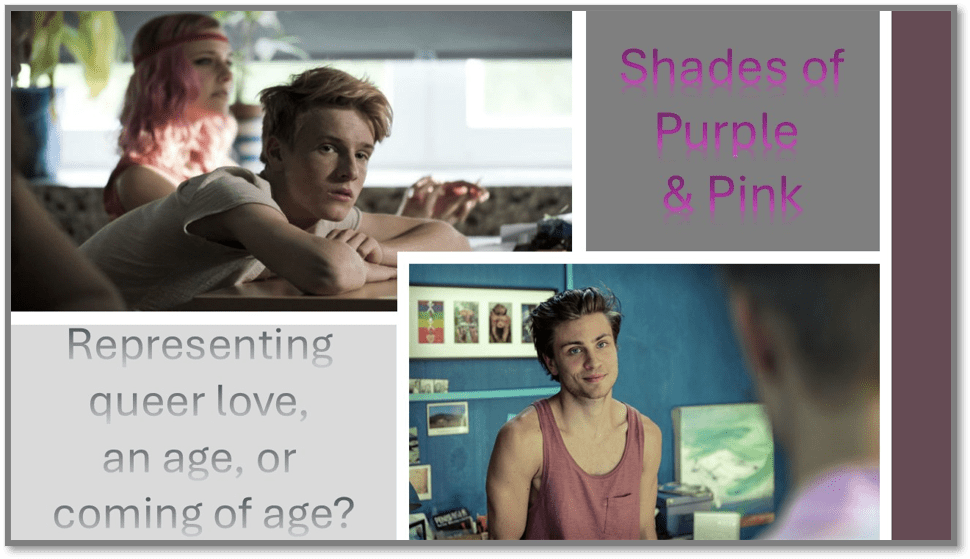
Hence, Fraga has a point, for much of the examination of the queer in this film falls into the examination of concepts of defiance to ‘taste’ prescriptions – the aesthetic realm if you like. This goes for even the mise-en-scène elements of the film that use configurations of shape, design and colour to indicate norm defiance and the shift of centre that defines values outside that centre or which have become it. Sometimes the issues are purely of colour, but accentuated by the refocusing of foreground and background of the scene by focal issues – backgrounds blur very often for hosts of reasons as the eye centres on what feels essential – at the cost of colour diversities or in collusion with them:
But there is an issue here. It reminds me of Circus of Books where Rachel Mason, the director, hand-held camera operative in domestic scenes and interviewer sports the difference of her brightly dyed hair against the sober conservative colours of her elder gay brother, and cries because she, the rebel in the family, had not even noticed or been trusted to hear, about his coming out, when she was there at the time, rather absorbed in being deliberatively ‘weird’ as the favoured word of her queer schoolmates. Is the representation of queer issues as issues of aesthetic choice actually strong enough to bear the burdens of a theme that has a darker side. How can we know?
And there I need to come back to the quotation from the source novel in my title. Tereza likens life to a house you own, in which different rooms represent inner qualities – some behind open or openable doors, others locked up
Stell dir dein Leben vor wie ein großes Haus mit vielen Zimmern, Phil. … Manche sind groß und voller Licht und wieder andere sind dunkel, sie verbergen Schrecken und Kummer. Und ab und zu – nur ab und zu, hörst du ? – öffnet sich zu einem dieser schrecklichen Zimmer und du musst hineinsehen, ob du willst oder nicht. (Imagine your life like a big house with many rooms, Phil. … Some are large and full of light, and others are dark, hiding terror and sorrow. And every now and then – only once in a while, you hear? – it opens up one of those horrible rooms and you have to look inside whether you want to or not.)
Okay. It is metaphor or parable – not one you imagine many people using however! But it raises other issues in a film about difference, for both young males live in not only big, but huge, houses, mansions. Behind both images is the metaphor used by Christ of Heaven, under the governance of God and sometimes used by open churches to speak of diversity and inclusion (John 14 (2) – here in the International Standard Version): ‘My Father’s house has many rooms; if that were not so, would I have told you that I am going there to prepare a place for you?’
However, be that as it may, this does not justify the use of unbelievably ‘big houses with many rooms’, that accommodate the families of the two young male lovers in the film (Louis Hofmann as Phil and Jannik Schümann as Nicholas). Both are house posed as metaphors – Nicholas’ open because of the absentee nature of his parents (father to international work, mother to Prosecco-drinking friends) but Phil’s because, if the mood befits his mother, Glass, because of the incredible belief in diversity and inclusion – at least until some emotional catastrophe that doesn’t get spoken from Glass’s locked rooms in which terror resides – of that woman. Her house is named VISIBLE because it openly manifests queer structure but with open areas and some knotted and closed up – like Glass herself.
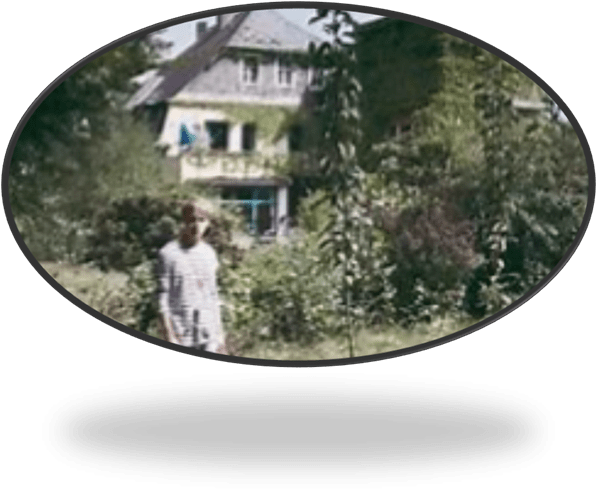
Phil in the storm-ruined garden at Visible
The mother’s house with many rooms, fast becoming Phil’s inheritance, is a complex symbol in the film, as is the storm with which the film opens that has so devastated landscapes in which emotional interactions occur, not least the most secreted one – Phil’s twin sister’s relationship (Dianne played by Ada Philine Stappenbeck) to secret lover, Jan, and its consequences after that storm. But to transform setting into symbol is allowable even in queer films, though it is as much at the cost of realistic grasp of diversity and exclusion as it is to the benefit of the aesthetics of the film’s mise-en-scène.
But Fraga could be being somewhat unjust in his refusal to use what Coleridge called the ‘willing suspension of disbelief’ in literary works in the interest of the bigger picture of life that art intends to open up to us, through its privileged right to make everything in its world subject to imaginative and symbolic reconfiguration. For even LGBQT+audiences include other diversities and the questions they raise for their appropriate representation, and in my eyes this film is a brilliant eye-opener into the life of Glass (brilliantly portrayed by Sabine Timoteo).
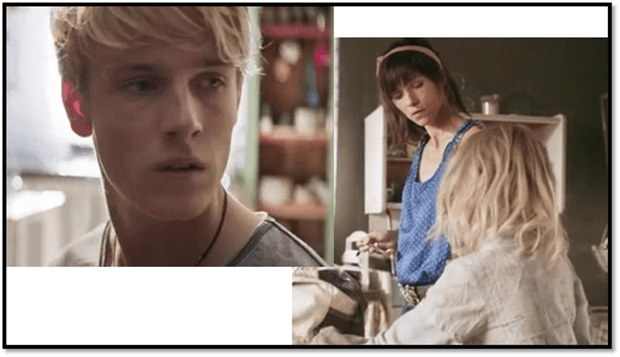
A woman who is both serially polyamorous, by choice or necessity, and whose life too is a mansion with many rooms, rhrough which terror and mental illness stalk the house, Visible, sometimes themselves visible as a storm in its effects. And the questions asked here are ‘queer’ and necessary questions, such as those I type into my collage below of two stills from the film.
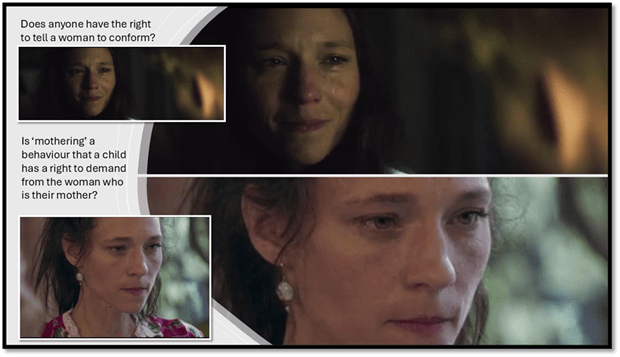
Moreover, queer lives are neither exempt from the tensions of these questions (they arise in Circus of Books too) nor are the processes by which they are lived to better or worse mutual understandings (between queer people as well as between people who choose a ‘queer’ (whoever defines it) lifestyle and those who don’t – the latter often feeling there was no choice to make.I cannot therefore agree with Fraga’s judgement that:
The problem is that the subplot which ascends into foreground lacks profundity and so the drama at the end of the film becomes a little petty, and the plot becomes somewhat flimsy.[2]
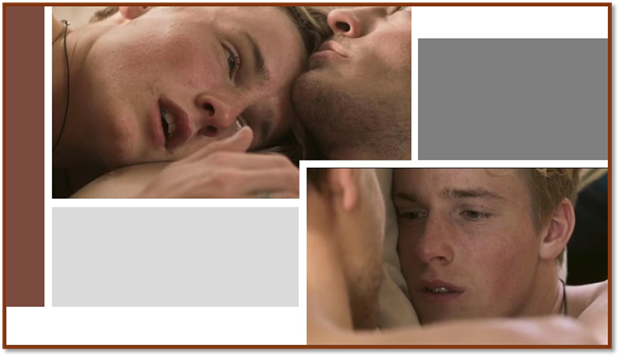
What I believe is that the film’s is not main and sub-plot but bears a particular direction in looking at how gaps in communication bed down into human and social structure, governing the creation of homophobia and other breakdowns in mutual wish to understand and hear each other. Ears are so often either focally important or put into the margins where visual focus is otherwise – such as in the picture bottom right in the collage repeated below:
Whilst the gorgeous eyes and physique of Jannik Schümann may be the cynosure of all eyes, including Phil’s in this still, the cinematography insists of on the blurred focals of the right ear of Phil from behind, defining the margins of our gaze. And choosing to ‘listen’ as well as look will matter in the film hereafter and before. Phil, after all, like Rachel Thomas, misses a lot about his environment and the meaning of his feelings, and the duties they may incur for him as well as liberties and pleasures – the story that his sister secretes, to say nothing of the larger one of the mother, all symbolised in a torn out page stuffed in a dark drawer of the leaves of the belladonna plant (significantly a plant of beautiful appearance of medicinal benefit or a poison and named after the stereotype of the femme fatale).

What we hear and how we apply what we hear matters, as Dianne knows well having killed her mother’s unborn baby with the knowledge she heard about that plant from the arcane knowledge banks of her mother. Below (top left) Phil’s blurred marginal ear hears what we may miss – that his mother-double friend Kat (Svenga Jung is incredible) says about Nicholas: that there is something strange about him, which is not, as Fraga’s review implies, that he is bisexual, but that he collects the details of other’s lives and exholds them to himself in privacy – in that symbolic shed in his parents’ garden.
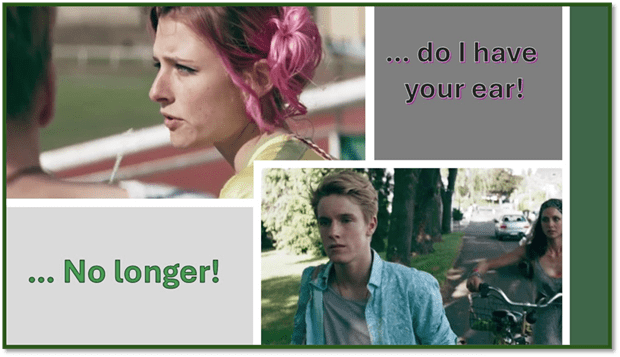
For right or wrong people can choose not to hear in other circumstance – in the bottom right picture, the prominence of Phil’s ear betokens how he hears Kat’s plea to forgive him for sleeping with Nicholas but will not use that information to return his gaze, effectively turning his back on first love and friendship as the ‘centre’ of his world shifts to his own future – not family as Fraga suggests, for the elder Phil has turned his back on the absorption that families require into their beloved ‘secrets’ too – the very worst aspect of the bourgeois family and the most attuned to homophobia. Faced with his twin sister again later, Phil’s very demeanour speaks of never having heard her in the past as Rachel’s tears to her brother in Circus of Books does.

In the end, of course, he does not leave his family intil he has heard them and begins to love them again:
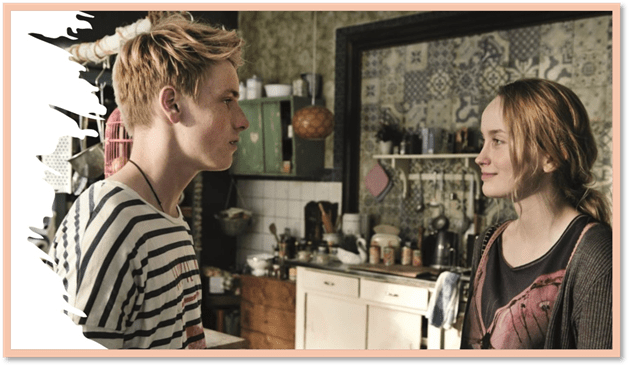
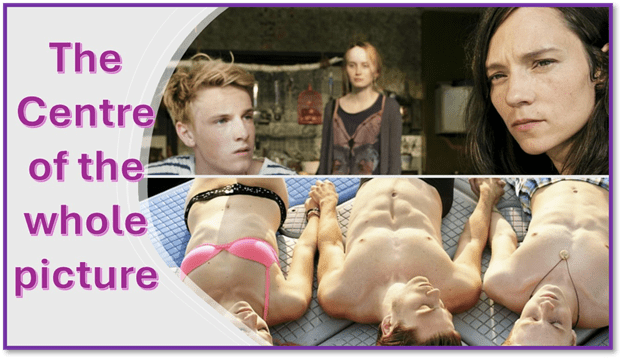
This is the message I got from the film – what is the centre (or ‘middle’ , since ‘die Mitte’ might indicate that too, of my world. And, fanciful or not I see that in the proxemics of placement of actor figures in the film’s mise en scène too, as below, where different foci and meaning of what is at the centre or middle of the gaze you hold of the world apply. In what sense, for instance is Nicholas the ‘centre’ or middle in the scene on the pool raft below and why is Dianne placed at the centre or middle of the scene in which son and mother contend below:
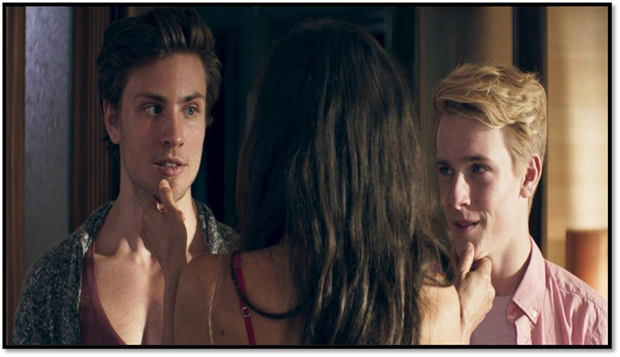
A particularly strong moment in the dividing and uniting of a scene through ‘die mitte’ is that one where Glass from the back places herself symmetrically between the boys (both now ‘her boys’ perhaps) with a phanding hol;ding each of their chins and they only seeing the other as reflection in Glass’s eyes.
But I have to admit that Fraga has the right to focus on the queer coming-of-age plot and its appeal to queer men in particular, although he manifests a too dominantly visual appreciation of that plot that rather undermines hearing its nuance:
Get ready for an elegant, sexy and thoroughly enjoyable journey into a teenager’s world, more specifically into his first incursion into love. This is a happy-go-lucky, feel-good, clean, conventional and technically accomplished movie. … The camera work is very clever (with jump cuts and fast editing, not too different from a music video), the photography is elegant and sultry (think of a vaguely toned down Pierre et Gilles and you are partway there), plus the soundtrack packed with indie rock is very much fun.
Centre of my World is very beautiful and touching, and never vulgar. But it’s also too perfect: …[3]
Never vulgar indeed, though I don’t therefore see it as a safe vehicle for ogling near-naked boys or think it appropriate to normalise stereotypes of gay men around that behaviour. I suppose there is still a case for seeing any decontextualised voyeurism as a route that slips into the non-consensual entitlement to see the body of others as yours to see by right. The young men are perfectly cast for their roles however, physically as actors of some accomplishment.
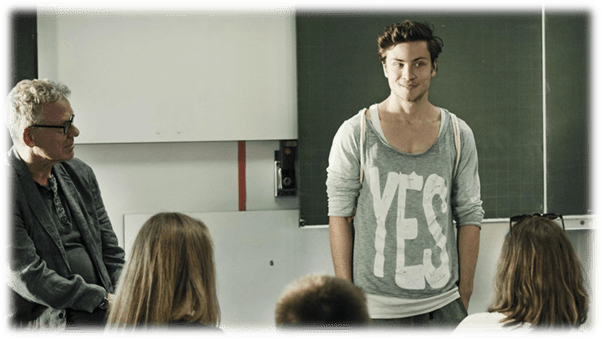
When Phil first sees Nicholas on his return to the area they live, he sees him with the YES of emblazoned desire on his t-shirt before it fades, showing us its origin from within Phil’s point of view:
The boys perform desire to the demands of the aesthetic configuration of the frames in which they are put, allowing ‘natural ‘ symbols to represent it, like the rundown, over their oiled bodies, of shower water, which makes the representation of kissing more sensual.

The sexual gaze in other scenes has more .ultivariant and nuanced uses, implying Phil’s doubts tbat he will achieve the ideal of constancy, perhaps even of ownership and therefore ethically complex, he begins to know is how he centres his world at tbis point, a feeling that it takes a lot longer than adolescence for some of us to overcome. The physical signs of their sex/gender developmental and type variance shows throughout,not least in the shade of facial hair on Nicholas. It is all beautifully, artistically and meaningfully shot, showi g tenderness too can be harder to read than we think.
The development of sex/gender and sexuality is pointed by the twin theme (sometimes illustrated by dynamic graphics of splitting zygotes. The representation of the ambiguous sex/gender markers of Phil’s childhood is such that distinguishing the twins by that category exactly is deliberately obscured.
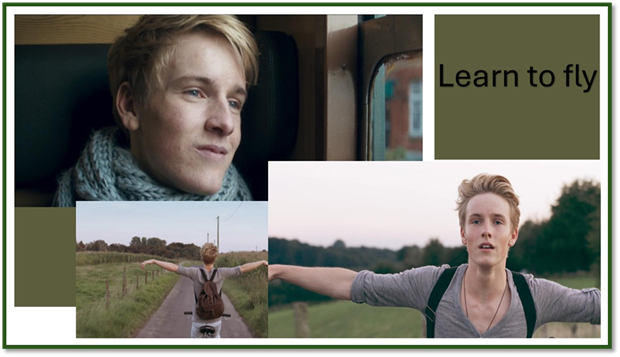
The representation of the achievement of individual autonomy and the loss pf sexual virginity as comfort in two kinds of flight is beautiful, especially the elegant and swanlike imitation of flight by Phil on his bike after his first sexual encounter with Nicholas. When he flees from home, alone and empowered to follow what path he wishes in his dream.of the USA, he is entirely self-powered with. O need or room for performed metaphor.
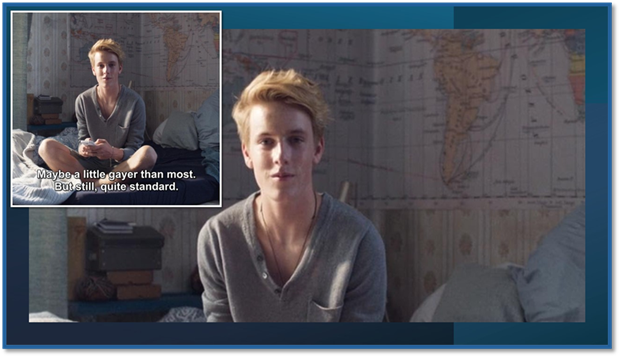
The film opens with frank humour about what we shall see. In one scene he sits before the camera in a pink feather boa. However I like the scene when Phil as grown up voiceover speaks of his story as that of a boy: ‘A little gayer than most but still quite standard’. As this and as a first love story where the willed ending of that love defines it as much as its beginning, it is entirely satisfying and any tears have that tendency to being happily nuanced ones.
With love
Steven xxxxxxxxxx
[1] Victor Fraga (2017) ‘This fairy tale teen gay romance set in Germany takes a very unexpected turn, but not in the direction many LGBT fans would expect’ in Dirty Movies (DMovies) [ online, 20-03-2017] available: https://dmovies.org/2017/03/20/centre-world-die-mitte-der-welt/ (My emphasis in bold).
[2] Fraga op.cit.
[3] Ibid.

