


Why not name Troy, Byzantium, Constantinople, and Istanbul and keep proliferating names for names for the primary city of the Golden Horn until you reach 10 such names for cities rich in trade that are for ever renewed or ‘renovated’. In a description of the renovation of Istanbul under Erdoğan as ‘the simulacrum of progress and development’ , amongst the many examples of building renewal in the city is this: “Galata Tower was ‘renovated’ with jackhammers”. [1] We cannot resist renovation, but in making things new how do we deal with loss of what the renewed replaces. But even without ideologies of progress this novel asks that we hear that persons can be ‘crushed, absolutely crushed – / In time – / Yes, in time’. [2] This blog is about Kenan Orhan (2026) The Renovation London, Hamish Hamilton.
For other Booker blogs use this link for a list: https://livesteven.com/2026/07/29/do-booker-winners-become-so-for-a-reason-the-2026-longlist-came-out-on-28-august/
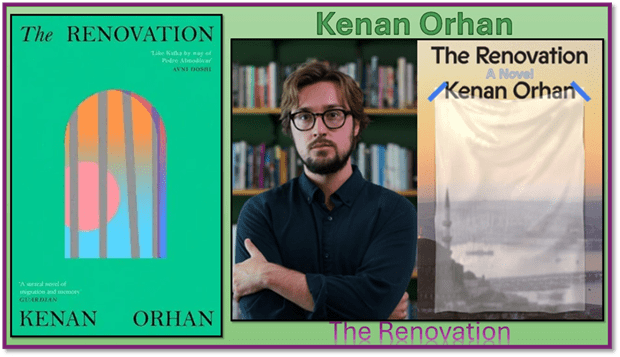
Did I mention that since we travel so rarely, I might as well mention, because it is relevant to the novel I focus upon in this blog, that I am looking for my city names that require travel in space, of course, but also time. Let’s look at a picture of modern Istanbul – of the Galata Tower, dressed in collage to resemble meanings in this novel.Indeed, in one moment Orhan says this very thing in the voice of his female narrator, Dilara, who notes her error in thinking of place as stable and continuous, when trying to work out her response to the modernisations, in building and names of buildings and institutions in Istanbul by President Erdoğan of the country he now demands, though not mentioned in this novel, we know now as Türkiye, not ‘Turkey’:
Some days I believed places are endless and immortal, unhampered by these paper-anchor names, and other days I truly feared that the name is the sum total of a thing, the cold new word prising it away from itself moment by moment. … Istanbul was Konstantiniyye, was Constantinople, was Alma Roma, was Augusta Antonina, was Byzantion, was Lygos – the impossibility of continuity. A place was the sum of its names. [3]
Whilst within Istanbul, and this is the least jarring of the examples given, there is the Galata Tower. I quoted above the sentence, “Galata Tower was ‘renovated’ with jackhammers”. Galata Tower, at least the one we think of in Istanbul now – alas for me only in pictures, started life in 1343 (past Byzantine towers being re-forgotten for the moment) as the Christea Turris (Tower of Christ) which served as part of the defensive structure of the Genoese community in Constantinople, rewarded with this privileges (including defensive walls) because of their assistance to the Holy Roman Empire of the East against raiding and occupying armies of Crusaders.
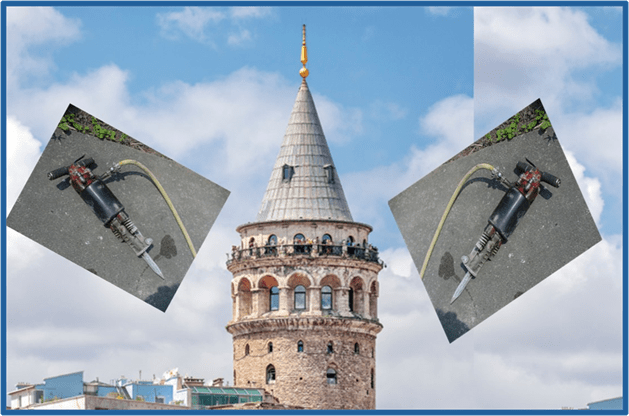
After the fall of Constantinople in 1453, the Ottoman Empire under Mehmed allowed the continuance of that community, if not with the walls associated with the Tower, and the Tower came to be known as a glory of a cosmopolitan Islamic city. It is a building that has changed – in name, function and use therefore, so that alone is not the object of the satire against the project of renovation in the city under President Recep Tayyip Erdoğan, that monstrous ever surviving cancerous formation of extreme right-wing politics through a manipulated ‘democracy’.
There is a terrible lesson involved in awareness that buildings, institutions and even whole cities may change their nature entirely in being changed in style, even if only in style of naming. An extreme of despair about renewal lies behind that sentence that allies the three concepts; The Galata Tower as a monument, jackhammers – the tool par excellence of demolition and ‘the simulacrum of progress and development‘: a represent of futurity as a perpetual serial motion to ‘better times’. Note that what Erdoğan, according to Orhan’s Delara, gives to the city is not ‘progress and development but its mere ‘likeness’ – the appearance alone of ‘progress and development’. This sentence then might be a fair extrapolation, and certainly one the novel clings to that even people who are not displaced, migrants from or exiles from a place once known as ‘home’ may in fact be displaced by such changes or even the recognisable appearance of changes that are more still more than a matter of style and naming but effect the thing’s their essential being or nature as changed – in which as much is lost as gained. In that sense, even if Adam and Eve had not been exiled from Paradise by God after their fall, they would in the new order of things after the Fall, blamed on them of course, have to travel back to their home to be in that place they mourn, but to travel in time not physical space. Time-space travel is the underlying construct of this beautiful, wondrous and tragicomic novel, one that must be at least shortlisted for the Booker prize.
There is a heart-breaking moment in which Delara compares her immigrant status in Italy to those who stayed in Istanbul, though she wishes that they had not done so. What she realises is that her own father’s dementia in which no new memories could be laid down but old ones persisted has so locked him in the city of Istanbul of the past, at least up to this point. Early in the novel before the loss becomes more devastating there are just a few moments in which the present Italian city in which he lives with Delara seems to him to fail the past city he perceives himself still to be living within, so that he continually says, ‘This is not correct’. [4] Later, his protests against reality turn into uncontrolled screaming as he rolls on the floor. But, at the point when Delara remembers her relatives in Istanbul, she says:
When we emigrated, something about my dad’s condition, something about how he conflated the present with the past, kept me feeling safe – like we were bringing a little of old Istanbul with us. … The way he talked was a bridge to our lives left behind. Maybe that is what we do – the children, I mean: we make our parents into portals.
Many things changed in Turkey, but they didn’t affect him. They renamed the Bosporus Bridge a few days after the coup attempt. People thought it was an act of remembering, of honouring. Truly, it was a forgetting. The way a a state orchestrates memorials is the same way that it orchestrates forgettings. possibilities are limited when a country organizes its memory. Until we left, I had not noticed how easily state architecture conspires against the public. Indeed I doubted I would recognize Istanbul any more. [5]
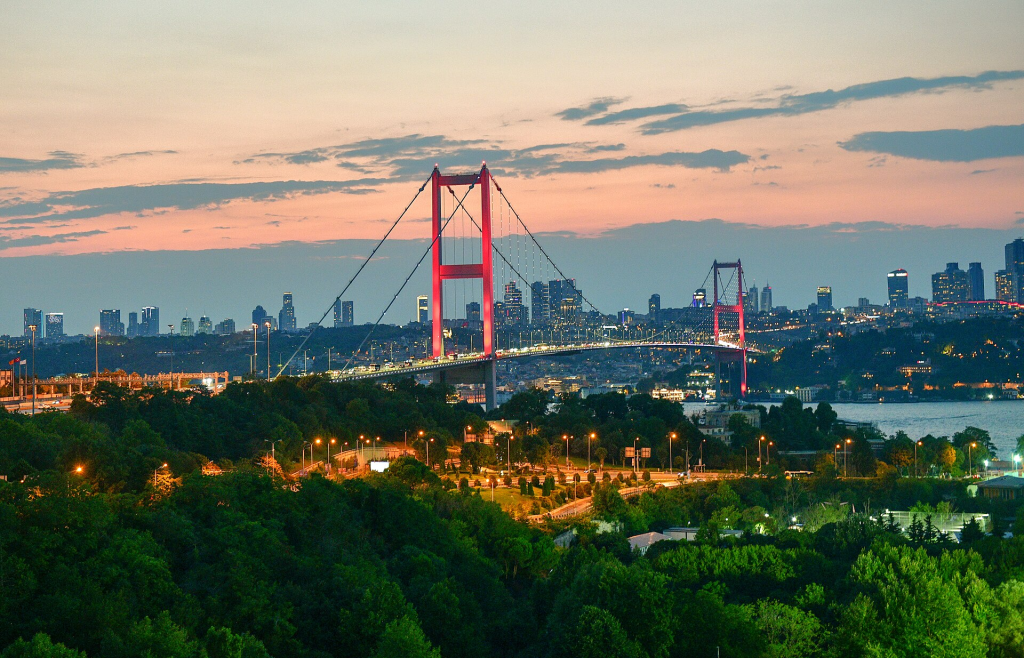
The Bosphorus Bridge (Turkish: Boğaziçi Köprüsü), known officially as the 15 July Martyrs Bridge (Turkish: 15 Temmuz Şehitler Köprüsü) and colloquially as the First Bridge (Turkish: Birinci Köprü), is the oldest and southernmost of the three suspension bridges spanning the Bosphorus strait (Turkish: Boğaziçi) in Istanbul, Turkey, thus connecting Europe and Asia (alongside the Fatih Sultan Mehmet Bridge and Yavuz Sultan Selim Bridge).
But the point is that neither do those who remain in Istanbul recognize the city of old as does Delara’s father, locked into stasis as it is for him in memories, changing only by the disease of dementia’s progress not by metamorphosing realities: ‘The country was changing – quickly, quickly. I heard from friends I desperately wished had fled like me, that the streets were shedding their small family-run shops to make way for glitzy new banks, new chain cafés and restaurants. The verdigris hills had gone over to cheap flats, gaudy hotels, skyscrapers casting phallic shadows over the city‘. [5] Even, as Delara discovers are her memories – helped by objects and photos found in an old storage box (somewhat like the ‘black box’ of her father’s extant long-term memory (LTM) – of a restaurant on the shores of the Bosporus where her family once communed for special family parties are realer to her alienated memory than to those of her family who live with a replacement of that restaurant – filling its old space with new overlaid memory – and hence have forgotten the old one. [6]
The knowledge of care-giving for someone with dementia is good and precise, even down to the theories of the psychological organisation and process of how memory is laid down, stored and recalled. The novel, in fact was based on a short story published in The Atlantic journal in 2023, and from the quotation the interviewer (Oliver Munday, the associate creative director of the journal) gives of the story that story obviously contained some part of the prose I have quoted above (he quotes: “The way he talked was a bridge to our lives left behind.” ). Asked by Munday in 2023 about the germ for the story, Orhan says it was born of considering the role of the ‘subconscious’ in the mind in creating identity through memory and loss.
Orhan: We pull a lot of our identities out from the soils of where we have lived, especially where we grew up. I think for anyone who has left behind some limb of themselves in another, unrevisited place, our natural inclination is to reexperience the things we miss through pictures. Often I find myself instead talking with relatives about memories of Istanbul, usually completely unspurred by external factors. Maybe we’re at a restaurant, and I might say I miss the marzipan of our favorite confectioners in Bebek. Then we take turns remembering the bakery and peripheral moments and then other places, almost like driving up the street of time, and they are nostalgic discussions—melancholic and brooding—but communal, sometimes even competitive (who can remember more precisely?). It’s a less harsh way of realigning our memories than relying on photographs. Photographs are unforgiving with their starkness. Relatives can allow for a freedom of reality. And that is what the narrator is doing, I think. She is using her father’s memories almost as a plane to travel back home. She wants to use his stunted memory to hold on to a past now obliterated. She is maintaining a pathway back to the city, back to her happiness and homeland, but as this starts to fade, she finds a similar tonic—a similar pathway—in the magic of the prison cell. [7]
In fact this line of thought must have developed much more in preparing the short story as a full novel, wherein not only ‘identity’ is theorised through knowledge about the experience that is memory and loss but even issues like psychological hope and despair as aspects of how the mind (and the configurations of ‘reality’ we meet in the external world, often patterned by the state in the interests of whomever holds power) shapes and is shaped by and in time. Take this passage. [8]
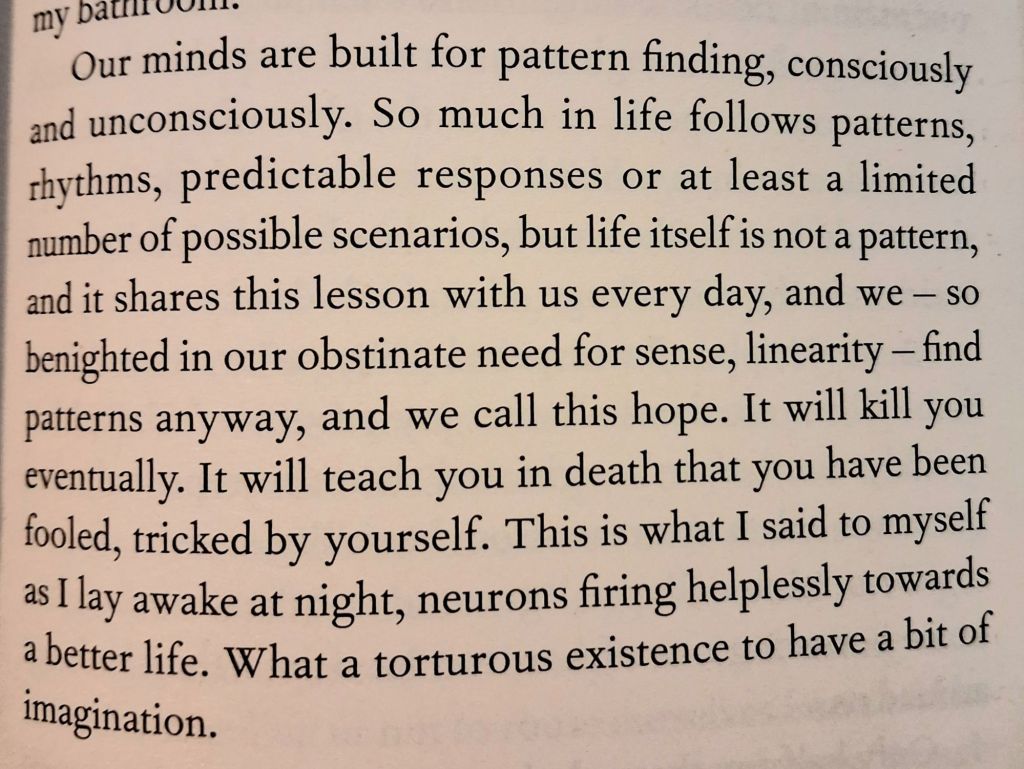
This is a dark passage but seems to me infallible in its truth-telling, even if we replace the subjective terms for mental patterns with those used in cognitive psychology, such as mental schemas, in thought of Piaget, Bartlett and others. These schemas, after all, are a form of organization of stored memory that create perceptual categories for recognizing things, processes and events in the mental activity we call pattern recognition. Without such patterns we could have no ‘expectations’ of future time that were not (perhaps scarily) open to uncontrollable happenstance nor that function we call ‘hope’. In almost every sense pattern-building precedes the knowledge of time as a relationship of what we perceive, mentally store and recall, or imagine as possible in our lives (even at the higher level of group life – the life for instance of a neighbourhood or country). We could have no sense of time without what we call memory and the various psychological means of representing futurity (expectations, hope, progress, decline and so on). In my title I quote the darkest part of the book that immediately precedes its reflections on Istanbul, based on Dilara’s thoughts about the future she has ahead with her father in the light of the mental models she holds of its past and of the possibilities of ever returning to Turkey, as the daughter of a political intellectual cast in his form (later – in an interview with Simon Scott (see below for full reference) – Orhan admits this is also very near his own feelings). It reads like a free verse poem:
Time has run out, the pantry pillaged, the pill bottles tipped and hollow. return us to our country! Now, now!
In time, yes. In time.
Tomorrow, tonight, this minute! Strip away this life, this Italian dream, this festooned exile!
In time, yes. In time.
I haven't got it. I haven't got any time. I haven't -
In time, yes. In time.
Hear me! I -
In time, yes. In time.
I am crushed, absolutely crushed -
In time -
Yes, in time. [9]
It is unfair of me to type this in the schematic typeface used on WordPress for Verse, for it isn’t in the novel, but to helps to emphasis how we lose the conventions in novels of who is speaking at each paragraph in the patterns of rhythmic and direct repetition, that in fact emphasises how many roles ‘time’ takes on in this prose and even how wickedly sound displaces sense (in the repetition of the sound ‘pill’, in a novel with many being taken as medicines, to link pill to the robbery of precious things by pillage. Unable to pattern time in its normal schematics, it is perhaps ‘time’ that crushes all sense of hope and after that identity with the word ‘I’. All this happens in a kind of nostalgia, but represented like a sickness (as indeed that word did represent mental illness). But Turks have a different word. Discussing with Scott Simon the Turkish word ‘huzun’ and its relationship to this novel, Orhan says huzun is:
a longing for things that are missed and missed in a way that perhaps you can’t surmount but are worth missing. They’re worth collecting and holding on to and remembering them. It affects all of us deeply, whether we call it melancholy or nostalgia or huzun. … moments in our lives where with great clarity, we become aware of a past, and we become aware of … our own mortality in a way. But it makes those moments, those things that we remember tenderly, all the sweeter, I think’.
Mortality and death and other rushing experiences are instinct with this word it seems. Asked if this is the feeling that represents the fate of Turkey in his mind, Orhan continues by speaking of his fear, grief and ‘angers’ (sic.) about the country from which he is exiled and:
sense of loss that kind of no matter what happens now, no matter how hard I hold on to the memories of the past, no matter how drastic a political change might be in store for Turkey, no matter what happens to this regime when it’s finally ousted, I’ll never actually be able to go back to the Turkey that I knew. We’re both 10-year strangers from each other now, 12-year strangers. I think in the wake of not going back for so long, it’s become a gloomier but still beloved place for me’.[11]
If you want to understand the imaginative processes of this novel logically, and by use of logic alone, give up now, for Orhan is invoking the pre-cognitive stages of thought in development of what he calls the ‘subconscious’ though I would prefer the Freudian term ‘Unconscious’. You need to remember as you read that the narrator is a developmental child psychologist and that the minset of such an intellectual needed understanding by the author of the novel to capture how she thinks. In the passage from 2023 quoted above, Orhan says that Delara ‘is maintaining a pathway back to the city, back to her happiness and homeland, but as this starts to fade, she finds a similar tonic—a similar pathway—in the magic of the prison cell’. That the prison is in part the Unconscious form of huzun seems to me clear, as clear as ‘magical thinking’ can ever be. With Scott, Orhan discussed the meaning of the bathroom ‘renovated’ into the form of a prison in the novel, which soon Dilara comes to recognise and depend upon
SIMON: Yeah. As the novel goes on, it’s hard not to wonder if the prison you describe is just not an expression of the political tumult in Turkey, but also of the personal tumult inside Dilara’s family.
ORHAN: It is. There are actually two prisons in this book. There’s the political prison Dilara fled with her family from Istanbul. But what she couldn’t flee is the prison of care. It’s very difficult to be a caregiver in health care, but I think doing it for your own relatives is very different and very demanding. And watching them kind of unravel in front of you while also having to take care of them is insanely difficult, especially in the duality of how they used to raise you.
But neither Simon nor Orhan say openly that the prison is more and less than just a symbol of the chaos of Turkish descent into a prolonged and hard-to-understand maintained fascism and of that into what life descends in dementia-care-giving families and the minds of the individuals in it. It is an a state where reality gives way to a kind of unconscious state from which there is no escape, and from which soon you may not wish to escape, finding the reality of the life of the bourgeoisie (those grotesque ‘nice’ characters Lucia and Giovanni with their dinner parties and skiing holdays) in settled capitalism in Italy even more confusing than it. In the Simon interview, Orhan chose to read this passage from the book:
KENAN ORHAN: (Reading) The guard, who really could’ve been my contractor in disguise, seemed genuinely shocked to see me. What is this, he exclaimed in Turkish. He paused with a stupefied look on his face. Where am I, I responded in Turkish. Are you sick? Silivri Prison. I was growing impatient. That’s not right. This is supposed to be a waterfall shower with two heads and massaging jets and a marble bench. Massaging jets, haha. No. This is a prison. But what’s it doing in my bathroom, I asked. He looked into the cell and frowned. Now, how did they mess up like that?
Below is what Silivri Prison (now called the Marmara Prison) looks like:
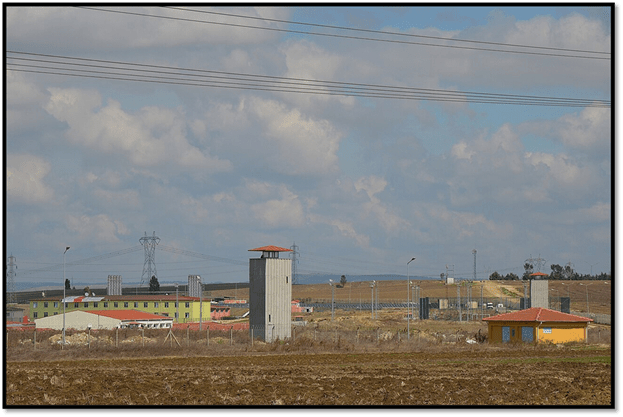
A view of Silivri Prison from outside (the prison is now named Marmara Prison). Photograph by CeeGee – Own work, CC BY-SA 4.0, https://commons.wikimedia.org/w/index.php?curid=35853115
To Simon, Orhan went further though in showing why he represented Dilara’s magical thinking – in the invention of something that in ‘containing’ (as prisons do) made her feel more secure – and achingly cruel to, and without any true care for, the other women with whom she is locked in – he showed that the whole thing, like the tone of the passage above has to be done as magical comedy (he calls it surrealism/fabulism) – in that sense like the Kafka of Metamorphosis, or Ionesco of Rhinoceros.
Political exile, on the other hand, is such an absurd and strange notion on its own that perhaps, like very good comedies and slapsticks, the more seriously you take it, the better it will be. But now I’ve now conflated seriousness with realism. I think a weakness of realism is that sometimes its scenes only speak deeply to those already affected by or familiar with the conditions described. That is why I favor a bit of surrealism/fabulism. The surreal can bridge the gaps of experience by weirding life down to a more universal ether. Someone who has never missed a homeland can better understand the longing when memories become magical. Loss and grief then become starker in the absence of this golden magic. [11]
But the issue is ‘magical thinking‘. This is why Dilara takes on her father’s personality, finally bricking herself up within an interior to which there is only a sensory access to Istanbul outside it, as if she had the choice to do which he never had. Unlike him, she does not focus on the imprisoned women she meets – becoming as much their guard as the man named as such. When they call ‘Save Us’, she knows she cannot nor would she will to do so. [12] Recognizing that one female prisoner she sees has become a ‘prisoner in her own body’ does not make her any the more empathetic to her as she becomes to acknowledge that anyone, her chiefly, can ‘become yourself a prison cell’. [13] She becomes as addicted to magical self-storying as anyone other could be to drugs. Of her father she says: ‘The picture show of his brain did what it could to keep up a few flickering images of light, a bit of narrative, our great addiction‘. [14] Note ‘our great addiction’ here. I am not saying that Orhan critiques Dilara for her escape into magical story with her father – both political exile and care-giving for a father with dementia are cruel realities which you survive as best you can, but the difference between Dilara’s descent into the Unconscious and her father’s have differing degrees of responsibility attached to them, which, in a hard world, we need to notice. As we need to notice Berk, who has no choice but to go to the prison to which he is sent. [15]
And whilst we draw to a close we should note that the theme of renovation and progress is as instinct in the idea of Silivri Prison and the mental construct (without any boundaries at all to its own growth) that it becomes. Just as we renovate our houses to look for more space in which to live our lives, if we are bourgeois enough, so prisons must grow if you want to construct a social psychology in which people think of themselves as regulated and imprisoned inmates. The novel is most like allegory (Spenserian though rather than like Bunyan) when Dilara queries a prison guard and prison supervisor overlooking the planned prison renovations. It is because the prison authorities are desperate for space to pursue the shackling of human minds that they rely on a principle that everything requires progressive expansion in order to exist and the ‘continuity of space’ (over the minds in which time-space is constructed). This is fine comic writing: [16]
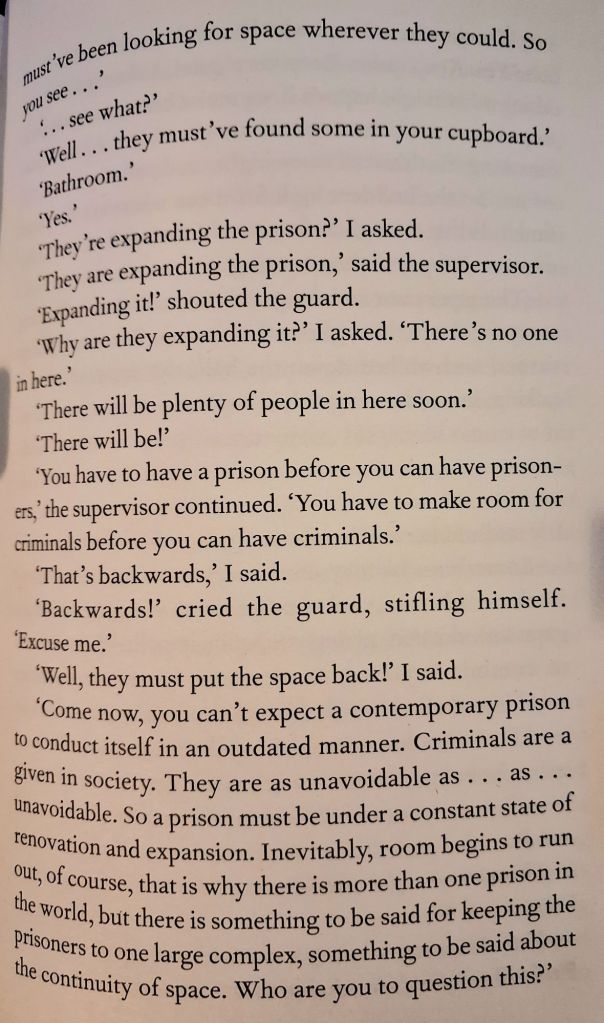
‘Who are any one of us to question what established power in the status quo tells us is inevitable, natural, normal or for which there are no alternatives? but the pain of Dilara’s father is different from that of Dilara, as is the pain of the imprisoned women in her bathroom-cum-mental-prison-cum-cell-in Silivri. The latter and the former are political prisoners whose lives, in order to be lives must be a protest against fascism, whilst Dilara and her husband have become trapped in a mental illness which they can only flee – externally for the husband, internally for Dilara (within multiple doors, behind several screens which hide you. All she believes can be done is to wish for the fall of Erdoğan. She suffers very real pain in that process but it is at a distance from the much more real pain arising as a consequence of protest – the beat of a bat on her father’s head, the imprisonment of Berk and of the female protest – from minimal to the effects of political journalism in Silivri. In the imaginary Silivri she inhabits she still feels able to ‘need a coat’ in the exercise yard, an item of which her fellow inmates have less chance than she has – her prison still being attached to her bedroom with a stocked wardrobe. [17]
Yet Dilara cannot travel to Istanbul except in as far as madness allows for internal travel by magical-thinking carpet, or through time into the LTM of her father, while it lasts and is never renovated. To have your top 10 travel destinations is indulgent isn’t it in the world revealed by this novel. But read it – it will take you on a long journey where you’ll sense the historic span of the city we now call Istanbul in the country we are mow asked to call Türkiye. Please resist the latter renaming. It is the least (the very least) you can do and is less trouble than following the path of literary heroes like Harold Pinter and James Kelman to find out about the oppression of the Kurdish population.
That’s all for now
With love
Steven xxxxxxx
[1] Kenan Orhan (2026; 235) The Renovation London, Hamish Hamilton.
[2] Ibid: 234
[3] ibid; 236f.
[4] see ibid: 17, 91, 98f., for instance.
[5] ibid: 159f.
[6] For the storage box see ibid: 32, 62 (where the photographs are introduced), 149 & 155f.
[7] Oliver Munday (2023) Interview: ‘Kenan Orhan on Exile and Memory’ in The Atlantic. (April 27, 2023) [online] Available at: https://www.theatlantic.com/books/archive/2023/04/kenan-orhan-interview-the-renovation-short-story/673864/
[8] My photograph of paragraph from Kenan Orhan op.cit: 215
[10] Kenan Orhan op.cit: 233f.
[11] Scott Simon (2026) Author Interviews: ‘In Kenan Orhan’s debut novel ‘The Renovation,’ a hole in the bathroom tears open time and space’ in NPR (online transcript of recorded interview) in NPR (February 14, 2026, 8:02 AM ET) Available at: https://www.npr.org/2026/02/14/nx-s1-5613426/in-kenan-orhans-debut-novel-the-renovation-a-hole-in-the-bathroom-tears-open-time-and-space
[12] Kenan Orhan op.cit: 238f.
[13] ibid: 187 & 209 respectively.
[14] ibid: 201
[15] ibid: 137
[16] My picture of ibid: 101
[17] ibid: 184


4 thoughts on “Why not name Troy, Byzantium, Constantinople, and Istanbul and keep proliferating names for the primary city of the Golden Horn until you reach 10 such names for cities rich in trade that are for ever renewed or ‘renovated’. This blog is about Kenan Orhan (2026) ‘The Renovation’.”